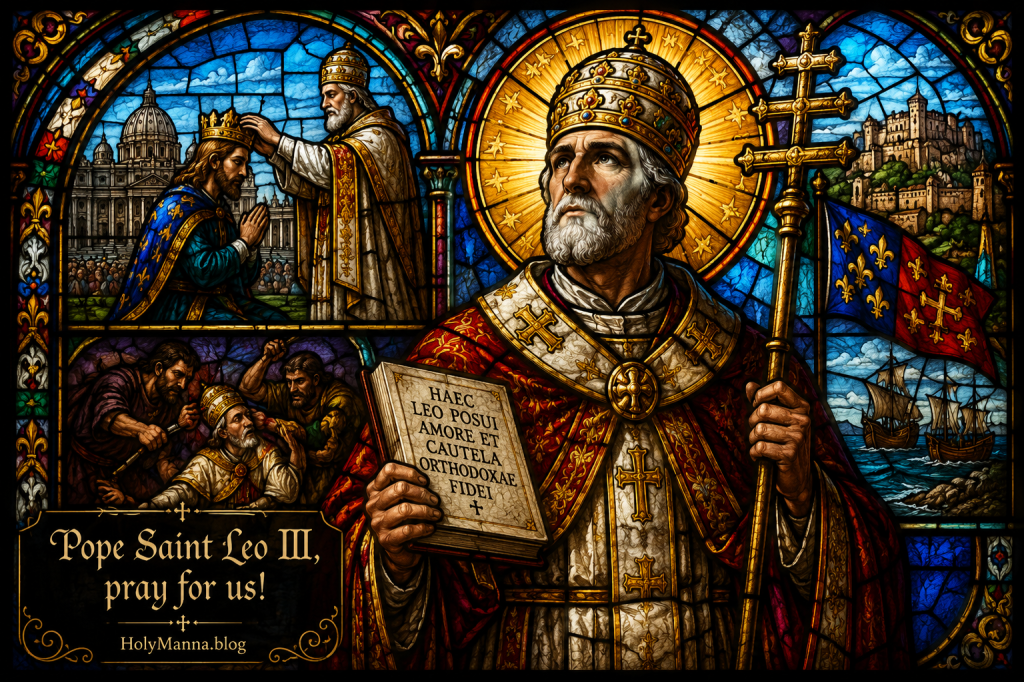
The Wounded Pope Who Crowned an Emperor
Pope Saint Leo III lived in a world where the Church was holy, but politics could be brutal. Rome was unstable, noble families fought for influence, the Byzantine Empire was losing power in the West, and the papacy needed protection from enemies both inside and outside the city. Into that world stepped a Roman priest who would become one of the most important popes of the early Middle Ages.
Leo III served as Pope from 795 to 816. He is best remembered for crowning Charlemagne as emperor on Christmas Day in the year 800, an act that helped shape medieval Christendom and laid the foundation for what would later be called the Holy Roman Empire. But that famous moment was only one part of his story.
He was also a pope who survived a violent attack, endured public accusations, defended the faith against heresy, supported the poor, beautified churches, strengthened Catholic life across Europe, and showed mercy to the very men who tried to destroy him.
His life reminds Catholics that holiness is not always lived in peaceful chapels and quiet monasteries. Sometimes holiness has to stand in the middle of betrayal, violence, politics, and confusion. Sometimes the saint is the one who keeps shepherding even after being wounded.
The Catechism of the Catholic Church teaches that the Pope, as Bishop of Rome and successor of Saint Peter, is “the perpetual and visible source and foundation of the unity both of the bishops and of the whole company of the faithful” CCC 882. Pope Saint Leo III carried that mission during one of the most dangerous and consequential periods in Church history.
Raised in the Heart of the Roman Church
Pope Saint Leo III was born in Rome, likely around the middle of the eighth century. Catholic sources identify his parents as Atyuppius, sometimes written Atzuppius, and Elizabeth. Little is known about his childhood, but what is known is important. Leo was formed from an early age within the life of the Roman Church.
He was educated in the vestiarium, the office connected with the papal treasury and administration. That means Leo grew up learning not only prayer and doctrine, but also the practical work of Church governance. He learned how the Church in Rome functioned, how resources were managed, how worship was supported, and how papal service required both spiritual conviction and administrative skill.
He eventually became a subdeacon and later Cardinal-Priest of Santa Susanna. Under Pope Adrian I, Leo became an important official, serving in a role connected with the papal treasury. By the time he was elected pope, he was not an outsider to Roman Church life. He had spent years serving quietly before being called to lead publicly.
When Pope Adrian I died, Leo was elected quickly, on December 26, 795, the same day Adrian was buried. He was consecrated the next day. That speed may have been deliberate. Rome was full of competing political factions, and a quick election helped protect the freedom of the Church from outside manipulation.
From the beginning, Leo understood that the papacy needed help. Rome was vulnerable. The old protection once expected from the Byzantine emperor was no longer reliable. So Leo strengthened the alliance with Charlemagne, King of the Franks. He sent Charlemagne the keys of the Confession of Saint Peter and the standard of the city of Rome. These were powerful symbols. They showed that Charlemagne was being recognized as protector of Rome and defender of the Holy See.
That alliance would eventually become one of the defining features of Leo’s pontificate.
The Pope They Tried to Blind and Silence
The most dramatic moment in Pope Saint Leo III’s life came on April 25, 799. During the procession of the Greater Litanies, Leo was attacked near the Flaminian Gate by men connected with powerful Roman enemies. These opponents were linked to factions that had resented Leo’s election and wanted him removed from office.
The attack was not random. His enemies tried to tear out his tongue and gouge out his eyes.
That kind of violence was meant to do more than hurt him. In that age, physical mutilation could be used to make a ruler seem unfit to govern. If Leo could not see and could not speak, his enemies believed he could no longer serve as pope. They were trying to silence the voice of Peter and blind the shepherd of Rome.
Leo was badly wounded and taken to the monastery of Saint Erasmus on the Coelian Hill. Catholic tradition says that God miraculously restored the use of his eyes and tongue. The Roman Martyrology honors him as the pope whose eyes and tongue were restored by God after they had been torn out by impious men.
This is the central miracle associated with Pope Saint Leo III. It is also one of the most striking images in the history of the papacy. His enemies tried to destroy his ability to lead, but God restored him. They tried to silence him, but he spoke again. They tried to make him disappear from history, but his name would be remembered for more than a thousand years.
There is a deep spiritual lesson here. The Church has always believed that God can bring grace out of suffering. The wounded Christ still reigns. The wounded saints still witness. Leo III shows that being wounded does not mean being finished.
Where has life tried to silence the voice of faith? Where has suffering made it tempting to stop leading, stop praying, or stop trusting God?
A Pope Falsely Accused
After the attack, Leo escaped and fled north to Charlemagne at Paderborn. Charlemagne received him with honor. Meanwhile, Leo’s enemies accused him of serious sins, including adultery and perjury. These charges were grave, but they were not proven.
Charlemagne eventually had Leo escorted back to Rome. When Leo returned, the people welcomed him joyfully. In the year 800, Charlemagne came to Rome, and Leo’s case was addressed before a solemn assembly. The bishops declared that they had no authority to judge the pope. Still, Leo voluntarily took an oath declaring his innocence in order to remove scandal and suspicion.
This moment was remembered centuries later in Catholic art, especially in Raphael’s Justification of Leo III, also known as The Oath of Leo III. The scene expresses an important truth about the papacy. The Pope is not above God. No man is above God. But the Pope, as successor of Peter, occupies a unique office in the visible structure of the Church.
That is why Leo’s story has to be understood carefully. It is not a story about personal power. It is a story about the burden of an office Christ entrusted to His Church. Jesus said to Peter, “You are Peter, and on this rock I will build my church” Matthew 16:18. The Catholic Church sees the papacy through that promise.
One of the most moving details from Leo’s life comes after his vindication. His main enemies were condemned to death, but Leo asked that their sentence be changed to exile.
That is not normal human instinct. These men had tried to mutilate him, ruin his reputation, and remove him from the papacy. Yet Leo asked that their lives be spared. This is where his holiness shines in a quiet but powerful way. He did not confuse justice with revenge. He had suffered deeply, but he still chose mercy.
Christmas Day and the Crown of Charlemagne
Two days after Leo took his oath of innocence, one of the most famous events of the Middle Ages took place.
On Christmas Day in the year 800, Charlemagne was attending Mass in Saint Peter’s Basilica. After the Gospel had been sung, Charlemagne knelt in prayer before the Confession of Saint Peter. Pope Leo III approached him and placed a crown on his head. The people acclaimed, “To Charles, the most pious Augustus, crowned by God, to our great and pacific emperor, life and victory!”
With that act, Leo crowned Charlemagne Emperor of the Romans.
This moment changed the history of Europe. The imperial idea in the West was revived. The old Western Roman Empire had collapsed centuries earlier, but now a new Christian imperial order was being born. Over time, this would be connected with what later became known as the Holy Roman Empire.
For Catholics, this moment can be difficult to understand in the modern world because today the Church and political authority are usually viewed through a very different lens. In Leo’s time, the ideal was that temporal power should defend the Church, protect Christian society, uphold justice, and serve the common good. The emperor was not supposed to replace the Church. He was supposed to protect it.
The coronation also showed how deeply Rome needed protection. Leo was not crowning Charlemagne because medieval life was clean and easy. He was acting in a world where the papacy was vulnerable, enemies were violent, and Christian civilization needed defenders.
There is a famous story that Charlemagne may not have known Leo was going to crown him that day. Charlemagne’s biographer claimed that the king would not have entered the church if he had known what was coming. Historians debate how much Charlemagne knew beforehand. Since this detail cannot be fully verified, it is best treated as a famous historical story rather than a certain fact. What is certain is that Leo’s coronation of Charlemagne became one of the defining images of medieval Christendom.
Guarding the Faith With Courage and Care
Pope Saint Leo III was not only a political figure. He was a guardian of Catholic doctrine.
One major theological issue during his pontificate was Adoptionism. This heresy claimed that Jesus, considered as man, was Son of God only by adoption rather than by nature. The Church rejected this because Jesus Christ is not merely a holy man adopted by God. He is the eternal Son of God made flesh. He is one divine Person, true God and true man.
The Catechism of the Catholic Church teaches that Jesus Christ is “true God and true man” CCC 464. That truth is at the heart of Christianity. If Christ is not truly God, then He cannot save. If He is not truly man, then He has not truly entered our condition. Leo’s opposition to Adoptionism helped defend the Church’s faith in the mystery of the Incarnation.
Leo also played an important role in the history of the Filioque. The Filioque is the Latin phrase meaning “and the Son,” referring to the Catholic teaching that the Holy Spirit proceeds from the Father and the Son. Leo accepted the doctrine expressed by the Filioque, but he was cautious about adding the phrase into the Creed at that time. He wanted to guard the truth while also avoiding unnecessary division with the East.
That detail shows something important about Leo. He was not careless with doctrine, and he was not careless with unity. He wanted both truth and communion. He understood that Catholic teaching must be defended, but also that the words used in worship carry enormous weight.
A famous inscription associated with Leo’s defense of the Creed is often given in Latin as “Haec Leo posui amore et cautela orthodoxae fidei.” In English, this means, “I, Leo, placed these here for love and protection of the orthodox faith.” This is not a personal quote in the way later saints sometimes leave behind spiritual sayings. It is best understood as an inscription connected with his effort to preserve the Creed and protect the faith.
A Pope for More Than Rome
Leo’s work reached far beyond the city of Rome. He strengthened Church life across Europe and helped organize Catholic communities in several regions.
In Bavaria, he helped establish Salzburg as a metropolitan see by giving the pallium to Arno, Bishop of Salzburg. This strengthened the Church’s structure in that region and helped support the spread and organization of Catholic life.
In England, Leo became involved in disputes involving Canterbury, York, and Lichfield. He confirmed Canterbury’s primacy, supported ecclesiastical order, and helped resolve confusion that had affected the English Church. These decisions may sound technical today, but they mattered deeply. Clear Church order helped protect unity, teaching, and pastoral care.
Leo also supported monks suffering in the East. When monks facing pressure in Constantinople appealed to him, he sent encouragement and material assistance. He later ratified efforts meant to secure peace between East and West.
He also had to govern practically. Saracen raids threatened the coast, so Leo maintained naval defenses and arranged patrols. He entrusted Corsica to Charlemagne’s protection because Rome could not adequately defend it from Muslim pirates. He also worked to recover papal lands and strengthen the administration of Church property.
In other words, Leo was a shepherd, but he was also a ruler in a dangerous age. He had to pray, teach, defend doctrine, feed the poor, negotiate with kings, strengthen bishops, protect Rome, and endure betrayal.
That is a heavy cross.
Beauty, Charity, and the Christian Imagination
Pope Saint Leo III also left behind a legacy of beauty. He renovated churches, supported charitable institutions, helped the poor, and adorned sacred spaces with mosaics. He understood something the Church has always known: beauty teaches.
Sacred art is not decoration in the shallow sense. It is catechesis in color, stone, and light. It helps the faithful see what words alone may not fully capture. Leo’s mosaics and church restorations helped communicate the Christian meaning of authority, service, and worship.
One of the most famous artistic memories associated with his reign is the Triclinium Leoninum, connected with the Lateran Palace. Its imagery showed Saint Peter giving spiritual authority to Leo and a banner to Charlemagne. The message was clear. Both spiritual and temporal authority were meant to serve Christ and His Church.
Centuries later, Raphael preserved Leo’s story in the Vatican through scenes such as The Crowning of Charlemagne and The Justification of Leo III. These works show how deeply Leo’s life entered the Catholic imagination. He was remembered not only as a pope in history books, but as a symbol of wounded authority, papal endurance, Christian kingship, and divine providence.
The Miracle Remembered and the Silence Around Later Miracles
The main miracle associated with Pope Saint Leo III is the miraculous restoration of his eyes and tongue after the attack of 799. Catholic tradition preserves this miracle, and it became central to his memory as a saint.
There are not many well-attested miracle stories attributed to Leo after his death. Some saints have long traditions of posthumous healings, shrines, apparitions, or miracles connected with their relics. Leo’s sanctity is remembered more through the miracle during his life, his endurance under suffering, his defense of the Church, and his enormous historical impact.
His relics were kept in Saint Peter’s Basilica, associated with the relics of other saintly popes named Leo, including Saint Leo the Great, Saint Leo II, and Saint Leo IV. He died on June 12, 816, after more than twenty years as pope. His feast day is June 12.
He was formally entered into the Roman liturgical memory under Pope Clement X in 1673. His veneration reminds the faithful that sainthood is not only found in hidden holiness, but also in public responsibility carried with courage.
The Legacy of a Wounded Shepherd
Pope Saint Leo III is most known for crowning Charlemagne as emperor on Christmas Day in 800. That one act reshaped medieval Europe and helped form the political and religious imagination of Christendom for centuries.
But if that is all that is remembered, something important is lost.
Leo was also the pope who was attacked, wounded, and nearly silenced. He was the pope who fled to Charlemagne, returned to Rome, cleared his name, and asked mercy for his enemies. He was the pope who defended the divinity of Christ against Adoptionism. He was the pope who handled the Filioque with doctrinal conviction and pastoral caution. He was the pope who supported churches, strengthened Catholic life across Europe, helped the poor, defended Rome, and left behind a legacy of sacred beauty.
His life shows that God does not always choose leaders who avoid suffering. Sometimes He permits His servants to be wounded so that their witness becomes clearer. Leo’s enemies wanted to make him unable to see and unable to speak. Instead, his restored sight and speech became signs of God’s protection over the Church.
There is something deeply Catholic in that. The Church herself has often been wounded, accused, betrayed, and attacked. Yet Christ preserves her. He does not promise that the gates of hell will never rage. He promises that they will not prevail.
Learning Courage Without Losing Mercy
Pope Saint Leo III’s life gives modern Catholics a lot to think about. Most people will never crown an emperor, govern Rome, or settle disputes between kingdoms. But every Catholic knows what it feels like to face pressure, betrayal, accusation, fear, or the temptation to give up.
Leo teaches courage, but not the noisy kind that just wants to win an argument. He teaches the courage to return after being wounded. He teaches the courage to speak after being silenced. He teaches the courage to defend truth without becoming reckless. He teaches the courage to forgive without pretending evil is harmless.
His mercy toward his attackers is especially challenging. He did not say their actions were acceptable. He did not deny the seriousness of what they had done. But he still asked that their lives be spared. That is Christian mercy. It does not erase justice. It purifies the heart from revenge.
Where is God asking for courage right now? Where is He asking for mercy instead of bitterness? Where is He asking for faithfulness even when the situation feels unfair?
Leo’s life also encourages Catholics to trust that God can still work through wounded people. A person does not need a perfect past, a perfect reputation, or a peaceful life to serve Christ faithfully. Sometimes the wound becomes part of the witness.
Engage With Us!
Share your thoughts and reflections in the comments below. Pope Saint Leo III’s life is filled with courage, betrayal, mercy, doctrine, politics, and faithfulness, which makes his story feel surprisingly relevant even today.
- What part of Pope Saint Leo III’s story challenges you the most: his courage, his mercy, his endurance, or his defense of the faith?
- Have you ever had to keep doing the right thing after being misunderstood, accused, or wounded?
- What can Leo’s mercy toward his enemies teach us about forgiveness without denying justice?
- How can Catholics today defend truth with both courage and charity?
- Where might God be asking you to speak again after fear, pain, or discouragement tried to silence you?
Pope Saint Leo III reminds the Church that Christ can restore what the world tries to destroy. He can give sight where there has been darkness. He can give voice where there has been silence. He can raise up wounded servants to protect the faith, serve the poor, and guide others toward holiness.
May his example encourage every Catholic to live with courage, forgive with mercy, defend the truth with love, and do everything with the love and mercy Jesus taught us.
Pope Saint Leo III, pray for us!
Follow us on YouTube, TikTok, Instagram and Facebook for more insights and reflections on living a faith-filled life.


Leave a Reply