The Heart That Was Opened for the World
The Solemnity of the Most Sacred Heart of Jesus is one of the most tender and powerful feasts in the Catholic Church. It is a feast about love, but not the vague, sentimental kind of love that disappears when life gets hard. This feast brings us straight to the Heart of Jesus Christ, the Heart that beat in the womb of Mary, grew tired on dusty roads, felt compassion for sinners, wept for friends, burned with zeal for the Father, and was pierced on the Cross for the salvation of the world.
The Church celebrates this solemnity on the Friday after the second Sunday after Pentecost, shortly after the Solemnity of Corpus Christi. That placement is not random. The Sacred Heart and the Eucharist belong together. The Eucharist is the gift of Christ’s Body and Blood, and the Sacred Heart shows us the love from which that gift flows.
The center of the feast is beautifully stated in The Catechism of the Catholic Church: “He has loved us all with a human heart.” That line from CCC 478 is the key to the whole devotion. Jesus is not God pretending to be human. He is true God and true man. His love is divine, eternal, perfect, and merciful. His love is also human, personal, tender, and real.
The Sacred Heart tells the world that God’s love is not an abstract idea. It has a face. It has wounds. It has blood and water flowing from its side. It has a Heart.
When Love Became Visible
The story behind the Solemnity of the Sacred Heart begins long before the formal feast appeared on the Church calendar. Its roots are in Scripture, in the Cross, and in the Church’s earliest contemplation of Christ’s pierced side.
In John 19:34, after Jesus dies on the Cross, a soldier pierces His side with a lance, and blood and water flow out. The Church has always seen deep meaning in this moment. The blood and water point to the sacraments, especially the Eucharist and Baptism. From the opened side of Christ, the Church is born, just as Eve was formed from the side of Adam. Jesus is the new Adam, and His Bride, the Church, comes forth from His saving sacrifice.
The Gospel gives us one of the most direct invitations into this mystery. In Matthew 11:28-29, Jesus says, “Come to me, all you who labor and are burdened, and I will give you rest.” Then He reveals His own interior life: “Learn from me, for I am meek and humble of heart.”
That is the doorway into the feast. Jesus does not simply tell the weary to try harder. He does not shame the sinner who is tired of sin. He does not crush the person who feels spiritually exhausted. He says, “Come to me.” Then He offers His own Heart as the place where the burdened soul can learn rest, humility, mercy, and love.
The Fathers of the Church meditated deeply on the pierced side of Christ. St. Augustine saw the opened side as the door of life, the place where the sacraments pour out for the Church. Later saints and mystics continued to contemplate the Heart of Jesus as a refuge, a fountain of mercy, and the sign of Christ’s infinite love.
During the Middle Ages, devotion to the Heart of Jesus grew through saints such as St. Bernard of Clairvaux, St. Bonaventure, St. Lutgarde, St. Mechtilde, and St. Gertrude the Great. These saints did not invent a new faith. They helped the Church linger more deeply before a mystery already revealed in Scripture: the Son of God loved us, suffered for us, and opened His Heart to us.
The modern liturgical devotion took stronger shape in France. St. John Eudes promoted devotion to the Hearts of Jesus and Mary and helped establish liturgical celebrations in their honor. Then, in the seventeenth century, St. Margaret Mary Alacoque, a Visitation nun in Paray-le-Monial, received private revelations of the Sacred Heart of Jesus.
Between 1673 and 1675, Christ showed St. Margaret Mary His Heart, burning with love and wounded by the indifference and ingratitude of souls. He called for love in return, for reparation, for frequent Communion, for the Holy Hour, and for a feast honoring His Sacred Heart.
A Catholic clarification is important here. The Church does not base the faith on private revelation. The Catechism teaches in CCC 67 that private revelations do not add to the one definitive Revelation of Christ. They can help the faithful live the Gospel more fully in a particular moment of history. That is exactly what happened with the Sacred Heart. The revelations to St. Margaret Mary helped awaken the Church to a mystery already present in Scripture, Tradition, the Eucharist, and the Cross.
In 1856, Pope Pius IX extended the Feast of the Sacred Heart to the universal Church. Later popes continued to teach on it with great seriousness. Pope Leo XIII promoted consecration to the Sacred Heart in Annum Sacrum. Pope Pius XI explained the importance of reparation in Miserentissimus Redemptor. Pope Pius XII gave one of the great doctrinal treatments of the devotion in Haurietis Aquas. Pope Francis renewed the Church’s attention to the Sacred Heart in Dilexit Nos, reminding Catholics that the Heart of Christ is not an outdated devotion, but a profound way to return to the center of the Gospel.
The Gospel Written in a Heart
The Sacred Heart is one of the clearest images of the Catholic faith because it gathers so much doctrine into one symbol. It points to the Incarnation, the Passion, the Eucharist, divine mercy, human love, reparation, and mission.
At the heart of the devotion is the truth that Jesus Christ loves us with both divine and human love. Because He is God, His love is eternal, infinite, and perfect. Because He is man, His love is also expressed through a real human Heart. He loved with human emotions, human tenderness, human obedience, and human suffering.
That is why CCC 478 says the Sacred Heart of Jesus, “pierced by our sins and for our salvation,” is the chief sign and symbol of the love with which the divine Redeemer loves the Father and every human person.
This matters because Catholicism is not a religion of vague spirituality. God did not save us from a distance. The Son entered history. He took flesh. He had a Heart. He loved the Father perfectly from within human life. He loved sinners with mercy. He loved His enemies from the Cross. He loved to the end.
The Sacred Heart also corrects two common mistakes.
First, it corrects a cold and fearful image of God. In the centuries when devotion to the Sacred Heart spread, many Catholics had been influenced by Jansenism, a harsh movement that emphasized divine justice in a way that often weakened trust in God’s mercy. The Sacred Heart reminded the faithful that Jesus is not an angry master waiting to reject the weak. He is the Good Shepherd whose Heart burns with mercy for the lost.
Second, it corrects a shallow and emotional view of love. The Sacred Heart is tender, but it is not soft. It is merciful, but it is not permissive. Christ’s Heart forgives sin, but it also calls the sinner to conversion. It welcomes the weary, but it also says, “Learn from me.”
True devotion to the Sacred Heart does not end with looking at a holy image. It asks for a changed heart. Pride must become humility. Lust must become reverence. Anger must become patience. Resentment must become forgiveness. Lukewarm faith must become love that is willing to sacrifice.
This is why reparation is so important. Reparation means offering love to Christ in response to sin, indifference, sacrilege, and ingratitude. It is not merely feeling guilty. It is loving where love has been refused. It is adoring where Christ has been ignored. It is making room in our hearts, homes, parishes, and culture for the King whose Heart was pierced for us.
In 1 John 4:8, the apostle gives the deepest foundation for this feast: “God is love.” The Sacred Heart shows us what that love looks like when it enters the world, walks among sinners, carries a Cross, and opens itself completely.
Love Returned for Love
The Sacred Heart has inspired many beautiful Catholic devotions. These practices are not spiritual decorations. When lived well, they teach the soul to receive Christ’s love and return love for love.
One of the best known is the First Friday devotion. This devotion is connected to St. Margaret Mary Alacoque and encourages Catholics to receive Holy Communion on nine consecutive First Fridays in honor of the Sacred Heart. It is closely tied to Confession, Eucharistic love, conversion, and perseverance. The Church values this devotion, but also warns against treating it like a superstition or a mechanical guarantee. The point is not to check off nine Fridays and live however one wants. The point is to form a heart that loves Christ, receives Him worthily, and remains close to Him.
The Holy Hour is another important devotion. It is traditionally practiced on Thursday evenings in memory of Christ’s agony in the Garden of Gethsemane. Jesus asked His apostles in Matthew 26:40, “So you could not keep watch with me for one hour?” The Holy Hour answers that question with love. It places the soul before Jesus in the Eucharist, not to entertain Him, impress Him, or explain everything, but simply to remain with Him.
The Litany of the Sacred Heart is one of the Church’s most beautiful prayers. It addresses Jesus through titles that unfold the mystery of His love: “Heart of Jesus, aflame with love for us,” “Heart of Jesus, fountain of life and holiness,” “Heart of Jesus, patient and full of mercy,” and “Heart of Jesus, source of all consolation.” These are not just poetic lines. They are a school of prayer. Each invocation teaches the soul who Jesus is and what kind of heart He wants to form in us.
Consecration to the Sacred Heart is another major practice. To consecrate oneself, one’s family, or one’s nation to the Sacred Heart is to acknowledge Jesus Christ as King and center. It means placing life under His authority, His mercy, and His love. The enthronement of the Sacred Heart in the home is a beautiful expression of this. A family places an image of the Sacred Heart in a prominent place as a sign that Christ is not a visitor in the home. He is Lord of the home.
The devotion also has major pilgrimage sites. The most famous is Paray-le-Monial in France, where St. Margaret Mary received the great revelations of the Sacred Heart. Pilgrims go there to encounter the message of Christ’s love, His sorrow over indifference, and His desire that love be returned with love.
Another major site is the Basilica of Sacré-Cœur in Montmartre, Paris. This great basilica, dedicated to the Sacred Heart, is closely associated with Eucharistic adoration and reparation. Its very presence over the city is a reminder that Christ’s mercy is not hidden away. His Heart is lifted up before the world.
The Solemnity of the Sacred Heart is also the World Day of Prayer for the Sanctification of Priests. This connection is deeply fitting. Priests are called to be conformed to the Heart of Christ the Good Shepherd. They preach His Word, offer His sacrifice, forgive sins in His name, anoint the sick, bless families, and carry the wounds of the people entrusted to them. On this feast, the Church prays that priests may be holy, humble, courageous, faithful, and full of the pastoral charity that flows from the Heart of Jesus.
The day after the Sacred Heart, the Church celebrates the Immaculate Heart of Mary. This closeness is beautiful. Mary’s Heart is not equal to Christ’s Heart, but it is perfectly united to Him. Her Immaculate Heart shows what a human heart looks like when it is completely surrendered to God. She receives the love of Jesus, suffers with Him, and points every soul back to Him.
A Feast That Still Shapes Catholic Life
The Sacred Heart is loved throughout the Catholic world. It appears in churches, homes, schools, monasteries, hospitals, retreat houses, and family prayer corners. Many Catholic families keep an image of the Sacred Heart near the entrance of the home, in the dining room, or in a place of prayer as a quiet declaration that Jesus reigns there.
June is traditionally dedicated to the Sacred Heart. During this month, Catholics often pray the Litany of the Sacred Heart, make acts of reparation, spend more time in Eucharistic adoration, go to Confession, and renew their consecration to Jesus.
In many places, the feast is celebrated with Mass, Eucharistic processions, parish Holy Hours, family enthronements, and communal prayers of consecration. Some communities sing hymns such as “To Jesus’ Heart All Burning,” “O Sacred Heart, O Love Divine,” and “Heart of Jesus, Meek and Mild.” These hymns carry a very Catholic instinct: doctrine becomes prayer, prayer becomes song, and song becomes love.
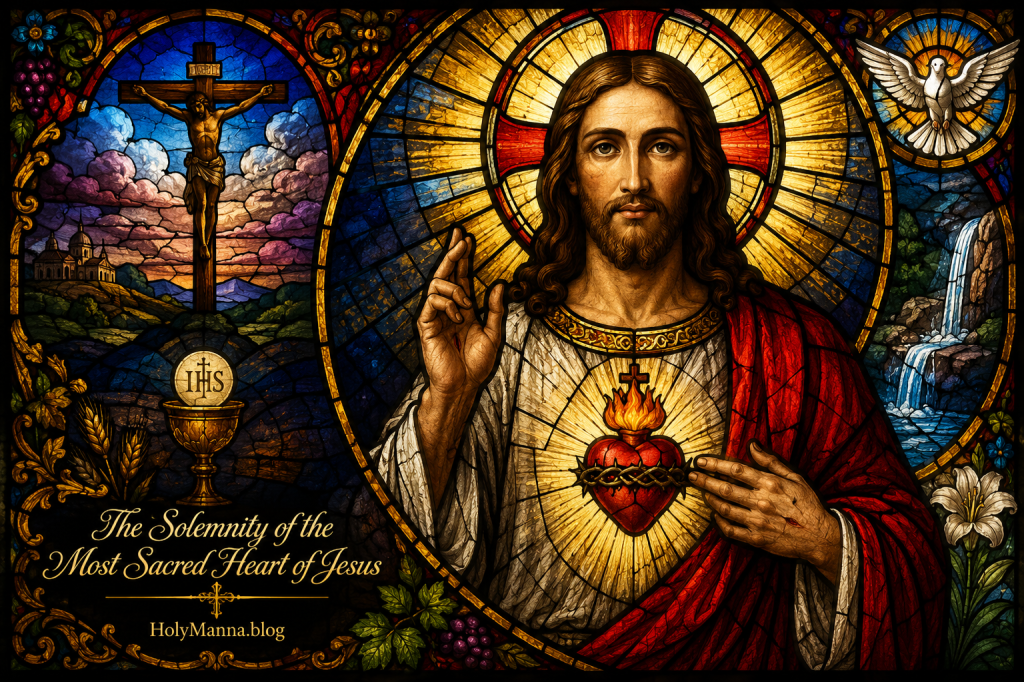
The image itself is rich with meaning. The Heart is often shown burning with flames, surrounded by thorns, pierced, surmounted by a Cross, and shining with light. The flames show Christ’s burning love. The thorns show the pain caused by sin and ingratitude. The wound recalls the lance at Calvary. The Cross shows that His love is sacrificial. The light reminds us that His mercy shines in the darkness.
For many Catholics, the Sacred Heart is also a family devotion. Parents teach children to pray before His image. Grandparents pass down the First Friday devotion. Parishes renew consecrations. Priests preach about mercy and conversion. Homes become small domestic churches where Christ’s Heart is honored not only with words, but with forgiveness, patience, modesty, hospitality, and prayer.
That is the real cultural power of the Sacred Heart. It does not merely decorate Catholic life. It forms Catholic life.
The Heart That Meets the Tired Soul
This feast speaks with surprising force to modern life. Many people today are exhausted, anxious, distracted, and quietly lonely. The world tells people to build a personal brand, chase success, stay attractive, stay productive, stay entertained, and never appear weak. Then, when the soul gets tired, the world offers more noise.
Jesus offers His Heart.
He does not say, “Come to me when you have everything figured out.” He says, “Come to me, all you who labor and are burdened, and I will give you rest.” That invitation is not only for the visibly broken. It is for the successful person who is secretly empty. It is for the parent who feels worn down. It is for the young adult trying to find purpose. It is for the sinner who keeps falling. It is for the Catholic who goes to Mass but feels spiritually dry. It is for the person who wants to pray but does not know where to begin.
The Sacred Heart shows that Jesus is not disgusted by weakness. He enters it. He carries it. He heals it from the inside.
But His love is not passive. He does not leave the heart unchanged. The Heart of Jesus wants to make our hearts like His. That means learning humility in a prideful world. It means learning purity in a culture that treats people like objects. It means learning mercy in a society addicted to outrage. It means learning fidelity when feelings change. It means learning reparation when sin has wounded love.
A person devoted to the Sacred Heart should become easier to forgive, slower to condemn, more faithful in prayer, more reverent at Mass, more compassionate toward the suffering, and more serious about sin without becoming harsh toward sinners.
The Sacred Heart is Jesus saying, “This is how far love goes. Now let your heart become like Mine.”
What would change if every thought, word, relationship, and decision passed through the Heart of Jesus first?
Engage with Us!
Share your thoughts and reflections in the comments below. The Solemnity of the Most Sacred Heart of Jesus is a beautiful opportunity to think honestly about how we receive Christ’s love and how we return that love in daily life.
- Where in your life do you most need to hear Jesus say, “Come to me, all you who labor and are burdened”?
- How can devotion to the Sacred Heart help you grow in humility, mercy, and patience this week?
- Is there an area of sin, resentment, pride, or indifference where Jesus is asking you to make reparation with love?
- What would it look like for your home, family, or daily routine to be more clearly centered on the Heart of Christ?
- How can you pray more intentionally for priests on this feast, especially those who have helped bring Christ’s mercy into your life?
May the Sacred Heart of Jesus teach every soul to love with patience, forgive with courage, serve with humility, and live with mercy. Let every day become an offering of faith, and let everything be done with the love and mercy Jesus taught us.
Sacred Heart of Jesus, we trust in You!
Follow us on YouTube, TikTok, Instagram and Facebook for more insights and reflections on living a faith-filled life.


Leave a Reply