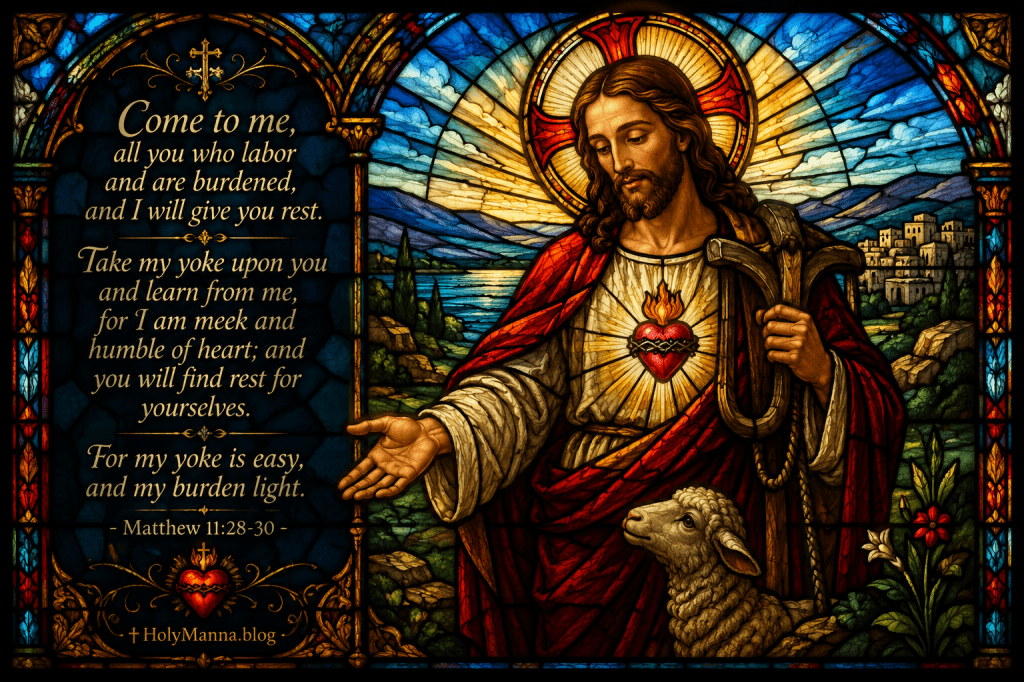
Solemnity of the Most Sacred Heart of Jesus – Lectionary: 170
The Heart That Loved First
Before anyone can love God well, the soul must first discover that God has already loved first. That is the quiet fire burning through today’s readings for the Solemnity of the Most Sacred Heart of Jesus. From Moses speaking to Israel in Deuteronomy 7:6-11, to David blessing the Lord in Psalm 103, to Saint John proclaiming that “God is love” in 1 John 4:8, to Jesus inviting the weary to rest in His “meek and humble” Heart in Matthew 11:29, the Church places one great truth before us: God’s love is not earned by human greatness, but freely given through divine mercy.
This feast brings the whole story of salvation into focus. Israel was not chosen because it was powerful, impressive, or numerous. Moses reminds the people that the Lord set His heart on them because He loved them and remained faithful to His covenant. That same covenant mercy echoes in the psalm, where God is praised as the One who pardons, heals, redeems, and crowns His people with compassion. Saint John then brings this ancient mercy into the light of Christ, teaching that love is revealed not because humanity reached up to God, but because the Father sent His Son as expiation for sins. In the Gospel, that same Son opens His Heart to the tired, the burdened, the humble, and the childlike.
Historically, these readings reach back to the Exodus, the covenant at Sinai, and Israel’s identity as a people chosen by grace. Religiously, they point forward to the fullness of revelation in Jesus Christ, whose Sacred Heart shows the human and divine love of the Son of God. The Catechism teaches that God chose Israel out of “sheer gratuitous love” (CCC 218) and that Jesus “has loved us all with a human heart” (CCC 478). That is the mystery celebrated today. The Sacred Heart is not a sentimental image. It is the visible sign of the faithful, wounded, merciful love of Christ.
So today’s readings prepare the heart for a simple but life-changing invitation. Stop trying to prove worthiness before God. Remember His mercy. Receive His love. Then learn to love from the Heart of Jesus, because the Christian life begins not with what humanity offers to God, but with what God has already poured out through Christ.
First Reading – Deuteronomy 7:6-11
Chosen by Love Before We Could Ever Prove Ourselves
In Deuteronomy 7:6-11, Moses speaks to Israel as they stand on the edge of the Promised Land. They are not listening to a motivational speech from a military leader. They are hearing a covenant reminder from the servant of God. Behind them is Egypt, slavery, the Red Sea, the wilderness, manna, failure, mercy, and forty years of learning that the Lord is faithful even when His people are fragile. Before them is the land promised to Abraham, Isaac, and Jacob.
This reading matters deeply on the Solemnity of the Most Sacred Heart of Jesus because it reveals the pattern of divine love. God does not choose His people because they are impressive. He chooses them because He loves them. That is the same mystery revealed fully in the Sacred Heart of Jesus. The Heart of Christ is not the reward for the strong. It is the refuge of the weak, the weary, the sinful, and the small. Israel was chosen out of covenant mercy, and in Christ, that mercy becomes visible in a human Heart.
This passage also prepares the soul to understand the rest of today’s readings. Psalm 103 praises the Lord who pardons, heals, redeems, and crowns His people with compassion. 1 John 4:7-16 declares that “God is love” and that He loved first. Matthew 11:25-30 shows Jesus inviting the burdened to come to His meek and humble Heart. The central theme is simple and life-changing: God’s love comes first, and His love calls His people into faithful communion.
Deuteronomy 7:6-11 – New American Bible (Revised Edition)
6 For you are a people holy to the Lord, your God; the Lord, your God, has chosen you from all the peoples on the face of the earth to be a people specially his own. 7 It was not because you are more numerous than all the peoples that the Lord set his heart on you and chose you; for you are really the smallest of all peoples. 8 It was because the Lord loved you and because of his fidelity to the oath he had sworn to your ancestors, that the Lord brought you out with a strong hand and redeemed you from the house of slavery, from the hand of Pharaoh, king of Egypt. 9 Know, then, that the Lord, your God, is God: the faithful God who keeps covenant mercy to the thousandth generation toward those who love him and keep his commandments, 10 but who repays with destruction those who hate him; he does not delay with those who hate him, but makes them pay for it. 11 Therefore carefully observe the commandment, the statutes and the ordinances which I command you today.
Detailed Exegesis
Verse 6 – “For you are a people holy to the Lord, your God; the Lord, your God, has chosen you from all the peoples on the face of the earth to be a people specially his own.”
Moses begins with Israel’s identity. They are holy because they belong to the Lord. Holiness here is not first about personal achievement. It is about consecration. Israel has been set apart by God for God. The phrase “a people specially his own” points to covenant intimacy. Israel is not merely another nation with religious customs. Israel is the chosen people through whom God will reveal His law, His mercy, His promises, and eventually the Messiah.
This verse helps Christians understand that holiness begins with belonging. Before Israel could live differently, Israel had to remember who they were. The same is true for the baptized. The Christian life is not an attempt to become lovable enough for God. It is the response of those who have already been claimed by grace. The Sacred Heart of Jesus reveals the depth of that belonging, because Christ gives Himself completely so that humanity may be restored to communion with the Father.
Verse 7 – “It was not because you are more numerous than all the peoples that the Lord set his heart on you and chose you; for you are really the smallest of all peoples.”
This verse is one of the most humbling lines in the Old Testament. God did not choose Israel because they were the largest, strongest, or most impressive people. Moses strips away every possible reason for pride. Israel cannot say, “God chose us because we were mighty.” Israel cannot say, “God needed us because we were powerful.” They were the smallest of all peoples.
The phrase “set his heart on you” is especially beautiful on the Solemnity of the Sacred Heart. It speaks of divine affection, commitment, and covenant love. God’s heart was set on Israel not because Israel was great, but because God is faithful and loving. This prepares the Church to contemplate Jesus, who later says, “I am meek and humble of heart” in Matthew 11:29. The God who set His heart on little Israel now reveals His Heart in the humility of Christ.
Verse 8 – “It was because the Lord loved you and because of his fidelity to the oath he had sworn to your ancestors, that the Lord brought you out with a strong hand and redeemed you from the house of slavery, from the hand of Pharaoh, king of Egypt.”
Here Moses gives the reason for Israel’s election. God loved them, and God kept His oath. Divine love and divine fidelity belong together. God’s love is not a passing emotion. It is covenant faithfulness. He remembers His promise to Abraham, Isaac, and Jacob, and He acts with power to redeem His people from slavery.
The Exodus becomes the great sign of salvation in the Old Testament. Israel was not merely improved or inspired. Israel was redeemed. The Lord brought them out of bondage with a strong hand. For Catholics, this points forward to the greater redemption accomplished by Jesus Christ. Pharaoh’s slavery becomes a foreshadowing of humanity’s slavery to sin. The Exodus points toward the Cross. The blood of the Passover lamb points toward the Blood of Christ. The Sacred Heart shows the source of this redemption, because Jesus saves not from obligation, but from love.
Verse 9 – “Know, then, that the Lord, your God, is God: the faithful God who keeps covenant mercy to the thousandth generation toward those who love him and keep his commandments.”
Moses now calls Israel to knowledge. “Know, then” means this truth must sink deep into the heart and memory of the people. The Lord is God. He is not like the false gods of the surrounding nations. He is faithful. He keeps covenant mercy. His mercy is not thin or temporary. It stretches “to the thousandth generation” toward those who love Him and keep His commandments.
This verse holds mercy and obedience together. God’s covenant love comes first, but it calls for a faithful response. In Catholic teaching, obedience is not the enemy of love. Obedience is love made visible. Jesus Himself says in John 14:15, “If you love me, you will keep my commandments.” The Sacred Heart does not invite people into vague spirituality. The Sacred Heart draws them into covenant love, where mercy transforms conduct, worship, relationships, and daily decisions.
Verse 10 – “But who repays with destruction those who hate him; he does not delay with those who hate him, but makes them pay for it.”
This verse can sound severe to modern ears, but it must be read within the covenant setting. Moses is not describing a petty or unstable God. He is warning Israel that rejecting the Lord is not harmless. To hate God means to refuse His covenant, reject His commandments, and turn toward idolatry and injustice. Sin destroys communion with God, and if left unrepented, it brings judgment.
Catholic faith never separates mercy from justice. The Sacred Heart is merciful, but not indifferent. Jesus receives sinners, forgives sinners, heals sinners, and dies for sinners, but He also calls sinners to repentance. God’s justice is not opposed to His love. It is the seriousness of His love. A God who did not care about evil would not truly love the oppressed, the wounded, or the sinner trapped in destruction.
Verse 11 – “Therefore carefully observe the commandment, the statutes and the ordinances which I command you today.”
The reading ends with a call to obedience. Because God chose Israel, loved Israel, redeemed Israel, and kept covenant mercy with Israel, the people must carefully observe His commandments. The order is important. Obedience does not come before redemption. It comes after redemption. God does not say, “Obey so that I might love you.” He says, in effect, “I have loved you, chosen you, and redeemed you. Now live as My people.”
This verse speaks clearly to Christian discipleship. Grace is not permission to remain unchanged. Grace is the power to live differently. The commandments teach the redeemed how to walk in freedom. The Sacred Heart of Jesus does not merely comfort the soul. He forms the soul. He teaches the soul how to love rightly, worship faithfully, forgive generously, and reject the false gods that still promise freedom while creating slavery.
Teachings
The heart of this reading is divine election by love. Israel is chosen not because of greatness, but because of God’s gratuitous mercy. This is one of the great foundations of biblical faith. God acts first. God chooses first. God loves first. The human response comes after the divine initiative.
The Catechism of the Catholic Church explains this mystery in its teaching on God’s love for Israel:
“In the course of its history, Israel was able to discover that God had only one reason to reveal himself to them, a single motive for choosing them from among all peoples as his special possession: his sheer gratuitous love. And thanks to the prophets Israel understood that it was again out of love that God never stopped saving them and pardoning their unfaithfulness and sins.” (CCC 218)
This teaching fits perfectly with Deuteronomy 7:6-11. God’s choice is not rooted in Israel’s superiority. It is rooted in His love. That same love continues even when Israel fails. The prophets will later show that God’s love remains patient, wounded, persistent, and merciful.
The Catechism continues:
“God’s love for Israel is compared to a father’s love for his son. His love for his people is stronger than a mother’s for her children. God loves his people more than a bridegroom his beloved; his love will be victorious over even the worst infidelities and will extend to his most precious gift: ‘God so loved the world that he gave his only Son.’” (CCC 219)
This is where the first reading opens directly into the Solemnity of the Sacred Heart. The love God showed Israel reaches its fullness in the gift of Jesus Christ. The Father’s love is revealed in the Son. The Son’s love is revealed in His Sacred Heart. The Heart of Jesus shows that God’s covenant mercy is not an abstract idea. It has flesh, blood, tears, patience, wounds, and glory.
The reading also teaches that redemption leads to obedience. Israel was freed from Egypt so they could belong to God and worship Him in freedom. This pattern continues in the Christian life. Christ does not free the soul so it can return to spiritual Egypt. He frees the soul so it can live as a child of God.
The Catechism explains the relationship between covenant and commandments:
“The gift of the Commandments and of the Law is part of the covenant God sealed with his own. In Exodus, the revelation of the ‘ten words’ is granted between the proposal of the covenant and its conclusion after the people had committed themselves to ‘do’ all that the Lord had said, and to ‘obey’ it.” (CCC 2060)
This matters because modern culture often treats commandments as restrictions on freedom. Scripture sees them differently. The commandments are the moral path of a redeemed people. They protect love. They teach freedom. They form the heart in covenant fidelity.
Saint Augustine captured the connection between love and obedience with his famous teaching:
“Once for all, then, a short precept is given thee: Love, and do what thou wilt.”
This quote is often misunderstood. Augustine does not mean that love allows a person to do anything selfishly. He means that when the heart truly loves God, its desires are purified. Real love seeks what is good, holy, just, and faithful. The Sacred Heart forms this kind of love in us. It does not merely make us feel religious. It teaches us how to will the good.
Historically, this reading also recalls the Exodus, the defining act of God’s saving power in the Old Testament. Israel’s liberation from Egypt was not only a political rescue. It was a theological revelation. The Lord showed that He is faithful to His promises, stronger than earthly kings, merciful to the oppressed, and committed to forming a holy people. In the light of Christ, Catholics see the Exodus as a foreshadowing of salvation through Jesus. Just as Israel was redeemed from Pharaoh, humanity is redeemed from sin and death. Just as Israel was led toward the Promised Land, Christians are led toward eternal life with God.
On the Solemnity of the Sacred Heart, this first reading teaches that the love of God has always been personal, faithful, and saving. The Heart of Jesus is the fullness of the love that first chose Israel, rescued the enslaved, forgave the unfaithful, and kept covenant mercy to the thousandth generation.
Reflection
This reading speaks to one of the deepest struggles in the human heart: the temptation to believe love must be earned by being impressive. Many people carry that fear into their relationship with God. They assume God loves them more when they are strong, disciplined, useful, successful, and spiritually put together. But Moses tells Israel something different. God did not choose them because they were powerful. He chose them because He loved them.
That truth can bring real freedom. The Christian life does not begin with proving worthiness. It begins with receiving mercy. The Sacred Heart of Jesus reminds the soul that God’s love is not a prize for the flawless. It is the healing fire offered to sinners, strugglers, the weary, and the small.
Still, this reading does not let anyone confuse mercy with spiritual laziness. God’s love calls for a response. Moses ends by telling Israel to observe the commandments carefully. In daily life, that means love must become obedience. It means choosing prayer when distraction feels easier. It means going to Confession when pride wants to hide. It means forgiving when resentment feels justified. It means keeping the commandments not as a cold checklist, but as a grateful response to the God who loved first.
A good step today is to pray honestly with this question: Where has the soul been trying to earn the love God has already given? Another step is to remember one concrete way God has already redeemed, protected, forgiven, or carried the soul through difficulty. Gratitude weakens fear. Remembering God’s mercy makes obedience less like a burden and more like a loving response.
This reading also invites the faithful to examine false forms of slavery. Egypt is not only ancient history. People can still be enslaved by approval, lust, resentment, anxiety, ambition, comfort, anger, addiction, and fear. The Lord who redeemed Israel still redeems His people today through Jesus Christ. The Sacred Heart does not simply admire the burdened from a distance. He calls them out of slavery and into covenant love.
What would change if God’s love was received as the starting point rather than treated as the finish line?
Which commandment currently feels heavy, and how might it become lighter if seen as a response to the Heart of Jesus?
What “Egypt” is Christ asking the soul to leave behind so it can live more freely as His own?
The first reading ends with obedience, but it begins with love. That order is everything. God sets His Heart on His people first. Then He teaches them how to live. The Sacred Heart of Jesus reveals that this same divine love has come all the way down to us, not to flatter us, but to redeem us, form us, and bring us home.
Responsorial Psalm – Psalm 103:1-4, 6-8, 10
The Soul Remembers the Mercy of God
In Psalm 103:1-4, 6-8, 10, the Church gives the faithful a song of remembrance. After hearing Moses proclaim in Deuteronomy 7:6-11 that God chose Israel because He loved them, the psalm teaches the soul how to respond to that kind of mercy. The answer is praise. Not shallow praise. Not routine religious language. This is the praise of someone who has been forgiven, healed, rescued, and crowned with compassion.
This psalm is traditionally attributed to David, and it carries the feel of a man who knows both sin and mercy. David knew what it meant to fail deeply, but he also knew that the Lord does not abandon the repentant heart. In Israel’s worship, psalms like this formed the people’s memory. They reminded Israel that the God who delivered them from Egypt is not only powerful, but merciful, gracious, slow to anger, and abounding in covenant love.
On the Solemnity of the Most Sacred Heart of Jesus, this psalm fits beautifully into today’s central theme: God loves first, and His mercy restores the burdened soul. The Sacred Heart of Jesus is the fullness of what this psalm sings. He is the One who pardons sins, heals wounds, redeems from the pit, defends the oppressed, and refuses to treat the repentant sinner as his sins deserve.
Psalm 103:1-4, 6-8, 10 – New American Bible (Revised Edition)
Praise of Divine Goodness
1 Of David.
Bless the Lord, my soul;
all my being, bless his holy name!
2 Bless the Lord, my soul;
and do not forget all his gifts,
3 Who pardons all your sins,
and heals all your ills,
4 Who redeems your life from the pit,
and crowns you with mercy and compassion,6 The Lord does righteous deeds,
brings justice to all the oppressed.
7 He made known his ways to Moses,
to the Israelites his deeds.
8 Merciful and gracious is the Lord,
slow to anger, abounding in mercy.10 He has not dealt with us as our sins merit,
nor requited us as our wrongs deserve.
Detailed Exegesis
Verse 1 – “Bless the Lord, my soul; all my being, bless his holy name!”
The psalm begins by speaking inwardly. The soul is commanded to bless the Lord. This is not because God needs human praise, but because the human heart needs to remember God rightly. The phrase “all my being” shows that true worship is not partial. It involves the whole person: mind, body, heart, memory, desire, and will.
To bless God is to acknowledge His holiness, goodness, and mercy. On the Solemnity of the Sacred Heart, this verse invites the faithful to bring the whole self before Christ. Not only the polished parts. Not only the strong parts. The whole being is invited to praise, because the whole person is loved by the Heart of Jesus.
Verse 2 – “Bless the Lord, my soul; and do not forget all his gifts.”
The psalm repeats the call to bless the Lord, but now adds a warning: do not forget. Forgetfulness is one of the great dangers of the spiritual life. Israel often forgot the Lord’s mighty deeds after the Exodus. Christians can do the same after receiving grace. The soul can forget forgiveness, forget answered prayers, forget protection, forget conversion, and forget the mercy already received.
This verse calls the faithful to holy memory. God’s gifts are not only material blessings. They include grace, forgiveness, the sacraments, Scripture, the Church, daily providence, and the gift of salvation in Jesus Christ. The Sacred Heart teaches the soul to remember that every grace begins in divine love.
Verse 3 – “Who pardons all your sins, and heals all your ills.”
Here the psalm names two great works of God: pardon and healing. Sin is not treated lightly. It must be pardoned. Human woundedness is not ignored. It must be healed. The Lord cares about both the guilt of sin and the wounds sin leaves behind.
This verse points directly toward Christ. Jesus forgives sins and heals the sick throughout the Gospels, revealing that God’s mercy is not distant or abstract. The Sacred Heart is the Heart of the Divine Physician. He does not come only to excuse sinners, but to restore them. He forgives the guilt, begins healing the damage, and slowly teaches the soul how to live in freedom.
Verse 4 – “Who redeems your life from the pit, and crowns you with mercy and compassion.”
The word “redeems” recalls rescue, deliverance, and being bought back from danger. The “pit” can suggest death, destruction, despair, or the downward pull of sin. God does not merely offer advice from above. He reaches into the pit and redeems.
The second half of the verse is tender. The Lord “crowns” the redeemed soul with mercy and compassion. This is royal language applied to sinners who have been rescued. God does not pull the soul from the pit just to shame it forever. He crowns it with mercy. In the light of the Sacred Heart, this is stunning. Jesus lifts the fallen not to humiliate them, but to restore their dignity as beloved sons and daughters of the Father.
Verse 6 – “The Lord does righteous deeds, brings justice to all the oppressed.”
The psalm now moves from personal mercy to public justice. God pardons the sinner, but He also defends the oppressed. His mercy is not sentimental weakness. It is righteous love. The Lord acts rightly, and His righteousness includes concern for those crushed by injustice.
This verse keeps devotion to the Sacred Heart from becoming self-centered. The Heart of Jesus loves the sinner and the suffering. He calls His people not only to personal repentance, but also to works of mercy, protection of the vulnerable, defense of human dignity, and compassion for the oppressed. Catholic devotion must become Catholic action.
Verse 7 – “He made known his ways to Moses, to the Israelites his deeds.”
This verse reaches back to the Exodus and the covenant. God revealed His ways to Moses, especially through the Law, the covenant, and His mercy after Israel’s failures. He also revealed His deeds to the Israelites through liberation from Egypt, guidance in the wilderness, manna from heaven, water from the rock, and His faithful presence.
The verse reminds the faithful that God is not unknowable in a vague or distant sense. He reveals Himself. In the Old Testament, He made His ways known to Moses. In the fullness of time, He reveals Himself in Jesus Christ. The Sacred Heart of Jesus is the deepest revelation of God’s way, because it shows that God’s way is holy love, humble mercy, and faithful redemption.
Verse 8 – “Merciful and gracious is the Lord, slow to anger, abounding in mercy.”
This verse echoes God’s self-revelation to Moses in Exodus 34:6. After Israel sinned with the golden calf, God revealed Himself not first as a destroyer, but as merciful and gracious. This became one of Israel’s most treasured descriptions of the Lord.
On this feast, the verse shines with special beauty. The Sacred Heart of Jesus is merciful and gracious. He is slow to anger. He abounds in mercy. He is not indifferent to sin, but He is patient with sinners. He does not rush to condemn the repentant heart. He invites, waits, forgives, heals, and restores.
Verse 10 – “He has not dealt with us as our sins merit, nor requited us as our wrongs deserve.”
This verse brings the psalm to a deeply personal place. Every honest soul knows this is true. If God dealt with humanity strictly according to sin, no one could stand. But He does not treat the repentant according to what sin deserves. He treats them according to His mercy.
This does not mean justice disappears. It means mercy triumphs for those who turn back to God. In Christ, this mercy becomes visible on the Cross. Jesus takes sin seriously enough to die for it, and loves sinners deeply enough to offer forgiveness. The Sacred Heart is the Heart that bears the cost of mercy.
Teachings
The central teaching of this psalm is that God’s mercy is not occasional. It is part of His revealed identity. The Lord pardons, heals, redeems, crowns, defends, reveals, and forgives. This is the same God who chose Israel in love in Deuteronomy 7:6-11, and the same God whom Saint John proclaims when he writes, “God is love” in 1 John 4:8.
The Catechism of the Catholic Church connects this mercy directly to God’s revelation to Moses:
“After Israel’s sin, when the people had turned away from God to worship the golden calf, God hears Moses’ prayer of intercession and agrees to walk in the midst of an unfaithful people, thus demonstrating his love. When Moses asks to see his glory, God responds ‘I will make all my goodness pass before you, and will proclaim before you my name “the Lord”; and I will be gracious to whom I will be gracious, and will show mercy on whom I will show mercy.’ Then the Lord passes before Moses and proclaims, ‘The Lord, the Lord, a God merciful and gracious, slow to anger, and abounding in steadfast love and faithfulness’; Moses then confesses that the Lord is a forgiving God.” (CCC 210)
This teaching helps explain why Psalm 103:8 is so important. The psalm is not inventing a comforting image of God. It is remembering how God revealed Himself. Even after the golden calf, when Israel had betrayed the covenant almost immediately, the Lord showed Himself as merciful, gracious, slow to anger, and abounding in steadfast love.
This is the same mercy Catholics see fulfilled in the Sacred Heart of Jesus. The Catechism teaches:
“Jesus knew and loved us each and all during his life, his agony and his Passion, and gave himself up for each one of us: ‘The Son of God . . . loved me and gave himself for me.’ He has loved us all with a human heart. For this reason, the Sacred Heart of Jesus, pierced by our sins and for our salvation, ‘is quite rightly considered the chief sign and symbol of that . . . love with which the divine Redeemer continually loves the eternal Father and all human beings’ without exception.” (CCC 478)
This quote brings Psalm 103 into the center of the feast. The Lord who pardons, heals, redeems, and crowns with mercy is not an idea. He is Jesus Christ. His Heart is the chief sign and symbol of divine love poured out for sinners.
Saint Augustine often taught that praise heals the direction of the heart because it turns the soul away from self-enclosure and back toward God. In his preaching on the psalms, he reminds believers that blessing the Lord is not flattery, but right worship. The soul becomes properly ordered when it remembers the greatness and mercy of God. That is exactly what Psalm 103 does. It teaches the soul to stop obsessing over fear, shame, and self-reliance, and to remember the gifts of the Lord.
This psalm also stands within the worshiping memory of Israel. The people of God needed to remember the Exodus, the covenant, the Law, and the Lord’s mercy after sin. Catholics continue this pattern every time they participate in the Mass. The Eucharist is the great act of remembrance, not as mere nostalgia, but as sacramental participation in Christ’s saving sacrifice. The same Lord who redeemed Israel from slavery now redeems humanity through the Cross, and the Sacred Heart reveals the love behind that redemption.
Reflection
This psalm is a remedy for spiritual forgetfulness. Many people remember their sins more easily than they remember God’s mercy. They remember their failures more vividly than their blessings. They remember wounds, regrets, disappointments, and anxieties, but forget the times God forgave, carried, protected, corrected, and healed them.
That is why the psalm says, “Do not forget all his gifts.” The soul needs to be reminded because fear has a loud memory. Shame has a loud memory. Resentment has a loud memory. But faith must also have a memory. The Christian must learn to remember mercy with the same seriousness that the world remembers pain.
A simple daily practice can begin here. At the end of the day, name three gifts from the Lord. One may be forgiveness. One may be protection from temptation. One may be a conversation, a meal, a moment of peace, the grace to keep going, or the courage to apologize. Gratitude trains the soul to bless the Lord with “all my being.”
This psalm also invites the faithful to bring real wounds to Jesus. God “pardons” and “heals.” Some wounds need Confession. Some wounds need prayer. Some wounds need time, counsel, and patient grace. The Sacred Heart does not shame the wounded soul for needing healing. He invites it closer.
The verse about justice for the oppressed also asks something practical. If the Lord brings justice to the oppressed, then devotion to Him must make His people more attentive to those who suffer. That begins at home, in the parish, at work, and in ordinary relationships. It can mean defending someone’s dignity, checking on the lonely, helping the poor, protecting the vulnerable, or refusing to participate in gossip that crushes another person’s name.
What gifts of God has the soul forgotten because anxiety has been louder than gratitude?
Where is the Sacred Heart inviting deeper healing instead of hidden shame?
Who is oppressed, lonely, burdened, or forgotten nearby, and how can Christ’s mercy reach that person through an ordinary act of love?
The psalm does not pretend life is easy. It speaks of sin, illness, the pit, oppression, and wrongs. But it also speaks of pardon, healing, redemption, justice, mercy, and compassion. That is why it belongs on the Solemnity of the Sacred Heart. The Heart of Jesus does not deny the pit. He redeems from it. He does not ignore sin. He pardons it. He does not discard the wounded. He crowns them with mercy and compassion.
Second Reading – 1 John 4:7-16
The Love That Begins in God and Becomes Visible in Us
In 1 John 4:7-16, Saint John brings the Church to the very center of Christian faith. This is not a vague message about being nice. It is a deep proclamation of who God is, how God has revealed Himself, and how Christians are called to live because of that revelation. Saint John writes to a Christian community that needed to remain faithful to the truth about Jesus Christ and to the commandment of love. For John, these two things can never be separated. True faith confesses that Jesus is the Son of God, and true faith becomes visible through love.
This reading fits perfectly on the Solemnity of the Most Sacred Heart of Jesus. In Deuteronomy 7:6-11, Moses tells Israel that God chose them because He loved them. In Psalm 103, the soul praises the Lord who pardons, heals, redeems, and crowns with mercy. Now, in 1 John 4:7-16, the Church hears the deepest explanation of that mercy: “God is love.” This love is not merely spoken. It is revealed. The Father sends the Son. The Son becomes the expiation for sins. The Spirit allows believers to remain in God. Then love becomes the sign that God’s life is truly dwelling in His people.
On this feast, Saint John helps the faithful understand the Sacred Heart not as a sentimental symbol, but as the living sign of divine love made flesh. The Heart of Jesus shows that God loved first, loved completely, and loved sinners all the way to the Cross.
1 John 4:7-16 – New American Bible (Revised Edition)
God’s Love and Christian Life. 7 Beloved, let us love one another, because love is of God; everyone who loves is begotten by God and knows God. 8 Whoever is without love does not know God, for God is love. 9 In this way the love of God was revealed to us: God sent his only Son into the world so that we might have life through him. 10 In this is love: not that we have loved God, but that he loved us and sent his Son as expiation for our sins. 11 Beloved, if God so loved us, we also must love one another. 12 No one has ever seen God. Yet, if we love one another, God remains in us, and his love is brought to perfection in us.
13 This is how we know that we remain in him and he in us, that he has given us of his Spirit. 14 Moreover, we have seen and testify that the Father sent his Son as savior of the world. 15 Whoever acknowledges that Jesus is the Son of God, God remains in him and he in God. 16 We have come to know and to believe in the love God has for us.
God is love, and whoever remains in love remains in God and God in him.
Detailed Exegesis
Verse 7 – “Beloved, let us love one another, because love is of God; everyone who loves is begotten by God and knows God.”
Saint John begins with the word “Beloved.” Before he commands love, he reminds the Church of its identity. Christians are beloved because they have first been loved by God. The command to love one another does not begin with human effort. It begins with divine grace.
When John says “love is of God,” he teaches that authentic Christian love has its source in God Himself. Love is not merely a personality trait or a social virtue. It flows from communion with God. To be “begotten by God” means to share in the new life given through grace. The one who loves with true charity shows that God’s life is active within the soul.
Verse 8 – “Whoever is without love does not know God, for God is love.”
This verse is one of the most profound statements in all of Scripture. John does not simply say that God loves. He says “God is love.” Love is not something added to God. Love belongs to His very being.
At the same time, this verse must be understood through Catholic faith. It does not mean that any feeling called love is automatically holy. It means that true love must be measured by God, especially by the self-giving love revealed in Jesus Christ. A person may know many religious facts, but without charity, that knowledge is incomplete. To know God truly is to be changed by His love.
Verse 9 – “In this way the love of God was revealed to us: God sent his only Son into the world so that we might have life through him.”
John now explains how God’s love is revealed. It is revealed in the sending of the Son. Love becomes visible in the Incarnation. The eternal Son enters the world so that humanity might have life through Him.
This verse points directly to the Sacred Heart of Jesus. The love of God did not remain distant in heaven. It took on flesh. It had a human face, human hands, human tears, and a human Heart. Jesus came not merely to teach better morals, but to give life. The Sacred Heart reveals the love of the Son who comes into the world so that sinners may live.
Verse 10 – “In this is love: not that we have loved God, but that he loved us and sent his Son as expiation for our sins.”
Here Saint John gives the order of salvation. Love begins with God, not with us. Humanity did not first rise up in perfect love toward God. God first came down in mercy toward humanity.
The word “expiation” means that Jesus offers Himself for the forgiveness of sins. His love is sacrificial. It deals with sin honestly and mercifully. The Sacred Heart is not a symbol of vague affection. It is the Heart of the One who bears sin, pours Himself out, and reconciles humanity to the Father.
Verse 11 – “Beloved, if God so loved us, we also must love one another.”
John now turns doctrine into daily life. If God has loved us in this way, then Christians must love one another. The word “must” matters. Love is not optional for the disciple. It is the necessary response to God’s love.
This verse keeps devotion to the Sacred Heart from becoming private sentiment. To love the Heart of Jesus is to become more loving in real relationships. The mercy received from Christ must become patience, forgiveness, generosity, truthfulness, and sacrifice toward others.
Verse 12 – “No one has ever seen God. Yet, if we love one another, God remains in us, and his love is brought to perfection in us.”
John acknowledges that no one has seen God in His divine essence. Yet God’s presence becomes visible in the communion of believers. When Christians love one another, God remains in them, and His love is brought to perfection in them.
This does not mean human love improves God’s love. It means God’s love reaches its intended fruit in the believer’s life. The invisible God becomes visible through the charity of His people. The Sacred Heart forms hearts that can make divine love recognizable in the world.
Verse 13 – “This is how we know that we remain in him and he in us, that he has given us of his Spirit.”
Saint John now speaks of the Holy Spirit. Christian love is not produced by willpower alone. The Spirit is given so that believers may remain in God and God in them.
This verse reveals the Trinitarian depth of the reading. The Father sends the Son. The Son saves the world. The Spirit dwells in believers and makes divine love possible within them. On the Solemnity of the Sacred Heart, this matters because the love of Jesus is not merely admired from the outside. Through the Spirit, that love is poured into the heart of the Christian.
Verse 14 – “Moreover, we have seen and testify that the Father sent his Son as savior of the world.”
John speaks as a witness. The Christian faith rests on testimony, not myth. The apostles saw, heard, touched, followed, and proclaimed Jesus Christ. Their testimony is that the Father sent His Son as Savior of the world.
This verse also guards the universal scope of salvation. Jesus is not only the teacher of one group or the inspiration of one nation. He is the Savior of the world. The love revealed in the Sacred Heart is offered to all people without exception. Christ’s Heart is large enough for every sinner, every nation, every wound, and every soul willing to come to Him.
Verse 15 – “Whoever acknowledges that Jesus is the Son of God, God remains in him and he in God.”
John now makes confession of faith essential. Christian love cannot be separated from the truth about Jesus. To acknowledge Jesus as the Son of God is to receive Him according to who He truly is, not merely as a moral teacher or religious symbol.
This verse was especially important in the early Church, when false teachings about Christ threatened the faith of believers. It remains important today. The Sacred Heart belongs to Jesus Christ, true God and true man. Devotion to His Heart is rooted in the confession that the Son of God truly entered human history and truly loved with a human Heart.
Verse 16 – “We have come to know and to believe in the love God has for us. God is love, and whoever remains in love remains in God and God in him.”
John brings the passage to its beautiful conclusion. Christian life is not only knowing facts about God. It is coming to know and believe in the love God has for us. This is often harder than it sounds. Many people believe God is powerful. Many believe God is real. Many believe God is just. But the wounded soul can struggle to believe deeply that God’s love is personal, faithful, and merciful.
The verse ends by repeating the great truth: “God is love.” To remain in love is to remain in God. This is not emotional spirituality. It is covenant communion. The soul remains in God by faith, grace, charity, obedience, and sacramental life. The Sacred Heart invites the faithful to remain in this love, not for a moment of comfort only, but as a whole way of life.
Teachings
The central teaching of this reading is that love begins in the very life of God. Christianity does not teach that God became loving after creating the world or after seeing human need. God is eternally love because He is Trinity. The Father, Son, and Holy Spirit live in an eternal communion of love, and by grace, human beings are invited to share in that communion.
The Catechism of the Catholic Church explains this mystery with the same words from Saint John:
“But St. John goes even further when he affirms that ‘God is love’: God’s very being is love. By sending his only Son and the Spirit of Love in the fullness of time, God has revealed his innermost secret: God himself is an eternal exchange of love, Father, Son and Holy Spirit, and he has destined us to share in that exchange.” (CCC 221)
This teaching gives depth to the whole reading. When John says “God is love,” he is not offering a slogan. He is revealing the mystery of the Trinity. The Father sends the Son. The Spirit is given. The believer is invited to remain in God. The Sacred Heart of Jesus is the visible sign of this eternal love entering human history.
The Catechism also teaches why the Word became flesh:
“The Word became flesh for us in order to save us by reconciling us with God, who ‘loved us and sent his Son to be the expiation for our sins’: ‘the Father has sent his Son as the Savior of the world,’ and ‘he was revealed to take away sins.’” (CCC 457)
This directly echoes 1 John 4:10 and 1 John 4:14. Jesus is sent as Savior and expiation. The love of God does not ignore sin. It enters the world to conquer sin and reconcile humanity to the Father.
The Catechism continues:
“The Word became flesh so that thus we might know God’s love: ‘In this the love of God was made manifest among us, that God sent his only Son into the world, so that we might live through him.’ ‘For God so loved the world that he gave his only Son, that whoever believes in him should not perish but have eternal life.’” (CCC 458)
This teaching fits the Solemnity of the Sacred Heart beautifully. The Heart of Jesus reveals the love of God in a way the human soul can approach. In Christ, God’s love is not abstract. It is embodied, visible, sacrificial, and near.
The reading also teaches that divine love comes before human merit. The Catechism says:
“By giving up his own Son for our sins, God manifests that his plan for us is one of benevolent love, prior to any merit on our part: ‘In this is love, not that we loved God but that he loved us and sent his Son to be the expiation for our sins.’ ‘God shows his love for us in that while we were yet sinners Christ died for us.’” (CCC 604)
This is the same theme heard in the first reading. Israel was chosen not because of greatness, but because of love. Sinners are saved not because they loved first, but because God loved first. The Sacred Heart is the sign of love prior to merit.
The Holy Spirit also plays a major role in this reading. Saint John says that believers know they remain in God because He has given them of His Spirit. The Catechism teaches:
“‘God is Love’ and love is his first gift, containing all others. ‘God’s love has been poured into our hearts through the Holy Spirit who has been given to us.’” (CCC 733)
This means Christian love is not merely human kindness. It is charity poured into the heart by the Holy Spirit. The love of the Sacred Heart is meant to become the life of the Christian through grace.
Saint Augustine expressed the transformation of Christian love in a famous teaching from his homily on the First Letter of John:
“Love, and do what you will.”
This line should never be read as permission for selfishness. Augustine means that when true charity governs the heart, the will is purified. A soul formed by God’s love will desire what is good, holy, merciful, and faithful. That is the transformation Saint John describes. God’s love remains in the believer, and His love is brought to perfection in concrete acts of charity.
Historically, this reading also speaks to the early Church’s struggle to preserve true faith in Jesus Christ. Some false teachers separated spirituality from the Incarnation or treated Jesus as less than the eternal Son of God made flesh. John refuses that separation. The Father sent His Son. Believers must acknowledge that Jesus is the Son of God. Love and doctrine belong together. A Catholic devotion to the Sacred Heart must therefore be both tender and truthful. It loves Jesus as He truly is: the eternal Son of God, Savior of the world, who loved humanity with a real human Heart.
Reflection
This reading asks the soul to receive one truth before trying to do anything else: God loved first. That sounds simple, but many people live as if the opposite were true. They try to earn God’s attention, earn His mercy, earn His patience, and earn a place in His Heart. Saint John gently destroys that fear. “In this is love: not that we have loved God, but that he loved us.”
The Sacred Heart of Jesus is the remedy for a performance-based spiritual life. It reminds the faithful that God’s love is not the paycheck for good behavior. It is the source of conversion. A soul does not become holy by pretending it never needed mercy. A soul becomes holy by receiving mercy and letting that mercy become love.
This reading also gives a practical examination of conscience. If God has loved us this way, then love must become visible. It must show up in speech, family life, friendships, parish life, work, forgiveness, service, and sacrifice. Saint John does not allow love to remain a religious idea. He says, “Beloved, if God so loved us, we also must love one another.”
A simple way to live this reading is to choose one concrete act of love each day. Forgive someone instead of rehearsing resentment. Speak gently when irritation feels easier. Pray for someone difficult. Visit or call someone lonely. Apologize without adding excuses. Give time to someone who cannot repay it. These ordinary choices become places where the invisible God is made visible through charity.
This reading also invites the soul to ask whether it truly believes in God’s love. Saint John says, “We have come to know and to believe in the love God has for us.” Many Catholics believe the doctrines of the faith, but still struggle to believe that God’s mercy is personally meant for them. The Sacred Heart invites that wounded hesitation into prayer. Jesus does not merely love humanity as a crowd. He loves each soul with a human Heart.
Where is the soul still trying to earn the love that God has already poured out in Christ?
Who needs to experience the love of the Sacred Heart through a concrete act of patience, forgiveness, or mercy today?
What would change if the words “God is love” were trusted not as a slogan, but as the deepest truth about reality?
Saint John’s message is both comforting and demanding. God is love. God loved first. God sent His Son. God gave His Spirit. Therefore, the Christian must remain in love. The Sacred Heart of Jesus reveals the love that saves, but it also forms the heart that must now love in return.
Holy Gospel – Matthew 11:25-30
The Meek and Humble Heart That Gives Rest to the Weary
In Matthew 11:25-30, the Church brings the faithful to the words that stand at the very center of the Solemnity of the Most Sacred Heart of Jesus. This is the only place in the Gospels where Jesus directly describes His own Heart. He does not say He is powerful and distant of heart, though He is almighty. He does not say He is brilliant and untouchable of heart, though He is divine Wisdom. He says, “I am meek and humble of heart.” That one sentence opens a window into the deepest tenderness of the Son of God.
This Gospel comes after Jesus has preached, healed, taught, and faced resistance from many who considered themselves wise and religiously important. The scribes and Pharisees often studied the Law carefully, yet many failed to recognize the One to whom the Law pointed. Meanwhile, the poor, the humble, the sick, sinners, and the childlike were often the ones most ready to receive Him. In the culture of Jesus’ time, a yoke was a wooden beam placed on animals for labor, but it was also a common image for teaching, discipleship, and obedience to the Law. Jesus does not remove the call to discipleship. He offers His own yoke, one carried with Him, under the mercy of His Heart.
This reading completes today’s theme beautifully. In Deuteronomy 7:6-11, God chooses His people because He loves them. In Psalm 103, the soul praises the Lord who pardons, heals, redeems, and crowns with compassion. In 1 John 4:7-16, Saint John proclaims that “God is love.” Now in the Gospel, that love speaks in the voice of Jesus Christ: “Come to me, all you who labor and are burdened, and I will give you rest.” The Sacred Heart is not an abstract doctrine. He is a Person, and He is inviting the weary to come close.
Matthew 11:25-30 – New American Bible (Revised Edition)
The Praise of the Father. 25 At that time Jesus said in reply, “I give praise to you, Father, Lord of heaven and earth, for although you have hidden these things from the wise and the learned you have revealed them to the childlike. 26 Yes, Father, such has been your gracious will. 27 All things have been handed over to me by my Father. No one knows the Son except the Father, and no one knows the Father except the Son and anyone to whom the Son wishes to reveal him.
The Gentle Mastery of Christ. 28 “Come to me, all you who labor and are burdened, and I will give you rest. 29 Take my yoke upon you and learn from me, for I am meek and humble of heart; and you will find rest for yourselves. 30 For my yoke is easy, and my burden light.”
Detailed Exegesis
Verse 25 – “At that time Jesus said in reply, ‘I give praise to you, Father, Lord of heaven and earth, for although you have hidden these things from the wise and the learned you have revealed them to the childlike.’”
Jesus begins with praise. Even while facing rejection from the proud and resistance from the powerful, He turns to the Father in thanksgiving. This reveals the Son’s complete trust in the Father’s will. Jesus calls Him “Father, Lord of heaven and earth,” holding together intimacy and majesty. God is not merely a distant ruler. He is Father. Yet He is not a small private comfort. He is Lord of all creation.
The contrast between the “wise and the learned” and the “childlike” does not mean the Catholic faith rejects reason, study, or theology. The Church has always treasured truth, learning, and the disciplined use of the mind. The warning is against pride. The “wise and learned” here are those who become too self-sufficient to receive revelation. The childlike are humble, teachable, and open to grace. The Sacred Heart is most easily received by the heart that knows it needs mercy.
Verse 26 – “Yes, Father, such has been your gracious will.”
Jesus does not merely accept the Father’s will. He delights in it. This verse reveals the deep harmony between the Son and the Father. The salvation of the humble is not an accident. It is the Father’s gracious will.
This matters for the Solemnity of the Sacred Heart because the Heart of Jesus is not working against the Father, as if the Son is merciful while the Father is harsh. The Son reveals the Father. The mercy of Jesus is the mercy of the Father made visible. God’s will is gracious, and Jesus rejoices in that will.
Verse 27 – “All things have been handed over to me by my Father. No one knows the Son except the Father, and no one knows the Father except the Son and anyone to whom the Son wishes to reveal him.”
This verse brings the reader into the mystery of the Trinity. The Son receives all from the Father, and the Father and Son know one another in a unique divine communion. No one can know the Father apart from the Son’s revelation. Jesus is not merely a prophet pointing toward God. He is the eternal Son who reveals the Father from within the life of God.
For Catholics, this verse is foundational. The Christian does not invent God based on personal preference or cultural trends. The Christian receives the Father through Jesus Christ. The Sacred Heart reveals the Father’s love because the Heart belongs to the Son who knows the Father perfectly. To come to the Heart of Jesus is to be drawn into the love of the Father.
Verse 28 – “Come to me, all you who labor and are burdened, and I will give you rest.”
This is one of the most tender invitations in all of Scripture. Jesus does not say, “Come to me, all who are already strong.” He does not say, “Come to me, all who have no wounds, no shame, no sins, and no exhaustion.” He says, “all you who labor and are burdened.”
The burdens may include sin, fear, grief, anxiety, discouragement, religious scrupulosity, family struggles, hidden shame, or the weight of trying to carry life without grace. Jesus offers rest, but not the shallow rest of escape. He offers the deep rest of communion with Him. The Sacred Heart is the place where the weary soul learns that God is not disgusted by weakness. He invites it closer.
Verse 29 – “Take my yoke upon you and learn from me, for I am meek and humble of heart; and you will find rest for yourselves.”
Jesus does not offer a burden-free life. He offers His yoke. In the biblical world, a yoke guided labor and joined the one carrying it to the work assigned. Rabbis sometimes used the image of a yoke to describe obedience to teaching. Jesus invites His disciples to take His teaching, His way, His discipline, and His companionship upon themselves.
Then He reveals His Heart: “I am meek and humble of heart.” Meekness is not weakness. Humility is not insecurity. The meek and humble Heart of Jesus is strong enough to endure the Cross, gentle enough to receive sinners, and lowly enough to wash the feet of His disciples. The rest He promises comes from learning His way. A soul becomes restless when it tries to be its own savior. It finds rest when it learns from the Heart of Christ.
Verse 30 – “For my yoke is easy, and my burden light.”
This verse can sound surprising because Christian discipleship involves sacrifice, repentance, self-denial, and carrying the cross. Jesus does not mean that following Him is always comfortable. He means that His yoke is good, fitting, and life-giving because it is carried with Him and under His grace.
Sin often promises freedom but becomes crushing. Pride promises control but brings anxiety. Lust promises pleasure but creates slavery. Resentment promises justice but poisons the soul. The yoke of Christ is different. It may require sacrifice, but it leads to life. His burden is light because love carries what fear cannot.
Teachings
The Gospel reveals the Sacred Heart as the living center of Christ’s mercy, humility, and divine revelation. Jesus praises the Father, reveals the Father, invites the burdened, and teaches the world that His Heart is meek and humble. This is not sentimental language. It is the revelation of who God is in the flesh.
The Catechism of the Catholic Church teaches that Jesus is the perfect revelation of the Father:
“By calling God ‘Father,’ the language of faith indicates two main things: that God is the first origin of everything and transcendent authority; and that he is at the same time goodness and loving care for all his children. God’s parental tenderness can also be expressed by the image of motherhood, which emphasizes God’s immanence, the intimacy between Creator and creature.” (CCC 239)
This teaching helps explain why Jesus’ prayer begins with “Father, Lord of heaven and earth.” The Father is both majestic and tender. He is Lord of heaven and earth, yet He reveals His mysteries to the childlike. The Sacred Heart of Jesus shows that divine authority and divine tenderness are not enemies. They meet perfectly in Christ.
The Catechism also teaches that Jesus is the model of holiness:
“The Word became flesh to be our model of holiness: ‘Take my yoke upon you, and learn from me.’ ‘I am the way, and the truth, and the life; no one comes to the Father, but by me.’ On the mountain of the Transfiguration, the Father commands: ‘Listen to him!’ Jesus is the model for the Beatitudes and the norm of the new law: ‘Love one another as I have loved you.’ This love implies an effective offering of oneself, after his example.” (CCC 459)
This quote draws directly from today’s Gospel. Jesus does not merely command from a distance. He says, “Learn from me.” He is the teacher and the lesson. His meek and humble Heart becomes the pattern for Christian life. Holiness is not simply avoiding sin. Holiness is becoming like Christ.
The Church also teaches why the Sacred Heart holds such a privileged place in Catholic devotion:
“Jesus knew and loved us each and all during his life, his agony and his Passion, and gave himself up for each one of us: ‘The Son of God . . . loved me and gave himself for me.’ He has loved us all with a human heart. For this reason, the Sacred Heart of Jesus, pierced by our sins and for our salvation, ‘is quite rightly considered the chief sign and symbol of that . . . love with which the divine Redeemer continually loves the eternal Father and all human beings’ without exception.” (CCC 478)
This teaching brings the whole Gospel passage into focus. The invitation “Come to me” comes from the same Heart that loved during His public ministry, His agony, His Passion, and His sacrifice on the Cross. The Sacred Heart is the sign of Christ’s continuing love for the Father and for every human person.
Saint Augustine reflected deeply on Christ’s easy yoke. In one of his sermons, he explains that the Lord’s burden is light because it is carried by love. He teaches:
“All other burdens oppress and crush you, but Christ’s burden takes weight off you.”
This is a beautiful way to understand Matthew 11:30. The burden of Christ is not like the burdens of sin, fear, vanity, or self-reliance. Those burdens crush the soul. Christ’s burden heals the soul because it joins the disciple to Him. Love makes the hard road possible.
Pope Benedict XVI also reflected often on this Gospel, teaching that Jesus does not offer merely a moral program, but Himself. The weary are not invited first to a system, but to a Person. That is profoundly Catholic. The faith is not less than commandments, doctrine, worship, and moral truth, but it is always more than a system. At the center is Jesus Christ, the Son of God, whose Heart is meek and humble.
Historically, this Gospel has become one of the most important passages for devotion to the Sacred Heart. When the Church celebrates the Sacred Heart, she listens especially to these words because Jesus Himself reveals His Heart here. The devotion grew strongly through saints such as Saint Margaret Mary Alacoque, who received revelations emphasizing Christ’s burning love and the need for reparation, Eucharistic devotion, and trust in His mercy. Yet the roots of the devotion are not private revelation. They are biblical. The Heart of Jesus is revealed in Scripture, pierced on Calvary, and offered to the weary in today’s Gospel.
Reflection
This Gospel speaks directly to the tired soul. Many people carry burdens they were never meant to carry alone. Some carry the pressure to be perfect. Some carry shame from past sins. Some carry family wounds, financial stress, grief, anxiety, resentment, exhaustion, or the quiet ache of trying to appear fine when they are not fine. Into all of that, Jesus says, “Come to me.”
That invitation is simple, but it is not shallow. To come to Jesus means more than thinking religious thoughts. It means bringing the real burden into prayer. It means opening the heart honestly before Him. It means receiving His mercy in Confession. It means kneeling before Him in the Eucharist. It means asking Him to teach the soul how to live differently.
Jesus also says, “Learn from me.” This is where the Gospel becomes practical. The Christian life is not merely asking Jesus to remove every difficulty. It is learning His Heart in the middle of real life. Learn His meekness when anger wants to take over. Learn His humility when pride wants the last word. Learn His patience when family life is messy. Learn His obedience when the commandments feel inconvenient. Learn His trust when the future feels uncertain.
A good way to live this Gospel today is to name the burden honestly before Christ. Not vaguely. Not politely. Honestly. Then ask what part of His yoke He is inviting the soul to take up. Sometimes His yoke is forgiveness. Sometimes it is repentance. Sometimes it is rest. Sometimes it is discipline. Sometimes it is silence before speaking. Sometimes it is returning to prayer after drifting away.
The promise of Jesus is not that life will never be heavy. The promise is that His Heart will never be harsh toward those who come humbly. His yoke is easy because He carries it with us. His burden is light because it is carried in love.
What burden has the soul been carrying without bringing it honestly to Jesus?
Where is Christ asking the heart to become more meek and humble instead of defensive, proud, or restless?
How might daily prayer, Confession, Eucharistic adoration, or one concrete act of forgiveness help the soul enter the rest Jesus promises?
The Sacred Heart of Jesus does not call from a distance. He calls from the center of the Gospel with words the weary still need to hear: “Come to me.” The one who answers that invitation does not escape discipleship. The soul receives something better. It receives the Heart of the Master, whose meekness heals, whose humility teaches, and whose love gives rest.
Come Rest in the Heart That Loved First
Today’s readings bring the soul to one simple and saving truth: God’s love always comes first. In Deuteronomy 7:6-11, Israel learns that the Lord did not choose His people because they were powerful, impressive, or worthy by worldly standards. He chose them because He loved them. In Psalm 103, the soul remembers what that love looks like in action. God pardons, heals, redeems, and crowns His people with mercy and compassion. In 1 John 4:7-16, the Church hears the mystery spoken plainly: “God is love.” Then, in Matthew 11:25-30, that love speaks through the voice of Jesus, who says, “Come to me, all you who labor and are burdened, and I will give you rest.”
This is the beauty of the Solemnity of the Most Sacred Heart of Jesus. The love of God is not distant, cold, or theoretical. It has become visible in Christ. The Catechism teaches that Jesus “has loved us all with a human heart” (CCC 478). That means the weary are not approaching an abstract idea when they turn to Him. They are approaching the living Savior whose Heart is meek, humble, pierced, merciful, and still burning with love for every soul.
The call of this feast is not only to admire the Sacred Heart, but to enter more deeply into His love. That begins by letting go of the lie that God must be impressed before He can love. It continues by remembering His mercy, returning to Him in prayer, receiving His forgiveness in Confession, drawing near to Him in the Eucharist, and learning to love others with the patience and tenderness received from Him.
The Sacred Heart does not invite the faithful into shallow comfort. He invites them into real conversion. He does not say, “Stay burdened.” He says, “Come to me.” He does not say, “Carry life alone.” He says, “Take my yoke upon you and learn from me.” He does not teach with harshness. He teaches with a Heart that is meek and humble.
So today, the Church places every tired, distracted, wounded, and searching heart before the Heart of Christ. The invitation is personal. Bring Him the burden. Bring Him the sin. Bring Him the fear. Bring Him the resentment. Bring Him the restless places that have been looking for peace everywhere else. Then ask for the grace to love as He loves.
What would change if the soul truly believed that God’s love is the beginning of the journey, not the reward at the end?
Most Sacred Heart of Jesus, make every heart more like Yours.
Engage with Us!
Share your reflections in the comments below. The Solemnity of the Most Sacred Heart of Jesus invites every soul to slow down, look honestly at the love of Christ, and ask where that love still needs to heal, teach, and transform daily life.
- In the First Reading from Deuteronomy, God reminds Israel that He chose them not because they were powerful, but because He loved them. Where in life is it hardest to believe that God’s love comes before personal achievement, strength, or spiritual perfection?
- In Psalm 103, the soul is told not to forget the Lord’s gifts. What mercy, healing, forgiveness, or blessing from God needs to be remembered with deeper gratitude today?
- In the Second Reading from First John, Saint John teaches that “God is love.” How can this truth become more than a comforting phrase and actually shape the way family, friends, coworkers, and strangers are treated?
- In the Holy Gospel, Jesus says, “Come to me, all you who labor and are burdened, and I will give you rest.” What burden needs to be brought honestly to the Sacred Heart of Jesus in prayer, Confession, or Eucharistic adoration?
- As the Church celebrates the Most Sacred Heart of Jesus, what is one concrete way to become more meek, humble, patient, forgiving, or merciful this week?
May this feast help every heart trust the love of Jesus more deeply, return to Him more freely, and live with the mercy He has shown us. Let faith become visible in daily life through patient words, generous service, honest repentance, and love that reflects the meek and humble Heart of Christ.
Sacred Heart of Jesus, we trust in You!
Immaculate Heart of Mary, pray for us!
Saint Michael the Archangel, defend us in battle!
Follow us on YouTube, TikTok, Instagram and Facebook for more insights and reflections on living a faith-filled life.


Leave a Reply