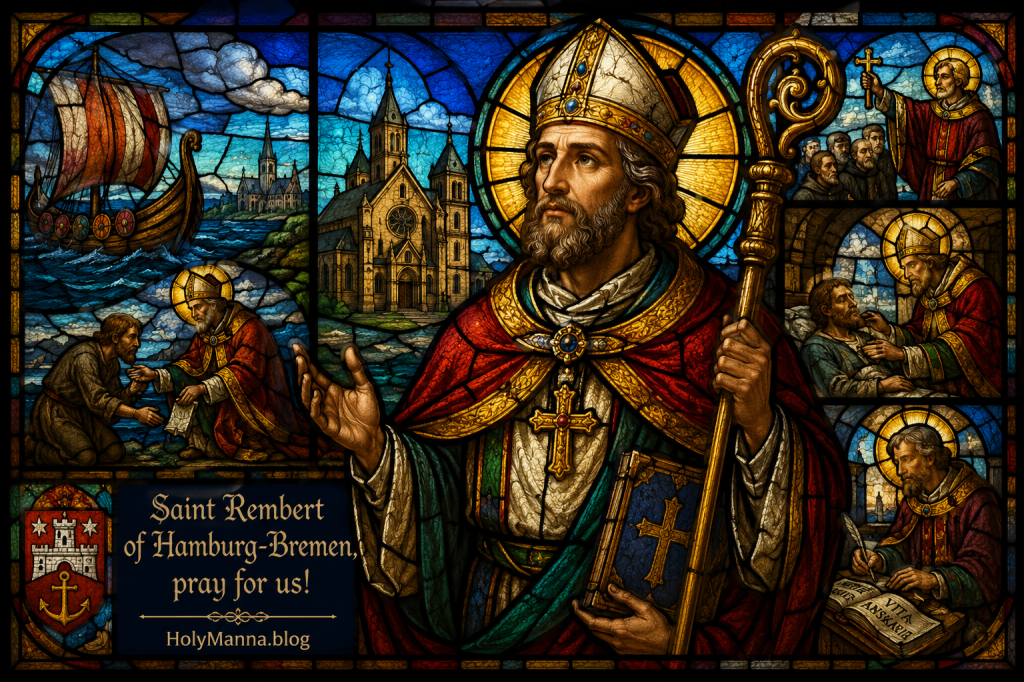
A Shepherd for the Edge of the Christian World
Saint Rembert of Hamburg-Bremen was a ninth-century Benedictine monk, missionary bishop, writer, and faithful successor of Saint Ansgar, the great “Apostle of the North.” He lived during one of the most dangerous periods in northern Europe, when Viking raids, political instability, and fragile Christian communities made missionary work difficult, costly, and sometimes terrifying.
Rembert is remembered in Catholic tradition as the bishop who carried Saint Ansgar’s mission forward after Ansgar’s death. He preached the Gospel toward Denmark, Sweden, Friesland, and northern Germany. He cared for the poor and sick. He ransomed Christian captives taken during the Norman invasions. He founded a monastery near Bremen. He also wrote Vita Anskarii, the Life of Saint Ansgar, one of the most important sources for the early Catholic mission to Scandinavia.
Some later devotional traditions invoke Saint Rembert as a patron of the blind, those suffering from eye diseases, and protection against storms at sea. This patronage is connected to miracle stories attributed to him, though it is not consistently listed in the major Catholic reference sources. Because of that, it is best presented as a devotional tradition rather than a universally established patronage.
Saint Rembert’s life matters because he shows the Church that holiness is not only found in beginning great works. Sometimes holiness is found in preserving them when everything becomes harder.
The Young Monk Saint Ansgar Chose
Saint Rembert was probably born around the year 830 near Bruges in Flanders, though some historical details about his origin remain uncertain. Some sources connect him with a Flemish background, while others leave open the possibility that his family background may have had Norman or Danish connections. What is more certain is that he was educated at the monastery of Turholt, also called Torhout, near Bruges.
It was there that Saint Ansgar noticed him.
Ansgar had already become one of the great missionary figures of the Church. He had labored to bring the Gospel to northern peoples, especially in Denmark and Sweden. When he met Rembert, he saw something in him that was steady, humble, intelligent, and spiritually serious. Rembert became Ansgar’s companion, disciple, and spiritual son.
There is no dramatic conversion story preserved from Rembert’s youth. His life seems to have been shaped less by one sudden moment and more by faithful formation. He was formed in monastic discipline, trained under Saint Ansgar, and gradually prepared for a mission much larger than himself.
Near the end of his life, Saint Ansgar recommended Rembert as his successor. Butler’s account preserves a famous line attributed to Ansgar about him: “Rembert is more worthy to be archbishop, than I to discharge the office of his deacon.”
That is one of the most beautiful things said about Saint Rembert. It shows that Ansgar did not choose him because he was flashy, powerful, or politically useful. He chose him because he trusted his soul.
After Saint Ansgar died in 865, Rembert was chosen to succeed him as archbishop of Hamburg-Bremen. Pope Nicholas I confirmed him by sending him the pallium. According to Catholic tradition, Rembert also became formally connected with the monastery of Corvey after his consecration, in keeping with Ansgar’s wishes.
The Church teaches in The Catechism of the Catholic Church that “the Church on earth is by her nature missionary” CCC 849. Saint Rembert’s whole life becomes a witness to that truth. He inherited a mission that was fragile, dangerous, and uncertain, but he did not walk away from it.
A Missionary Bishop in a Violent Age
As archbishop of Hamburg-Bremen, Rembert inherited one of the most challenging missionary responsibilities in the Western Church. Hamburg-Bremen was not only a local diocese. It was also a missionary center for northern Europe. Its concern stretched toward Denmark, Sweden, Friesland, the Slavic peoples, and the wider northern frontier.
This was not easy work. Christian communities in the region were vulnerable. The Viking Age brought repeated raids, kidnappings, destruction, and fear. The Church’s northern mission was still young, and many of the people Rembert served were either newly converted, only partially evangelized, or surrounded by pagan culture.
Rembert’s greatness was not that he made everything easy. He did not. His greatness was that he remained faithful when the mission became hard.
He traveled as a missionary, encouraged Christian communities, supported evangelization among the northern peoples, and continued the work begun by Saint Ansgar. Catholic sources connect him with missionary efforts in West Friesland, Denmark, and Sweden, though the exact details of his journeys are not always easy to verify.
He also cared for the poor and sick. He founded a monastery at Bücken near Bremen, helping strengthen the spiritual and cultural foundations of the Church in the region. Later devotional accounts also say he maintained the poorhouse in Bremen that Saint Ansgar had established.
This balance is important. Rembert was not only a preacher. He was not only an administrator. He was a father to the poor, a defender of captives, a writer for the Church, and a shepherd to people living in fear.
The Church teaches in The Catechism that works of mercy are charitable actions by which Christians come to the aid of neighbors in spiritual and bodily need, CCC 2447. Rembert lived this with remarkable seriousness. His love for souls was not theoretical. It had hands, feet, money, courage, and sacrifice.
One of the most moving stories from his life says that he sold sacred vessels to ransom Christians who had been taken captive by the Normans. Another story says he gave away his own riding horse to ransom a young woman captured by the Slavs.
That detail is powerful. A bishop’s horse in the ninth century was not a luxury. It was transportation, pastoral access, and missionary mobility. Sacred vessels were also precious because they were used in divine worship. Rembert’s charity cost him something real.
He understood that love of God and love of neighbor are never enemies. The same bishop who revered the sacred mysteries also saw Christ in the captive, the poor, the sick, and the threatened.
Several miracle stories are attributed to Saint Rembert in later hagiographical tradition. These include stories that he calmed storms at sea, restored sight to the blind, and performed an exorcism connected with the son of Louis the German. These stories are part of later devotional tradition and cannot all be verified with historical certainty. Still, they show how Catholics remembered him: as a holy bishop whose prayer brought peace, healing, and deliverance.
The Bishop Who Faced Raiders, Captivity, and Fear
Saint Rembert was not a martyr, but he lived in a world where faithfulness required courage. His ministry unfolded during the Norman invasions, when Viking raiders attacked Christian settlements and carried people away as captives.
The current Roman Martyrology remembers him especially for caring for captives during these invasions. That detail should not be overlooked. In an age of violence, Rembert did not respond only with words. He used what he had to free people.
Catholic tradition also remembers him as helping defend Christian communities. One account says that in 884, Rembert helped put Norman marauders to flight on the coast of Friesland. Because of this, he was later held in special veneration there.
There is something deeply Catholic about this part of his life. Rembert was not looking for conflict, but he also did not abandon his people when danger came. He was a shepherd, and a shepherd does not run when wolves come near the flock.
Another surprising story connected with Rembert comes from the medieval missionary world. A tradition says that Rembert asked Ratramnus of Corbie about the so-called cynocephali, legendary “dog-headed men” mentioned in medieval accounts. The question was whether such beings, if they were rational and human, should be evangelized.
To modern ears, that sounds strange. But the deeper point is beautiful. Rembert’s missionary concern was not, “Are these people familiar?” or, “Are these people useful?” His concern was whether they were human beings called to salvation in Christ.
That instinct is deeply Catholic. The Gospel is not for one tribe, one language, one class, or one continent. Christ sends His Church to all nations. The dignity of every human person comes from being created by God and called to communion with Him.
Rembert’s life reminds Catholics that missionary love must always be bigger than fear.
The Saint Who Preserved Another Saint’s Story
One of Saint Rembert’s greatest legacies is that he wrote Vita Anskarii, the Life of Saint Ansgar.
This matters more than it may seem at first. Without Rembert’s writing, the Church would know much less about Saint Ansgar and the early Catholic mission to Scandinavia. Rembert was not only continuing Ansgar’s mission in practice. He was preserving it for future generations.
A saint’s biography is not just a record of events. In Catholic tradition, the life of a saint becomes a witness. It teaches. It encourages. It shows the Gospel lived in flesh and blood.
Rembert understood that memory matters. If the Church forgets the saints, she forgets what grace can do in ordinary human beings. By writing Ansgar’s life, Rembert gave the Church a spiritual inheritance.
No widely verified personal quotation from Saint Rembert himself is consistently preserved in major Catholic sources. His most important surviving voice is found in the work he wrote, Vita Anskarii. Through that work, Rembert did what faithful Catholics are still called to do today. He handed on a holy story so that others might believe more deeply.
A Legacy That Outlived the Mission Field
Saint Rembert died at Bremen on June 11, 888. He was buried near the cathedral church in Bremen. Near the end of his life, a foot ailment appears to have limited his activity, and he accepted Adalgar of Bremen as coadjutor. Adalgar later succeeded him.
After his death, Rembert continued to be remembered as a missionary bishop, defender of Christian captives, and faithful successor of Saint Ansgar. His feast is commemorated on June 11 in the current Roman Martyrology. Some older Catholic sources also list February 4, traditionally connected with his election or commemoration.
His impact was especially remembered in northern Europe, particularly in Bremen, Friesland, and places connected with his early life near Torhout. In Friesland, his veneration was connected to the tradition that he helped defend Christians against Norman raiders in 884.
Later devotional traditions also remembered miracle stories connected with him. These include the healing of blindness, protection during storms at sea, and an exorcism. These miracle stories cannot be fully verified from the more cautious historical sources, but they remain part of the devotional memory attached to him.
No clearly documented posthumous miracle account appears consistently in the major Catholic reference sources consulted. Still, his legacy after death was real. His written life of Saint Ansgar shaped how later generations understood the northern mission. His reputation for mercy toward captives preserved the memory of a bishop who saw human suffering and did not look away. His name remained attached to Catholic life in regions connected to his ministry, especially in the Low Countries and northern Germany.
Saint Rembert’s impact was not the impact of a conqueror. It was the impact of a faithful steward. He received a mission. He protected it. He strengthened it. He passed it on.
The Grace of Faithful Continuation
Saint Rembert is a saint for anyone who has ever had to continue something difficult.
He did not begin the northern mission. He inherited it. He did not step into ease. He stepped into danger. He did not receive a comfortable Church, a stable culture, or a peaceful assignment. He received a fragile mission surrounded by raids, fear, captivity, poverty, and uncertainty.
Yet he stayed faithful.
That is why his life feels so relevant. Many people want to start something meaningful, but fewer are willing to continue it when the excitement fades. Many want the glory of beginning, but holiness often comes through the hidden work of persevering.
Saint Rembert teaches that Catholic faithfulness is not always dramatic. Sometimes it looks like caring for the poor. Sometimes it looks like writing down the story of someone holier so others can learn from it. Sometimes it looks like using personal possessions to rescue someone in danger. Sometimes it looks like defending the vulnerable when the world becomes violent. Sometimes it looks like carrying forward a mission someone else began.
The Church teaches in The Catechism that charity is the greatest social commandment and that it respects others and their rights, CCC 1889. Rembert shows that charity is not weakness. Charity can ransom captives. Charity can protect the poor. Charity can preach to distant peoples. Charity can preserve the memory of the saints. Charity can keep a mission alive when history becomes brutal.
Where is God asking for faithful continuation instead of quick success?
Who needs to be ransomed today through mercy, patience, prayer, forgiveness, or practical help?
What holy story needs to be preserved so the next generation can believe?
Saint Rembert reminds the Church that not every saint is called to be the first. Some are called to be the faithful second. Some are called to guard what another saint planted. Some are called to keep the lamp burning through the storm.
That kind of holiness may not always look impressive, but it is precious in the eyes of God.
Engage With Us!
Share your thoughts and reflections in the comments below. Saint Rembert’s life gives a beautiful witness to perseverance, charity, and quiet courage, especially when the mission becomes difficult.
- Where in your life is God asking you to remain faithful, even without quick results?
- How can Saint Rembert’s love for captives inspire you to help someone who feels trapped, forgotten, or spiritually discouraged?
- What does it mean to continue someone else’s good work with humility and love?
- How can you help preserve the faith for the next generation in your family, parish, or community?
May Saint Rembert’s example encourage every Catholic heart to stay faithful to the mission God has given them. Live with courage. Serve with mercy. Protect the vulnerable. Preserve what is holy. And in all things, do everything with the love and mercy Jesus taught us.
Saint Rembert of Hamburg-Bremen, pray for us!
Follow us on YouTube, TikTok, Instagram and Facebook for more insights and reflections on living a faith-filled life.


Leave a Reply