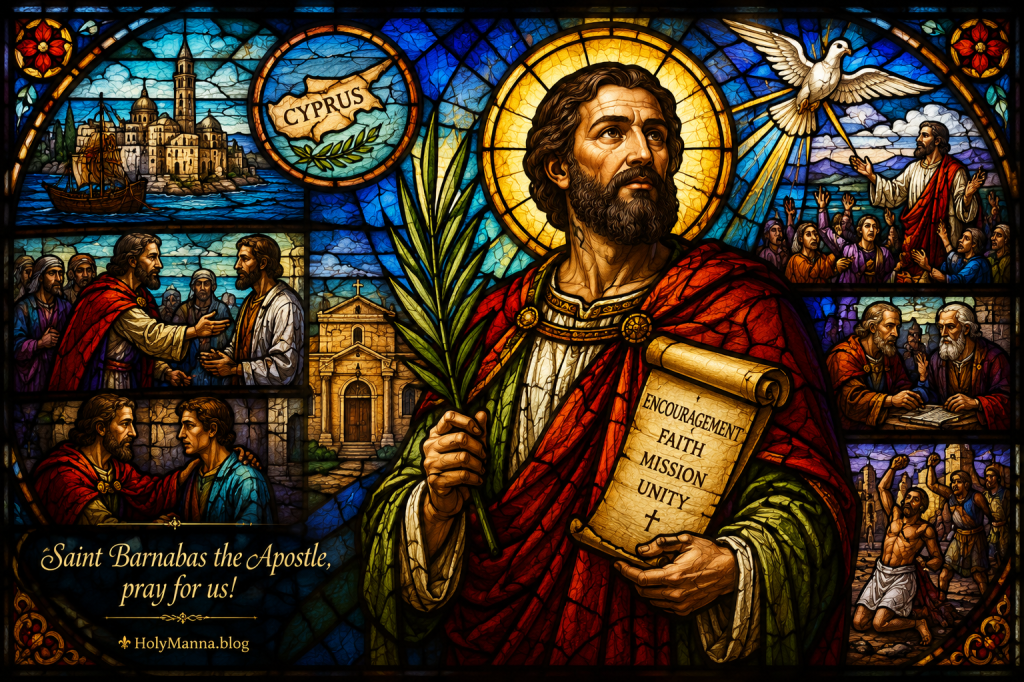
The Apostle Who Saw Grace Before Everyone Else Did
Saint Barnabas is one of the great hidden pillars of the early Church. He was not one of the Twelve Apostles chosen during the earthly ministry of Jesus, yet Sacred Scripture calls him an apostle, and the Catholic Church honors him as Saint Barnabas, Apostle. His feast day is celebrated on June 11, and he is especially venerated as the patron saint of Cyprus. Catholic devotional tradition also associates him with Antioch, peacemakers, peacekeeping missions, and protection against hailstorms.
Barnabas is most remembered as the “son of encouragement”, a name that perfectly describes his mission. He encouraged the early Christians with generosity. He encouraged Saint Paul when other believers feared him. He encouraged the Church in Antioch when Gentiles were coming to faith. He encouraged John Mark after failure. He encouraged the young Church to trust that the Gospel was truly meant for all nations.
His life matters because Barnabas shows that encouragement is not soft sentiment. Christian encouragement is courageous. It sees grace at work before the crowd is ready to believe it. It strengthens the weak, defends the outsider, restores the fallen, and sends others into mission.
The Catechism of the Catholic Church teaches that the Church is missionary by her very nature because she receives her mission from Christ and the Holy Spirit. Barnabas lived that truth with his whole life. He was sent, he preached, he suffered, he reconciled, and according to Catholic tradition, he sealed his witness with martyrdom.
A Levite from Cyprus with an Open Hand
Saint Barnabas was born on the island of Cyprus into a Jewish family. His original name was Joseph, and Acts of the Apostles tells us that he was a Levite. This means he belonged to the tribe traditionally associated with service in the worship of Israel.
His first appearance in Scripture is simple, but powerful. In the earliest Christian community in Jerusalem, believers cared for one another with striking generosity. Those who had property sold it so that the needs of the poor could be met. Barnabas did exactly that. He sold a field and brought the money to the Apostles.
Scripture says, “Joseph, also named by the apostles Barnabas, which is translated son of encouragement, a Levite, a Cypriot by birth, sold a piece of property that he owned, then brought the money and put it at the feet of the apostles” (Acts 4:36-37).
That is where the story of Barnabas begins. Not with a public speech. Not with a miracle. Not with applause. It begins with a man quietly giving what he had for the good of the Church.
The Catechism of the Catholic Church teaches that in the communion of saints, “Everything the true Christian has is to be regarded as a good possessed in common with everyone else” (CCC 952). Barnabas lived that teaching before it was written in a catechism. He understood that Christian life is not only about believing rightly. It is also about loving generously.
Some later traditions say Barnabas may have been one of the seventy-two disciples sent out by Jesus in The Gospel of Luke. Other traditions say he may have studied under the famous rabbi Gamaliel, possibly alongside Saul of Tarsus. These are interesting stories, but they cannot be verified with certainty. The most reliable foundation for his life remains Scripture, and Scripture already gives a beautiful portrait of him as generous, trusted, Spirit-filled, and deeply missionary.
The Man Who Believed Saul Could Become Paul
One of Barnabas’s most important moments came after the conversion of Saul of Tarsus.
Saul had persecuted the Church. He had been present at the death of Saint Stephen. He had dragged Christians from their homes. So when Saul later tried to join the disciples in Jerusalem, many were afraid of him. They did not believe that he had truly become a disciple.
Barnabas stepped into that fear with courage.
Acts of the Apostles tells us that Barnabas took Saul to the Apostles and explained how Saul had seen the Lord, how the Lord had spoken to him, and how Saul had preached boldly in Damascus in the name of Jesus.
That one act changed Christian history.
Before the Church widely trusted Saul, Barnabas did. Before the former persecutor became known throughout the world as Saint Paul, Barnabas saw the grace of God at work in him. Barnabas became the bridge between Saul’s painful past and Paul’s apostolic future.
This is one of the most beautiful lessons of Barnabas’s life. He did not deny Saul’s past. He simply believed that Christ’s mercy was greater than Saul’s past.
Who today is being remembered only for what they used to be, instead of what God is making them now?
Antioch and the Birthplace of the Christian Name
Barnabas was later sent by the Church in Jerusalem to Antioch. This was a major moment in early Christian history. Gentiles were coming to faith in Jesus, and the Church needed a wise, faithful, Spirit-filled man to discern what was happening.
Barnabas arrived and saw the grace of God. He did not respond with suspicion. He rejoiced.
Scripture describes him with one of the most beautiful lines in the New Testament: “He was a good man, filled with the holy Spirit and faith” (Acts 11:24).
Barnabas encouraged the believers in Antioch to remain faithful to the Lord. Then he went to Tarsus to find Saul and bring him into the work. Together, Barnabas and Saul taught the Church in Antioch for a full year.
It was also in Antioch that the disciples were first called Christians.
That detail is easy to pass over, but it is remarkable. Barnabas helped shepherd the community where the name “Christian” first became attached to the followers of Jesus. He stood at the crossroads where Jewish and Gentile believers were becoming one visible people in Christ.
The Catechism of the Catholic Church teaches that the Church is catholic because Christ is present in her and because she has been sent by Christ to the whole human race. Barnabas helped the Church live that catholicity in real time. He welcomed Gentiles, strengthened them, taught them, and helped defend their place in the household of God.
A Missionary Sent by the Holy Spirit
In Antioch, Barnabas was counted among the prophets and teachers of the Church. While the community was worshiping and fasting, the Holy Spirit said, “Set apart for me Barnabas and Saul for the work to which I have called them” (Acts 13:2).
After prayer and fasting, the Church laid hands on them and sent them out.
This moment reveals something deeply Catholic. Barnabas did not invent his own mission. He was sent by the Holy Spirit through the praying Church. His apostolic work was not independent ambition. It was ecclesial mission.
Barnabas and Saul first traveled to Cyprus, Barnabas’s homeland. They preached in Salamis and then crossed the island to Paphos. There they encountered a Roman proconsul named Sergius Paulus and a false prophet named Elymas, also called Bar-Jesus. Elymas tried to turn the proconsul away from the faith. Saint Paul rebuked him, and Elymas was struck blind for a time. The proconsul believed, astonished by the teaching of the Lord.
This miracle is directly connected in Scripture to Paul’s rebuke, but Barnabas was part of that apostolic mission. The Gospel was being preached in power, and Barnabas was there as one of the men sent by the Holy Spirit.
From Cyprus, Barnabas and Paul continued through Asia Minor, preaching in places such as Pisidian Antioch, Iconium, Lystra, and Derbe. Their mission brought conversions, opposition, threats, and suffering. In Iconium, Scripture says the Lord confirmed their preaching with signs and wonders.
Barnabas was not simply an encourager in private conversation. He was a missionary who carried the Gospel into difficult and dangerous places.
When the Crowd Mistook Him for Zeus
One of the most surprising stories about Barnabas happened in Lystra.
There, Paul healed a man who had been crippled from birth. The crowd misunderstood the miracle completely. Instead of recognizing the power of Christ, they thought pagan gods had come down in human form. They called Barnabas Zeus and Paul Hermes, because Paul was the chief speaker.
The priest of Zeus even brought oxen and garlands to offer sacrifice to them.
Barnabas and Paul were horrified. They tore their garments and rushed into the crowd, refusing the false worship. Their words were direct and humble: “We are of the same nature as you, human beings” (Acts 14:15).
This is the closest reliable quotation associated with Barnabas, though it is spoken together with Paul. There are no securely verified personal sayings of Saint Barnabas outside Scripture. Still, this moment tells us plenty about his heart.
The crowd was ready to treat him like a god, and Barnabas wanted nothing to do with it. He rejected false glory immediately. He pointed the people away from himself and toward the living God.
That is the mark of a true saint. Barnabas did not use spiritual power to make himself important. He used every moment to lead people back to the Lord.
The Defender of Gentile Converts
Barnabas played a major role in the Council of Jerusalem, described in Acts of the Apostles 15.
The early Church was facing a serious question. Did Gentile converts need to be circumcised and observe the Mosaic law in order to be saved? Some said yes. Paul and Barnabas strongly opposed this teaching.
They went to Jerusalem, where the Apostles and elders gathered to discern the matter. Barnabas and Paul testified about the signs and wonders God had worked among the Gentiles through their ministry.
The Council, under the guidance of the Holy Spirit, did not impose the full Mosaic law on Gentile Christians. The letter sent from Jerusalem described Barnabas and Paul as beloved men who had dedicated their lives to the name of Jesus Christ.
This was a defining moment in Christian history. Barnabas helped defend the truth that salvation comes through the grace of the Lord Jesus Christ. Gentile believers were not second-class members of the Church. They were brothers and sisters in Christ.
This moment also shows an early Catholic pattern of authority and discernment. The Church faced a doctrinal and pastoral crisis, gathered in council, listened to testimony, and acted under apostolic authority with confidence in the Holy Spirit.
Barnabas stood right in the middle of that moment.
A Saint Who Still Needed Grace
Saint Barnabas was holy, but he was not imaginary. His life also included weakness and tension.
In The Letter to the Galatians, Saint Paul says that Barnabas was temporarily influenced when some Jewish Christians withdrew from table fellowship with Gentile believers. Paul writes that “even Barnabas” was carried away by their behavior (Galatians 2:13).
That phrase is striking. Barnabas had defended Gentile converts, preached among them, and rejoiced in their conversion. Yet even Barnabas could feel pressure. Even Barnabas could be shaken.
This does not erase his sanctity. It makes his sanctity more real.
The saints are not people who never needed correction. They are people who kept walking with Christ. Barnabas reminds Catholics that holiness does not mean having no weaknesses. Holiness means letting grace keep forming the heart, even after failure, embarrassment, or correction.
The Disagreement with Paul and the Second Chance for Mark
Another famous hardship in Barnabas’s life came through a disagreement with Saint Paul.
After the Council of Jerusalem, Paul wanted to revisit the communities they had evangelized. Barnabas wanted to take John Mark with them. Paul objected because Mark had left them during an earlier missionary journey. The disagreement became sharp. Paul chose Silas and went one direction. Barnabas took Mark and sailed to Cyprus.
At first glance, this seems like a sad division between two great saints. And it was painful. But there is also something deeply beautiful in Barnabas’s choice.
Barnabas had once stood up for Paul when the Church was afraid of him. Now he stood up for Mark when Paul was not ready to trust him again.
Barnabas believed in second chances.
Later in Scripture, Paul speaks positively of Mark and asks that he be welcomed. Catholic tradition also associates Mark with The Gospel of Mark. That means Barnabas’s patience may have helped restore and strengthen the man later remembered as one of the four Evangelists.
Encouragement is not pretending failure does not matter. True Christian encouragement believes that failure does not have to be the final chapter.
The Final Witness in Cyprus
After Barnabas sailed to Cyprus with Mark, Scripture becomes mostly silent about his final years. Paul still mentions Barnabas in The First Letter to the Corinthians, which suggests that Barnabas remained known as an apostolic laborer and that the relationship between Paul and Barnabas was not necessarily permanently broken.
Catholic tradition holds that Barnabas returned to Cyprus and continued preaching the Gospel. He is honored as the apostolic father of the Church in Cyprus.
According to venerable tradition, Barnabas was martyred at Salamis in Cyprus, probably around A.D. 61 or 62. The exact details are uncertain because they come from later accounts rather than Scripture. Some traditions say he was stoned by hostile opponents. Others say he was tortured, burned, or killed by a mob. Some accounts say John Mark buried his body.
What the Church does preserve with confidence is his memory as an apostle and martyr. The Roman Martyrology honors him as one who was born in Cyprus, labored with Paul in the mission to the Gentiles, returned to Cyprus, and crowned his apostolic work with martyrdom.
His martyrdom matters because it completes the pattern of his life. Barnabas encouraged the Church not only with words, money, and mission, but with the gift of his own life.
Relics, Legends, and the Memory of Cyprus
One of the most famous posthumous traditions about Saint Barnabas concerns the discovery of his relics centuries after his death.
According to later tradition, during the reign of Emperor Zeno in the fifth century, Saint Barnabas appeared to Archbishop Anthemios of Cyprus and revealed the location of his burial. His body was then discovered with a copy of The Gospel of Matthew, which tradition says had been copied by Barnabas’s own hand.
This story became deeply important for the Christians of Cyprus. It strengthened devotion to Barnabas as the island’s apostolic patron and helped preserve the memory of Cyprus as a land evangelized by one of the great missionaries of the New Testament.
Because this story comes from later tradition, it cannot be verified in every detail. Still, it remains an important part of Catholic and Cypriot Christian memory.
The traditional site associated with Saint Barnabas is near Salamis, close to modern Famagusta in Cyprus, where a monastery and shrine have long been connected with his memory. Pilgrims and Christians in Cyprus have honored him for centuries as the island’s great apostolic father.
There is also a later tradition connecting Barnabas with Milan, claiming that he preached there and helped establish the Christian community. Catholic scholarship generally treats this as a late and historically uncertain legend. It should be mentioned as a tradition, not as a verified fact.
Another important clarification concerns writings attributed to Barnabas. The ancient Epistle of Barnabas was known in early Christianity, but Catholic scholarship does not securely attribute it to Saint Barnabas the Apostle. The so-called Gospel of Barnabas is not an authentic apostolic Gospel and should not be confused with the canonical Gospels or with the real Saint Barnabas. Some early writers also speculated that Barnabas may have written The Letter to the Hebrews, but that attribution is not certain.
So Saint Barnabas did not leave behind a verified book or a collection of personal quotations. His legacy is written instead in the life of the Church.
His legacy is Paul welcomed.
His legacy is Mark restored.
His legacy is Gentiles defended.
His legacy is Cyprus evangelized.
His legacy is the Church encouraged.
The Saint of Encouragement for a Tired Church
Saint Barnabas is remembered because he strengthened people for the mission of Christ.
He encouraged the poor through generosity. He encouraged Paul through trust. He encouraged Antioch through teaching. He encouraged Gentile converts through defense. He encouraged Mark through mercy. He encouraged Cyprus through evangelization and, according to tradition, through martyrdom.
That kind of encouragement is desperately needed.
Many people today hear plenty of criticism. They hear reminders of their failures. They hear why they are not qualified, not ready, not holy enough, not useful enough, and not worth the risk.
Barnabas speaks a different word.
He does not say sin is harmless. He does not say failure is meaningless. He does not say truth should be softened. Instead, he shows that grace can be trusted. He shows that the Holy Spirit can transform a persecutor into an apostle, a failed missionary into an evangelist, and a young Gentile community into a people first called Christian.
The Catechism of the Catholic Church teaches that the apostolate of the Church flows from charity and that all the faithful share in the mission of Christ according to their state in life. Barnabas shows what that looks like in practice. Not everyone will preach across the Mediterranean. Not everyone will stand before councils. Not everyone will die as a martyr. But every Christian can encourage someone toward holiness.
A Catholic can be a Barnabas in a parish, in a family, in a workplace, in a friendship, in a classroom, or in a difficult conversation.
Sometimes encouragement looks like giving generously.
Sometimes it looks like defending someone being judged unfairly.
Sometimes it looks like inviting a gifted person into mission.
Sometimes it looks like telling a person who failed, “This is not the end of your story.”
Sometimes it looks like standing firm when the Gospel is misunderstood.
Saint Barnabas reminds the Church that encouragement is not optional niceness. It is a work of love.
Who needs a Barnabas today?
Who needs someone to see grace in them before everyone else sees it?
Where is God asking for courage, generosity, reconciliation, or mercy?
Engage with Us!
Share your thoughts and reflections in the comments below. Saint Barnabas gives Catholics a powerful example of encouragement, courage, generosity, and second chances. His story invites every believer to ask how the Holy Spirit may be calling them to strengthen someone else in faith.
- Where in your life is God asking you to become a “son” or “daughter of encouragement” for someone else?
- Is there someone whose past you have remembered more than their conversion, growth, or repentance?
- What part of Saint Barnabas’s life challenges you most: his generosity, his trust in Paul, his defense of Gentile converts, or his mercy toward Mark?
- How can you encourage someone this week in a way that leads them closer to Christ rather than simply making them feel better?
- Where do you need to believe again that God can bring fruit from failure?
Saint Barnabas teaches that a life of faith does not have to be loud to be powerful. The Church still remembers the man who encouraged, defended, restored, preached, and gave everything for Christ. May his example inspire every Christian to live with courage, speak with mercy, strengthen the weary, and do everything with the love and mercy Jesus taught us.
Saint Barnabas the Apostle, pray for us!
Follow us on YouTube, TikTok, Instagram and Facebook for more insights and reflections on living a faith-filled life.


Leave a Reply