Memorial of Saint Barnabas, Apostle – Lectionary: 580/362
The Heart That Can Be Sent
Grace is often easiest to recognize in public miracles, but today’s readings invite the faithful to notice a quieter miracle: a heart made ready for mission through charity, reconciliation, and obedience to the Holy Spirit.
On the Memorial of Saint Barnabas, Apostle, the Church gives a portrait of Christianity spreading from the inside out. In The Acts of the Apostles, Barnabas arrives in Antioch and sees the grace of God at work among new believers. He does not respond with suspicion, jealousy, or control. He rejoices, encourages them to remain faithful, and then goes looking for Saul, the future Saint Paul, so the mission can grow. This is apostolic love in action. Barnabas shows that the Gospel does not spread through ego, resentment, or rivalry. It spreads through saints who can recognize grace, strengthen others, and make room for God’s work in someone else.
Antioch was one of the great crossroads of the ancient world, filled with different peoples, cultures, languages, and beliefs. It was there that the disciples were first called Christians, a name that marked them as people belonging to Christ. That matters deeply. The Christian identity was born in a missionary setting, in a community learning how to live as one family in Christ while being sent to the nations. This is why Psalm 98 fits so beautifully: “All the ends of the earth have seen the victory of our God.” The salvation promised to Israel is now being proclaimed to the world, and the Church is learning to sing a new song in every land.
Yet The Gospel of Matthew reminds every disciple that mission cannot be separated from conversion of heart. Jesus does not allow His followers to settle for a righteousness that only looks holy from the outside. He goes beneath the commandment against killing and exposes the anger, contempt, and bitterness that wound communion long before hands commit violence. His words are direct: “Go first and be reconciled with your brother, and then come and offer your gift.” Worship at the altar and charity toward one’s neighbor belong together.
This is the central theme tying the readings together: the Church is sent to announce salvation to the nations, but the missionary heart must first be purified by charity. Barnabas encourages, the psalm sings, and Jesus reconciles. Together, they show that the Christian life is not built on religious appearances, private grudges, or spiritual ambition. It is built on communion with Christ, love for the Church, peace with one’s brother, and openness to the Holy Spirit.
Before diving into each passage, the question becomes personal: Is the heart ready to recognize grace, seek reconciliation, and be sent where the Holy Spirit calls?
First Reading – Acts 11:21-26; 13:1-3
The Son of Encouragement and the Church That Learned to Be Sent
The first reading brings the faithful into one of the most important turning points in the early Church. The Gospel has begun to move beyond Jerusalem and into Antioch, one of the major cities of the Roman Empire. Antioch was a busy, diverse, and culturally mixed city, filled with Gentiles, Jews, merchants, officials, travelers, and people shaped by many religious traditions. It was not the kind of place where anyone would expect a neat, quiet, predictable Christian community to grow.
Yet that is exactly where grace begins to bloom.
The Church in Jerusalem hears that many people in Antioch are turning to the Lord, so they send Barnabas. This choice says something beautiful about the early Church. Barnabas is not sent as a suspicious inspector looking for problems. He is sent as a faithful apostle who can discern grace, encourage new believers, and strengthen the Church in unity. His name means “son of encouragement,” and in today’s reading, he lives that name fully.
This reading fits perfectly into today’s central theme: the Christian mission begins in a heart free enough to encourage, forgive, and be sent. Barnabas shows the missionary heart from the outside. He rejoices when he sees grace, makes room for Saul, and accepts the call of the Holy Spirit. Later, The Gospel of Matthew will show the same truth from the inside. A disciple cannot be sent in love while holding on to anger, rivalry, or contempt. Mission begins with a heart surrendered to God.
Acts 11:21-26; 13:1-3 – New American Bible (Revised Edition)
21 The hand of the Lord was with them and a great number who believed turned to the Lord. 22 The news about them reached the ears of the church in Jerusalem, and they sent Barnabas [to go] to Antioch. 23 When he arrived and saw the grace of God, he rejoiced and encouraged them all to remain faithful to the Lord in firmness of heart, 24 for he was a good man, filled with the holy Spirit and faith. And a large number of people was added to the Lord. 25 Then he went to Tarsus to look for Saul, 26 and when he had found him he brought him to Antioch. For a whole year they met with the church and taught a large number of people, and it was in Antioch that the disciples were first called Christians.
1 Now there were in the church at Antioch prophets and teachers: Barnabas, Symeon who was called Niger, Lucius of Cyrene, Manaen who was a close friend of Herod the tetrarch, and Saul. 2 While they were worshiping the Lord and fasting, the holy Spirit said, “Set apart for me Barnabas and Saul for the work to which I have called them.” 3 Then, completing their fasting and prayer, they laid hands on them and sent them off.
Detailed Exegesis
Verse 21: “The hand of the Lord was with them and a great number who believed turned to the Lord.”
This verse gives the real explanation for the growth of the Church in Antioch. The success of the Gospel is not credited first to human strategy, personality, or clever organization. Scripture says that “the hand of the Lord was with them.” This phrase recalls the Old Testament language of God’s power, protection, and saving action. The same Lord who delivered Israel now strengthens the apostolic Church.
The conversion of “a great number” shows that the Gospel is becoming visibly fruitful among new peoples. This is not merely private spirituality. It is ecclesial growth. People are turning to the Lord, which means they are being drawn into faith in Jesus Christ and into communion with His Church. The Catechism of the Catholic Church teaches that the Church’s mission flows from Christ Himself: “The Church, in Christ, is like a sacrament, a sign and instrument, that is, of communion with God and of unity among all men.” CCC 775 Antioch becomes one of those places where communion with God begins to gather people from many backgrounds into one Body.
Verse 22: “The news about them reached the ears of the church in Jerusalem, and they sent Barnabas [to go] to Antioch.”
Jerusalem remains the mother Church, the place where the apostles first received the Holy Spirit at Pentecost and where the earliest Christian community was formed. When news reaches Jerusalem, the response is not indifference. The Church sends Barnabas, which shows apostolic care and pastoral responsibility.
Barnabas is the right man for the moment. He had already shown generosity by selling property and placing the proceeds at the apostles’ feet in Acts 4:36-37. He had also helped Saul be accepted by the disciples when many were still afraid of him in Acts 9:26-27. Barnabas is a man of trust, encouragement, and discernment. He knows how to recognize conversion without ignoring the need for formation.
This verse also shows that missionary expansion does not happen apart from the Church. Antioch is growing, but it remains connected to Jerusalem. Catholic mission is never detached from apostolic communion. The Church is sent outward, but she remains one Body.
Verse 23: “When he arrived and saw the grace of God, he rejoiced and encouraged them all to remain faithful to the Lord in firmness of heart.”
This verse reveals the beauty of Barnabas’s soul. He arrives and “saw the grace of God.” That is a deeply Catholic way of seeing. Barnabas does not look first for what is messy, unfamiliar, or imperfect. He sees grace at work.
He rejoices because grace is not his possession. It belongs to God. A jealous person would resent the success of others. A suspicious person would only look for danger. A controlling person would try to take over. Barnabas rejoices. His joy shows that his heart is purified enough to celebrate the work of God in others.
Then he encourages them to remain faithful. This is important. Christian encouragement is not sentimental approval. Barnabas does not simply tell the Christians in Antioch that they are doing great and leave them alone. He strengthens them in perseverance. He urges them to remain close to the Lord with “firmness of heart.” In other words, grace has begun a work in them, but they must remain steadfast.
This is a powerful lesson for daily discipleship. The beginning of faith is beautiful, but perseverance is necessary. A person can be touched by grace, moved at Mass, inspired by prayer, or stirred by a retreat, but the heart must be strengthened to remain faithful when emotions fade and ordinary life returns.
Verse 24: “For he was a good man, filled with the holy Spirit and faith. And a large number of people was added to the Lord.”
Scripture does not call Barnabas “good” in a shallow way. His goodness is rooted in the Holy Spirit and faith. He is good because grace has shaped his character. He is steady, generous, discerning, humble, and available to God.
The fruit of this holiness is missionary growth: “a large number of people was added to the Lord.” Notice that the people are not merely added to an organization, a social movement, or a religious club. They are added to the Lord. The Church grows because souls are being joined to Christ.
This verse shows that personal holiness and evangelization belong together. The Church does not only need talented people. She needs Spirit-filled people. Barnabas is fruitful because he is faithful. He is able to encourage others because he is first filled with the Holy Spirit himself.
Verse 25: “Then he went to Tarsus to look for Saul.”
This short verse carries enormous weight. Barnabas realizes that the growing Church in Antioch needs strong teaching and formation, so he goes to find Saul. This is the Saul who once persecuted the Church. This is the Saul whom many Christians had feared. This is the Saul who will become Saint Paul, Apostle to the Gentiles.
Barnabas does something that only a humble disciple can do. He makes room for another person’s vocation. He does not treat Antioch as his personal territory. He does not cling to influence. He does not make the mission about himself. He goes looking for the man God has chosen.
This is encouragement at its highest level. Barnabas does not merely cheer people up. He helps call forth their mission. He sees what God may do through Saul and takes the risk of bringing him into the center of the Church’s life. In that sense, Barnabas becomes a bridge between Saul’s conversion and Paul’s apostolic mission.
Verse 26: “And when he had found him he brought him to Antioch. For a whole year they met with the church and taught a large number of people, and it was in Antioch that the disciples were first called Christians.”
Barnabas finds Saul and brings him to Antioch, where the two teach for a whole year. The growth of the Church requires more than initial enthusiasm. It requires doctrine, formation, worship, community, and perseverance. The early Christians need to be taught who Christ is, how to live in Him, and what it means to belong to His Body.
Then comes the famous line: “It was in Antioch that the disciples were first called Christians.” This name matters. The disciples are now publicly recognized as people who belong to Christ. Their identity is no longer hidden inside Judaism alone, nor is it merely a local movement. In a Gentile city, among diverse peoples, the followers of Jesus receive the name that will mark the Church across the centuries.
To be called Christian means to belong to Christ. It means that His name, His Cross, His teaching, His mercy, and His mission define the disciple. This moment in Antioch shows the Gospel becoming visible to the nations.
Verse 13:1: “Now there were in the church at Antioch prophets and teachers: Barnabas, Symeon who was called Niger, Lucius of Cyrene, Manaen who was a close friend of Herod the tetrarch, and Saul.”
This verse shows the maturity of the Church in Antioch. The community now has prophets and teachers, men gifted by the Holy Spirit for building up the Church. Their names also reveal the diversity of the Christian community. Barnabas comes from Cyprus. Saul comes from Tarsus. Lucius is connected with Cyrene in North Africa. Manaen has ties to the household of Herod the tetrarch. Symeon, called Niger, may indicate an African or dark-skinned background, though Scripture does not give every detail.
The point is clear. In Antioch, the Gospel is gathering people from different places, social levels, and histories into one Church. This is not modern diversity as a slogan. This is Catholicity in action. The Church is universal because Christ came to save all nations and gather all peoples into one communion.
This also connects beautifully with Psalm 98, where the psalmist proclaims: “All the ends of the earth have seen the victory of our God.” Psalm 98:3 Antioch becomes one of the places where that promise begins to take flesh.
Verse 13:2: “While they were worshiping the Lord and fasting, the holy Spirit said, ‘Set apart for me Barnabas and Saul for the work to which I have called them.’”
The missionary movement begins during worship and fasting. This is deeply important. The Church does not launch Barnabas and Saul because someone had a clever idea. The Holy Spirit speaks while the community is praying, fasting, and worshiping the Lord.
This is the Catholic pattern of mission. Before the Church is sent, the Church worships. Before the apostle preaches, the apostle listens. Before action, there is adoration. Before mission, there is surrender.
The Holy Spirit says, “Set apart for me Barnabas and Saul.” Their mission belongs to God. They are not self-appointed. They are chosen and sent. This protects Catholic mission from becoming ego-driven. The disciple does not invent his mission in isolation. He receives it in prayer and in communion with the Church.
Verse 13:3: “Then, completing their fasting and prayer, they laid hands on them and sent them off.”
The Church completes the fasting and prayer, then lays hands on Barnabas and Saul. The laying on of hands is a biblical gesture of blessing, commissioning, and invocation of the Holy Spirit. It shows that the mission is not merely personal enthusiasm. It is ecclesial sending.
Barnabas and Saul go out, but they do not go alone. They are sent by the Holy Spirit through the praying Church. This is apostolic mission. It is personal, but not private. It is Spirit-led, but not detached from the Church. It is bold, but not self-made.
This verse reminds the faithful that every authentic Catholic mission should be rooted in prayer, fasting, obedience, and communion. The Church does not bear lasting fruit by activism alone. She bears fruit when she listens to the Holy Spirit and sends disciples who have first been formed at the altar.
Teachings: The Apostolic Heart That Strengthens the Church
This reading teaches that the Church is missionary by nature. Antioch is not a side story in Christian history. It is one of the great launching points of the Gospel to the nations. From this community, Barnabas and Saul are sent into the wider world. The same Spirit who gathered believers in Jerusalem now moves the Church outward.
The Catechism of the Catholic Church teaches this clearly: “The whole Church is apostolic, in that she remains, through the successors of St. Peter and the other apostles, in communion of faith and life with her origin: and in that she is ‘sent out’ into the whole world. All members of the Church share in this mission, though in various ways. ‘The Christian vocation is, of its nature, a vocation to the apostolate as well.’ Indeed, we call an apostolate ‘every activity of the Mystical Body’ that aims ‘to spread the Kingdom of Christ over all the earth.’” CCC 863
Barnabas embodies this teaching. He remains connected to the apostolic Church in Jerusalem, but he is also sent outward to Antioch. He strengthens communion while encouraging mission. This is a deeply Catholic balance. The Church is never meant to become closed in on herself, but she also never abandons apostolic unity.
The Catechism continues: “Christ, sent by the Father, is the source of the Church’s whole apostolate; thus the fruitfulness of apostolate for ordained ministers as well as for lay people clearly depends on their vital union with Christ. In keeping with their vocations, the demands of the times, and the various gifts of the Holy Spirit, the apostolate assumes the most varied forms. But charity, drawn from the Eucharist above all, is always ‘as it were, the soul of the whole apostolate.’” CCC 864
That sentence explains Barnabas beautifully. His apostolate is fruitful because it is filled with charity. He does not compete with Saul. He does not resent Antioch. He does not control the mission. He serves it. He strengthens others because he is united to Christ.
The Catechism also teaches that the Holy Spirit prepares and guides the Church’s mission: “The Holy Spirit is the protagonist, ‘the principal agent of the whole of the Church’s mission.’ It is he who leads the Church on her missionary paths.” CCC 852
That is exactly what happens in Antioch. The Holy Spirit speaks while the Church worships and fasts. Barnabas and Saul are not simply choosing a career path. They are being set apart for the work of God.
Saint Barnabas also teaches the holiness of encouragement. Christian encouragement is not shallow positivity. It is the grace-filled ability to help others remain faithful to Christ. Barnabas encourages the believers in Antioch to stay firm. He encourages Saul by bringing him into the mission. He encourages the Church by recognizing grace where others might have seen only uncertainty.
Pope Benedict XVI reflected on Barnabas as a man who helped the early Church receive Saint Paul. He noted that Barnabas stood beside Paul when others still feared him and later brought him to Antioch, where Paul’s great missionary service began to unfold. This matters because the history of the Church is filled with hidden Barnabas moments, times when one person’s encouragement becomes the doorway to another person’s vocation.
There is also an important connection to the Eucharistic life of the Church. Antioch’s mission begins in worship and fasting, and the Church’s apostolate is nourished by charity drawn from the Eucharist. Catholic evangelization is not just religious activity. It flows from the altar, where Christ gives Himself to His people and forms them into His Body.
The first reading, then, is not only about ancient missionary history. It is about how the Church still lives. She recognizes grace, strengthens believers, forms disciples, listens to the Holy Spirit, and sends them into the world.
Reflection: Becoming a Barnabas in an Age of Criticism
This reading feels especially needed in a world trained to notice what is wrong before noticing where God is working. Barnabas arrives in Antioch and sees grace. That alone is a powerful examination of conscience.
Many people can spot problems quickly. They can notice what is disorganized, immature, awkward, or imperfect. They can point out what is missing in a parish, a family, a ministry, a friendship, or a new convert’s life. Barnabas teaches another way. He sees grace first, and then he strengthens it.
This does not mean ignoring error or pretending formation is unnecessary. Barnabas teaches for a whole year with Saul. He cares about doctrine. He cares about perseverance. He cares about firmness of heart. But he begins with joy because he can recognize that God is already at work.
That is a lesson for daily life. A Catholic parent can be a Barnabas by noticing the small signs of grace in a child instead of only correcting failures. A spouse can be a Barnabas by encouraging holiness instead of keeping score. A friend can be a Barnabas by helping someone return to confession, prayer, and Mass without shame. A parishioner can be a Barnabas by strengthening new people instead of quietly judging them. A coworker can be a Barnabas by living faith with calm conviction and humble charity.
The reading also challenges every disciple to make room for someone else’s calling. Barnabas goes to find Saul. He does not need to be the only teacher, the only leader, or the only important voice in Antioch. He knows the mission is bigger than himself.
That is rare holiness. The ego wants to be needed. Charity wants Christ to be known.
In practical terms, this reading invites the faithful to take three simple steps. First, look for grace before criticizing weakness. Second, encourage someone to remain faithful to Christ with firmness of heart. Third, pray and fast before making important decisions, because mission should be received from the Holy Spirit, not invented by ambition.
The Church today needs more sons and daughters of encouragement. Not people who flatter sin. Not people who avoid truth. Not people who confuse kindness with cowardice. The Church needs Catholics who can speak truth with charity, rejoice when others grow, and help hidden vocations come alive.
Where is God asking for a Barnabas-like heart that sees grace before defects?
Who needs encouragement to remain faithful to the Lord with firmness of heart?
Is there someone whose vocation needs support instead of competition?
What mission might the Holy Spirit be preparing through prayer, fasting, and worship?
How can this week become a chance to strengthen the Church instead of simply criticizing what is weak?
Saint Barnabas reminds the faithful that encouragement is not a small virtue. In the hands of the Holy Spirit, encouragement can help form saints, strengthen communities, and send the Gospel to the nations.
Responsorial Psalm – Psalm 98:1-6
The New Song of a Church Sent to the Nations
Psalm 98 sounds like a trumpet blast after the quiet obedience of Barnabas and the missionary Church in Antioch. In the first reading, the Gospel begins to spread beyond Jerusalem, and in this psalm, the whole earth is invited to rejoice because God’s saving victory has been revealed to the nations.
This psalm belongs to the family of royal psalms, hymns that praise the Lord as King. In ancient Israel, victory songs celebrated God’s faithfulness, His mighty deeds, and His protection of His people. Yet Psalm 98 reaches beyond Israel alone. It announces that the mercy and faithfulness promised to the house of Israel will become visible to “all the ends of the earth.” That makes it a perfect response for the Memorial of Saint Barnabas, Apostle.
Barnabas saw the grace of God in Antioch and rejoiced. Psalm 98 teaches the whole Church to do the same. When the Gospel spreads, when sinners turn to Christ, when the Holy Spirit sends missionaries, and when the nations begin to see the victory of God, the proper response is worship. The Church does not merely analyze grace. She sings over it.
Psalm 98:1-6 – New American Bible (Revised Edition)
The Coming of God
1 A psalm.
Sing a new song to the Lord,
for he has done marvelous deeds.
His right hand and holy arm
have won the victory.
2 The Lord has made his victory known;
has revealed his triumph in the sight of the nations,
3 He has remembered his mercy and faithfulness
toward the house of Israel.
All the ends of the earth have seen
the victory of our God.4 Shout with joy to the Lord, all the earth;
break into song; sing praise.
5 Sing praise to the Lord with the lyre,
with the lyre and melodious song.
6 With trumpets and the sound of the horn
shout with joy to the King, the Lord.
Detailed Exegesis
Verse 1: “Sing a new song to the Lord, for he has done marvelous deeds. His right hand and holy arm have won the victory.”
The psalm begins with a command to sing, but not just any song. It calls for a “new song” because God has done something marvelous. In Scripture, a new song often appears when God reveals His saving power in a fresh and decisive way. It is the sound of a people who have witnessed grace and cannot stay silent.
The phrase “His right hand and holy arm” points to God’s strength. In biblical language, the right hand symbolizes power, authority, and victory. The psalm is not praising human effort first. It is praising the Lord who acts, saves, and wins the victory for His people.
For Christians, this victory is fully revealed in Jesus Christ. Through His Passion, Death, Resurrection, and Ascension, the Lord has conquered sin and death. The Church sings a new song because salvation is not a theory. It has entered history in the person of Christ.
Verse 2: “The Lord has made his victory known; has revealed his triumph in the sight of the nations.”
God’s victory is not hidden. The Lord makes it known. He reveals His triumph publicly, “in the sight of the nations.” This verse prepares the heart to understand the missionary movement in The Acts of the Apostles. The Gospel is not meant to remain private, tribal, or locked inside one city. It is meant to be proclaimed.
Antioch becomes one of the living examples of this verse. People from different backgrounds begin turning to the Lord, and the Church recognizes that God’s saving work is reaching the Gentiles. This is why Barnabas rejoices. He sees what the psalm announces: the Lord is making His victory known beyond expected borders.
This also reminds the faithful that evangelization is not a human hobby. It is part of God’s own desire to reveal His salvation to the world.
Verse 3: “He has remembered his mercy and faithfulness toward the house of Israel. All the ends of the earth have seen the victory of our God.”
This verse holds together both covenant and mission. God remembers His mercy and faithfulness toward Israel. He does not abandon His promises. The salvation revealed to the nations is not a rejection of Israel, but the fulfillment of God’s covenant plan.
The second half of the verse widens the horizon: “All the ends of the earth have seen the victory of our God.” The mercy promised to Israel becomes light for the world. This is the Catholic vision of salvation history. God begins with a chosen people, forms them through covenant, prophecy, worship, and law, and then brings His saving plan to fulfillment in Christ for all nations.
This connects beautifully to the name “Christian” first given in Antioch. The disciples now bear the name of Christ in a city full of nations, languages, and cultures. God’s victory is becoming visible in the Church.
Verse 4: “Shout with joy to the Lord, all the earth; break into song; sing praise.”
The response to salvation is not quiet indifference. The psalm calls “all the earth” to shout with joy. Worship expands as salvation is revealed. The nations are not merely spectators of Israel’s God. They are invited into praise.
This verse also teaches that Catholic worship is never just private emotion. The Church’s praise is public, communal, embodied, and joyful. The heart that has received mercy should not remain cold. Grace should become thanksgiving.
At the same time, this joy is not shallow excitement. It is rooted in God’s victory. The Christian can sing even in a difficult world because Christ has already conquered the deepest enemies: sin, death, and the devil.
Verse 5: “Sing praise to the Lord with the lyre, with the lyre and melodious song.”
The psalm now brings in instruments, showing that worship involves beauty. The lyre and melodious song lift the heart toward God. In Israel’s worship, music was not entertainment in the modern sense. It was ordered praise. It helped the people remember who God is and what He had done.
This matters for Catholic life. Beauty has always belonged to worship. Sacred music, reverent liturgy, chant, hymns, incense, vestments, candles, and sacred art all point beyond themselves. They teach the soul to adore. They help the faithful sing the new song not only with words, but with the whole life of the Church.
The verse also connects with Saint Barnabas. A life of encouragement can become a kind of melody in the Church. Some people bring noise, criticism, and division. Barnabas brings harmony. He strengthens the song of the Church by helping others remain faithful to the Lord.
Verse 6: “With trumpets and the sound of the horn shout with joy to the King, the Lord.”
The psalm reaches its royal climax. Trumpets and horns announce the presence of the King. The Lord is not merely a helper or distant observer. He is King. His victory deserves public proclamation, joyful worship, and total allegiance.
For Christians, this kingship is revealed in Jesus Christ. He reigns from the Cross, conquers through mercy, and gathers the nations into His Kingdom through the Church. This is why the Church’s mission is urgent. If Christ is King, then every nation, every family, every human heart, and every corner of daily life belongs to Him.
This final verse prepares the faithful for the Gospel’s call to deeper righteousness. If the Lord is King, then He must reign not only over public worship, but also over anger, speech, relationships, grudges, and reconciliation.
Teachings: The Song of Salvation and the Mission of the Church
Psalm 98 teaches the Church that salvation is meant to become praise. When God acts, His people sing. When His mercy is revealed, the nations are invited to rejoice. This is why the psalm fits so naturally between Barnabas’s mission in Antioch and Jesus’ teaching on reconciliation in The Gospel of Matthew. The Church cannot announce God’s victory with a divided heart. The new song must rise from a life being made new.
The Catechism of the Catholic Church teaches that praise is the prayer that recognizes God for who He is: “Praise is the form of prayer which recognizes most immediately that God is God. It lauds God for his own sake and gives him glory, quite beyond what he does, but simply because HE IS. It shares in the blessed happiness of the pure of heart who love God in faith before seeing him in glory.” CCC 2639
This teaching helps explain the heart of Psalm 98. The psalm praises God for His mighty deeds, but it also praises Him because He is the Lord, the King, the faithful covenant God. Praise lifts the soul beyond self-concern and teaches it to rejoice in God.
The Catechism also connects Christian praise to the Church’s liturgical life: “The Eucharist contains and expresses all forms of prayer: it is ‘the pure offering’ of the whole Body of Christ to the glory of God’s name and, according to the traditions of East and West, it is the ‘sacrifice of praise.’” CCC 2643
That line gives Psalm 98 a Eucharistic depth. Every Mass is the Church’s new song. At the altar, the victory of Christ is made sacramentally present. The faithful do not gather to celebrate themselves. They gather to join the praise of Christ, who offers Himself to the Father and draws the whole Church into His sacrifice of love.
Saint Augustine often taught that the “new song” belongs to the “new man,” the person renewed by grace. This is an important key to the psalm. A person cannot sing the new song while clinging to the old life. The new song is not only about music. It is about conversion. It is about a heart remade by Christ.
That is why today’s psalm is so connected to the Gospel. Jesus will tell His disciples to reconcile before offering their gift at the altar. In other words, the worshiping heart must become a converted heart. The lips may sing, but the life must also sing.
This psalm also reveals the Catholic meaning of mission. The Lord has made His victory known “in the sight of the nations.” The Church exists to continue that proclamation. The Catechism teaches: “The ultimate purpose of mission is none other than to make men share in the communion between the Father and the Son in their Spirit of love.” CCC 850
That is exactly what Psalm 98 celebrates. God’s victory is not merely political or earthly. It is communion with Him. The nations are invited into the joy of the Lord, and the Church is sent to announce that invitation.
Reflection: Learning to Sing the New Song
Psalm 98 asks a simple but searching question: What song is the heart singing right now?
Some hearts sing the old song of resentment. Some sing the old song of comparison. Some sing the old song of anxiety, bitterness, self-pity, or criticism. Those songs can become familiar. They can even feel honest. But they do not sound like the victory of God.
The Christian is invited to sing a new song.
That does not mean pretending life is easy. It does not mean ignoring suffering, injustice, grief, or spiritual struggle. The psalms are honest about pain. But Psalm 98 reminds the faithful that pain is not the final word. Christ has won the victory, and His mercy is still moving through history.
This reading also invites Catholics to recover joy in worship. The Mass is not merely an obligation to get through. It is the sacrifice of praise, the place where Christ’s victory becomes present and the Church learns again how to sing. A distracted heart can become attentive. A tired soul can become grateful. A wounded person can discover that God’s mercy is still faithful.
A practical way to live this psalm is to begin each day with praise before petition. Before asking God for help, name what He has already done. Thank Him for life, mercy, confession, the Eucharist, family, work, friendship, protection, and the gift of faith. Praise does not deny need. Praise puts need in the presence of the King.
Another way to live this psalm is to let joy become missionary. Barnabas saw grace and rejoiced. That joy strengthened others. In the same way, a Catholic who lives with steady Christian joy becomes a witness. Not forced cheerfulness. Not fake positivity. Real joy rooted in the victory of Christ.
The world has plenty of noise. It needs the new song.
What old song is Christ asking the heart to leave behind?
Does worship feel like an obligation only, or like a chance to join the Church’s sacrifice of praise?
Where has God shown mercy and faithfulness lately, even in small ways?
How can praise become more visible in daily life, at home, at work, and in relationships?
If all the ends of the earth are meant to see the victory of God, how can one ordinary Catholic life make that victory easier for others to recognize?
Psalm 98 reminds the faithful that the Church’s mission is not gloomy, bitter, or self-protective. The Gospel is good news. Christ is King. Mercy has been revealed. The nations are invited. The altar still teaches the new song. And every disciple, like Barnabas, is called to rejoice when the grace of God becomes visible.
Holy Gospel – Matthew 5:20-26
The Altar, the Brother, and the Heart Christ Wants to Heal
The Gospel brings the faithful into the Sermon on the Mount, where Jesus teaches with divine authority and reveals the deeper righteousness of the Kingdom. He is speaking to disciples formed by the Law of Moses, the worship of Israel, and the religious world of scribes and Pharisees. These were people who knew the commandments, the Temple, sacrifice, and the seriousness of covenant life.
Yet Jesus does not simply repeat what they already know. He goes deeper.
In today’s Gospel, Christ takes the commandment against murder and leads His disciples into the hidden places of the heart, where anger, contempt, and resentment begin their work long before violence appears in the hands. This fits directly into today’s central theme. Saint Barnabas shows a heart free enough to encourage and be sent. Psalm 98 teaches the Church to sing the new song of salvation. Now Jesus reveals that the missionary heart must also be a reconciled heart.
The Gospel cannot be preached with a heart full of contempt. Worship cannot be separated from charity. A disciple cannot bring a gift to the altar while refusing the call to peace. Christ wants more than religious appearances. He wants a heart so healed by grace that it can love, forgive, reconcile, and truly belong to the Kingdom.
Matthew 5:20-26 – New American Bible (Revised Edition)
20 I tell you, unless your righteousness surpasses that of the scribes and Pharisees, you will not enter into the kingdom of heaven.
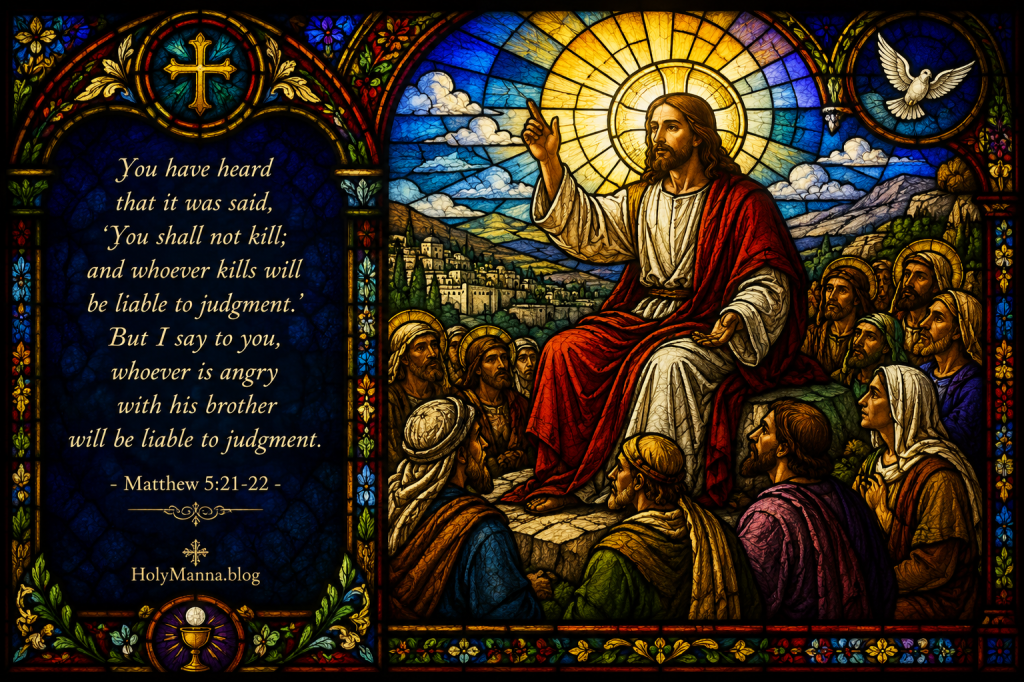
Teaching About Anger. 21 “You have heard that it was said to your ancestors, ‘You shall not kill; and whoever kills will be liable to judgment.’ 22 But I say to you, whoever is angry with his brother will be liable to judgment, and whoever says to his brother, ‘Raqa,’ will be answerable to the Sanhedrin, and whoever says, ‘You fool,’ will be liable to fiery Gehenna. 23 Therefore, if you bring your gift to the altar, and there recall that your brother has anything against you, 24 leave your gift there at the altar, go first and be reconciled with your brother, and then come and offer your gift. 25 Settle with your opponent quickly while on the way to court with him. Otherwise your opponent will hand you over to the judge, and the judge will hand you over to the guard, and you will be thrown into prison. 26 Amen, I say to you, you will not be released until you have paid the last penny.
Detailed Exegesis
Verse 20: “I tell you, unless your righteousness surpasses that of the scribes and Pharisees, you will not enter into the kingdom of heaven.”
Jesus begins with a challenging statement. The scribes and Pharisees were known for religious seriousness, knowledge of the Law, and attention to external observance. Many ordinary people would have considered them examples of righteousness. Yet Jesus says His disciples must have a righteousness that surpasses theirs.
This does not mean Jesus rejects the Law. Earlier in the Sermon on the Mount, He says He has not come to abolish the Law but to fulfill it. Here, He reveals what fulfillment looks like. The righteousness of the Kingdom is not satisfied with outward performance while the heart remains proud, bitter, or unreconciled.
Catholic moral life is never merely external behavior. The heart matters because sin begins there, and grace must transform the whole person. Jesus is calling His disciples into interior holiness, the kind of holiness that allows worship, speech, relationships, and hidden desires to come under the reign of God.
Verse 21: “You have heard that it was said to your ancestors, ‘You shall not kill; and whoever kills will be liable to judgment.’”
Jesus recalls the commandment against murder, rooted in Exodus 20:13 and Deuteronomy 5:17. This commandment protects the sacredness of human life because every person is made in the image of God. In Israel, murder was not only a crime against another human being. It was an offense against the Creator who gives life.
Most people hear this commandment and feel safe because they have not physically killed anyone. Jesus knows that. He begins with what everyone recognizes as serious, then leads them beneath the surface to the spiritual roots of violence.
Murder does not begin with the weapon. It begins when a person allows another human being to become disposable in the heart. It begins when resentment becomes hatred, when anger becomes revenge, and when contempt makes a brother seem less than human.
Verse 22: “But I say to you, whoever is angry with his brother will be liable to judgment, and whoever says to his brother, ‘Raqa,’ will be answerable to the Sanhedrin, and whoever says, ‘You fool,’ will be liable to fiery Gehenna.”
This is one of the most searching teachings in the Sermon on the Mount. Jesus speaks with divine authority: “But I say to you.” He does not merely interpret the Law from the outside. He reveals its deepest meaning from within His own authority as the Son of God.
Jesus is not condemning every emotional experience of anger. Anger can arise when something unjust happens. The danger is anger that is chosen, fed, justified, and allowed to become contempt or vengeance. That kind of anger destroys charity.
The word “Raqa” was an insult meaning something like empty-headed or worthless. To call someone “You fool” in this context is not harmless teasing. It is contemptuous speech that reduces a brother to an object of scorn. Jesus exposes the spiritual danger of words that murder dignity.
The reference to the Sanhedrin points to the highest Jewish council, while Gehenna refers to a place associated with judgment. Gehenna was connected to the Valley of Hinnom near Jerusalem, remembered for terrible evils in Israel’s history and later used as an image of final punishment. Jesus is making the point unmistakable: contempt is not a small matter in the Kingdom of God.
The Catechism of the Catholic Church teaches this clearly: “Anger is a desire for revenge. ‘To desire vengeance in order to do evil to someone who should be punished is illicit,’ but it is praiseworthy to impose restitution ‘to correct vices and maintain justice.’ If anger reaches the point of a deliberate desire to kill or seriously wound a neighbor, it is gravely against charity; it is a mortal sin. The Lord says, ‘Everyone who is angry with his brother shall be liable to judgment.’” CCC 2302
Verse 23: “Therefore, if you bring your gift to the altar, and there recall that your brother has anything against you,”
Jesus now moves from the heart to worship. The image is powerful. A person is standing at the altar, ready to offer a gift to God. In the Jewish world, sacrifice was central to covenant worship. The altar was sacred. The offering mattered. Worship was not casual.
Yet Jesus says that if, at that very moment, a person remembers that a brother has something against him, he must pay attention. The memory itself becomes a summons from God. The Lord is not asking for empty ritual. He is asking for a heart living in charity.
This verse is especially important for Catholics because the altar remains central to Christian worship. At every Mass, the faithful approach the sacrifice of Christ made present in the Eucharist. Jesus teaches that the altar cannot be used as a hiding place from the demands of love.
Verse 24: “Leave your gift there at the altar, go first and be reconciled with your brother, and then come and offer your gift.”
This verse is the heart of the Gospel passage. Jesus does not say to finish worship first and reconcile later. He says, “Go first.” Reconciliation has urgency because charity is not optional.
This does not mean every broken relationship can be instantly repaired. Some wounds are serious. Some relationships involve danger, manipulation, abuse, or injustice. Forgiveness does not require pretending evil never happened, nor does reconciliation always mean restoring the same closeness. Still, the disciple of Jesus must not cling to hatred, revenge, or pride. The heart must be willing to seek peace where peace is morally possible.
Saint John Chrysostom reflected on this teaching with great force, saying that Christ permits His own worship to be interrupted for the sake of reconciliation with one’s brother. His point is deeply Catholic: God does not desire an offering that is separated from charity. A heart that refuses mercy cannot offer worship as though love of God and love of neighbor were unrelated.
The Catechism teaches the same truth in its explanation of the Lord’s Prayer: “Love, like the Body of Christ, is indivisible; we cannot love the God we cannot see if we do not love the brother or sister we do see. In refusing to forgive our brothers and sisters, our hearts are closed and their hardness makes them impervious to the Father’s merciful love; but in confessing our sins, our hearts are opened to his grace.” CCC 2840
Verse 25: “Settle with your opponent quickly while on the way to court with him. Otherwise your opponent will hand you over to the judge, and the judge will hand you over to the guard, and you will be thrown into prison.”
Jesus gives a practical image from ordinary life. If someone is on the way to court with an opponent, the wise thing is to seek settlement quickly before judgment is handed down. The image carries a spiritual warning. Do not delay reconciliation. Do not assume there will always be more time. Do not let pride harden while the road is still open.
The phrase “while on the way” can also describe human life itself. Every person is on the way toward judgment. While there is still time, the disciple should seek peace, repent, forgive, apologize, and make restitution where possible.
Catholic spirituality takes this seriously. The Sacrament of Reconciliation is not merely a place to name private sins. It is where Christ heals the soul and restores communion with God and the Church. The Christian who seeks mercy from God must also become merciful toward others.
Verse 26: “Amen, I say to you, you will not be released until you have paid the last penny.”
Jesus ends with a solemn warning. “Amen, I say to you” signals authority and seriousness. The image of paying the last penny shows that unresolved sin and refusal of reconciliation have consequences.
This verse should not be reduced to fear alone. It is a mercy that Jesus warns His disciples. He is telling them that anger, contempt, and delayed reconciliation are spiritually dangerous. These are not harmless private feelings when they are chosen and nursed. They bind the heart.
The good news is that Christ does not expose the sickness in order to shame the sinner. He exposes it in order to heal it. The One who commands reconciliation is also the One who gives grace to forgive, repent, and begin again.
Teachings: The Righteousness of the Kingdom and the Healing of Anger
This Gospel reveals that Christian morality is rooted in charity. Jesus does not merely forbid murder. He forbids the interior movement that makes hatred possible. He teaches that the disciple must guard the heart, the tongue, and the relationship with one’s brother.
The Catechism of the Catholic Church places this teaching under the Fifth Commandment and explains the danger of anger and hatred: “Anger is a desire for revenge. ‘To desire vengeance in order to do evil to someone who should be punished is illicit,’ but it is praiseworthy to impose restitution ‘to correct vices and maintain justice.’ If anger reaches the point of a deliberate desire to kill or seriously wound a neighbor, it is gravely against charity; it is a mortal sin. The Lord says, ‘Everyone who is angry with his brother shall be liable to judgment.’” CCC 2302
The Catechism continues: “Deliberate hatred is contrary to charity. Hatred of the neighbor is a sin when one deliberately wishes him evil. Hatred of the neighbor is a grave sin when one deliberately desires him grave harm. ‘But I say to you, Love your enemies and pray for those who persecute you, so that you may be sons of your Father who is in heaven.’” CCC 2303
These teachings protect the seriousness of the Gospel. In a culture that often treats anger as honesty and contempt as entertainment, Jesus teaches that the heart is morally accountable. Words matter. Interior attitudes matter. The way one speaks about a brother, a spouse, a parent, a child, a coworker, a political opponent, or a fellow parishioner matters.
The Catechism also connects forgiveness to the Lord’s Prayer and the life of grace: “Now and this is daunting this outpouring of mercy cannot penetrate our hearts as long as we have not forgiven those who have trespassed against us. Love, like the Body of Christ, is indivisible; we cannot love the God we cannot see if we do not love the brother or sister we do see. In refusing to forgive our brothers and sisters, our hearts are closed and their hardness makes them impervious to the Father’s merciful love; but in confessing our sins, our hearts are opened to his grace.” CCC 2840
The Church does not teach that forgiveness is easy or that wounds disappear overnight. The Catechism speaks with great pastoral realism: “It is not in our power not to feel or to forget an offense; but the heart that offers itself to the Holy Spirit turns injury into compassion and purifies the memory in transforming the hurt into intercession.” CCC 2843
That sentence is a gift for anyone who still feels pain. Jesus does not command emotional amnesia. He commands a heart surrendered to the Holy Spirit. Forgiveness may begin before feelings catch up. Reconciliation may require time, prudence, boundaries, and truth. But hatred must not be enthroned.
Saint John Chrysostom, preaching on this Gospel, emphasized that reconciliation is so important that Christ tells the worshiper to leave the gift at the altar and go first to make peace. His teaching presses the point that worship and charity cannot be separated. A person cannot honor God while willingly despising the person made in God’s image.
Saint Augustine also helps illuminate this passage through his teaching on the new life in Christ. The “new song” of Psalm 98 belongs to the heart renewed by grace. That renewed heart cannot remain content with old resentments. The lips may sing praise, but the Lord desires the whole life to become praise.
This Gospel also gives depth to the witness of Saint Barnabas. Barnabas is remembered as the “son of encouragement,” the man who saw grace in Antioch and helped make room for Saul. His life shows the opposite of contempt. He does not reduce Saul to his past. He sees what grace can do. In that sense, Barnabas lives the kind of righteousness Jesus teaches: a righteousness that seeks communion, encourages conversion, and refuses to let fear or resentment have the final word.
Reflection: Leaving the Gift and Choosing Peace
This Gospel is hard because it reaches into the parts of the heart that are easy to justify. Most people can explain why they are angry. They can remember what was said, what was done, who started it, and why the other person should apologize first. Anger often feels righteous because it tells the wounded heart a comforting story: “This person owes me, and until they pay, the distance is deserved.”
Jesus interrupts that story.
He does not deny that real wounds exist. He does not pretend injustice is imaginary. He does not command His disciples to be naive. But He does command them to take anger seriously before it becomes contempt, and to seek reconciliation before worship becomes hollow.
This Gospel applies directly to ordinary life. It applies to the family member who has not been called because the conversation might be awkward. It applies to the spouse who gets politeness in public and cold silence at home. It applies to the parishioner quietly judging another family at Mass. It applies to online speech, where people made in the image of God are often treated like targets instead of souls. It applies to friendships weakened by pride, workplaces poisoned by sarcasm, and hearts that have learned to call resentment “boundaries” when it is really unforgiveness.
A Catholic way forward begins with honesty. Name the anger before God. Ask whether it has become a desire for revenge. Ask whether speech has become contemptuous. Ask whether someone has been reduced to a label, an insult, or a past mistake.
Then take one concrete step toward peace. That step may be an apology. It may be a humble message. It may be a decision to stop gossiping. It may be bringing the wound to confession. It may be praying sincerely for someone who is hard to love. It may be seeking wise counsel when reconciliation is complicated or unsafe. The point is not to pretend everything is simple. The point is to refuse hatred a permanent home.
Before the altar, the Christian remembers that Christ reconciled sinners to the Father through His own Blood. The Eucharist is not a reward for people who never struggle. It is the sacrament of communion for those willing to be healed, converted, and made one in Christ.
The altar teaches the heart to love.
The brother reveals whether that love has become real.
Who comes to mind when Jesus says, “go first and be reconciled”?
Has anger become a desire for revenge, even in small hidden ways?
Are there words, jokes, labels, or thoughts that have turned another person into someone easy to despise?
What step toward peace is possible today without denying truth or ignoring prudence?
How might the next Mass be different if the heart approached the altar with a sincere desire for reconciliation?
Jesus is not asking for a shallow peace. He is calling His disciples into the deep freedom of the Kingdom. A reconciled heart is not weak. It is strong enough to stop keeping score. It is humble enough to apologize. It is courageous enough to forgive. It is free enough to worship.
That is the heart Christ wants to send into the world.
The Heart That Sings, Forgives, and Goes
Today’s readings leave the faithful with one clear invitation: become the kind of disciple the Holy Spirit can send.
Saint Barnabas shows what that looks like in real life. He arrives in Antioch, sees the grace of God, and rejoices. He does not lead with suspicion or pride. He encourages. He strengthens. He makes room for Saul. He helps the Church become more missionary because his own heart is already generous, humble, and open to the Holy Spirit.
Then Psalm 98 gives that mission its sound. “Sing a new song to the Lord, for he has done marvelous deeds.” The Gospel is not gloomy news. It is the victory of God made visible to the nations. The Church sings because Christ has conquered sin and death, and every conversion, every act of mercy, every reconciled relationship, and every soul returning to God becomes part of that new song.
But Jesus makes the lesson deeply personal in The Gospel of Matthew. Before the disciple can bring the gift to the altar with integrity, the heart must be willing to seek peace. Christ does not want worship that hides resentment. He does not want religious appearances covering anger, contempt, or pride. He wants a heart reconciled enough to love, free enough to forgive, and humble enough to go first.
Together, these readings show that mission and reconciliation belong together. A Christian cannot be a Barnabas to the world while refusing peace with a brother. A Catholic cannot sing the new song while clinging to the old grudges. A disciple cannot approach the altar while ignoring the call to charity. The Holy Spirit sends hearts that have first been softened by grace.
The call to action is simple, but not easy. See grace before criticizing weakness. Encourage someone who is trying to remain faithful. Pray and fast before important decisions. Bring anger honestly before the Lord. Seek reconciliation where it is possible. Approach the altar with a heart that wants to be healed, not merely seen.
Where is Christ asking the heart to become more like Barnabas today?
Who needs encouragement instead of judgment?
What old resentment is keeping the soul from singing the new song?
What act of reconciliation could make the next Mass more honest, humble, and holy?
Saint Barnabas reminds the Church that encouragement can change history. Psalm 98 reminds the Church that salvation is meant to become praise. Jesus reminds the Church that worship and charity cannot be separated. The disciple who receives that message becomes ready for the mission: to carry Christ into the world with a heart that sings, forgives, and goes.
Engage with Us!
Share your reflections in the comments below. Today’s readings invite the faithful to look honestly at the heart, rejoice when grace is visible, seek reconciliation where love has grown cold, and become the kind of disciple the Holy Spirit can send into the world.
- In the First Reading from Acts 11:21-26; 13:1-3, Barnabas sees the grace of God in Antioch and rejoices. Where is God asking for a Barnabas-like heart that encourages others instead of criticizing their imperfections?
- Barnabas goes to Tarsus to look for Saul and helps bring him into the mission of the Church. Who in your life might need encouragement, trust, or support to grow into the person God is calling them to become?
- Psalm 98 calls the whole earth to sing a new song to the Lord. What old song of resentment, fear, discouragement, or comparison is Christ asking you to leave behind so your life can become a song of praise?
- In Matthew 5:20-26, Jesus tells His disciples to be reconciled before offering their gift at the altar. Is there a relationship where the Lord is asking you to take one humble step toward peace, forgiveness, or healing?
- Jesus warns against anger and contempt because they wound charity in the heart. Are there words, thoughts, or attitudes that need to be surrendered to His mercy before they harden into sin?
- As Saint Barnabas was set apart by the Holy Spirit for mission, how might God be calling you to serve, encourage, teach, forgive, or witness to Christ in ordinary daily life?
May these readings help every heart become more open to grace, more courageous in reconciliation, and more ready to be sent. Live today with faith, speak with charity, forgive with humility, and do everything with the love and mercy Jesus taught us.
Sacred Heart of Jesus, we trust in You!
Immaculate Heart of Mary, pray for us!
Saint Michael the Archangel, defend us in battle!
Follow us on YouTube, TikTok, Instagram and Facebook for more insights and reflections on living a faith-filled life.


Leave a Reply