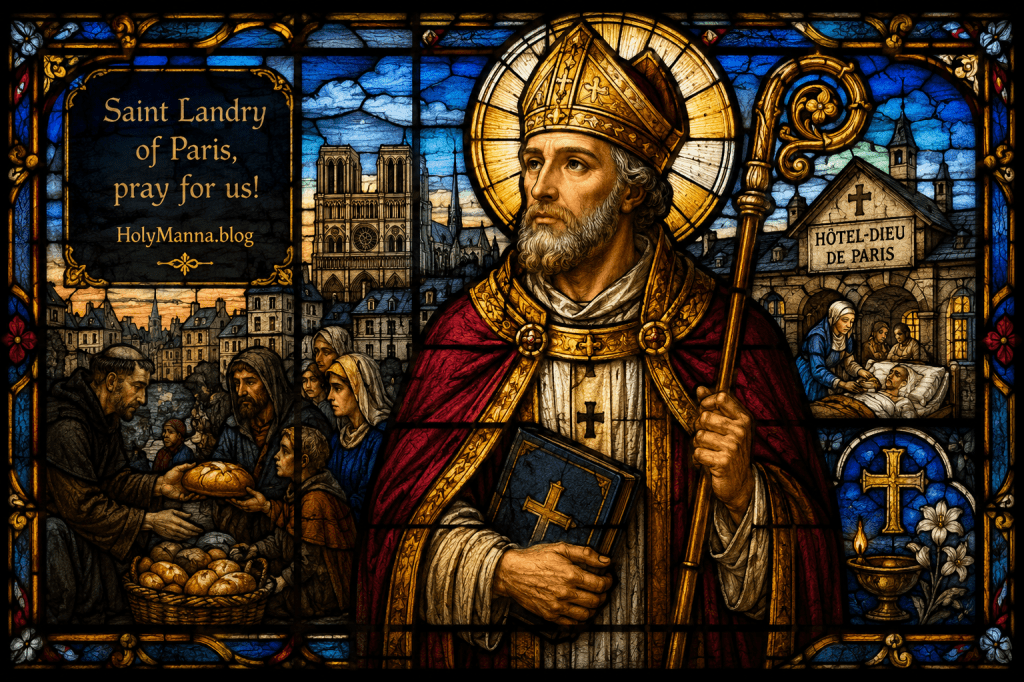
The Bishop Who Turned Mercy into a Hospital
Saint Landry of Paris, also known as Saint Landericus or Saint Landri, was a seventh-century Bishop of Paris remembered for one unforgettable reason: when his people were hungry, sick, and forgotten, he did not look away. He gave.
He gave from his own possessions first. Then, according to Catholic tradition, when the famine grew worse and the need became desperate, he sold or melted down some of the Church’s sacred vessels and furnishings to feed the poor.
That detail can sound shocking at first. Sacred vessels are not ordinary objects. They are set apart for the worship of God. Yet Saint Landry’s action reveals something deeply Catholic. He understood that reverence for God at the altar must never become indifference toward Christ suffering in the poor.
Saint Landry is most known for traditionally founding the Hôtel-Dieu of Paris, one of the most important Christian hospitals in European history. His charity was not vague or sentimental. It became food for the hungry, shelter for the sick, and a real institution of mercy in the heart of Paris.
His feast day is celebrated on June 10. He is honored as a patron of the poor, the sick, hospital workers, and the City of Paris. His life beautifully reflects the teaching of The Catechism of the Catholic Church, which says in CCC 2447, “The works of mercy are charitable actions by which we come to the aid of our neighbor in his spiritual and bodily necessities.”
Saint Landry did exactly that. He turned mercy into action.
A Servant Formed for a City in Need
Very little is known with certainty about Saint Landry’s early life. He lived in the Merovingian period of France, a time when Paris was growing in importance but still marked by poverty, disease, political pressure, and social instability.
Catholic tradition says that before becoming bishop, Landry served in the royal chancery under King Clovis II, the son of King Dagobert I. This means he likely had experience in administration, law, documents, and public responsibility before he became a shepherd of souls.
That background matters. Saint Landry was not only compassionate. He was practical. He knew how systems worked. He understood that charity must be organized if it is going to endure.
Around the year 650, he became Bishop of Paris, succeeding Bishop Audobert, also called Andebert in some sources. Catholic sources differ slightly on the exact dates of his episcopacy and death. Some place his death around 656, while others place it around 660 or 661. The safest way to describe his life is to say that he served as Bishop of Paris in the middle of the seventh century and died sometime between 656 and 661.
There is no famous dramatic conversion story attached to Saint Landry. No sudden vision is recorded. No prison cell conversion. No lightning bolt moment. Instead, his deeper conversion seems to have been lived through his vocation. He became a bishop who let the suffering of his people shape his heart.
That kind of conversion is worth noticing. Some saints are remembered for one dramatic moment of surrender. Others are remembered because they kept saying yes every day until their whole life became an act of mercy.
The Famine That Revealed His Heart
The defining moment of Saint Landry’s life came during the famine of 651. Hunger spread through Paris, and the poor began to suffer terribly.
A bishop could have responded with prayers alone. Prayers would have been necessary, of course, but Saint Landry understood that Christian charity also requires bread. He began by selling his own belongings, including his furniture, to feed the hungry.
Then came the harder decision. When his personal resources were not enough, he sold or melted down some of the Church’s sacred vessels and furnishings to provide relief.
This act made him famous in Catholic memory. It was not a rejection of sacred worship. It was a radical recognition that the hungry poor belong to Christ. The same Lord adored in the Eucharist is mystically present in those who suffer.
Saint Landry’s life sounds like a sermon on Matthew 25:40, where Jesus says, “whatever you did for one of these least brothers of mine, you did for me.”
The Church has always taught that love for the poor is not optional. The Catechism of the Catholic Church says in CCC 2444, “The Church’s love for the poor . . . is a part of her constant tradition.” Saint Landry lived that truth centuries before modern Catholics used the phrase “social teaching.”
He did not treat the poor as a side concern. He treated them as Christ knocking at the door.
How many Catholics today would be willing to sacrifice comfort, reputation, or even prized possessions so that the hungry could eat?
The House of God for the Sick
Saint Landry’s greatest legacy is the Hôtel-Dieu of Paris. The name means “House of God,” and that name tells the whole story.
According to Catholic tradition, Saint Landry saw that the sick and poor were not being adequately cared for by scattered shelters and casual charity. The bishop’s residence could no longer serve as the main place of care for everyone who came seeking help. The need was too great.
So Landry helped establish a dedicated hospital near the cathedral, traditionally associated with Saint Christopher. This institution later became the famous Hôtel-Dieu de Paris.
That makes Saint Landry one of the great figures in the Catholic history of healthcare. He did not simply tell people to be compassionate. He built a place where compassion could happen every day.
The Hôtel-Dieu became one of the most important hospitals in Christian Europe. It stood near Notre-Dame and served the poor, the sick, the abandoned, and the vulnerable. In a world without modern hospitals, health insurance, or organized public welfare, this was not a small act. It was a revolution of mercy.
Saint Landry understood something the Church still teaches. The sick are not burdens to be hidden. They are members of Christ’s Body. The poor are not interruptions to religious life. They are invitations to encounter Jesus.
The Catechism of the Catholic Church teaches that the corporal works of mercy include feeding the hungry, sheltering the homeless, clothing the naked, visiting the sick and imprisoned, and burying the dead. Saint Landry’s life gathered those works into one visible witness.
He made mercy concrete.
A Bishop of Charity and Order
Saint Landry was not only a bishop of compassion. He was also a bishop of order, administration, and ecclesial responsibility.
He is connected with the Abbey of Saint-Denis, one of the most important religious sites in French Catholic history. During his episcopacy, King Clovis II granted privileges to the abbey. Saint Landry’s name is connected with the royal charter involving Saint-Denis, a reminder that he lived in a world where bishops had to navigate complicated relationships with kings, monasteries, and Church authority.
A later tradition attributes this remark to him concerning the king’s request: “the request of the king is for us like a command which it is extremely difficult to resist.”
This should not be treated as a famous devotional quote from his own writings. It is better understood as an attributed administrative remark preserved in later tradition. Still, it gives a glimpse into the pressures he faced. He was a bishop trying to serve Christ faithfully while also dealing with royal power and ecclesiastical decisions.
Saint Landry is also associated with Marculf’s Formulas, an important Merovingian collection of model legal and administrative documents. Catholic historical tradition identifies the Bishop Landri connected with this work as very likely Saint Landry of Paris.
That may sound like a small academic detail, but it reveals something important. Saint Landry’s mercy was not careless. It was disciplined. He knew that love needs structure. A hospital needs order. A diocese needs governance. Charity needs wisdom.
For Catholics today, that is a powerful lesson. Good intentions are beautiful, but organized love can feed more people, heal more wounds, and last longer.
The Saint of Saint-Germain l’Auxerrois
Tradition also connects Saint Landry with the early church of Saint-Germain l’Auxerrois in Paris. This church would later become closely associated with the kings of France. Some traditions say that Saint Landry may have built the original church.
After his death, Saint Landry was buried at Saint-Germain l’Auxerrois. Pilgrims came there to honor him, and his relics became part of the sacred memory of Paris.
A statue of Saint Landry can still be associated with that church’s memory. In his traditional iconography, he is shown holding a book in his left hand and placing his right hand over his heart. The book represents learning, teaching, and ecclesiastical wisdom. The hand over the heart represents charity, especially his love for the poor.
That image tells his story beautifully.
He was not a bishop of cold administration. He was not a bishop of shallow emotion. He was a shepherd whose mind and heart worked together for Christ.
Truth and mercy belonged together in him.
No Martyrdom, But a Real Cross
Saint Landry was not a martyr in the strict sense. He was not killed for the faith. No tradition records a bloody persecution or formal execution.
But that does not mean his life was easy.
His cross was the cross of a shepherd watching his people suffer. He lived through famine, poverty, sickness, and political pressure. He had to make hard decisions in a world where there were no easy solutions. Selling personal goods was one thing. Selling or melting down Church furnishings during a famine was another.
That decision likely required courage. It would have been noticed. It may have been criticized. Yet Saint Landry seems to have understood that a bishop must sometimes risk misunderstanding in order to save lives.
His hardship was not martyrdom by sword. It was martyrdom in the older sense of witness. He bore witness that Christian love must cost something.
Is charity still charity when it costs nothing?
Miracles Remembered After His Death
Several miracle stories are associated with Saint Landry after his death. The best-known accounts come from The Golden Legend, a medieval collection of saints’ lives. These stories belong to Catholic hagiographical tradition, but they cannot be verified by modern historical standards.
One story tells of a man named Raoul Gracard, who was suddenly afflicted with severe swelling in his head and redness in his face. His condition was so alarming that people thought he looked like a leper. According to the story, he went to Saint Landry’s shrine, confessed devoutly, kissed the saint’s sudary, made an offering and a vow, and was healed before he returned home. This story comes from medieval tradition and cannot be verified.
Another story tells of a squire who suffered from paralysis and could not properly use his hands or feet. His friends carried him to Saint Landry’s tomb. Bishop Maurice of Paris prayed for him, touched the afflicted parts of his body with one of Saint Landry’s teeth while making the Sign of the Cross, and the man was healed. This story also comes from medieval tradition and cannot be verified.
A third story concerns a knight named Gilbert, who had a thorn lodged in his knee. No medicine could help him. He was brought to Saint Landry’s church, where the Sign of the Cross was made over him with the saint’s sudary. According to the account, the thorn came out, and he was healed. This story also cannot be verified by modern historical standards.
Catholics should understand these stories properly. Relics are not magic. The saints do not replace Christ. God alone heals. The saints intercede because they are alive in Christ.
The Catechism of the Catholic Church teaches in CCC 956 that the saints in heaven “do not cease to intercede with the Father for us.” That is the Catholic heart of these miracle stories. Saint Landry’s mercy did not end with death because the saints continue to love the Church from heaven.
Relics, Revolution, and a Memory That Would Not Die
Saint Landry’s relics were preserved at Saint-Germain l’Auxerrois, and later accounts say they were kept in a silver shrine. In 1408, two of his bones were given to the parish church of Saint-Landry in Paris.
The old church of Saint-Landry had a special place in Parisian memory. Tradition says it began as a chapel near where Saint Landry had lived and prayed. By the twelfth century, it had become its own parish church.
During the French Revolution, the church was sold in 1792 and later used for secular purposes. It was eventually demolished in 1828. Some accounts say that Saint Landry’s relics were destroyed or scattered during the upheavals connected with the Revolution.
That part of the story is painful, but it is also strangely fitting. Buildings can be destroyed. Shrines can be melted. Relics can be scattered. But the witness of mercy does not disappear.
Saint Landry’s name remained in Paris. It was connected to churches, chapels, the Hôtel-Dieu, and even the Port Saint-Landry, one of the early river ports of Paris. His memory stayed tied to the city’s Christian identity.
His legacy also crossed the Atlantic. Saint Landry Catholic Church in Opelousas, Louisiana, is dedicated to him, and the civil parish of St. Landry in Louisiana takes its name from that church. In Opelousas, his memory continues through parish devotion, sacred art, stained glass, and public memorials.
A seventh-century Bishop of Paris became the namesake of a Catholic church and civil parish in Louisiana. That is one of the beautiful surprises of Catholic history. The communion of saints does not stay trapped in one century or one country. It travels.
The Lesson of a Bishop Who Gave Everything
Saint Landry is remembered because he understood that mercy must become visible.
He did not only feel sorry for the hungry. He fed them. He did not only worry about the sick. He helped build a hospital. He did not only preach charity. He gave until it cost him something.
His life challenges Catholics who live in a world full of suffering but also full of distraction. It is easy to scroll past the poor. It is easy to assume someone else will help. It is easy to keep faith comfortable and private.
Saint Landry will not let that happen.
He reminds the Church that love for Jesus must become love for the wounded person nearby. Eucharistic faith must form merciful hearts. The Catholic who kneels before Christ in adoration must also recognize Christ in the hospital bed, the food line, the lonely neighbor, the elderly parishioner, the overwhelmed parent, and the forgotten poor.
The lesson is not that every Catholic must found a hospital. The lesson is that every Catholic must ask what mercy looks like in the real circumstances of daily life.
For one person, it may mean visiting someone who is sick. For another, it may mean giving generously to a parish food pantry. For another, it may mean checking on an elderly neighbor. For another, it may mean serving quietly, forgiving patiently, or sacrificing comfort for someone who has less.
Saint Landry’s holiness was practical. That is why it still speaks.
Who is Christ asking to be served today?
What comfort might need to be surrendered so someone else can be loved?
Where can mercy become more than a feeling and become a real act of Christian service?
Engage With Us!
Share your thoughts and reflections in the comments below. Saint Landry’s life gives Catholics a powerful example of mercy that becomes practical, costly, and deeply faithful.
- What part of Saint Landry’s story challenges you the most?
- How can Catholics today better live the corporal works of mercy in ordinary parish life?
- Who in your life needs concrete mercy right now, not just good intentions?
- What would it look like to build a “House of God” in your own home, workplace, parish, or community?
- How does Saint Landry’s love for the poor help you understand the words of Jesus in Matthew 25 more deeply?
Saint Landry of Paris reminds the Church that mercy is not weakness. Mercy is courage shaped by love. May his example inspire every Catholic to live with deeper faith, serve with greater generosity, and do everything with the love and mercy Jesus taught us.
Saint Landry of Paris, pray for us!
Follow us on YouTube, TikTok, Instagram and Facebook for more insights and reflections on living a faith-filled life.


Leave a Reply