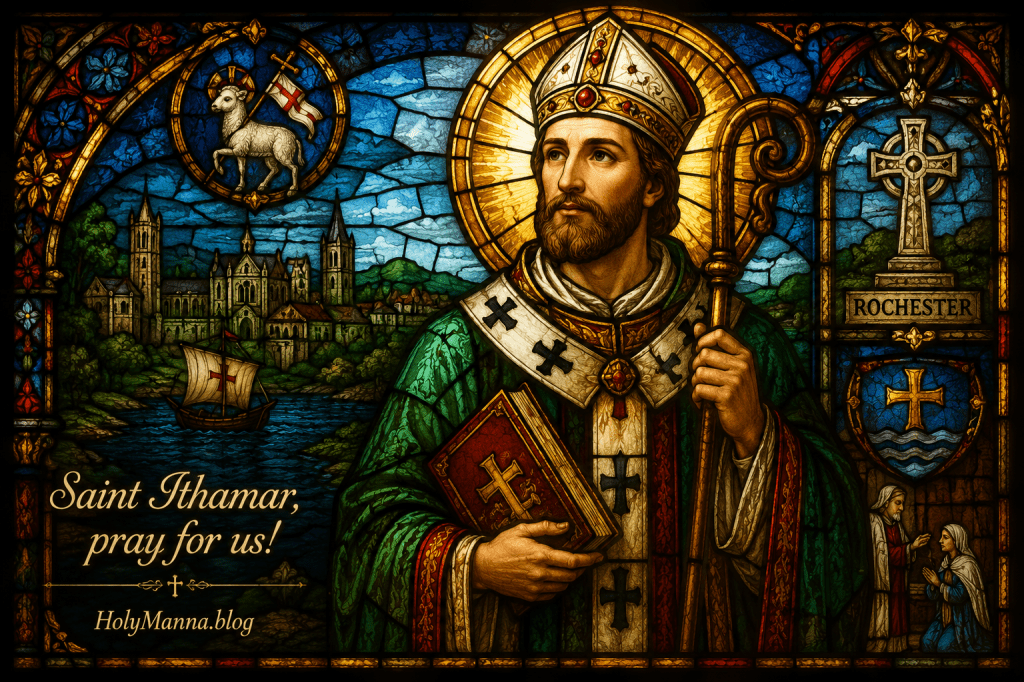
When the Faith Took Root in English Soil
Saint Ithamar, Bishop of Rochester, is one of the quiet but deeply meaningful saints of early English Catholic history. He is not remembered because he left behind famous writings, founded a great religious order, or died a dramatic martyr’s death. He is remembered because his life marked a turning point in the story of the Church in England.
Saint Ithamar was the first native Anglo-Saxon bishop in England. That one fact matters more than it may sound at first. Before him, the bishops who helped build up the English Church were mostly missionaries from outside the Anglo-Saxon people, especially those connected with the Roman mission sent by Pope Saint Gregory the Great and led by Saint Augustine of Canterbury. With Ithamar, the Catholic faith was no longer only being brought to the English people from the outside. It had begun to bear native fruit.
Born in Kent, Ithamar became Bishop of Rochester around the year 644, succeeding Saint Paulinus, one of the great missionary bishops of early England. Saint Bede, the great historian of the English Church, praised Ithamar as being “of the Kentish nation, but not inferior to his predecessors in learning and conduct of life.” That short sentence gives us the clearest ancient portrait of him. He was local, he was learned, and he was holy.
The Catechism of the Catholic Church teaches that bishops, as successors of the apostles, receive the fullness of the sacrament of Holy Orders and are entrusted with teaching, sanctifying, and governing the People of God. In that light, Saint Ithamar was not simply a historical churchman. He was a successor of the apostles in a young and growing Christian land, a living sign that the Gospel had taken root among the English people.
A Son of Kent Chosen for the Church
Very little is known about Saint Ithamar’s early family life. The surviving sources tell us that he was from Kent, the same region where the Roman mission had first entered Anglo-Saxon England. This alone places him close to one of the most important chapters in English Catholic history.
The Christian faith had come to Kent in a powerful way through Saint Augustine of Canterbury, who arrived in 597. By the time Ithamar rose to the episcopacy, the Church in England was still young. The faith had to be taught, protected, organized, and lived in a culture still being formed by the Gospel. Bishops were not simply ceremonial leaders. They were pastors, teachers, defenders of doctrine, and fathers to communities learning how to live as Christians.
One fascinating detail about Ithamar is his name. “Ithamar” may not have been his birth name. Some historical research suggests that he may have taken this biblical name when he became bishop. In the Old Testament, Ithamar was one of the sons of Aaron, connected to the priestly line of Israel. For a native Englishman becoming one of the first great native shepherds of the English Church, the name carried deep meaning.
It was as if his very name pointed to priestly service. The Catholic faith had crossed seas, languages, and cultures, and now a son of Kent stood in apostolic ministry. He was not borrowing someone else’s faith. He was living it, guarding it, and handing it on.
Saint Ithamar is most known for being the first native Anglo-Saxon bishop in England, for serving as Bishop of Rochester, and for helping consecrate Saint Deusdedit, the first native-born Archbishop of Canterbury. Together, these moments show a Church growing from missionary beginnings into a truly local Catholic community.
A Learned Bishop in a Young Christian Land
Saint Ithamar became Bishop of Rochester after the death of Saint Paulinus in 644. Paulinus had been one of the great missionary figures of the early English Church, and succeeding him would not have been a small task. Rochester was one of the earliest English dioceses and had an important place in the Christianization of Kent.
Saint Bede’s praise matters because Bede was not careless with words. When he says Ithamar was not inferior to his predecessors in learning and conduct of life, he is comparing him to holy and learned missionary bishops who helped plant the Church in England. That means Ithamar was remembered not only as a native bishop, but as a worthy bishop.
His life also reminds us that holiness is sometimes quiet. No ancient source preserves dramatic sermons from his lips. No famous personal writings have survived. No verified miracle during his lifetime is clearly recorded. Yet the Church remembered him as a saint because he faithfully lived the office entrusted to him.
One of the most important moments of his episcopal life came when he helped consecrate Deusdedit as Archbishop of Canterbury. Deusdedit was also native-born, a West Saxon. This means Ithamar, the first native Anglo-Saxon bishop, helped consecrate the first native-born Archbishop of Canterbury. That moment is easy to miss, but it is spiritually beautiful. The faith once carried to England by missionaries was now producing native shepherds capable of leading the Church from within.
The Catechism reminds us that the Church is apostolic because she is built on the foundation of the apostles, preserves their teaching, and continues to be taught, sanctified, and guided by their successors. Saint Ithamar’s life is a concrete example of that truth. The apostolic faith did not remain distant. It became local. It entered Kent. It formed a bishop. It shaped a people.
Faithful Without the Spotlight
Saint Ithamar does not appear to have suffered martyrdom, and there are no major records of persecution connected to his life. He seems to have died of natural causes, probably around the year 656, although the exact year remains uncertain. The safest historical range places his death after March 26, 655, when he was still alive for the consecration of Deusdedit, and before 664, when his successor had already been appointed.
His hardships were likely the quieter burdens of an early medieval bishop. He served a young Church that still needed structure, formation, catechesis, and faithful leadership. He followed in the footsteps of major missionary saints, and he had to prove that the native English Church could produce leaders of equal holiness and learning.
That may not sound dramatic, but it is deeply relatable. Many saints are not called to shed their blood. Some are called to remain steady when the Church needs faithful builders. Ithamar’s life teaches that perseverance, learning, humility, and holiness in ordinary responsibility can become a powerful witness.
In a world that often rewards visibility, Ithamar reminds Catholics that God also sanctifies hidden fidelity. A bishop who quietly teaches, governs, prays, and shepherds can shape generations.
The Saint Whose Tomb Became a Place of Healing
Although no clear miracles during Saint Ithamar’s lifetime are preserved in the early sources, his tomb became associated with miracles after his death. This is where his story becomes especially moving.
After he died, Saint Ithamar was buried at Rochester. Over time, his tomb became a place of devotion, and medieval Christians began to report healings through his intercession. The most famous miracles associated with him were cures of ailments of the eyes. Because of these stories, many came to honor him as a heavenly intercessor for those suffering from eye troubles.
A twelfth-century collection known as the Miracles of Saint Ithamar preserved stories of posthumous miracles attributed to him. These accounts depend on Saint Bede for the basic details of his life, then focus on the healings and favors associated with his shrine. Since these miracle stories come from later medieval tradition, they should be received as part of the devotional memory surrounding the saint. Some details cannot be historically verified with certainty, but they show how deeply the faithful of Rochester trusted his intercession.
One later story says that a Bishop John of Rochester suffered from a serious affliction of the eyes and was healed through Saint Ithamar’s prayers. After this healing, Ithamar’s relics were honored even more prominently. This story belongs to later hagiographical tradition and cannot be fully verified, but it fits the long-standing association between Saint Ithamar and healing of the eyes.
His relics were eventually moved, or translated, to a more fitting shrine. In Catholic tradition, the translation of relics was not simply the moving of bones. It was an act of reverence for the saint, a recognition that God had worked through that person’s life and continued to bless the faithful through their intercession. The Catechism teaches that the saints in heaven continue to intercede for us, and their care for the Church on earth is part of the communion of saints.
During the Middle Ages, Rochester became a place of pilgrimage. Saint Ithamar was honored there alongside other local saints, including Saint Paulinus and Saint William of Perth. Pilgrims came to pray, seek healing, and remember the holy men connected with Rochester’s Christian identity.
After the Reformation, the medieval shrines of Rochester were destroyed or lost, as happened to many Catholic shrines throughout England. Yet Saint Ithamar’s memory did not disappear. In modern times, Rochester Cathedral has restored visible markers honoring Saint Ithamar and Saint Paulinus near the High Altar, giving renewed recognition to saints whose shrines had been absent for centuries.
There is also a modern pilgrimage route known as the Ithamar Way, which helps preserve his memory and connects pilgrims with the early Christian heritage of Rochester. For a saint whose written record is so small, this ongoing remembrance says something powerful. The Church does not only remember those who spoke loudly. She also remembers those who faithfully carried the apostolic faith into ordinary soil.
A Quiet Saint for a Restless Age
Saint Ithamar’s life speaks strongly to Catholics today because his holiness was rooted in faithfulness, not fame. He lived at a time when the Church in England was young, fragile, and still being formed. He did not need to reinvent the faith. He needed to receive it, live it, teach it, and hand it on.
That is still the work of Catholic life today.
Many people inherit the faith from parents, grandparents, parishes, schools, or saints they have never met. But at some point, the faith must become personal. Not private, not self-made, and not separated from the Church, but truly received into the heart. Saint Ithamar shows what happens when the Gospel becomes native to a soul and to a people.
He also reminds us of the importance of learning. Bede praised him for both learning and conduct of life. That pairing matters. Catholic holiness is not anti-intellectual. The Church calls the faithful to love God with the whole heart, soul, mind, and strength. A holy life should be joined to a teachable mind. A Catholic who wants to grow in faith should study Scripture, learn the teachings of the Church, receive the sacraments, pray faithfully, and live with integrity.
Saint Ithamar also offers a beautiful lesson about spiritual sight. The miracles associated with his tomb were especially connected to healing of the eyes. Whether or not every medieval story can be verified, the symbolism is powerful. So many people today can see everything on a screen but struggle to see God’s presence in daily life. They can see problems, scandals, worries, and distractions, but miss grace.
Saint Ithamar invites the faithful to ask for clearer vision. Not only healthy eyes, but a purified heart. Not only the ability to see the world, but the grace to see Christ at work within it.
Where does the faith need to become more deeply rooted in daily life? Is Catholicism something merely inherited, or is it becoming something truly lived? What would change if the eyes of the heart were healed enough to see ordinary responsibilities as places of holiness?
Saint Ithamar’s story may be quiet, but it is not small. He stands at the moment when the Catholic faith in England began to produce native shepherds. He reminds the Church that evangelization is not complete when people merely hear the Gospel. It bears fruit when they become saints.
Engage with Us!
Share your thoughts and reflections in the comments below. Saint Ithamar’s life is a beautiful reminder that quiet fidelity can shape the future of the Church, even when the world barely notices.
- What part of Saint Ithamar’s story speaks most strongly to your own faith journey?
- How can you help the Catholic faith become more deeply rooted in your family, parish, workplace, or community?
- Where might God be calling you to grow in both learning and holiness, like Saint Ithamar?
- What distractions make it harder for you to see God clearly in daily life?
- How can you live today in a way that helps others see Christ more clearly?
May Saint Ithamar remind us that holiness does not always need a spotlight. Sometimes it looks like steady faith, humble leadership, prayerful service, and a life rooted deeply in Christ. Let us live with courage, hand on the faith with love, and do everything with the mercy and compassion Jesus taught us.
Saint Ithamar, pray for us!
Follow us on YouTube, TikTok, Instagram and Facebook for more insights and reflections on living a faith-filled life.


Leave a Reply