Wednesday of the Tenth Week in Ordinary Time – Lectionary: 361
When the Heart Can No Longer Stand in Two Places
Every soul eventually comes to a holy crossroads, where comfort, compromise, and cultural noise must give way to one clear question: Will the Lord truly be God here?
Today’s readings are united by the call to an undivided heart. In 1 Kings 18:20-39, Elijah stands on Mount Carmel before a wavering Israel and asks the question that still pierces every generation: “How long will you straddle the issue? If the Lord is God, follow him; if Baal, follow him.” 1 Kings 18:21 The people have not fully rejected the Lord, but they have tried to share their worship with Baal, the false god associated with storms, fertility, and prosperity. In a time of drought, that false god is exposed as powerless. The prophets of Baal cry out, dance, and even wound themselves, but Scripture gives the haunting verdict: “There was no sound, no one answering, no one listening.” 1 Kings 18:29
Against that silence, Elijah repairs the broken altar of the Lord. That detail matters. Before the fire falls, worship must be restored. Before the people can proclaim, “The Lord is God! The Lord is God!” 1 Kings 18:39, the covenant must be remembered, the altar rebuilt, and the heart turned back to the living God.
The responsorial psalm gives the prayer of the soul that has made that choice. “You are my Lord, you are my only good.” Psalm 16:2 This is the language of fidelity, not divided affection. The psalmist knows that false gods multiply sorrow, while the Lord alone gives security, joy, and the path to life. The same truth that blazes on Mount Carmel becomes quiet confidence in the heart of the believer.
Then, in Matthew 5:17-19, Jesus reveals the fullness of this faithful obedience. He does not come to abolish the Law or the Prophets, but to fulfill them. The commandments are not discarded in Christ. They are brought to completion in Him, written more deeply upon the heart by grace. As The Catechism of the Catholic Church teaches, “Jesus did not abolish the Law of Sinai, but rather fulfilled it.” CCC 592 The Christian life is not a loose spirituality where God receives whatever is left over. It is a life reordered by Christ, where love becomes obedient, worship becomes true, and the heart no longer tries to stand in two places.
Today’s readings prepare the faithful to ask with honesty: Where has the altar been broken? What false god has been given too much room? What command of Christ has been treated as optional? The Lord who answered Elijah with fire now speaks through His Son, calling every heart away from compromise and into the freedom of faithful love.
First Reading – 1 Kings 18:20-39
When the False Gods Go Silent and the Living God Answers With Fire
The first reading brings the faithful to Mount Carmel, one of the most dramatic moments in the prophetic history of Israel. The kingdom has been spiritually compromised under King Ahab and Queen Jezebel, and the worship of Baal has taken root among the people. Baal was treated by his worshipers as a storm and fertility god, the kind of false deity people turned to for rain, crops, prosperity, and survival. That detail matters because Israel is suffering through drought. The supposed god of rain has nothing to give.
Into that confusion steps Elijah, the prophet of the Lord. He does not begin with a complicated argument. He asks a piercing question. The issue is not whether Israel believes in spiritual things. The issue is whether Israel will belong completely to the Lord. This reading fits today’s central theme beautifully: God does not want a divided heart. He calls His people away from compromise, back to true worship, and into faithful obedience.
1 Kings 18:20-39 – New American Bible (Revised Edition)
20 So Ahab summoned all the Israelites and had the prophets gather on Mount Carmel.
21 Elijah approached all the people and said, “How long will you straddle the issue? If the Lord is God, follow him; if Baal, follow him.” But the people did not answer him. 22 So Elijah said to the people, “I am the only remaining prophet of the Lord, and there are four hundred and fifty prophets of Baal. 23 Give us two young bulls. Let them choose one, cut it into pieces, and place it on the wood, but start no fire. I shall prepare the other and place it on the wood, but shall start no fire. 24 You shall call upon the name of your gods, and I will call upon the name of the Lord. The God who answers with fire is God.” All the people answered, “We agree!”
25 Elijah then said to the prophets of Baal, “Choose one young bull and prepare it first, for there are more of you. Call upon your gods, but do not start the fire.” 26 Taking the young bull that was turned over to them, they prepared it and called upon Baal from morning to noon, saying, “Baal, answer us!” But there was no sound, and no one answering. And they hopped around the altar they had prepared. 27 When it was noon, Elijah taunted them: “Call louder, for he is a god; he may be busy doing his business, or may be on a journey. Perhaps he is asleep and must be awakened.” 28 They called out louder and slashed themselves with swords and spears according to their ritual until blood gushed over them. 29 Noon passed and they remained in a prophetic state until the time for offering sacrifice. But there was no sound, no one answering, no one listening.
30 Then Elijah said to all the people, “Come here to me.” When they drew near to him, he repaired the altar of the Lord which had been destroyed. 31 He took twelve stones, for the number of tribes of the sons of Jacob, to whom the Lord had said: Israel shall be your name. 32 He built the stones into an altar to the name of the Lord, and made a trench around the altar large enough for two measures of grain. 33 When he had arranged the wood, he cut up the young bull and laid it on the wood. 34 He said, “Fill four jars with water and pour it over the burnt offering and over the wood.” “Do it again,” he said, and they did it again. “Do it a third time,” he said, and they did it a third time. 35 The water flowed around the altar; even the trench was filled with the water. 36 At the time for offering sacrifice, Elijah the prophet came forward and said, “Lord, God of Abraham, Isaac, and Israel, let it be known this day that you are God in Israel and that I am your servant and have done all these things at your command. 37 Answer me, Lord! Answer me, that this people may know that you, Lord, are God and that you have turned their hearts back to you.” 38 The Lord’s fire came down and devoured the burnt offering, wood, stones, and dust, and lapped up the water in the trench. 39 Seeing this, all the people fell prostrate and said, “The Lord is God! The Lord is God!”
Detailed Exegesis
Verse 20 – “So Ahab summoned all the Israelites and had the prophets gather on Mount Carmel.”
Ahab gathers Israel and the prophets of Baal on Mount Carmel, a high place near the Mediterranean coast. This is not a private disagreement. This is a public spiritual confrontation. Israel’s covenant identity is on trial. Mount Carmel becomes the place where false worship will be exposed and the Lord will reveal Himself as the living God.
Verse 21 – “Elijah approached all the people and said, ‘How long will you straddle the issue? If the Lord is God, follow him; if Baal, follow him.’ But the people did not answer him.”
Elijah’s question goes straight to the heart. The people are not portrayed as openly denying the Lord. They are wavering between the Lord and Baal. Their silence reveals spiritual paralysis. They do not want to choose because choosing would require conversion. This is the danger of compromise. A divided heart often tries to avoid an answer.
Verse 22 – “So Elijah said to the people, ‘I am the only remaining prophet of the Lord, and there are four hundred and fifty prophets of Baal.’”
Elijah stands alone in human terms, outnumbered by the prophets of Baal. Yet the truth of God is not determined by majority vote. This verse reminds the faithful that holiness often feels lonely when a culture drifts away from God. Elijah’s courage comes not from numbers, but from fidelity.
Verse 23 – “‘Give us two young bulls. Let them choose one, cut it into pieces, and place it on the wood, but start no fire. I shall prepare the other and place it on the wood, but shall start no fire.’”
Elijah proposes a sacrifice, but removes any possibility of human manipulation. No one may light the fire. The test will reveal who is truly God. In the religious world of ancient Israel, sacrifice was not empty ritual. It was an act of worship, surrender, and covenant relationship.
Verse 24 – “‘You shall call upon the name of your gods, and I will call upon the name of the Lord. The God who answers with fire is God.’ All the people answered, ‘We agree!’”
Fire often symbolizes divine presence, judgment, purification, and acceptance of sacrifice. Elijah is not asking for a magic trick. He is asking the living God to reveal the truth. The people agree because the test is clear. The God who answers is God.
Verse 25 – “Elijah then said to the prophets of Baal, ‘Choose one young bull and prepare it first, for there are more of you. Call upon your gods, but do not start the fire.’”
Elijah gives the prophets of Baal every advantage. They are more numerous. They choose first. They begin first. This makes the silence of Baal even more devastating. False gods can be given every opportunity and still have no life, no voice, and no saving power.
Verse 26 – “Taking the young bull that was turned over to them, they prepared it and called upon Baal from morning to noon, saying, ‘Baal, answer us!’ But there was no sound, and no one answering. And they hopped around the altar they had prepared.”
The prophets of Baal spend hours crying out, but nothing happens. Their movement is frantic, but their god is silent. This is a vivid picture of idolatry. The human heart can exhaust itself chasing what cannot answer. Noise does not equal prayer. Intensity does not equal truth.
Verse 27 – “When it was noon, Elijah taunted them: ‘Call louder, for he is a god; he may be busy doing his business, or may be on a journey. Perhaps he is asleep and must be awakened.’”
Elijah mocks Baal to expose the absurdity of false worship. The living God of Israel does not sleep, wander off, or need to be awakened. False gods are human projections. They are small, limited, and powerless because they are not real.
Verse 28 – “They called out louder and slashed themselves with swords and spears according to their ritual until blood gushed over them.”
The prophets become violent toward their own bodies. This reveals the cruelty of idolatry. False worship does not lift up the person made in the image of God. It degrades the person. It demands pain and gives no mercy. The Lord, by contrast, calls His people to worship in truth, dignity, and covenant love.
Verse 29 – “Noon passed and they remained in a prophetic state until the time for offering sacrifice. But there was no sound, no one answering, no one listening.”
This is one of the most haunting lines in the passage. Baal does not merely fail to act. Baal is nothing. There is no sound, no answer, no listener. Every idol eventually reaches this silence. The thing that promised life is unable to save when the soul most needs rescue.
Verse 30 – “Then Elijah said to all the people, ‘Come here to me.’ When they drew near to him, he repaired the altar of the Lord which had been destroyed.”
Before the fire falls, Elijah repairs the altar. This is deeply significant. The broken altar reflects the broken covenant life of Israel. Conversion begins with repaired worship. The faithful cannot defeat idols merely by rejecting them. The faithful must return to the Lord, rebuild the altar, and restore right worship.
Verse 31 – “He took twelve stones, for the number of tribes of the sons of Jacob, to whom the Lord had said: Israel shall be your name.”
The twelve stones recall the twelve tribes of Israel. Elijah is reminding the people who they are. They are not Baal’s people. They are not defined by Ahab’s corruption or Jezebel’s influence. They belong to the Lord, the God who named Israel and formed them as His covenant people.
Verse 32 – “He built the stones into an altar to the name of the Lord, and made a trench around the altar large enough for two measures of grain.”
The altar is built to the name of the Lord. In Scripture, the name of the Lord represents His presence, authority, and covenant faithfulness. The trench prepares for the sign that will follow. Elijah is making it clear that when fire comes, it will not be due to human trickery.
Verse 33 – “When he had arranged the wood, he cut up the young bull and laid it on the wood.”
Elijah prepares the sacrifice carefully. There is order here, not frenzy. The prophets of Baal were chaotic. Elijah is reverent. True worship is not driven by panic. It is ordered toward God with trust, humility, and obedience.
Verse 34 – “He said, ‘Fill four jars with water and pour it over the burnt offering and over the wood.’ ‘Do it again,’ he said, and they did it again. ‘Do it a third time,’ he said, and they did it a third time.”
The sacrifice is drenched three times. The wood is soaked. Human explanation is removed. The number three also gives the moment a solemn weight. Elijah wants the people to know that if fire comes, it is entirely the work of God.
Verse 35 – “The water flowed around the altar; even the trench was filled with the water.”
The water fills the trench, making the miracle even more impossible by natural means. God’s power is most clearly seen when human strength is insufficient. The Lord does not need favorable conditions to act. He is God over drought, water, fire, sacrifice, and history.
Verse 36 – “At the time for offering sacrifice, Elijah the prophet came forward and said, ‘Lord, God of Abraham, Isaac, and Israel, let it be known this day that you are God in Israel and that I am your servant and have done all these things at your command.’”
Elijah prays at the time of sacrifice and invokes the God of Abraham, Isaac, and Israel. This is covenant language. Elijah is not inventing a new religion. He is calling Israel back to the God of their fathers. He also identifies himself as a servant, not a performer. His authority comes from obedience.
Verse 37 – “‘Answer me, Lord! Answer me, that this people may know that you, Lord, are God and that you have turned their hearts back to you.’”
Elijah’s prayer reveals his true desire. He does not ask for victory to humiliate his enemies. He asks that the people may know the Lord and have their hearts turned back. The purpose of the miracle is conversion. God’s fire is not entertainment. It is mercy calling a wandering people home.
Verse 38 – “The Lord’s fire came down and devoured the burnt offering, wood, stones, and dust, and lapped up the water in the trench.”
The Lord answers with overwhelming power. The fire consumes not only the offering, but also the wood, stones, dust, and water. Nothing is beyond His reach. This is divine action that leaves no room for confusion. The living God has spoken.
Verse 39 – “Seeing this, all the people fell prostrate and said, ‘The Lord is God! The Lord is God!’”
The people fall in worship and confess the truth. Their silence from verse 21 becomes adoration in verse 39. This is the movement of conversion. The divided heart finally chooses. The people who once wavered now proclaim that the Lord alone is God.
Teachings
This reading is one of Scripture’s clearest confrontations with idolatry. The prophets of Baal are not merely wrong in an intellectual sense. They are worshiping what cannot save. Their god cannot hear, answer, forgive, heal, or give life. The Lord, however, answers not because Elijah manipulates Him, but because He is the living God who desires the conversion of His people.
The Catechism of the Catholic Church teaches the seriousness of idolatry with great clarity: “Idolatry not only refers to false pagan worship. It remains a constant temptation to faith. Idolatry consists in divinizing what is not God. Man commits idolatry whenever he honors and reveres a creature in place of God, whether this be gods or demons, for example, satanism, power, pleasure, race, ancestors, the state, money, etc.” CCC 2113
This is why Mount Carmel still matters. Baal may not be worshiped by name in most modern homes, but the human heart can still bow before false gods. Power can become a god. Pleasure can become a god. Money can become a god. Image, control, success, romance, political identity, entertainment, and comfort can all become altars when they receive the trust, obedience, and devotion owed to God alone.
The Catechism also explains what true worship requires: “To adore God is to acknowledge him as God, as the Creator and Savior, the Lord and Master of everything that exists, as infinite and merciful Love. ‘You shall worship the Lord your God, and him only shall you serve,’ says Jesus, citing Deuteronomy.” CCC 2097
Elijah’s action on Mount Carmel is not simply a dramatic miracle story. It is a restoration of true worship. He repairs the altar because Israel’s worship has been broken. He uses twelve stones because Israel’s identity must be remembered. He prays in the name of the God of Abraham, Isaac, and Israel because the people must return to the covenant.
The Catechism directly mentions this scene when teaching about prayer: “The sacrifice on Mount Carmel is a decisive test for the faith of the People of God. In response to Elijah’s plea, ‘Answer me, O LORD, answer me,’ the Lord’s fire burns the holocaust, ‘at the hour of the evening oblation.’ The Eastern liturgies repeat Elijah’s plea in the Eucharistic epiclesis.” CCC 2583
That connection is powerful for Catholics. Elijah’s prayer over the sacrifice points forward, in a mysterious way, to the Church’s liturgical prayer. At every Mass, the Church does not call down fire upon an altar of stone. She asks the Father to send the Holy Spirit upon the gifts of bread and wine, so that they become the Body and Blood of Christ. The God who answered Elijah is the same God who acts in the sacraments.
St. Augustine, the great Doctor of the Church, captures the ache beneath every false worship when he writes: “You have made us for yourself, O Lord, and our heart is restless until it rests in you.” St. Augustine, Confessions, Book I
That is the deeper truth behind Mount Carmel. The heart was made for God. When it gives itself to idols, it becomes restless, divided, and exhausted. When it returns to the Lord, it finds the One who can answer with fire, mercy, and life.
Reflection
This reading invites the faithful to be honest about divided worship. Elijah’s question is not trapped in the ancient world. It still reaches the modern heart with uncomfortable precision: “How long will you straddle the issue?” 1 Kings 18:21
A Catholic life cannot be built on occasional religious feeling while the rest of the heart belongs to false gods. The Lord is patient, but He is not one option among many. He is not a spiritual accessory. He is God. That means He deserves the first place in worship, the first place in moral decisions, the first place in family life, the first place in desires, and the first place in the hidden places no one else sees.
The prophets of Baal show what happens when the soul gives itself to what cannot answer. A person can spend hours chasing approval, pleasure, distraction, success, or control, and still end the day with the same emptiness: “There was no sound, no one answering, no one listening.” 1 Kings 18:29 Idols make big promises, but they cannot give peace.
Elijah shows a better way. He repairs the altar first. That is where daily conversion can begin. A Catholic can repair the altar by returning to Confession, protecting Sunday Mass, creating a daily rhythm of prayer, reading Scripture, praying the Rosary, removing occasions of sin, and placing Christ back at the center of ordinary decisions. The altar is repaired one faithful act at a time.
This passage also teaches that God’s fire is merciful. The Lord does not answer Elijah merely to prove a point. He answers to turn hearts back. His power is ordered toward salvation. The same God who consumed the sacrifice on Carmel desires to burn away compromise in the soul, not to destroy His people, but to restore them.
What false god has been allowed to take up space in the heart?
Where has worship become broken, distracted, or half-hearted?
What altar needs to be repaired this week through prayer, Confession, obedience, or renewed reverence at Mass?
What would it look like today to stop straddling the issue and say with the whole heart, “The Lord is God”?
The people on Mount Carmel began in silence, but they ended in worship. That is the hope of this reading. A divided heart can become whole again. A broken altar can be repaired. A wandering soul can return. And when the living God answers, the only fitting response is surrender, adoration, and the joyful confession: “The Lord is God! The Lord is God!” 1 Kings 18:39
Responsorial Psalm – Psalm 16:1-2, 4-5, 8, 11
The Quiet Prayer of a Heart That Has Chosen God
After the fire of Mount Carmel, Psalm 16 gives the interior response of the soul that has stopped wavering. Where Elijah confronts Israel with the question of divided worship, this psalm shows what undivided worship sounds like from the inside. It is calm, trusting, and deeply personal. The psalmist is not performing before a crowd. He is praying from the center of the heart.
Traditionally connected to David, this psalm belongs to the world of covenant faith, where the faithful Israelite knows that the Lord is not simply one blessing among many. The Lord is refuge, inheritance, cup, security, and joy. In a culture surrounded by nations that worshiped many gods, this psalm is a beautiful act of holy refusal. The psalmist will not pour out offerings to false gods. He will not even take their names upon his lips. His life belongs to the Lord.
This fits today’s theme perfectly. The first reading exposes the silence of idols. The psalm reveals the peace of choosing God alone. The Gospel will later show that this choice becomes concrete through faithful obedience to Christ, who fulfills the Law and the Prophets.
Psalm 16:1-2, 4-5, 8, 11 – New American Bible (Revised Edition)
God the Supreme Good
1 A miktam of David.
Keep me safe, O God;
in you I take refuge.
2 I say to the Lord,
you are my Lord,
you are my only good.4 They multiply their sorrows
who court other gods.
Blood libations to them I will not pour out,
nor will I take their names upon my lips.
5 Lord, my allotted portion and my cup,
you have made my destiny secure.8 I keep the Lord always before me;
with him at my right hand, I shall never be shaken.11 You will show me the path to life,
abounding joy in your presence,
the delights at your right hand forever.
Detailed Exegesis
Verse 1 – “Keep me safe, O God; in you I take refuge.” Psalm 16:1
The psalm opens with trust. The speaker does not begin by claiming strength, control, or self-sufficiency. He asks God for protection because he knows where safety is truly found. In the biblical world, refuge often meant a place of shelter from enemies, violence, or danger. Here, the Lord Himself is the refuge. This is the first movement away from idolatry. The faithful soul stops running to false shelters and turns to the living God.
Verse 2 – “I say to the Lord, you are my Lord, you are my only good.” Psalm 16:2
This is the heart of the psalm. The psalmist does not merely believe that God exists. He confesses that God is Lord and that God is his only good. Created things can be good when received properly, but they are never the highest good. This verse gives voice to an undivided heart. It is the answer Israel struggled to give on Mount Carmel. If the Lord is God, then He must be followed as Lord.
Verse 4 – “They multiply their sorrows who court other gods. Blood libations to them I will not pour out, nor will I take their names upon my lips.” Psalm 16:4
The psalmist sees clearly what false worship does to the human heart. Those who chase other gods do not multiply joy. They multiply sorrow. The reference to blood libations recalls pagan rituals that were incompatible with covenant worship. The psalmist refuses both the action and the language of idolatry. He will not pour out offerings to false gods, and he will not give them honor by invoking their names. This verse echoes the first reading, where the prophets of Baal cry out and wound themselves, but receive no answer. False gods demand much and give nothing.
Verse 5 – “Lord, my allotted portion and my cup, you have made my destiny secure.” Psalm 16:5
The language of “portion” speaks of inheritance. In ancient Israel, land and inheritance were signs of stability and belonging. For the psalmist, the Lord Himself is the inheritance. The “cup” can suggest what one receives from the Lord’s hand, one’s share in life. This verse is a profound act of trust. The psalmist does not say that God merely gives him security. He says God is his portion, his cup, and the One who secures his destiny.
Verse 8 – “I keep the Lord always before me; with him at my right hand, I shall never be shaken.” Psalm 16:8
To keep the Lord always before oneself means to live with holy attention. God is not an occasional thought or emergency contact. He is the constant center. The right hand is a place of strength, help, and nearness. The psalmist is not saying that life will be easy. He is saying that a life rooted in God cannot be finally overthrown. This is the peace of a soul that has chosen its foundation well.
Verse 11 – “You will show me the path to life, abounding joy in your presence, the delights at your right hand forever.” Psalm 16:11
The psalm ends with hope. God does not merely protect the faithful from danger. He shows the path to life. This verse points beyond temporary safety toward communion with God. The joy promised here is not shallow happiness or passing comfort. It is joy in God’s presence. For Christians, this verse shines with the hope of eternal life, fulfilled in Christ, who opens the way to the Father.
Teachings
Psalm 16 teaches that the human heart was made for the Lord, and that peace comes when God is loved above every created thing. This is why the psalm sits so naturally beside the story of Elijah on Mount Carmel. Elijah exposes the emptiness of false gods. The psalmist shows the beauty of belonging to the true God.
The line “You are my Lord, you are my only good” Psalm 16:2 is a simple but powerful summary of right worship. The Catholic faith does not teach contempt for creation. God made creation good. The problem begins when a created thing is treated as ultimate. That is why The Catechism of the Catholic Church warns so directly against idolatry: “Idolatry not only refers to false pagan worship. It remains a constant temptation to faith. Idolatry consists in divinizing what is not God. Man commits idolatry whenever he honors and reveres a creature in place of God, whether this be gods or demons, for example, satanism, power, pleasure, race, ancestors, the state, money, etc.” CCC 2113
This psalm also teaches the virtue of hope. The psalmist trusts that the Lord will keep him safe, secure his destiny, and show him the path to life. Christian hope is not wishful thinking. It is confidence rooted in God’s promises. The Catechism teaches: “Hope is the theological virtue by which we desire the kingdom of heaven and eternal life as our happiness, placing our trust in Christ’s promises and relying not on our own strength, but on the help of the grace of the Holy Spirit.” CCC 1817
The final verse of the psalm has also held special importance in Christian tradition because it points toward life beyond death. In the preaching of the apostles, Psalm 16 is connected to the Resurrection of Christ. The path to life is not an abstract idea. It is fulfilled in Jesus, who conquers death and brings humanity into the joy of the Father’s presence.
St. Augustine understood the restlessness of the heart that seeks its happiness anywhere other than God. In his Confessions, he writes: “You have made us for yourself, O Lord, and our heart is restless until it rests in you.” St. Augustine, Confessions, Book I
That is the spiritual heartbeat of this psalm. The soul is restless when it courts other gods. It becomes steady when it says to the Lord, “You are my only good.” Psalm 16:2
The psalm also reflects true adoration. The faithful person does not merely ask God for benefits. He takes refuge in God, chooses God, and rejoices in God. The Catechism teaches: “Adoration is the first attitude of man acknowledging that he is a creature before his Creator. It exalts the greatness of the Lord who made us and the almighty power of the Savior who sets us free from evil.” CCC 2628
That is why Psalm 16 is not simply a comforting prayer. It is a school of worship. It teaches the soul how to stop clinging to false securities and how to rest in the Lord as its refuge, portion, cup, and joy.
Reflection
The beauty of Psalm 16 is that it does not sound frantic. It sounds settled. After the chaos of Baal’s prophets in the first reading, this psalm feels like a deep breath of faith. The prophets of Baal shout, dance, and bleed before a god who cannot answer. The psalmist simply says, “In you I take refuge.” Psalm 16:1
That is the difference between idolatry and faith. Idolatry exhausts the soul. Faith anchors it.
Everyday life offers countless false refuges. A person can run to the phone, the feed, the bank account, the next purchase, the next compliment, the next drink, the next achievement, or the next distraction. None of these things can become the soul’s shelter. They may numb a wound for a moment, but they cannot secure a destiny. Only the Lord can do that.
This psalm invites the faithful to make a quiet but decisive act of trust. It may begin in morning prayer with the words, “You are my Lord, you are my only good.” Psalm 16:2 It may continue through the day by refusing to give false gods the attention they demand. It may become practical through choosing Sunday Mass over convenience, silence over noise, gratitude over comparison, Confession over hiding, and obedience over compromise.
To keep the Lord always before oneself does not mean thinking religious thoughts every second. It means living with God as the center. It means asking whether this choice leads toward the path of life or away from it. It means remembering that joy is not found by chasing every desire, but by standing near the One who made the heart for Himself.
What false refuge is most tempting when life feels stressful, lonely, or uncertain?
Can the heart honestly say to the Lord, “You are my only good”?
What would change this week if the Lord were kept “always before” every decision, conversation, and desire?
Where is God inviting the soul away from multiplied sorrows and back onto the path of life?
The psalm gives the faithful a prayer for the undivided heart. The Lord is refuge. The Lord is portion. The Lord is cup. The Lord is security. The Lord is joy. When the heart learns to say that with trust, the idols begin to lose their power, and the soul begins to discover the freedom of belonging completely to God.
Holy Gospel – Matthew 5:17-19
The Lord Who Does Not Lower the Law, but Fulfills It With Love
The Holy Gospel brings the faithful into the Sermon on the Mount, where Jesus teaches His disciples what life in the Kingdom truly looks like. He is speaking to Jews who know the Law of Moses, the writings of the prophets, the worship of Israel, and the covenant promises of God. Some may have wondered if Jesus was replacing everything that came before Him. Others may have feared that His authority meant the commandments no longer mattered.
Jesus removes all confusion. He does not come as an enemy of the Law and the Prophets. He comes as their fulfillment. Everything God revealed to Israel finds its meaning, completion, and perfection in Him.
This connects beautifully with today’s theme of the undivided heart. Elijah calls Israel to stop wavering between the Lord and Baal. Psalm 16 gives voice to the soul that says, “You are my Lord, you are my only good.” Psalm 16:2 Now Jesus shows that loving God with an undivided heart includes faithful obedience. The commandments are not obstacles to love. In Christ, they become the path by which love is purified, deepened, and made real.
Matthew 5:17-19 – New American Bible (Revised Edition)
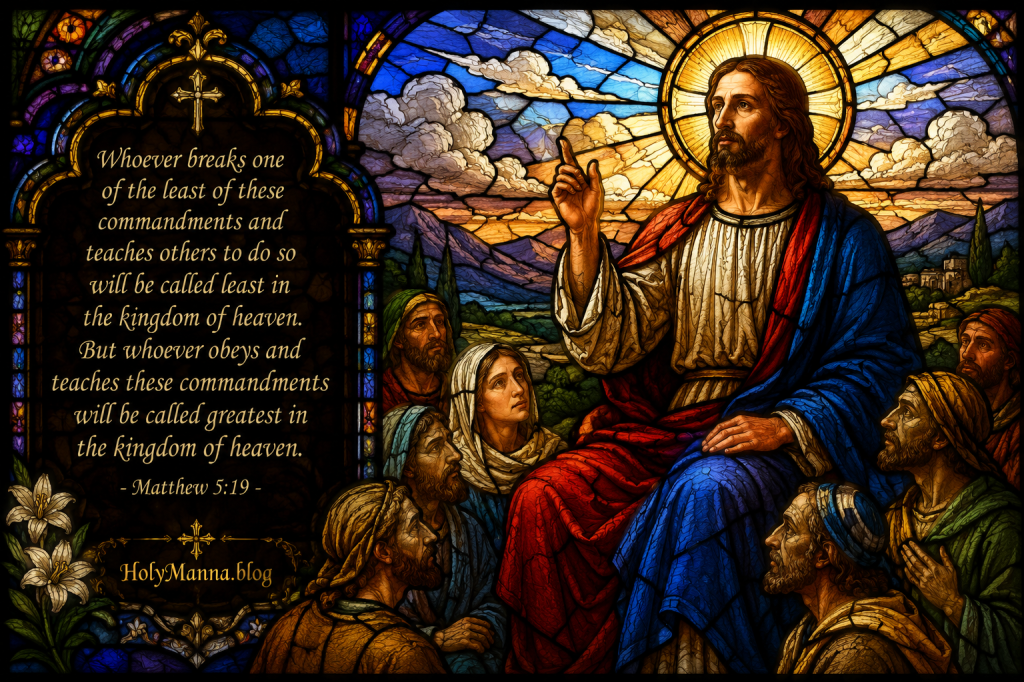
Teaching About the Law. 17 “Do not think that I have come to abolish the law or the prophets. I have come not to abolish but to fulfill. 18 Amen, I say to you, until heaven and earth pass away, not the smallest letter or the smallest part of a letter will pass from the law, until all things have taken place. 19 Therefore, whoever breaks one of the least of these commandments and teaches others to do so will be called least in the kingdom of heaven. But whoever obeys and teaches these commandments will be called greatest in the kingdom of heaven.
Detailed Exegesis
Verse 17 – “Do not think that I have come to abolish the law or the prophets. I have come not to abolish but to fulfill.” Matthew 5:17
Jesus begins with a correction. He knows that His teaching may sound radical, but it is not rebellion against God’s revelation. The “law and the prophets” refers to the sacred heritage of Israel, especially the Torah and the prophetic writings. Jesus is saying that He has not come to destroy what God has spoken. He has come to bring it to completion.
To fulfill does not mean merely to repeat. It means to bring something to its intended purpose. The sacrifices, the Temple, the priesthood, the prophecies, the covenant promises, and the moral law all find their deepest meaning in Christ. He fulfills the sacrifices by offering Himself on the Cross. He fulfills the Temple by becoming God’s presence among us. He fulfills the prophets by accomplishing what they foretold. He fulfills the moral law by revealing its deepest demand, a heart transformed by love.
This matters because the Christian life is not lawlessness. Jesus does not rescue the faithful from obedience. He rescues the faithful for obedience, now made possible through grace.
Verse 18 – “Amen, I say to you, until heaven and earth pass away, not the smallest letter or the smallest part of a letter will pass from the law, until all things have taken place.” Matthew 5:18
Jesus speaks with solemn authority. The phrase “Amen, I say to you” signals a teaching of great weight. He then says that not even the smallest letter or mark of the Law will pass away until all is accomplished. In other words, God’s revelation is not casual. It is not disposable. It is not subject to fashion, pressure, or personal preference.
This does not mean every ceremonial and judicial command of ancient Israel continues in the same way for Christians. Those elements are fulfilled in Christ and transformed in the New Covenant. But the moral law, rooted in God’s wisdom and goodness, remains. The commandments reveal the shape of love because God’s truth does not expire.
This verse also pushes against a very modern temptation: the idea that Jesus is gentle because He asks little of us. The truth is better and more challenging. Jesus is gentle because He gives grace, but He still calls the whole person to conversion.
Verse 19 – “Therefore, whoever breaks one of the least of these commandments and teaches others to do so will be called least in the kingdom of heaven. But whoever obeys and teaches these commandments will be called greatest in the kingdom of heaven.” Matthew 5:19
Jesus now applies His teaching to daily discipleship. The commandments matter, even the ones people might be tempted to treat as small. He warns not only against breaking them, but against teaching others to break them. This can happen through false doctrine, bad example, silence in the face of confusion, or a lifestyle that makes sin seem normal.
The second half of the verse is deeply encouraging. Greatness in the Kingdom is not measured by fame, status, money, influence, or online attention. It is measured by humble fidelity. The one who obeys and teaches the commandments is great because he helps others walk the path of life.
This verse also reminds Catholic parents, teachers, catechists, godparents, sponsors, friends, and parish leaders that every life teaches something. A person teaches by words, but also by habits, priorities, reverence, mercy, modesty, honesty, and courage. The Christian who lives the commandments with love becomes a quiet witness that God’s law is not a burden, but a gift.
Teachings
The Catholic Church teaches that Jesus fulfills the Law, not by weakening it, but by revealing its full meaning. The Catechism of the Catholic Church states: “Jesus did not abolish the Law of Sinai, but rather fulfilled it with such perfection that he revealed its ultimate meaning and redeemed the transgressions against it.” CCC 592
This is the key to understanding the Gospel. Jesus does not cancel what God commanded. He brings it into the light of His own Person. The Law was never meant to be a cold checklist separated from love. It was meant to form a holy people who belonged to God. In Christ, that holiness becomes possible through grace.
The Catechism of the Catholic Church also teaches: “The New Law or the Law of the Gospel is the perfection here on earth of the divine law, natural and revealed. It is the work of Christ and is expressed particularly in the Sermon on the Mount. It is also the work of the Holy Spirit and through him it becomes the interior law of charity.” CCC 1965
This is why the Sermon on the Mount is so important. Jesus is not merely giving higher moral standards from the outside. He is revealing the life of the Kingdom and giving the grace to live it from within. The New Law is not less demanding than the Old. It is deeper because it reaches the heart.
The Catechism continues: “The New Law is the grace of the Holy Spirit given to the faithful through faith in Christ. It works through charity; it uses the Sermon on the Mount to teach us what must be done and makes use of the sacraments to give us the grace to do it.” CCC 1966
This is the Catholic balance that must never be lost. God commands, and God gives grace. The faithful are called to obey, but not by sheer self-reliance. The sacraments give strength. The Holy Spirit writes the law of charity on the heart. Confession restores the sinner. The Eucharist nourishes the disciple. Prayer keeps the soul close to Christ.
St. John Chrysostom, preaching on this passage, taught that Jesus fulfilled the Law by obeying it perfectly and by leading His disciples into a deeper righteousness. His teaching helps the faithful understand that Christ does not relax the moral life. He raises it into its intended fullness. The Lord who says “I have come not to abolish but to fulfill” Matthew 5:17 will soon teach that anger must be healed, lust must be purified, oaths must give way to truthfulness, and love must extend even to enemies.
St. Augustine also saw the Sermon on the Mount as a pattern for Christian life. In his teaching on this Gospel, he presents the sermon as the Lord’s instruction for the heart that seeks blessedness. The commandments of Christ are not random restrictions. They are the road toward the happiness for which the human person was created.
This connects with the First Reading. Elijah repaired the altar before the fire came down. In the Gospel, Jesus repairs the human understanding of the Law. He shows that obedience is not mere external compliance. It is worship offered from a heart converted to God. The same Lord who called Israel away from Baal now calls every disciple away from compromise and into the fullness of truth.
Reflection
This Gospel challenges a very common temptation: wanting Jesus without His commandments. Many people admire Jesus as compassionate, merciful, welcoming, and gentle. All of that is true. But the same Jesus says, “I have come not to abolish but to fulfill.” Matthew 5:17 His mercy does not erase truth. His love does not make obedience optional. His grace does not bless compromise. Instead, He heals the heart so it can finally live in the truth.
The modern heart often wants a faith that feels inspiring but asks very little. Jesus offers something better. He offers a faith that saves, transforms, and reorders the whole life. That means the commandments cannot be treated as outdated rules or personal suggestions. They are the path of life when lived in Christ.
This is where the Gospel becomes very practical. A Catholic disciple can begin by asking whether any commandment has been quietly downgraded. Maybe Sunday Mass has become negotiable. Maybe Confession has been avoided. Maybe gossip is excused as venting. Maybe lust is treated as harmless. Maybe resentment is protected. Maybe honesty is bent when convenient. Maybe Church teaching is accepted only when it already feels easy.
Jesus does not expose these things to shame the soul. He exposes them to heal the soul. The Law fulfilled in Christ is not a cage. It is a road out of slavery. It teaches the heart how to love God and neighbor rightly.
This Gospel also gives a mission. Jesus praises the one who obeys and teaches. That does not mean every Catholic needs a classroom or a microphone. It means every Catholic life should quietly point toward the Kingdom. Parents teach their children by praying at home. Spouses teach by fidelity. Friends teach by refusing to normalize sin. Catechists teach by clarity and charity. Parishioners teach by reverence at Mass. Christians online teach by whether they speak truth with love or merely chase approval.
Which command of Christ has been treated as small, optional, or inconvenient?
Where does the heart want Jesus to comfort, but not correct?
How can obedience become less about fear and more about love this week?
What kind of faith is being taught by daily habits, private choices, and public example?
The Gospel today is not asking for a colder religion. It is calling for a fuller one. Jesus fulfills the Law because He fulfills the human heart. He shows that the commandments are not opposed to love. They reveal what love looks like when it becomes faithful, concrete, and free. The disciple who follows Him does not stand in two places. He lets Christ become Lord of worship, Lord of conscience, Lord of desire, and Lord of everyday life.
Let the Fire Fall Where the Heart Has Been Divided
Today’s readings bring the soul to a holy decision. On Mount Carmel, Elijah asks Israel to stop wavering between the Lord and Baal. In Psalm 16, the faithful heart answers with trust: “You are my Lord, you are my only good.” Psalm 16:2 In the Gospel, Jesus teaches that this undivided love must become real obedience, because He has come not to abolish the Law, but to fulfill it.
Together, these readings tell one clear story. God is not asking for a small corner of the heart. He is asking for the whole heart. He is not one option among many. He is refuge, portion, cup, destiny, joy, and Lord. The false gods of every age may promise comfort, freedom, control, pleasure, or success, but they eventually fall silent. Only the living God answers. Only the Lord can turn hearts back. Only Christ can fulfill the law of love within the soul.
The invitation today is simple, but it is not small. Repair the altar. Return to prayer. Go to Confession. Protect Sunday Mass. Let the commandments of Christ shape ordinary decisions. Refuse the idols that multiply sorrow. Keep the Lord always before the heart. Let faith become more than belief, and let belief become worship, obedience, and love.
Where is God asking for a more complete yes?
What false god needs to lose its place in the heart?
What would change if the Lord truly became the first love, the highest good, and the center of daily life?
The people on Mount Carmel began in silence, but they ended in worship. That same mercy is offered today. A divided heart can become whole. A broken altar can be rebuilt. A tired soul can find the path to life. And when the living God is placed at the center again, the only fitting response is the ancient cry of faith: “The Lord is God! The Lord is God!” 1 Kings 18:39
Engage with Us!
Share your reflections in the comments below. Today’s readings invite every heart to look honestly at worship, trust, and obedience. Elijah asks whether the Lord truly has first place. The psalmist shows the peace of choosing God as the only good. Jesus reveals that love for God becomes concrete through faithful obedience to His commandments.
- In the First Reading from 1 Kings 18:20-39, Elijah asks, “How long will you straddle the issue?” 1 Kings 18:21 Where might God be asking you to stop wavering and choose Him more completely?
- In Psalm 16, the psalmist prays, “You are my Lord, you are my only good.” Psalm 16:2 What false refuge or distraction most often competes with God for your trust, attention, or affection?
- In the Holy Gospel from Matthew 5:17-19, Jesus says, “I have come not to abolish but to fulfill.” Matthew 5:17 Which commandment or teaching of Christ is He inviting you to live with deeper love, humility, and faithfulness?
- Looking at all three readings together, what altar in your life may need to be repaired through prayer, Confession, reverence at Mass, or renewed obedience to God?
May these readings help every heart turn away from silent idols and return to the living God with courage and trust. Let faith become worship, let worship become obedience, and let every word, choice, and act of love be shaped by the mercy Jesus taught us.
Sacred Heart of Jesus, we trust in You!
Immaculate Heart of Mary, pray for us!
Saint Michael the Archangel, defend us in battle!
Follow us on YouTube, TikTok, Instagram and Facebook for more insights and reflections on living a faith-filled life.


Leave a Reply