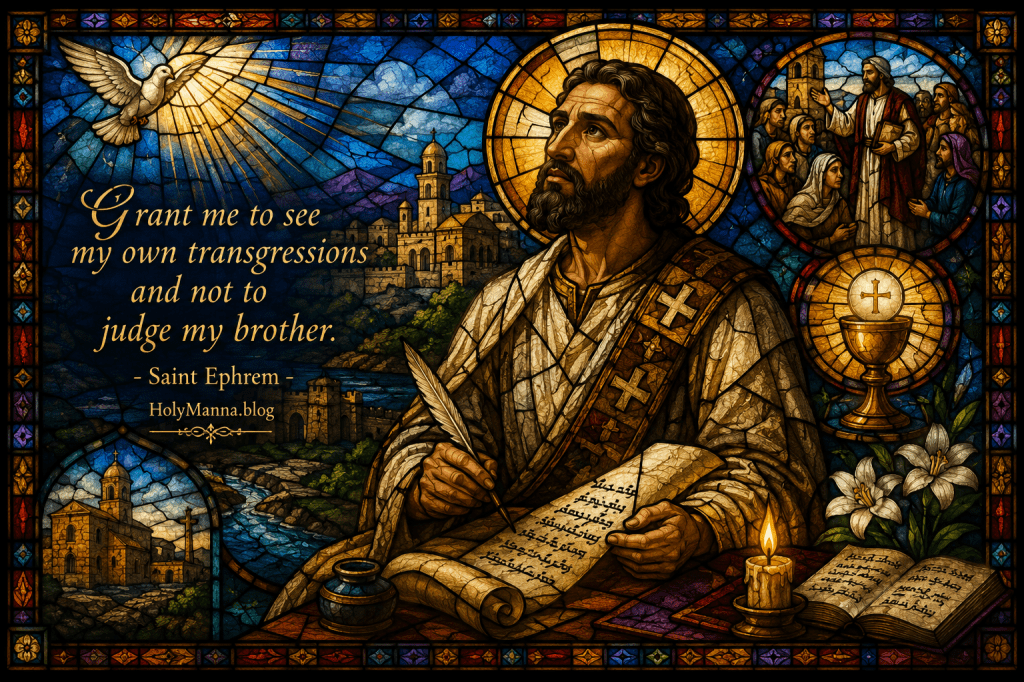
The Harp Who Taught the Church to Sing the Truth
Saint Ephrem the Syrian is one of the most beautiful and surprising saints in the Catholic tradition. He was a deacon, not a priest. He was a theologian, but he did not write like a dry academic. He was a defender of orthodoxy, but his favorite weapon was not a sword or a political platform. It was song.
The Church remembers him as the “Harp of the Holy Spirit,” because his hymns, poems, prayers, and biblical reflections seemed to make the truths of the faith come alive with music. He lived in the fourth century, when the Church was still defending the full divinity of Christ against heresies like Arianism, and when Christian communities in the East were being tested by war, exile, false teaching, famine, and disease.
Saint Ephrem’s greatness is not only that he knew the faith. His greatness is that he made the faith sing. He helped ordinary Christians remember doctrine not just with their minds, but with their hearts. He is one of the great witnesses to the Catholic truth that beauty matters because beauty can serve truth.
This fits deeply with the Catholic vision of faith. The Catechism of the Catholic Church teaches that Scripture must be read within “the living Tradition of the whole Church” and with attention to the unity of God’s plan. Ephrem did exactly that. He read Scripture through Christ, through the Church, through worship, and through the mystery of salvation. His theology was poetic, but it was not vague. It was beautiful because it was true.
A Child of Nisibis
Saint Ephrem was born around the year 306 in Nisibis, a city in Roman Mesopotamia near the border with Persia. Today, that region is associated with southeastern Turkey and the wider Syriac Christian world. Nisibis was not a peaceful little village tucked away from history. It was a frontier city, shaped by Roman and Persian conflict, and surrounded by a mix of cultures, languages, and religious beliefs.
Some older stories say Ephrem’s father was a pagan priest, but more careful Catholic sources are cautious about that claim. Pope Benedict XVI taught that Ephrem was born into a Christian family, while other Catholic sources say he was probably the son of believing parents. What matters most is that Ephrem grew up in a world where Christianity had to be chosen seriously. This was not comfortable cultural religion. This was a faith that had to survive pressure, confusion, and danger.
He came under the influence of Saint James of Nisibis, the city’s holy bishop. Saint James had attended the Council of Nicaea in 325, the great council that defended the truth that Jesus Christ is true God from true God, consubstantial with the Father. That Nicene faith shaped Ephrem’s whole life.
Ephrem was baptized as a young man, which was common in his time, and he became known for his deep knowledge of Scripture. Bishop James saw his gifts and gave him the role of teacher and interpreter of the Bible. Ephrem helped shape the famous school of Nisibis, a major center of Syriac Christian learning.
He was ordained a deacon and remained a deacon for the rest of his life. That detail is easy to pass over, but it is powerful. The Catechism of the Catholic Church, CCC 1570, teaches that deacons share in Christ’s mission of service through the ministry of the word, divine worship, pastoral care, and charity. That was Ephrem’s whole life. He taught the word. He served worship. He guarded the faithful from error. He cared for the suffering.
He did not need a higher title to become a saint. He needed fidelity.
The Deacon Who Refused Glory
Saint Ephrem became famous for his humility. There is a traditional story that he refused to become a priest or bishop, and that he may even have pretended to be foolish or mad in order to avoid being elevated to a higher office. This story cannot be verified with certainty, so it should be treated as a beloved tradition rather than a documented historical event.
Still, the story fits the man the Church remembers. Ephrem did not chase honor. He did not build his life around reputation. His gift was immense, but his posture was lowly.
That humility also appears in the testament attributed to him. As he approached death, he asked not to be buried with pomp or placed in a position of honor in the church. He wanted simplicity. He wanted prayer. He wanted to be remembered not as a great man, but as a sinner who trusted in mercy.
That spirit is also heard in the famous Prayer of Saint Ephrem, treasured especially in the Eastern Catholic and Orthodox traditions during Great Lent: “Grant me to see my own transgressions and not to judge my brother.”
That one line is enough to stop a soul in its tracks. Ephrem knew that holiness begins when a person stops obsessing over everyone else’s sins and finally stands honestly before God.
How different would daily life look if every Catholic prayed that line before speaking, posting, correcting, criticizing, or complaining?
A City Under Siege
Saint Ephrem lived during a time of real danger. Nisibis was attacked multiple times by Persian forces under King Shapur II. The city became a symbol of Christian endurance on the edge of empire.
One of the most famous stories about Ephrem comes from this period. According to tradition, during a Persian siege, Ephrem spoke against the invading army from the walls of the city, and a swarm of flies and mosquitoes descended upon the Persians, helping drive them away. This story is a beloved hagiographical tradition and cannot be verified with modern historical certainty.
Even if the details belong to sacred legend, the meaning is clear. Christians remembered Nisibis as a city defended not merely by walls, soldiers, or strategy, but by prayer. Ephrem was remembered as a man whose faith mattered when fear was real.
There is another ancient story connected to his spiritual authority. A holy elder was said to have seen a dream or vision of Ephrem, and in that vision the elder heard people say that Ephrem taught as if a fountain flowed from his mouth. This also belongs to the world of Christian hagiography, but it beautifully expresses why the Church calls him the “Harp of the Holy Spirit.” His words refreshed thirsty souls.
The Refugee Saint
In 363, after Emperor Julian the Apostate’s failed campaign against Persia, the Roman emperor Jovian surrendered Nisibis to the Persians. The Christian population was forced to leave. Ephrem lost his homeland and became a refugee.
That detail makes his life feel suddenly close. He was not writing hymns from comfort. He knew displacement. He knew grief. He knew what it meant to leave behind a city, a community, and a way of life.
Ephrem eventually settled in Edessa, another major center of Syriac Christianity. There he spent the final decade of his life teaching, preaching, writing, and defending the faith. Edessa was filled with theological confusion. Various heretical movements were active there, including Arian, Gnostic, Marcionite, Manichaean, and Bardesanite influences.
Ephrem did not respond only with arguments. He responded with beauty.
Some false teachers were using catchy songs to spread error among ordinary Christians. Ephrem saw the danger. People remember what they sing. So he took popular melodies and filled them with orthodox doctrine. He composed hymns on Christ, Mary, the Eucharist, Paradise, repentance, the saints, and the mysteries of salvation. He taught the faithful to sing truth until truth became part of their memory.
Some Catholic traditions also say that he trained choirs of women or consecrated virgins to sing these hymns publicly. This is one of the most striking parts of his legacy. Ephrem understood that catechesis was not only for scholars. It belonged to the whole Church.
He used beauty the way the world uses entertainment. He used it to form souls.
The Poet of Christ, Mary, and the Eucharist
Saint Ephrem’s writings are rich, biblical, and deeply Catholic in spirit. He loved symbols, images, paradoxes, and sacred poetry. For him, creation itself was filled with signs pointing to God. One saying attributed to him captures this vision beautifully: “In every place you look, His symbol is there.”
That is not vague spirituality. That is a sacramental imagination. Ephrem saw the world as created by God, wounded by sin, redeemed by Christ, and filled with echoes of divine meaning.
He wrote beautifully about the Incarnation. He loved the paradox that the infinite God became small. The Creator entered creation. The Word became an infant. The One whom the heavens cannot contain was carried in the womb of the Virgin Mary.
His Marian devotion was profound. He praised Mary’s purity, her divine motherhood, and her unique place in salvation history. In one traditional translation attributed to Ephrem, he says of Christ and His Mother: “You alone and your Mother are more beautiful than any others, for there is no blemish in you nor any stains upon your Mother.”
That line shows why Ephrem is so important for understanding early Christian love for Mary. He did not treat Mary as a distraction from Jesus. He honored her because of Jesus. Mary matters because the Word truly became flesh in her womb.
Ephrem also wrote with extraordinary reverence about the Eucharist. In one famous Eucharistic image attributed to him, he says: “In your bread hides the Spirit who cannot be consumed; in your wine is the fire that cannot be swallowed.”
That is powerful Catholic language. Ephrem saw the Eucharist as divine fire, medicine, mystery, and the return to Paradise. His Eucharistic theology harmonizes beautifully with the Catholic faith expressed in The Catechism of the Catholic Church, CCC 1324, which teaches that the Eucharist is “the source and summit of the Christian life.”
Ephrem’s hymns remind the Church that doctrine is not cold. The truth about Christ is meant to be adored.
Stories of Wonder and the Limits of History
Several miracle stories and legends are associated with Saint Ephrem, but they should be handled honestly.
The most famous miracle story from his lifetime is the defense of Nisibis, when flies and mosquitoes were said to have driven away the Persian army after Ephrem prayed or spoke against the invaders. This is a traditional story and cannot be historically verified with certainty.
Another beloved story says an elder saw a vision of Ephrem’s teaching flowing like a fountain from his mouth. This also cannot be verified as history, but it reflects how Christians understood his gift. His words were remembered as living water for the Church.
There is also the tradition that Ephrem met Saint Basil the Great. Some ancient sources preserve this story, and it is possible, but historians are not fully certain about the details. In the story, Ephrem recognizes Basil’s holiness and doctrinal authority, while Basil honors Ephrem’s spiritual wisdom. Whether every detail is historical or not, the story shows the mutual reverence between the Syriac and Greek Christian worlds.
Another famous tradition says Ephrem avoided priestly or episcopal ordination by pretending to be mad. This cannot be verified, but it has long been used to illustrate his humility.
When it comes to miracles after his death, Catholic sources do not preserve a large collection of formally verified posthumous miracle stories like those found in later canonization processes. Ephrem lived long before the modern procedures for investigating miracles and canonizations. His sainthood comes from ancient and continuous veneration by the Church.
There are traditions of reverence for his tomb and relics, especially in the Syriac Christian world, but specific posthumous healings or interventions are not widely documented in Roman Catholic sources. Because of that, it is better to be honest: the greatest posthumous “miracle” attached to Saint Ephrem is the endurance of his voice. His hymns crossed languages, cultures, centuries, and divisions within the Christian East. They continued to teach Christians long after his body was buried.
A Martyr of Charity
Saint Ephrem was not martyred by execution, but his death was still a witness of heroic love.
During a famine in Edessa, Ephrem left his solitude to help organize relief for the poor and hungry. He rebuked the wealthy for hoarding grain while others suffered. He helped gather resources, arrange care, and serve those in need.
When disease spread, he cared for the sick. Eventually, he contracted illness himself and died on June 9, 373.
That ending matters. Ephrem could have been remembered only as a brilliant poet. He could have been remembered only as a theologian. He could have been remembered only as a defender of orthodoxy. But the final chapter of his life was mercy.
He died serving suffering people.
That is Catholic holiness. The same man who wrote about divine fire in the Eucharist found Christ in the sick and hungry. The same deacon who defended doctrine also washed the wounds of the poor. The same saint who taught people to sing the truth also showed them how to live it.
The Catechism of the Catholic Church, CCC 2447, reminds Catholics that the works of mercy are charitable actions by which Christians come to the aid of their neighbor in spiritual and bodily needs. Ephrem lived that before he died. He taught the faith with words, then sealed it with service.
The Voice That Would Not Die
After Saint Ephrem’s death, his influence spread rapidly. Saint Jerome wrote that Ephrem’s works were so treasured that in some churches they were read publicly after Sacred Scripture. That is an astonishing testimony to his influence.
His writings were preserved, translated, prayed, sung, and loved across many Christian traditions. Syriac Christians honored him deeply. Greek, Armenian, Coptic, Chaldean, Russian, and other Christian communities also received his legacy. He became known as the “Sun of the Syrians,” the “Doctor of the Syrians,” the “Column of the Church,” and most famously, the “Harp of the Holy Spirit.”
In 1920, Pope Benedict XV declared Saint Ephrem a Doctor of the Universal Church. That title matters. A Doctor of the Church is not simply an intelligent saint. A Doctor is someone whose teaching has special value for the whole Church.
Ephrem’s recognition as a Doctor reminds Catholics that the Church breathes with the beauty of East and West. The Catholic faith is not trapped in one language, culture, or style. It can be sung in Syriac poetry, defined in Greek theology, preached in Latin clarity, prayed in silence, and lived in charity.
His feast day is celebrated in the Roman Catholic calendar on June 9. He remains especially beloved in the Syriac Christian tradition, and his Prayer of Saint Ephrem remains one of the great prayers of Lent in the Byzantine tradition.
His cultural impact is enormous. Hundreds of hymns attributed to him have survived. He helped shape Christian hymnody, liturgical poetry, Marian devotion, Eucharistic imagery, biblical interpretation, and the use of sacred music as catechesis. He also stands as a patron-like figure for teachers, writers, poets, musicians, catechists, spiritual directors, and all who use beauty to lead others toward God.
What Saint Ephrem Teaches the Church Today
Saint Ephrem is a saint for a noisy age.
Modern people are catechized constantly by music, screens, slogans, trends, and entertainment. Ephrem understood long ago that the heart remembers what it sings. He did not complain that heretics were using beauty effectively. He answered by making truth more beautiful.
That is a lesson Catholics need today. Truth should never be watered down, but it should be presented with beauty, clarity, reverence, and love. The Gospel deserves better than dullness. The faith is not boring. Sin is boring. Christ is not.
Ephrem also teaches humility. He had a brilliant mind, but he did not seek status. He had influence, but he wanted a simple burial. He was a master teacher, but he begged God for repentance. His prayer still cuts through pride: “Grant me to see my own transgressions and not to judge my brother.”
He teaches courage. He defended the truth in an age of heresy. He did not act as if doctrine was optional. He knew that false teaching wounds souls.
He teaches compassion. He did not only sing about Christ. He served Christ in the sick, the hungry, and the poor.
He teaches the Catholic imagination. He saw Scripture, creation, Mary, the Eucharist, Paradise, repentance, and daily life as part of one great mystery centered on Jesus Christ.
What would happen if Catholics today brought that same imagination into family life, parish life, online life, work, art, music, and conversation?
Saint Ephrem’s life says something urgently needed: beauty can defend truth, but only holiness can make beauty credible.
Engage with Us!
Share your thoughts and reflections in the comments below. Saint Ephrem’s life gives so much to consider, especially for anyone who loves Scripture, music, teaching, writing, or serving others in quiet ways.
- How can Saint Ephrem’s use of music and poetry inspire Catholics to share the faith more beautifully today?
- Where is God asking you to stop judging others and begin praying, “Grant me to see my own transgressions”?
- How does Saint Ephrem’s devotion to the Eucharist challenge the way you approach Mass and Holy Communion?
- What part of Saint Ephrem’s life speaks to you most: his humility, his teaching, his courage, his creativity, or his charity?
- How can you use your own gifts, whether writing, music, teaching, hospitality, service, or encouragement, to help someone encounter Christ?
Saint Ephrem reminds the Church that truth is worth defending, beauty is worth offering, and mercy is worth living. May his example help every Catholic speak with courage, create with reverence, serve with humility, and do everything with the love and mercy Jesus taught us.
Saint Ephrem, pray for us!
Follow us on YouTube, TikTok, Instagram and Facebook for more insights and reflections on living a faith-filled life.


Leave a Reply