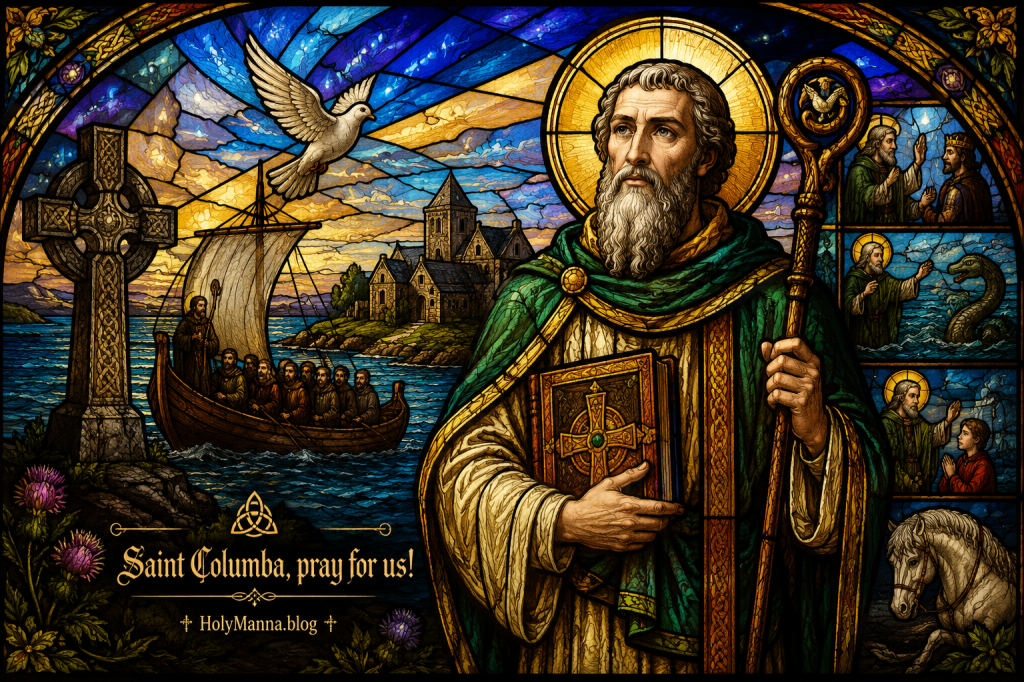
The Dove Who Crossed the Sea for Christ
Saint Columba, also known as Colum Cille or Colmcille, is one of the great missionary saints of the early medieval Church. Celebrated on June 9, he is remembered as an Irish priest, monk, abbot, scholar, scribe, poet, founder of monasteries, and missionary to Scotland. He is also honored as one of the great patron saints of Ireland, alongside Saint Patrick and Saint Brigid.
His name means “dove,” and the fuller Irish form, Colum Cille, is often understood as “dove of the Church” or “dove of the churches.” That name fits him beautifully. Columba carried the Gospel across the sea, not as a conqueror with weapons, but as a monk with Scripture, prayer, courage, discipline, and a heart burning for souls.
He is most known for founding the monastery of Iona, a small island off the western coast of Scotland that became one of the most important missionary centers in Christian history. From Iona, Columba and his monks helped evangelize northern Scotland, especially among the Picts, which is why he is often called the Apostle of the Picts.
From a Catholic perspective, Columba’s life is a powerful reminder that God can turn exile into mission, repentance into holiness, and a small island into a lighthouse for nations. The Catechism of the Catholic Church teaches that the saints are joined to us in Christ and that their holiness strengthens the whole Church. As CCC 946 reminds us, “After confessing ‘the holy catholic Church,’ the Apostles’ Creed adds ‘the communion of saints.’” Columba belongs to that great communion, not as a distant figure from legend, but as a spiritual father whose life still speaks.
Born for Nobility, Chosen for the Church
Saint Columba was born on December 7, 521, traditionally at Gartan in County Donegal, Ireland. He came from a noble Irish family connected to the powerful Uí Néill dynasty, and he was related by blood to kings and chieftains. His father was named Fedhlimidh, and his mother was Eithne, who also came from royal lineage.
But Columba’s greatness did not come from his royal blood. It came from grace.
He was baptized and educated in the faith by a priest named Cruithnechan, who is remembered as his tutor and foster-father. From his earliest years, Columba was formed by Christian teaching, sacred learning, and the life of the Church. He later studied at Movilla under Saint Finnian and at Clonard under another great Saint Finnian, whose monastic school formed many of the saints later known as the Twelve Apostles of Ireland.
Columba was ordained a priest and quickly became known for his learning, discipline, love of Scripture, and leadership. He was not a quiet background figure. He had a strong personality, noble connections, and extraordinary gifts. Yet, under the discipline of grace, those gifts became tools for the Gospel.
Before leaving Ireland, Columba founded or inspired several monasteries, especially Derry and Durrow. Derry, whose Irish name is connected with Columba, remained especially dear to him. These monasteries were not simply places where monks prayed in isolation. They were schools of holiness, centers of learning, places of hospitality, scriptoria for copying sacred texts, and missionary bases for the spread of the faith.
Columba loved books. He loved Scripture. He loved the written Word of God. Tradition says he copied many manuscripts by hand, and his name is closely associated with Ireland’s sacred manuscript culture. The psalter known as the Cathach is traditionally connected to him, and the wider Columban monastic tradition helped prepare the way for masterpieces such as the Book of Durrow and the Book of Kells.
That detail matters. Columba teaches that evangelization is not only preaching out loud. Sometimes it is copying a page of Scripture carefully. Sometimes it is preserving truth in a culture that could forget. Sometimes it is making beauty for the glory of God.
The Book, the Battle, and the Call to Exile
One of the most famous stories associated with Saint Columba concerns a copied psalter, a royal judgment, and a tragic battle. This story is deeply woven into his memory, though Catholic sources rightly treat some details with caution.
According to the traditional legend, Columba secretly copied a psalter belonging to Saint Finnian. A dispute followed over who owned the copy. King Diarmait judged against Columba with the famous saying, “To every cow its calf, and to every book its copy.” This saying is often described as one of the earliest “copyright” stories in Western tradition, though it should be remembered that the line is attributed to the king, not to Columba himself.
The same tradition connects Columba with the Battle of Cúl Dreimhne in 561, where many men were killed. In the penitential version of the story, Columba was told to leave Ireland and win as many souls for Christ as had been lost in the battle. Some historians question whether all the details happened exactly this way, and the earliest sources emphasize Columba’s missionary exile rather than the dramatic battle story. Still, the tradition has long shaped Catholic reflection on his life.
Whether every detail can be verified or not, the spiritual meaning is powerful. Columba’s exile became his mission. If pride, conflict, or sorrow marked part of his early life, God did not waste it. He purified it.
That is a deeply Catholic lesson. Grace does not pretend that human weakness is unreal. Grace heals it, redirects it, and places it at the service of Christ. As CCC 1431 teaches about interior repentance, conversion is “a radical reorientation of our whole life, a return, a conversion to God with all our heart.” Columba’s departure from Ireland can be seen through that lens. He became a pilgrim for Christ.
Iona, the Small Island That Changed Nations
In 563, Columba left Ireland with twelve companions and sailed to Iona, a small island off the western coast of Scotland. Tradition says they traveled in a simple boat, trusting God as they crossed the sea. There, on Iona, they built a humble monastic settlement with simple dwellings, a church, and a life ordered around prayer, fasting, work, study, and mission.
Iona did not look powerful. It was small, remote, windswept, and simple. Yet in the providence of God, it became one of the great spiritual centers of Christian history.
From Iona, Columba and his monks ministered to the Irish settlers of Dalriada and then to the Picts of northern Scotland. His most famous missionary encounter was with King Brude, a Pictish ruler near Inverness. According to the traditional story, when the king’s gates were shut against Columba, the saint made the sign of the Cross, and the gates opened. The king received him with reverence, and the encounter helped open the way for the Gospel among the Picts.
Some versions say King Brude was baptized by Columba, while other Catholic sources are more cautious and simply say Columba’s mission helped prepare the way for the conversion of the region. Either way, Columba’s importance is clear. He carried the faith into places where it had not yet taken deep root, and he did so through monastic witness, preaching, prayer, courage, and holiness.
The Catechism teaches that the Church is missionary by her very nature. As CCC 849 says, “The Church on earth is by her nature missionary.” Columba lived that truth with his whole body and soul. He crossed the sea because Christ deserved to be known, loved, and worshiped.
A Monk of Fire, Discipline, and Tenderness
Saint Columba was a man of strong character. He came from nobility, moved among kings, defended causes, founded communities, and led men with authority. But the Catholic memory of Columba does not present him merely as a powerful leader. It remembers him as a monk transformed by prayer.
He was known for fasting, vigils, study, manual labor, preaching, and copying Scripture. Saint Adomnán, the ninth abbot of Iona and Columba’s great biographer, described him as holy, graceful in speech, and radiant with spiritual joy. Columba was never idle. He prayed, read, wrote, taught, traveled, counseled, and served.
Yet he was not remembered as harsh or cold. Catholic tradition also remembers his tenderness. He helped the poor. He cared for captives and the vulnerable. He prayed for women in childbirth. He helped the sick. He showed concern for those who had sinned and wanted to begin again. He even showed tenderness toward animals, which appears in one of the most touching stories from the end of his life.
Near his death, an old white workhorse that served the monastery came to Columba, placed its head against him, and seemed to weep. When one of the monks tried to drive the animal away, Columba stopped him. He said the Creator had allowed the animal to sense that its master would soon depart. Then he blessed the horse.
That story may sound simple, but it reveals something beautiful. Holiness does not make a person less human. It makes a person more fully alive to God’s creation, more attentive, more merciful, and more gentle.
Miracles on the Road of Mission
Many miracles are associated with Saint Columba, especially through Saint Adomnán’s Life of Saint Columba. Since this work is hagiography, some stories should be read with reverence and prudence. The Church does not ask Catholics to treat every medieval miracle story as a defined doctrine. But Catholic tradition does recognize that God works through His saints, and that miracles can strengthen faith and point souls toward Christ.
One early miracle says that when Columba was still a deacon, there was no wine available for the Holy Sacrifice of the Mass. Columba blessed water in the name of Christ, and it became wine. This miracle naturally echoes Christ’s miracle at Cana and places Columba’s holiness close to the Eucharist, the source and summit of the Christian life. As CCC 1324 teaches, “The Eucharist is ‘the source and summit of the Christian life.’”
Other stories tell of Columba healing the sick, blessing water that brought healing, delivering people from spiritual affliction, calming storms, receiving prophetic knowledge, and seeing souls carried by angels. These stories present him as a man deeply united to God, someone whose prayer became a channel of mercy for others.
One of the most famous stories connected to Columba is his encounter with a beast in the River Ness. According to Adomnán, Columba came upon people burying a man who had been killed by a water beast. When one of Columba’s companions entered the river, the beast rushed toward him. Columba made the sign of the Cross and commanded the creature, “You will go no further. Do not touch the man. Turn back speedily.” The beast fled, and those present glorified God.
This story is often linked to the Loch Ness Monster, although the ancient account speaks specifically of the River Ness. Whether one reads it as a literal miracle story or as part of the hagiographic tradition surrounding the saint, its Catholic meaning is clear. The sign of the Cross is not superstition. It is the sign of Christ’s victory. Columba’s confidence was not in himself, but in the Lord.
Another miracle story says Columba raised a dead child among the Picts. According to the account, the child belonged to a family connected with the new Christian faith, and local pagan religious figures mocked the Christians after the child died. Columba prayed in the name of Jesus Christ, and the child was restored to life. This story cannot be independently verified by modern historical methods, but it belongs to the ancient tradition surrounding his sanctity and missionary witness.
Trials, Exile, and the Cross Without Martyrdom
Saint Columba was not a martyr in the bloody sense. He did not die by execution for the faith. But his life was still marked by the Cross.
He left his homeland. He endured the hardship of voluntary exile. He lived the severe discipline of monastic life. He faced spiritual opposition, political danger, pagan resistance, harsh travel, storms, hunger, and the burden of leading souls. He also carried the weight of penitential memory, especially in the traditions that connect his exile with conflict in Ireland.
There is a lesson here for ordinary Catholics. Not every saint is asked to shed blood, but every saint is asked to die to self. Columba’s martyrdom was the daily martyrdom of obedience, penance, perseverance, and mission.
He also lived in a violent and unstable world. Early medieval Ireland and Scotland were marked by tribal conflict, royal rivalries, hostage-taking, raids, and shifting alliances. Columba’s holiness was not lived in a quiet spiritual bubble. It was lived in the real world, among kings and warriors, sinners and scholars, monks and poets, the sick and the poor.
That makes him deeply relatable. Holiness is not escape from reality. Holiness is fidelity to Christ inside reality.
The Saint Who Defended Poets and Shaped Culture
One of the most fascinating parts of Columba’s life is his role at the assembly of Druim Cett in 575. There, he helped address political matters involving Irish and Scottish rulers. He also became associated with the defense and reform of the Irish poets, known as the filidh.
The poets held an important place in Irish society. They preserved genealogy, memory, law, praise, and story. But their privileges had become controversial. Columba helped preserve the poetic class while also supporting necessary reform.
This is a beautiful Catholic detail. Columba did not treat culture as something to be automatically destroyed. He understood that culture could be purified, disciplined, and ordered toward truth. He did not reject language, memory, beauty, or song. He placed them under Christ.
That is a lesson needed today. Catholic evangelization does not mean becoming boring, rootless, or culturally empty. It means taking every true and beautiful gift and letting Christ make it holy.
A Death Filled with Scripture and Prayer
Saint Columba died on June 9, 597, at Iona. The account of his final hours is one of the most moving scenes in early Christian hagiography.
The day before his death, he was copying Scripture. When he reached the end of a page, he stopped and said, “Here, at the end of the page, I must stop; and what follows let Baithene write.” Baithene was his beloved disciple and successor.
What an image. The old missionary monk, near death, still has Scripture before him. He does not cling to the work as if it belongs to him. He passes it on. The Gospel must continue. The next generation must write the next line.
That night, when the bell rang for the midnight office, Columba went to the church. He entered before the other monks and knelt near the altar. There, in the house of prayer, he collapsed. His monks gathered around him, and he gave them his final blessing.
His last remembered instruction was simple and deeply Catholic: “Be at peace, and have unfeigned charity among yourselves.”
That final line may be the best summary of his entire life. After the journeys, the monasteries, the manuscripts, the miracles, the kings, the battles, the penance, and the preaching, the final word was charity.
The Catechism teaches that charity is the soul of holiness. As CCC 1827 says, “The practice of all the virtues is animated and inspired by charity.” Columba understood that. A monastery without charity is just a building. A mission without charity becomes noise. A brilliant mind without charity can become dangerous. But a soul filled with charity becomes a light.
Relics, Iona, and a Legacy That Outlived Empires
After his death, Columba was buried at Iona. His relics, books, and garments were venerated, and many stories of miracles and divine assistance after his death became attached to his memory.
Because of Viking and Danish raids, his relics were eventually moved for protection. Some traditions connect them with Downpatrick, the place also associated with Saint Patrick and Saint Brigid. His monastic family continued to honor him, and Iona remained a sacred place of pilgrimage, memory, and Christian identity.
One famous posthumous story says that Columba appeared in a vision to King Oswald of Northumbria before battle, encouraging him. After the victory, the spread of Christianity in that region was strengthened. This story cannot be verified in the same way a modern record could be verified, but it belongs to the ancient Christian tradition of Columba’s heavenly intercession and influence.
Iona’s legacy became enormous. It helped shape Christianity in Scotland and northern England. The wider Columban tradition influenced monastic learning, sacred art, manuscript culture, missionary preaching, and the formation of Christian civilization in the British Isles. The island became associated with kings, pilgrims, monks, scholars, and seekers of God.
Modern Catholic devotion to Saint Columba continues, especially in Ireland and Scotland. His feast is celebrated on June 9. In Ireland, he is honored as Saint Columba, Abbot and Missionary, and as a secondary patron of the nation. In Scotland, Iona remains one of the most spiritually significant places connected with early Christianity.
There are also cultural traditions connected with his feast. In parts of northern Scotland, children were once given cakes made from oats or rye in memory of Saint Columba. It is a humble custom, but a beautiful one. Saints are remembered not only in churches and books, but also at kitchen tables, in family stories, in pilgrimages, and in the small traditions that keep faith alive.
The Mission Hidden Inside the Wound
Saint Columba’s life is so powerful because it does not feel polished in an artificial way. He was noble, gifted, intense, learned, and zealous. He was also connected to conflict, exile, and penance. That is exactly why his story matters.
God did not wait for Columba to have a quiet, uncomplicated past before using him. God purified him and sent him.
That is good news for every Catholic who has ever looked back and wondered whether past mistakes, regrets, or wounds disqualify them from mission. Columba’s life says the opposite. In Christ, the wound can become the place where grace enters. The exile can become the beginning. The sorrow can become a school of mercy. The strong personality can become holy when surrendered to God.
Columba also reminds the Church that evangelization requires more than words. It requires prayer, sacrifice, Scripture, beauty, learning, courage, hospitality, repentance, and charity. He did not simply tell people about Christ. He built a community where Christ could be seen.
Where might God be asking you to become a pilgrim for Christ?
What part of your past needs to be surrendered so it can become mission instead of shame?
How can your home, parish, work, or friendships become a little Iona, a small place where Christ is known, loved, and served?
Saint Columba teaches that holiness can cross oceans. It can begin in repentance. It can live in a monastery, a manuscript, a sermon, a meal shared with the poor, a word of peace, or a blessing given at the end of life.
And his last lesson remains the most practical one of all: be at peace, and love sincerely.
Engage with Us!
Share your thoughts and reflections in the comments below. Saint Columba’s life is full of mission, repentance, learning, courage, and charity, and his story gives every Catholic something to ponder.
- What part of Saint Columba’s story speaks most to you: his love of Scripture, his missionary exile, his courage before kings, or his final call to charity?
- Have you ever experienced a season of exile, loss, or disappointment that God later used for something good?
- How can you bring more peace and sincere charity into your family, parish, workplace, or friendships this week?
- What would it look like for you to make your daily life more rooted in Scripture, prayer, and mission like Saint Columba?
May Saint Columba pray for us, that our wounds may become places of grace, our gifts may serve the Gospel, and our lives may point others to Jesus Christ. Let us live with faith, speak with charity, and do everything with the love and mercy Jesus taught us.
Saint Columba, pray for us!
Follow us on YouTube, TikTok, Instagram and Facebook for more insights and reflections on living a faith-filled life.


Leave a Reply