Tuesday of the Tenth Week in Ordinary Time – Lectionary: 360
When the Empty Jar Becomes a Lampstand
Sometimes God teaches the soul to shine by first bringing it to the edge of what it cannot control.
Today’s readings begin in a drought, move through a prayer for deliverance, and end with Jesus telling His disciples, “You are the salt of the earth” and “You are the light of the world” (Matthew 5:13-14). At the center of it all is a simple but demanding theme: faithful trust in God becomes visible witness to the world. The widow of Zarephath trusts the word of the Lord when her jar is nearly empty. The Psalmist seeks the light of God’s face when others only ask for better times. Then Christ calls His disciples to become salt and light, not by chasing attention, but by living such faithful lives that others are led to glorify the Father.
The historical setting of 1 Kings makes this even more powerful. Elijah is prophesying during a time of drought and spiritual corruption, when Israel has been tempted by Baal worship and false promises of fertility, security, and control. God sends His prophet not to a palace, but to a poor widow in Zarephath, a Gentile region connected to Sidon. In a place where human strength seems absent, God reveals His providence through a handful of flour and a little oil. The Catechism teaches that God’s providence is concrete and immediate, guiding all things with wisdom and love (CCC 302-305). Today, that providence appears not as abundance piled high, but as daily bread that does not fail.
The Psalm gives voice to the heart that must choose between fear and faith. “Lord, show us the light of your face” (Psalm 4:7) becomes the prayer of every soul tempted to measure God’s goodness by comfort, wealth, or ease. The widow has almost no grain, yet the Psalm reminds us that the joy God gives is greater “than they have when grain and wine abound” (Psalm 4:8). This is the quiet revolution of faith. The world says joy comes when the jar is full. Scripture says joy comes when the heart belongs to God.
Then Jesus gathers all of this into the mission of the disciple. Salt preserves what would decay. Light reveals what darkness tries to hide. The Church, formed by Christ and sustained by grace, is called to be visible in the world through holiness, charity, courage, and good works. As the Catechism teaches, the laity share in Christ’s mission by the witness of their lives and by announcing Him in the ordinary places where they live and work (CCC 904-905). The readings prepare the heart to see that Christian witness does not begin with being impressive. It begins with surrender.
What if the place where life feels most empty is the very place where God wants to reveal His faithfulness? Today’s readings invite every disciple to bring the nearly empty jar to the Lord, pray for the light of His face, and then live in such a way that others can see the Father’s goodness shining through ordinary faith.
First Reading – 1 Kings 17:7-16
When God Provides Through the Empty Jar
The story of Elijah and the widow of Zarephath takes place during one of the darkest spiritual seasons in Israel’s history. King Ahab had led Israel into the worship of Baal, a false god associated with storms, fertility, rain, and agricultural abundance. So when Elijah announced a drought, it was not merely a weather event. It was a public challenge to idolatry. The living God of Israel was showing that rain, bread, life, and survival do not come from Baal. They come from the Lord.
This makes today’s first reading deeply connected to the theme of hidden trust becoming visible witness. Before Jesus tells His disciples in the Gospel, “You are the salt of the earth” and “You are the light of the world” (Matthew 5:13-14), the widow of Zarephath shows what that light looks like in real life. She is poor. She is a Gentile. She is preparing what she believes will be the last meal for herself and her son. Yet when God’s word reaches her through Elijah, she obeys. Her kitchen becomes a sanctuary of trust. Her empty jar becomes a sign of divine providence.
This reading also prepares the heart to understand the Psalm: “Lord, show us the light of your face” (Psalm 4:7). The widow does not have grain and wine in abundance. She has a handful of flour and a little oil. Yet through faith, she receives the joy of knowing that God sees her, hears her, and provides for her. That is the kind of faith that becomes salt for a decaying world and light for a fearful one.
1 Kings 17:7-16 – New American Bible (Revised Edition)
7 After some time, however, the wadi ran dry, because no rain had fallen in the land. 8 So the word of the Lord came to him: 9 Arise, go to Zarephath of Sidon and stay there. I have commanded a widow there to feed you. 10 He arose and went to Zarephath. When he arrived at the entrance of the city, a widow was there gathering sticks; he called out to her, “Please bring me a small cupful of water to drink.” 11 She left to get it, and he called out after her, “Please bring along a crust of bread.” 12 She said, “As the Lord, your God, lives, I have nothing baked; there is only a handful of flour in my jar and a little oil in my jug. Just now I was collecting a few sticks, to go in and prepare something for myself and my son; when we have eaten it, we shall die.” 13 Elijah said to her, “Do not be afraid. Go and do as you have said. But first make me a little cake and bring it to me. Afterwards you can prepare something for yourself and your son. 14 For the Lord, the God of Israel, says: The jar of flour shall not go empty, nor the jug of oil run dry, until the day when the Lord sends rain upon the earth.” 15 She left and did as Elijah had said. She had enough to eat for a long time—he and she and her household. 16 The jar of flour did not go empty, nor the jug of oil run dry, according to the word of the Lord spoken through Elijah.
Detailed Exegesis
Verse 7 – “After some time, however, the wadi ran dry, because no rain had fallen in the land.”
Elijah had been sustained by God near the Wadi Cherith, where ravens brought him food and water flowed for a time. Now the wadi runs dry. This moment matters because it shows that God’s provision can change without God’s faithfulness changing. The drying wadi does not mean God has abandoned Elijah. It means God is moving him into a deeper lesson of dependence.
Spiritually, this verse speaks to every season when something reliable suddenly fails. A job becomes uncertain. A relationship weakens. A prayer life feels dry. A source of comfort disappears. The Catholic life does not promise that every wadi will keep flowing. It teaches that God remains Father even when the old means of support no longer work. As The Catechism teaches, God’s providence guides creation toward its proper end with wisdom and love (CCC 302).
Verse 8 – “So the word of the Lord came to him:”
The most important thing in the drought is not the lack of rain, but the presence of God’s word. Elijah is not guided by panic, guesswork, or worldly calculation. He is guided by the Lord.
This is essential to the Catholic understanding of faith. God speaks, and the faithful person responds. The spiritual life begins with listening. Before Elijah can go anywhere, he must first receive the word of the Lord. This is why Scripture, Sacred Tradition, prayer, the sacraments, and the teaching authority of the Church matter so much. The Christian life is not built on impulse. It is built on obedience to the God who speaks.
Verse 9 – “Arise, go to Zarephath of Sidon and stay there. I have commanded a widow there to feed you.”
This command would have sounded strange. Zarephath belonged to the region of Sidon, Gentile territory associated with the very world from which Queen Jezebel came. Human wisdom might have expected God to send Elijah to a wealthy Israelite household. Instead, God sends him outside Israel, to a widow who appears to have nothing.
This reveals the freedom of God’s mercy. The Lord is not limited by social rank, national boundaries, or human expectations. Jesus Himself later points to this widow in The Gospel of Luke when He says that Elijah was sent to a widow in Zarephath rather than to all the widows in Israel (Luke 4:25-26). That reference shows that her faith foreshadows the wider mission of salvation, which will extend beyond Israel to the nations.
Verse 10 – “He arose and went to Zarephath. When he arrived at the entrance of the city, a widow was there gathering sticks; he called out to her, ‘Please bring me a small cupful of water to drink.’”
Elijah obeys immediately. He does not wait for a full explanation. He does not demand proof that the plan will work. He rises and goes. His obedience leads him to the very widow God had prepared.
The widow is gathering sticks at the entrance of the city. She is not introduced as powerful, secure, or impressive. She is introduced in poverty and vulnerability. In the ancient world, widows were often among the most economically fragile people in society. Without a husband’s protection and provision, a widow and her child could easily fall into hunger and danger.
Elijah’s request for water is simple, but in a drought, even water is costly. This first request begins the widow’s test of generosity.
Verse 11 – “She left to get it, and he called out after her, ‘Please bring along a crust of bread.’”
The widow begins to respond to Elijah’s request for water, and then he asks for bread. The request deepens the test. It is one thing to give a cup of water. It is another thing to give food when food is nearly gone.
This verse brings the reader to the edge of sacrificial faith. Real trust is not theoretical. It becomes concrete when God asks for something that feels costly. Catholic faith is incarnational, which means grace works through real bodies, real hunger, real homes, real kitchens, real choices, and real sacrifices.
Verse 12 – “She said, ‘As the Lord, your God, lives, I have nothing baked; there is only a handful of flour in my jar and a little oil in my jug. Just now I was collecting a few sticks, to go in and prepare something for myself and my son; when we have eaten it, we shall die.’”
This is one of the most heartbreaking lines in the Old Testament. The widow is not mildly inconvenienced. She is preparing for death. Her words reveal total human helplessness. She has no baked bread, only a handful of flour and a little oil. She has a son to feed, and she believes there is no future left.
Her phrase, “As the Lord, your God, lives”, is also meaningful. She recognizes Elijah’s God, though she calls Him “your God” rather than “my God.” She is on the edge of faith, standing between what she has heard and what she has not yet fully experienced. By the end of the story, she will know the Lord not merely as Elijah’s God, but as the God who provides in her own house.
Verse 13 – “Elijah said to her, ‘Do not be afraid. Go and do as you have said. But first make me a little cake and bring it to me. Afterwards you can prepare something for yourself and your son.’”
Elijah’s first words are crucial: “Do not be afraid.” Scripture often places those words at the beginning of a divine invitation. Fear closes the heart. Faith opens it.
Then Elijah says, “But first make me a little cake.” This is not selfishness. It is a prophetic invitation to place the word of God before fear. The widow is being asked to act as though God’s promise is more reliable than her visible scarcity. This is the heart of faith. She must choose whether the last handful of flour belongs to fear or to God.
This verse also anticipates the Gospel logic of discipleship. Jesus will later teach, “But seek first the kingdom of God and his righteousness, and all these things will be given you besides” (Matthew 6:33). The widow lives that truth before it is spoken in the Sermon on the Mount.
Verse 14 – “For the Lord, the God of Israel, says: The jar of flour shall not go empty, nor the jug of oil run dry, until the day when the Lord sends rain upon the earth.”
Here the promise is spoken clearly. God does not promise luxury. He promises daily provision. The jar will not go empty, and the jug will not run dry until the drought ends.
This is providence in its most humble form. God’s care does not always arrive as excess. Sometimes it arrives as enough. The widow will still return to the jar each day. She will still depend on God each day. The miracle does not remove dependence. It sanctifies dependence.
This connects beautifully to the Lord’s Prayer, where Christians ask for daily bread. God teaches His children not only to receive provision, but to receive it in a way that keeps the heart close to Him.
Verse 15 – “She left and did as Elijah had said. She had enough to eat for a long time, he and she and her household.”
This is the turning point. The widow acts. She does not merely admire the promise. She obeys it. Her faith becomes visible in a simple action: she leaves and does what Elijah said.
That is often how grace enters daily life. The miracle is on the other side of obedience. The widow cannot see the full jar before she gives the first cake. She must trust before she sees. This is why her story is so powerful. Faith is not proven by feelings alone. Faith becomes real when it takes the next obedient step.
Her obedience also becomes fruitful for others. Elijah eats. She eats. Her son eats. Her household is sustained. Hidden trust becomes communal blessing.
Verse 16 – “The jar of flour did not go empty, nor the jug of oil run dry, according to the word of the Lord spoken through Elijah.”
The final verse confirms the faithfulness of God. What the Lord said, the Lord did. The jar and jug become daily witnesses to the truth of God’s word.
The miracle is quiet, repetitive, and domestic. No thunder. No army. No palace. Just flour, oil, a prophet, a widow, a son, and a God who keeps His promise. This is one of the most beautiful things about the reading. God’s glory is not only revealed in dramatic public signs. It is also revealed in the steady faithfulness that keeps a household alive.
Teachings: Providence, Obedience, and the Faith of the Poor
This reading is a profound lesson in divine providence. The widow’s jar teaches what the Church has always believed: God is not distant from His creation. He is intimately involved in the lives of His people, even in their smallest needs.
The Catechism of the Catholic Church teaches, “Creation has its own goodness and proper perfection, but it did not spring forth complete from the hands of the Creator. The universe was created ‘in a state of journeying’ toward an ultimate perfection yet to be attained, to which God has destined it. We call ‘divine providence’ the dispositions by which God guides his creation toward this perfection” (CCC 302).
That teaching helps explain the widow’s story. The drought is real. Hunger is real. Death seems near. Yet God is guiding the story toward life, faith, and revelation. Providence does not mean that life will never become difficult. It means that difficulty is never outside the reach of God’s wisdom.
The Church also teaches that God works through secondary causes, which means He allows human cooperation to matter. In this reading, God provides for Elijah through the widow, and He provides for the widow through Elijah. Their obedience becomes part of His plan.
The Catechism says, “God is the sovereign master of his plan. But to carry it out he also makes use of his creatures’ cooperation. This use is not a sign of weakness, but rather a token of almighty God’s greatness and goodness. For God grants his creatures not only their existence, but also the dignity of acting on their own, of being causes and principles for each other, and thus of cooperating in the accomplishment of his plan” (CCC 306).
That is exactly what happens at Zarephath. God could have fed Elijah without the widow. God could have filled the widow’s house without Elijah. Instead, He gives both of them the dignity of participating in His providence.
The widow also reveals the holiness of the poor who trust in God. Catholic tradition has always recognized a special nearness between poverty of spirit and openness to grace. This does not romanticize suffering. Hunger is not good in itself. Poverty is not automatically holy. But the poor often reveal, with painful clarity, what every soul must learn: human life depends entirely on God.
This is why the widow is remembered so powerfully by Christ. In The Gospel of Luke, Jesus says, “Indeed, I tell you, there were many widows in Israel in the days of Elijah when the sky was closed for three and a half years and a severe famine spread over the entire land. It was to none of these that Elijah was sent, but only to a widow in Zarephath in the land of Sidon” (Luke 4:25-26).
Jesus is not insulting Israel. He is revealing that faith can appear where people least expect it. The widow is a Gentile, yet she receives the prophet. She has almost nothing, yet she gives. She is unknown to the powerful, yet heaven remembers her.
Saint Augustine often taught that God’s gifts are not meant to make the heart proud, but dependent on grace. His famous line from Sermon 169 fits the widow’s story well: “God created us without us: but he did not will to save us without us.” The widow does not save herself, and she does not create the miracle. Yet she cooperates with grace by obeying the word spoken to her.
This is a crucial Catholic point. Grace comes first, but human cooperation matters. The widow’s yes becomes the place where God’s promise takes flesh.
Reflection: Trusting God When the Jar Looks Empty
This reading speaks directly to the places where life feels thin, stretched, and uncertain. Most people know what it feels like to look at some part of life and think, “There is only a handful of flour in my jar and a little oil in my jug” (1 Kings 17:12). It may not be literal hunger. It may be emotional exhaustion, financial stress, spiritual dryness, loneliness, discouragement, or fear about the future.
The widow teaches that faith does not wait until the jar is full. Faith obeys when the jar is low.
That does not mean acting recklessly or pretending problems are not real. The widow is honest about her situation. She names the scarcity. She names the fear. She names the possibility of death. But she does not let fear have the final word. She allows the word of God to interrupt despair.
That is a powerful pattern for daily Catholic life. When fear rises, the first step is to listen for the Lord. The next step is to obey in the concrete thing He asks today. Pray before checking the phone. Go to Mass when the soul feels dry. Give generously even when the budget feels tight. Apologize before pride hardens. Go to confession instead of hiding. Feed someone else even when the heart feels hungry.
The widow’s obedience was small, but it was total. She made a little cake. That was her act of faith. Most holy lives are built the same way. One small yes at a time.
This reading also challenges the way modern life thinks about security. The world says peace comes from having more than enough. Scripture says peace comes from trusting the God who provides enough for today. The world says to protect yourself first. Elijah says, “Do not be afraid” and asks the widow to put God’s word first.
That is uncomfortable because it reaches into the places people guard most tightly: time, money, plans, comfort, reputation, and control. Yet the widow shows that what is surrendered to God is not lost. It becomes the place where providence begins to shine.
What jar feels almost empty right now?
Where is fear asking for the first place in your heart?
What small act of obedience might God be asking for before you see the miracle?
Do you trust God only when abundance is visible, or can you trust Him when all you have is enough for today?
The widow of Zarephath does not preach a sermon. She does not lead an army. She does not hold a title. She simply trusts the word of the Lord when everything in her life says to be afraid. And because she trusts, her home becomes a witness. Her flour becomes a testimony. Her little jug of oil becomes a quiet lampstand.
That is where today’s Gospel begins to glow inside this first reading. Before the disciple becomes light to the world, the disciple must first become faithful in the hidden place. Before good works shine before others, the heart must learn to give God the first cake.
The empty jar is not the end of the story when God is present. Sometimes it is the beginning of the miracle.
Responsorial Psalm – Psalm 4:2-5, 7-8
The Joy That Outlasts Better Times
The Responsorial Psalm gives voice to the heart that stands between fear and faith. After hearing about the widow of Zarephath, who trusts God with her last handful of flour, the Church places on our lips the prayer of someone surrounded by trouble but still reaching for the face of God. This Psalm is traditionally associated with David, and it has long been prayed as an evening prayer, the kind of prayer a faithful soul whispers when the day has been heavy, enemies feel close, and peace must be found in God rather than in circumstances.
In the world of ancient Israel, grain and wine were signs of blessing, harvest, stability, and celebration. A full barn meant security. A good harvest meant hope. Yet Psalm 4 teaches that the deepest joy of the faithful does not depend on overflowing grain or abundant wine. It comes from the light of God’s face. That connects beautifully with today’s theme. The widow in 1 Kings has almost no flour, yet God provides. The Psalmist is hemmed in by trouble, yet God gives joy. In the Gospel, Jesus tells His disciples that they are light for the world. Taken together, these readings show that the disciple’s light is not born from comfort. It is born from trust.
Psalm 4:2-5, 7-8 – New American Bible (Revised Edition)
2 Answer me when I call, my saving God.
When troubles hem me in, set me free;
take pity on me, hear my prayer.3 How long, O people, will you be hard of heart?
Why do you love what is worthless, chase after lies?
Selah
4 Know that the Lord works wonders for his faithful one;
the Lord hears when I call out to him.
5 Tremble and sin no more;
weep bitterly within your hearts,
wail upon your beds,7 Many say, “May we see better times!
Lord, show us the light of your face!”
Selah
8 But you have given my heart more joy
than they have when grain and wine abound.
Detailed Exegesis
Verse 2 – “Answer me when I call, my saving God. When troubles hem me in, set me free; take pity on me, hear my prayer.”
The Psalm begins with urgency. The speaker does not hide his distress. He calls God “my saving God”, which means he is not praying to an abstract power, but to the Lord who rescues, defends, and remains faithful to His covenant.
The phrase “When troubles hem me in, set me free” captures the feeling of being spiritually cornered. This is the prayer of someone who feels pressure from every side. Yet he turns that pressure into prayer instead of despair. This is deeply Catholic. The Church does not teach that prayer requires pretending everything is fine. Prayer brings real fear, real pressure, and real need before the Father.
This verse also echoes the widow’s situation in 1 Kings 17. She is literally hemmed in by famine and death. The Psalm teaches the interior response to that kind of crisis: call on God, ask for mercy, and trust that He hears.
Verse 3 – “How long, O people, will you be hard of heart? Why do you love what is worthless, chase after lies?”
Now the Psalm turns outward. The speaker confronts those who have hardened their hearts. The words “love what is worthless” and “chase after lies” name the temptation of every age. In ancient Israel, this could include idolatry, false worship, empty honor, and trust in human power instead of the Lord.
This line fits the religious background of today’s first reading. Elijah is ministering during a time when Israel has been tempted by Baal worship, a false promise of rain, fertility, and security. The Psalm asks the question behind that temptation: why chase what cannot save?
That question still speaks directly to modern life. People chase approval, comfort, status, lust, money, control, and constant distraction as though these things can satisfy the soul. But the Psalm reminds the reader that the human heart becomes hard when it loves what is empty.
Verse 4 – “Know that the Lord works wonders for his faithful one; the Lord hears when I call out to him.”
This verse restores confidence. The Lord is not deaf to His faithful ones. He hears. He acts. He works wonders.
In Catholic faith, this does not mean God always answers prayer in the exact way or timing expected. It means God’s love is active, wise, and faithful. He hears as Father, not as a machine that dispenses requests. The widow of Zarephath did not receive a palace or a storehouse. She received daily bread. That was wonder enough because it came from the hand of God.
The phrase “his faithful one” points to covenant belonging. The faithful one is not perfect in the sense of never struggling, but is set apart for God. This prepares the heart for the Gospel. Jesus calls His disciples salt and light because they belong to Him, and belonging to Him makes their lives visible signs of God’s goodness.
Verse 5 – “Tremble and sin no more; weep bitterly within your hearts, wail upon your beds.”
This verse moves from trust to repentance. The Psalm does not treat emotional intensity as an excuse for sin. It says, in effect, let your trembling lead you back to God. Let your unrest become repentance. Let the silence of the night become the place where the heart turns away from sin.
The mention of the bed is important. This is private, hidden prayer. It is what happens when the noise of the day is gone and the soul has to face God honestly. Many sins begin because people refuse to sit with the truth of their own hearts. The Psalm invites the reader to let conscience speak in the presence of God.
In the Catholic life, this verse naturally points toward examination of conscience and confession. God does not expose sin to crush the soul. He reveals sin to heal it. The same Lord who hears the cry for help also calls the sinner away from hardness of heart.
Verse 7 – “Many say, ‘May we see better times! Lord, show us the light of your face!’”
This verse names a very human desire. “May we see better times!” is the cry of every tired heart. Better finances. Better health. Better relationships. Better leadership. Better culture. Better circumstances. There is nothing wrong with asking God for relief, but the Psalm lifts the prayer higher.
The better prayer is “Lord, show us the light of your face!” In Scripture, the light of God’s face means His favor, presence, blessing, and nearness. This prayer echoes the priestly blessing from Numbers: “The Lord let his face shine upon you, and be gracious to you!” (Numbers 6:25).
This also connects directly to today’s Gospel. Jesus tells His disciples, “You are the light of the world” (Matthew 5:14), but the disciple’s light comes from first receiving the light of God’s face. Christians do not shine because they are impressive. They shine because they have been turned toward God.
Verse 8 – “But you have given my heart more joy than they have when grain and wine abound.”
This is the spiritual center of the Psalm. Grain and wine represent abundance, harvest, and earthly gladness. The Psalmist does not deny that these are good. In Catholic tradition, created goods are gifts from God. Bread and wine themselves become signs of the Eucharist, where Christ gives His very Body and Blood.
But the Psalmist says God has given him a joy greater than material abundance. This joy is not shallow optimism. It is the fruit of communion with God. It is the joy of a heart that knows the Lord is near, even when life is not easy.
This verse belongs beside the widow’s jar. She does not have grain and wine abounding. She has a handful of flour and a little oil. Yet God’s providence becomes her joy. The world measures blessing by how much is stored up. The Psalm measures blessing by the presence of God.
Teachings: Prayer, Joy, and the Light of God’s Face
The Psalm teaches that prayer begins with God’s initiative and ends in deeper trust. The soul calls out because God has already drawn near. The Catechism of the Catholic Church explains this beautifully: “God calls man first. Man may forget his Creator or hide far from his face; he may run after idols or accuse the deity of having abandoned him; yet the living and true God tirelessly calls each person to that mysterious encounter known as prayer. In prayer, the faithful God’s initiative of love always comes first; our own first step is always a response.” (CCC 2567).
That teaching shines through Psalm 4. The Psalmist calls because God has already invited the relationship. Even when the heart feels trapped, prayer is not shouting into emptiness. Prayer is responding to the God who has already turned toward His people.
The Psalm also teaches the testing of trust. When troubles hem the heart in, prayer becomes difficult. The Catechism says, “Filial trust is tested, it proves itself, in tribulation. The principal difficulty concerns the prayer of petition, for oneself or for others in intercession. Some even stop praying because they think their petition is not heard. Here two questions should be asked: Why do we think our petition has not been heard? How is our prayer heard, how is it efficacious?” (CCC 2734).
This is exactly the spiritual struggle inside the Psalm. The faithful person asks God to answer, but also learns to seek something deeper than immediate relief. The prayer moves from “May we see better times!” to “Lord, show us the light of your face!” (Psalm 4:7). That movement is the heart of mature faith.
Saint Augustine loved the Psalms because he saw in them the voice of Christ and the voice of the Church. Speaking of the restless human heart, he famously prayed in Confessions, “You have made us for yourself, O Lord, and our heart is restless until it rests in you.” That truth belongs perfectly with Psalm 4. The human heart cannot find lasting rest in grain, wine, better times, or worldly success. It rests only in God.
This Psalm also points toward Christian joy. The Church does not define joy as a good mood or a comfortable life. Joy is a fruit of the Holy Spirit, rooted in communion with God. The Catechism says, “The fruits of the Spirit are perfections that the Holy Spirit forms in us as the first fruits of eternal glory. The tradition of the Church lists twelve of them: charity, joy, peace, patience, kindness, goodness, generosity, gentleness, faithfulness, modesty, self-control, chastity.” (CCC 1832).
That is why the Psalmist can say that God gives more joy than material abundance. This joy is supernatural. It is not produced by circumstances. It is formed by grace.
Historically, Psalm 4 has also been cherished as a night prayer. In the Church’s prayer, the night often becomes a school of trust. At the end of the day, the faithful entrust their anxieties, sins, regrets, and unfinished work to God. The Psalm teaches the soul to sleep not because everything is solved, but because God hears.
Reflection: Asking for the Light, Not Just Easier Days
This Psalm is painfully honest about the way people pray when life feels heavy. Many say, “May we see better times!” (Psalm 4:7). That prayer is understandable. There are seasons when anyone would ask for better times. Better health. Better peace at home. Better financial stability. Better culture. Better news. Better energy. Better answers.
God is not offended by that prayer. He is a Father. He knows what His children need. But Psalm 4 gently raises the question: what if better times are not enough? What if the soul gets better circumstances but still lacks the light of God’s face?
That is the difference between comfort and communion.
The widow of Zarephath needed bread, and God gave bread. But the greater gift was that she encountered the God who provides. The Psalmist wants relief, but the deeper request is for God’s face. The disciple in the Gospel is called to shine, but that light must first be received from the Lord.
This applies directly to ordinary Catholic life. When anxiety rises, prayer should not be the last resort after every other strategy has failed. It should be the first movement of the heart. Before scrolling, before spiraling, before venting, before assuming the worst, the soul can pray, “Answer me when I call, my saving God” (Psalm 4:2).
The Psalm also invites a nightly examination of conscience. “Tremble and sin no more” (Psalm 4:5) is a call to stop excusing what hardens the heart. Before bed, a Catholic can ask where the day was spent chasing lies. Was there gossip? Was there envy? Was there impurity? Was there resentment? Was there pride? Was there neglect of prayer? That honest look is not meant to create despair. It is meant to lead the soul back to mercy.
The practical path is simple and demanding. Call on God when trouble presses in. Reject what is worthless. Stop chasing lies. Let the conscience speak. Ask for the light of God’s face. Then receive the joy that comes from Him rather than from perfect circumstances.
What “better times” are you asking for right now, and have you also asked for the light of God’s face?
Where has the heart been chasing what is worthless or loving what cannot save?
When trouble hems you in, do you turn first to prayer or first to panic?
What would change if every night ended with an honest examination of conscience and an act of trust in God?
The Psalm does not deny hunger, pressure, fear, or longing. It simply teaches the faithful where to bring them. The world says joy comes when grain and wine abound. The Psalm says joy comes when the face of God shines on the heart.
That is the joy that does not run dry.
Holy Gospel – Matthew 5:13-16
The Faith That Refuses to Hide
The Gospel brings today’s readings into full light. After the widow of Zarephath trusts God with her nearly empty jar, and after the Psalmist asks, “Lord, show us the light of your face” (Psalm 4:7), Jesus turns to His disciples and tells them what a life touched by God is meant to become. It is meant to be salt. It is meant to be light. It is meant to preserve, illuminate, and point others toward the Father.
These words come from the Sermon on the Mount, one of the most important teachings in The Gospel of Matthew. Jesus has just proclaimed the Beatitudes, blessing the poor in spirit, the meek, the merciful, the pure of heart, the peacemakers, and those persecuted for righteousness. Then He tells His disciples that this blessed life is not meant to stay hidden inside private devotion. It must become visible holiness.
In the ancient world, salt was precious because it seasoned food, preserved it from corruption, and was connected to covenant and sacrifice. Light was essential in homes, cities, worship, and daily life. A lamp was not decorative. It was necessary. A city on a mountain could be seen from far away. Jesus uses these ordinary images to reveal something extraordinary: the disciple’s life is meant to make God visible.
This fits today’s theme perfectly. Hidden trust becomes public witness. The widow’s obedience in a small kitchen becomes a sign of God’s providence. The Psalmist’s prayer for the light of God’s face becomes the light Christ now shares with His Church. A Christian does not shine because he is impressive. A Christian shines because he belongs to Christ.
Matthew 5:13-16 – New American Bible (Revised Edition)
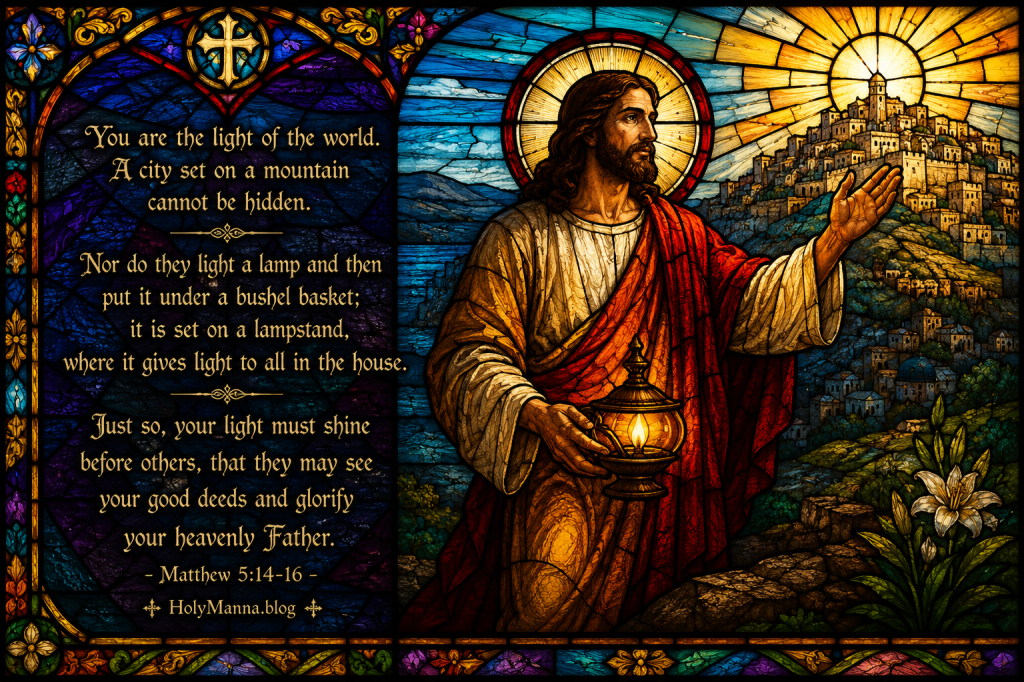
13 “You are the salt of the earth. But if salt loses its taste, with what can it be seasoned? It is no longer good for anything but to be thrown out and trampled underfoot. 14 You are the light of the world. A city set on a mountain cannot be hidden. 15 Nor do they light a lamp and then put it under a bushel basket; it is set on a lampstand, where it gives light to all in the house. 16 Just so, your light must shine before others, that they may see your good deeds and glorify your heavenly Father.
Detailed Exegesis
Verse 13 – “You are the salt of the earth. But if salt loses its taste, with what can it be seasoned? It is no longer good for anything but to be thrown out and trampled underfoot.”
Jesus begins with identity. He does not say, “Try to become salt one day.” He says, “You are the salt of the earth” (Matthew 5:13). The disciple already has a mission because the disciple already belongs to Christ.
Salt had several meanings in the biblical world. It gave flavor. It preserved food from decay. It was also associated with sacrifice and covenant. In Leviticus, offerings were to be seasoned with salt, a sign of permanence and fidelity before God. So when Jesus calls His disciples salt, He is saying that they are meant to preserve the world from spiritual decay by living the covenant faithfully.
This is not a call to be loud, harsh, or argumentative. Salt works quietly, but it changes what it touches. A Catholic life should do the same. In a family, workplace, parish, school, friendship, or online space, the disciple preserves what is good by practicing truth, charity, chastity, patience, courage, humility, and mercy.
Jesus also gives a warning. Salt that loses its taste becomes useless. This is a serious word for any Christian tempted to become indistinguishable from the world. A disciple who hides the faith, softens truth into comfort, or keeps Catholic conviction buried out of fear has lost the very flavor Christ gave him. The world does not need bland Christianity. It needs holy Christianity.
Verse 14 – “You are the light of the world. A city set on a mountain cannot be hidden.”
Jesus now moves from salt to light. This is astonishing because elsewhere Christ reveals Himself as the true Light. Yet here He gives His disciples a share in His mission. Christians do not produce light from themselves. They reflect the light of Christ.
The image of a city set on a mountain would have been easy for His listeners to picture. A raised city could be seen from a distance, especially at night. It could not pretend to be invisible. Its position made it public.
This is what discipleship is meant to be. Faith is personal, but it is never merely private. Catholic life is not meant to be reduced to a quiet opinion kept safely inside the heart. Baptism places a Christian in Christ and sends him into the world as a visible witness. The disciple does not need to perform holiness for applause, but he must not bury holiness out of fear.
This verse also connects beautifully with the Psalm. The Psalmist prays, “Lord, show us the light of your face” (Psalm 4:7). In the Gospel, those who receive that light are now sent to reflect it. The light of God’s face becomes the light of Christian witness.
Verse 15 – “Nor do they light a lamp and then put it under a bushel basket; it is set on a lampstand, where it gives light to all in the house.”
Jesus uses a household image. A lamp is lit for a purpose. It belongs on a lampstand so that everyone in the house can benefit from its light. To place it under a basket would defeat the purpose of lighting it in the first place.
This verse speaks directly to fear, embarrassment, and spiritual laziness. Some people hide the light because they fear rejection. Some hide it because they do not want to be seen as different. Some hide it because they are comfortable. Some hide it because they think evangelization belongs only to priests, religious, theologians, or people with a platform.
Jesus says the lamp belongs on the lampstand.
In Catholic life, the lampstand can be very ordinary. It can be the dinner table where a family prays together. It can be the office where someone refuses dishonesty. It can be a friendship where someone speaks the truth with charity. It can be a phone screen where someone chooses purity over temptation. It can be a parish where someone serves without needing recognition. It can be a confession line where someone humbly begins again.
The light is not meant to draw attention to itself. It is meant to help others see.
Verse 16 – “Just so, your light must shine before others, that they may see your good deeds and glorify your heavenly Father.”
This verse gives the purpose of Christian witness. Jesus does not say, “Let your light shine so people will admire you.” He says the goal is that others may “glorify your heavenly Father” (Matthew 5:16).
This protects discipleship from pride. Good works are necessary, but they must point beyond the disciple. The Christian life should make people more aware of God, not more impressed with the Christian’s image.
The words “good deeds” are important. Jesus is not describing faith as a vague feeling or private inspiration. Faith becomes visible through works of love. Feeding the hungry, forgiving enemies, caring for the poor, defending truth, honoring marriage, protecting the vulnerable, serving the lonely, and living with integrity all become ways the light of Christ shines in the world.
This is where today’s first reading and Gospel meet. The widow’s good deed was simple. She gave bread. Yet that small act became a testimony to God’s faithfulness. In the same way, the disciple’s ordinary acts of faith, mercy, sacrifice, and courage can become a lampstand for the Father’s glory.
Teachings: The Visible Holiness of the Church
This Gospel teaches that Christian identity carries a public mission. Baptism does not make someone a private admirer of Jesus. It makes the person a member of His Body, called to share in His priestly, prophetic, and kingly mission. The Church is visible in the world because Christ wills His disciples to be visible signs of His truth and love.
The Catechism of the Catholic Church teaches, “The fidelity of the baptized is a primordial condition for the proclamation of the Gospel and for the Church’s mission in the world. In order that the message of salvation can show the power of its truth and radiance before men, it must be authenticated by the witness of the life of Christians. The witness of a Christian life and good works done in a supernatural spirit have great power to draw men to the faith and to God.” (CCC 2044).
That is almost a direct commentary on today’s Gospel. Jesus says, “Your light must shine before others” (Matthew 5:16), and the Church teaches that the Gospel’s truth must be authenticated by Christian witness. The world needs doctrine, but it also needs to see doctrine embodied. It needs the Creed lived at the kitchen table, in the workplace, on the internet, in friendships, in marriage, in parenting, in suffering, and in service.
The Catechism also describes the mission of the lay faithful in the world: “Their ‘prophetic’ role is to evangelize, that is, ‘the proclamation of Christ by word and the testimony of life.’ For lay people, ‘this evangelization acquires a specific property and peculiar efficacy because it is accomplished in the ordinary circumstances of the world.’” (CCC 905).
This teaching is deeply connected to salt and light. Most Catholics will not preach from pulpits, but every Catholic has a pulpit of ordinary life. The home, office, classroom, parish, gym, hospital room, group chat, and neighborhood are all places where the light can shine.
Saint John Chrysostom, preaching on this passage, warned Christians not to live only for themselves. In his Homilies on the Gospel of Matthew, he taught, “For it is not for your own life apart, but for the whole world, that your account is to be taken.” That line captures the weight of the Gospel. The disciple’s holiness is never merely personal improvement. It is part of God’s mercy toward the world.
Saint Augustine also helps illuminate this passage. In The Sermon on the Mount, he explains that good works must be done not for human praise, but for God’s glory. The danger is not that others see good works. Jesus commands that they be seen. The danger is wanting the glory to stop with the disciple instead of rising to the Father.
This is why humility is essential. A Christian who hides the light fails the mission. A Christian who uses the light for self-glory corrupts the mission. The holy path is to shine in such a way that people look past the disciple and praise God.
There is also a Eucharistic depth here. The same Church that is called to be light is fed by Christ, the Light of the world. The same people called to preserve the world from corruption are preserved by grace through the sacraments. No disciple can remain salty or luminous by willpower alone. The lamp must be fed by oil. The soul must be fed by Christ.
Reflection: Stop Hiding the Light Christ Gave You
This Gospel is both encouraging and uncomfortable. Jesus says, “You are the salt of the earth” and “You are the light of the world” (Matthew 5:13-14). That is a dignity, but it is also a responsibility.
Many Catholics today feel the pressure to become quiet, vague, and harmless. Faith is tolerated as long as it stays private. Moral conviction is acceptable as long as it never challenges anyone. Prayer is fine as long as it never leaves the church building. But Jesus does not call His disciples to be hidden lamps. He calls them to shine.
That does not mean becoming obnoxious. It does not mean turning every conversation into a debate. It does not mean performing holiness online or correcting everyone with a cold heart. Salt without charity becomes harsh. Light without humility becomes glare. But charity without truth becomes sentimentality, and humility without courage becomes fear.
The Catholic life needs all of it together: truth, charity, courage, humility, prayer, sacrifice, and visible goodness.
This Gospel can begin very simply. Let the light shine at home first. Pray before meals, even when guests are present. Speak kindly when sarcasm would be easier. Put the phone away and give real attention. Ask forgiveness when wrong. Bring peace instead of drama.
Then let the light shine in public. Refuse dishonest shortcuts at work. Do not laugh along with cruelty or impurity. Defend the dignity of the person who is being mocked. Share the faith naturally when the moment opens. Wear Catholic identity without shame. Invite someone to Mass. Offer to pray for someone and then actually pray.
And most importantly, let good works point to the Father. The disciple is not the destination. The disciple is the lampstand. The light belongs to Christ.
Where have you been tempted to hide your Catholic faith because it feels easier to stay quiet?
What part of your life needs to become salt, preserving what is good instead of blending into what is decaying?
Do your good works lead others to glorify God, or do they quietly seek approval for yourself?
How can your home become a lampstand for Christ this week?
The widow of Zarephath became a witness through a hidden act of trust. The Psalmist found joy in the light of God’s face. Now Jesus tells His disciples to become that light in the world.
The Church does not need Catholics who are famous. She needs Catholics who are faithful. She needs men and women who trust God when the jar is low, pray when trouble presses in, and shine without shame when the world grows dark.
A lamp belongs on the lampstand. A city on a mountain cannot be hidden. A disciple who belongs to Christ is meant to help others see the Father.
When Trust Becomes Light
Today’s readings leave the heart with one clear invitation: trust God in the hidden place, and let that trust become light for the world.
The widow of Zarephath stands at the edge of death with only a handful of flour and a little oil, yet she hears the word of the Lord and obeys. Her faith is not dramatic. It is simple, costly, and real. She gives the first cake, and God turns her empty jar into a daily sign of His providence. The Psalmist then teaches the soul how to pray when trouble presses in: “Lord, show us the light of your face” (Psalm 4:7). The true joy of the faithful is not found merely when grain and wine abound, but when the heart knows that God is near. Then Jesus brings everything into focus by saying, “You are the salt of the earth” and “You are the light of the world” (Matthew 5:13-14).
This is the path of Catholic discipleship. The Lord feeds the heart in scarcity, steadies the soul in prayer, and sends His people into the world as witnesses. A Christian does not become light by pretending life is easy. A Christian becomes light by trusting God when the jar is low, praying when the heart is hemmed in, and choosing holiness when it would be easier to blend into the darkness.
The call today is not to become impressive. It is to become faithful. Give God the first place, especially in the area that feels most uncertain. Bring Him the fear, the scarcity, the exhaustion, the private struggle, and the little bit that still feels left. Then let His grace turn ordinary obedience into visible witness.
Where is God asking for trust before there is proof?
What part of your life needs the light of His face today?
How can your words, choices, and good works help someone else glorify the Father?
The widow’s jar did not run dry. The Psalmist’s heart found joy beyond abundance. The disciple’s lamp belongs on the lampstand. Today, the Lord invites every heart to live the same mystery: trust Him in the quiet place, and let that trust shine.
Engage with Us!
Share your reflections in the comments below. Today’s readings invite a deep and honest conversation about trust, prayer, and witness. The widow of Zarephath teaches us to give God the first place when the jar looks empty. The Psalmist teaches us to seek the light of God’s face when life feels heavy. Jesus teaches us that faith is not meant to stay hidden, but to shine before others so they may glorify the Father.
- First Reading, 1 Kings 17:7-16: Where is God asking you to trust Him with your “last handful of flour,” and what would it look like to place Him first in that area of your life?
- Responsorial Psalm, Psalm 4:2-5, 7-8: When trouble hems you in, do you ask only for better times, or do you also ask the Lord to show you the light of His face?
- Holy Gospel, Matthew 5:13-16: Where is Jesus calling you to be salt and light this week, especially in a place where it would be easier to stay quiet or blend in?
May these readings help every heart trust God more deeply, pray more honestly, and live more visibly as a disciple of Christ. The world does not need hidden lamps or tasteless salt. It needs faithful Catholics who live with courage, humility, joy, and mercy. Let everything be done with the love and mercy Jesus taught us, so that our lives may help others see the goodness of the Father.
Sacred Heart of Jesus, we trust in You!
Immaculate Heart of Mary, pray for us!
Saint Michael the Archangel, defend us in battle!
Follow us on YouTube, TikTok, Instagram and Facebook for more insights and reflections on living a faith-filled life.


Leave a Reply