The Bishop Who Sheltered Souls in the Storm
Saint Medard of Noyon is one of those saints whose life feels both ancient and surprisingly relatable. He lived in sixth-century northern Gaul, in what is now France, during a time when the old Roman world was fading, the Frankish kingdoms were rising, and many communities were still fragile, fearful, and only partly formed by the Gospel.
He is remembered as a bishop, missionary, confessor, and father to the poor. He was not a martyr, and he did not leave behind a famous book of theology. His holiness was written in a different language. It was written in mercy, practical charity, courage, patience, and pastoral care.
Saint Medard is most famous for his compassion toward the poor, his missionary work in northern Gaul and Flanders, his connection to Saint Radegund, the miracles reported during and after his life, and the beloved legends that made him a patron against storms, rain, toothaches, imprisonment, and hardship. His feast day is celebrated on June 8.
In a Catholic world that sometimes feels battered by spiritual storms, Saint Medard still speaks. He reminds the faithful that holiness is not only found in grand speeches or dramatic sacrifice. Sometimes holiness looks like giving away a cloak, protecting the vulnerable, forgiving a thief, sheltering a soul, and trusting Christ when the sky turns dark.
The Catechism of the Catholic Church teaches that “God blesses those who come to the aid of the poor and rebukes those who turn away from them” CCC 2443. Saint Medard lived that truth before it was written in a catechism. His life became a sermon of charity.
A Child of Picardy Formed by Faith and Mercy
Saint Medard was born around the year 456 or 457 in Salency, in Picardy, in northern France. His father is traditionally named Nectardus or Nectard, a man of Frankish origin, while his mother, Protagia or Protogia, was Gallo-Roman. Catholic tradition remembers his mother as a woman of deep Christian piety, and some accounts say she helped bring her husband more fully into the Christian faith.
This detail matters because Medard grew up in a world where Christian culture was still being formed among peoples with different customs, backgrounds, and loyalties. His own home reflected that meeting of worlds. Frankish strength and Gallo-Roman Christian culture came together in a child who would become one of the great bishops of northern Gaul.
Tradition also connects Saint Medard with Saint Gildard, Bishop of Rouen. Some Catholic sources say Gildard was his brother, and later tradition even says they were twins who were born on the same day, consecrated bishops on the same day, died on the same day, and entered heaven together. That beautiful story belongs more to devotional tradition than firm historical record, but it shows how deeply the Christian imagination loved to see holiness reflected in family bonds.
From his youth, Medard was known for tenderness toward the poor. One of the most famous stories says that when he was still young, he gave his coat to a poor blind man. When asked why he had done it, he reportedly said that “the misery of a fellow-member in Christ so affected him” that he could not refuse to share his clothing.
This saying comes through hagiographical tradition rather than from any writing of Medard himself. No verified writings of Saint Medard are known to survive. Still, the story captures the heart of his sanctity. He saw the poor not as problems, strangers, or interruptions, but as fellow members of Christ.
Another story says that Medard once gave one of his father’s horses to a poor man who had lost his only horse. When his father later counted the animals, the number had not decreased. According to the tradition, this miracle convinced his parents to allow Medard greater freedom in giving alms. This story cannot be historically verified, but it expresses the Catholic conviction that generosity never truly impoverishes the soul.
Long before he became a bishop, Medard had already learned the grammar of Christian love. He did not wait to become important before becoming charitable. He did not wait to have authority before becoming merciful. He simply saw a need and responded like a disciple of Jesus.
A Priest Whose Life Preached Before His Words Did
Saint Medard was ordained a priest around the age of thirty-three. Catholic tradition remembers him as a powerful preacher, but the secret of his preaching was not cleverness. It was credibility.
People listened because his life matched his words. He prayed. He fasted. He practiced humility. He showed patience. He cared for the poor. He did not speak about mercy as an idea. He lived mercy as a habit.
This is an important lesson for every Catholic. The world has no shortage of opinions. What it desperately needs is witness. Saint Medard reminds the faithful that a holy life gives weight to holy words.
The Catechism of the Catholic Church teaches that the Church’s love for the poor is part of her constant tradition, inspired by the Gospel of the Beatitudes, the poverty of Jesus, and His concern for the poor. CCC 2444. Saint Medard’s life shows this beautifully. His compassion was not sentimental. It was concrete.
He gave. He forgave. He preached. He protected. He served.
The Bishop Who Guided the Church Through Troubled Times
In 530, after the death of the Bishop of Vermand, Medard was chosen to succeed him. Catholic tradition says he resisted the office, as many saints have done, because he understood the weight of the responsibility. Eventually, he accepted the burden of pastoral leadership.
Some accounts say he was consecrated by Saint Remigius of Reims, the great bishop who baptized King Clovis. Whether every detail can be proven or not, Medard clearly belonged to the generation of Catholic leaders who helped shape Christian life among the Franks after the conversion of Clovis and the growing influence of the Church in Gaul.
Soon after becoming bishop, Medard transferred the episcopal see from Vermand to Noyon. This was not a minor administrative move. Vermand was exposed to danger and difficult to defend during a violent period of wars and invasions. Noyon was stronger and safer, a better place from which to protect the Church and serve the people.
That decision reveals something important about Medard. He was not only a gentle saint of legends and miracles. He was also a practical shepherd. He understood that charity sometimes requires organization, leadership, prudence, and the courage to make difficult decisions.
After the death of Saint Eleutherius, Bishop of Tournai, Medard was also asked to care for Tournai. He reportedly resisted this added responsibility too, but eventually accepted after pressure from King Clotaire. The dioceses of Noyon and Tournai remained united for centuries, until the twelfth century.
As bishop, Medard worked to evangelize parts of northern Gaul and Flanders, where pagan customs and rough moral conditions still lingered. Catholic tradition remembers him as a missionary bishop who preached Christ with patience and courage. Some accounts say he faced threats from those who resisted the Gospel, yet continued his work with meekness and perseverance.
The Catechism of the Catholic Church teaches that bishops, as successors of the apostles, are entrusted with teaching, sanctifying, and governing the people of God. CCC 888 to 896. Saint Medard lived this mission in a world that needed all three. He taught the faith, sanctified through sacramental and pastoral care, and governed with prudence in unstable times.
Mercy for Thieves and Miracles of Conversion
Several memorable stories are associated with Saint Medard’s charity and miracles during life. These stories cannot all be historically verified, but they have been treasured in Catholic tradition because they reveal the kind of man the faithful remembered him to be.
One story says that thieves stole honey from Medard. As they fled, the bees pursued them until the thief confessed and asked forgiveness. Another story says that a thief stole a bull from Medard, but the bell around the animal’s neck would not stop ringing until the thief returned what he had taken.
The most remarkable part is not merely the strange miracle. It is Medard’s response. According to the story, when the thieves repented, Medard gave them what they had tried to steal.
That is not weakness. That is Gospel strength.
Saint Medard did not pretend sin was harmless. Theft is theft. But he understood that the goal of Christian correction is not humiliation. It is repentance and restoration. His mercy gave the sinner a way back.
This is why his life feels so needed today. Modern culture often swings between two extremes. It either excuses sin completely or crushes sinners without mercy. Saint Medard shows a more Catholic way. Name the sin. Call the sinner back. Then open the door to grace.
The Gospel never teaches cold vengeance. Jesus teaches mercy that heals and truth that saves.
The Eagle, the Rain, and the Saint Who Shelters
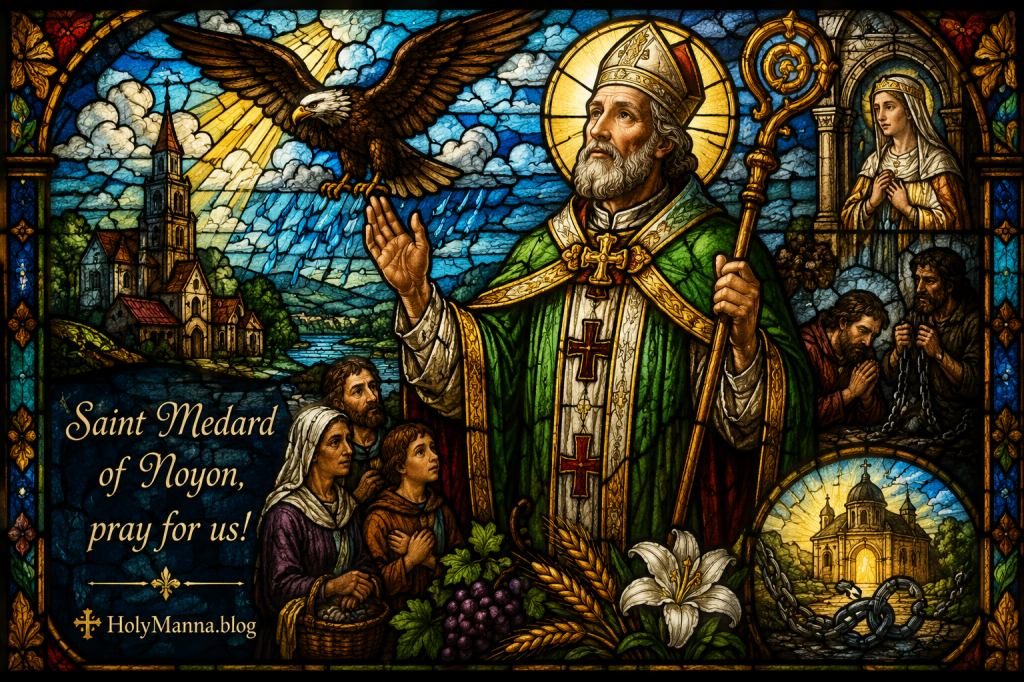
The most famous legend of Saint Medard says that when he was a child, he was caught in a sudden rainstorm. As the rain fell, an eagle spread its wings over him and kept him dry.
This story cannot be historically verified, but it became one of the most beloved images associated with Saint Medard. In sacred art, he is often shown with an eagle sheltering him from the rain. Over time, this helped connect him with storms, rain, good weather, harvests, vineyards, farmers, and those who work outdoors.
A popular French proverb developed around his feast day: “Should Saint Medard’s day be wet, it will rain for forty yet.” The idea was that rain on June 8 meant forty more days of wet weather, while good weather on his feast meant fair skies ahead. This is folk tradition, not Catholic doctrine, but it shows how deeply his memory entered the daily life of ordinary Catholic people.
It is easy to smile at weather sayings, but the deeper image is beautiful. Saint Medard became known as a saint of shelter.
The eagle sheltering him from rain became a symbol of the way God sheltered him. Then Medard, in turn, became a shelter for others. He sheltered the poor through almsgiving. He sheltered frightened communities through wise leadership. He sheltered sinners through mercy. He sheltered captives through intercession. He sheltered Saint Radegund when she sought consecrated life.
The legend may not be verifiable, but the spiritual truth is clear. Saints become signs of God’s protection.
A Bishop Who Helped a Queen Seek God
One of the most important historical and spiritual connections in Saint Medard’s life is his relationship with Saint Radegund, Queen of the Franks.
Radegund had been married to King Clotaire, a powerful and violent ruler. After much suffering, she sought to leave the royal court and dedicate herself to God. Catholic tradition says she came to Bishop Medard at Noyon, and he gave her the religious veil. She later became one of the great holy women of the early medieval Church and founded the monastery of the Holy Cross at Poitiers.
This moment reveals Medard as more than a local bishop. He was a spiritual father to souls seeking holiness in complicated circumstances.
Radegund’s story was not simple. She was a queen. Her marriage involved politics, power, and pain. Medard’s role required courage and discernment. He helped a woman of royal status step away from worldly power and toward a life consecrated to Christ.
There is something deeply Catholic here. The Church does not measure greatness by crowns, comfort, or influence. The Church measures greatness by holiness.
Saint Medard helped Radegund choose the better crown.
A Holy Death and a Tomb Filled With Signs of Mercy
Saint Medard died on June 8. Traditional Catholic sources often place his death around 545, though some early historical evidence and later scholarship suggest the year may have been closer to 557 or 558. The exact year is debated, but the Catholic memory is clear. He died revered as a holy bishop and father of his people.
At first, he was buried in his own cathedral. Soon, many miracles were reported at his tomb. King Clotaire then had his body translated to Soissons, near the royal manor of Crouy, where a church and later the great Benedictine Abbey of Saint-Medard were built over his relics.
The shrine became an important place of veneration. Saint Gregory of Tours, one of the most important early witnesses to the cult of the saints in Gaul, wrote of broken chains and shackles preserved at Medard’s tomb. These were remembered as signs that prisoners had been miraculously freed through the saint’s intercession.
This is one of the strongest and most moving parts of Medard’s legacy. He became a saint for captives, prisoners, and those trapped by chains.
Some of those chains may have been literal. Others were surely spiritual. Fear can be a chain. Sin can be a chain. Shame can be a chain. Addiction can be a chain. Despair can be a chain.
The Catholic Church teaches that the saints continue to intercede for the faithful. The Catechism of the Catholic Church says, “They do not cease to intercede with the Father for us” CCC 956. This is how Catholics understand the miracles associated with Medard after death. His love did not end at the grave because, in Christ, charity is stronger than death.
The Laughing Saint, the Rose Queen, and a Culture Shaped by Holiness
Saint Medard’s legacy spread widely in northern France. He became a patron invoked against bad weather, toothache, imprisonment, sterility, and other hardships. He was also associated with farmers, peasants, vineyards, brewers, harvests, captives, and prisoners.
One unusual detail is that he is sometimes depicted laughing with his mouth open. Because of that image, popular devotion came to invoke him against toothache. It is one of those wonderfully human details that shows how Catholic devotion often meets ordinary people in ordinary suffering.
Another beautiful tradition connected to Saint Medard is the Rosière of Salency, also called the Rose Queen tradition. According to local Catholic tradition, Medard established a yearly honor for a young woman known for exceptional virtue. She would be crowned with roses and given a gift, often described as a stipend or monetary reward. Later accounts say she was escorted to church by twelve boys and twelve girls and honored publicly for her virtue.
This tradition cannot be fully verified in all its earliest details, but it became an important cultural expression of Medard’s memory. It reflected a deeply Catholic instinct. A Christian community should honor virtue. Not fame. Not vanity. Not popularity. Virtue.
Imagine a culture where young people are publicly honored for modesty, charity, purity, fidelity, and goodness. That is the kind of society Catholic holiness tries to build.
Saint Medard’s influence was not limited to private devotion. His memory shaped weather lore, local festivals, pilgrimage, art, patronage, and popular Catholic imagination. He became one of those saints whose life continued to echo in the fields, homes, churches, and prayers of ordinary people.
A Saint Worth Remembering Today
Saint Medard is worth remembering because he teaches a form of holiness that is practical, steady, and merciful.
He was not famous for conquering armies. He was famous for giving to the poor. He was not remembered for harshness toward sinners. He was remembered for calling thieves to repentance and then surprising them with generosity. He was not a bishop who hid from trouble. He moved his see, strengthened the Church, preached in difficult places, and cared for souls during a violent age.
His life points back to Christ the Good Shepherd.
Jesus says, “I am the good shepherd. A good shepherd lays down his life for the sheep” John 10:11. Saint Medard lived that shepherd’s heart in his own time and place. He protected. He guided. He forgave. He evangelized. He sheltered.
The faithful do not need to be bishops to imitate him. A parent can imitate Saint Medard by making the home a shelter from the storms of the world. A teacher can imitate him by forming young people in virtue. A friend can imitate him by correcting with mercy instead of cruelty. A parishioner can imitate him by seeing the poor as fellow members of Christ. A struggling Catholic can imitate him by refusing to let dark times become an excuse for spiritual laziness.
Who in daily life needs shelter rather than judgment?
Who needs generosity instead of suspicion?
Where is Christ asking His people to bring mercy into a storm?
Saint Medard’s answer is simple and demanding. Give what can be given. Forgive where mercy is possible. Tell the truth with charity. Protect the vulnerable. Stay faithful when the weather turns.
Engage With Us!
Share your thoughts and reflections in the comments below. Saint Medard’s life gives so much to reflect on, especially for anyone trying to live the faith with courage, mercy, and practical love in a world that often feels stormy.
- What part of Saint Medard’s life challenges you the most: his charity to the poor, his mercy toward thieves, his courage as a bishop, or his protection of those in need?
- Is there someone in your life who needs you to be a shelter in the storm right now?
- How can you practice mercy without ignoring truth or excusing sin?
- What spiritual chain do you need to ask Christ to break in your life through prayer, confession, and the intercession of the saints?
- How would your family, parish, or community look different if virtue were publicly honored the way the Rose Queen tradition honored goodness?
Saint Medard of Noyon reminds the faithful that holiness does not always look dramatic. Sometimes it looks like a cloak given away, a thief forgiven, a frightened soul protected, a poor person seen, and a storm endured with trust in God. May his example encourage every Catholic to live with faith, courage, compassion, and the love and mercy Jesus taught us.
Saint Medard of Noyon, pray for us!
Follow us on YouTube, TikTok, Instagram and Facebook for more insights and reflections on living a faith-filled life.


Leave a Reply