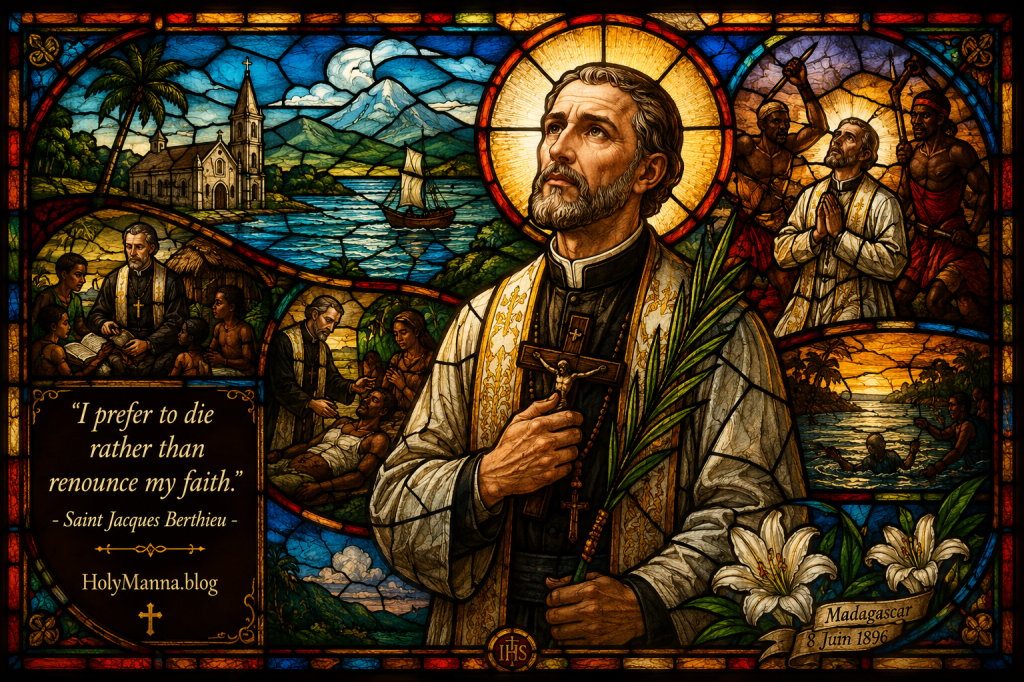
A Shepherd in a Time of Fire
Saint Jacques Berthieu was a French Jesuit priest, missionary, catechist, and martyr who gave his life for Christ in Madagascar. He is remembered as a faithful shepherd who refused to abandon his people, even when war, fear, and persecution surrounded them. He was born in France, served as a diocesan priest, entered the Society of Jesus, and spent the last decades of his life bringing the Catholic faith to the Malagasy people.
He is most known for his martyrdom during the Menalamba revolt in 1896. When his captors pressured him to renounce Christianity, he refused. His most famous words still echo with the courage of the martyrs: “I prefer to die rather than renounce my faith.”
The Church honors him as a witness to the truth of the Gospel. The Catechism of the Catholic Church teaches that martyrdom is “the supreme witness given to the truth of the faith.” CCC 2473. Saint Jacques Berthieu lived that truth not only at the moment of death, but through years of hidden sacrifice, pastoral tenderness, and missionary perseverance.
He was canonized by Pope Benedict XVI on October 21, 2012, and his feast day is celebrated on June 8. He is often remembered as Madagascar’s first officially recognized martyr.
A Country Boy Called to the Altar
Jacques Berthieu was born on November 27, 1838, in Polminhac, in the Cantal region of Auvergne, France. He came from a rural farming family, where the rhythms of work, prayer, and Catholic life shaped him from childhood. He was baptized the same day he was born, a beautiful reminder that his life began under the sign of grace.
He studied with the Brothers of the Christian Schools in Aurillac and later entered the minor seminary at Pléaux when he was fifteen. He continued his formation at the major seminary of Saint-Flour and was ordained a diocesan priest in the 1860s, most commonly listed as May 21, 1864. Some Catholic sources give 1863, so the exact year appears differently across records, but his priestly identity is never in doubt.
After ordination, he served for about nine years as a parish vicar in Roannes-Saint-Mary. These years formed him in the ordinary duties of priestly life. He learned to preach, confess, teach, visit the sick, and walk with families through the simple and difficult moments of life.
Yet the Lord was preparing him for something more. In 1873, already in his mid-thirties, Father Berthieu entered the Society of Jesus. This detail is worth noticing. He did not begin the most famous chapter of his life as a teenager or even as a young priest. He began it after years of parish ministry.
His life quietly reminds every Catholic that God’s call does not expire. The Lord can begin a new mission in a soul long after the world thinks the “exciting years” are over. What mission might God still be preparing in the hidden places of your life?
As a Jesuit, Father Berthieu was deeply formed by the Spiritual Exercises of Saint Ignatius of Loyola and by devotion to the Sacred Heart of Jesus. This devotion became one of the spiritual engines of his life. The Sacred Heart taught him that Christ’s love is not vague or sentimental. It is a pierced, suffering, Eucharistic, merciful love that gives everything for the salvation of souls.
The Priest Who Became Father and Mother
In 1875, Father Jacques Berthieu left Marseille for the Madagascar mission. His first assignment was on the island of Sainte-Marie, now called Nosy Boraha. Missionary life was not romantic or easy. He struggled with the Malagasy language, and because he was no longer a very young man, learning it was difficult. His memory was not as flexible as it once had been.
But he persevered. Eventually, the people were able to understand him clearly. That small victory says something important about sanctity. Holiness is not always natural talent. Sometimes holiness is a tired priest studying one more lesson, practicing one more phrase, and refusing to quit because souls are worth the effort.
On Sainte-Marie and later in other mission areas, he taught catechism, baptized converts, prepared children for First Holy Communion, regularized marriages, visited the sick, cared for lepers, supported schools, and helped teach practical agriculture. He served the whole person, body and soul.
The Malagasy people came to love him deeply. Some remembered him as both father and mother to them. Pope Benedict XVI later described how the people saw him as “a priest come down from heaven.” That may sound dramatic to modern ears, but it shows how deeply his priesthood touched ordinary people. He was not merely passing through. He belonged to them.
He was especially devoted to catechesis. One beautiful story says that a young teacher once saw Father Berthieu studying the catechism while traveling on horseback. The young man wondered why a priest would still be studying such a basic book. Father Berthieu answered, “My son, the catechism is a book one can never understand deeply enough, since it contains all of Catholic doctrine.”
That quote is pure Catholic wisdom. The faith is not something we master once and then move beyond. The mysteries of God deepen as we return to them. A child can learn the catechism, but even a priest, missionary, and future martyr can keep discovering its riches.
He also had a deep love for the Eucharist. Witnesses remembered how often he was found on his knees in prayer. He loved the Rosary, the Blessed Virgin Mary, Saint Joseph, the Sacred Heart, and the Blessed Sacrament. His courage did not come from personality alone. It came from communion with Christ.
No Recorded Wonders, But a Life Full of Grace
Catholic sources do not preserve verified accounts of Saint Jacques Berthieu performing extraordinary miracles during his lifetime. There are no well-attested stories of him healing the sick instantly, multiplying food, or performing dramatic signs like some saints of earlier centuries.
That honesty matters. Saints do not need invented miracles to be holy.
The grace of Saint Jacques Berthieu’s life was visible in pastoral charity. He visited lepers and brought them food, clothing, catechesis, and the sacraments. He cared for the dying with urgency and tenderness. He once told his people that whether he was eating or sleeping, they should not hesitate to call him for someone near death, because visiting the dying was one of his strictest priestly duties.
That may not look spectacular in the world’s eyes, but it looks very much like the Gospel. Christ says in The Gospel of John, “I am the good shepherd. A good shepherd lays down his life for the sheep.” John 10:11. Father Berthieu lived that verse long before he died for it.
He also defended Christian marriage and challenged practices that harmed families. In a culture where polygamy was common, he taught the Catholic vision of marriage as faithful, exclusive, and permanent. This was not always popular. The truth rarely is. But he preached it because he believed the Gospel was not only a message to be admired. It was a life to be lived.
One surprising detail from his life shows his courage in another way. Catholic sources recount that he once rebuked a French colonel for immoral behavior toward local women. This cost him protection later. That detail matters because it prevents his story from being reduced to politics. He was a French missionary in a colonial setting, but he was not simply a servant of colonial power. He was a priest of Jesus Christ, and he challenged sin even when it came from his own countrymen.
The Red Shawls and the Gathering Storm
Father Berthieu’s final trial came during the Menalamba revolt in 1896. The Menalamba, whose name is often translated as “red shawls,” resisted French colonial rule and also opposed Christianity, which they associated with foreign influence and the weakening of traditional religious structures.
The history is complicated, and Catholic storytelling should not flatten it. There were political, cultural, and colonial tensions in Madagascar at the time. Yet the Church recognizes Father Berthieu as a martyr because he was directly pressured to renounce the Catholic faith and refused.
In March 1896, danger grew around his mission territory. French forces judged the area too difficult to defend and ordered people to evacuate. Father Berthieu refused to abandon the Christians entrusted to him. He became sick and weak and was eventually brought to Antananarivo to recover. There he prayed for long hours before the Blessed Sacrament and made what he may have believed would be his final retreat.
Then he returned to his people.
That is the whole soul of Saint Jacques Berthieu in one sentence. He returned.
On June 7, 1896, around two thousand refugees under his care were ordered to move toward Antananarivo under French escort. As the group traveled, the soldiers moved ahead, while the weak, elderly, sick, and children fell behind. Father Berthieu moved among them on horseback, encouraging them and helping them continue.
Then he heard the cries of a mission worker who could no longer walk. Father Berthieu gave the man his horse and continued on foot. It was an act of mercy, but it made him vulnerable. Soon he was separated from protection.
He escaped briefly with some Christians to Ambohibemasoandro, where he spent the night. The next morning, June 8, he celebrated Mass. It was his final Mass.
Later that day, Menalamba fighters entered the village, found him, captured him, and stripped him of his cassock. When they saw the crucifix around his neck, one of them tore it away and mocked it as an amulet. They asked whether he would continue to pray and teach others to pray.
Father Berthieu answered, “I have to pray until I die.”
That is the kind of sentence that sounds simple until it costs everything.
The Martyr Who Would Not Renounce Christ
The captors beat Father Berthieu, mocked him, wounded him, and forced him to march. Even while suffering, he remained a priest. One account says that when a man approached him along the way, Father Berthieu asked, “Have you received baptism, my son?” When the man said no, Father Berthieu gave him a cross and medals and told him to pray to Jesus Christ every day, learn the Christian religion, and ask for baptism when he found a priest.
This is a stunning detail. He was being led toward death, and still he was thinking about another soul’s salvation.
At one point, he was brought near a church he himself had helped build, but he was refused entry. So he knelt outside and prayed the Our Father and the Hail Mary. His captors continued mocking him, especially his crucifix and Rosary.
Finally, near Ambiatibe, his captors decided to kill him. A chief offered to spare his life if he would renounce Christianity and stop “misleading” the people. Father Berthieu refused. The famous words attributed to him summarize the heart of every martyr: “I prefer to die rather than renounce my faith.”
Several shots were fired. Some missed. One wounded him without killing him. He remained on his knees in prayer. Finally, a shot fired at close range killed him.
It was June 8, 1896.
His body was thrown into the Mananara River and was never recovered.
There is a powerful story connected to his teaching on the resurrection. Father Berthieu had reportedly told his Christians, “Even if you were to be devoured by a crocodile, you would rise again.” After his body disappeared in the crocodile-infested waters of the Mananara River, that saying became unforgettable among the faithful. It was not a magical legend. It was a missionary’s vivid way of teaching the Catholic doctrine of the resurrection of the body.
This is deeply Catholic. The Church teaches that death is real, but it is not final. Christ rose bodily from the dead, and those who belong to Him will rise. The martyr’s body may be lost to the river, but the martyr himself is not lost to God.
The Blood That Became Seed
After his death, Father Jacques Berthieu’s reputation for martyrdom spread in Madagascar and France. Catholics remembered him as the shepherd who stayed with his flock until the end. His cause for canonization was investigated in the twentieth century, and Pope Paul VI beatified him on October 17, 1965, during the Second Vatican Council.
Pope Paul VI called him Madagascar’s protomartyr. In Catholic tradition, the word “protomartyr” means the first recognized martyr of a particular place or community. This title gave special honor to the Church in Madagascar and recognized the fruitfulness of Father Berthieu’s witness.
There is also a striking tradition connected to the aftermath of his death. Pope Paul VI noted that the blood of this martyr bore fruit, including the later conversion and baptism of some connected to his killing. That detail is one of the most Christian parts of his story. The martyr does not die cursing his enemies. He dies in Christ, and Christ can turn even violence into grace.
This reflects the mysterious power of martyrdom. The Catechism of the Catholic Church teaches that martyrdom is witness to the truth of the faith, but it is also an act of charity. The martyr bears witness not only by refusing to deny Christ, but by loving Christ more than life itself.
Saint Jacques Berthieu was canonized by Pope Benedict XVI on October 21, 2012, on World Mission Sunday. Pope Benedict presented him as a model for priests, missionaries, persecuted Christians, and all who are called to remain faithful in difficult times.
The Miracle That Opened the Door to Canonization
The official miracle recognized for Saint Jacques Berthieu’s canonization involved the healing of Jean François Régis Randriamiadana in Madagascar. Catholic sources describe him as suffering from a severe and dangerous condition after food poisoning, with grave symptoms and no adequate medical solution.
His family prayed through the intercession of Blessed Jacques Berthieu. They also used water associated with the Mananara River and leaves from the place connected with the martyr’s final journey. The healing was described as sudden and complete. The Church later investigated the case, and medical experts judged the healing scientifically inexplicable. After theological review, Pope Benedict XVI approved the miracle, allowing Father Berthieu to be canonized.
There are also local devotional stories associated with the Mananara River, where his body was thrown. Some faithful have connected water from that place with healing and intercession. These stories belong to the devotional memory surrounding the saint, though not every local account can be verified in the same way as the official canonization miracle.
Today, Ambiatibe is a major place of memory and pilgrimage. The Society of Jesus has described the shrine connected with Saint Jacques Berthieu as more than a single location. It includes a path of about twelve kilometers, following the route of his final suffering from Ambohibemasoandro to the Mananara River. Pilgrims can walk a Way of the Cross through the landscape of his martyrdom.
This is a powerful form of Catholic memory. The faithful do not simply read about the martyr. They walk with him. They pray where he prayed. They remember that discipleship is not an idea. It is a road.
In France, his memory also remains alive, especially in his native region of Cantal. The parish Saint Jacques Berthieu en Carladès bears his name, and his hometown of Polminhac continues to honor him. His witness belongs to Madagascar, to France, to the Jesuits, and to the whole Catholic Church.
A Saint for Anyone Tempted to Walk Away
Saint Jacques Berthieu is not remembered because he built an empire, wrote a famous book, or performed dramatic miracles during his lifetime. He is remembered because he stayed faithful.
He stayed when the language was difficult. He stayed when mission life was exhausting. He stayed when anti-religious laws uprooted him. He stayed when colonial conflict made everything dangerous. He stayed with the sick, the poor, the lepers, the children, the dying, and the frightened. He stayed with his people when he could have saved himself.
Most of all, he stayed with Jesus.
That is why his life speaks so clearly today. Many people are tempted to walk away from the faith when it becomes inconvenient, misunderstood, demanding, or costly. Some drift away because prayer feels dry. Some pull back because Catholic teaching challenges them. Some stay silent because being publicly Catholic can be awkward. Saint Jacques Berthieu reminds the Church that love is proven by fidelity.
His life also reminds Catholics that catechesis matters. He kept studying the catechism because he knew the faith was deeper than slogans. A Catholic who wants to follow Christ well must keep learning, praying, and being formed by the Church. The faith is not a childhood subject. It is a lifelong pilgrimage.
He reminds priests and parents, catechists and teachers, godparents and parish volunteers, that the people entrusted to us need shepherds who do not disappear when life gets messy. The world has plenty of influencers. The Church needs witnesses.
Where is Christ asking you to stay faithful when it would be easier to leave?
Who has God entrusted to your care, and how can you serve them with the patience of a good shepherd?
What would change if every Catholic treated the catechism, the Eucharist, and the Rosary not as old religious habits, but as sources of courage for real life?
Saint Jacques Berthieu teaches that holiness is not always loud. Sometimes it is a priest on horseback studying the catechism. Sometimes it is a missionary bringing food to lepers. Sometimes it is a pastor giving up his horse to help a weaker man. Sometimes it is a bleeding martyr kneeling in prayer and saying, “I prefer to die rather than renounce my faith.”
The world may forget many things, but heaven does not forget fidelity.
Engage with Us!
Share your thoughts and reflections in the comments below. Saint Jacques Berthieu’s life gives us a powerful reminder that faith is not only something we profess when life is peaceful. It is something we cling to when love becomes costly.
- What part of Saint Jacques Berthieu’s story challenged you the most?
- Have you ever experienced a moment when staying faithful to Christ cost you something?
- How can you deepen your own understanding of the Catholic faith through Scripture, the catechism, prayer, and the sacraments?
- Who in your life needs you to be more like a good shepherd, patient, present, and faithful?
- What is one practical way you can live with more courage, compassion, and trust in Jesus this week?
May Saint Jacques Berthieu pray for us, especially when faith feels difficult and love requires sacrifice. May his witness help us stay close to Jesus, serve others with courage, and do everything with the love and mercy Christ taught us.
Saint Jacques Berthieu, pray for us!
Follow us on YouTube, TikTok, Instagram and Facebook for more insights and reflections on living a faith-filled life.


Leave a Reply