Monday of the Tenth Week in Ordinary Time – Lectionary: 359
Blessed When the Stream Runs Low
There are moments when faith becomes real because there is nothing left to lean on except God.
Today’s readings bring us into that holy place of dependence. In 1 Kings 17:1-6, Elijah stands before King Ahab and announces a drought, not as a random act of judgment, but as a direct challenge to Israel’s false worship of Baal, the pagan god many believed controlled rain, fertility, and life. Then, almost immediately, the Lord sends Elijah into hiding by the Wadi Cherith, where the prophet must learn to live one day at a time, drinking from the stream and receiving bread and meat from ravens. The man who speaks boldly before a king must also become humble enough to be fed in secret.
That same trust echoes through Psalm 121, where the pilgrim lifts his eyes toward the mountains and asks, “From whence shall come my help?” The answer is not power, comfort, status, or control. “My help comes from the Lord, the maker of heaven and earth.” The God who commands the rain is also the God who guards the tired traveler. He is not distant. He does not sleep through the suffering of His people. He watches over their coming and going, even when the road feels uncertain.
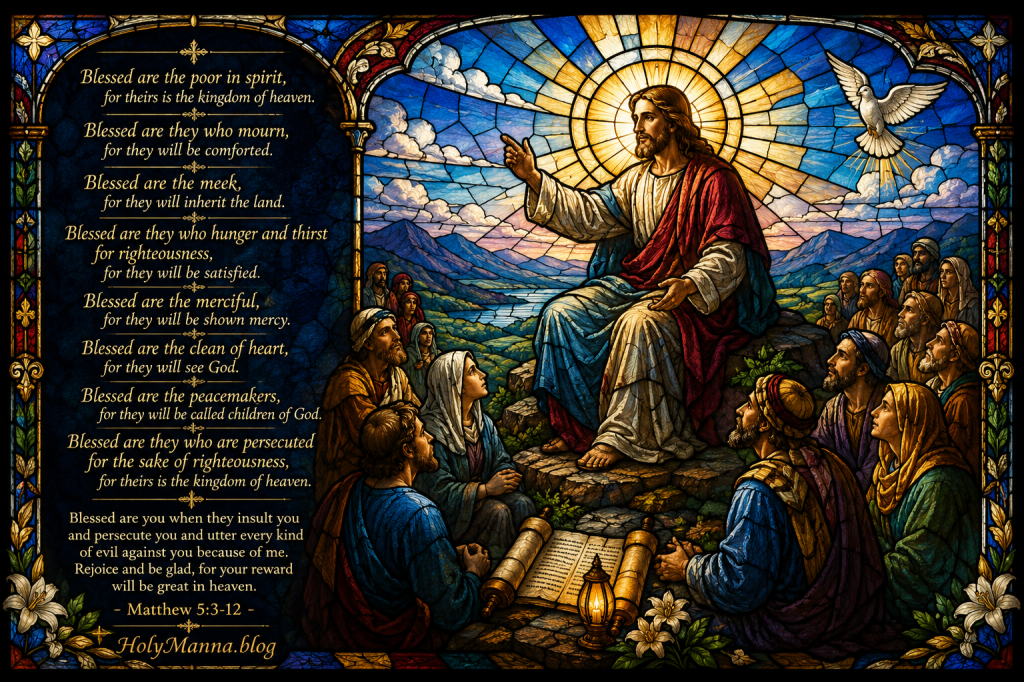
Then, in Matthew 5:1-12, Jesus climbs the mountain and reveals the strange beauty of the Kingdom through the Beatitudes. The world calls the powerful blessed, but Christ blesses the poor in spirit. The world avoids grief, but Christ blesses those who mourn. The world rewards aggression, but Christ blesses the meek. The world chases comfort, but Christ blesses those who hunger and thirst for righteousness. As The Catechism teaches, “The Beatitudes are at the heart of Jesus’ preaching” and they reveal the face of Christ Himself. CCC 1716-1717
The central theme of today’s readings is holy dependence. Elijah depends on God in the drought. The Psalmist depends on God along the journey. The disciple depends on God by living the Beatitudes, even when that life looks weak or foolish to the world. Together, these readings prepare the heart to ask a simple but serious question: When the stream runs low, will trust still remain?
First Reading – 1 Kings 17:1-6
The Prophet, the Drought, and the God Who Provides in Secret
The story of Elijah begins like thunder in a dry sky. Israel is under the rule of King Ahab, one of the most spiritually disastrous kings in the history of the Northern Kingdom. Through his marriage to Jezebel and his tolerance of Baal worship, Ahab helps lead Israel into religious compromise. Baal was worshiped by many pagans as a storm and fertility god, the supposed giver of rain, crops, and prosperity. So when Elijah announces a drought, he is not simply predicting bad weather. He is proclaiming that the Lord, the God of Israel, is the true Lord of creation.
Elijah’s name itself means, “The Lord is my God.” That meaning matters because his whole mission is to call Israel back to the first commandment. The land has become spiritually dry before it becomes physically dry. The drought reveals what idolatry always does. It promises life, but it leaves the soul empty.
This reading fits beautifully into today’s theme of holy dependence. Elijah speaks boldly before a king, but then God sends him into hiding by the Wadi Cherith. There, the prophet must depend on God for water from a stream and food delivered by ravens. The man who confronts power must also learn hidden trust. The Lord provides, but He provides one morning and one evening at a time.
1 Kings 17:1-6 – New American Bible (Revised Edition)
Elijah Proclaims a Drought. 1 Elijah the Tishbite, from Tishbe in Gilead, said to Ahab: “As the Lord, the God of Israel, lives, whom I serve, during these years there shall be no dew or rain except at my word.” 2 The word of the Lord came to Elijah: 3 Leave here, go east and hide in the Wadi Cherith, east of the Jordan. 4 You shall drink of the wadi, and I have commanded ravens to feed you there. 5 So he left and did as the Lord had commanded. He left and remained by the Wadi Cherith, east of the Jordan. 6 Ravens brought him bread and meat in the morning, and bread and meat in the evening, and he drank from the wadi.
Detailed Exegesis
Verse 1 – “Elijah the Tishbite, from Tishbe in Gilead, said to Ahab: ‘As the Lord, the God of Israel, lives, whom I serve, during these years there shall be no dew or rain except at my word.’”
Elijah enters Scripture suddenly, with no long introduction and no dramatic origin story. He comes from Gilead, a rugged region east of the Jordan, and he stands before Ahab with the courage of a man who knows he serves the living God. His words, “As the Lord, the God of Israel, lives,” are a direct challenge to Baal worship. Baal was believed to control rain and fertility, but Elijah declares that rain belongs to the Lord alone. This is a confrontation between covenant faith and idolatry.
The phrase “whom I serve” can also be understood as “before whom I stand.” Elijah’s identity is rooted in his relationship to God before it is rooted in his public mission. He stands before Ahab because he first stands before the Lord. That is the foundation of every faithful witness. Before a Christian can speak truthfully to the world, the Christian must first live truthfully before God.
Verse 2 – “The word of the Lord came to Elijah.”
This short verse carries enormous weight. Elijah is not acting on personal anger, political strategy, or religious ego. He moves because the word of the Lord comes to him. In Scripture, prophets are not self-appointed commentators on culture. They are servants of the divine word. Their authority comes from obedience.
This matters deeply for Catholic life. The Church does not preach herself. She receives and hands on what God has revealed. As The Catechism teaches, “In order to reveal himself to men, in the condescension of his goodness God speaks to them in human words: ‘Indeed the words of God, expressed in the words of men, are in every way like human language, just as the Word of the eternal Father, when he took on himself the flesh of human weakness, became like men.’” CCC 101
Elijah becomes a living example of what happens when a person receives God’s word and obeys it.
Verse 3 – “Leave here, go east and hide in the Wadi Cherith, east of the Jordan.”
After Elijah’s bold public confrontation, God sends him into hiding. This feels surprising. Human instinct might expect Elijah to build momentum, gather followers, and continue preaching in public. Instead, God tells him to disappear.
The Wadi Cherith becomes a hidden classroom of trust. A wadi is a streambed that may flow during certain seasons and dry up during others. Elijah is sent to a place that can sustain him, but not in a way that allows him to feel permanently secure. The Lord is teaching him dependence.
This is often how God forms His servants. Before Mount Carmel, there is Cherith. Before public victory, there is hidden obedience. Before Elijah calls Israel back to the Lord, he must learn to rely on the Lord himself.
Verse 4 – “You shall drink of the wadi, and I have commanded ravens to feed you there.”
God’s provision is both simple and strange. Elijah will drink from the stream, and ravens will bring him food. Ravens were not animals Israelites would normally associate with purity or comfort. Yet God uses them as instruments of providence. The Lord is not limited by what seems ordinary, respectable, or predictable.
This detail reminds readers that God often provides in ways that humble human expectations. He may not always provide through the source someone would have chosen. He may provide through an unexpected person, an uncomfortable season, a quiet grace, a closed door, or a daily strength that arrives only when needed.
This verse also echoes Israel’s wilderness experience. God fed His people with manna day by day, teaching them to trust Him for daily bread. Elijah receives that same lesson in prophetic form. He is not given a storehouse. He is given enough.
Verse 5 – “So he left and did as the Lord had commanded. He left and remained by the Wadi Cherith, east of the Jordan.”
This verse is the quiet heart of the reading. Elijah obeys. He does not negotiate with God. He does not demand a clearer timeline. He does not ask whether ravens are a respectable catering plan. He leaves and does what the Lord commands.
The repetition matters. He left. He remained. Faith is not only the courage to begin. Faith is also the perseverance to stay where God has placed a person. Many people can obey for a moment. The harder grace is remaining faithful when the hidden season stretches longer than expected.
Elijah’s obedience prepares the reader for the Beatitudes in today’s Gospel. The poor in spirit are those who know they cannot sustain themselves apart from God. Elijah becomes poor in spirit beside the stream. His greatness begins with dependence.
Verse 6 – “Ravens brought him bread and meat in the morning, and bread and meat in the evening, and he drank from the wadi.”
God keeps His word. Elijah receives bread and meat in the morning and again in the evening. The rhythm is daily, humble, and sufficient. He drinks from the wadi and eats what God sends.
This is not abundance in the worldly sense. Elijah is not living in comfort. He is not in a palace. He is not surrounded by security. Yet he is being sustained by divine providence. That distinction is important. God’s care does not always look like luxury. Sometimes it looks like enough grace for the next step.
This verse invites readers to recognize the small mercies that arrive each day. The strength to pray. The courage to apologize. The grace to resist temptation. The friend who checks in. The meal on the table. The quiet desire to return to confession. These may not look dramatic, but they may be ravens in the morning and ravens in the evening.
Teachings: Providence, Idolatry, and Daily Bread
Elijah’s confrontation with Ahab reveals the seriousness of idolatry. Israel was not merely experimenting with another religious style. The people were betraying the covenant. Baal worship promised rain, fertility, prosperity, and control over life. The Lord responds by showing that creation obeys Him alone.
The Catechism teaches, “Idolatry not only refers to false pagan worship. It remains a constant temptation to faith. Idolatry consists in divinizing what is not God. Man commits idolatry whenever he honors and reveres a creature in place of God, whether this be gods or demons, for example satanism, power, pleasure, race, ancestors, the state, money, etc. Jesus says, ‘You cannot serve God and mammon.’ Many martyrs died for not adoring ‘the Beast,’ refusing even to simulate such worship. Idolatry rejects the unique Lordship of God; it is therefore incompatible with communion with God.” CCC 2113
That teaching makes Elijah’s moment feel very close to modern life. Most people today are not tempted to build an altar to Baal, but every generation is tempted to trust created things as though they were God. Money, pleasure, politics, reputation, technology, comfort, success, and personal control can all become false gods. They promise rain, but they cannot save the soul.
Elijah also teaches the Catholic heart about providence. God is not a distant observer. He governs creation and cares for His servants, even when they are hidden, threatened, or unsure of what comes next. The Catechism teaches, “Jesus asks for childlike abandonment to the providence of our heavenly Father who takes care of his children’s smallest needs: ‘Therefore do not be anxious, saying, “What shall we eat?” or “What shall we drink?” . . . Your heavenly Father knows that you need them all. But seek first his kingdom and his righteousness, and all these things shall be yours as well.’” CCC 305
This is exactly what Elijah lives. He does not know the whole plan. He knows the next command. He does not receive comfort in excess. He receives daily bread. He does not escape the drought. He is sustained inside it.
The New Testament later holds Elijah up as a model of prayer. Saint James writes, “Elijah was a human being like us; yet he prayed earnestly that it might not rain, and for three years and six months it did not rain upon the land. Then he prayed again, and the sky gave rain and the earth produced its fruit.” James 5:17-18
That line, “a human being like us,” is deeply encouraging. Elijah was not powerful because he was superhuman. He was powerful because he belonged to God, listened to God, and obeyed God. His prayer mattered because his heart stood before the living Lord.
Historically, this reading also prepares for the great showdown on Mount Carmel in 1 Kings 18, where Elijah will confront the prophets of Baal and call Israel back to covenant fidelity. But before that public fire falls from heaven, Elijah must sit beside a stream in silence. The hidden formation comes before the visible mission.
Reflection: Trusting God When the Stream Is All You Have
This reading speaks directly to anyone living through a dry season. There are seasons when prayer feels dry, relationships feel strained, money feels uncertain, work feels unstable, and the future feels unclear. The temptation in those moments is to panic, grasp, compromise, or run back to false securities.
Elijah shows another way. He listens. He obeys. He hides when God tells him to hide. He receives what God gives. He lets the Lord sustain him one day at a time.
That kind of trust is not passive. It is courageous. It takes courage to stand before Ahab, but it also takes courage to sit by the Wadi Cherith and wait. It takes courage to speak truth in public, but it also takes courage to be faithful when nobody sees.
A practical way to live this reading is to name the false sources of security that compete for trust. A person can ask honestly, Where do I look for life when I feel afraid? It may be control, approval, comfort, distraction, money, or resentment. The Christian life requires bringing those false gods into the light and letting the Lord reclaim the heart.
Another way to live this reading is to practice daily dependence. Instead of demanding certainty about the entire future, a disciple can ask, Lord, what is the next faithful step? That next step may be prayer before checking the phone, confession after a long absence, honesty in a difficult conversation, patience with family, generosity in a tight season, or silence instead of retaliation.
Elijah’s bread came in the morning and in the evening. God often gives grace in that same rhythm. Not all at once. Not always early. Not always dramatically. But faithfully.
Where is the Lord asking you to trust Him with daily bread instead of demanding tomorrow’s guarantee?
What false source of security has been promising rain but leaving your soul dry?
Are you willing to obey God in the hidden place, even before you see the public fruit?
The drought does not mean God has disappeared. Sometimes the drought is where the Lord reveals what was false, removes what was shallow, and teaches the soul to depend on Him alone. Elijah’s stream may seem small, but the God who sends him there is not small. He is the living God, the guardian of Israel, and the Father who knows what His children need.
Responsorial Psalm – Psalm 121
The Guardian Who Never Sleeps
After Elijah is sent into hiding by the Wadi Cherith, today’s Psalm gives the heart its response: “Our help is from the Lord, who made heaven and earth.” This is not a vague spiritual comfort. It is a declaration of faith in the God who governs creation, guards His people, and provides for the soul even when the road is uncertain.
Psalm 121 is one of the “Songs of Ascents,” a group of psalms traditionally associated with pilgrims traveling up to Jerusalem for worship. These journeys were often physically demanding and spiritually meaningful. The road could be dangerous, the hills could hide threats, and the traveler had to keep moving with trust. In that setting, the Psalmist looks toward the mountains and asks where help will come from.
This Psalm fits today’s theme of holy dependence beautifully. Elijah depends on the Lord in the drought. The pilgrim depends on the Lord along the road. In the Gospel, Jesus will bless those who are poor in spirit because they know they cannot save themselves. Together, these readings teach that true security does not come from control, comfort, or perfect circumstances. It comes from the Lord, the Maker of heaven and earth, who never sleeps through the struggles of His people.
Psalm 121 – New American Bible (Revised Edition
The Lord My Guardian
1 A song of ascents.
I raise my eyes toward the mountains.
From whence shall come my help?
2 My help comes from the Lord,
the maker of heaven and earth.3 He will not allow your foot to slip;
or your guardian to sleep.
4 Behold, the guardian of Israel
never slumbers nor sleeps.
5 The Lord is your guardian;
the Lord is your shade
at your right hand.
6 By day the sun will not strike you,
nor the moon by night.
7 The Lord will guard you from all evil;
he will guard your soul.
8 The Lord will guard your coming and going
both now and forever.
Detailed Exegesis
Verse 1 – “I raise my eyes toward the mountains. From whence shall come my help?”
The Psalm begins with a pilgrim looking upward. The mountains may refer to the hills surrounding Jerusalem, the holy city where the Temple stood. They may also suggest the danger and uncertainty of the journey. In the ancient world, roads through hills and mountains could be places of exposure, exhaustion, and threat.
The question, “From whence shall come my help?” is not despair. It is honest faith. The Psalmist does not pretend the road is easy. He names the need for help. This is the beginning of prayer. Before the soul can receive divine aid, it must stop pretending it is self-sufficient.
Verse 2 – “My help comes from the Lord, the maker of heaven and earth.”
The answer comes immediately. Help does not come from idols, luck, human power, or personal control. Help comes from the Lord. The Psalmist identifies Him as “the maker of heaven and earth,” which means the God who helps is not limited by the dangers of the road. He is the Creator of everything the pilgrim can see and everything the pilgrim cannot see.
This connects directly to 1 Kings 17:1-6. The Lord who withholds rain from the land is also the Lord who provides water for Elijah at the wadi. He is sovereign over the heavens, but He is also attentive to one hidden servant in need. Catholic faith never separates God’s majesty from His tenderness. The Creator is also the Guardian.
Verse 3 – “He will not allow your foot to slip; or your guardian to sleep.”
The image becomes personal. The Lord does not only rule the universe from a distance. He watches the steps of His people. For a pilgrim walking rough paths, a slipping foot could mean injury, danger, or delay. Spiritually, the verse points to God’s preserving grace. He holds the faithful steady when temptation, fear, grief, or confusion threatens to make them fall.
The phrase “your guardian” is deeply comforting. God is not careless with the soul. He does not grow distracted. He does not become weary of protecting those who belong to Him.
Verse 4 – “Behold, the guardian of Israel never slumbers nor sleeps.”
This verse expands the promise from the individual pilgrim to the whole people of God. The Lord is not merely one person’s private comfort. He is the Guardian of Israel, faithful to His covenant, faithful to His promises, and faithful through every generation.
This matters because human guardians get tired. Kings fail. Armies lose. Parents grow weary. Friends may not always understand. Even the strongest people eventually need rest. But the Lord never slumbers nor sleeps. His care is constant.
For Catholics, this verse also prepares the heart to understand the providence of the Father. God’s watchfulness does not mean believers will never suffer. Elijah still faces drought. Jesus will still bless those who mourn and those who are persecuted. But God’s watchfulness means suffering is never outside His sight, and the faithful are never abandoned.
Verse 5 – “The Lord is your guardian; the Lord is your shade at your right hand.”
The Psalm becomes even more intimate. The Lord is not only Israel’s guardian in a general sense. He is “your guardian.” He is “your shade.” In a hot and exposed land, shade was not a luxury. It was protection, relief, and survival.
The phrase “at your right hand” suggests closeness and readiness. God is not far away, watching from a distance with cold detachment. He is near enough to shelter. This verse reveals the tenderness of divine providence. God’s care is not abstract. It reaches the real places where people are tired, vulnerable, and exposed.
Verse 6 – “By day the sun will not strike you, nor the moon by night.”
The Psalmist speaks of protection by day and by night. The sun represents the visible dangers of the journey: heat, exhaustion, exposure, and physical hardship. The moon may represent the fears, dangers, and uncertainties of the night. Together, they suggest the whole span of life. God guards His people in what they can see and in what they cannot see.
This does not mean the faithful will never feel heat or darkness. It means neither day nor night has ultimate power over the soul held by God. The Lord’s protection is not limited to certain hours or favorable conditions. His care surrounds the whole journey.
Verse 7 – “The Lord will guard you from all evil; he will guard your soul.”
Here the Psalm reaches its deepest promise. The Lord guards the soul. This is more important than physical ease, social approval, or worldly success. God’s greatest protection is not always the removal of suffering, but the preservation of the soul in grace.
This is essential for understanding Catholic faith. The saints were not always protected from pain, persecution, sickness, or martyrdom. Yet they were guarded in the deepest sense because God preserved them for eternal life. The Lord guards what matters most. He guards the soul so it may remain faithful, repentant, hopeful, and open to heaven.
Verse 8 – “The Lord will guard your coming and going both now and forever.”
The final verse gathers the whole journey into God’s care. “Your coming and going” means every movement, every season, every transition, every departure, and every return. The Lord guards the pilgrim not only for one difficult day, but “both now and forever.”
This verse turns the Psalm into a prayer for the whole Christian life. God guards the child, the student, the worker, the parent, the sinner returning to confession, the grieving spouse, the aging disciple, and the soul approaching eternity. From the first step to the final breath, the Lord remains faithful.
Teachings: Providence, Pilgrimage, and the God Who Watches Over the Soul
Psalm 121 teaches that life is a pilgrimage under the care of God. The believer walks through uncertainty, but not alone. This is deeply connected to the Catholic understanding of divine providence. God is not merely the Creator who made the world and then stepped away. He continues to sustain, govern, and guide creation with wisdom and love.
The Catechism teaches, “With creation, God does not abandon his creatures to themselves. He not only gives them being and existence, but also, and at every moment, upholds and sustains them in being, enables them to act and brings them to their final end. Recognizing this utter dependence with respect to the Creator is a source of wisdom and freedom, of joy and confidence.” CCC 301
That teaching is the heart of this Psalm. The Lord who made heaven and earth does not abandon the pilgrim on the road. He sustains existence itself, but He also sustains the tired soul that wonders where help will come from.
The Catechism also teaches, “We firmly believe that God is master of the world and of its history. But the ways of his providence are often unknown to us. Only at the end, when our partial knowledge ceases, when we see God ‘face to face,’ will we fully know the ways by which, even through the dramas of evil and sin, God has guided his creation to that definitive sabbath rest for which he created heaven and earth.” CCC 314
This is important because Psalm 121 does not promise that the road will make perfect sense while a person is walking it. Sometimes the ways of providence are hidden. Elijah does not know the whole plan when he sits beside the Wadi Cherith. The pilgrim does not know every danger on the road. The disciple listening to the Beatitudes does not yet see the Cross and Resurrection in full. Still, God guards the journey.
Saint Augustine expresses the restlessness of the human heart and its need for God with one of the most famous lines in Christian tradition: “You have made us for yourself, O Lord, and our heart is restless until it rests in you.” Confessions, Book I, Chapter 1
That is why the Psalmist’s question matters so much. “From whence shall come my help?” The human heart looks everywhere for help. It looks to success, comfort, relationships, money, entertainment, control, and approval. Some of those things can be good in their proper place, but none of them can be the final guardian of the soul. The heart remains restless until it learns to say, “My help comes from the Lord.”
This Psalm also belongs naturally to the life of the Church because Christians are a pilgrim people. Every Mass is a movement toward the heavenly Jerusalem. Every confession is a return to the road. Every act of trust is a step toward the Father’s house. The Christian life is not aimless wandering. It is a guarded pilgrimage.
Reflection: Learning to Look Up Before Fear Looks In
This Psalm is for anyone who feels exposed on the road. It is for the person trying to stay faithful in a culture that often mocks faith. It is for the parent worried about a child. It is for the young adult trying to choose holiness when temptation is loud. It is for the worker carrying stress quietly. It is for the grieving person who still shows up to prayer with tired eyes. It is for the sinner who wants to come home but wonders whether God is still watching.
The Psalm begins with a lifted gaze. That is a simple but powerful lesson. Fear bends the soul inward. Anxiety makes a person stare at the problem, replay the conversation, calculate every possible disaster, and carry tomorrow before tomorrow arrives. The Psalmist does something different. He raises his eyes.
A practical way to live this Psalm is to begin the day by looking toward God before looking toward the noise. Before the phone, before the inbox, before the headlines, before the list of problems, the soul can say, “My help comes from the Lord, the maker of heaven and earth.” That small act can re-order the whole day.
Another way to live this Psalm is to entrust the unknown road to God. The Lord guards “your coming and going.” That includes the meeting that feels intimidating, the conversation that needs courage, the medical result that causes anxiety, the family situation that feels unresolved, and the quiet spiritual battle nobody else sees.
This Psalm does not tell believers to pretend life is easy. It tells them they are guarded. There is a big difference. Christian hope is not denial. It is confidence in the God who never sleeps.
Where do you instinctively look for help when life feels uncertain?
What would change if your first response to anxiety was prayer instead of control?
Do you believe the Lord is guarding your soul even when He has not removed the difficulty?
What part of your coming and going needs to be entrusted to God today?
The same Lord who fed Elijah in the drought watches over the pilgrim on the road. He guards the soul in the heat of the day and the fear of the night. He does not sleep through the suffering of His people. He remains near, steady, faithful, and awake.
The Christian can walk forward because the Guardian of Israel is already watching.
Holy Gospel – Matthew 5:1-12
The Mountain Where Jesus Redefines the Blessed Life
The Gospel brings us to one of the most famous and challenging moments in all of Scripture: the beginning of the Sermon on the Mount. Jesus sees the crowds, goes up the mountain, sits down, and begins to teach. In the Jewish world, mountains were places of divine encounter. Moses received the Law on Mount Sinai. Elijah encountered the Lord on Mount Horeb. Now Jesus goes up the mountain, not merely as another teacher, but as the Son who fulfills the Law and reveals the heart of the Father.
The Beatitudes are not sentimental religious sayings. They are the charter of the Kingdom. They reveal what a life transformed by grace looks like. The world calls the comfortable blessed. Jesus blesses the poor in spirit. The world avoids sorrow. Jesus blesses those who mourn. The world prizes domination. Jesus blesses the meek. The world chases pleasure and applause. Jesus blesses those who hunger for righteousness, show mercy, seek purity, make peace, and endure persecution for the sake of God.
This Gospel completes today’s theme of holy dependence. Elijah depends on God in the drought. The Psalmist depends on God along the road. In the Beatitudes, Jesus blesses the soul that depends entirely on God and no longer measures blessedness by comfort, control, or worldly success.
Matthew 5:1-12 – New American Bible (Revised Edition)
The Sermon on the Mount. 1 When he saw the crowds, he went up the mountain, and after he had sat down, his disciples came to him. 2 He began to teach them, saying:
The Beatitudes
3 “Blessed are the poor in spirit,
for theirs is the kingdom of heaven.
4 Blessed are they who mourn,
for they will be comforted.
5 Blessed are the meek,
for they will inherit the land.
6 Blessed are they who hunger and thirst for righteousness,
for they will be satisfied.
7 Blessed are the merciful,
for they will be shown mercy.
8 Blessed are the clean of heart,
for they will see God.
9 Blessed are the peacemakers,
for they will be called children of God.
10 Blessed are they who are persecuted for the sake of righteousness,
for theirs is the kingdom of heaven.11 Blessed are you when they insult you and persecute you and utter every kind of evil against you [falsely] because of me. 12 Rejoice and be glad, for your reward will be great in heaven. Thus they persecuted the prophets who were before you.
Detailed Exegesis
Verse 1 – “When he saw the crowds, he went up the mountain, and after he had sat down, his disciples came to him.”
Jesus sees the crowds before He teaches them. That detail matters because His teaching flows from divine compassion. He does not speak from distance or irritation. He sees the human hunger in front of Him.
The mountain recalls Sinai, where Moses received the Law. But Jesus does more than repeat Moses. He fulfills the Law and reveals the deeper righteousness of the Kingdom. His sitting posture also matters. In the ancient world, a rabbi often sat to teach with authority. The disciples come near, showing that the Beatitudes are not merely ideals for the curious crowd. They are the way of life for those who follow Him.
Verse 2 – “He began to teach them, saying:”
Jesus teaches with authority because He is the Word made flesh. This is not advice from a wise moralist. This is divine instruction. The Beatitudes come from the heart of Christ and reveal the shape of Christian discipleship.
In Catholic life, the teachings of Jesus are never optional decorations. They form the conscience, purify desire, and prepare the soul for heaven. The Beatitudes are especially important because they show what grace does inside a person who belongs to the Kingdom.
Verse 3 – “Blessed are the poor in spirit, for theirs is the kingdom of heaven.”
To be poor in spirit is to know one’s total dependence on God. This is not self-hatred, laziness, or weakness. It is humility. It is the spiritual honesty that says, “Everything good comes from the Lord.”
This Beatitude connects strongly with Elijah at the Wadi Cherith. Elijah has no control over the drought, the stream, or the ravens. He must receive everything from God. The poor in spirit live that way interiorly. They do not build their identity on power, money, reputation, or self-sufficiency. Their hands are empty enough to receive the Kingdom.
Verse 4 – “Blessed are they who mourn, for they will be comforted.”
Jesus does not call sorrow meaningless. He blesses those who mourn and promises comfort. This includes the grief of suffering, death, disappointment, and loss. It also includes the holy mourning of repentance, the sorrow of a heart that recognizes sin and longs to return to God.
The world often says mourning should be avoided, hidden, or medicated with distraction. Christ says mourning can become a place of grace when it opens the heart to the Father. Christian comfort is not shallow positivity. It is the consolation of God, who enters human sorrow and promises resurrection.
Verse 5 – “Blessed are the meek, for they will inherit the land.”
Meekness is not weakness. Jesus Himself is meek and humble of heart. Meekness is strength surrendered to God. It is the refusal to dominate, retaliate, manipulate, or make the self the center of everything.
The meek person trusts that God is the true defender of justice. This is why meekness is so powerful. It frees the soul from the exhausting need to control every outcome. In a loud and aggressive culture, meekness becomes a quiet act of rebellion against pride.
Verse 6 – “Blessed are they who hunger and thirst for righteousness, for they will be satisfied.”
Hunger and thirst are not casual desires. They are survival desires. Jesus is describing a soul that longs for holiness, justice, truth, and right relationship with God.
This Beatitude asks whether righteousness is something a person merely admires or something the person truly craves. The disciple does not seek holiness as a hobby. The disciple hungers for it like bread and thirsts for it like water. God promises that this hunger will not be wasted. He will satisfy the soul that truly desires Him.
Verse 7 – “Blessed are the merciful, for they will be shown mercy.”
Mercy is love meeting misery with compassion, truth, and forgiveness. It does not deny sin. It does not excuse evil. It brings the healing love of God to the wounded and the guilty.
The merciful person remembers that he has first received mercy from God. This Beatitude is deeply practical. It reaches into family conflict, marriage, friendships, parish life, online conversations, and the way people speak about those who have fallen. The merciful do not crush the weak, because they know how gently God has treated them.
Verse 8 – “Blessed are the clean of heart, for they will see God.”
The clean of heart are those whose desires are being purified and unified by grace. They do not want a divided life, where God receives one part of the heart while sin keeps another. Purity of heart means integrity before God.
This Beatitude is especially important in a distracted and impure age. The clean of heart are not merely those who avoid obvious sins. They are those who ask God to purify their vision, motives, imagination, relationships, and loves. Jesus promises that the purified heart will see God. The goal of purity is not repression. The goal is communion.
Verse 9 – “Blessed are the peacemakers, for they will be called children of God.”
Peacemakers do not simply avoid conflict. They help restore right order. True peace begins with reconciliation with God, then extends into the soul, the family, the Church, and society.
A peacemaker speaks truth with charity. A peacemaker refuses gossip, needless division, resentment, and revenge. This Beatitude does not bless cowardice or fake niceness. It blesses those who work for the peace that comes from Christ, the peace built on truth, justice, mercy, and love.
Verse 10 – “Blessed are they who are persecuted for the sake of righteousness, for theirs is the kingdom of heaven.”
Jesus does not hide the cost of discipleship. Those who live for righteousness may face rejection, misunderstanding, and persecution. The prophets knew this. Elijah knew this. The saints knew this. The Christian should not be surprised when fidelity to God creates tension with the world.
This Beatitude does not bless suffering caused by arrogance, harshness, or foolishness. It blesses those who suffer because they are faithful to righteousness. Their reward is not worldly approval. Their reward is the Kingdom of heaven.
Verse 11 – “Blessed are you when they insult you and persecute you and utter every kind of evil against you falsely because of me.”
Jesus now makes the teaching personal. He moves from “Blessed are they” to “Blessed are you.” Discipleship is not theoretical. At some point, the follower of Christ may be insulted, misunderstood, mocked, or falsely accused because of Him.
The key phrase is “because of me.” Christian suffering finds its meaning in union with Christ. The disciple does not seek conflict for its own sake, but when faithfulness to Jesus brings opposition, the disciple is invited to stand firm with Him.
Verse 12 – “Rejoice and be glad, for your reward will be great in heaven. Thus they persecuted the prophets who were before you.”
Jesus ends with joy. This is astonishing. He does not say to merely endure persecution with clenched teeth. He says, “Rejoice and be glad.” Christian joy is not dependent on comfort. It is rooted in heaven.
Jesus also connects His disciples with the prophets. Elijah, Jeremiah, Isaiah, and the faithful witnesses of Israel were often rejected because they spoke the word of God. The disciple who suffers for Christ stands in that same prophetic line. The world may reject the witness, but heaven sees it.
Teachings: The Beatitudes as the Face of Christ
The Beatitudes are at the center of Catholic moral and spiritual life because they reveal not only what Christians should do, but what Christians are called to become. They are not a replacement for the Commandments. They bring the Commandments to their fulfillment in the heart of the disciple.
The Catechism teaches, “The Beatitudes are at the heart of Jesus’ preaching. They take up the promises made to the chosen people since Abraham. The Beatitudes fulfill the promises by ordering them no longer merely to the possession of a territory, but to the Kingdom of heaven.” CCC 1716
This matters because Jesus is not offering a political slogan or a self-help plan. He is announcing the Kingdom. The promises of God are fulfilled in Him, and the Beatitudes show the inner life of the Kingdom taking root in the human soul.
The Catechism continues, “The Beatitudes depict the countenance of Jesus Christ and portray his charity. They express the vocation of the faithful associated with the glory of his Passion and Resurrection; they shed light on the actions and attitudes characteristic of the Christian life; they are the paradoxical promises that sustain hope in the midst of tribulations; they proclaim the blessings and rewards already secured, however dimly, for Christ’s disciples; they have begun in the lives of the Virgin Mary and all the saints.” CCC 1717
This is one of the most beautiful teachings in The Catechism. The Beatitudes depict the face of Jesus. He is poor in spirit. He mourns over sin and death. He is meek. He hungers and thirsts for righteousness. He is merciful. He is clean of heart. He makes peace through the blood of His Cross. He is persecuted for righteousness and crucified outside the city.
So the Beatitudes are not impossible demands placed on ordinary people from a distance. They are the life of Christ being formed in His disciples by grace.
Saint Augustine described the Sermon on the Mount as a complete pattern of Christian life. He wrote, “If anyone will piously and soberly consider the sermon which our Lord Jesus Christ spoke on the mount, as we read it in the Gospel according to Matthew, I think that he will find in it, so far as regards the highest morals, a perfect standard of the Christian life.” On the Sermon on the Mount, Book I, Chapter 1
Saint Augustine’s point is simple and challenging. The Sermon on the Mount is not an optional spiritual extra. It is the standard of life for those who belong to Christ.
Saint John Chrysostom, preaching on The Gospel of Matthew, helps clarify the first Beatitude when he says, “What is meant by ‘the poor in spirit’? The humble and contrite in mind.” Homily 15 on Matthew
This humility is the doorway into the rest of the Beatitudes. Without poverty of spirit, the soul cannot mourn sin. Without mourning, it cannot receive comfort. Without meekness, it cannot make peace. Without hunger for righteousness, it cannot become holy. Without mercy, it cannot reflect the Father. Without purity, it cannot see God.
The Beatitudes also show the Catholic understanding of happiness. True happiness is not the same as pleasure, comfort, or emotional ease. The Catechism teaches, “The Beatitudes reveal the goal of human existence, the ultimate end of human acts: God calls us to his own beatitude. This vocation is addressed to each individual personally, but also to the Church as a whole, the new people made up of those who have accepted the promise and live from it in faith.” CCC 1719
In other words, every human heart is made for blessedness, but that blessedness is found in God. The Beatitudes point beyond shallow happiness toward eternal communion with the Lord.
Reflection: Living the Beatitudes
The Beatitudes are beautiful, but they are not easy. They confront the way the world trains people to think. The world says the blessed are the rich in ego, the emotionally untouched, the aggressive, the comfortable, the admired, the powerful, the entertained, and the applauded. Jesus says the blessed are poor in spirit, mourning, meek, hungry for righteousness, merciful, clean of heart, peacemaking, and persecuted for the Kingdom.
That means discipleship requires a new imagination. A Christian must learn to see life through the eyes of Christ. The person who feels weak but depends on God may be closer to the Kingdom than the person who looks successful but is spiritually empty. The person who mourns sin may be healthier than the person who no longer feels guilt. The person who chooses mercy may be stronger than the person who always wins the argument.
A practical way to live this Gospel is to choose one Beatitude each day and practice it intentionally. Poverty of spirit can begin with a simple prayer: “Lord, everything good comes from You.” Mourning can begin with honest repentance. Meekness can begin by refusing a harsh response. Hunger for righteousness can begin by making time for prayer and confession. Mercy can begin by forgiving one person. Purity of heart can begin by removing one source of temptation. Peacemaking can begin by refusing gossip. Courage under persecution can begin by not hiding the faith out of fear.
The Beatitudes are not meant to make ordinary Catholics feel defeated. They are meant to make ordinary Catholics look at Jesus. He is the Blessed One. He lives these words perfectly. The Christian life is the slow, grace-filled process of becoming more like Him.
Which Beatitude feels most difficult to live right now?
Where has the world taught you to measure blessing differently than Jesus does?
Are you willing to be poor in spirit if it means receiving the Kingdom with empty hands?
What would change in your family, workplace, parish, or friendships if mercy and peacemaking became daily habits?
The Sermon on the Mount begins with a promise. Not a promise that life will be comfortable, easy, or admired. A better promise. The promise that the soul shaped by Christ is truly blessed, even in poverty, sorrow, meekness, hunger, mercy, purity, peacemaking, and persecution.
The world may not recognize that kind of blessedness. Heaven does.
When the Stream Runs Low, the Kingdom Draws Near
Today’s readings lead the soul from drought, to pilgrimage, to the mountain of Christ. Elijah stands before Ahab and announces that the false gods of Israel cannot give life. Then he is sent into hiding, where he learns to receive everything from the Lord one morning and one evening at a time. Psalm 121 places that same trust on the lips of every pilgrim: “My help comes from the Lord, the maker of heaven and earth.” Then, in Matthew 5:1-12, Jesus climbs the mountain and reveals the blessed life through the Beatitudes.
The message is clear and deeply practical. God does not always remove the drought immediately, but He provides in it. God does not promise that the road will never feel dangerous, but He guards the soul along the way. God does not call His disciples to chase the world’s version of success, but to become poor in spirit, merciful, clean of heart, peaceful, and faithful even under pressure.
This is holy dependence. It is the freedom of finally admitting that control cannot save us, approval cannot satisfy us, comfort cannot sanctify us, and idols cannot give rain. Only the Lord can sustain the heart. Only the Father can guard the journey. Only Christ can teach the soul what it means to be truly blessed.
So today, take one step deeper into trust. Let go of one false security. Pray before reaching for distraction. Choose mercy where resentment feels easier. Make peace where pride wants to win. Ask for purity where the heart feels divided. Return to confession if sin has dried up the soul. Sit beside the stream God has given today, even if it feels small, and receive His grace with humility.
Where is the Lord asking you to depend on Him more completely?
What Beatitude is He inviting you to live more intentionally this week?
The Christian life is not built on perfect circumstances. It is built on the living God. The same Lord who fed Elijah, guarded the pilgrim, and blessed the poor in spirit is still near. He still provides. He still watches. He still calls His people up the mountain to hear the voice of Christ and discover the kind of blessedness the world can never take away.
Engage with Us!
Share your reflections in the comments below. Today’s readings invite every heart to look honestly at where trust is being placed, especially when life feels dry, uncertain, or difficult. God provides for Elijah in the hidden place, guards the pilgrim on the road, and teaches true blessedness through the words of Jesus in Matthew 5:1-12.
- In the First Reading from 1 Kings 17:1-6, where do you see yourself needing to trust God for daily bread instead of demanding the whole plan at once?
- In Psalm 121, the Psalmist says, “My help comes from the Lord, the maker of heaven and earth.” Where do you need to lift your eyes back to God instead of relying only on control, comfort, or your own strength?
- In the Holy Gospel from Matthew 5:1-12, which Beatitude is Jesus inviting you to live more deeply right now: poverty of spirit, mercy, purity of heart, peacemaking, or faithfulness under pressure?
- How can today’s readings help you become more dependent on God in your family, work, parish, friendships, and personal prayer?
- What is one practical step you can take this week to live with greater trust, humility, mercy, and peace?
May these readings help every soul walk forward with deeper faith, steadier hope, and a heart more open to grace. The Lord still provides in the drought, still guards His people on the journey, and still calls His disciples to live the Beatitudes with courage. Go into this week ready to live a life of faith, and do everything with the love and mercy Jesus taught us.
Sacred Heart of Jesus, we trust in You!
Immaculate Heart of Mary, pray for us!
Saint Michael the Archangel, defend us in battle!
Follow us on YouTube, TikTok, Instagram and Facebook for more insights and reflections on living a faith-filled life.


Leave a Reply