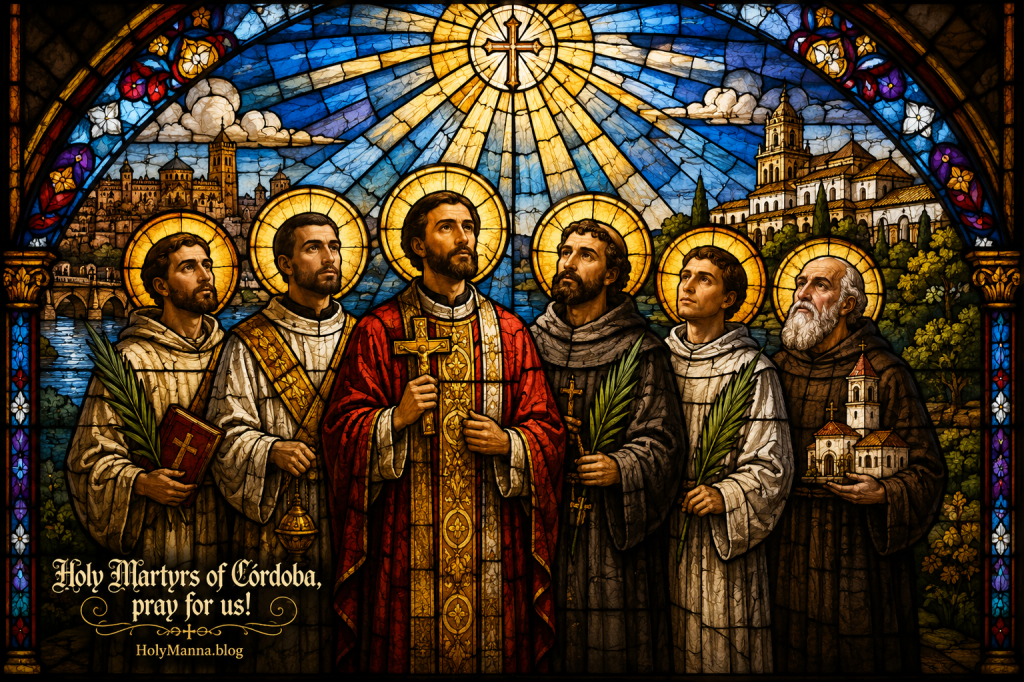
The Six Witnesses Who Chose Christ Over Silence
In the ninth century, in the heart of Muslim-ruled Córdoba, six Catholic men walked together toward death with one shared conviction: Jesus Christ is truly God.
Their names were Peter, Walabonsus, Sabinian, Wistremundus, Habentius, and Jeremiah. Peter was a priest. Walabonsus was a deacon. Sabinian, Wistremundus, Habentius, and Jeremiah were monks. Together, they are remembered as part of the Martyrs of Córdoba, a group of Christians who gave their lives during a difficult and tense period for the Church in Spain.
They were martyred on June 7, 851, under the rule of Abd al-Rahman II. Their story is not one of comfort, popularity, or easy discipleship. It is the story of men who knew that confessing Christ publicly could cost them everything, and they still chose to speak.
The Church remembers them because they lived the meaning of martyrdom. The Catechism of the Catholic Church teaches, “Martyrdom is the supreme witness given to the truth of the faith: it means bearing witness even unto death” CCC 2473. That is exactly what these six men did. They did not die because they loved conflict. They died because they loved Christ more than life itself.
Their witness must be remembered carefully and charitably. Their story took place during a time of real religious tension, but Catholic martyrdom is never about hatred. It is about fidelity. It is about truth. It is about the courage to confess Christ with a heart rooted in love.
Born Into a Church Under Pressure
These saints lived in Córdoba during the period of Islamic rule in Spain. Christians in the region, often called Mozarabs, were allowed to exist in many places, but they lived under heavy social, political, economic, and religious pressure. Their public Christian identity was often restricted, and many were tempted to keep their faith quiet in order to survive peacefully.
Peter was born in Astigi, known today as Écija, near Seville. He came to Córdoba to study and became known for his knowledge of Scripture and Catholic teaching. Eventually, he became a priest and served at the monastery of the Blessed Virgin Mary at Cuteclara, west of Córdoba.
Walabonsus, also known as Wallabonsus or Valabonso, was from Elepla, identified with modern Niebla in Huelva. He became a deacon and, like Peter, studied in Córdoba. Tradition says he came from a mixed family. His father was Christian, and his mother had converted from Islam to Christianity. He is also remembered as the brother of Saint Maria of Córdoba, who would later become a martyr herself.
Sabinian came from the village of Froniano and became a monk of the monastery of Saint Zoilus of Armilata, a remote monastic house in the mountainous region north of Córdoba. He appears in the tradition as a more mature monk, already formed in discipline, prayer, and sacrifice.
Wistremundus was also connected to the monastery of Saint Zoilus of Armilata. He was from Écija, like Peter, but unlike Sabinian, he seems to have been younger and newly entered into monastic life. This makes his witness especially striking. He had only recently begun the monastic journey, yet he was already willing to give his life for Christ.
Habentius was a monk of Saint Christopher’s monastery, south of Córdoba beyond the Guadalquivir River. He was known for intense asceticism. Saint Eulogius describes him as a man who had already died to the world before he died as a martyr. He lived enclosed, practiced severe penance, and embraced a life of radical renunciation.
Jeremiah was the elder of the group. He had once been wealthy, but he gave his resources to found the monastery of Tábanos. He and his wife Elizabeth, along with members of their family, embraced religious life. He was connected to other Córdoba martyrs, including Saint Isaac and Saint Columba. His story is especially powerful because he shows that old age is not a time to retire from holiness. It can become the final offering of a life given to God.
These men came from different places and different stages of life. One was a priest. One was a deacon. Some were young. Some were old. Some were scholars. Some were ascetics. One was a former wealthy founder. Yet when the moment came, they were united by one confession.
They belonged to Christ.
Monks, Ministers, and Men Already Offered to God
The lives of these six saints were shaped by monasteries. This matters because the monasteries around Córdoba were not simply quiet escapes from the world. They were places where Christian identity was preserved, Scripture was studied, prayer was practiced, and souls were trained for courage.
Peter and Walabonsus served at the monastery of the Blessed Virgin Mary at Cuteclara. There they deepened their knowledge of Scripture and placed themselves under spiritual discipline. Their learning was not meant to make them impressive. It was meant to make them faithful.
Sabinian and Wistremundus came from the monastery of Saint Zoilus of Armilata. This monastery stood in a remote mountainous region, far from the noise of the city. It represented the hidden strength of the Church, the kind of strength that grows in prayer before it is ever seen in public.
Habentius lived a life of dramatic penance at Saint Christopher’s monastery. His asceticism can sound extreme to modern ears, but it points to something important. Before he was asked to surrender his life in martyrdom, he had already been surrendering his comfort, his reputation, his desires, and his will to God.
Jeremiah founded Tábanos with his own wealth. He did not simply give spare change to the Church. He used his fortune to build a home of prayer, and then he entered that life himself. His wife Elizabeth and his family also became part of that religious world. His legacy began before his death because he had already chosen to build something for God.
No major authenticated miracles are known from their lives in the way we might hear about with other saints. There are no famous healings, no dramatic wonders, and no widely preserved miracle stories from their lifetime. Their greatest miracle was the transformation of ordinary human fear into supernatural courage. Grace made them capable of choosing Christ when silence would have been safer.
That may not sound spectacular at first, but it is the kind of miracle every Christian needs.
The Road to Martyrdom
In June of 851, Córdoba was shaken by the martyrdoms of other Christians, especially Saint Isaac and Saint Sancho. Their deaths stirred the hearts of Peter, Walabonsus, Sabinian, Wistremundus, Habentius, and Jeremiah.
The six men went before the judge and publicly confessed Christ. Saint Eulogius, who preserved the memory of the Córdoba martyrs, records their witness as a united confession. The most important line associated with them is simple and powerful: “We confess Christ truly as God.”
That is the center of their story.
They were not defending a vague spirituality. They were not dying for a private opinion. They were confessing the divinity of Jesus Christ, the truth at the heart of the Catholic faith. As The Gospel of John proclaims, “The Word became flesh and dwelt among us” John 1:14. These martyrs gave their lives rather than deny the mystery of the Incarnation.
Their trial ended in condemnation. Jeremiah, the elderly founder of Tábanos, was brutally scourged. The tradition says he was beaten so severely that he died from the scourging, or was dragged out half-dead before the final executions. The others were beheaded. Peter and Walabonsus, the priest and deacon, were killed first. Then the monks followed.
Their bodies were displayed, later burned, and their ashes were thrown into the Guadalquivir River. This was likely meant to prevent Christians from collecting relics and honoring them as martyrs.
But the attempt to erase them failed.
Their bodies were taken away, but their witness remained. Their relics were denied to the faithful, but their names entered the memory of the Church. Their ashes were scattered into the river, but their confession still speaks more than a thousand years later.
The Memory That Could Not Be Burned
Because their bodies were burned and their ashes were thrown into the river, there does not seem to be a major relic shrine connected to these six martyrs as a group. No major authenticated posthumous healing miracles were found in the main Catholic traditions connected to them.
Still, their memory did not disappear. Saint Eulogius preserved their story in his writings, and the Church continued to honor them in the martyrological tradition. Their feast is remembered on June 7.
There are also several meaningful stories and local traditions connected especially to Walabonsus.
One ancient tradition connected to the martyr movement says that Peter and Walabonsus appeared after death, or were seen in heavenly glory, encouraging Saint Sisenandus toward martyrdom. This is best understood as a visionary or devotional tradition rather than a formally verified miracle.
A local tradition in Niebla also says that after Walabonsus died, his sister Maria was overwhelmed with grief. According to the story, Walabonsus appeared to one of Maria’s companions and told her that Maria should stop weeping because they would soon be reunited. Maria later became a martyr herself. This is a beautiful local legend, but it cannot be historically verified.
Niebla also preserves a tender tradition involving figs. According to the story, as Walabonsus was being led toward martyrdom near the Guadalquivir, a young woman offered him fruit to refresh him. In memory of this, figs have been blessed and distributed to the sick during celebrations in honor of San Walabonso. This story is part of local devotion and cannot be verified with certainty, but it shows how deeply his memory entered the heart of his people.
Walabonsus remains especially beloved in Niebla. His feast has been celebrated there for centuries, with prayers, processions, music, fireworks, and acts of care for the sick. His memory became not only a religious devotion, but part of the town’s Catholic identity.
That is the strange beauty of martyrdom. The world may try to silence a witness, but the Church remembers. Families remember. Villages remember. The faithful remember.
The Lesson of Six Different Lives
One of the most beautiful parts of this story is that these six saints were not all the same.
Peter shows the courage of the priest who teaches, leads, and dies for the truth he preaches.
Walabonsus shows the courage of the deacon, the young servant of the Church, willing to give his life in witness to Christ.
Sabinian shows the courage of the mature monk, formed by prayer and ready for the final offering.
Wistremundus shows the courage of the young disciple, newly committed but already burning with faith.
Habentius shows the courage of the ascetic, a man who had been practicing self-denial long before the sword came.
Jeremiah shows the courage of the elder, the husband, founder, and former wealthy man who surrendered everything to God.
Together, they teach that holiness does not have one personality type. It does not belong only to priests, monks, scholars, young people, old people, converts, founders, or ascetics. Holiness belongs to anyone who lets grace take over the whole life.
Their witness also reminds Catholics that public faith matters. Many Christians today are not asked to face martyrdom in the same way, but many are tempted to hide their faith, soften the truth, stay silent, or treat Christianity as something private and harmless.
These martyrs ask a hard question.
When the world makes faith uncomfortable, will Christ still be confessed?
Not with bitterness. Not with pride. Not with anger. But with courage, charity, and truth.
Courage Without Hatred
The story of the Córdoba martyrs must be told with a Catholic heart. They lived in a time of conflict, and their words were shaped by that conflict. Their witness was real, but it should not be twisted into contempt for others.
The Church calls Catholics to confess Christ clearly and to love every person. The same Church that honors martyrs also teaches respect for the dignity of those who do not share the fullness of the Catholic faith. Courage and charity are not enemies. In fact, Christian courage without charity becomes something less than Christian.
These saints were not canonized because they hated their persecutors. They are remembered because they loved Christ enough to die rather than deny Him.
That distinction matters.
A Catholic life should be bold, but not cruel. Convicted, but not arrogant. Clear, but not hateful. The martyrs teach that truth is worth suffering for, but Jesus teaches that truth must always be carried with love.
As Saint Paul writes, “If I have not love, I am nothing” 1 Corinthians 13:2.
A Reflection for Today
Most people reading this will never be dragged before a judge and asked to deny Christ. But every Christian faces smaller courts every day.
There is the court of public opinion. The court of social media. The court of workplace pressure. The court of family tension. The court of private temptation. The court of comfort.
In those moments, the question becomes very simple.
Will Christ be confessed here?
Maybe that means making the Sign of the Cross before a meal without embarrassment. Maybe it means refusing to laugh at something degrading. Maybe it means defending Church teaching with patience instead of hiding behind silence. Maybe it means going back to Confession after a long fall. Maybe it means teaching children the faith even when the culture teaches something else. Maybe it means living chastely, forgiving generously, worshiping faithfully, and refusing to let comfort become the master of the soul.
Saints Peter, Walabonsus, Sabinian, Wistremundus, Habentius, and Jeremiah remind the Church that discipleship is not theoretical. It becomes real when it costs something.
Their story is not comfortable, but it is deeply clarifying. They force modern Catholics to ask whether faith is only a preference or truly the center of life.
Where is Jesus asking for a clearer witness today?
Where has silence become too easy?
Where is fear being allowed to make decisions that belong to faith?
The martyrs of Córdoba answer with their lives. Christ is worth everything.
Engage With Us!
Share your thoughts and reflections in the comments below. The story of these six martyrs is challenging, but it is also deeply encouraging because it reminds Catholics that courage is possible when grace strengthens the soul.
- Which of these six saints speaks most powerfully to your own stage of life: Peter the priest, Walabonsus the deacon, Sabinian the mature monk, Wistremundus the young monk, Habentius the ascetic, or Jeremiah the elder founder?
- Where do you feel most tempted to stay silent about your faith?
- How can you confess Christ more clearly this week while still acting with charity and humility?
- What comfort, fear, or habit might God be asking you to surrender so your witness can become stronger?
- How does the courage of the martyrs help you understand the words of Jesus, “Whoever loses his life for my sake will find it” Matthew 16:25?
May the witness of Saints Peter, Walabonsus, Sabinian, Wistremundus, Habentius, and Jeremiah strengthen every Catholic heart that feels tired, afraid, or pressured to hide the faith. May their courage remind the Church that Jesus Christ is worth every sacrifice. And may their example help every soul live with faith, speak with charity, and do everything with the love and mercy Jesus taught us.
Holy Martyrs of Córdoba, pray for us!
Follow us on YouTube, TikTok, Instagram and Facebook for more insights and reflections on living a faith-filled life.


Leave a Reply