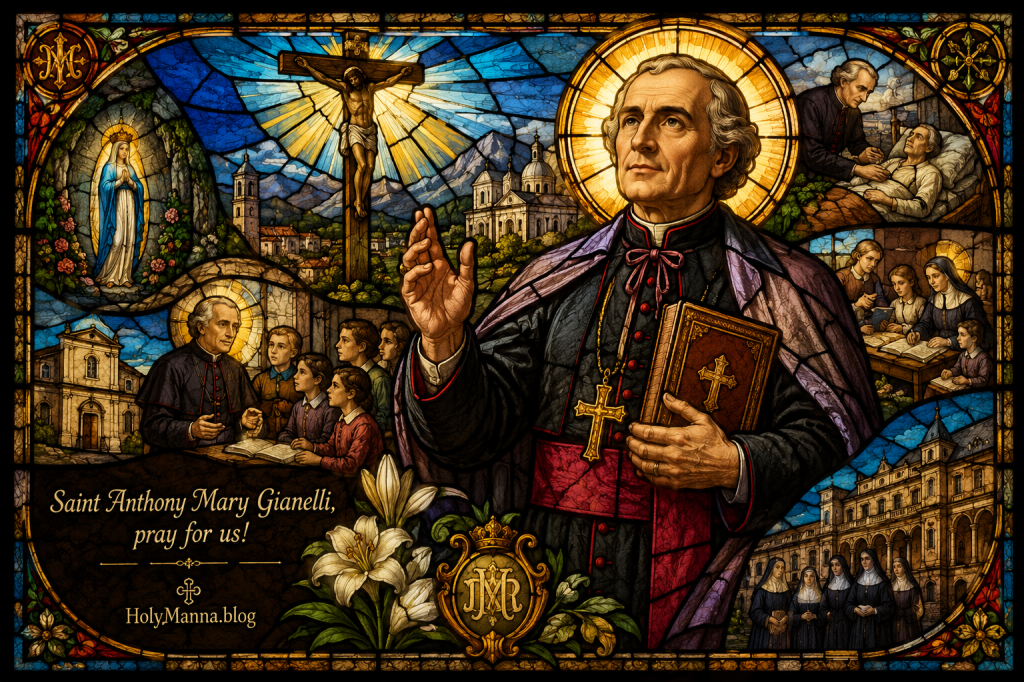
The Bishop Who Turned Mercy Into a Mission
Saint Anthony Mary Gianelli was the kind of saint who reminds the Church that holiness is not always loud, dramatic, or instantly recognized. Sometimes holiness looks like a tired priest sitting in the confessional for hours. Sometimes it looks like a bishop traveling rough roads to visit forgotten parishes. Sometimes it looks like founding schools for poor girls, caring for the sick, reforming seminaries, and begging people to return to God before it is too late.
Born in 1789 and called home to the Lord in 1846, Saint Anthony Mary Gianelli became a priest, missionary preacher, educator, bishop of Bobbio, and founder of the Daughters of Mary Most Holy of the Garden, also known as the Gianelline Sisters. His life was marked by a simple but powerful spiritual cry: “God, God, God alone.”
The Church remembers him on June 7, the day of his death. Some Gianelline and local communities also honor October 21, the anniversary of his canonization by Pope Pius XII in 1951. He is especially remembered for his zeal for souls, his devotion to Our Lady of the Garden, his love for the poor, his reform of priests and seminaries, and his belief that Catholic charity must become visible in real places: classrooms, hospitals, confessionals, prisons, poor homes, and parish streets.
His life beautifully reflects what The Catechism of the Catholic Church teaches about Holy Orders: “Holy Orders is the sacrament through which the mission entrusted by Christ to his apostles continues to be exercised in the Church until the end of time.” CCC 1536. Saint Anthony Mary Gianelli lived that mission with the heart of a shepherd.
A Child Born From Prayer
Anthony Mary Gianelli was born on April 12, 1789, in Cerreta di Carro, near Chiavari in Liguria, Italy. His parents, Giacomo Gianelli and Maria Tosso, were poor farmers. They did not have wealth, influence, or comfort, but they gave their son something far more important: a Catholic home shaped by prayer, work, sacrifice, and trust in God.
A beloved Catholic tradition says that Anthony’s birth was surrounded by prayer. His mother was gravely ill, and neighbors prayed for both mother and child. When both survived, the child came to be remembered as the “Son of Prayer.” This story is preserved in the tradition of his religious family and reflects the way Catholics close to his legacy understood his life from the very beginning: as a gift received through prayer.
He was baptized on April 19, 1789. As a boy, he attended a parish school opened by Father Francis Ricci in a nearby village. From childhood, he showed intelligence, seriousness, and a deep love for the faith. Some Catholic biographies say he was already known for repeating catechism lessons to other children, almost like a young preacher before he ever entered seminary.
One pious story from his childhood says that while Anthony was carrying wood, he came upon a dangerous swollen torrent. He knelt and prayed, and the waters lowered while the wood was carried across. This story cannot be historically verified with the certainty of an official Church document, so it should be received as a devotional tradition. Still, it reveals something important about how the faithful remembered him: as a child who instinctively turned to God in need.
Because his family was poor, Anthony could not easily pursue advanced studies. Providence came through a benefactress, Nicoletta Assereto Rebisso, who helped him go to Genoa and continue his education. His talents and virtue quickly became evident. He entered the seminary, became known for piety and discipline, and received permission to preach because of his exceptional gifts. He was ordained a priest on May 24, 1812, while still very young.
A Priest Who Loved the Confessional
After his ordination, Father Gianelli served in Genoa as an assistant parish priest, teacher, professor of rhetoric, seminary formator, preacher, and spiritual director. He taught young men, guided religious sisters, preached missions, and heard confessions with great seriousness and tenderness.
A saying often attributed to him captures the heart of his priesthood: “The confessional is the garden of the priest.”
That line says so much. For Saint Anthony Mary Gianelli, the confessional was not simply a place where a priest performed a duty. It was the garden where grace took root again. It was the place where wounded souls came back to life. It was where the mercy of Christ touched real sinners with real burdens and gave them a new beginning.
This fits beautifully with the Catholic understanding of the Sacrament of Reconciliation. The Catechism of the Catholic Church teaches that “Those who approach the sacrament of Penance obtain pardon from God’s mercy for the offense committed against him.” CCC 1422. Gianelli believed that deeply, and he wanted priests to believe it too.
He did not see priesthood as a career. He saw it as spiritual fatherhood. He cared deeply about priestly formation because he knew that lukewarm priests weaken the Church, while holy priests help bring entire communities back to Christ.
Chiavari and the Birth of a Mission
In 1826, Father Gianelli was appointed archpriest of Saint John the Baptist in Chiavari. It became one of the defining chapters of his life. He found a community that needed renewal, catechesis, confession, education, and works of mercy. He gave himself completely.
He opened a seminary in Chiavari and became deeply involved in priestly formation. He encouraged serious study, especially the theology of Saint Thomas Aquinas and the moral teaching of Saint Alphonsus Liguori. He preached parish missions, promoted confession, visited the sick, cared for the poor, and strengthened Catholic education.
He also became concerned for poor girls who had limited access to education and formation. In 1827, he helped form the Ladies of Charity, a work connected to the free education of poor girls. This concern would soon grow into the foundation of a religious congregation.
On January 12, 1829, Gianelli gathered a group of women who wanted to consecrate themselves to God and serve the poor. This was the beginning of the Daughters of Mary Most Holy of the Garden, named in honor of Our Lady of the Garden, venerated in Chiavari. The sisters became known as the Gianelline Sisters.
Their mission was deeply Catholic and deeply practical. They taught children, cared for the sick, served abandoned girls, helped orphans, worked in hospitals, and responded to the needs of the poor. Saint Anthony Mary Gianelli wanted their charity to be watchful, tender, and ready to act.
This is exactly the kind of charity described in The Catechism of the Catholic Church: “The works of mercy are charitable actions by which we come to the aid of our neighbor in his spiritual and bodily necessities.” CCC 2447. Gianelli did not treat that teaching like a slogan. He built institutions around it.
The Shepherd During the Cholera Crisis
One of the most famous stories associated with Saint Anthony Mary Gianelli took place during the cholera outbreak of 1835. As fear spread through the region, Gianelli did what a Catholic shepherd should do in a time of crisis. He led the people to prayer, penance, and trust in God.
Catholic tradition says that he organized a procession with a crucifix venerated in his parish and led the faithful to the Shrine of Our Lady of the Garden. During the procession, a flock of swallows reportedly circled around the crucifix. The people interpreted this as a sign of heavenly favor, and Gianelli is said to have cried out, “The grace is granted!”
The crucifix was reportedly exposed for eighty days, and a later procession of thanksgiving was held. This story is a beloved Catholic tradition connected with his ministry, but it should be presented carefully. It cannot be verified in the same way as a formally documented miracle in a canonization process. Still, it reveals the heart of the saint. In crisis, he did not lead people into panic. He led them to repentance, procession, Marian devotion, and confidence in divine mercy.
That matters today. A Catholic response to suffering is never just fear management. It is prayer, conversion, charity, repentance, courage, and trust in the Lord.
A Bishop Ready to Die for His People
In 1838, Anthony Mary Gianelli was consecrated Bishop of Bobbio. The diocese had suffered through political upheaval, suppression, vacancy, and decline. It needed renewal, discipline, and fatherly care. Gianelli entered as a reformer, but not as a cold administrator. He entered as a shepherd.
At the beginning of his episcopal ministry, he said, “I cannot be good if I am not ready to die for you, for each of you.”
That was not a dramatic line meant for a ceremony. It was his way of life.
Before taking possession of the diocese, he distributed income due to him to the poor. As bishop, he lived simply, visited parishes, corrected abuses, strengthened catechesis, reorganized the seminary, held diocesan synods, encouraged priests, and removed clergy when necessary. He personally guided seminarians, supported his sisters, preached missions, heard confessions, and cared for the poor.
Pope Pius XII later described him as a bishop consumed by pastoral zeal. That description fits. Gianelli’s holiness was not passive. It moved. It governed. It taught. It corrected. It suffered.
He also renewed devotion to Saint Columbanus, the great Irish missionary monk associated with Bobbio, and wrote a life of Saint Columbanus. This shows another important part of Gianelli’s work. He wanted the people of Bobbio to remember their Catholic roots. He knew that local saints, sacred history, and inherited devotion help Catholics understand who they are.
The Cross Without Martyrdom
Saint Anthony Mary Gianelli was not a martyr in the strict sense. He did not die by violence for the faith. But his life carried the shape of the Cross.
He endured poverty, exhausting work, opposition, illness, difficult clergy reform, and the heavy burden of shepherding a wounded diocese. He also experienced the sorrow that comes when those one forms take painful roads away from the faith.
One striking story involves Cristoforo Bonavino, later known as Ausonio Franchi. Gianelli called him to Bobbio and ordained him a priest. Bonavino later abandoned the faith, became associated with atheism and Freemasonry, and publicly rejected the Church. Before his death, however, he returned to the Catholic faith. He later testified that Gianelli’s life had been one continuous act of faith, hope, and charity directed toward the glory of God and the salvation of souls.
That story is important because even saints do not always see immediate fruit. Some spiritual seeds take years to grow. Some are watered by suffering. A holy life can keep speaking long after a relationship seems broken or a mission appears to have failed.
By 1845, Gianelli’s health was failing. He suffered serious illness, including gastric fever and lung problems. By the spring of 1846, he was too weak to celebrate Mass. He traveled to Piacenza for health reasons, but his condition worsened. He died on June 7, 1846. His remains were returned to Bobbio, where he continued to be venerated.
The Miracles, Graces, and Legacy That Followed
After his death, devotion to Saint Anthony Mary Gianelli continued through the Church, especially through the congregation he founded. The Church later recognized his heroic virtue and approved the miracles required for his beatification and canonization. He was beatified by Pope Pius XI on April 19, 1925, and canonized by Pope Pius XII on October 21, 1951.
The specific medical miracle cases approved for his beatification and canonization are not always easily available in common Catholic summaries, so they should not be invented or embellished. What can be said with confidence is that the Church judged him worthy of public veneration and canonized him as a saint, which includes the Church’s careful discernment of heroic virtue and miracles.
Several devotional traditions remain associated with him. The story of his birth, when he and his mother survived through prayer, gave him the title “Son of Prayer.” The childhood torrent story presents him as a boy protected through prayer, though it cannot be verified as an official miracle. The cholera procession and the circling swallows became one of the most beloved stories of his pastoral life, though it also belongs to devotional tradition rather than formal dogmatic proof.
The Daughters of Mary Most Holy of the Garden also preserve a tradition that women who struggled to conceive received the grace of children through his intercession. These accounts are part of the devotional memory surrounding the saint, though individual stories should be presented as traditions unless they are documented in a formal ecclesial process.
His most visible legacy is the Gianelline Sisters. Their work has spread beyond Italy to countries across several continents, including places in Europe, the Americas, Africa, Asia, and the Holy Land. They continue to serve in education, hospitals, social services, parish ministry, missions, care for the elderly, and works for the poor.
In the year 2000, Saint Anthony Mary Gianelli was proclaimed patron of the Val di Vara, the region connected with his birthplace. His memory remains especially strong in Liguria, Chiavari, Bobbio, and among the communities of his spiritual daughters.
The Saint of God Alone
Saint Anthony Mary Gianelli’s spirituality can be summed up in one phrase he loved: “God, God, God alone.”
Pope John Paul II later recalled this phrase when speaking to the Daughters of Mary Most Holy of the Garden. He also highlighted Gianelli’s teaching that poverty was the “true badge” of the institute and that a Daughter of Mary “cannot be without the Cross.”
Those sayings reveal the saint’s inner life. He did not build schools, preach missions, reform seminaries, and serve the sick simply because he was energetic. He did it because he belonged to God. His charity flowed from worship. His work flowed from prayer. His reform flowed from love for Christ and His Church.
He was not a soft sentimental figure. He was gentle, but strong. He was merciful, but serious about sin. He loved priests, but demanded holiness from them. He loved the poor, but did not reduce Catholic charity to social activism. He loved Mary, but always as a son being led more deeply to Jesus.
Saint Anthony Mary Gianelli understood something every Catholic needs to remember. God does not ask everyone to become a bishop, founder, or missionary preacher. But He does ask every Christian to become holy in the place where He has planted them.
A Reflection for Ordinary Catholics With Real Responsibilities
Saint Anthony Mary Gianelli is a beautiful saint for anyone who feels stretched thin by responsibilities. He knew what it meant to carry many burdens at once. He was a teacher, pastor, preacher, founder, bishop, reformer, spiritual father, and servant of the poor. Yet the center of his life remained simple: God first.
His life asks modern Catholics to take ordinary duties seriously. A parent can turn the home into a school of faith. A teacher can turn the classroom into a place of dignity and formation. A priest can turn the confessional into a garden of mercy. A young adult can turn a career into an offering. A parish volunteer can turn unseen service into love for Christ.
The lesson is not that everyone must do everything. The lesson is that everything can be done for God.
Where is God asking for more faithfulness right now?
Is there a place in daily life that could become a small “garden” of mercy, patience, or service?
Who are the poor, sick, lonely, confused, or spiritually tired people nearby who need the love of Christ made visible?
Saint Anthony Mary Gianelli teaches that holiness does not float above real life. It enters the hospital room, the school hallway, the parish office, the family table, the confessional line, and the difficult conversation. It brings truth and mercy together. It serves without needing applause. It keeps choosing God alone.
Engage with Us!
Share your thoughts and reflections in the comments below. Saint Anthony Mary Gianelli’s life gives us so much to think about, especially when it comes to prayer, service, priestly holiness, Catholic education, and love for the poor.
- What part of Saint Anthony Mary Gianelli’s life challenges you the most: his love for confession, his care for the poor, his reform of clergy, or his complete surrender to God?
- Where in your daily life is God asking you to serve with more patience, courage, and mercy?
- How can your home, parish, workplace, or classroom become a place where others encounter the love of Christ?
- *What would change in your life if you lived more deeply by Saint Anthony Mary Gianelli’s motto, *“God, God, God alone”?
May Saint Anthony Mary Gianelli pray for all priests, bishops, teachers, religious sisters, parents, and ordinary Catholics trying to love God faithfully in the middle of real life. May his example inspire us to serve the poor, seek the sacraments, love the Church, honor Our Lady, and do everything with the love and mercy Jesus taught us.
Saint Anthony Mary Gianelli, pray for us!
Follow us on YouTube, TikTok, Instagram and Facebook for more insights and reflections on living a faith-filled life.

 Holy Manna!
Leave a comment