When Heaven Walks Through the Streets
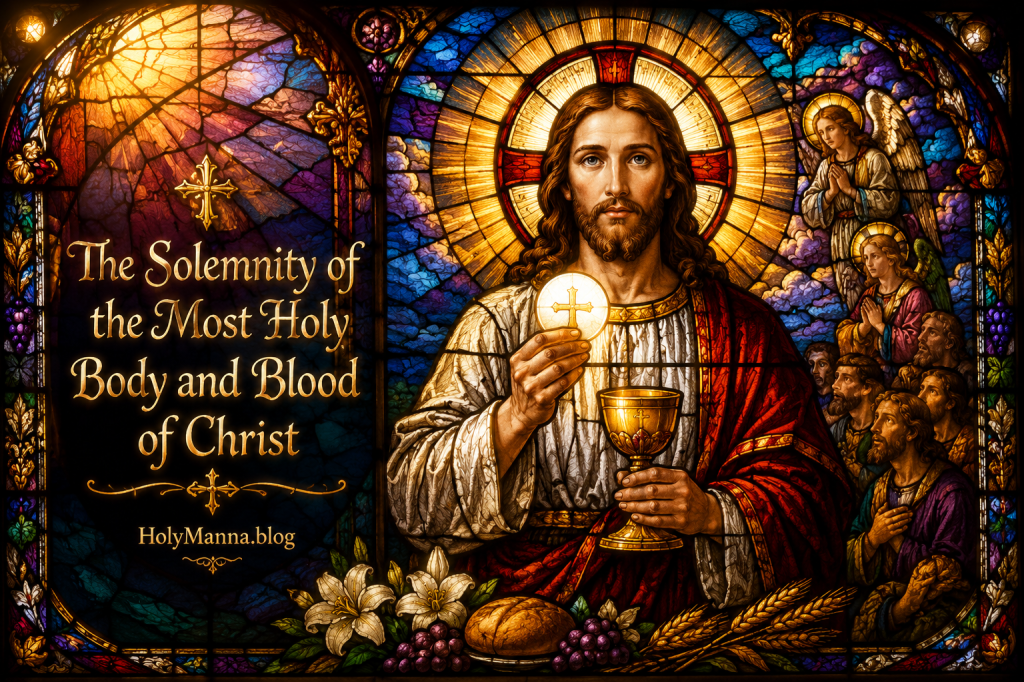
The Solemnity of the Most Holy Body and Blood of Christ, traditionally known as Corpus Christi, is one of the most powerful public expressions of Catholic faith. It is the day the Church steps outside the walls of the sanctuary and proclaims to the world that the Eucharist is not merely a symbol, not merely a reminder, and not merely a sacred meal.
The Eucharist is Jesus Christ Himself.
In this solemnity, the Church celebrates the Real Presence of Christ in the Blessed Sacrament: His Body, Blood, Soul, and Divinity under the appearances of bread and wine. This is the beating heart of Catholic worship. This is why the Catechism of the Catholic Church teaches that the Eucharist is “the source and summit of the Christian life” (CCC 1324).
That phrase is not Catholic decoration. It is the Church saying that everything in Christian life flows from the Eucharist and everything in Christian life leads back to the Eucharist. Baptism prepares the soul for communion with Christ. Confession restores that communion when sin has wounded it. Marriage and Holy Orders are strengthened by it. The works of mercy flow from it. The entire life of the Church is gathered around the altar because Christ Himself is there.
The Solemnity of the Most Holy Body and Blood of Christ reminds the faithful that Catholicism is not built on an idea about Jesus. It is built on communion with Jesus.
A Feast Born From Love, Wonder, and Holy Longing
The story behind Corpus Christi begins in the Middle Ages, during a time of intense Eucharistic devotion, but also real confusion and controversy over the Real Presence of Christ in the Eucharist. The Church had always believed, taught, and worshiped Christ as truly present in the Blessed Sacrament, but errors and doubts had begun to spread in parts of Europe. In response, God raised up saints, theologians, bishops, and pastors who helped the Church proclaim her Eucharistic faith with renewed clarity.
One of the central figures in this story is Saint Juliana of Cornillon, also known as Saint Juliana of Liège. She was born near Liège, in present-day Belgium, around the end of the twelfth century. From an early age, she had a profound love for the Eucharist. She lived in a religious community and spent much of her life in prayer, service, and adoration.
According to the tradition passed down by the Church, Saint Juliana began receiving a recurring vision while in prayer. She saw a bright full moon marked by a dark line. Over time, she came to understand the moon as a symbol of the Church’s liturgical life, beautiful and radiant, but marked by something missing. The dark line represented the absence of a feast dedicated specifically to honoring the Eucharist.
The Church already celebrated the institution of the Eucharist on Holy Thursday, but Holy Thursday is also surrounded by the sorrow of the Lord’s Passion. It is the night of the Last Supper, the agony in the garden, the betrayal of Judas, and the beginning of Christ’s suffering. Saint Juliana desired a feast filled with joyful thanksgiving, solemn praise, and public adoration of Jesus truly present in the Eucharist.
After years of prayer, discernment, and consultation with theologians and Church leaders, her desire began to bear fruit. Bishop Robert of Liège approved the local celebration of the feast in his diocese in the thirteenth century. Later, Jacques Pantaléon, who had known of this Eucharistic devotion, became Pope Urban IV.
In 1264, Pope Urban IV extended the feast to the universal Latin Church through the papal bull Transiturus de hoc mundo. The feast was placed on the Thursday after Trinity Sunday, although in many places today, including the United States, it is transferred to the following Sunday.
This feast was not created because the Church suddenly invented Eucharistic doctrine. The faith was apostolic. The feast was created so the Church could proclaim that ancient faith more solemnly, more publicly, and more joyfully.
The Miracle That Pointed Back to the Mystery
The Solemnity of Corpus Christi is also closely associated with the Eucharistic Miracle of Bolsena. According to Catholic tradition, a priest named Peter of Prague was struggling with doubts about the Real Presence. While celebrating Mass in Bolsena in 1263, the consecrated Host began to bleed onto the corporal.
The relic was brought to Orvieto, where Pope Urban IV was residing. The Cathedral of Orvieto still preserves the sacred corporal, and the city remains one of the great places of Eucharistic devotion connected with this feast.
It is important to understand this properly. The miracle did not create Catholic belief in the Eucharist. The Church’s faith in the Eucharist comes from Christ Himself, from Scripture, from the Apostles, and from Sacred Tradition. The miracle served as a sign, a confirmation, and a call to deeper faith.
God did not need the miracle to make the Eucharist true. The miracle helped awaken hearts to the truth already present on every Catholic altar.
The Bread That Is More Than Bread
The theological meaning of this feast reaches into the center of the Gospel.
At the Last Supper, Jesus took bread and said, “This is my body”. He took the chalice and said, “This is my blood of the covenant”. The Church has always taken the Lord at His word. The Eucharist is not a metaphor that Catholics decided to treat seriously. It is Christ’s own gift, given in the language of sacrifice, covenant, communion, and divine love.
In The Gospel of John, Jesus says, “My flesh is true food, and my blood is true drink” (John 6:55). Many of His listeners struggled with this teaching. Some walked away. Jesus did not soften the teaching or explain it away as a symbol. Instead, He let the weight of the mystery stand.
Saint Paul also teaches the reality of the Eucharist in The First Letter to the Corinthians when he says, “The cup of blessing that we bless, is it not a participation in the blood of Christ?” and “The bread that we break, is it not a participation in the body of Christ?” (1 Corinthians 10:16).
The Catechism of the Catholic Church teaches that Christ is present in the Eucharist “truly, really, and substantially” (CCC 1374). That presence is called “real” not because the other ways Christ is present are unreal, but because the Eucharist contains Christ Himself in the fullest sacramental way.
The Church also teaches that the Eucharist is a sacrifice. The Mass does not crucify Jesus again. It makes present the one sacrifice of Calvary in an unbloody sacramental manner. The Catechism of the Catholic Church teaches, “The sacrifice of Christ and the sacrifice of the Eucharist are one single sacrifice” (CCC 1367).
That is why the Mass is not a performance, a lecture, or a religious gathering centered on human emotion. The Mass is the sacrifice of Christ made present. Heaven touches earth. The Lamb of God is offered. The faithful are fed with the Bread of Life.
Saint Thomas Aquinas and the Poetry of Eucharistic Faith
When Pope Urban IV established the feast, he asked Saint Thomas Aquinas to compose the liturgical texts for it. This gave the Church some of her most beautiful Eucharistic hymns and prayers.
Saint Thomas Aquinas gave the Church Pange Lingua, whose final verses are known as Tantum Ergo and are traditionally sung at Benediction of the Blessed Sacrament. He also composed Lauda Sion, the great sequence for the Mass of this solemnity. Other Eucharistic hymns associated with him include O Salutaris Hostia, Panis Angelicus, and Adoro Te Devote.
These hymns are not only beautiful. They are theology set on fire.
In Lauda Sion, the Church sings of the Eucharistic mystery with reverent boldness. The hymn teaches that what appears to the senses as bread and wine is truly the Body and Blood of Christ. Faith sees what the eyes cannot. Love adores what the senses cannot grasp.
That is one of the deepest lessons of this feast. The Eucharist humbles human pride. The eyes see bread. Faith hears Christ say, “This is my body”. The tongue tastes wine. Faith hears Christ say, “This is my blood”. The Catholic heart bows before the Lord who hides His glory under the humblest signs.
The Procession: Jesus Passing Through the Streets
One of the most beloved traditions of this feast is the Eucharistic procession. After Mass, the consecrated Host is placed in a monstrance and carried through the streets while the faithful follow in prayer, song, adoration, and reverence.
This is not religious theater. It is public worship.
The Church carries Christ through ordinary streets because Christ came for ordinary people. He passes homes, businesses, schools, hospitals, traffic, sidewalks, elderly neighbors, young families, distracted souls, wounded hearts, curious strangers, and people who may not even know what they are seeing.
The procession says something powerful without needing many words: Jesus is Lord here too.
He is not Lord only inside the church building. He is Lord of the city. He is Lord of the home. He is Lord of the workplace. He is Lord of the poor, the sick, the unborn, the elderly, the lonely, the sinner, the saint, and the person who is still searching.
Canon Law specifically encourages Eucharistic processions, especially on this solemnity, when they can be fittingly held according to the judgment of the diocesan bishop. The procession is a public witness of veneration toward the Most Holy Eucharist.
The procession usually concludes with Benediction of the Blessed Sacrament. The priest blesses the people with the Eucharistic Lord Himself. This is one of the most moving moments in Catholic devotional life. The blessing does not come from a symbol. It comes from Christ truly present.
Devotion, Pilgrimage, and the Catholic Heart
The Solemnity of the Most Holy Body and Blood of Christ is deeply connected with Eucharistic adoration. The Catechism of the Catholic Church teaches that the Church has always offered worship to the Eucharist, not only during Mass, but also outside Mass by reserving the consecrated Hosts, exposing them for solemn veneration, and carrying them in procession.
Common devotions associated with this feast include Eucharistic adoration, Holy Hours, Benediction, Forty Hours devotion, visits to the tabernacle, Eucharistic Congresses, and public processions.
These devotions are not meant to replace the Mass. They flow from the Mass and lead back to the Mass. The Eucharist is first and above all the sacrifice of Christ made present in the liturgy. Adoration outside Mass helps the faithful continue loving, worshiping, and contemplating the same Jesus received and adored in the Mass.
Several places are especially connected with this feast. Liège is remembered as the place where Saint Juliana’s Eucharistic mission first took root. Bolsena and Orvieto are associated with the Eucharistic miracle that became closely linked to the feast’s spread. Rome has long celebrated the solemnity with papal Masses and Eucharistic processions. Around the world, countless parishes and dioceses hold processions, Holy Hours, and solemn celebrations.
Pilgrimage connected to this feast is not simply about going somewhere sacred. It is about becoming someone more Eucharistic. A pilgrim walks with Christ, adores Christ, receives Christ, and asks to be changed by Christ.
A Feast Celebrated With Song, Flowers, Incense, and Faith
Throughout Catholic history, Corpus Christi has inspired rich cultural celebrations. In many countries, streets are decorated with flowers, carpets, banners, candles, and sacred images. Children who have recently received First Holy Communion often participate in processions. Choirs sing Eucharistic hymns. Bells ring. Incense rises. The Blessed Sacrament is carried under a canopy as the faithful kneel in reverence.
In some places, entire towns pause as the Eucharistic Lord passes by. Windows are decorated. Altars are set up along the route. Families gather in prayer. Communities that may struggle to agree on many things find themselves united around the one Lord who gives Himself to all.
The hymns of this feast are among the treasures of Catholic worship. Tantum Ergo is still sung at Benediction around the world. O Salutaris Hostia lifts the heart toward the saving Victim who opens the gate of heaven. Panis Angelicus contemplates the wonder that the Bread of Angels has become food for pilgrims on earth.
This cultural beauty matters because Catholicism is not embarrassed by the body, the senses, or public devotion. Flowers, candles, incense, music, vestments, bells, and processions all teach something. They teach that the invisible God has come close in visible signs. They teach that worship should involve the whole person. They teach that beauty can become a doorway to faith.
What the Popes Teach About This Feast
The modern popes have spoken beautifully about the Solemnity of the Most Holy Body and Blood of Christ.
Saint John Paul II emphasized that this feast is missionary. The Church does not receive the Eucharist and then hide from the world. The faithful receive Christ and are sent into the world as witnesses of His love. In the Eucharistic procession, the Church publicly proclaims that Christ’s sacrifice is for the salvation of the whole world.
Pope Benedict XVI often connected Corpus Christi with Holy Thursday. Holy Thursday remembers the institution of the Eucharist in the intimacy of the Upper Room. Corpus Christi brings that same mystery into the open, proclaiming it with joy, adoration, and public witness. Benedict also reminded the faithful that receiving Christ and adoring Christ belong together. A Catholic cannot truly understand Holy Communion without worshiping the One received.
Pope Francis has reflected on the Eucharist through the themes of thanksgiving, remembrance, and presence. The Eucharist gathers up the whole of life: work, suffering, gratitude, weakness, success, failure, family, mission, and hope. Everything can be brought to the altar because Christ gives Himself for the redemption of everything.
Pope Leo XIV has emphasized that the Eucharist is Christ’s true, real, and substantial presence, and that Christ transforms the bread into Himself in order to transform the faithful into Himself. That is the hidden challenge of the feast. The Eucharist is not only adored. The Eucharist changes people.
The Feast That Answers Human Hunger
Every human heart is hungry.
Some hunger for love. Some hunger for peace. Some hunger for forgiveness. Some hunger for belonging. Some hunger for truth. Some hunger for a reason to keep going.
The Solemnity of the Most Holy Body and Blood of Christ proclaims that God does not answer that hunger from a distance. He comes close. He gives His Body. He pours out His Blood. He remains with His Church.
This is why the Eucharist is so personal and so powerful. Jesus does not merely send help. He gives Himself. He does not only teach about love. He becomes the food of love. He does not only invite the faithful to remember Calvary. He makes the sacrifice of Calvary present on the altar.
The world often teaches people to consume, achieve, distract themselves, and keep moving. The Eucharist teaches something completely different. It teaches the soul to receive. It teaches the heart to adore. It teaches the body to kneel. It teaches the Christian to become a gift.
The procession through the streets asks a quiet but serious question: If Christ is willing to be carried through the streets, is the soul willing to carry Him into the home, the workplace, the family, the friendships, the wounds, the temptations, and the hidden parts of life?
A Catholic life cannot be Eucharistic only on Sunday. The person who receives the Body of Christ is called to become a living member of the Body of Christ. The person who adores Christ in the monstrance is called to recognize Christ in the poor, the forgotten, the elderly, the unborn, the lonely, and the difficult person across the table.
The Eucharist forms saints, not spectators.
Living Corpus Christi Every Day
The lesson of this feast is not complicated, but it is demanding. Adore Christ. Receive Christ worthily. Follow Christ publicly. Carry Christ humbly. Become more like the One who gives Himself completely.
A practical way to live this feast is to make a visit to the Blessed Sacrament, even for a few quiet minutes. Another way is to prepare more carefully for Mass by arriving early, making a good examination of conscience, and receiving Holy Communion with reverence. Catholics conscious of grave sin should seek sacramental Confession before receiving the Eucharist, because love for the Eucharist includes reverence for the holiness of the One received.
Families can make this feast meaningful by attending a Eucharistic procession, teaching children how to genuflect reverently, praying before the tabernacle, or singing a Eucharistic hymn together. Anyone carrying stress, grief, temptation, or confusion can bring that burden to adoration and sit quietly before the Lord who remains.
Christ in the Eucharist is not distant. He is not abstract. He is not a memory trapped in the past.
He is here.
And on this feast, the Church carries Him into the world so the world can remember that it has not been abandoned.
Engage with Us!
Share your thoughts and reflections in the comments below. The Solemnity of the Most Holy Body and Blood of Christ invites every Catholic to look again at the Eucharist with wonder, reverence, and love.
- How does the Real Presence of Jesus in the Eucharist change the way Mass should be approached?
- What would it look like to carry Christ more faithfully into daily life after receiving Him in Holy Communion?
- When was the last time adoration, Benediction, or a Eucharistic procession helped deepen faith?
- What hunger in the heart needs to be brought before Jesus in the Blessed Sacrament?
- How can families, parishes, and communities become more visibly Eucharistic in the way they love, forgive, serve, and worship?
May this feast renew faith in the Real Presence of Jesus Christ and awaken a deeper love for the Holy Eucharist. Live with reverence, walk with courage, and do everything with the love and mercy Jesus taught us.
Lamb of God, Who takes away the sins of the world, have mercy on us!
Follow us on YouTube, TikTok, Instagram and Facebook for more insights and reflections on living a faith-filled life.


Leave a Reply