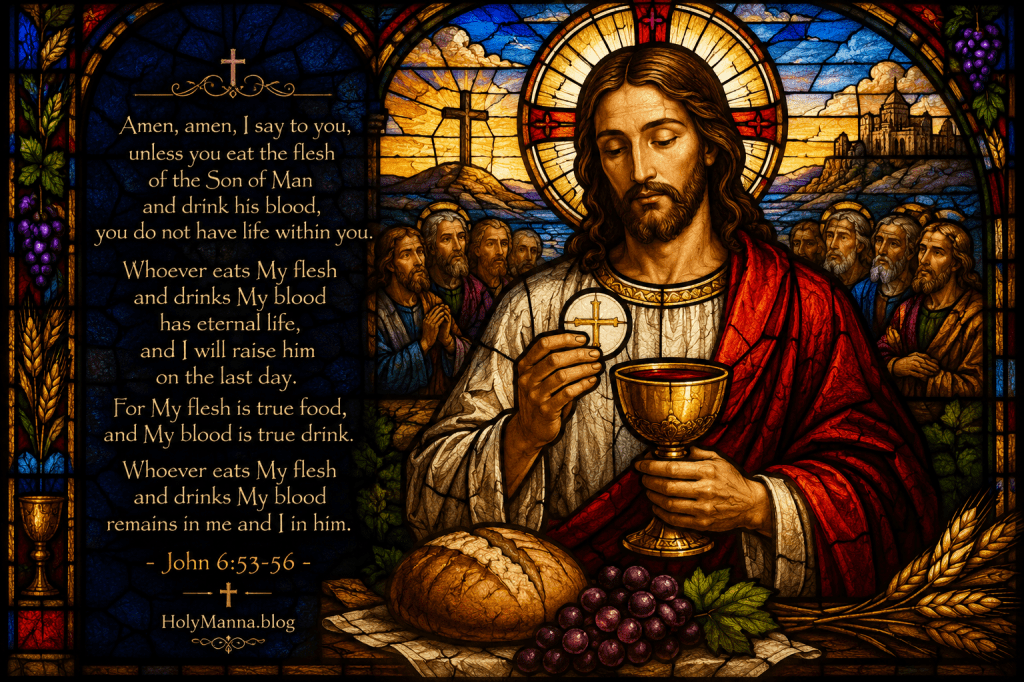
The Solemnity of the Most Holy Body and Blood of Christ – Lectionary: 167
The Bread That Remembers, Feeds, and Unites
There is a hunger in every human heart that ordinary bread cannot satisfy. On this Solemnity of the Most Holy Body and Blood of Christ, the Church gathers around one great mystery: the God who once fed Israel with manna in the wilderness now feeds His people with the Body and Blood of His Son.
Today’s readings move like a sacred journey. In Deuteronomy 8:2-3, 14-16, Moses tells Israel to remember the desert, the hunger, the serpents, the thirst, the water from the rock, and the manna from heaven. God was not abandoning His people in the wilderness. He was teaching them that life depends on more than survival, comfort, and control. As Moses says, “not by bread alone that people live, but by all that comes forth from the mouth of the Lord” (Deuteronomy 8:3).
That same hunger echoes through Psalm 147, where Jerusalem praises the Lord who gives peace, protects His people, speaks His Word, and “satisfies you with finest wheat” (Psalm 147:14). For Israel, bread was never only bread. It was a sign of covenant love, daily dependence, and divine care. By the time Jesus speaks in John 6:51-58, the meaning becomes unmistakable. The manna was a sign pointing forward to something greater. Christ Himself is the living Bread come down from heaven.
Saint Paul gives the Church the Eucharistic key in 1 Corinthians 10:16-17. The cup and the bread are not empty symbols. They are a real participation in the Blood and Body of Christ. This is why The Catechism of the Catholic Church teaches that in the Eucharist, Christ is truly, really, and substantially present, Body, Blood, Soul, and Divinity (CCC 1374). It is also why the Eucharist makes the Church one, because “we, though many, are one body” (1 Corinthians 10:17; CCC 1396).
The central theme of today’s readings is that the Eucharist is the true Bread from Heaven, given to nourish God’s people through the wilderness of this life and unite them as one Body in Christ. The desert teaches us to hunger. The psalm teaches us to praise. Saint Paul teaches us to recognize Communion as participation. Jesus teaches us to believe His words with reverent faith: “My flesh is true food, and my blood is true drink” (John 6:55).
If Christ gives Himself so completely in the Eucharist, how should the soul prepare to receive Him today?
First Reading – Deuteronomy 8:2-3, 14-16
The Wilderness Where God Teaches His People to Hunger for Heaven
Before Israel entered the Promised Land, Moses looked back over forty years of desert wandering and told the people to remember. That word matters. Israel had been rescued from Egypt, led through danger, fed with manna, and given water from the rock. Yet Moses knew the human heart. Once people become comfortable, they can forget the God who carried them when they had nothing.
This reading comes from Moses’ farewell teaching in Deuteronomy, where he prepares Israel to live faithfully in the land God promised. The danger was not only starvation in the desert. The deeper danger was pride in prosperity. Israel could receive God’s gifts and then forget the Giver.
On the Solemnity of the Most Holy Body and Blood of Christ, this reading prepares the soul to understand the Eucharist. The manna was real food, but it was also a sign pointing forward. God fed Israel in the wilderness so His people would learn that life is more than bread, more than comfort, more than security, and more than what the body can consume. In Christ, the true Bread from Heaven, that lesson reaches its fullness. The same God who fed Israel with manna now feeds the Church with the Body and Blood of His Son.
Deuteronomy 8:2-3, 14-16 – New American Bible (Revised Edition)
2 Remember how for these forty years the Lord, your God, has directed all your journeying in the wilderness, so as to test you by affliction, to know what was in your heart: to keep his commandments, or not. 3 He therefore let you be afflicted with hunger, and then fed you with manna, a food unknown to you and your ancestors, so you might know that it is not by bread alone that people live, but by all that comes forth from the mouth of the Lord.
14 you then become haughty of heart and forget the Lord, your God, who brought you out of the land of Egypt, that house of slavery; 15 he guided you through the vast and terrible wilderness with its saraph serpents and scorpions, its parched and waterless ground; he brought forth water for you from the flinty rock 16 and fed you in the wilderness with manna, a food unknown to your ancestors, that he might afflict you and test you, but also make you prosperous in the end.
Detailed Exegesis
Verse 2 – “Remember how for these forty years the Lord, your God, has directed all your journeying in the wilderness, so as to test you by affliction, to know what was in your heart: to keep his commandments, or not.”
Moses begins with memory because faith is strengthened by remembering what God has already done. The forty years in the wilderness were not random suffering. They were a time of purification, testing, and formation. God was revealing what was hidden in Israel’s heart.
In Scripture, testing does not mean God is ignorant and needs information. It means God allows the truth of the heart to come into the open. Israel had to learn whether it would trust God only when life was easy, or whether it would obey Him when the road was long, dry, and uncertain.
This speaks directly to the Eucharistic theme of the day. Before God gives the fullness of heavenly food, He teaches His people to hunger rightly. The desert strips away illusions. It reveals whether the soul depends on God or on comfort. It teaches that obedience is not only for peaceful seasons, but also for seasons of confusion and need.
Verse 3 – “He therefore let you be afflicted with hunger, and then fed you with manna, a food unknown to you and your ancestors, so you might know that it is not by bread alone that people live, but by all that comes forth from the mouth of the Lord.”
This verse is the spiritual heart of the reading. God allowed Israel to feel hunger, but He did not abandon His people to hunger. He fed them with manna, a mysterious bread from heaven that they could not produce, predict, or control.
The manna taught dependence. Each morning, Israel had to receive what God provided. They could not hoard it in distrust. They could not manufacture it by human effort. They had to live daily from the hand of God.
Moses explains the deeper lesson: human beings do not live by bread alone. Physical food matters, but it is not enough to sustain the whole person. The soul needs the Word of God. The soul needs communion with God. The soul needs more than survival.
Jesus quotes this verse during His temptation in the desert, showing that true life is found in obedience to the Father. On Corpus Christi, the Church hears this verse as preparation for John 6, where Jesus reveals Himself as the living Bread come down from heaven. The manna kept Israel alive for a time. The Eucharist gives the life of Christ and prepares the soul for eternal life.
Verse 14 – “you then become haughty of heart and forget the Lord, your God, who brought you out of the land of Egypt, that house of slavery;”
Moses warns Israel against becoming haughty of heart. Pride often grows after blessing, not before it. When people are desperate, they may cry out to God. When they become secure, they can begin to believe they saved themselves.
Egypt is called “that house of slavery” because Israel’s identity begins with deliverance. They were not self-rescued. They were redeemed. Everything they had came from the Lord’s mercy.
This warning matters for the Eucharistic life. The Mass is the great school of humility. Every communicant approaches the altar empty-handed. No one deserves the Eucharist. No one earns Christ’s Body and Blood. The faithful receive because Christ gives Himself freely.
The danger Moses names is still very real. A person can receive gifts from God, including family, work, health, faith, and even the Eucharist itself, and slowly begin to treat them casually. Forgetfulness is one of the quiet enemies of holiness.
Verse 15 – “he guided you through the vast and terrible wilderness with its saraph serpents and scorpions, its parched and waterless ground; he brought forth water for you from the flinty rock”
Moses reminds Israel that the desert was dangerous. It was not a mild inconvenience. It was a “vast and terrible wilderness” filled with serpents, scorpions, thirst, and barren ground. Israel survived because God guided them.
The water from the rock is another great sign of God’s provision. In a place where life seemed impossible, God brought life. The rock became a source of water because God commanded it.
Catholic tradition has long seen the desert miracles as signs that point forward to Christ. Saint Paul later speaks of Israel drinking from the spiritual rock, and says “the rock was the Christ” (1 Corinthians 10:4). The same pattern appears here: God gives life where human strength fails.
This verse reminds the Church that the Eucharist is food for pilgrims, not a reward for people who have already arrived. The Christian life still passes through deserts. There are temptations, wounds, dryness, grief, confusion, and spiritual battles. Yet Christ remains present, guiding His people and feeding them with Himself.
Verse 16 – “and fed you in the wilderness with manna, a food unknown to your ancestors, that he might afflict you and test you, but also make you prosperous in the end.”
Moses repeats the gift of manna because Israel must never forget it. The manna was unknown to their ancestors, which means it came as a surprising gift. God nourished His people in a way they could not have imagined.
The verse ends with hope. God’s testing was not meant to destroy Israel. It was meant to prepare them. The wilderness was painful, but it was ordered toward blessing. God humbled His people so He could lead them into deeper life.
This is essential for understanding the Eucharist. God does not feed His people merely to make them comfortable. He feeds them to make them holy. The Eucharist strengthens the soul for obedience, charity, endurance, and union with Christ. It is heavenly food for the journey toward the eternal Promised Land.
Teachings
The first reading teaches that hunger can become a holy teacher when it leads the soul back to God. Israel’s desert experience reveals that God sometimes allows His people to feel their weakness so they can discover His faithfulness. The manna was both nourishment and instruction. It fed the body, but it also trained the heart to depend on God.
The Catechism of the Catholic Church connects the manna directly to the Eucharistic mystery when it teaches: “The miracles of the multiplication of the loaves, when the Lord says the blessing, breaks and distributes the loaves through his disciples to feed the multitude, prefigure the superabundance of this unique bread of his Eucharist.” (CCC 1335)
This teaching helps us see the pattern running through salvation history. God feeds His people in the desert. Jesus multiplies loaves for the crowds. Then, at the Last Supper and in every Mass, Christ gives something infinitely greater than earthly bread. He gives Himself.
The Church also teaches that the Eucharist is true food for the soul. The Catechism says: “What material food produces in our bodily life, Holy Communion wonderfully achieves in our spiritual life.” (CCC 1392) This means the Eucharist preserves, increases, and renews the life of grace in the soul. Just as the Israelites needed manna to continue through the wilderness, Christians need the Eucharist to continue faithfully through the pilgrimage of this life.
The saints loved this connection between manna and the Eucharist. Saint Thomas Aquinas, in the Corpus Christi hymn Lauda Sion, sings of Christ as the true bread that fulfills the ancient signs: “Lo! the angel’s food is given to the pilgrim who has striven; see the children’s bread from heaven.” His words capture the heart of today’s feast. The Eucharist is food for pilgrims. It is not ordinary bread. It is the Bread of Heaven given to the children of God.
This reading also warns against spiritual forgetfulness. Moses knows that prosperity can tempt the heart toward pride. That is why the Eucharist is also an antidote to pride. At every Mass, the faithful kneel before a mystery they cannot control, manufacture, or fully comprehend. The Eucharist humbles the mind and softens the heart. It reminds the Church that salvation is not self-made. It is received.
Reflection
This reading asks every Catholic to remember the desert. Not only Israel’s desert, but the personal deserts where God has already been faithful. There have been seasons when strength ran low, when prayer felt dry, when the future seemed unclear, and when the heart had to choose between trust and fear. Those moments were not wasted if they taught dependence on God.
The Eucharist is Christ’s answer to that hunger. He does not simply tell His people to keep walking. He feeds them with Himself. He does not remove every desert immediately, but He gives the food that makes faithfulness possible.
A practical way to live this reading is to practice Eucharistic gratitude. Before Mass, remember one specific way God has provided in the past. After Communion, thank Jesus for feeding the soul even when feelings are quiet. During the week, choose one moment of hunger, frustration, or weakness and turn it into prayer: Lord, teach me to live not by bread alone, but by every word that comes from You.
This reading also invites a serious examination of pride. Comfort can make the soul forgetful. Success can make prayer seem less urgent. Busy routines can make the Eucharist feel ordinary. Moses speaks directly into that danger. Do not forget the Lord who brought you out of slavery. Do not forget the God who carried you through the wilderness. Do not forget the Bread from Heaven who waits at every Mass.
Where has God fed you in a wilderness season, and have you remembered to thank Him?
What hunger in your life might be teaching you to depend more deeply on Christ?
Do you approach the Eucharist as a routine, or as the true Bread from Heaven given for your journey home?
The God who fed Israel with manna still feeds His people today. But now the gift is greater than manna. The gift is Christ Himself, Body, Blood, Soul, and Divinity, given so the soul may live.
Responsorial Psalm – Psalm 147:12-15, 19-20
The God Who Feeds His People With Peace, Wheat, and His Word
After Moses reminds Israel of the manna in the wilderness, the responsorial psalm lifts the eyes of God’s people toward Jerusalem. The desert journey has become worship. The God who fed His people when they had nothing is now praised as the Lord who strengthens the city, blesses its children, brings peace, gives His Word, and satisfies His people with the finest wheat.
Psalm 147 is a hymn of praise, likely connected to Israel’s restoration after exile, when Jerusalem was rebuilt and the people recognized that their survival had come from God alone. This psalm celebrates the Lord as the One who protects, nourishes, and teaches His covenant people. He does not merely give bread. He gives peace. He does not merely strengthen gates. He strengthens hearts through His Word.
On the Solemnity of the Most Holy Body and Blood of Christ, this psalm becomes beautifully Eucharistic. The phrase “finest wheat” points beyond ordinary provision. It prepares the Church to recognize Christ, the true Bread from Heaven, who feeds His people not only with earthly food, but with His very Body and Blood. The God who once gave manna in the desert now gives the Eucharist, the sacrament of unity, peace, and divine life.
Psalm 147:12-15, 19-20 – New American Bible (Revised Edition)
12 Glorify the Lord, Jerusalem;
Zion, offer praise to your God,
13 For he has strengthened the bars of your gates,
blessed your children within you.
14 He brings peace to your borders,
and satisfies you with finest wheat.
15 He sends his command to earth;
his word runs swiftly!19 He proclaims his word to Jacob,
his statutes and laws to Israel.
20 He has not done this for any other nation;
of such laws they know nothing.
Hallelujah!
Detailed Exegesis
Verse 12 – “Glorify the Lord, Jerusalem; Zion, offer praise to your God,”
The psalm begins with a call to praise. Jerusalem, also called Zion, is summoned to glorify the Lord because the city belongs to Him. This is not generic religious enthusiasm. It is covenant praise. Israel praises God because He has chosen, protected, corrected, and restored His people.
In Catholic worship, this verse finds a deep echo in the Mass. The Church, the new Zion, gathers to glorify the Lord not only with words, but through the Eucharistic sacrifice. Every Mass is an act of praise offered to the Father through the Son in the Holy Spirit. The Eucharist is the perfect thanksgiving because Christ Himself is the offering.
This verse invites the faithful to remember that worship is not a side activity in the Christian life. Worship is the proper response to being loved, saved, fed, and gathered by God.
Verse 13 – “For he has strengthened the bars of your gates, blessed your children within you.”
The strengthened gates symbolize protection and security. In the ancient world, city gates represented safety, order, and the ability to live without constant fear of invasion. God is praised because He protects His people and blesses the children within the city.
Spiritually, this verse reveals God as the guardian of His covenant family. He does not only rescue individuals in isolation. He forms a people, shelters them, and blesses their generations.
This connects closely to the Eucharist because Holy Communion strengthens the Church from within. The Eucharist protects the soul from spiritual weakness, deepens charity, and unites believers as one Body in Christ. The strongest walls of the Church are not made of stone. They are built from grace, truth, charity, and communion with Christ.
Verse 14 – “He brings peace to your borders, and satisfies you with finest wheat.”
This verse is the center of the psalm’s Eucharistic beauty. God gives peace and satisfies His people with the finest wheat. Peace in Scripture is more than the absence of conflict. It is wholeness, order, blessing, and right relationship with God.
The finest wheat recalls abundance, nourishment, and covenant blessing. In the context of Corpus Christi, it points toward the Eucharist, where Christ gives something greater than earthly wheat. He gives Himself. The bread of the altar becomes, through the power of Christ’s word and the Holy Spirit, the true Body of the Lord.
This is why the Eucharist is both food and peace. It nourishes the soul and draws the faithful into deeper communion with God and one another. The world often offers distraction instead of peace and consumption instead of communion. The Eucharist gives what the soul actually needs.
Verse 15 – “He sends his command to earth; his word runs swiftly!”
God’s Word is living, active, and effective. When the Lord speaks, creation responds. His command reaches the earth with power and speed. This verse reminds the faithful that God’s Word does not remain trapped in heaven. It enters history. It creates, guides, judges, heals, and saves.
On this feast, the verse also prepares the heart for the mystery of the Incarnation and the Eucharist. The eternal Word became flesh in Jesus Christ. At Mass, by the words of consecration and the power of the Holy Spirit, Christ becomes truly present under the appearances of bread and wine.
The same God whose word runs swiftly over the earth now speaks through the liturgy. The Scriptures are proclaimed. The words of Christ are spoken at the altar. The faithful receive the Word made flesh as food for the journey.
Verse 19 – “He proclaims his word to Jacob, his statutes and laws to Israel.”
God’s gift to Israel was not only land, protection, or bread. He gave His Word, His statutes, and His law. This made Israel distinct among the nations. The law was not meant to crush God’s people, but to teach them how to live in covenant with Him.
This verse shows that divine instruction is a form of love. God speaks because He wants His people to know Him and walk in the path of life. His commandments reveal the shape of holiness.
In the Mass, the Liturgy of the Word continues this pattern. God still speaks to His people before feeding them in the Eucharist. The Word prepares the soul to receive the Sacrament. The readings are not a warm-up before Communion. They are part of the one act of worship in which Christ teaches, nourishes, and gathers His Church.
Verse 20 – “He has not done this for any other nation; of such laws they know nothing. Hallelujah!”
The psalm ends in wonder. Israel recognizes that God’s covenant revelation is a unique gift. The Lord has made Himself known to His people in a way they did not earn and could never have invented.
For Catholics, this sense of wonder becomes even greater in the Eucharist. God has not only spoken His law. He has sent His Son. He has not only fed His people with wheat. He feeds them with the Body and Blood of Christ. He has not only blessed Jerusalem. He gathers the Church from every nation into one Eucharistic communion.
The final “Hallelujah!” is not decorative. It is the only fitting response. When God feeds, protects, speaks, and dwells among His people, praise becomes the natural language of the redeemed.
Teachings
This psalm teaches that God’s people are sustained by three great gifts: His protection, His peace, and His nourishment. These gifts come together most fully in the Eucharist. At Mass, Christ protects His Church by strengthening her in grace. He brings peace by reconciling sinners to Himself. He satisfies His people with the finest wheat, which becomes His true Body.
The Catechism of the Catholic Church teaches: “The Eucharist is ‘the source and summit of the Christian life.’ ‘The other sacraments, and indeed all ecclesiastical ministries and works of the apostolate, are bound up with the Eucharist and are oriented toward it. For in the blessed Eucharist is contained the whole spiritual good of the Church, namely Christ himself, our Pasch.’” (CCC 1324)
This teaching helps explain why the psalm fits so perfectly into Corpus Christi. The psalm praises God for feeding and strengthening Jerusalem. The Church praises God because, in the Eucharist, He gives the whole spiritual good of the Church: Christ Himself.
The Catechism also teaches: “The Eucharist is the efficacious sign and sublime cause of that communion in the divine life and that unity of the People of God by which the Church is kept in being.” (CCC 1325) This connects beautifully with the psalm’s vision of Jerusalem as a protected, blessed, and united city. The Eucharist is not only personal nourishment. It is the sacrament that keeps the Church alive in unity.
The phrase “finest wheat” has always carried a Eucharistic beauty in Catholic prayer. Saint Thomas Aquinas, in the Corpus Christi hymn Lauda Sion, writes: “Lo! the angel’s food is given to the pilgrim who has striven; see the children’s bread from heaven, which on dogs may not be spent.” His hymn teaches that the Eucharist is heavenly food for the children of God, the true fulfillment of the signs and promises of the Old Covenant.
The psalm also reminds the faithful that the Eucharist and the Word of God belong together. God “proclaims his word to Jacob” (Psalm 147:19) and “satisfies you with finest wheat” (Psalm 147:14). In the Mass, the same pattern remains. God speaks in the Scriptures, then feeds His people with Christ in the Eucharist. The Word awakens faith. The Eucharist deepens communion.
Reflection
This psalm invites the faithful to see the Mass with fresh eyes. At every Eucharist, God does what Psalm 147 celebrates. He gathers His people like Jerusalem. He strengthens what is weak. He blesses His children. He speaks His Word. He brings peace. He satisfies the soul with the true Bread from Heaven.
Many people spend their lives hungry for peace but settle for noise. They hunger for love but settle for attention. They hunger for meaning but settle for productivity. They hunger for communion but settle for scrolling. The Eucharist gently exposes these lesser hungers and redirects the soul toward Christ.
A simple way to live this psalm is to bring real hunger to Mass. Before the readings begin, ask God to speak clearly through His Word. Before Communion, ask Jesus for the peace only He can give. After receiving Him, remain quiet long enough to thank Him. The soul does not need perfect words. It needs reverence, gratitude, and openness.
This psalm also calls Catholic families and parishes to become places of Eucharistic peace. If God strengthens the gates and blesses the children within, then homes should be guarded from bitterness, impurity, cynicism, and constant distraction. If Christ gives Himself as food, then the faithful should become more generous, more patient, and more willing to feed others with mercy.
Where are you looking for peace apart from Christ?
Do you let the Word of God prepare your heart before receiving the Eucharist?
How can your home become more like Zion, a place where God is praised, His Word is honored, and His peace is protected?
The Lord who satisfied Jerusalem with finest wheat now satisfies the Church with something infinitely greater. He gives Jesus Christ, the living Bread from Heaven, so His people may be strengthened, united, and sent forth in peace.
Second Reading – 1 Corinthians 10:16-17
One Cup, One Bread, One Body in Christ
Saint Paul’s words to the Corinthians are brief, but they carry the weight of the Church’s Eucharistic faith. In only two verses, he teaches that the Eucharist is real participation in the Body and Blood of Christ, and that this communion with Christ makes the Church one body.
The city of Corinth was wealthy, busy, divided, and morally confused. It was a place of trade, status, competing loyalties, and pagan religious meals. The Christians there were not living in a quiet Catholic bubble. They were surrounded by a culture that treated worship, food, sexuality, money, and social rank very differently from the Gospel. Paul writes to form them into a Eucharistic people, a people whose unity does not come from personality, politics, class, ethnicity, or personal preference, but from Christ Himself.
This reading fits today’s theme beautifully. In Deuteronomy, God feeds Israel with manna in the wilderness. In Psalm 147, God satisfies Jerusalem with finest wheat. In John 6, Jesus reveals Himself as the living Bread come down from heaven. Here, in 1 Corinthians 10, Saint Paul shows what happens when the Church receives that Bread: the many become one Body because they partake of the one loaf.
1 Corinthians 10:16-17 – New American Bible (Revised Edition)
16 The cup of blessing that we bless, is it not a participation in the blood of Christ? The bread that we break, is it not a participation in the body of Christ? 17 Because the loaf of bread is one, we, though many, are one body, for we all partake of the one loaf.
Detailed Exegesis
Verse 16 – “The cup of blessing that we bless, is it not a participation in the blood of Christ? The bread that we break, is it not a participation in the body of Christ?”
Paul begins with two questions, but he expects the answer to be obvious. The Eucharistic cup is a real participation in the Blood of Christ. The Eucharistic bread is a real participation in the Body of Christ.
The word participation matters. Paul is not speaking about a mere symbol, a mental reminder, or a religious object lesson. He is speaking about communion. The faithful truly share in Christ’s sacrifice and life through the Eucharist. This does not mean Christ is sacrificed again in a bloody way. It means the one sacrifice of Calvary is made sacramentally present in the Mass.
The phrase “cup of blessing” also echoes Jewish meal prayers, especially the blessing cups associated with sacred meals. For Christians, this blessing reaches its fullness in the chalice of the New Covenant. At the Last Supper, Jesus took the cup and said, “This cup is the new covenant in my blood” (Luke 22:20). Paul’s language shows that the earliest Christians understood the Eucharist as a sacred participation in Christ Himself.
This verse also prepares the Church to hear Jesus’ words in John 6 with reverence. When Christ says, “My flesh is true food, and my blood is true drink” (John 6:55), Paul shows how the Church lives that mystery at the altar. The Eucharist is not only believed. It is blessed, broken, shared, and received.
Verse 17 – “Because the loaf of bread is one, we, though many, are one body, for we all partake of the one loaf.”
Paul now moves from communion with Christ to communion within the Church. Because the loaf is one, the people who receive it are made one body. The Eucharist unites vertically and horizontally. It unites the believer to Christ, and it unites believers to one another in Christ.
This is not sentimental unity. Paul is not saying Christians should simply try to get along because community is nice. He is saying the Eucharist creates a real spiritual bond. The Church is one Body because all her members receive from the one Christ.
This would have been a serious challenge to the Corinthians. Their community struggled with division, pride, factions, and social inequality. Paul reminds them that the Eucharist does not allow Christians to live as isolated spiritual consumers. If they receive one Bread, they must become one Body.
This verse also teaches that Holy Communion is never merely private. A person may receive Jesus personally, but never individualistically. The Eucharist draws each soul into the mystery of the Church. To receive the Body of Christ at Mass is also to be more deeply joined to the Body of Christ, the Church.
Teachings
This reading teaches one of the great mysteries of Catholic life: the Eucharist both gives Christ to the Church and makes the Church one in Christ. It is the sacrament of communion, sacrifice, unity, and divine life.
The Catechism of the Catholic Church teaches: “The unity of the Mystical Body: the Eucharist makes the Church. Those who receive the Eucharist are united more closely to Christ. Through it Christ unites them to all the faithful in one body, the Church.” (CCC 1396)
That teaching is almost a direct echo of Saint Paul. The Eucharist does not simply symbolize unity. It makes unity. When Catholics receive Holy Communion worthily, Christ deepens their incorporation into His Body. This is why division, resentment, and contempt are so dangerous in Eucharistic people. The Sacrament that unites the Church calls every communicant to live in charity.
The Catechism also teaches: “The Eucharist is the efficacious sign and sublime cause of that communion in the divine life and that unity of the People of God by which the Church is kept in being.” (CCC 1325) This means the Church does not stay alive by strategy, branding, buildings, personalities, or programs. Those things may have their place, but the Church is kept in being by communion with God, especially through the Eucharist.
The Church’s Eucharistic faith did not develop as a late invention. It is rooted in Scripture and witnessed by the early saints. Saint Augustine preached to newly baptized Christians: “If you receive worthily, you are what you have received.” His point was deeply Pauline. The faithful receive the Body of Christ so they may live as the Body of Christ.
Saint John Paul II taught this same truth in Ecclesia de Eucharistia: “The Church draws her life from the Eucharist.” That short sentence says a lot. The Eucharist is not one devotion among many. It is the heartbeat of the Church. Without the Eucharist, Catholic life becomes weaker, thinner, and less rooted in Christ.
The history of the Church also shows how seriously Catholics have taken this reading. The Solemnity of Corpus Christi developed as a public celebration of the Real Presence of Christ in the Eucharist. The Church brings the Blessed Sacrament into processions not because Catholics worship bread, but because Catholics adore Jesus Christ truly present under the appearances of bread. The one Bread that makes the Church one is worthy of adoration, reverence, and public praise.
Reflection
Saint Paul’s words ask a very practical question: if the faithful receive one Bread, why do they so often live divided?
The Eucharist is not magic. It does not force a person to become holy against his will. But when received with faith, repentance, and love, it transforms the heart. It teaches the soul to live differently. A person cannot honestly receive the Body of Christ and then remain comfortable with gossip, bitterness, pride, racism, cruelty, unforgiveness, or contempt for other members of the Church.
Holy Communion should make Catholics more Catholic in the deepest sense: more united to Christ, more faithful to the Church, more patient with sinners, more hungry for holiness, and more willing to love sacrificially.
A simple way to live this reading is to prepare for Communion by asking two questions before Mass. First, Lord, where do You want to unite my heart more deeply to Yours? Second, Lord, where do You want to heal division between me and another person? These questions turn Communion from routine into a real encounter.
This reading also invites a deeper reverence for parish life. The people in the pews are not strangers who happen to attend the same service. They are members of the same Body. Some may be easy to love. Some may be difficult. Some may be wounded. Some may be annoying. But in Christ, they are not disposable. The Eucharist calls the Church to something stronger than preference. It calls the Church to communion.
Practically, this can begin in small ways. Pray for someone who frustrates you at Mass. Stop repeating the story that keeps resentment alive. Make peace with a family member before receiving Communion when possible. Serve in the parish without needing attention. Receive the Eucharist, then become a person through whom Christ’s peace can travel.
Do you receive Holy Communion as an individual moment only, or as a call to deeper unity with the Church?
Is there someone in the Body of Christ whom you have treated as an enemy rather than as a brother or sister?
What would change in your parish, family, or friendships if the Eucharist truly shaped the way you loved?
Saint Paul gives the Church a simple but demanding truth. There is one cup. There is one bread. There is one Body. The Eucharist is Christ’s gift of Himself, and through that gift, He gathers scattered hearts into communion.
Holy Gospel – John 6:51-58
The Living Bread Who Gives His Flesh for the Life of the World
By the time Jesus speaks these words in The Gospel of John, the crowd has already seen Him multiply the loaves. They have eaten ordinary bread and followed Him because they want more. But Jesus does not let them stop at a miracle meal. He leads them deeper, from bread that fills the stomach to Bread that gives eternal life.
This passage comes from the Bread of Life discourse in John 6, one of the most important Eucharistic teachings in all of Scripture. Jesus speaks in the synagogue at Capernaum, surrounded by people who know the story of Moses, the manna, and the wilderness. Their ancestors ate bread from heaven in the desert. Now Jesus reveals that the manna was only a sign. The true Bread from Heaven is not a thing. He is a Person.
That is why this Gospel is the summit of today’s readings. In Deuteronomy 8:3, God teaches Israel that man does not live by bread alone. In Psalm 147:14, God satisfies His people with finest wheat. In 1 Corinthians 10:16-17, Saint Paul teaches that the cup and bread are participation in the Blood and Body of Christ. Now, in John 6:51-58, Jesus speaks plainly: “My flesh is true food, and my blood is true drink” (John 6:55). The Eucharist is not a symbol that points to an absent Christ. It is Christ Himself, truly present, given for the life of the world.
John 6:51-58 – New American Bible (Revised Edition)
51 I am the living bread that came down from heaven; whoever eats this bread will live forever; and the bread that I will give is my flesh for the life of the world.”
52 The Jews quarreled among themselves, saying, “How can this man give us [his] flesh to eat?” 53 Jesus said to them, “Amen, amen, I say to you, unless you eat the flesh of the Son of Man and drink his blood, you do not have life within you. 54 Whoever eats my flesh and drinks my blood has eternal life, and I will raise him on the last day. 55 For my flesh is true food, and my blood is true drink. 56 Whoever eats my flesh and drinks my blood remains in me and I in him. 57 Just as the living Father sent me and I have life because of the Father, so also the one who feeds on me will have life because of me. 58 This is the bread that came down from heaven. Unlike your ancestors who ate and still died, whoever eats this bread will live forever.”
Detailed Exegesis
Verse 51 – “I am the living bread that came down from heaven; whoever eats this bread will live forever; and the bread that I will give is my flesh for the life of the world.”
Jesus begins with the great claim: He is “the living bread” (John 6:51). This recalls the manna in the wilderness, but it also surpasses it. The manna came from heaven as a temporary food. Jesus comes from heaven as eternal life Himself.
When Jesus says “whoever eats this bread will live forever” (John 6:51), He is not promising a longer earthly life. He is speaking of divine life, the life of grace that begins now and reaches its fullness in the resurrection. The Eucharist nourishes the soul with the life of Christ.
Then Jesus makes the teaching even more concrete: “the bread that I will give is my flesh for the life of the world” (John 6:51). This points toward the Cross. His flesh will be given in sacrifice on Calvary, and that same sacrifice will be made sacramentally present in the Eucharist. The Mass is not a new sacrifice. It is the one sacrifice of Christ made present under sacramental signs.
Verse 52 – “The Jews quarreled among themselves, saying, ‘How can this man give us his flesh to eat?’”
The crowd understands that Jesus is saying something shocking. They do not respond, He must mean this only as a metaphor. They quarrel because His words sound too real, too physical, and too demanding.
Their question matters: “How can this man give us his flesh to eat?” (John 6:52). This is the moment where Jesus could have softened the teaching if He meant only symbolic language. Instead, He intensifies it. Catholic faith takes that seriously.
This verse also reveals a pattern in the spiritual life. People often resist God not because He is unclear, but because He is asking for more trust than they expected. The Eucharist requires humility before a mystery. The senses see bread and wine. Faith hears Jesus say, “This is my body” (Matthew 26:26).
Verse 53 – “Jesus said to them, ‘Amen, amen, I say to you, unless you eat the flesh of the Son of Man and drink his blood, you do not have life within you.’”
Jesus answers with solemn authority: “Amen, amen, I say to you” (John 6:53). In The Gospel of John, this phrase signals a teaching of great importance. Jesus is not backing away. He is making the requirement unmistakable.
The command to eat His flesh and drink His blood would have been startling to Jewish listeners, especially because the Law forbade the drinking of blood. Blood represented life, and life belonged to God. Yet Jesus reveals the astonishing fulfillment: His Blood is the life of the New Covenant, poured out for sinners and given sacramentally in the Eucharist.
When He says, “you do not have life within you” (John 6:53), He teaches that the Eucharist is not optional decoration for Christian life. It is the food of eternal life. The Church receives this with reverence, which is why the Eucharist stands at the heart of Catholic worship.
Verse 54 – “Whoever eats my flesh and drinks my blood has eternal life, and I will raise him on the last day.”
Jesus now gives the promise attached to Eucharistic communion: eternal life and resurrection. The Eucharist is not only nourishment for today. It is a pledge of future glory.
This verse connects Holy Communion to the resurrection of the body. Christianity is not a vague spirituality where the soul escapes creation forever. Catholics believe in the resurrection of the body and life everlasting. The Body and Blood of Christ prepare the whole person for that final victory.
The Eucharist is therefore food for pilgrims moving toward heaven. Every worthy Communion plants the life of Christ more deeply in the soul and points toward the day when Christ will raise the faithful on the last day.
Verse 55 – “For my flesh is true food, and my blood is true drink.”
This is one of the clearest Eucharistic sentences in Scripture. Jesus does not say His flesh is imaginary food, symbolic food, or inspirational food. He says “true food” (John 6:55). He does not say His blood is a figure of speech. He says “true drink” (John 6:55).
The Catholic Church believes these words as Jesus speaks them. In the Eucharist, Christ is truly, really, and substantially present under the appearances of bread and wine. The outward appearances remain, but the deepest reality is changed by the power of Christ’s word and the Holy Spirit.
This verse also corrects a shallow view of faith. Human beings are not saved by ideas alone. God made us body and soul, so He comes to us sacramentally. He feeds us through visible signs that truly give the grace they signify.
Verse 56 – “Whoever eats my flesh and drinks my blood remains in me and I in him.”
Jesus now speaks of communion as abiding. To receive the Eucharist is not simply to remember Jesus from a distance. It is to remain in Him and to have Him remain in the soul.
This language is deeply Johannine. Later, Jesus will say, “Remain in me, as I remain in you” (John 15:4). The Eucharist is one of the great ways Christ fulfills that promise. He comes to dwell within the faithful, strengthening union with Him.
This verse also shows why Holy Communion should bear visible fruit. If Christ remains in the soul, then the soul should become more patient, more pure, more forgiving, more courageous, and more charitable. Communion is intimate, but it is never meant to remain private in its effects.
Verse 57 – “Just as the living Father sent me and I have life because of the Father, so also the one who feeds on me will have life because of me.”
Jesus reveals the source of Eucharistic life. The Son lives in perfect communion with the Father. The life He receives from the Father is the life He gives to those who feed on Him.
This verse draws the faithful into the inner life of God. The Eucharist is not only moral encouragement. It is participation in divine life. Through Christ, the believer is brought into communion with the Father by the power of the Holy Spirit.
This is why the Eucharist is called the source and summit of Christian life. Everything in Catholic life flows from communion with God and leads back to communion with God. The Eucharist is where that communion is most profoundly given on earth.
Verse 58 – “This is the bread that came down from heaven. Unlike your ancestors who ate and still died, whoever eats this bread will live forever.”
Jesus closes by returning to the manna. The ancestors ate bread from heaven in the wilderness, but they still died. The manna was miraculous, but temporary. It sustained earthly life, but it could not conquer death.
Jesus is greater than manna. He is the true Bread come down from heaven. Whoever eats this Bread will live forever, not because earthly death disappears immediately, but because Christ gives eternal life and promises resurrection.
This final verse gathers the whole feast together. The desert manna, the finest wheat, the one loaf, and the living Bread all point to one mystery: God feeds His people with Himself. The Eucharist is the food that carries the Church through the wilderness of this life into the eternal banquet of heaven.
Teachings
This Gospel is one of the great biblical foundations for the Catholic doctrine of the Real Presence. Jesus’ words are direct, repeated, and intensified. He speaks of eating His flesh and drinking His blood. He promises eternal life. He says His flesh is true food and His blood is true drink. The Church receives this teaching with reverent faith.
The Catechism of the Catholic Church teaches: “The mode of Christ’s presence under the Eucharistic species is unique. It raises the Eucharist above all the sacraments as ‘the perfection of the spiritual life and the end to which all the sacraments tend.’ In the most blessed sacrament of the Eucharist ‘the body and blood, together with the soul and divinity, of our Lord Jesus Christ and, therefore, the whole Christ is truly, really, and substantially contained.’” (CCC 1374)
That teaching is the Catholic faith in plain language. Jesus is not present in the Eucharist as a memory only. He is not present as a symbol only. He is not present as a poetic reminder of fellowship. He is truly present, really present, and substantially present. The whole Christ is given to the Church under the appearances of bread and wine.
The Catechism of the Catholic Church also explains the change that takes place at the consecration: “Because Christ our Redeemer said that it was truly his body that he was offering under the species of bread, it has always been the conviction of the Church of God, and this holy Council now declares again, that by the consecration of the bread and wine there takes place a change of the whole substance of the bread into the substance of the body of Christ our Lord and of the whole substance of the wine into the substance of his blood. This change the holy Catholic Church has fittingly and properly called transubstantiation.” (CCC 1376)
This is why the Church kneels, genuflects, adores, and keeps the Blessed Sacrament in the tabernacle. Reverence is not extra decoration. Reverence is the honest response to the presence of Jesus Christ.
The saints also speak with deep Eucharistic faith. Saint Thomas Aquinas, in Adoro Te Devote, writes: “Sight, touch, taste are all deceived in their judgment of you, but hearing suffices firmly to believe.” This is the posture of Catholic faith before the Eucharist. The eyes see bread. The tongue tastes wine. But faith hears the voice of Christ: “This is my body” (Matthew 26:26).
Saint Augustine preached the Eucharist as both the true Body of Christ and the sacrament that forms the Church into Christ’s Body. He told the faithful: “Be what you see; receive what you are.” His words do not weaken belief in the Real Presence. They deepen it. The faithful receive the Body of Christ so they may live as the Body of Christ.
Saint John Paul II taught in Ecclesia de Eucharistia: “The Church draws her life from the Eucharist.” That sentence belongs at the center of Catholic life. The Church is not kept alive by trends, personalities, strategies, or programs. The Church lives because Christ gives Himself to her in the Eucharist.
This Gospel also explains why the Mass is the heart of Catholic worship. Jesus says, “the bread that I will give is my flesh for the life of the world” (John 6:51). That gift is fulfilled on the Cross and made sacramentally present at every Mass. The Eucharist is inseparable from Calvary. It is the sacrifice of Christ made present in an unbloody manner, so the faithful can be united to His offering and receive the fruits of His redeeming love.
Reflection
This Gospel asks for more than admiration. It asks for faith. Jesus does not merely say, “Think about me.” He says, “Whoever eats my flesh and drinks my blood has eternal life” (John 6:54). The Eucharist is an invitation into communion with the living Lord.
That truth should change the way Catholics prepare for Mass. If the Eucharist is truly Jesus, then Sunday Mass is not just a religious obligation. It is a meeting with the King of Heaven who humbles Himself to become our food. Arriving with reverence, dressing with care, listening attentively, observing the Eucharistic fast, and staying after Communion in thanksgiving are simple ways to let the body teach the soul what the Church believes.
This Gospel also calls for a clean heart. The Eucharist is mercy, but mercy is not casual. When a person is conscious of grave sin, the loving response is not to receive Communion unworthily, but to return to Christ through Confession. The Catechism of the Catholic Church teaches: “Anyone conscious of a grave sin must receive the sacrament of Reconciliation before coming to communion.” (CCC 1385) This is not rejection. It is preparation for a worthy embrace.
The Eucharist also teaches Catholics how to live after Mass. Jesus gives His flesh “for the life of the world” (John 6:51). Those who receive Him are called to become people of self-giving love. A Eucharistic life should be visible in patience at home, honesty at work, purity in relationships, mercy in conflict, reverence in worship, and courage in public faith.
A practical way to live this Gospel is to make a Eucharistic act of faith before Communion: Lord Jesus, I believe You are truly present in the Most Holy Eucharist. Help my unbelief, cleanse my heart, and unite me more deeply to You. Then, after receiving Communion, remain with Him. Do not rush past the moment. The Lord of heaven has entered the soul.
This passage also invites Eucharistic adoration. If Jesus is truly present in the Eucharist, then time before the tabernacle is never wasted. Quiet prayer before the Blessed Sacrament can heal distracted hearts, restore peace, deepen love, and teach the soul to remain in Christ.
Do you truly believe that the Eucharist is Jesus Christ, Body, Blood, Soul, and Divinity?
How would your preparation for Mass change if you remembered that you are about to receive the living Bread from Heaven?
What part of your life needs to become more Eucharistic, more grateful, more sacrificial, and more united to Christ?
Jesus does not leave His people hungry. He gives Himself. The manna in the wilderness was a sign. The finest wheat of the psalm was a promise. The one loaf of Saint Paul was a communion. But in the Gospel, Christ reveals the fullness of the mystery: “Whoever eats this bread will live forever” (John 6:58).
This is the gift of Corpus Christi. The living God feeds His people with His own life, and the Bread from Heaven carries the Church home.
The Bread From Heaven Still Carries Us Home
The readings for the Solemnity of the Most Holy Body and Blood of Christ lead the Church on a sacred journey from the desert to the altar. In Deuteronomy 8:2-3, 14-16, Israel remembers the wilderness, where God allowed hunger to teach His people trust and then fed them with manna from heaven. In Psalm 147:12-15, 19-20, Jerusalem praises the Lord who strengthens, protects, speaks, and “satisfies you with finest wheat” (Psalm 147:14). In 1 Corinthians 10:16-17, Saint Paul reveals that the Eucharist is true participation in the Body and Blood of Christ, and that the one Bread makes the many into one Body. Then, in John 6:51-58, Jesus brings the whole mystery into focus: “I am the living bread that came down from heaven” (John 6:51).
The message is simple, but it is deep enough to spend a lifetime contemplating. God knows His people are hungry. He knows the soul cannot survive on comfort, success, distraction, or earthly bread alone. So He gives something greater than manna, greater than finest wheat, and greater than any passing satisfaction. He gives Himself.
This is the heart of Corpus Christi. The Eucharist is not a religious symbol pointing to a distant Savior. It is Jesus Christ truly present, Body, Blood, Soul, and Divinity. As The Catechism of the Catholic Church teaches, “In the most blessed sacrament of the Eucharist ‘the body and blood, together with the soul and divinity, of our Lord Jesus Christ and, therefore, the whole Christ is truly, really, and substantially contained’” (CCC 1374).
That truth should change everything. It should change the way Catholics prepare for Mass, the way they receive Holy Communion, the way they pray after Communion, and the way they live when they leave the church. If Christ gives Himself completely, then the faithful are invited to respond with more than routine. They are invited to respond with reverence, repentance, gratitude, adoration, and love.
The Eucharist also teaches the Church how to live in a divided world. Saint Paul reminds the faithful, “we, though many, are one body, for we all partake of the one loaf” (1 Corinthians 10:17). A Eucharistic people cannot be content with bitterness, gossip, pride, resentment, or coldness toward others. The Body of Christ received at the altar must shape the Body of Christ living in the world.
So the call today is clear. Come to the Eucharist hungry. Come with faith. Come with a heart ready to be humbled, healed, forgiven, and strengthened. Make time for Confession when needed. Spend time in adoration. Stay after Mass in thanksgiving. Let the Bread from Heaven teach the soul how to love, how to forgive, how to endure, and how to become a gift for others.
If Jesus gives Himself so completely in the Eucharist, what part of your life still needs to be surrendered to Him?
How would your week change if every Mass became the center of your life instead of one more thing on the schedule?
The God who fed Israel in the wilderness has not stopped feeding His people. The same Lord who brought water from the rock now pours grace from the altar. The same God who satisfied Jerusalem with finest wheat now satisfies the Church with Christ Himself. The same Jesus who said, “Whoever eats this bread will live forever” (John 6:58) still waits for His people in the Eucharist.
Come hungry. Come reverently. Come home to the Bread that gives eternal life.
Engage with Us!
Share your reflections in the comments below. Today’s readings invite every Catholic to look honestly at hunger, gratitude, reverence, unity, and faith in the Real Presence of Jesus Christ in the Eucharist.
- In the First Reading from Deuteronomy 8:2-3, 14-16, where has God allowed a wilderness season in your life so that you could learn to trust Him more deeply?
- In Psalm 147:12-15, 19-20, the Lord satisfies His people with “finest wheat”. Where are you seeking peace or satisfaction apart from Christ, and how can the Eucharist re-center your heart?
- In 1 Corinthians 10:16-17, Saint Paul teaches that “we, though many, are one body”. Is there someone in your family, parish, or community whom God is asking you to love with more patience, mercy, or forgiveness?
- In John 6:51-58, Jesus says, “My flesh is true food, and my blood is true drink”. How would your preparation for Mass change if you approached every Communion with deeper faith in the Real Presence?
- On this Solemnity of the Most Holy Body and Blood of Christ, what one step can you take this week to grow in Eucharistic devotion, such as going to adoration, making a better thanksgiving after Communion, or returning to Confession if needed?
May this feast renew a deeper love for Jesus in the Most Holy Eucharist. May every Communion lead to greater faith, greater reverence, greater unity, and greater charity. Go forward this week nourished by the Bread from Heaven, and strive to live a life of faith by doing everything with the love and mercy Jesus taught us.
Sacred Heart of Jesus, we trust in You!
Immaculate Heart of Mary, pray for us!
Saint Michael the Archangel, defend us in battle!
Follow us on YouTube, TikTok, Instagram and Facebook for more insights and reflections on living a faith-filled life.

 Holy Manna!
Leave a comment