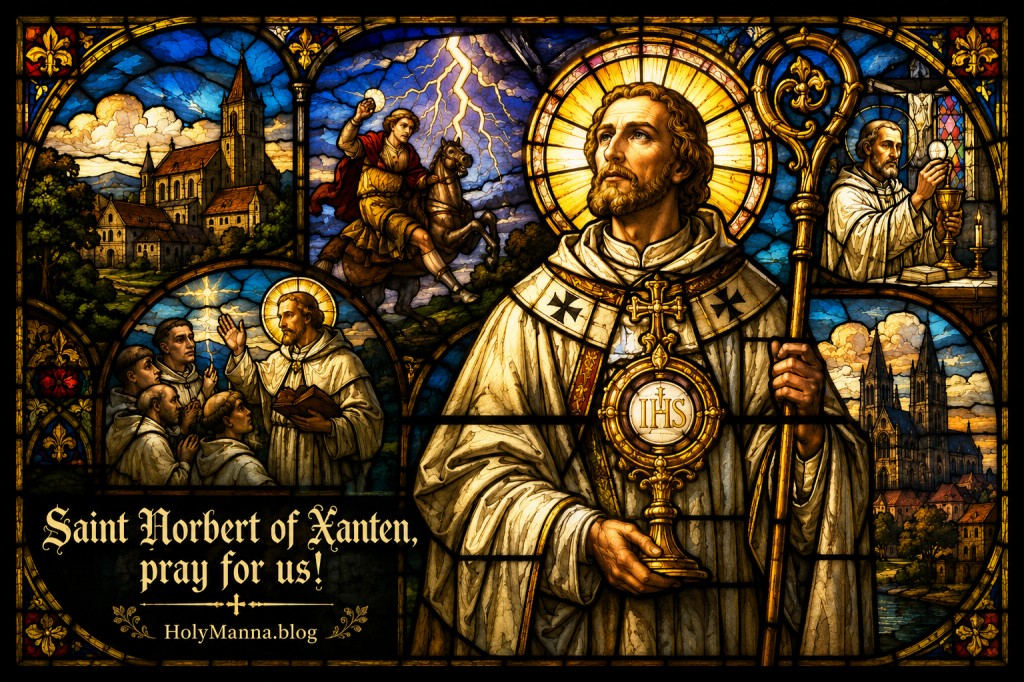
A Nobleman Struck Down by Grace
Saint Norbert of Xanten is one of those saints whose life feels almost cinematic. He began as a nobleman with influence, comfort, and access to the highest circles of power. He ended as a barefoot preacher, a founder of a great religious order, an Archbishop of Magdeburg, and one of the Church’s great defenders of the Real Presence of Jesus Christ in the Eucharist.
He is most known as the founder of the Premonstratensians, also called the Norbertines or White Canons. He is remembered as a reformer of clergy, a preacher of penance and peace, a defender of the Eucharist, and a bishop who refused to let comfort weaken his love for Christ and His Church.
Saint Norbert’s life speaks powerfully to Catholics today because he shows that conversion is not just a private emotional moment. True conversion changes everything. It changes how a person speaks, how a person worships, how a person handles authority, how a person treats the poor, and how a person approaches the altar of God.
The Catechism of the Catholic Church teaches that the Eucharist is “the source and summit of the Christian life” in CCC 1324. Saint Norbert lived as if that sentence were written into his bones. His life points us back to the altar, back to reverence, back to repentance, and back to the truth that Jesus Christ is truly present in the Blessed Sacrament.
From Courtly Comfort to Holy Restlessness
Norbert was born around the year 1080 in Xanten, near the Rhine River, in what is now Germany. He came from nobility. His father, Heribert, Count of Gennep, was connected to the imperial house of Germany, and his mother, Hadwigis, came from the noble house of Lorraine.
From the beginning, Norbert had all the advantages that could make a man successful in the world. He was intelligent, well connected, well formed, and socially gifted. He entered clerical life and received a canonry at Xanten, but his early life was not yet marked by deep holiness. Catholic tradition remembers him as a man who enjoyed ease, refinement, status, and courtly life.
He served in the court of Emperor Henry V, where he saw the complicated relationship between political power and the Church. He lived during the time of the Investiture Controversy, when the Church was fighting to protect her freedom from secular rulers who wanted control over bishops and Church offices. That struggle would later shape Norbert’s own mission. He would become a man who defended the freedom, holiness, and integrity of the Church.
Still, before he became a reformer, Norbert himself needed reform. Before he preached penance, he had to repent. Before he called priests back to holiness, he had to be awakened from his own lukewarmness.
That awakening came suddenly.
The Storm That Became His Damascus Road
Around the year 1115, Norbert was riding on horseback when a violent storm overtook him. Lightning struck near his horse. The animal threw him to the ground, and Norbert lay there as if dead for nearly an hour.
When he came to himself, he was shaken to the depths of his soul. Catholic tradition compares this moment to Saint Paul being struck down on the road to Damascus. Norbert cried out, “Lord, what wouldst thou have me to do?”
The answer he received came from Psalm 34: “Turn away from evil, and do good: seek after peace, and pursue it.”
That became the spiritual program of his entire life.
Norbert left behind the ease of courtly life. He returned to Xanten, began wearing a hair shirt beneath his clothing, and gave himself to prayer, penance, and spiritual direction. He placed himself under the guidance of Abbot Cono of Siegburg. In gratitude, he later founded the Abbey of Fürstenberg and entrusted it to Cono and his Benedictine successors.
His conversion was not shallow. It was not just a frightening experience that faded after a few days. It became a new life. Norbert had been struck down by lightning, but more importantly, he had been struck by grace.
A Priest Set on Fire for Reform
Norbert was ordained a priest around 1115. Some traditions say he received the diaconate and priesthood on the same day by dispensation. Before offering his first Mass, he made a forty-day retreat at Siegburg Abbey, preparing himself through prayer, fasting, and penance.
When he returned to Xanten to celebrate Mass, he preached boldly about the vanity of worldly pleasures, the seriousness of sin, and the duty of man to serve God. Some people listened. Others were offended. Some young clerics mocked him, and one even spat in his face.
Norbert endured the insult with patience. That detail matters because it shows that his zeal was not just fiery speech. He was learning humility. He was learning to suffer for the truth without becoming bitter.
He tried to reform the clergy around him, but resistance was strong. Some accused him of hypocrisy and innovation. Eventually, Norbert resigned his ecclesiastical positions, sold his property, gave the proceeds to the poor, and kept only what he needed for the celebration of Holy Mass.
Then he became a barefoot preacher.
He traveled through parts of modern Germany, France, Belgium, and the Netherlands, preaching penance, peace, and conversion. He begged for his bread. He reconciled enemies. He urged those who had gained wealth unjustly to make restitution. He called the clergy to holiness and the laity to repentance.
Norbert’s preaching had power because people could see that he lived what he preached. He was not a comfortable critic of other people’s sins. He was a converted sinner who had allowed God to remake him.
The Valley of Prémontré and the Birth of the White Canons
In 1119, Pope Calixtus II and Bishop Bartholomew of Laon encouraged Norbert to settle down and found a religious community. His mission needed roots. His reforming fire needed a home where it could continue after his death.
Norbert chose a lonely valley in the Forest of Coucy, near Laon in northern France. The place was called Prémontré. Catholic tradition says the valley was shaped like a cross. Another tradition says that in a small chapel dedicated to Saint John the Baptist, Norbert had a vision of the Crucified Christ, who revealed that this desolate place would become the site of a great monastery. This vision is part of Norbertine tradition, but like many medieval stories, it cannot be verified with modern certainty.
The first community lived simply in huts around the chapel. Norbert and his companions embraced the Rule of Saint Augustine. On Christmas Day in 1121, the first members made their vows. The Order of Prémontré was born.
They became known as the Premonstratensians, Norbertines, or White Canons. They wore a white habit, often understood as a sign of purity, poverty, and resurrection joy. They were canons regular, meaning priests living in community according to a rule, combining solemn liturgical prayer, Eucharistic devotion, preaching, pastoral ministry, and communal life.
Their life was not meant to be hidden away from the needs of the Church. They prayed like monks, served like pastors, preached like missionaries, and lived as brothers. Their spirituality was rooted in the Augustinian ideal of being “one heart and one mind on the way to God.”
Saint Norbert also welcomed women and laypeople into the broader spiritual family of the order. Blessed Ricwera is remembered in Norbertine tradition as the first nun associated with the Order of Prémontré. Count Theobald of Champagne wanted to enter religious life, but Norbert discerned that God was calling him to holiness in marriage and public responsibility. Norbert gave him a rule of life and invested him with the white scapular, a tradition connected with the early Third Order of Saint Norbert.
That is a beautiful Catholic insight. Not everyone is called to the monastery. Not everyone is called to priesthood. But everyone is called to holiness.
The Apostle of the Blessed Sacrament
Saint Norbert is especially remembered for his love and defense of the Holy Eucharist. At Antwerp, he confronted the lingering influence of Tanchelm, a heretical preacher whose followers attacked Catholic teaching on the priesthood and the Eucharist.
Norbert preached the truth of the Real Presence with clarity and courage. Catholic sources say many people returned to the faith, and some brought back Sacred Hosts that had been stolen and profaned. Because of this mission, he became known as the Apostle of Antwerp and the Apostle of the Blessed Sacrament.
This is one of the most important parts of his legacy. Norbert understood that when people lose faith in the Eucharist, everything else begins to unravel. If the altar becomes ordinary, the soul becomes dull. If the priesthood is treated as merely human, the sacraments are no longer received with awe. If the Eucharist is treated like a symbol only, Catholics forget that Jesus Christ gives Himself truly, really, and substantially.
The Catechism of the Catholic Church teaches in CCC 1374 that in the Eucharist, “the body and blood, together with the soul and divinity, of our Lord Jesus Christ” are truly, really, and substantially contained. Saint Norbert did not defend an idea. He defended the living presence of Christ.
This is why sacred art often shows Saint Norbert holding a ciborium or monstrance. He is the saint who points Catholics back to the Blessed Sacrament and says, in effect, “Here is your Lord. Do not forget Him.”
The Spider in the Chalice and Other Stories of Faith
One of the most famous stories associated with Saint Norbert is the spider in the chalice. According to tradition, while Norbert was celebrating Mass, a spider fell into the chalice after the consecration. In the Middle Ages, spiders were often feared as poisonous. Out of reverence for the Precious Blood of Christ, Norbert consumed the contents of the chalice, spider and all, and was unharmed.
This story is part of Catholic tradition, but it should be understood as a traditional hagiographical account rather than a medically verified miracle. The Church’s liturgical tradition did provide reverent ways to handle such situations, so the point of the story is not that every priest should imitate the same action. The point is that Saint Norbert’s reverence for the Eucharist was heroic.
Catholic tradition also records that Norbert restored sight to a blind woman near Würzburg. The people were so moved that they wanted him to become their bishop, but Norbert fled secretly to avoid the honor.
He is also remembered for casting out demons, reconciling feuding families, and restoring peace where hatred had taken root. These accounts reveal the kind of saint he was. He did not separate doctrine from charity. He defended the Eucharist, reformed clergy, served the poor, and brought enemies back to peace.
There is also a tradition connected to his patronage of expectant mothers and infertile couples. A pious married woman once asked Norbert whether she and her husband should separate and enter religious life because they had no children. Norbert prophesied that they would be blessed with children and that the first child would be dedicated to God. According to Norbertine tradition, that child, Nicholas, later became a Norbertine at Prémontré. This story is treasured in Norbertine devotion, though it cannot be verified with modern certainty.
Because of this tradition, Saint Norbert is invoked by expectant mothers, infertile couples, parents praying for children, unborn children, and families praying for safe childbirth.
A Bishop Who Was Mistaken for a Beggar
In 1126, Norbert was chosen as Archbishop of Magdeburg. He did not seek the position. In fact, he had avoided high office before. But the Church needed him, and he accepted the burden.
A famous story says that when Norbert arrived at his episcopal residence, he was dressed so poorly that the porter refused to let him enter, thinking he was a beggar. When the people explained that this was the new archbishop, Norbert reportedly said, “Brother, you know me better than they do who have raised such a one to this dignity.”
It is a beautiful line because it reveals a man who remembered who he was apart from grace. Norbert knew his past. He knew his weakness. He knew that any dignity he carried belonged to Christ and His Church.
As Archbishop of Magdeburg, Norbert faced serious problems. Church property had been seized by powerful laymen. Some clergy were living in scandal. Discipline had weakened. The poor were being neglected. Norbert worked to recover Church lands, reform the clergy, strengthen the diocese, defend the rights of the Church, and care for the people entrusted to him.
His reforms made enemies. Catholic sources record multiple attempts on his life. One man came pretending to seek confession while carrying a dagger. Another attack involved an arrow that narrowly missed him. Norbert forgave his attackers and remained firm.
He was not a martyr in the strict sense because he was not killed for the faith. Yet his episcopal life was marked by danger, suffering, opposition, and spiritual courage. He shows us that reforming the Church is rarely comfortable. Holiness often disturbs the comfortable before it heals the wounded.
A Loyal Son of the Church in a Time of Schism
After the death of Pope Honorius II, a schism broke out between Pope Innocent II and the antipope Anacletus II. Saint Norbert strongly supported Pope Innocent II and worked alongside Saint Bernard of Clairvaux to defend the rightful pope and restore unity.
This is another important part of Norbert’s witness. He was a reformer, but he was not a rebel. He was bold, but he was not disobedient. He loved the Church enough to call her members to holiness, but he did not separate himself from the Church when she suffered.
In a time when Catholics can be tempted either toward cowardly silence or prideful rebellion, Saint Norbert offers a better way. Be faithful. Be courageous. Love the truth. Love the Church. Stay close to Christ.
The Final Offering of a Worn-Out Saint
Years of preaching, travel, fasting, conflict, and service wore down Norbert’s body. In 1132, he accompanied Emperor Lothair to Rome for the imperial coronation and became seriously ill, likely with malaria. His health never fully recovered.
By 1134, he was extremely weak. Norbertine tradition says he was still able to bless the holy oils on Holy Thursday, but by Easter he could only celebrate Mass while seated. He died in Magdeburg on June 6, 1134.
He was buried in the Norbertine Abbey of Saint Mary at Magdeburg. After his death, his tomb became associated with many miracles. Catholic sources speak of healings and divine favors granted through his intercession, though individual miracle stories from this period cannot always be verified in detail.
The Catechism of the Catholic Church teaches in CCC 956 that the saints “do not cease to intercede with the Father for us.” Catholics do not honor saints because they replace Christ. Catholics honor saints because Christ’s grace shines through them, and because the members of His Body remain united in Him.
Relics, Bohemia, and a Legacy That Crossed Centuries
Saint Norbert was canonized by Pope Gregory XIII in 1582. His cult was later extended to the whole Church by Pope Clement X.
For centuries, his body remained in Magdeburg. After Magdeburg came under Protestant control, the Norbertines sought to recover his relics. In 1627, his relics were translated from Magdeburg to Strahov Abbey in Prague. Catholic sources record that six hundred Protestants were reconciled to the Catholic Church on the day of the translation or during its octave. Because of this, the Archbishop of Prague proclaimed Saint Norbert Patron and Protector of Bohemia.
Strahov Abbey remains one of the great centers of devotion to Saint Norbert. His relics are venerated there, and the Norbertine community continues to honor his memory.
His greatest legacy, however, is the Norbertine Order itself. The order spread rapidly during and after his lifetime. Norbertine houses were founded across Europe, and by the later Middle Ages, the order had grown into a major religious family. Today, Norbertines continue to serve the Church through prayer, parish ministry, education, preaching, missions, contemplative life, and service to the poor.
Saint Norbert’s life also left a deep cultural mark in Catholic art. He is often depicted as a bishop holding a monstrance or ciborium, pointing to his defense of the Real Presence. Sometimes he is shown with an olive branch, a sign of his work as a peacemaker. His white habit remains a visual reminder of the order he founded and the purity of worship he desired for the Church.
Words That Still Burn
The safest and most central saying connected to Saint Norbert is the biblical command associated with his conversion from Psalm 34: “Turn away from evil, and do good: seek after peace, and pursue it.”
This was not an original saying composed by Norbert, but it became the command that reshaped his life.
Another famous line comes from the story of his arrival as Archbishop of Magdeburg. When the porter mistook him for a beggar, Norbert reportedly said, “Brother, you know me better than they do who have raised such a one to this dignity.”
A powerful priestly meditation is also traditionally attributed to Saint Norbert: “O Priest, who are you? You are not yourself because you are God. You are not of yourself because you are the servant and minister of Christ. You are not your own because you are the spouse of the Church. You are not yourself because you are the mediator between God and man. You are not from yourself because you are nothing. What then are you? Nothing and everything.”
Because medieval attributions can be difficult to verify with certainty, this priestly meditation is best presented as traditionally attributed to Saint Norbert.
What Saint Norbert Teaches Us Today
Saint Norbert teaches that no one is too comfortable to be converted. No one is too worldly to become holy. No one is too compromised for grace to interrupt.
His life also teaches that love for the Eucharist must become visible. Reverence at Mass is not old-fashioned. It is Catholic. Belief in the Real Presence is not optional spirituality. It is the heart of the faith. If Jesus is truly present in the Eucharist, then the altar deserves our attention, our silence, our gratitude, our repentance, and our love.
He also teaches that reform begins with personal conversion. Norbert did not start by shouting at everyone else. He first allowed God to strip away his own vanity. Only then could he preach with authority.
For Catholics today, Saint Norbert gives a clear path. Return to confession. Worship with reverence. Pray before the Blessed Sacrament. Make peace where there is division. Speak the truth without cruelty. Love the Church without pretending her members are perfect. Serve the poor. Be faithful in the vocation God has actually given, whether that is priesthood, marriage, religious life, family life, or quiet daily work.
Saint Norbert began as a nobleman chasing comfort. Grace knocked him to the ground. He rose as a preacher, a founder, a bishop, and an Apostle of the Blessed Sacrament.
Where is God asking for deeper conversion today?
What would change if every Catholic approached the Eucharist with the reverence Saint Norbert had?
Is there a place in daily life where peace needs to be pursued instead of merely wished for?
Engage with Us!
Share your thoughts and reflections in the comments below. Saint Norbert’s life gives us so much to think about, especially when it comes to conversion, reverence for the Eucharist, and courage in a time of confusion.
- What part of Saint Norbert’s conversion story speaks most strongly to your own faith journey?
- How can Catholics today grow in deeper reverence for Jesus in the Blessed Sacrament?
- Where might God be calling you to turn away from evil, do good, seek peace, and pursue it?
- How can Saint Norbert’s courage inspire us to love the Church faithfully without becoming bitter or passive?
- What practical step can you take this week to make the Eucharist more central in your life?
May Saint Norbert teach us to love Jesus in the Eucharist with greater reverence, to seek peace with real courage, and to live our faith with the love and mercy Jesus taught us. May everything we do lead us closer to Christ, and may our lives become a quiet but faithful witness to His goodness.
Saint Norbert of Xanten, pray for us!
Follow us on YouTube, TikTok, Instagram and Facebook for more insights and reflections on living a faith-filled life.


Leave a Reply