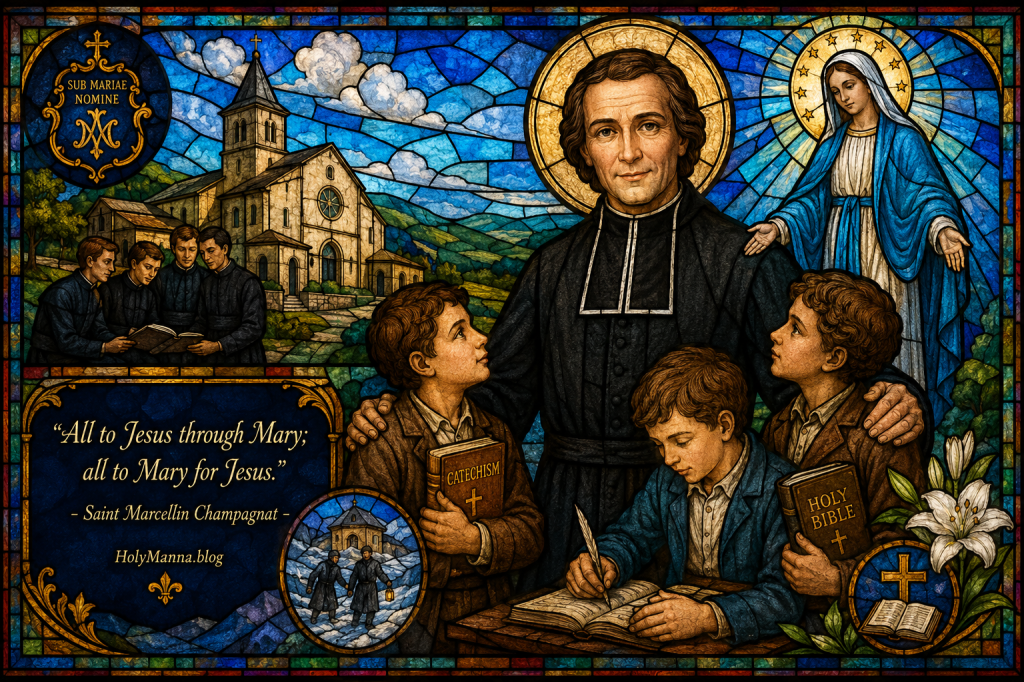
The Priest Who Saw One Forgotten Child and Built a Mission for the World
Saint Marcellin Champagnat was a French Catholic priest, a son of Mary, and the founder of the Marist Brothers, a religious community dedicated to the Christian education of children and young people, especially the poor and forgotten.
He was born during one of the most violent and confusing moments in French history. The French Revolution had shaken the Church, scattered religious communities, closed schools, and left many families spiritually wounded. In that world, Marcellin saw a crisis that was not only political or social. He saw children growing up without education, without catechesis, and sometimes without even knowing the basic truths of the Catholic faith.
His response was simple, bold, and deeply Catholic. He formed teachers who would help children know Jesus Christ and experience the love of Mary.
He once said, “I cannot see a child without wanting to let him know how much Jesus Christ has loved him and how much he should, in return, love the divine Savior.”
That one sentence tells the whole story of his heart.
Saint Marcellin is remembered because he understood something the Church has always taught. Children are not projects. They are souls loved by God. The Catechism of the Catholic Church teaches that parents are the first educators of their children and that the home is the first school of Christian life, but the Church also knows that families often need support from parishes, catechists, and Catholic schools. Marcellin gave his whole life to that mission.
A Child of Revolution and Marian Faith
Marcellin Joseph Benedict Champagnat was born on May 20, 1789, in Marlhes, near Saint-Étienne, France. It was the same year the French Revolution began. His family lived in a rural region where faith, work, and hardship were woven into daily life.
His father, Jean-Baptiste Champagnat, was active in local civic affairs and had a practical, energetic personality. He gave Marcellin a strong work ethic, courage, and the ability to face problems directly. His mother, Marie-Thérèse, gave him something even more important. She helped form his Catholic faith, his prayer life, and his devotion to the Blessed Virgin Mary.
Another important influence was his aunt, a religious sister who had been forced from her convent during the Revolution. Through her, young Marcellin saw the cost of fidelity to God during a time when religious life was under attack. Catholic faith was not an idea in his childhood home. It was something people had suffered for, protected, and passed down.
One surprising detail about Saint Marcellin is that the future founder of a worldwide teaching congregation struggled with school. According to Catholic and Marist tradition, his first experience in school was painful. A teacher struck another child harshly, and Marcellin was so disturbed that he refused to return. That early wound would later shape the kind of education he wanted for children. He did not want classrooms ruled by fear. He wanted schools marked by love, patience, discipline, and Christian charity.
Marcellin was not a naturally polished student. When he later entered seminary, he had to work hard and overcome real academic difficulty. That matters. The saint who would one day found schools all over the world was not a child prodigy. He was a humble young man who had to persevere.
His vocation came through the encouragement of a priest who saw something in him. The priest told him, “My son, you ought to be a priest; God wants that.”
Marcellin believed the call. He entered the seminary, struggled, matured, prayed, and kept going. He was ordained a priest on July 22, 1816.
The very next day, he joined a group of young priests at the shrine of Our Lady of Fourvière in Lyon. There they pledged themselves to the work of Mary and the foundation of the Society of Mary. From the beginning, Marcellin carried one urgent conviction in his heart. The Church needed Brothers who would teach children the faith.
He kept saying, “We need Brothers.”
The Dying Boy Who Changed Everything
After his ordination, Father Champagnat was sent as assistant priest to La Valla-en-Gier, a rural parish spread across difficult mountain terrain. Families lived far from the church. Many children lacked schooling. Many knew very little about the Catholic faith.
Then came the encounter that changed his life.
One day, Marcellin was called to visit a dying teenager named Jean-Baptiste Montagne. The boy was about seventeen years old and knew almost nothing about God, the soul, sin, salvation, or the love of Jesus Christ. Marcellin was deeply shaken. This was not merely a lack of education. This was a young soul standing at the edge of eternity without having been properly taught the faith.
Marcellin prepared the boy as best he could. Montagne died soon after.
That moment became a holy wound in the heart of Saint Marcellin. He realized that Jean-Baptiste Montagne was not an exception. Many children in the countryside were spiritually abandoned. They needed teachers. They needed catechists. They needed someone who would look at them and say, by word and by life, that Jesus loved them.
Less than six months after his ordination, on January 2, 1817, Marcellin gathered two young men and began the Little Brothers of Mary. This small beginning would grow into the Marist Brothers of the Schools.
The mission was not complicated. The Brothers would educate children, teach the Catholic faith, live in simplicity, love Mary, and serve especially those who were poor or neglected.
Marcellin believed that education had to form the whole person. Children needed reading, writing, and practical skills, but they also needed virtue, prayer, discipline, truth, and the love of Christ. This vision fits beautifully with The Catechism, which teaches that catechesis is an education in the faith that seeks to form children, young people, and adults into the fullness of Christian life.
For Marcellin, Catholic education was never only about information. It was about salvation.
Teaching With the Heart of a Father
Saint Marcellin became a spiritual father to the Brothers and to the children they served. He trained young men to become religious educators, but he also taught them how to love.
One of his most famous sayings was, “To teach children you must first love them, and love them all equally.”
That line is simple, but it is demanding. It means the difficult child must be loved. The poor child must be loved. The slow learner must be loved. The child with no support at home must be loved. The child who tests everyone’s patience must be loved.
This was not sentimental. Marcellin believed in discipline, sacrifice, and serious formation. But he knew that Christian discipline without love becomes harsh and empty. The Brothers were supposed to be signs of Mary’s tenderness and Christ’s mercy.
The young institute grew quickly, but growth brought difficulty. Marcellin had almost no resources. Some people thought his plan was unrealistic. Some clergy criticized him. He was mocked as imprudent, incapable, and even foolish. Yet he kept going.
In 1824, he was freed from parish duties so he could give himself fully to the Brothers. Soon after, he began building Notre-Dame de l’Hermitage, the motherhouse of the Marist Brothers. He had little money, so he worked with his own hands. He was not the kind of founder who only gave instructions from a desk. He carried stones, helped build walls, walked long distances, begged for help, trained Brothers, wrote letters, handled debts, and prayed constantly.
His motto was, “All to Jesus through Mary; all to Mary for Jesus.”
Mary was not an afterthought in his spirituality. She was his Good Mother, his Ordinary Resource, and the First Superior of the Institute. He trusted her completely because he believed she always leads souls to Jesus.
The Memorare in the Snow
One of the most beloved stories associated with Saint Marcellin is known as the “Memorare in the Snow.”
In February 1823, Marcellin and Brother Stanislaus were returning from visiting a sick Brother. A severe snowstorm overtook them in the mountains. They became lost, exhausted, and in danger of death. Brother Stanislaus was especially weak, and the situation became desperate.
Marcellin turned to the Blessed Virgin Mary and prayed the Memorare. Soon after, according to Marist tradition, they saw a light in the distance and found shelter at a nearby home.
The early Brothers saw this as a sign of Mary’s protection. This story is not one of the formal canonization miracles recognized by the Church, but it is one of the most cherished stories in Marist tradition. It reveals how deeply Marcellin trusted Mary in moments of danger.
Even today, Marists around the world remember this event through devotion to the Memorare, especially the practice of praying it at midday.
A Mission Bigger Than One Village
Marcellin’s heart was rooted in rural France, but his vision was larger than France. In 1836, the Society of Mary was officially recognized, and Marcellin professed as a member of it. That same year, the Marists were entrusted with missions in Oceania, and Marcellin sent Brothers to accompany the missionary priests.
He once wrote, “Every diocese of the world figures in our plans.”
That is an astonishing statement from a poor country priest whose work began with two young men in a humble house. But saints often see farther than the rest of us because they are looking through the eyes of faith.
Marcellin believed the Gospel was for every child, every village, every nation, and every soul.
Worn Out by Love
Saint Marcellin faced many hardships, but he was not a martyr in the bloody sense. His martyrdom was the long, hidden sacrifice of daily fidelity.
He endured criticism, poverty, debts, exhaustion, illness, administrative burdens, and the constant pressure of forming a growing religious institute. He had to seek legal recognition for the Brothers, protect the young community from instability, and prepare them for the future.
His body eventually began to break down. Before his death, he arranged for Brother François Rivat to lead the Brothers after him. On May 18, 1840, he read his spiritual testament.
His final message was full of charity and unity. He wanted the Brothers to live like the first Christians. He desired that people would be able to say of them, “See how they love one another.”
He also urged them to be of one heart and one mind.
On June 6, 1840, the Vigil of Pentecost, Saint Marcellin Champagnat died at Notre-Dame de l’Hermitage while the Brothers were singing the Salve Regina. He was only fifty-one years old.
By the time of his death, the mission had already grown dramatically. There were dozens of schools, hundreds of Brothers connected with the work, and thousands of students being educated.
The seed had become a tree.
A Legacy That Crossed the World
After his death, devotion to Marcellin continued to grow among the Marist Brothers, students, teachers, families, and Catholic communities formed by his charism.
The Church recognized miracles attributed to his intercession during the process that led to his beatification and canonization. For his beatification, two cures were accepted. One involved John Ranaivo, who was cured of cerebrospinal meningitis in Madagascar. Another involved Georgina Grondin, who was cured of a malignant tumor in Waterville, Maine.
For his canonization, the Church recognized the cure of Brother Heriberto Weber Nellessen in Uruguay. He suffered from a serious pulmonary illness with severe respiratory complications. After prayers asking for Marcellin’s intercession, he recovered in a way judged rapid, complete, lasting, and scientifically inexplicable by the Church’s process.
Marcellin was beatified by Pope Pius XII on May 29, 1955. He was canonized by Pope Saint John Paul II on April 18, 1999.
Pope Saint John Paul II presented him as a priest captivated by the love of Jesus and Mary, deeply attentive to the spiritual and educational neglect of young people. That is the Catholic heart of Marcellin’s legacy. He did not simply create schools. He answered a crisis of souls.
Today, the Marist Brothers serve in many countries across the world. Their work includes schools, youth ministry, missions, social outreach, children’s rights initiatives, universities, retreats, and lay formation. Marist communities celebrate his feast day on June 6, often through Masses, school celebrations, service projects, prayers, and events known as Champagnat Day.
Important places connected with his life include Marlhes, his birthplace; La Valla, where he served as a young priest and founded the Brothers; Notre-Dame de l’Hermitage, the motherhouse he helped build; and Fourvière in Lyon, where the early Marist dream was entrusted to Our Lady.
A statue of Saint Marcellin holding a child is also found in Saint Peter’s Basilica in Rome, a beautiful image of the priest who carried young souls to Christ.
The Lesson of Saint Marcellin
Saint Marcellin Champagnat speaks powerfully to our time.
Many young people today are surrounded by information but starving for formation. They know technology, trends, entertainment, and opinions, but many do not know how deeply Jesus loves them. Many have never been taught how to pray, how to forgive, how to suffer well, how to live chastely, how to recognize sin, or how to trust God.
Marcellin reminds Catholics that this crisis cannot be answered only with frustration. It must be answered with love, teaching, patience, and witness.
He teaches parents to take seriously their role as the first educators of their children. He teaches teachers to love the students entrusted to them. He teaches catechists to see every child as a soul made for Heaven. He teaches priests and religious to go after the forgotten. He teaches ordinary Catholics that one encounter can become a mission.
The dying boy Jean-Baptiste Montagne changed Marcellin’s life because Marcellin allowed the suffering in front of him to become a call from God.
Who is the Montagne in our own life?
Who is the person God is asking us not to overlook?
What child, student, friend, coworker, or family member needs someone to patiently show them the love of Jesus?
Saint Marcellin did not wait until he had perfect resources. He began with faith, Mary, and two young men willing to serve. That is how God often works. He begins with the little, the hidden, and the humble.
And when a soul gives everything to Jesus through Mary, nothing offered in love is wasted.
Engage with Us!
Share your thoughts and reflections in the comments below. Saint Marcellin Champagnat’s life gives us so much to consider, especially in a world where many young people are searching for truth, love, and meaning.
- How does Saint Marcellin’s encounter with the dying Jean-Baptiste Montagne challenge the way you see the spiritual needs of young people today?
- Who helped teach you the Catholic faith with patience, love, and kindness?
- How can parents, teachers, catechists, and parish leaders better help children know that Jesus loves them?
- Where is God asking you to begin a mission, even if your resources feel small?
- How can devotion to Mary help you trust Jesus more deeply in moments of fear, exhaustion, or uncertainty?
May Saint Marcellin Champagnat inspire us to teach with love, serve with humility, and never overlook the souls God places in front of us. Let us live with faith, speak with charity, and do everything with the love and mercy Jesus taught us.
Saint Marcellin Champagnat, pray for us!
Follow us on YouTube, TikTok, Instagram and Facebook for more insights and reflections on living a faith-filled life.


Leave a Reply