Saturday of the Ninth Week in Ordinary Time – Lectionary: 358
The Gift God Sees When No One Else Notices
Some of the holiest moments in life happen quietly, without applause, without attention, and without anyone realizing how much they cost.
Today’s readings invite us into that hidden place where real faith is tested. Saint Paul stands near the end of his life in 2 Timothy 4:1-8, looking back not with regret, but with the peace of a man who has spent himself for Christ. The psalmist in Psalm 71 gives voice to a soul that has praised God from youth into old age, still trusting Him as strength begins to fail. Then, in Mark 12:38-44, Jesus sits across from the Temple treasury and notices a poor widow whose tiny offering looks insignificant to everyone except God.
The central theme is faithful surrender. Paul surrenders his life in mission. The psalmist surrenders every season of life in praise. The widow surrenders her whole livelihood in trust. Together, they teach that God does not measure love by outward appearance, public recognition, or impressive numbers. He measures the heart.
This matters deeply in the religious world of the readings. Paul writes as an apostle preparing Timothy to guard the faith in a time when many will prefer comfortable myths over sound doctrine. The psalm reflects the lifelong dependence of Israel on the Lord, the God who remains faithful from youth to old age. The Gospel takes place in the Temple, the heart of Jewish worship, where offerings were made to God and religious leaders were expected to defend the vulnerable. Yet Jesus exposes the danger of religious performance when it is separated from justice, humility, and love.
That is why the poor widow becomes such a powerful image of true discipleship. Her two small coins are not much in the eyes of the crowd, but they reveal a soul that trusts God completely. Her gift prepares the heart to understand Saint Paul’s words: “I have competed well; I have finished the race; I have kept the faith.” 2 Tim 4:7 Both Paul and the widow show what it means to give God everything, whether through a lifetime of apostolic suffering or one quiet act of hidden generosity.
The Catechism of the Catholic Church reminds the faithful that the Christian life must become a witness before the world, because “the fidelity of the baptized is a primordial condition for the proclamation of the Gospel.” CCC 2044 Today’s readings ask every Catholic to look beyond appearances and ask a deeper question: Is God receiving the leftovers, or is He receiving the heart?
First Reading – 2 Timothy 4:1-8
A Faithful Life Poured Out for Christ
Saint Paul’s final words to Timothy feel like a torch being passed in the middle of a storm. This is not casual advice from an older mentor. This is an apostolic charge from a man who knows his martyrdom is near. Paul is writing from prison, nearing the end of his earthly race, and he wants Timothy to understand what matters when the Church faces confusion, opposition, and spiritual fatigue.
In the early Church, preaching the Gospel was not a safe hobby or a private preference. It could cost friendships, reputation, freedom, and life itself. Paul had endured beatings, imprisonment, rejection, hunger, betrayal, and persecution for the sake of Christ. Yet his concern is not self-pity. His concern is fidelity. Timothy must proclaim the Word when people welcome it and when people reject it. He must guard sound doctrine when the culture prefers comforting myths. He must fulfill his ministry when the work feels heavy.
This reading fits beautifully with today’s central theme of faithful surrender. Paul gives his life to Christ through apostolic mission. Like the poor widow in the Gospel, he does not offer God what is leftover. He offers everything. His final confidence is not that he avoided suffering, but that he remained faithful.
2 Timothy 4:1-8 – New American Bible (Revised Edition)
Solemn Charge. 1 I charge you in the presence of God and of Christ Jesus, who will judge the living and the dead, and by his appearing and his kingly power: 2 proclaim the word; be persistent whether it is convenient or inconvenient; convince, reprimand, encourage through all patience and teaching. 3 For the time will come when people will not tolerate sound doctrine but, following their own desires and insatiable curiosity, will accumulate teachers 4 and will stop listening to the truth and will be diverted to myths. 5 But you, be self-possessed in all circumstances; put up with hardship; perform the work of an evangelist; fulfill your ministry.
Reward for Fidelity. 6 For I am already being poured out like a libation, and the time of my departure is at hand. 7 I have competed well; I have finished the race; I have kept the faith. 8 From now on the crown of righteousness awaits me, which the Lord, the just judge, will award to me on that day, and not only to me, but to all who have longed for his appearance.
Detailed Exegesis
Verse 1 – “I charge you in the presence of God and of Christ Jesus, who will judge the living and the dead, and by his appearing and his kingly power.”
Paul begins with solemn authority. He does not speak merely as a friend giving advice, but as an Apostle standing before God. Timothy’s mission is placed in the presence of Christ Jesus, the judge of the living and the dead. This reminds the Church that preaching, teaching, and Christian witness are never just human activities. They happen before the face of God.
Paul also points to Christ’s appearing and kingly power. This means Timothy must live and minister with eternity in view. The Christian does not measure faithfulness by popularity, comfort, or public approval. The final judgment belongs to Christ the King. This gives courage to every Catholic who must choose truth over convenience.
Verse 2 – “Proclaim the word; be persistent whether it is convenient or inconvenient; convince, reprimand, encourage through all patience and teaching.”
This is the heart of Paul’s command. Timothy must proclaim the Word in every season. The Gospel is not reserved for easy moments, agreeable audiences, or comfortable settings. The Word must be preached when hearts are open and when hearts are resistant.
Paul gives three pastoral actions: convince, reprimand, and encourage. Catholic teaching is not only affirmation, and it is not only correction. It includes both truth and mercy. To convince means to form the mind in truth. To reprimand means to correct what leads the soul away from God. To encourage means to strengthen the weary. Paul adds that all of this must be done with patience and teaching, because truth without charity becomes harsh, while charity without truth becomes empty sentiment.
Verse 3 – “For the time will come when people will not tolerate sound doctrine but, following their own desires and insatiable curiosity, will accumulate teachers.”
Paul warns Timothy that a time will come when people will reject sound doctrine. This does not mean people will stop being religious or spiritual. In fact, they may still seek teachers. The problem is that they will seek teachers who confirm their desires rather than teachers who proclaim the truth.
This verse speaks clearly to every age. The temptation is always to shape faith around personal preference instead of letting Christ shape the soul. Catholic doctrine is not meant to flatter fallen desires. It is meant to heal, purify, and lead the human person to salvation.
Verse 4 – “And will stop listening to the truth and will be diverted to myths.”
Once people reject sound doctrine, they become vulnerable to myths. In Paul’s context, these myths may have included false religious teachings, speculative ideas, and distortions of the apostolic faith. In every age, myths appear in different clothing. They can look like ideologies, spiritual trends, moral excuses, or cultural slogans that promise freedom while quietly leading the soul away from Christ.
The Catholic faith insists that truth is not invented by the individual. Truth is received from God. Jesus Christ is not one opinion among many. He is the Truth Himself. When the soul stops listening to truth, it does not become free. It becomes easier to deceive.
Verse 5 – “But you, be self-possessed in all circumstances; put up with hardship; perform the work of an evangelist; fulfill your ministry.”
Paul turns from warning to command. Timothy must remain steady. To be self-possessed means to be spiritually sober, clear-minded, and disciplined. The shepherd of souls cannot be ruled by panic, popularity, resentment, or fear.
Paul also tells Timothy to endure hardship. Evangelization will not always feel exciting or fruitful. Sometimes it will be misunderstood. Sometimes it will be rejected. Sometimes it will require hidden sacrifice. Yet Timothy must still perform the work of an evangelist and fulfill his ministry. The same applies to every baptized Catholic according to his or her vocation. Parents, catechists, priests, religious, teachers, friends, and ordinary parishioners all share in the Church’s mission by witnessing to Christ in daily life.
Verse 6 – “For I am already being poured out like a libation, and the time of my departure is at hand.”
Paul now speaks of his approaching death. He describes himself as being poured out like a libation, which was a drink offering poured before God in worship. This image is deeply sacrificial. Paul sees his life and death as an offering to the Lord.
His phrase, “the time of my departure,” carries the sense of setting sail or breaking camp. Death is not treated as annihilation. For the faithful Christian, death is a passage. Paul is not denying the seriousness of death, but he sees it through the victory of Christ. His life has become an offering, and now his final suffering will also be offered to God.
Verse 7 – “I have competed well; I have finished the race; I have kept the faith.”
This is one of the most powerful lines in the New Testament. Paul looks back on his life using the language of athletic struggle and perseverance. He has competed well. He has finished the race. He has kept the faith.
Paul does not claim that his life was easy. He does not say he was always admired, comfortable, or understood. His confidence comes from fidelity. He guarded the Gospel entrusted to him. He followed Christ through suffering. He finished the mission placed before him.
For Catholics, this verse is a reminder that holiness is not measured by worldly success. It is measured by faithfulness to Christ until the end.
Verse 8 – “From now on the crown of righteousness awaits me, which the Lord, the just judge, will award to me on that day, and not only to me, but to all who have longed for his appearance.”
Paul ends with hope. The crown of righteousness is not a trophy of pride, but the reward of grace for those who remain faithful. Christ is the just judge, and His judgment is not corrupt, confused, or superficial. He sees what the world misses.
Paul also makes this promise wider than himself. The crown is not only for Apostles. It is for all who have longed for Christ’s appearing. Every Catholic who lives in faithful expectation of the Lord, perseveres in grace, and finishes the race with love can hope in this promise.
Teachings
This reading reveals the apostolic heart of the Church. Paul is not handing Timothy a personal opinion or private spirituality. He is handing on the mission of proclaiming Christ. The faith must be preached, guarded, lived, and passed down.
The Catechism of the Catholic Church teaches this responsibility clearly:
“Before Pilate, Christ proclaims that he ‘has come into the world, to bear witness to the truth.’ The Christian is not to ‘be ashamed then of testifying to our Lord.’ In situations that require witness to the faith, the Christian must profess it without equivocation, after the example of St. Paul before his judges. He must keep ‘a clear conscience toward God and toward men.’”
CCC 2471
Paul’s charge to Timothy is not only for ordained ministers, though it applies powerfully to bishops, priests, and deacons. It also speaks to the whole baptized Church. Every Christian life is meant to become a witness. The Catechism says:
“The fidelity of the baptized is a primordial condition for the proclamation of the Gospel and for the Church’s mission in the world. In order that the message of salvation can show the power of its truth and radiance before men, it must be authenticated by the witness of the life of Christians. The witness of a Christian life and good works done in a supernatural spirit have great power to draw men to the faith and to God.”
CCC 2044
That is exactly what Paul embodies. His preaching is authenticated by his life. His words have weight because he has suffered for them. His final confidence is not based on comfort, but on fidelity.
Saint Augustine gives a helpful reminder for Christians tempted to blame the age rather than live faithfully within it:
“Bad times, hard times, this is what people keep saying; but let us live well, and times shall be good. We are the times: such as we are, such are the times.”
St. Augustine, Sermon 80
That wisdom fits Paul’s message to Timothy. The answer to a confused culture is not panic. The answer is holiness, truth, patience, and courageous witness. The Church does not need Catholics who simply complain about the times. The Church needs Catholics who keep the faith in the times they have been given.
Paul’s image of being poured out like a libation also points toward the Eucharistic shape of Christian life. Christ poured Himself out completely on the Cross, and the Mass makes that sacrifice present sacramentally. The disciple is invited to unite every suffering, every act of service, every hidden sacrifice, and every moment of perseverance to Christ’s self-offering.
Reflection
This reading asks a serious question: What does it mean to keep the faith when faith becomes inconvenient?
For some, it means speaking the truth gently when silence would be easier. For others, it means refusing to trade Catholic teaching for cultural approval. For parents, it may mean teaching children to pray, go to Mass, and love the truth even when the world offers easier paths. For young adults, it may mean choosing chastity, confession, reverence, and real discipleship in a culture that often treats those things as outdated. For anyone tired or discouraged, it may mean simply taking the next faithful step.
Paul’s words also challenge the way Catholics consume voices and opinions. He warns that people will accumulate teachers who tell them what they want to hear. That temptation is everywhere. A Catholic heart must ask: Is this forming the soul in truth, or is it simply confirming what the flesh already wants?
The path forward is practical. Spend time with Sacred Scripture. Learn the teachings of the Church. Go to confession regularly. Receive the Eucharist worthily. Choose Catholic voices that are faithful to the Church rather than merely entertaining. Speak truth with patience. Correct with charity. Encourage the weary. Do the hidden work of evangelization in ordinary life.
Most importantly, keep the finish line in view. Paul could say, “I have finished the race; I have kept the faith,” because he gave Christ his whole life one faithful act at a time. That is how saints are made. Not through one dramatic moment only, but through daily surrender.
Where is Christ asking for courage when the truth feels inconvenient?
What voices are shaping the soul most deeply right now?
Is the faith being lived as something comfortable and private, or as something worth proclaiming with love?
If today were part of the final race, what act of fidelity would matter most before God?
Saint Paul reminds the Church that the Christian life is not about drifting safely to the end. It is about running faithfully toward Christ. The crown is not promised to those who looked religious from a distance. It is promised to those who longed for the Lord, proclaimed His truth, endured hardship, and kept the faith.
Responsorial Psalm – Psalm 71:8-9, 14-17, 22
A Lifetime of Praise When Strength Begins to Fade
Psalm 71 is the prayer of a soul that has walked with God for a long time. It carries the voice of someone who has known the Lord from youth, has seen His faithfulness through many seasons, and now asks not to be abandoned in old age. This psalm is not sentimental. It is honest. The psalmist knows weakness, fear, memory, gratitude, and hope.
In Israel’s worship, the psalms were the prayer book of God’s people. They gave words to joy, sorrow, repentance, confidence, worship, and longing. They were sung in the Temple, prayed in homes, and carried in the hearts of the faithful. For Catholics, the psalms remain central to the prayer of the Church, especially in the Liturgy of the Hours and the Mass.
This psalm fits today’s theme of faithful surrender because it shows a heart that keeps praising God through every stage of life. Saint Paul surrenders his mission to Christ as his earthly race nears completion. The poor widow surrenders her whole livelihood in trust. The psalmist surrenders youth, old age, memory, weakness, and hope into the hands of the Lord. Together, the readings teach that true faith does not merely give God a season. True faith gives God the whole life.
Psalm 71:8-9, 14-17, 22 – New American Bible (Revised Edition)
8 My mouth shall be filled with your praise,
shall sing your glory every day.9 Do not cast me aside in my old age;
as my strength fails, do not forsake me.14 I will always hope in you
and add to all your praise.
15 My mouth shall proclaim your just deeds,
day after day your acts of deliverance,
though I cannot number them all.
16 I will speak of the mighty works of the Lord;
O God, I will tell of your singular justice.17 God, you have taught me from my youth;
to this day I proclaim your wondrous deeds.22 That I may praise you with the lyre
for your faithfulness, my God,
And sing to you with the harp,
O Holy One of Israel!
Detailed Exegesis
Verse 8 – “My mouth shall be filled with your praise, shall sing your glory every day.”
The psalm begins with a mouth full of praise. This is not occasional gratitude or a quick prayer when life is going well. The psalmist speaks of praising God every day. That daily praise reveals a heart trained by faith.
Catholic spirituality understands praise as more than emotion. Praise is an act of justice because God deserves glory simply because He is God. Even when circumstances change, His goodness does not change. This verse invites the faithful to let praise become a habit of the soul, not just a reaction to blessings.
Verse 9 – “Do not cast me aside in my old age; as my strength fails, do not forsake me.”
This verse is deeply human. The psalmist feels the vulnerability that comes with aging and declining strength. There is no pretending here. He brings his fear directly to God.
In a culture that often values people according to productivity, beauty, youth, and independence, this verse speaks with quiet power. The elderly, the sick, and the weak are not burdens in the eyes of God. They are beloved. The dignity of the human person does not fade when physical strength fades. This prayer reminds the Church to honor those who are aging, lonely, dependent, or forgotten.
Verse 14 – “I will always hope in you and add to all your praise.”
The psalmist does not stop at fear. He moves from vulnerability to hope. The word “always” matters. His hope is not limited to youth, health, comfort, or success. He chooses to hope in God even as strength fails.
This is the kind of hope Saint Paul shows in 2 Timothy 4:1-8. Paul is near death, yet he speaks of the crown of righteousness. Christian hope does not deny suffering. It looks through suffering toward the faithfulness of God. Hope is not pretending everything is easy. Hope is trusting that God remains faithful when life becomes hard.
Verse 15 – “My mouth shall proclaim your just deeds, day after day your acts of deliverance, though I cannot number them all.”
The psalmist has seen too much of God’s mercy to keep silent. He wants to proclaim God’s justice and deliverance day after day. Yet he admits that God’s works are too many to count.
This is a beautiful image of mature faith. A soul that has walked with God begins to see grace everywhere. Some deliverances are dramatic. Others are quiet. Some are remembered clearly. Others are only understood years later. The psalmist teaches that gratitude grows when memory becomes prayer.
Verse 16 – “I will speak of the mighty works of the Lord; O God, I will tell of your singular justice.”
Here the psalmist becomes a witness. He does not keep God’s mighty works locked inside private devotion. He speaks of them. He tells others.
This connects directly with Paul’s command to Timothy to proclaim the Word. The Christian life is not meant to be hidden out of fear. Every Catholic, according to his or her vocation, is called to speak of what God has done. This may happen in teaching, parenting, friendship, service, testimony, or quiet encouragement. The point is not to draw attention to oneself. The point is to give glory to God.
Verse 17 – “God, you have taught me from my youth; to this day I proclaim your wondrous deeds.”
This verse gives the psalm a lifelong shape. God has been the teacher of the psalmist from youth, and now the psalmist continues to proclaim His wondrous deeds. Faith is not treated as a passing phase or a childhood memory. It is a lifelong relationship.
For Catholics, this verse beautifully reflects the importance of formation. Children need to be taught the faith. Young people need examples of holiness. Adults need continued conversion. The elderly still have a mission of witness. No stage of life is spiritually wasted when it is offered to God.
Verse 22 – “That I may praise you with the lyre for your faithfulness, my God, and sing to you with the harp, O Holy One of Israel!”
The psalm ends in worship. The psalmist wants to praise God with music, celebrating His faithfulness. The title “Holy One of Israel” reminds the listener that God is not an abstract idea. He is the covenant Lord who has revealed Himself to His people.
This verse gathers the whole psalm into praise. The God who taught the psalmist in youth, sustained him in weakness, delivered him through trials, and remained faithful into old age is worthy of song. This is the movement of the Catholic life as well. Everything begins in grace, continues through trust, and finds its fulfillment in worship.
Teachings
The Church treasures the psalms because they teach the faithful how to pray with the whole heart. They give language to emotions that many people do not know how to bring before God. The psalms do not ask believers to hide fear, grief, weakness, or longing. They teach the soul to bring everything into prayer.
The Catechism of the Catholic Church teaches:
“The Psalter is the book in which the Word of God becomes man’s prayer. In other books of the Old Testament, ‘the words proclaim God’s works and bring to light the mystery they contain.’ The words of the Psalmist, sung for God, both express and proclaim the saving works of God. The same Spirit inspires God’s work and man’s response. Christ will unite the two. In him, the psalms continue to teach us how to pray.”
CCC 2587
This is why Psalm 71 speaks so powerfully. It is God’s inspired Word, yet it becomes the prayer of the human heart. The psalmist’s fear of being forsaken in old age becomes a prayer that countless believers can make their own. His praise becomes the Church’s praise. His hope becomes a school of trust.
The Catechism also teaches:
“The Psalms both nourished and expressed the prayer of the People of God gathered during the great feasts at Jerusalem and each Sabbath in the synagogues. Their prayer is inseparably personal and communal; it concerns those who are praying and all men. The Psalms arose from the communities of the Holy Land and the Diaspora, but embrace all creation. Their prayer recalls the saving events of the past, yet extends into the future, even to the end of history; it commemorates the promises God has already kept, and awaits the Messiah who will fulfill them definitively. Prayed by Christ and fulfilled in him, the Psalms remain essential to the prayer of the Church.”
CCC 2586
This teaching helps Catholics hear Psalm 71 not only as an ancient Israelite prayer, but as a prayer fulfilled in Christ. Jesus Himself prayed the psalms. He entered fully into human weakness, suffering, abandonment, and trust. On the Cross, He prayed with the language of the psalms, showing that every human sorrow can be brought into communion with the Father.
Saint Augustine also saw the psalms as the voice of Christ and His Body, the Church. He taught that when Christians pray the psalms, they are not praying alone. They are praying in Christ, with Christ, and as members of His Body. This gives Psalm 71 a deeper meaning. The aging psalmist, the suffering Paul, the poor widow, and every faithful Catholic belong to one story of trust, surrender, and praise.
The psalm also speaks to the Church’s care for the elderly and vulnerable. When the psalmist prays, “Do not cast me aside in my old age,” Ps 71:9, the Church hears a call to defend the dignity of those whose strength is failing. Catholic tradition insists that a person’s worth does not depend on usefulness or independence. Every human person remains precious because every human person is created by God and called to eternal life.
Reflection
Psalm 71 invites the faithful to ask whether praise has become a daily habit or only an occasional reaction. The psalmist says, “My mouth shall be filled with your praise,” Ps 71:8. That is a strong image. A mouth filled with praise has less room for bitterness, gossip, despair, and complaint.
This does not mean pretending life is easy. The psalmist admits weakness. He feels the fear of aging. He knows what it means to need God. Yet he chooses hope. That is the lesson. Catholic faith does not require a fake smile. It requires a surrendered heart.
There are simple ways to live this psalm. Begin the day by thanking God before reaching for a phone. Speak one blessing out loud before complaining. Pray for an elderly family member, neighbor, or parishioner. Visit someone who feels forgotten. Tell a younger person how God has been faithful. Remember past deliverances when present worries feel heavy.
The psalm also challenges families and parishes to honor the elderly as witnesses, not as leftovers. Those who have walked with God for decades carry memories the young need to hear. Their prayers matter. Their suffering can be offered. Their presence is a gift to the Church.
Is praise part of daily life, or only something offered when circumstances feel good?
Where does fear of weakness, aging, or dependence need to be surrendered to God?
Who in the parish or family needs to be reminded that they are not forgotten?
What stories of God’s faithfulness should be passed on to the next generation?
Today, the psalmist stands beside Saint Paul and the poor widow as another witness of faithful surrender. Paul gives his life. The widow gives her coins. The psalmist gives his praise through every season. Together, they remind the Church that God is worthy of the whole life, from youth to old age, from strength to weakness, from the first prayer to the final song.
Holy Gospel – Mark 12:38-44
The Two Coins That Revealed a Whole Heart
The Gospel today takes place in Jerusalem, near the Temple, the sacred center of Jewish worship. The Temple was where sacrifices were offered, prayers were lifted, and Israel came before the Lord. It was also a place where religious authority was visible. The scribes were respected experts in the Law, men who copied, interpreted, and taught the Scriptures. Many were honored in public because of their knowledge and position.
But Jesus sees beneath religious appearance. He warns His disciples about scribes who love status, honor, and public admiration while exploiting the vulnerable. Then He sits opposite the treasury and watches people give their offerings. In that place, where large gifts could be noticed and admired, Jesus draws attention to a poor widow whose offering seems tiny to everyone else.
This Gospel fits today’s theme of faithful surrender with striking power. Saint Paul gives his whole life in apostolic mission. The psalmist gives praise through every season of life. The poor widow gives two small coins, but Jesus says she has given more than all the others because she gave from her poverty, her whole livelihood. The world measures quantity. Christ measures love.
Mark 12:38-44 – New American Bible (Revised Edition)
38 In the course of his teaching he said, “Beware of the scribes, who like to go around in long robes and accept greetings in the marketplaces, 39 seats of honor in synagogues, and places of honor at banquets. 40 They devour the houses of widows and, as a pretext, recite lengthy prayers. They will receive a very severe condemnation.”
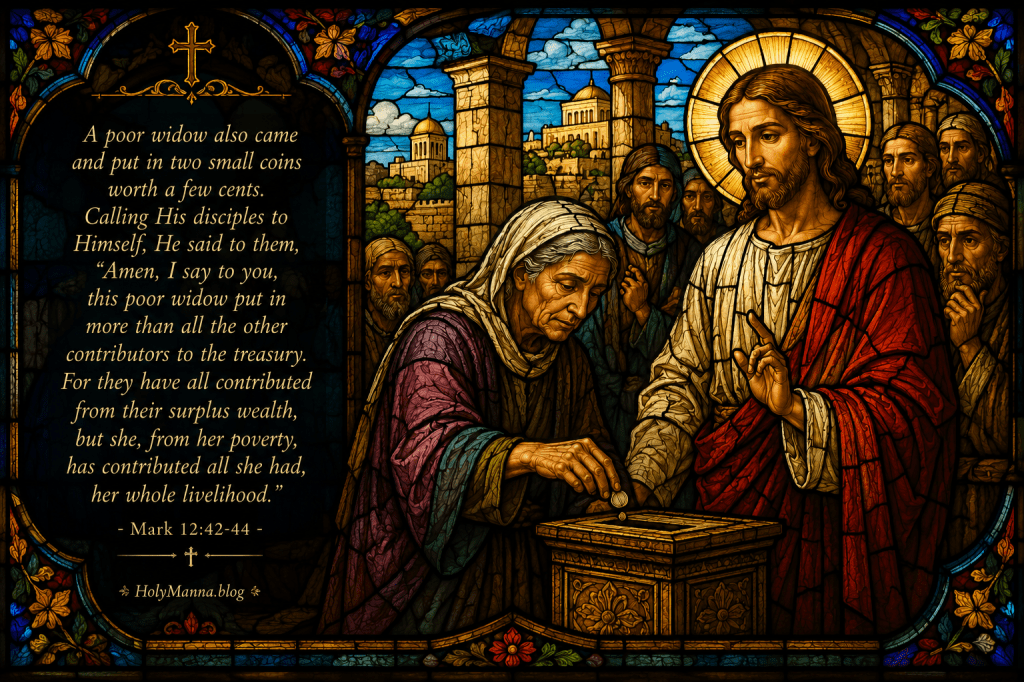
The Poor Widow’s Contribution. 41 He sat down opposite the treasury and observed how the crowd put money into the treasury. Many rich people put in large sums. 42 A poor widow also came and put in two small coins worth a few cents. 43 Calling his disciples to himself, he said to them, “Amen, I say to you, this poor widow put in more than all the other contributors to the treasury. 44 For they have all contributed from their surplus wealth, but she, from her poverty, has contributed all she had, her whole livelihood.”
Detailed Exegesis
Verse 38 – “In the course of his teaching he said, ‘Beware of the scribes, who like to go around in long robes and accept greetings in the marketplaces.’”
Jesus begins with a warning. He does not condemn every scribe, since some scribes were sincere seekers of God. Earlier in Mark 12, one scribe had answered wisely about the greatest commandment. Here, Jesus warns against a particular kind of religious corruption: the desire to use holiness as a costume.
The long robes and public greetings point to visible status. These men want recognition. They enjoy being treated as spiritually important. This is the danger of religious pride. A person can become attached to the appearance of holiness while drifting away from the humility that holiness requires.
For Catholics, this verse is a serious examination of conscience. Religious signs, titles, ministries, devotions, and knowledge can be beautiful when ordered toward God. They become dangerous when they are used to feed ego.
Verse 39 – “Seats of honor in synagogues, and places of honor at banquets.”
Jesus continues exposing the desire for prestige. The synagogue was a place of prayer and teaching, while banquets were social events where status could be displayed. These scribes wanted the best seats in both places. They wanted honor in worship and honor in society.
The problem is not that honor itself is always wrong. The problem is when honor becomes the goal. True authority in the Kingdom of God is ordered toward service. Jesus has already taught His disciples that greatness is found not in being served, but in serving. The scribes in this passage show the opposite spirit. Their religion has become a ladder for self-promotion.
Verse 40 – “They devour the houses of widows and, as a pretext, recite lengthy prayers. They will receive a very severe condemnation.”
This is one of the strongest condemnations in the Gospel. Widows in the ancient world were often among the most vulnerable members of society. Without a husband’s protection or income, a widow could easily face poverty, exploitation, and social insecurity. The Law of Moses repeatedly commanded care for widows, orphans, and strangers.
Jesus accuses these scribes of devouring widows’ houses. That means they are using their position to take advantage of the vulnerable. Even worse, they cover their injustice with lengthy prayers. Their prayer becomes a mask for greed.
This verse reveals why hypocrisy is so spiritually dangerous. It does not merely make a person look fake. It can become a tool that wounds others. When religious language is used to hide injustice, the offense is grave. Jesus says such men will receive a very severe condemnation because they have twisted what is sacred into a cover for sin.
Verse 41 – “He sat down opposite the treasury and observed how the crowd put money into the treasury. Many rich people put in large sums.”
Jesus sits and observes. That detail is quiet, but powerful. Christ sees how people give. He sees not only the amount, but the heart behind the offering.
The Temple treasury received contributions for the worship and maintenance of the Temple. Many rich people gave large sums, and those gifts may have been useful and even generous in a certain sense. Jesus does not say their gifts were evil. But He is about to show that God’s judgment reaches deeper than visible quantity.
This verse reminds the faithful that God sees the hidden motive behind every act of religion. He sees generosity, fear, pride, love, sacrifice, and trust. Nothing is hidden from Him.
Verse 42 – “A poor widow also came and put in two small coins worth a few cents.”
Now the poor widow appears. Mark emphasizes her poverty. She is not simply a widow. She is a poor widow. She gives two small coins, the smallest kind of offering. In human terms, it appears almost meaningless. Her gift would not impress anyone watching the treasury.
Yet this is the woman Jesus notices.
There is a beautiful reversal here. The scribes seek attention and receive condemnation. The widow seeks no attention and receives praise from the Son of God. She does not speak a word in the Gospel, but her act becomes a sermon.
Verse 43 – “Calling his disciples to himself, he said to them, ‘Amen, I say to you, this poor widow put in more than all the other contributors to the treasury.’”
Jesus calls His disciples because He wants them to learn how heaven measures things. The words “Amen, I say to you,” signal solemn teaching. What Jesus says next is surprising. The poor widow has put in more than all the others.
This is not a lesson in accounting. It is a lesson in love. The wealthy gave more money, but she gave more of herself. God does not measure generosity by amount alone. He measures sacrifice, trust, and love.
This verse also teaches that the hidden offerings of the poor are precious to God. The world may overlook them. The Church must not.
Verse 44 – “For they have all contributed from their surplus wealth, but she, from her poverty, has contributed all she had, her whole livelihood.”
Jesus explains the difference. The others gave from surplus. The widow gave from poverty. They gave what they could spare. She gave all she had.
This does not mean Christians are called to be reckless or ignore real responsibilities. Catholic teaching values prudence, family duties, justice, and stewardship. But the widow reveals the heart of true discipleship. She trusts God with everything.
Her gift points beyond itself. It points to Christ, who will soon give not two coins, but His whole life. He will be stripped, mocked, crucified, and poured out completely for the salvation of the world. The widow’s total gift becomes an image of the total self-gift of Jesus.
Teachings
This Gospel exposes false religion and reveals true worship. The scribes show what happens when religious life becomes a performance. The widow shows what happens when faith becomes surrender.
The Catechism of the Catholic Church teaches that external religious acts must be joined to a sincere heart. Prayer and worship cannot be separated from justice and charity. The Lord’s warning against the scribes shows that religious hypocrisy is especially grave when it harms the vulnerable.
The Church’s love for the poor is not optional. The Catechism teaches:
“God blesses those who come to the aid of the poor and rebukes those who turn away from them: ‘Give to him who begs from you, do not refuse him who would borrow from you’; ‘you received without pay, give without pay.’ It is by what they have done for the poor that Jesus Christ will recognize his chosen ones. When ‘the poor have the good news preached to them,’ it is the sign of Christ’s presence.”
CCC 2443
This teaching belongs at the heart of today’s Gospel. Jesus condemns those who exploit widows, then immediately honors a poor widow whose trust is greater than the visible gifts of the wealthy. The poor are not props in the Christian life. They are beloved by God, and Christ identifies Himself with them.
The Catechism continues:
“The Church’s love for the poor is a part of her constant tradition. This love is inspired by the Gospel of the Beatitudes, of the poverty of Jesus, and of his concern for the poor. Love for the poor is even one of the motives for the duty of working so as to ‘be able to give to those in need.’ It extends not only to material poverty but also to the many forms of cultural and religious poverty.”
CCC 2444
This is why the widow matters so much. She is materially poor, but spiritually rich. She has almost nothing, yet she gives with a freedom that the wealthy do not display. She reminds the Church that poverty is not romanticized, but the poor must be reverenced, protected, and loved.
The Gospel also calls Catholics to generous giving. The Catechism teaches:
“The faithful also have the duty of providing for the material needs of the Church, each according to his abilities.”
CCC 2043
The key phrase is “according to his abilities.” The widow’s ability was small in worldly terms, but immense in love. Her offering teaches that no gift is too small when it is given with faith. A parent’s tired prayer, a widow’s candle, a child’s coins, a worker’s honest tithe, a volunteer’s hidden service, and a suffering person’s silent offering can all become precious before God.
Saint Bede the Venerable, reflecting on this Gospel in the tradition preserved by the Church, saw the widow’s two coins as an image of love for God and neighbor. This is fitting because Jesus has just taught the greatest commandment: love God with all the heart, soul, mind, and strength, and love your neighbor as yourself. The widow’s offering is small, but it is whole. Her gift becomes a picture of undivided love.
This Gospel also carries a Eucharistic shape. At Mass, Catholics do not merely watch an offering. They are invited to unite their lives to Christ’s perfect offering to the Father. Jesus gives Himself completely in the Eucharist. The widow’s total gift quietly points toward the greater self-gift of the Lord.
Reflection
This Gospel asks one of the most uncomfortable and beautiful questions in the spiritual life: Is God receiving the leftovers, or is He receiving the heart?
The scribes gave God appearances. The widow gave God trust. That contrast is still alive today. A person can look religious, know Catholic language, attend parish events, and still quietly be chasing recognition. Another person can be unnoticed, poor, tired, grieving, or hidden, and yet be giving God everything.
The widow teaches that holiness is not always loud. Sometimes it looks like showing up for Mass when life is heavy. Sometimes it looks like giving generously when the budget is tight. Sometimes it looks like forgiving when pride wants revenge. Sometimes it looks like caring for an elderly parent, serving in a quiet ministry, praying when nobody sees, or remaining faithful when the world offers easier options.
The first practical step is to examine motives. Before serving, giving, posting, speaking, or volunteering, the heart can ask: Is this for God’s glory, or is this for attention? That simple question can purify a lot.
The second step is to honor the vulnerable. Jesus’ warning about widows is not background information. It is central. Catholics should notice those who are easily forgotten: the elderly, the poor, the lonely, the unborn, the sick, the grieving, and those spiritually lost. A Church that loves Jesus must care for the people Jesus defends.
The third step is to give something that costs love. Not every offering must be financial. Time can be an offering. Patience can be an offering. Forgiveness can be an offering. Prayer can be an offering. Truth spoken with charity can be an offering. The point is not to be dramatic. The point is to be sincere.
The widow’s two coins remind the faithful that Jesus sees the sacrifices no one else notices. He sees the single mother praying after everyone is asleep. He sees the young man fighting for purity. He sees the elderly parishioner offering pain for the Church. He sees the family giving quietly to someone in need. He sees the Catholic who chooses truth when it costs comfort.
What part of life is still being held back from God?
Where has faith become more about appearance than surrender?
Who are the widows, the vulnerable, and the forgotten people nearby who need Christian love?
What small offering could become great in the eyes of Christ if it were given with the whole heart?
In the Temple that day, many people saw money. Jesus saw a soul. The poor widow walked in with almost nothing, but she left behind one of the greatest lessons in the Gospel. God is not impressed by religious performance. He is moved by humble love, hidden sacrifice, and faithful surrender.
The Race, the Song, and the Two Small Coins
Today’s readings leave the heart with one clear message: God is not looking for religious performance. He is looking for faithful surrender.
Saint Paul stands at the end of his race and shows what a life poured out for Christ looks like. He has preached the Word when it was welcomed and when it was rejected. He has endured hardship, guarded sound doctrine, and remained faithful to the mission given to him. His words carry the peace of a soul that can say, “I have competed well; I have finished the race; I have kept the faith.” 2 Tim 4:7
The psalmist teaches the same lesson through a different kind of offering. His gift is lifelong praise. From youth to old age, from strength to weakness, he keeps turning toward the Lord. He reminds the faithful that God deserves praise not only when life feels easy, but also when the body grows tired, the future feels uncertain, and the soul needs to remember that God has always been faithful.
Then the poor widow enters the Temple with two small coins. To the world, her gift is almost nothing. To Jesus, it is everything. She gives not from surplus, but from poverty. She gives not what is convenient, but what costs trust. In her quiet surrender, she reveals the heart of true discipleship.
Together, Paul, the psalmist, and the widow teach that holiness is not measured by how impressive life looks from the outside. Holiness is measured by love, perseverance, and trust. The Christian life is not about giving God leftovers after everything else has been satisfied. It is about placing the whole heart before Him and saying, “Lord, this belongs to You.”
That kind of surrender begins in ordinary places. It begins in the decision to pray when the day is busy. It begins in speaking truth with charity when silence would be easier. It begins in caring for the vulnerable, giving generously, honoring the elderly, learning the faith, receiving the sacraments, and choosing Christ when comfort pulls in another direction.
The Catechism of the Catholic Church reminds the faithful that Christian witness must be real and visible in daily life: “The witness of a Christian life and good works done in a supernatural spirit have great power to draw men to the faith and to God.” CCC 2044
That is the invitation today. Run the race with Saint Paul. Praise the Lord with the psalmist. Give the heart with the poor widow. Let faith become more than something believed privately. Let it become a life poured out in love.
What would change today if God received not just what is left over, but the whole heart?
Christ sees every hidden sacrifice. He sees every quiet act of faith. He sees every small offering given with great love. And when life is finally placed before Him, the greatest blessing will be to hear that the race was finished, the faith was kept, and the heart was truly His.
Engage with Us!
Share your reflections in the comments below. Today’s readings invite every heart to look honestly at what is being offered to God, whether it is a lifetime of service like Saint Paul, a steady song of praise like the psalmist, or two small coins given with total trust like the poor widow.
- In the First Reading from 2 Timothy 4:1-8, where is Christ asking for courage to proclaim the truth, especially when it feels inconvenient or unpopular?
- In Psalm 71:8-9, 14-17, 22, how can daily praise become stronger, especially during seasons of weakness, aging, uncertainty, or spiritual fatigue?
- In the Holy Gospel from Mark 12:38-44, what part of life is still being held back from God, and what would it look like to give Him the whole heart like the poor widow?
- Across all the readings, how is God inviting the soul to move from religious appearance into deeper surrender, humility, and trust?
May these readings inspire a life of steady faith, generous love, and quiet perseverance. Let every prayer, sacrifice, act of service, and hidden offering be done with the love and mercy Jesus taught us, so that the whole heart may belong to God.
Sacred Heart of Jesus, we trust in You!
Immaculate Heart of Mary, pray for us!
Saint Michael the Archangel, defend us in battle!
Follow us on YouTube, TikTok, Instagram and Facebook for more insights and reflections on living a faith-filled life.


Leave a Reply