The Hidden Martyrs Who Stood Beside a Great Missionary
Some saints become famous across the whole Church. Their names are carved into history, their lives are preached from pulpits, and their stories are remembered by generations. Then there are saints like Eoban, Adalar, and their nine companions, holy men whose names are not as widely known, but whose courage shines with the same fire of the Gospel.
These saints were missionary priests, deacons, and monks who served alongside Saint Boniface, the great Apostle of Germany. They lived during the eighth century, a time when large parts of northern Europe were still being evangelized. The work was dangerous, exhausting, and often met with fierce resistance. Yet these men gave themselves to Christ and His Church with remarkable fidelity.
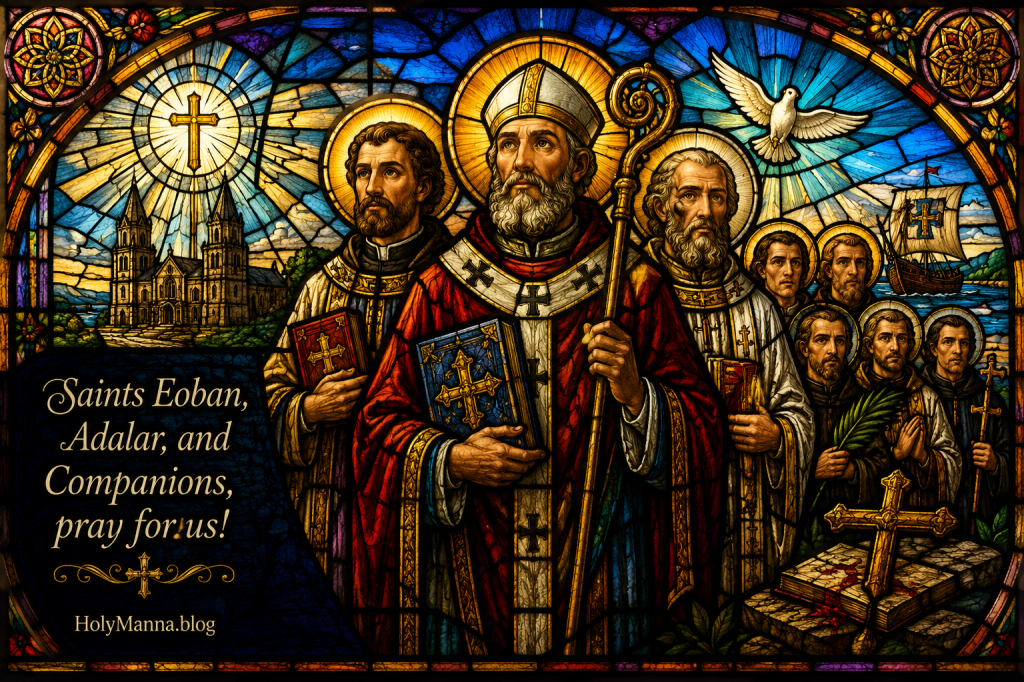
They are most remembered for their martyrdom at Dokkum in Frisia, in what is now the Netherlands, on June 5, 754. They were killed alongside Saint Boniface while preparing newly converted Christians for the Sacrament of Confirmation. Their lives remind the Church that sanctity is not always loud, famous, or celebrated in the moment. Sometimes holiness looks like standing faithfully beside a shepherd, carrying the Gospel into dangerous places, and refusing to abandon the mission when fear comes close.
The Catechism of the Catholic Church teaches that “Martyrdom is the supreme witness given to the truth of the faith: it means bearing witness even unto death” CCC 2473. Saints Eoban, Adalar, and their companions lived that truth with their blood.
Men Formed for the Mission Field
The personal details of these saints are limited, especially compared to the better-known life of Saint Boniface. Much of what the Church remembers about them comes through their connection to his final missionary journey. Still, what has been preserved is enough to show us men who were deeply committed to Christ, the Church, and the salvation of souls.
Saint Eoban was closely associated with Saint Boniface and the missionary Church in Utrecht. Some traditions identify him as Bishop of Utrecht, while other sources more cautiously describe him as a chorepiscopus, or assistant bishop, serving under the authority of Boniface and helping carry out the work of evangelization. He seems to have been one of Boniface’s trusted companions, a man capable of teaching, assisting, organizing, and strengthening the young Christian communities in the region.
Saint Adalar, also known as Adalher or Adelarius, is traditionally honored as the first bishop of Erfurt. Some later traditions say that Saint Boniface consecrated him around 741. However, older historical sources are more cautious and identify him simply as a priest at the time of Boniface’s final mission. Whether he was formally a bishop or remembered as one through later local devotion, the heart of his witness remains the same. He was a priest who gave his life with Boniface for the Gospel.
The nine companions are usually remembered as Wintrung and Walter, priests; Hamund, Scirebald, and Bosa, deacons; and Waccar, Gundekar, Elleher, and Hathawulf, monks. Their names vary slightly in spelling depending on the source, which is common with saints from this early medieval period. They were not all bishops or famous preachers. Some were monks. Some were deacons. Some were priests. Together, they formed a missionary household around Saint Boniface.
That alone says something beautiful. The Church’s mission does not depend only on one great saint. The Gospel is carried by many faithful hands. Some preach. Some serve. Some pray. Some organize. Some assist. Some remain hidden. All of them matter.
Carrying the Gospel to the Edge of Danger
Saints Eoban, Adalar, and their companions lived during one of the great missionary moments in European history. Saint Boniface had spent decades preaching the Gospel, reforming the Church, founding dioceses, strengthening Catholic discipline, and bringing many Germanic peoples into deeper communion with Rome.
By the time of his final journey, Boniface was already an elderly man. He had accomplished more than most people could imagine. He could have remained in a more secure position of honor. Instead, he returned to the mission field.
That detail is important. Boniface and his companions were not simply administrators. They were shepherds and missionaries. They believed that the Gospel was not meant to remain comfortable. Christ had commanded His Church to make disciples of all nations, and these men took that command seriously.
The Gospel of Matthew records the words of the risen Christ: “Go, therefore, and make disciples of all nations” Mt 28:19. That command shaped their lives. It also shaped their deaths.
There are no verified miracles during life specifically attributed to Eoban, Adalar, or the nine companions. Their miracle, if one may speak devotionally, was the quiet miracle of perseverance. They kept going. They remained faithful. They did not abandon the mission when it became difficult. In Catholic life, that kind of hidden faithfulness matters deeply.
They should be remembered because they show the beauty of supporting the mission of the Church without needing the spotlight. Not everyone is called to be Saint Boniface. Some are called to be Eoban, Adalar, Walter, Bosa, or Hathawulf, faithful companions who strengthen the mission by remaining steady.
The Attack at Dokkum
The final chapter of their earthly lives unfolded at Dokkum in Frisia. Boniface and his companions had gathered for missionary work, likely preparing to confirm newly baptized Christians. This was not a military expedition. It was not a political campaign. It was a sacramental mission.
Then pagan attackers came upon them.
The famous story says that Boniface’s followers wanted to defend him, but Boniface urged them not to fight back. That detail is mainly preserved in the larger tradition of Saint Boniface’s martyrdom. Since Eoban, Adalar, and the companions were martyred with him, they are remembered as sharing in that same peaceful witness.
Another famous story says that the attackers expected to find treasure among the missionaries. Instead, they found books and sacred writings. It is one of the most striking details associated with the martyrdom. These men had not come seeking wealth. They had come carrying the riches of the Gospel.
A later tradition also says that Boniface held up a sacred book during the attack, and a damaged codex preserved at Fulda became associated with that story. This tradition is beloved, though the exact details cannot be fully verified. Still, the image is powerful and deeply fitting. A missionary bishop facing death while holding a holy book is a sign of what these men lived for. They were men of the Word, men of the Church, and men of Christ.
Saints Eoban, Adalar, and the nine companions were killed with Boniface on June 5, 754. Their martyrdom was not a failure of the mission. In the mystery of God, it became part of the mission’s fruitfulness.
The Catechism of the Catholic Church teaches that the Church is missionary by her very nature because she draws her origin from the mission of the Son and the Holy Spirit according to the plan of the Father. These martyrs show what that means when lived with total seriousness. They preached Christ not only with words, but with their lives.
Relics, Memory, and the Quiet Power of Martyrs
After their death, the memory of these martyrs remained connected to several important places, especially Dokkum, Fulda, Utrecht, and Erfurt.
Dokkum became the place of martyrdom, the place where their earthly mission ended and their heavenly witness began. Fulda became deeply associated with Saint Boniface, whose tomb became a major place of pilgrimage and devotion. Eoban and Adalar were also remembered in connection with Fulda and Erfurt, where their relics became important to local Catholic devotion.
Saint Adalar became especially connected with Erfurt. Tradition honors him as one of the city’s earliest bishops and a patron of the local Church. Saint Eoban was also venerated there, and their relics were reportedly rediscovered during church construction in 1154. A medieval sarcophagus honoring Saints Adalar and Eoban in Erfurt Cathedral became a visible sign of their lasting place in the Catholic memory of the region.
There are no well-attested miracle stories specifically and individually attributed to Saints Eoban, Adalar, or the nine companions after death. Their legacy rests primarily on martyrdom, relics, pilgrimage, and local veneration. That should not make their witness seem smaller. In the Catholic tradition, martyrdom itself is a profound testimony to grace. The martyr’s death proclaims that Christ is worth more than life itself.
Their cultural impact is most visible in the Christian memory of Germany, the Netherlands, and the old missionary territories shaped by Saint Boniface. They are part of the hidden foundation of Christian Europe. They helped plant and water the faith in lands where the Church would later grow, build monasteries, form dioceses, educate generations, and shape Christian culture for centuries.
What is surprising is how little personal fame they received, even though they died in one of the most famous martyrdoms of the early medieval Church. Their lives remind modern Catholics that heaven does not measure importance the way the world does. The world remembers platforms, titles, and influence. God remembers fidelity.
The Courage to Stay Faithful
The story of Saints Eoban, Adalar, and their nine companions speaks directly to Catholics today. Most people will not be called to missionary martyrdom in a distant land. But every Christian is called to witness.
These saints teach the courage of faithful companionship. They stayed with Boniface. They stayed with the Church. They stayed with the mission. They stayed when danger came.
That is not a small thing.
In everyday Catholic life, faithfulness often looks ordinary. It looks like showing up for Mass when one feels tired. It looks like praying when distractions are loud. It looks like defending the dignity of the faith with charity when others mock it. It looks like serving in hidden ways without needing credit. It looks like standing beside holy people and helping them carry the mission forward.
The Church needs saints like Boniface, but the Church also needs saints like Eoban, Adalar, and the nine companions. The Church needs faithful priests, deacons, religious, parents, catechists, volunteers, friends, and quiet disciples who keep walking forward.
Their witness also challenges the modern desire for comfort. They knew the Gospel could cost them everything, and still they went. They believed Christ was worth the danger. They believed souls were worth the labor. They believed the Church’s mission was worth their lives.
Where is Christ asking for courage today?
Where is the temptation to stay comfortable instead of staying faithful?
Who needs a faithful companion in the mission right now?
Saints Eoban, Adalar, and their companions remind us that hidden holiness is still holiness. A quiet life given completely to Christ is never wasted. A faithful witness, even when forgotten by the world, is remembered forever by God.
Engage With Us!
Share your thoughts and reflections in the comments below. These hidden martyrs may not be as well known as Saint Boniface, but their courage gives every Catholic something powerful to consider.
- What part of the story of Saints Eoban, Adalar, and their companions challenges you the most?
- Have you ever been called to stand faithfully beside someone else in a difficult mission or season of life?
- Where might God be asking you to witness to the faith with more courage, even if your witness remains hidden?
- How can you support the mission of the Church in a simple, practical way this week?
May Saints Eoban, Adalar, and their nine companions pray for us. May their courage remind us that the Gospel is worth every sacrifice. And may we live each day with steady faith, humble courage, and the love and mercy Jesus taught us.
Saints Eoban, Adalar, and Companions, pray for us!
Follow us on YouTube, TikTok, Instagram and Facebook for more insights and reflections on living a faith-filled life.


Leave a Reply