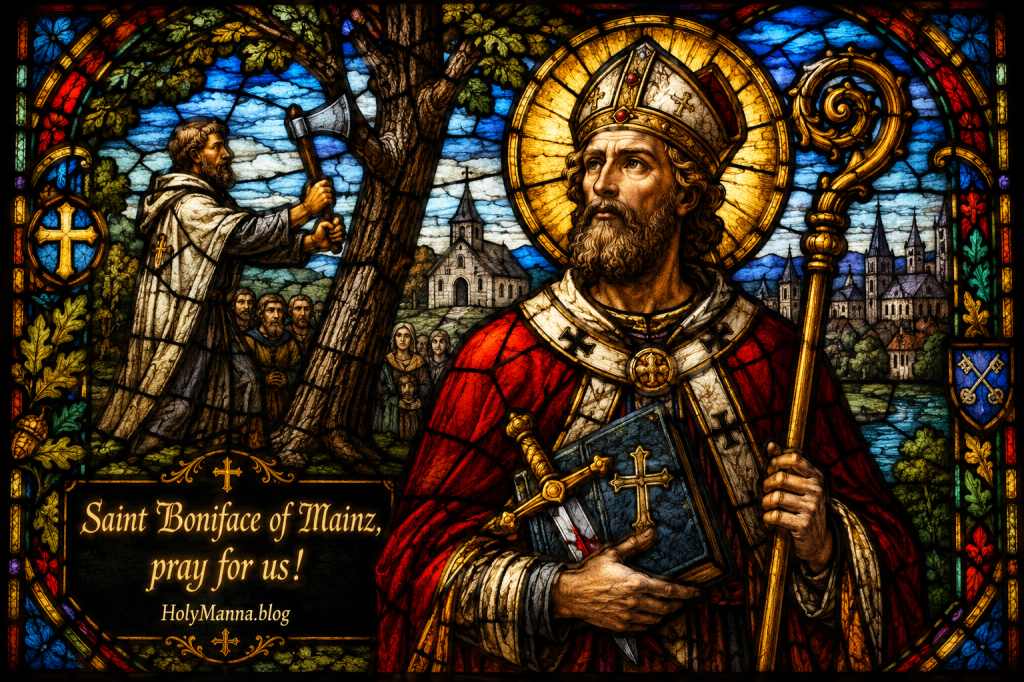
The Axe, the Oak, and the Apostle of Germany
Saint Boniface of Mainz was one of those saints who did not simply preach the Gospel. He helped build the world where the Gospel could take root.
Born in Anglo-Saxon England and baptized with the name Winfrid, he became a Benedictine monk, scholar, priest, missionary bishop, archbishop, reformer, founder of monasteries, and finally a martyr. He is honored as the Apostle of Germany because his missionary work helped establish, strengthen, and organize Catholic life among the Germanic peoples.
But Boniface was not a reckless religious adventurer. He was a son of the Church. He went to Rome. He received a mission from the pope. He preached Christ in communion with the Successor of Peter. He corrected abuses, formed clergy, founded monasteries, worked with holy men and women, and gave his life while still carrying the Gospel into dangerous places.
His life is a living example of what The Catechism of the Catholic Church teaches in CCC 849: “The Church on earth is by her nature missionary.” Boniface believed that with his whole heart. He did not treat the Gospel as a private comfort. He treated it as a mission worth crossing seas, confronting pagan worship, reforming broken Church structures, and dying for.
The English Boy Who Belonged to God
Saint Boniface was born around 672 to 675, traditionally in the region of Wessex in England, with Crediton in Devon often associated with his origins. His baptismal name was Winfrid or Wynfrith. He came from a respected family, and early tradition says his father originally hoped he would pursue a worldly path. But from a young age, Winfrid was drawn to the monastic life.
As a boy, he heard religious men speak about God, the Scriptures, and the life of prayer. Something in him awakened. He wanted to belong completely to Christ. His father resisted at first, but eventually allowed him to enter monastic formation.
Winfrid studied first near Exeter and later at the monastery of Nursling. There he became known for his intelligence, discipline, and love of sacred learning. He studied Scripture, grammar, rhetoric, poetry, and history. He became a monk, then a teacher, then a priest around the age of thirty.
This is one of the first surprising things about Saint Boniface. He was not an uneducated wandering preacher. He was a serious scholar. He wrote poems, grammatical works, letters, and theological reflections. He could have stayed in England and lived a respected life as a teacher, monk, and eventually an abbot.
But God was calling him beyond safety.
In 716, Winfrid made his first missionary journey to Frisia, in the region of the modern Netherlands. The mission failed. Political conflict and pagan resistance under the ruler Radbod made preaching almost impossible, so Winfrid returned to England.
That failure could have ended the story. It did not.
After returning, he was chosen to become abbot after the death of his own abbot, Winbert. For many men, that would have been the obvious path. It was stable. It was honorable. It was holy. But Winfrid declined, because his heart remained fixed on the mission field.
He was not running from monastic life. He loved monastic life. He was carrying its prayer, discipline, and learning into the wilderness.
Sent by Peter, Preaching Christ
After his first failed mission, Winfrid went to Rome. This moment shaped the rest of his life.
He placed his missionary desire before Pope Gregory II, who examined his faith and gave him an official mission to preach to the Germanic peoples. It was during this Roman mission that Winfrid became known as Boniface.
That detail matters deeply from a Catholic perspective. Saint Boniface did not appoint himself. He did not preach a private version of Christianity. He was sent by the Church. His missionary fire was joined to obedience.
He understood that evangelization must be Catholic, not merely energetic. It must be rooted in the faith handed down from the apostles. It must be in communion with the Church.
One of the clearest statements associated with him is his profession: “I profess integrally the purity of the holy Catholic faith.”
That was not just a sentence for Boniface. That was the shape of his life.
He also wrote with deep devotion to Rome, saying: “I never cease to invite and to submit to obedience to the Apostolic See.”
For modern Catholics, that can sound intense. But Boniface understood something many ages forget. Mission without truth becomes confusion. Zeal without obedience becomes pride. Reform without communion becomes rebellion. Boniface carried the Gospel with courage, but he carried it as a faithful son of the Church.
The Oak That Fell and the Fear That Broke
The most famous story from the life of Saint Boniface is the felling of Thor’s Oak, also called Donar’s Oak or Jupiter’s Oak.
In the region of Hesse, near Geismar, there stood a massive oak tree associated with pagan worship. The local people revered it as sacred. It represented the power of their old gods, especially Thor or Donar. To them, the tree was not merely wood and leaves. It was a symbol of fear, superstition, and spiritual bondage.
Boniface saw that preaching alone would not be enough. The people needed to see that the false gods had no power over Christ.
So he took an axe to the sacred oak.
According to early Christian tradition, as Boniface began cutting the tree, a powerful wind helped bring it down, splitting it apart. The people watched, expecting their god to strike Boniface dead. But nothing happened. The missionary stood unharmed.
That moment shattered the fear that had held many hearts captive.
Boniface then used the wood from the fallen oak to build a chapel dedicated to Saint Peter. That detail is beautiful. He did not simply tear down pagan worship and leave emptiness behind. He replaced fear with faith. He replaced superstition with the worship of Christ. He replaced a pagan shrine with a Catholic chapel.
This story is historically rooted in early accounts of his life, though the details of the wind and the dramatic reaction of the crowd belong to hagiographical tradition. Still, the spiritual meaning is clear. Christ is Lord over creation. Trees are not gods. Thunder is not divine. Fear does not deserve worship.
There is also a later legend that connects Saint Boniface to the origin of the Christmas tree. In some versions, after cutting down the oak, he pointed to a small evergreen tree as a symbol of Christ and eternal life. This is a beautiful Catholic story and can be used devotionally, but it cannot be verified as the direct historical origin of the modern Christmas tree.
The verified heart of the story is powerful enough. Boniface confronted pagan fear with Catholic faith, and the oak fell.
The Builder of a Catholic People
Saint Boniface was not only a preacher. He was also a builder.
He preached in Frisia, Hesse, Thuringia, Bavaria, and other Germanic regions. In some places, he met people who had never truly received the Gospel. In others, he found Christians whose faith had become mixed with pagan customs, bad teaching, weak discipline, and corrupt clergy.
That may be one of the most relatable parts of his life. Boniface was not only evangelizing pagans. He was also re-evangelizing Christians.
He founded monasteries and missionary centers. He helped organize dioceses. He formed clergy. He called synods. He corrected false teachers. He strengthened Catholic worship and sacramental life. He worked to make sure that the Church in these lands was not just Christian in name, but truly Catholic in faith, morals, worship, and unity.
He was consecrated a bishop around 722 or 723. Later, Pope Gregory III gave him the pallium, making him an archbishop with authority to organize the Church in missionary territory. Boniface helped establish or strengthen diocesan life in places such as Würzburg, Eichstätt, Erfurt, Buraburg, Salzburg, Freising, Regensburg, and Passau.
He also worked with Frankish rulers such as Charles Martel, Carloman, and Pepin, though the tradition that he personally crowned or anointed Pepin the Short should be treated carefully. Some traditions connect him to the Carolingian transition, but that claim cannot be proven with certainty. His true importance is not that he made kings. It is that he formed Christians.
Boniface called reforming councils in the 740s. These councils dealt with clerical discipline, obedience to bishops, rejection of superstition, reform of monasteries, and the moral life of the clergy. Priests were not supposed to live like warriors. Clergy were not to be careless, greedy, immoral, or tangled in pagan customs. Monasteries were to be places of prayer, learning, discipline, and fidelity to the Rule of Saint Benedict.
Boniface understood that evangelization cannot survive on emotional enthusiasm alone. Converts need catechesis. Families need parishes. Priests need discipline. Monks and nuns need holy order. Bishops need courage. The Church needs unity.
In other words, Boniface did not just want people to say yes to Christ once. He wanted them to live in Christ for generations.
The Holy Women Beside the Mission
One of the most beautiful and often overlooked parts of Saint Boniface’s story is his collaboration with holy women.
Boniface invited women religious from England to help form Christian life on the continent. Among them were Saint Lioba, Saint Walburga, Thecla, Chunihild, Chunitrude, and Berthgit. These women helped establish monasteries, educate the faithful, form young women, and deepen the spiritual life of newly Christian communities.
Saint Lioba became one of Boniface’s most trusted collaborators. She was known for wisdom, learning, humility, and holiness. Saint Walburga would also become deeply loved in Catholic tradition, especially in Germany.
This reminds modern Catholics that the evangelization of Europe was not only the work of bishops, monks, and kings. It was also the work of nuns, abbesses, teachers, intercessors, and spiritual mothers.
Boniface knew he needed prayer. In one moving request, he asked holy women to pray for his mission, saying: “Pray that I may not die without some fruit for that Gospel.”
That line reveals the soul of the saint. He did not want fame. He wanted fruit for the Gospel.
Fulda, the Monastery of His Heart
Among Saint Boniface’s great foundations, Fulda held a special place.
Founded around 744 with Saint Sturm, also called Sturmius, Fulda became one of the great monastic centers of Germany. Boniface wanted it to be a place of prayer, learning, missionary formation, and Catholic holiness. He placed it under the special protection of the Holy See, which again shows his deep devotion to Roman unity.
Fulda became one of the great lights of Christian Germany. It preserved learning, formed monks, copied manuscripts, taught the faith, and became a spiritual home for countless Catholics.
Boniface wanted to be buried there. That desire would eventually be fulfilled after his martyrdom, and Fulda became the great shrine associated with his memory.
There is something deeply Catholic about this. Boniface preached, yes. But he also built a place where prayer could continue after him. He knew his life would end, but the Church’s mission would continue.
The Old Missionary and the Final Journey
Near the end of his life, Saint Boniface entrusted much of his work in Mainz to his disciple Lullus. He was elderly, likely around eighty years old. He could have remained in a place of honor and influence. He had already done more than enough by ordinary human standards.
But saints do not measure love by minimum requirements.
Boniface returned to Frisia, the same region where his first mission had failed decades earlier. That is stunning. The old missionary went back to the place of his early disappointment, still hoping to win souls for Christ.
According to tradition, he sensed that death was near. He made arrangements for his burial, encouraged his disciples, and continued preaching, baptizing, and preparing converts for confirmation.
On June 5, 754, near Dokkum in Frisia, Boniface and his companions were attacked by a hostile pagan group. His attendants wanted to defend him by force. Boniface refused.
The words remembered from his final moments are among the most moving in his story: “Sons, cease fighting. Lay down your arms.”
He urged them to trust in God rather than answer bloodshed with bloodshed. Another phrase associated with his martyrdom is: “Put your trust in Him.”
Boniface and his companions were killed. Tradition often numbers the martyrs with him as fifty-two, though some sources give different numbers. Among them was Saint Eoban.
One tradition says Boniface held a sacred book over his head as the sword fell. Another account says a bloodstained copy of Saint Ambrose’s The Advantage of Death was found near him. That is why Saint Boniface is often shown in sacred art holding a book pierced by a sword.
His martyrdom beautifully reflects the teaching of CCC 2473: “Martyrdom is the supreme witness given to the truth of the faith.”
Boniface had spent his life preaching Christ. At the end, he witnessed to Christ with his blood.
The Miracles, Relics, and Memory That Followed
After the martyrdom of Saint Boniface, his attackers reportedly expected to find treasure among the missionary company. Instead, they found books, relics, and sacred objects. That detail is almost poetic. The treasure of Boniface was not gold. It was the Word of God, the sacred tradition of the Church, and the mission of Christ.
His body was brought first to Utrecht and then to Mainz before finally being taken to Fulda according to his wishes. Fulda became the great place of pilgrimage associated with him.
Several posthumous miracle stories are connected to Saint Boniface. These come from hagiographical and devotional tradition, so they should be received as part of Catholic memory rather than modern historical proof.
One tradition says that when his body was in Utrecht, a church bell rang by itself, signaling that his relics should continue toward their intended resting place. This story cannot be verified.
Other accounts speak of healings at his tomb in Fulda. The sick were said to be restored, the blind to receive sight, the dying to be strengthened, and the spiritually afflicted to find peace. These miracle stories belong to the devotional tradition surrounding his relics, though individual cases cannot be verified according to modern standards.
There is also a tradition of a spring or fountain near the site of his martyrdom at Dokkum. According to the story, fresh water came forth at or near the place where the martyr shed his blood. This became part of the local devotion to Saint Boniface, though the details cannot be verified.
His relics at Fulda became a powerful sign of Catholic identity in Germany. Over time, Fulda grew into a national sanctuary of Christian Germany. The memory of Boniface shaped not only local devotion, but the religious imagination of an entire people.
The Saint Who Shaped Christian Europe
Saint Boniface’s legacy is enormous.
He is remembered as the Apostle of Germany because he helped give lasting Catholic structure to the German Church. He strengthened communion with Rome. He helped reform the Frankish Church. He organized dioceses. He founded monasteries. He corrected abuses. He confronted superstition. He formed clergy. He encouraged women religious. He preached to pagans. He reformed Christians. He died as a martyr.
His feast day is celebrated on June 5. He is honored as a bishop and martyr. He is a patron of Germany and Devon, and he is also associated with brewers, tailors, file-cutters, and several German cities.
In art, he is often shown as a bishop holding an axe, because of the felling of Thor’s Oak. Sometimes he is shown with an oak tree. Sometimes he holds a book pierced by a sword, recalling the tradition of his martyrdom.
His cultural impact is especially strong in Germany, the Netherlands, and Devon. Fulda remains central to his memory. Dokkum preserves the memory of his martyrdom. Crediton honors him as a native son.
But his deeper legacy is spiritual. Boniface shows what happens when learning, courage, obedience, reform, and sacrifice come together in one Catholic soul.
He did not choose between truth and charity. He preached the truth because he loved souls. He did not choose between courage and obedience. He was bold because he belonged to the Church. He did not choose between prayer and action. His action came from prayer.
That is why his life still matters.
The False Oaks of the Modern Heart
Saint Boniface’s life asks uncomfortable but necessary questions.
The oak at Geismar was not just a tree. It was a symbol of fear. It represented the false powers people trusted more than God. It was the thing everyone was afraid to challenge.
Modern Catholics may not worship Thor’s Oak, but every age has its own sacred trees.
Comfort can become an oak. Approval can become an oak. Lust can become an oak. Pride can become an oak. Political power can become an oak. Money can become an oak. Fear of being judged can become an oak. Even a lazy, lukewarm version of religion can become an oak if it keeps the soul from surrendering fully to Christ.
Saint Boniface teaches that false worship must be named before it can be abandoned. He also teaches that tearing down an idol is not enough. The empty space must be given to Christ.
That is why he built a chapel from the fallen oak. He knew the human heart needs worship. If Christ does not reign there, something else will.
What false oak still stands in the heart today?
Where has fear been treated like a god?
What needs to be cut down so that Christ can finally be worshiped there?
Saint Boniface also teaches Catholics how to reform without becoming bitter. He corrected clergy, fought superstition, and challenged false teaching, but he stayed rooted in obedience and communion. He did not use reform as an excuse for pride. He used reform as an act of love.
That matters today. The Church always needs saints who are courageous and faithful, honest and humble, bold and obedient.
Boniface was all of those.
A Saint for Catholics Who Want to Build Something That Lasts
Saint Boniface did not live a small faith.
He crossed borders. He learned languages. He confronted fear. He endured failure. He obeyed the pope. He formed communities. He worked with holy women and men. He built monasteries. He corrected corruption. He preached Christ to the end.
He reminds Catholics that faith is not meant to be hidden in private comfort. It is meant to become visible in homes, parishes, friendships, workplaces, families, schools, and culture.
Not everyone is called to travel to foreign lands like Boniface. But every Catholic is called to mission. Every Catholic knows someone who needs encouragement, truth, mercy, and prayer. Every Catholic has some corner of life where Christ needs to be proclaimed more clearly.
The lesson of Saint Boniface is not simply to be loud. It is to be faithful.
Learn the faith. Love the Church. Pray deeply. Speak truth. Correct what is false. Build what is holy. Do not be afraid of the oak. Do not worship the oak. Let it fall, and build an altar to Christ where fear used to stand.
Engage with Us!
Share your thoughts and reflections in the comments below. Saint Boniface lived with courage, obedience, and missionary love, and his story still speaks powerfully to Catholics trying to follow Christ in a confused world.
- What part of Saint Boniface’s life challenges you the most: his courage, his obedience, his perseverance, or his martyrdom?
- What “false oak” in modern life do you think Catholics are most tempted to fear or worship today?
- How can you bring Christ more clearly into your home, workplace, parish, or friendships this week?
- Why do you think Saint Boniface was so committed to staying united with Rome while doing missionary work?
- What is one practical way you can build something holy that will outlast you, even in a small way?
May the example of Saint Boniface inspire a deeper love for Christ, a stronger trust in the Church, and a braver witness in daily life. May every false oak fall, and may every heart become a place where Jesus is loved, worshiped, and followed with the mercy and love He taught us.
Saint Boniface of Mainz, pray for us!
Follow us on YouTube, TikTok, Instagram and Facebook for more insights and reflections on living a faith-filled life.


Leave a Reply