Memorial of Saint Boniface, Bishop and Martyr – Lectionary: 357
When the Word Becomes Courage
Faith is easy to admire from a distance, but today’s readings ask what happens when the Word of God must be carried into pressure, confusion, and persecution.
The Church places before us a powerful thread: the Word of God forms witnesses who remain faithful because Jesus Christ is not only promised by Scripture, but revealed as Lord. In 2 Timothy 3:10-17, Saint Paul speaks to Timothy like a father preparing his son for a hard road. He does not hide the cost of discipleship, saying, “all who want to live religiously in Christ Jesus will be persecuted.” Yet Paul does not leave Timothy with fear. He points him back to the sacred Scriptures, which give “wisdom for salvation through faith in Christ Jesus.” The Word is not merely information. It is formation.
That same spirit runs through Psalm 119. The psalmist is surrounded by enemies, yet remains anchored in God’s law. In Israel’s faith, the law of the Lord was not seen as a burden, but as the covenant path of life, wisdom, and peace. That is why the psalm can say, “Lovers of your law have much peace.” Peace does not come from having no opposition. It comes from belonging to God and trusting His enduring Word when opposition comes.
Then, in Mark 12:35-37, Jesus brings the whole story to its center. Teaching in the temple, He quotes Psalm 110 and asks how the Messiah can be both David’s son and David’s Lord. This was not a clever religious puzzle. Jesus was revealing that the Messiah is greater than a political deliverer or earthly king. He is the Son of David according to His humanity, and Lord according to His divinity. The Scriptures that formed Timothy, strengthened the psalmist, and guided Israel all point to Him.
On the Memorial of Saint Boniface, Bishop and Martyr, these readings become even more vivid. Boniface was a missionary formed by the Word, faithful to the Church, and courageous in the face of danger. His life shows what happens when Scripture is not just studied, but obeyed. Today’s readings prepare the soul to ask a serious question: Is the Word of God shaping a faith that can stand when the world pushes back?
First Reading – 2 Timothy 3:10-17
A Faith Trained by Scripture and Tested by Fire
Saint Paul writes to Timothy like a spiritual father preparing his son for a world that will not always welcome the Gospel. This letter comes near the end of Paul’s life, when he is imprisoned and aware that martyrdom is close. His words carry the weight of someone who has preached Christ, suffered for Christ, and remained faithful through it all.
Timothy, meanwhile, is a younger bishop entrusted with guarding the faith and teaching the Church. Paul does not give him a motivational speech built on comfort. He gives him something stronger: the memory of apostolic witness, the reality of persecution, and the power of Sacred Scripture.
This reading fits beautifully with today’s central theme. The Word of God does not merely inform the faithful. It forms witnesses. It teaches, corrects, strengthens, and equips the soul to remain faithful when the world pushes back. On the Memorial of Saint Boniface, Bishop and Martyr, this becomes even more vivid. Like Timothy, Boniface was formed by the Word, sent by the Church, and strengthened to bear witness even unto death.
2 Timothy 3:10-17 – New American Bible (Revised Edition)
10 You have followed my teaching, way of life, purpose, faith, patience, love, endurance, 11 persecutions, and sufferings, such as happened to me in Antioch, Iconium, and Lystra, persecutions that I endured. Yet from all these things the Lord delivered me. 12 In fact, all who want to live religiously in Christ Jesus will be persecuted. 13 But wicked people and charlatans will go from bad to worse, deceivers and deceived. 14 But you, remain faithful to what you have learned and believed, because you know from whom you learned it, 15 and that from infancy you have known [the] sacred scriptures, which are capable of giving you wisdom for salvation through faith in Christ Jesus. 16 All scripture is inspired by God and is useful for teaching, for refutation, for correction, and for training in righteousness, 17 so that one who belongs to God may be competent, equipped for every good work.
Detailed Exegesis
Verse 10 – “You have followed my teaching, way of life, purpose, faith, patience, love, endurance.”
Paul begins by reminding Timothy that Christian teaching is never separated from Christian living. Timothy has not only heard Paul preach. He has watched him live. He has seen doctrine become patience, love, endurance, and purpose. In the Catholic life, truth is not meant to stay in the mind alone. It is meant to take flesh in daily holiness.
This matters because faith is learned through both words and witnesses. Timothy received teaching from Paul, but he also received an example. The Church continues this same pattern through the saints, priests, parents, catechists, godparents, and faithful Catholics who show what the Gospel looks like when lived with conviction.
Verse 11 – “Persecutions, and sufferings, such as happened to me in Antioch, Iconium, and Lystra, persecutions that I endured. Yet from all these things the Lord delivered me.”
Paul points to specific places where he suffered for preaching Christ. Antioch, Iconium, and Lystra were cities connected to his missionary journeys, and Timothy would have known these stories well. Paul was rejected, opposed, driven out, and even stoned. Yet he does not speak like a victim. He speaks like a man who knows the Lord was faithful.
The phrase “the Lord delivered me” does not mean Paul avoided suffering. It means suffering did not have the final word. God delivered him through persecution, not always around it. That distinction is important for Catholic discipleship. The Lord does not promise a life without trials. He promises His presence, His grace, and final victory in Christ.
Verse 12 – “In fact, all who want to live religiously in Christ Jesus will be persecuted.”
This is one of the most sobering lines in the New Testament. Paul does not say some Christians might face resistance. He says “all who want to live religiously in Christ Jesus will be persecuted.” To live faithfully in Christ is to live in a way that exposes the false promises of the world.
This persecution may not always look like violence. For many Catholics today, it may look like mockery, rejection, misunderstanding, professional pressure, family tension, or the temptation to soften the faith to be accepted. Paul’s message is not meant to frighten the faithful. It is meant to prepare them. If Christ was rejected, His disciples should not be shocked when fidelity costs something.
Verse 13 – “But wicked people and charlatans will go from bad to worse, deceivers and deceived.”
Paul warns Timothy that false teachers and corrupt people will continue to spread confusion. The word “charlatans” points to spiritual frauds, people who mislead others while often being misled themselves. Evil does not remain still. Deception tends to deepen when it is not corrected by truth.
This verse speaks powerfully to every age. The Church has always had to guard the deposit of faith against confusion, distortion, and half-truths. False teaching is dangerous because it often sounds religious while quietly moving people away from Christ. Paul wants Timothy to understand that fidelity requires discernment. Love must be joined to truth.
Verse 14 – “But you, remain faithful to what you have learned and believed, because you know from whom you learned it.”
Paul gives Timothy the answer to confusion: remain faithful. He does not tell him to reinvent Christianity. He does not tell him to chase novelty. He tells him to stay rooted in what he has received.
This is deeply Catholic. The faith is handed on. It is received through Scripture and Sacred Tradition, guarded by the apostles and their successors, and lived in the communion of the Church. Timothy knows the trustworthy sources from whom he learned the faith, including Paul and his own family. The Christian life depends on remaining connected to the apostolic faith, not drifting into whatever sounds appealing in the moment.
Verse 15 – “And that from infancy you have known the sacred scriptures, which are capable of giving you wisdom for salvation through faith in Christ Jesus.”
Timothy knew the Scriptures from childhood, most likely through the faithful teaching of his mother Eunice and grandmother Lois, who are mentioned earlier in 2 Timothy 1:5. Paul reminds him that Scripture gives “wisdom for salvation”, but always “through faith in Christ Jesus.”
That phrase is essential. Sacred Scripture is not read correctly when it is separated from Christ. The Old Testament prepares for Him. The New Testament proclaims Him. The whole Bible finds its center in Him. Catholic interpretation sees Scripture as one unified story of salvation, fulfilled in Jesus Christ and entrusted to the Church.
Verse 16 – “All scripture is inspired by God and is useful for teaching, for refutation, for correction, and for training in righteousness.”
This verse is one of the Church’s most important passages on the inspiration of Scripture. The phrase “inspired by God” means that Scripture has God as its true author, while also being written through real human authors. Catholics do not believe the Bible fell from heaven as a detached text. God worked through human authors, cultures, languages, and histories, while ensuring that what He wanted written for our salvation was faithfully written.
Paul also explains what Scripture does. It teaches truth, refutes error, corrects sin, and trains the soul in righteousness. Scripture is not meant only to comfort. It is meant to form. Sometimes the Word consoles, and sometimes it cuts. Sometimes it encourages, and sometimes it exposes what must change.
Verse 17 – “So that one who belongs to God may be competent, equipped for every good work.”
The goal of Scripture is not merely knowledge. The goal is holiness and mission. The person formed by God’s Word becomes “equipped for every good work.” Scripture prepares the faithful to live charity, defend truth, endure suffering, serve the Church, resist sin, and witness to Christ.
This verse brings the reading to its full meaning. The Word of God equips Christians to become saints. It does not simply make people more informed. It makes them more faithful, more courageous, more discerning, and more ready to love.
Teachings
This reading gives one of the clearest biblical foundations for the Catholic understanding of Sacred Scripture. Paul teaches that Scripture is inspired by God, useful for forming the believer, and ordered toward salvation in Christ. The Church receives this truth with reverence and teaches that Scripture must be read within the living faith of the Church.
The Catechism of the Catholic Church teaches in CCC 105, “God is the author of Sacred Scripture. ‘The divinely revealed realities, which are contained and presented in the text of Sacred Scripture, have been written down under the inspiration of the Holy Spirit.’ ‘For Holy Mother Church, relying on the faith of the apostolic age, accepts as sacred and canonical the books of the Old and the New Testaments, whole and entire, with all their parts, on the grounds that, written under the inspiration of the Holy Spirit, they have God as their author, and have been handed on as such to the Church herself.’”
This protects Catholics from two mistakes. The first mistake is treating the Bible as merely human literature. The second is treating the Bible as if it can be separated from the Church that received, preserved, canonized, proclaimed, and interprets it. Scripture is God’s Word, and it belongs in the heart of the Church.
The Catechism continues in CCC 106, “God inspired the human authors of the sacred books. ‘To compose the sacred books, God chose certain men who, all the while he employed them in this task, made full use of their own faculties and powers so that, though he acted in them and by them, it was as true authors that they consigned to writing whatever he wanted written, and no more.’”
This helps explain why Catholics take seriously both divine inspiration and historical context. Paul’s words to Timothy came through a real man, in a real situation, facing real suffering. Yet through Paul’s human authorship, the Holy Spirit speaks to the whole Church.
The Catechism also teaches in CCC 107, “The inspired books teach the truth. ‘Since therefore all that the inspired authors or sacred writers affirm should be regarded as affirmed by the Holy Spirit, we must acknowledge that the books of Scripture firmly, faithfully, and without error teach that truth which God, for the sake of our salvation, wished to see confided to the Sacred Scriptures.’”
This is why Paul can tell Timothy to rely on Scripture for teaching, correction, and training. Scripture teaches saving truth. It does not exist to satisfy curiosity alone. It leads the faithful to salvation in Jesus Christ.
Saint Jerome captured this same truth with his famous line, quoted in CCC 133: “Ignorance of the Scriptures is ignorance of Christ.” That teaching belongs at the heart of today’s reading. Timothy is told to remain rooted in Scripture because Scripture gives wisdom for salvation through Christ. To know Scripture is to be led more deeply into communion with the Lord.
The Church also teaches in CCC 108, “Still, the Christian faith is not a ‘religion of the book.’ Christianity is the religion of the ‘Word’ of God, ‘not a written and mute word, but incarnate and living.’ If the Scriptures are not to remain a dead letter, Christ, the eternal Word of the living God, must, through the Holy Spirit, ‘open our minds to understand the Scriptures.’”
This is especially important for today’s readings as a whole. Paul points Timothy to Scripture. The psalmist clings to God’s law. Jesus opens the meaning of Psalm 110 in the Temple. The Word of God is alive because it leads to the living Word, Jesus Christ.
Saint Boniface lived this truth in a dramatic way. He was a missionary bishop formed by Scripture, obedient to the Church, and willing to suffer for Christ. His preaching among the Germanic peoples was not based on personal opinion or cultural popularity. It was grounded in the Gospel and in communion with the apostolic Church. His martyrdom shows what Paul teaches Timothy: the Word forms courage, and courage becomes witness.
Reflection
This reading asks a serious question of every Catholic: Is Scripture forming a faith strong enough to endure pressure?
Many people want a faith that comforts them, but Paul describes a faith that also corrects, trains, and strengthens. Sacred Scripture does console the weary heart, but it also challenges the comfortable heart. It tells the truth about sin, grace, suffering, salvation, and the Lordship of Jesus Christ.
That can be difficult in daily life. It is easier to open a phone than open the Bible. It is easier to scroll through opinions than sit quietly with the Word of God. It is easier to look for affirmation than allow God to correct what needs healing. Yet Paul tells Timothy that Scripture equips the person who belongs to God for every good work.
A practical way to live this reading is to make the daily Mass readings part of ordinary life. Read them before work. Pray with one verse during lunch. Return to the Gospel before bed. Let the Word interrupt the noise. Let it shape decisions, conversations, habits, and priorities.
Another step is to receive correction without defensiveness. When Scripture reveals pride, impurity, resentment, dishonesty, laziness, or fear, the faithful response is not to look away. The faithful response is to bring it to Christ, confess what needs confession, and begin again with grace.
This reading also invites Catholics to stop being surprised when faithfulness brings resistance. Paul is clear that those who desire to live in Christ will face persecution. That does not mean becoming combative or bitter. It means becoming steady. The goal is not to win arguments for ego. The goal is to remain faithful to Jesus with patience, love, endurance, and truth.
Where is God’s Word trying to correct something that has been ignored for too long?
Is Scripture being treated as a living voice from God, or only as a religious text used when convenient?
When faith becomes uncomfortable, is the first instinct to remain faithful or to soften the truth?
The good news is that God never gives His Word merely to expose weakness. He gives His Word to form saints. The same Word that strengthened Paul, formed Timothy, and sustained Saint Boniface can still form courageous Catholics today. The world does not need Christians who simply know more religious information. It needs witnesses who have been trained by the Word, corrected by grace, and equipped for every good work.
Responsorial Psalm – Psalm 119:157, 160-161, 165-166, 168
The Peace of a Heart Anchored in God’s Word
Psalm 119 is the longest psalm in the Bible, and it is one long act of love for the Word of God. It praises the Lord’s law, commandments, testimonies, precepts, and judgments, not as cold religious rules, but as the path of covenant life. For ancient Israel, God’s law was not merely a legal code. It was the gift that taught the people how to live as His chosen ones.
This psalm fits today’s theme perfectly. In the first reading, Saint Paul tells Timothy to remain faithful to the sacred Scriptures in the face of persecution. In the Gospel, Jesus shows that Scripture finds its deepest meaning in Him. Here, the psalmist gives us the interior posture of a faithful soul: surrounded by enemies, but not shaken; pressured by powerful people, but still revering God’s Word; longing for salvation, but still keeping the commandments.
This is not fragile peace. This is covenant peace. It is the kind of peace that comes when a person has decided that God’s Word will be trusted more than fear, pressure, popularity, or human approval.
Psalm 119:157, 160-161, 165-166, 168 – New American Bible (Revised Edition)
157 Though my persecutors and foes are many,
I do not turn from your testimonies.160 Your every word is enduring;
all your righteous judgments are forever.161 Princes persecute me without reason,
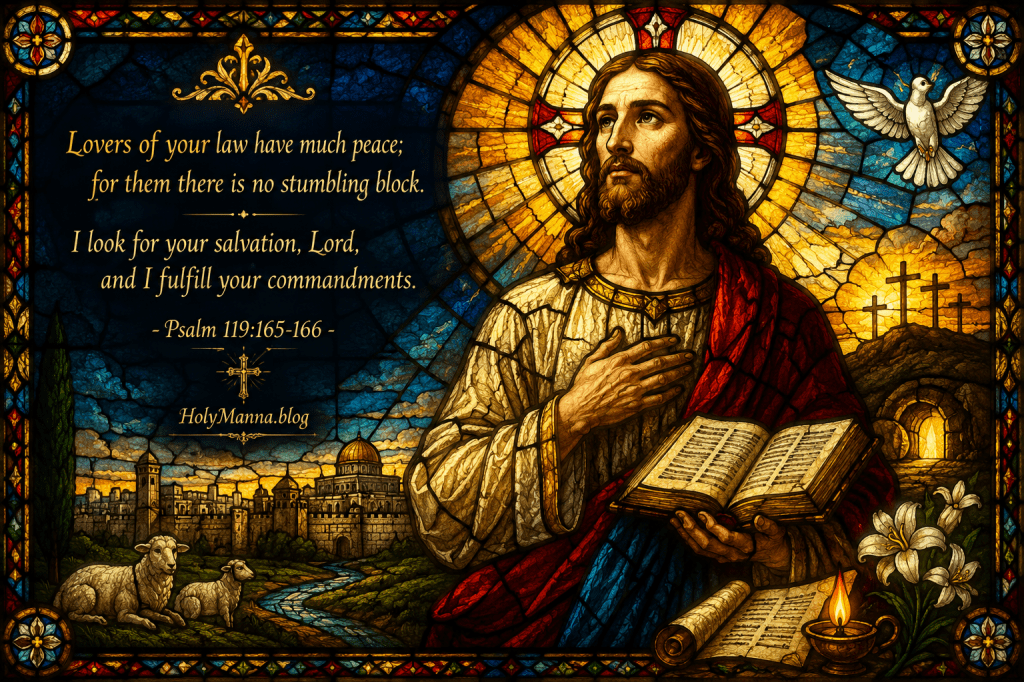
but my heart reveres only your word.165 Lovers of your law have much peace;
for them there is no stumbling block.
166 I look for your salvation, Lord,
and I fulfill your commandments.168 I observe your precepts and testimonies;
all my ways are before you.
Detailed Exegesis
Verse 157 – “Though my persecutors and foes are many, I do not turn from your testimonies.”
The psalmist does not pretend life is easy. He names the pressure honestly: “my persecutors and foes are many.” Yet his response is not panic, compromise, or bitterness. He says, “I do not turn from your testimonies.”
This verse gives the soul of today’s readings. Saint Paul tells Timothy that persecution is part of faithful discipleship. Saint Boniface would later live that truth as a missionary bishop and martyr. The faithful person is not defined by the number of enemies around him, but by the Word of God within him.
In Catholic life, this verse reminds us that fidelity is not proven only when faith is easy. Fidelity is revealed when obedience costs something. The psalmist teaches that God’s testimonies remain trustworthy even when the world becomes hostile.
Verse 160 – “Your every word is enduring; all your righteous judgments are forever.”
Here the psalmist contrasts the instability of the world with the permanence of God’s Word. Human opinions change. Political powers rise and fall. Cultural values shift from one generation to the next. But God’s Word endures.
This verse connects deeply with the Catholic teaching that Sacred Scripture is inspired by God and teaches saving truth. The Word of God is not trapped in the past. It remains living, authoritative, and true because God Himself is faithful.
The phrase “all your righteous judgments are forever” also reminds us that God’s commands are not arbitrary. They are righteous because God is righteous. His moral law is not meant to crush human freedom, but to guide it toward truth, holiness, and peace.
Verse 161 – “Princes persecute me without reason, but my heart reveres only your word.”
The psalmist now speaks of persecution from the powerful. “Princes” represents rulers, leaders, or those with public authority. Their persecution is “without reason,” which means the suffering is unjust. Yet the psalmist refuses to make human power his ultimate fear.
He says, “my heart reveres only your word.” This is a beautiful picture of holy fear. The faithful soul respects authority, but worship belongs to God alone. No ruler, employer, social movement, public opinion, or cultural pressure has the right to replace the authority of the Lord.
This verse prepares us for the Gospel, where Jesus teaches in the temple and reveals the true Lordship of the Messiah. If Christ is Lord, then every earthly power is limited. The Christian heart must remain reverent before God’s Word above all else.
Verse 165 – “Lovers of your law have much peace; for them there is no stumbling block.”
This is the heart of the responsorial psalm: “Lovers of your law have much peace.” The psalmist does not say that lovers of God’s law have no problems. He says they have peace. That distinction matters.
Biblical peace is not merely a relaxed feeling. It is the deep wholeness that comes from being rightly ordered toward God. The person who loves God’s law may still suffer, but he is not easily uprooted. He may be opposed, but he is not spiritually lost.
The phrase “for them there is no stumbling block” does not mean the faithful never face temptation. It means that God’s Word gives light for the path. When a person loves the Lord’s law, even trials can become occasions of deeper trust rather than occasions of collapse.
Verse 166 – “I look for your salvation, Lord, and I fulfill your commandments.”
This verse beautifully holds together hope and obedience. The psalmist looks for salvation, but he does not wait passively. He fulfills the Lord’s commandments.
That is very Catholic. Salvation is God’s gift, not something earned by human effort. Yet grace calls for a response. The faithful person hopes in the Lord and lives in obedience. Love for God becomes visible in action.
This verse also points toward Christ, because the salvation for which Israel longed is fulfilled in Him. The sacred Scriptures give “wisdom for salvation through faith in Christ Jesus,” as Saint Paul tells Timothy in the first reading. The psalmist waits for salvation, and the Gospel reveals that salvation in the Lordship of Christ.
Verse 168 – “I observe your precepts and testimonies; all my ways are before you.”
The psalm closes this selection with integrity. The psalmist observes God’s precepts because he knows his whole life is lived before God: “all my ways are before you.”
This is not fear in the unhealthy sense. It is reverence. It is the awareness that nothing in life is hidden from the Lord. The public life, the private life, the inner thoughts, the quiet choices, the hidden compromises, and the unseen acts of faithfulness all stand before God.
For Catholics, this verse invites an honest examination of conscience. God’s Word is not meant to remain in church or on a page. It is meant to enter every path we walk. The one who belongs to God lives with the quiet knowledge that every step matters.
Teachings
Psalm 119 teaches that God’s Word is not merely read. It is loved, trusted, obeyed, and carried into suffering. The psalmist’s devotion to the law of the Lord reflects the biblical conviction that God’s commandments are a gift of covenant love. They reveal the path of life and protect the faithful from spiritual confusion.
The Catechism of the Catholic Church teaches in CCC 2586, “The Psalms both nourished and expressed the prayer of the People of God gathered during the great feasts at Jerusalem and each Sabbath in the synagogues. Their prayer is inseparably personal and communal; it concerns both those who are praying and all men. The Psalms arose from the communities of the Holy Land and the Diaspora, but embrace all creation. Their prayer recalls the saving events of the past, yet extends into the future, even to the end of history; it commemorates the promises God has already kept, and awaits the Messiah who will fulfill them definitively. Prayed by Christ and fulfilled in him, the Psalms remain essential to the prayer of the Church.”
This matters for today’s psalm because the Church does not pray Psalm 119 as a museum piece from ancient Israel. She prays it in Christ. The longing for salvation, the love of God’s law, and the endurance under persecution all find their fullness in Jesus, who perfectly obeys the Father and brings salvation to the world.
The Catechism also teaches in CCC 2587, “The Psalter is the book in which the Word of God becomes man’s prayer. In other books of the Old Testament, ‘the words proclaim [God’s] works and bring to light the mystery they contain.’ The words of the Psalmist, sung for God, both express and extol the Lord’s saving works. The same Spirit inspires both God’s work and man’s response. Christ will unite the two. In him, the psalms continue to teach us how to pray.”
That line is especially beautiful for this reading. In 2 Timothy, Paul teaches that Scripture is inspired by God. In Psalm 119, the inspired Word becomes the prayer of a human heart. God speaks, and the faithful soul answers. The same Holy Spirit who inspired Scripture also teaches the Church how to pray with Scripture.
The Catechism teaches in CCC 1949, “Called to beatitude but wounded by sin, man stands in need of salvation from God. Divine help comes to him in Christ through the law that guides him and the grace that sustains him.”
This helps explain the psalmist’s love for God’s law. The law is not presented as a rival to grace. It is a guide that leads the soul toward life, while grace sustains the soul in holiness. The Christian does not obey God in order to replace grace. The Christian obeys because grace has awakened love.
Saint Augustine often taught that the law of God must be fulfilled through love. Without charity, commandments can feel like burdens. With charity, they become the path of freedom. This is why the psalm does not say that those who merely know the law have peace. It says, “Lovers of your law have much peace.” Love changes obedience from reluctant rule-keeping into faithful communion.
Saint Boniface also stands as a historical witness to this psalm. He preached among peoples who often followed old pagan customs and local powers. Yet Boniface remained anchored in God’s Word and in communion with the Church. Like the psalmist, he faced opposition without turning from the Lord’s testimonies. His martyrdom shows that peace does not mean safety. Peace means fidelity in the hands of God.
Reflection
This psalm speaks to the modern Catholic heart because many people are surrounded by noise, pressure, and confusion. The enemies may not always look like armies or princes. Sometimes they look like constant distraction, public mockery, moral compromise, family tension, workplace pressure, online outrage, or the fear of being seen as too Catholic.
The psalmist gives a different way to live. He does not build peace on comfort. He builds peace on God’s Word. He does not wait for every enemy to disappear before trusting the Lord. He chooses fidelity while pressure remains.
That is a deeply practical lesson. Peace grows when Scripture becomes part of daily life. A person who begins the day with God’s Word has a different foundation than a person who begins only with anxiety, headlines, notifications, and deadlines. Even one verse prayed slowly can steady the soul.
This psalm also invites Catholics to rediscover obedience as love. God’s commandments are not random restrictions. They are the path of life. When the Church teaches difficult truths about worship, sexuality, forgiveness, confession, marriage, justice, honesty, or human dignity, she is not trying to steal peace. She is guarding the path where true peace can be found.
A simple way to live this psalm is to choose one commandment or teaching that currently feels difficult and bring it honestly to prayer. Ask the Lord for understanding. Ask for trust. Ask for the grace to obey with love rather than resentment. Then take one concrete step of fidelity.
Where is pressure tempting the heart to turn away from God’s testimonies?
What would change if God’s Word became the first voice heard each morning instead of the last resort in a crisis?
Is obedience being treated as a burden to escape or as a path where peace can grow?
The psalmist reminds us that the peaceful soul is not necessarily the soul with the easiest life. It is the soul anchored in the enduring Word of God. For those who love His law, even persecution cannot steal the deeper peace of belonging to Him.
Holy Gospel – Mark 12:35-37
The Messiah Is More Than David’s Son
Jesus is teaching in the temple, only days before His Passion. The religious leaders have already challenged Him with questions about authority, taxes, resurrection, and the commandments. Now Jesus asks a question of His own. It is not a trap. It is a revelation.
In first-century Judaism, the title “son of David” carried deep messianic meaning. God had promised David that his throne would endure, and Israel longed for the anointed king who would restore God’s people. Many expected the Messiah to be a royal descendant of David, a deliverer who would triumph over Israel’s enemies. That expectation was true, but incomplete.
Jesus does not deny that the Messiah is David’s son. He reveals that the Messiah is far greater. By quoting Psalm 110, Jesus shows that the Messiah is not merely a human king from David’s line. He is David’s Lord. The Son of David is also the eternal Son of God.
This Gospel brings today’s theme to its center. Saint Paul teaches Timothy that Scripture gives “wisdom for salvation through faith in Christ Jesus.” The psalmist reveres God’s enduring Word. Now Jesus Himself opens the Scriptures and reveals that they point to Him. The Word of God forms courage because the Word of God reveals Christ, the Lord who reigns even through suffering.
Mark 12:35-37 – New American Bible (Revised Edition)
35 As Jesus was teaching in the temple area he said, “How do the scribes claim that the Messiah is the son of David? 36 David himself, inspired by the holy Spirit, said:
‘The Lord said to my lord,
“Sit at my right hand
until I place your enemies under your feet.”’37 David himself calls him ‘lord’; so how is he his son?” [The] great crowd heard this with delight.
Detailed Exegesis
Verse 35 – “As Jesus was teaching in the temple area he said, ‘How do the scribes claim that the Messiah is the son of David?’”
Jesus is teaching in the temple area, the religious heart of Israel. This setting matters. The temple was the place of sacrifice, worship, priesthood, and covenant identity. To teach there was to speak at the center of Jewish religious life.
His question concerns the scribes, the experts in the Law and the Scriptures. They correctly taught that the Messiah would be the son of David. This belief came from God’s covenant promise to David, especially the promise that David’s royal line would endure. The people of Israel expected a Messiah who would come from David’s house and bring deliverance.
Jesus does not say the scribes are wrong. He asks why their understanding is too small. If the Messiah is only David’s descendant, then He could be imagined merely as an earthly ruler. Jesus invites His listeners to go deeper. The Messiah is not less than David’s son, but He is much more than David’s son.
For Catholics, this verse reminds us that correct religious language still needs the fullness of revelation in Christ. A person can say true things about Jesus and still not grasp the full mystery of who He is. He is not only a teacher, prophet, moral example, or historical figure. He is Lord.
Verse 36 – “David himself, inspired by the holy Spirit, said: ‘The Lord said to my lord, “Sit at my right hand until I place your enemies under your feet.”’”
Jesus quotes Psalm 110, one of the most important messianic psalms in the New Testament. He says that David spoke “inspired by the holy Spirit.” That detail connects beautifully with the first reading, where Saint Paul teaches that “All scripture is inspired by God.” Jesus Himself affirms that the Holy Spirit speaks through the Scriptures.
The psalm begins with a mysterious line: “The Lord said to my lord.” The first “Lord” refers to God. The second “my lord” refers to the Messiah, the king whom David reveres. Jesus draws attention to the fact that David calls the Messiah “my lord.” In the ancient world, a father or ancestor normally held greater honor than a descendant. Yet David, the great king of Israel, speaks of this figure as his superior.
Then comes the command: “Sit at my right hand.” To sit at the right hand of God means to share in divine authority, victory, and royal dignity. This is not ordinary kingship. Jesus is revealing the Messiah’s exalted identity.
The phrase “until I place your enemies under your feet” expresses final victory. In ancient royal imagery, enemies placed under the feet of a king symbolized complete conquest. In Christ, this victory is fulfilled not through worldly domination, but through His Passion, Resurrection, Ascension, and final triumph over sin, death, and the devil.
Verse 37 – “David himself calls him ‘lord’; so how is he his son?” [The] great crowd heard this with delight.
Jesus now presses the question. If David calls the Messiah “lord,” how can the Messiah simply be David’s son? The answer is found in the mystery of Christ. According to His humanity, Jesus is truly descended from David. According to His divinity, He is the eternal Son of God, Lord even of David.
This verse reveals the unity of the Incarnation. Jesus is not half God and half man. He is true God and true man. He enters David’s family line without ceasing to be the eternal Word. He fulfills Israel’s hope while exceeding every human expectation.
The response of the crowd is striking: “The great crowd heard this with delight.” There is joy when Scripture is opened by Christ. The people are not hearing a cold theological puzzle. They are hearing the promise of God become larger and more wonderful than they imagined.
That delight should mark every Catholic reading of Scripture. When Jesus opens the Word, the soul discovers that God’s plan is deeper than first expected. The Messiah is not just the answer to Israel’s political longing. He is the Lord who saves the world.
Teachings
This Gospel gives a beautiful window into the Catholic understanding of Christ and Scripture. Jesus teaches that the Scriptures are inspired by the Holy Spirit, that they speak truly about the Messiah, and that their deepest meaning is fulfilled in Him.
The Catechism of the Catholic Church teaches in CCC 108, “Still, the Christian faith is not a ‘religion of the book.’ Christianity is the religion of the ‘Word’ of God, ‘not a written and mute word, but incarnate and living.’ If the Scriptures are not to remain a dead letter, Christ, the eternal Word of the living God, must, through the Holy Spirit, ‘open our minds to understand the Scriptures.’”
This is exactly what happens in the temple. Jesus, the living Word, opens the written Word. He shows that Psalm 110 is not merely a royal poem from Israel’s past. It is a revelation of the Messiah’s identity. Scripture comes alive because Christ reveals its fullness.
The Catechism teaches in CCC 437, “To the shepherds, the angel announced the birth of Jesus as the Messiah promised to Israel: ‘To you is born this day in the city of David a Savior, who is Christ the Lord.’ From the beginning he was ‘the one whom the Father consecrated and sent into the world,’ conceived as ‘holy’ in Mary’s virginal womb. God called Joseph to ‘take Mary as your wife, for that which is conceived in her is of the Holy Spirit,’ so that Jesus, ‘who is called Christ,’ should be born of Joseph’s spouse into the messianic lineage of David.”
This teaching helps explain why Jesus can be called the Son of David. He truly belongs to the messianic lineage promised to Israel. The Church does not spiritualize away His Davidic identity. Jesus fulfills the promises made to David, but He fulfills them in a way that reveals something far greater than earthly kingship.
The Catechism also teaches in CCC 440, “Jesus accepted Peter’s profession of faith, which acknowledged him to be the Messiah, by announcing the imminent Passion of the Son of Man. He unveiled the authentic content of his messianic kingship both in the transcendent identity of the Son of Man ‘who came down from heaven,’ and in his redemptive mission as the suffering Servant: ‘The Son of Man came not to be served but to serve, and to give his life as a ransom for many.’ Hence the true meaning of his kingship is revealed only when he is raised high on the cross. Only after his Resurrection will Peter be able to proclaim Jesus’ messianic kingship to the People of God: ‘Let all the house of Israel therefore know assuredly that God has made him both Lord and Christ, this Jesus whom you crucified.’”
This is the heart of today’s Gospel. Jesus is the Messiah, but His kingship cannot be reduced to political power or earthly victory. His throne is revealed through the Cross. His victory comes through sacrifice. His enemies are placed beneath His feet not by worldly force, but by the triumph of love over sin and death.
The Catechism teaches in CCC 663, “Henceforth Christ is seated at the right hand of the Father: ‘By “the Father’s right hand” we understand the glory and honor of divinity, where he who exists as Son of God before all ages, indeed as God, of one being with the Father, is seated bodily after he became incarnate and his flesh was glorified.’”
This directly echoes the words of Psalm 110: “Sit at my right hand.” The Church sees this fulfilled in the Ascension and exaltation of Christ. The risen Lord is not merely remembered as a great teacher. He reigns bodily in glory at the right hand of the Father.
Saint Augustine explained this mystery by holding together both truths: Christ is David’s son according to the flesh, and David’s Lord according to His divinity. This protects the full Catholic faith. Jesus is truly human, born into history. Jesus is truly divine, eternal with the Father. The Son of David is also the Lord before whom David bows.
Saint Boniface’s memorial gives this teaching a missionary shape. Boniface crossed into pagan lands not to preach a vague spirituality, but to proclaim Jesus Christ as Lord. He preached the Word because he believed the King revealed in Scripture was alive, reigning, and worthy of every sacrifice. His martyrdom was not defeat. It was witness to the Lordship of Christ.
Reflection
This Gospel asks Catholics to look honestly at the size of their faith. It is possible to believe true things about Jesus while still keeping Him too small. He can be treated as a helper in emergencies, a moral example for children, a comforting presence at Christmas, or a religious figure who fits neatly into private life. But Jesus does not allow Himself to be reduced.
He is the Son of David and David’s Lord. He is the promised Messiah and the eternal Son. He is the crucified Savior and the risen King. He is gentle enough to teach the crowd, but glorious enough to sit at the right hand of the Father.
That truth has practical consequences. If Jesus is Lord, then He cannot be given only the leftover spaces of life. He is Lord of Sunday and Monday. Lord of the home and the workplace. Lord of the screen, the calendar, the bank account, the relationship, the hidden wound, the private habit, and the public witness.
A concrete way to live this Gospel is to pray with one simple question before making decisions: Does this choice honor Jesus as Lord, or does it quietly treat Him as optional? That question can change how a person speaks, spends, forgives, works, dates, parents, worships, and handles suffering.
This Gospel also invites Catholics to read Scripture with Christ at the center. The Bible is not a scattered collection of religious thoughts. It is one great story of salvation fulfilled in Jesus. When the Old Testament is read through Christ, the promises become clearer. When the New Testament is read with the Old Testament, the depth of God’s plan becomes more beautiful.
Where has Jesus been accepted as Savior but not fully obeyed as Lord?
What part of life still resists being placed under His loving authority?
Does Scripture bring delight because it reveals Christ, or has it become something distant and unfamiliar?
The crowd heard Jesus with delight because He opened the Scriptures and revealed a greater Messiah than they expected. That same delight is still possible. When Christ is allowed to teach, the Word becomes alive. When Christ is confessed as Lord, courage begins to grow. And when the faithful heart kneels before the Son of David, it discovers that the King who reigns at the Father’s right hand is also the Savior who draws near.
Let the Word Make You Brave
Today’s readings bring the soul to one clear invitation: remain faithful to the Word of God, because the Word leads to Christ, and Christ is Lord.
Saint Paul tells Timothy to stay rooted in what he has received. The sacred Scriptures are not decoration for the spiritual life. They are God-breathed, powerful for teaching, correction, formation, and mission. They prepare the faithful not only to know the truth, but to live it when truth becomes costly.
The psalmist shows what that faith looks like from the inside. Surrounded by persecutors and pressured by the powerful, he does not run from God’s testimonies. He clings to them. He knows that real peace is not found in approval, comfort, or control. It is found in loving the law of the Lord and trusting that God’s Word endures forever.
Then Jesus opens the Scriptures in the temple and reveals the heart of everything. The Messiah is not only David’s son. He is David’s Lord. He is the promised King, the eternal Son, the crucified Savior, and the risen Lord seated at the right hand of the Father. The Scriptures form courage because they reveal Him.
On this Memorial of Saint Boniface, that message becomes flesh and blood. Boniface did not carry the Gospel because it was safe. He carried it because it was true. He preached Christ, served the Church, faced opposition, and gave his life as a witness to the Lord he loved.
That is the call for every Catholic today. Open the Scriptures. Let the Word correct what needs healing. Let it strengthen what feels weak. Let it form a heart that can stand when the world pushes back. The goal is not to become loud, harsh, or argumentative. The goal is to become faithful, steady, charitable, and brave.
Where is God asking for deeper fidelity today?
What part of life needs to come more fully under the Lordship of Jesus Christ?
How can the Word of God become less occasional and more daily, less distant and more alive?
The world does not need Christians who only admire courage from a distance. It needs saints in ordinary clothes, formed by Scripture, anchored in peace, and ready for every good work. Today, the Church places the Word of God in our hands again and invites us to let it become courage.
Engage with Us!
Share your reflections in the comments below. Today’s readings invite every Catholic to ask whether the Word of God is simply being heard, or whether it is truly forming a life of courage, peace, and faithful witness.
- First Reading, 2 Timothy 3:10-17: Where is God inviting you to remain faithful to what you have learned and believed, especially when following Christ becomes difficult or unpopular?
- Responsorial Psalm, Psalm 119:157, 160-161, 165-166, 168: What part of your life needs the peace that comes from loving God’s law and trusting His enduring Word?
- Holy Gospel, Mark 12:35-37: Where might Jesus be asking to be received not only as Savior and comforter, but as Lord over every part of your life?
May these readings help every heart return to Scripture with humility, receive correction with trust, and follow Jesus with courage. Live the faith boldly, love generously, forgive freely, and do everything with the love and mercy Jesus taught us.
Sacred Heart of Jesus, we trust in You!
Immaculate Heart of Mary, pray for us!
Saint Michael the Archangel, defend us in battle!
Follow us on YouTube, TikTok, Instagram and Facebook for more insights and reflections on living a faith-filled life.


Leave a Reply