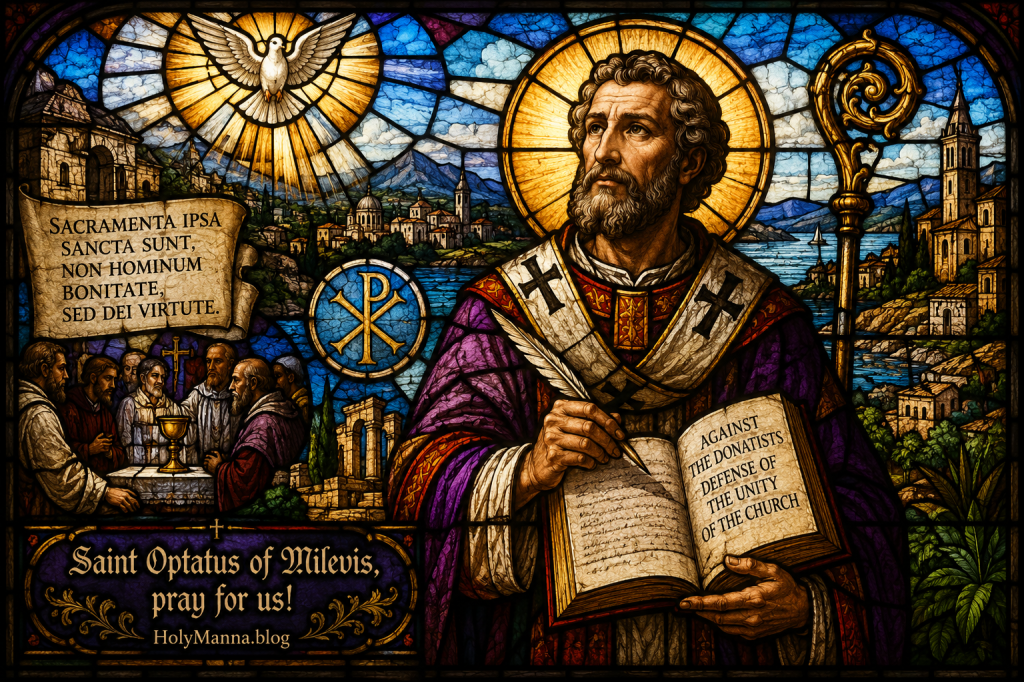
A Voice for Unity in a Divided Church
Saint Optatus of Milevis was a fourth century Catholic bishop in North Africa, in the region of Numidia, in what is now Algeria. He is not one of the best known saints in popular devotion, and his name is not usually the first one that comes to mind when people think of the great defenders of the Church. Yet his witness is incredibly important, especially in a time when many Catholics are tempted by discouragement, distrust, scandal, and division.
Optatus lived during one of the most painful conflicts in early Christianity, the Donatist schism. The Donatists claimed that the Church had to be made up of the spiritually pure, and they argued that sacraments administered by sinful or compromised clergy were invalid. In their eyes, if a bishop or priest had failed under persecution, everything connected to him became spiritually contaminated.
Saint Optatus answered with clarity and courage. The Church is holy because Christ is holy, not because every member of the Church is flawless. The sacraments are holy because Christ acts through them, not because the minister is personally perfect. The true Church is not a small breakaway faction in one region, but the Catholic Church spread throughout the world, united in one faith, one baptism, one Eucharist, and one visible communion.
That is why Saint Optatus matters. He defended the Catholic Church as one, holy, catholic, and apostolic before those words became familiar to many Christians in the Creed. His work helped prepare the way for Saint Augustine’s later defense of the Church against the Donatists. He reminds Catholics today that reform is necessary, repentance is necessary, holiness is necessary, but schism is never the answer.
The Catechism of the Catholic Church teaches that the Church is marked by unity, holiness, catholicity, and apostolicity. It also teaches that divisions among Christians wound the Body of Christ. In that sense, Saint Optatus was not fighting a mere academic argument. He was defending the visible unity of Christ’s Body.
From Milevis to the Front Lines of the Faith
Very little is known about the early life of Saint Optatus. Catholic tradition remembers him as Bishop of Milevis, a city in Numidia, North Africa. Milevis is generally identified with modern Milah in Algeria. This region was once one of the great centers of Christian thought, producing powerful figures such as Saint Cyprian, Saint Augustine, and Saint Fulgentius.
Saint Augustine later described Optatus as a convert, and Catholic sources suggest that he may have been trained as a rhetorician before becoming a bishop. That would make sense. His writing is careful, structured, persuasive, and sharp. He knew how to make an argument, but he was not simply trying to win a debate. He was trying to bring wounded Christians back to the unity of the Church.
His major surviving work is Against the Donatists, also known as De Schismate Donatistarum or Against Parmenian. Parmenian was a Donatist bishop of Carthage and one of the leading voices of the schismatic movement. Saint Jerome tells us that Optatus wrote six books against the Donatists during the reigns of the emperors Valentinian and Valens. The work now survives in seven books, with the seventh likely belonging to a later edition or addition.
Optatus was not remembered because he traveled the world, founded a great religious order, or died as a martyr. He was remembered because, when the Church was being ripped apart from within, he stood firm and said that the Catholic Church could not be reduced to a faction, a grudge, or a purity test.
He was most known for defending Catholic unity, the validity of the sacraments, the universality of the Church, and communion with the Chair of Peter in Rome.
The Schism That Broke North Africa’s Heart
The Donatist controversy began after the Roman persecutions, especially the persecution under Emperor Diocletian. During those terrible years, some Christians were accused of being traditores, meaning those who had handed over sacred books or objects to Roman officials. When the persecution ended, the Church had to face a painful question. What should be done with clergy who had failed under pressure?
The Catholic answer made room for repentance, discipline, and restoration. The Donatist answer hardened into separation. They argued that bishops and priests who had betrayed the faith could not validly administer the sacraments. They rejected Caecilian, the Catholic Bishop of Carthage, because one of the bishops involved in his consecration, Felix of Aptunga, was accused of being a traditor.
From there, the wound deepened. Rival bishops were set up. Catholics and Donatists competed for churches, altars, and communities. The tragedy was not merely that people disagreed. The tragedy was that Christians who shared baptism began to stand against one another at rival altars.
Optatus saw this clearly. For him, schism was not just a theological mistake. It was a wound against love, a wound against communion, and a wound against the Body of Christ.
He used the powerful image of setting up “altar against altar.” In Catholic eyes, that phrase is heartbreaking. The altar is where Christ gives Himself in the Eucharist. To divide the altar is to divide Christian communion at the very place where Christ offers unity.
This is why Optatus’ voice still feels so relevant. He was not naive about sin. He knew there were corrupt, weak, and sinful Christians. But he rejected the idea that personal failure justified tearing apart the Church.
The Sacraments Belong to Christ
One of Saint Optatus’ most important teachings was that the sacraments do not depend on the personal holiness of the priest or bishop who administers them. That may sound obvious to Catholics today, but in the fourth century this was one of the central battles.
The Donatists feared contamination. If a minister was sinful, they believed his sacraments were spiritually defective. Optatus responded by pointing to the deeper truth. The minister is not the owner of the sacrament. Christ is.
His most famous line says it beautifully:
“The sacraments are holy through themselves, not through men.”
That sentence deserves to be remembered. It does not mean priests and bishops can live however they want. It does not excuse sin, cowardice, scandal, or hypocrisy. It means that Christ does not abandon His people because His ministers are weak. The grace of baptism is not made powerless by the sins of the one who baptizes. The Eucharist is not made less holy because the priest is personally imperfect. The sacraments are Christ’s gifts before they are the minister’s actions.
This teaching is deeply connected to what the Church later expresses in The Catechism of the Catholic Church. The Church teaches that the sacraments act ex opere operato, meaning that they are effective because Christ Himself is at work in them. CCC 1128 teaches that “the sacraments act ex opere operato” and that they are efficacious because Christ acts through them.
That is one of the most comforting truths in Catholic life. Catholics do not receive grace because the minister is impressive. Catholics receive grace because Jesus is faithful.
How many wounded Catholics need to hear that again today?
The Catholic Church Is Not a Corner of the World
Saint Optatus also defended the universality of the Church. The Donatists were largely confined to North Africa, yet they claimed to be the true Church. Optatus challenged that claim directly. The Church founded by Christ could not be trapped inside one angry regional movement. The Church is Catholic, which means universal.
One of his most important ideas can be summarized in this line:
“The Catholic Church is the Church which is spread throughout the world.”
This is not merely a geographical statement. It is a theological statement. The Church is not a private club. She is not a local faction. She is not the possession of the morally confident. She is the Bride of Christ, sent to all nations.
That is why Catholicity matters. When Catholics profess belief in one, holy, catholic, and apostolic Church, they are not reciting decorative words. They are confessing that Christ founded a visible Church with a mission for the whole world.
Optatus understood this. The Donatists claimed purity, but they had lost universality. They claimed holiness, but they had wounded unity. They claimed to defend the Church, but they had separated from the Church’s visible communion.
The Catechism teaches that the Church is Catholic because Christ is present in her and because she has been sent by Christ to the whole human race. Saint Optatus was defending that truth long before modern Catholics had theology textbooks to explain it.
The Chair of Peter and the Bond of Communion
One of the most striking parts of Saint Optatus’ teaching is his appeal to the Chair of Peter in Rome. Writing as an African bishop in the fourth century, he pointed to Rome as a sign of visible Catholic unity.
He wrote that:
“Upon Peter first… was bestowed the Episcopal Cathedra.”
For Optatus, the Chair of Peter mattered because unity mattered. The Church was not meant to be a scattering of self-appointed groups, each claiming to be the pure remnant. Christ gave the Church visible communion, apostolic succession, and a real bond of unity.
This is one reason Catholic apologists often love Saint Optatus. He gives early testimony that communion with the Roman See was already seen as a powerful sign of Catholic unity. He even challenged the Donatists by showing that their rival claims could not stand against the worldwide communion united with Rome.
This does not mean Optatus reduced the Church to politics or administration. He understood the Church sacramentally. He understood the altar, baptism, apostolic succession, and communion as living realities. But he also knew that visible unity needs visible bonds.
The Catholic Church still teaches this. The Catechism explains that the Pope, as successor of Peter, is the perpetual and visible source and foundation of the unity of the bishops and of the whole company of the faithful. That is not bureaucracy. That is a gift of Christ to protect His people from becoming scattered sheep.
A Saint Who Corrected Without Forgetting Charity
Saint Optatus was firm, but he was not cruel. One of the most beautiful details about him is that he continued to call the Donatists brothers, even while correcting their schism.
He wrote:
“They therefore are without doubt brothers, though not good brothers.”
That line is both strong and merciful. Optatus did not pretend that schism was harmless. He did not soften the truth to avoid conflict. But he also did not erase the baptismal bond. He wanted the Donatists reconciled, not simply humiliated.
This is a very Catholic instinct. Truth and charity belong together. A Catholic can say, “This is wrong,” without saying, “You are beyond mercy.” A Catholic can defend the Church without hating the person who has wandered from her.
That is a lesson modern Catholics badly need. Today, many people speak about Church conflicts as if everyone must be either an enemy or an ally. Optatus gives a better way. He shows how to defend truth without losing the desire for reunion.
Can Catholics today correct error with courage while still speaking with the heart of a shepherd?
Stories from the Donatist Controversy
Several memorable stories are associated with Saint Optatus because he preserved them in his writings. These should be handled carefully, because many come from a polemical setting. Optatus was arguing against the Donatists, so he was not writing neutral history in the modern sense. Still, these stories became part of the Catholic memory of the controversy.
One famous story involves a wealthy woman named Lucilla. According to Optatus, Lucilla had a habit of kissing a bone of a martyr before receiving the Eucharist. Caecilian, who was then an archdeacon, corrected her for this practice before Communion. Optatus presents her resentment as one of the personal grudges that helped fuel opposition to Caecilian.
This story does not mean Catholics should reject devotion to relics. The Catholic Church has always honored the saints and shown reverence for their relics. The problem in the story is not love for the martyrs. The problem is disorder, pride, and resentment against legitimate correction.
That is a powerful warning. Even holy things can become spiritually dangerous when they are separated from humility and obedience.
Another striking story preserved by Optatus concerns the Eucharist. He reports that some Donatists committed a terrible sacrilege by giving the Eucharist to dogs. According to the story, the dogs became violent and attacked their own masters. This is not a miracle performed by Optatus, and because it comes from a polemical account, it cannot be independently verified. Still, Optatus presents it as a sign of divine judgment against sacrilege.
He also tells of a phial of sacred chrism that was thrown from a window but did not shatter. Optatus attributes this preservation to heavenly protection. This story also cannot be independently verified, but it reveals how deeply he believed in the holiness of the Church’s sacramental life.
These stories show what was at stake for Optatus. This was not just a paperwork dispute between bishops. This was about the altar, the Eucharist, sacred chrism, baptism, communion, and the visible Body of Christ.
The Altar and the Body and Blood of Christ
Saint Optatus also left a beautiful witness to early Catholic reverence for the Eucharist. In condemning attacks on Catholic altars, he asked:
“What is an altar but the seat of the Body and Blood of Christ?”
That line is stunning. It shows that Optatus did not see the altar as a bare symbol or religious furniture. The altar was sacred because it was connected to the Eucharistic sacrifice, the Body and Blood of Jesus Christ.
For Catholics, this is not a small detail. The Eucharist is the source and summit of the Christian life. The altar is where heaven touches earth in the sacrifice of the Mass. To attack the altar was, in Optatus’ eyes, to attack the sacred place where Christ gives Himself to His Church.
That reverence connects directly with The Catechism, which teaches that the Eucharist is “the source and summit of the Christian life” in CCC 1324. Saint Optatus lived centuries before that Catechism paragraph was written, but his faith points in the same direction.
He understood what every Catholic heart should remember. The Church is not held together by opinions, personalities, or programs. She is held together by Christ, especially Christ present in the Eucharist.
Hardship Without Martyrdom
Saint Optatus was not a martyr in the usual sense. There is no reliable tradition that he was executed for the faith. His hardship was different. He lived as a bishop during a bitter internal division that tore apart Christian communities in North Africa.
That kind of suffering is real. It is the suffering of watching Christians fight over the Church while claiming to defend her. It is the suffering of seeing sacraments questioned, altars opposed, and communion broken. It is the suffering of a shepherd who must speak clearly when silence would be easier.
Optatus endured this by writing, teaching, correcting, and defending the Catholic faith. He did not retreat from controversy. He also did not turn the controversy into a personal crusade. His purpose was ecclesial. He wanted unity restored.
His courage was not the courage of the arena. It was the courage of the bishop’s chair, the writing desk, and the Church council. Not every saint sheds blood. Some saints spend their lives keeping others from tearing apart the Body of Christ.
A Legacy Written Into the Church’s Memory
After his death, Saint Optatus’ legacy continued through his writings. He became one of the most important early Catholic voices against schism. Saint Augustine, who would later become the greatest anti-Donatist theologian, held Optatus in high esteem. In many ways, Optatus helped prepare the ground for Augustine’s deeper theological response.
His work is also historically valuable because it preserves details about the early Donatist controversy, including the dispute around Caecilian, the rival consecration of Majorinus, the involvement of Donatus, and the judgments that followed. For Church historians, Optatus is not only a theologian. He is a witness to one of the defining crises of North African Christianity.
There are no widely attested personal miracles after Saint Optatus’ death in the standard Catholic tradition. He is not remembered as a saint of healings, apparitions, or wonderworking relics. His miracle, one might say carefully and spiritually, is the endurance of his teaching. His words still help Catholics understand why the sacraments remain valid, why schism wounds the Church, and why unity with the visible Catholic communion matters.
His feast day is celebrated on June 4. The Roman Martyrology commemorates him at Milevis in Numidia as a bishop known for learning and holiness, especially for his writings against the Donatists and his defense of the universality and unity of the Church.
There does not appear to be a large popular cult, major pilgrimage center, or broad cultural festival attached to Saint Optatus. His impact is more theological than devotional, more ecclesial than cultural. But that does not make him less important. Some saints shape the Church through public miracles. Others shape her by defending the truth when confusion threatens to become normal.
Saint Optatus belongs to that second group.
A Catholic Lesson for an Age of Scandal and Division
Saint Optatus speaks directly to Catholics today. Many faithful people have been hurt by scandal, hypocrisy, weak leadership, and division. Some are tempted to give up on the Church because they have seen too much sin among her members.
Optatus would understand the grief, but he would reject the conclusion.
The Church is not holy because every Catholic is holy. The Church is holy because Christ is holy. The sacraments are not powerful because every priest is saintly. The sacraments are powerful because Christ acts through them. The answer to sin in the Church is repentance, reform, justice, holiness, and fidelity. The answer is not schism.
That is not an easy teaching, but it is a deeply Catholic one.
Saint Optatus also reminds Catholics not to confuse zeal with pride. The Donatists wanted a pure Church, but their pursuit of purity led them away from communion. That danger still exists. A person can begin by wanting holiness and end by despising everyone who fails to meet a personal standard. A person can begin by defending truth and end by losing charity.
The better path is the Catholic path. Stay close to Christ. Stay close to the Eucharist. Stay close to confession. Stay faithful to the Church. Work for reform where reform is needed. Speak the truth when truth must be spoken. But never forget that unity is not weakness. Unity is one of Christ’s gifts.
Where does disappointment with sinful Christians tempt the heart to pull away from the Church Christ founded?
How can the faithful pursue holiness without falling into spiritual pride?
What would change if Catholics remembered that the sacraments are Christ’s gifts before they are the minister’s actions?
Saint Optatus teaches that Catholic unity is worth defending, not because Catholics are perfect, but because Christ is faithful.
Engage with Us!
Share your thoughts and reflections in the comments below. Saint Optatus may not be one of the most famous saints, but his life speaks powerfully to the struggles of the Church today.
- Have you ever been tempted to judge the Church mainly by the failures of her members rather than by the faithfulness of Christ?
- How does Saint Optatus’ teaching on the sacraments help restore trust in Christ’s work through the Church?
- Why do you think unity is so difficult to preserve when people are hurt, angry, or disappointed?
- How can Catholics defend truth clearly while still treating separated or struggling Christians as brothers and sisters?
- What practical step can you take this week to strengthen unity in your parish, your family, or your own heart?
Saint Optatus of Milevis reminds the faithful that the Church belongs to Jesus Christ. Her unity is His gift. Her sacraments are His work. Her altar is the place where He gives Himself. May his example help Catholics remain faithful in times of confusion, courageous in times of division, and merciful in all things. Live the faith with conviction, stay close to the Eucharist, and do everything with the love and mercy Jesus taught us.
Saint Optatus of Milevis, pray for us!
Follow us on YouTube, TikTok, Instagram and Facebook for more insights and reflections on living a faith-filled life.


Leave a Reply