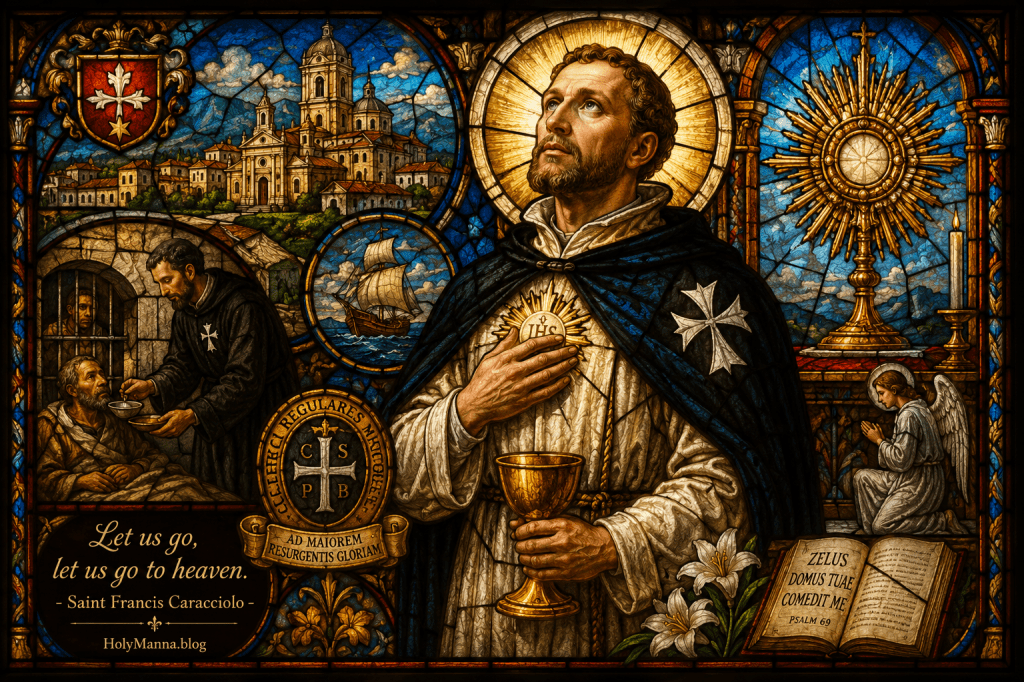
The Nobleman Who Knelt Before the Eucharist
Saint Francis Caracciolo was the kind of saint who quietly wrecks worldly ambition. He was born into nobility, surrounded by comfort, status, and opportunity, yet his life became a witness to something radically different. He chose poverty over privilege, service over honors, and Eucharistic adoration over worldly applause.
Born as Ascanio Caracciolo on October 13, 1563, in Villa Santa Maria near Chieti in Abruzzo, Italy, he would later become a priest, a co-founder of the Clerics Regular Minor, a servant of the poor, a companion to prisoners, and one of the great Eucharistic saints of the Catholic Reform. He is often remembered as “the Saint of the Eucharist,” a title that fits him beautifully because his life seemed to orbit around the Real Presence of Jesus Christ in the Blessed Sacrament.
The Church teaches in The Catechism of the Catholic Church that the Eucharist is “the source and summit of the Christian life” (CCC 1324). Saint Francis Caracciolo lived as if that sentence had been carved into his heart. For him, the Eucharist was not just a doctrine to defend. It was a Person to adore, a mystery to live, and a love that demanded everything.
Born Noble, Drawn to the Hidden Christ
Ascanio Caracciolo was born to Ferrante Caracciolo and Isabella Baratucci, members of a noble Italian family. From the outside, his future looked comfortable and secure. Yet even as a child, Ascanio showed signs that his heart belonged somewhere else.
Catholic tradition remembers him as a boy deeply devoted to the Blessed Sacrament and Our Lady. He wore the Carmelite scapular, prayed the Rosary, fasted on Saturdays in honor of Mary, and often visited churches where Jesus was present in the tabernacle. One beautiful tradition says he loved to pray in neglected churches, as if trying to make up for the lack of love shown to Christ there.
That detail says so much about him. Before he became a founder, before he became a priest, before anyone called him a saint, he was already learning how to love Jesus in hidden places. The world rewards noise, attention, and recognition. Saint Francis Caracciolo learned early that Christ often waits quietly, humbly, and patiently in the tabernacle.
Where does Jesus wait quietly in your life, hoping you will notice Him?
The Illness That Became a Calling
At age twenty-two, Ascanio was struck by a severe and disfiguring illness. Catholic sources describe it in different ways, some calling it a kind of leprosy and others describing it as a severe form of elephantiasis. Whatever the exact medical diagnosis, the suffering was serious enough to change the direction of his entire life.
In that crisis, Ascanio made a vow to God. If he recovered, he would renounce worldly riches and dedicate himself completely to the Lord. He did recover, and Catholic tradition treats this healing as a miraculous or providential cure.
True to his promise, Ascanio left behind wealth, status, and noble ambition. He went to Naples to study for the priesthood.
This moment is important because his conversion was not emotional talk. It became action. He made a promise to God, and then he lived it. The Catechism of the Catholic Church teaches that a vow is “a deliberate and free promise made to God concerning a possible and better good” (CCC 2102). Saint Francis Caracciolo’s vow was not a bargaining chip. It became the doorway into his vocation.
A Priest Among the Condemned and Forgotten
After his ordination, Francis did not look for a comfortable priestly life. He joined the Confraternity of the White Servants of Justice, known as I Bianchi, in Naples. This confraternity served prisoners, especially those condemned to death, and cared for the sick near the Hospital of the Incurables.
That part of his life deserves attention. Saint Francis Caracciolo did not love Jesus in the Eucharist while ignoring Jesus in the suffering. His adoration sent him into prisons, hospitals, and death chambers. He served the sick, assisted the dying, comforted prisoners, and ministered to those whom society had already written off.
He did humble work without needing applause. He helped clean rooms, make beds, mend clothing, and care for the poor. He begged alms for charitable works and gave generously to those in need. He was known as a priest who heard confessions tirelessly, taught children the faith, preached eternal truths, and called sinners back to God.
He earned nicknames that reveal his heart. Catholic tradition remembers him as “the father of the poor,” “the hunter of souls,” and “the man of bronze.” He was tender toward the suffering, relentless in seeking sinners, and strong enough to keep going when holiness became exhausting.
The Mistaken Letter That Was Not a Mistake
One of the most famous stories from Saint Francis Caracciolo’s life begins with a letter delivered to the wrong man.
In 1587, a letter from Giovanni Agostino Adorno was intended for another Caracciolo, Father Fabrizio Caracciolo. The letter concerned the founding of a new religious community of priests. By mistake, it was delivered to Ascanio instead.
Francis could have ignored it. He could have returned it and moved on with his life. Instead, he saw the mistake as a sign of Providence. He joined Adorno and Fabrizio Caracciolo, and together they began forming a new religious institute.
From a worldly point of view, it was an accident. From a Catholic point of view, it looks like the quiet handwriting of God.
The three men withdrew to a hermitage to draft the constitutions of the new order. In 1588, Pope Sixtus V approved the Clerics Regular Minor. The order combined active ministry with contemplative prayer, penance, poverty, Eucharistic adoration, and apostolic service.
Ascanio made his religious profession on April 9, 1589, and took the name Francis in honor of Saint Francis of Assisi. The order’s motto was Ad Maiorem Resurgentis Gloriam, meaning “For the greater glory of the Risen Christ.”
The Fourth Vow and the Freedom of Humility
One of the most striking features of the Clerics Regular Minor was their fourth vow. In addition to poverty, chastity, and obedience, members promised not to seek ecclesiastical honors or dignities.
That vow tells us a great deal about Saint Francis Caracciolo. He knew ambition could sneak into religious life. A man could preach humility while secretly craving titles. A priest could speak of serving Christ while quietly chasing promotion. Francis wanted his order to be protected from that temptation.
Later, when Pope Paul V wanted to make him a bishop, Francis refused. He did not reject service. He rejected honor for honor’s sake. His life preached a hard but necessary message: the Church does not need more ambitious souls. The Church needs more holy ones.
In a world obsessed with influence, platforms, followers, and status, Saint Francis Caracciolo feels surprisingly modern. He reminds us that greatness in the Kingdom of God is not about climbing higher. It is about kneeling lower.
What would change if holiness mattered more to you than recognition?
A Life Burning Before the Blessed Sacrament
Saint Francis Caracciolo’s love for the Eucharist became the center of his life and his order. The Clerics Regular Minor practiced adoration of the Blessed Sacrament by rotation, so that prayer before Jesus in the Eucharist would remain constant. Francis encouraged priests to celebrate Mass daily, promoted Eucharistic worship, and arranged for the Blessed Sacrament to be exposed regularly for adoration.
His favorite scriptural motto was from Psalm 69: “Zeal for your house consumes me.” In Latin, it is remembered as “Zelus domus tuae comedit me.”
That verse became almost a summary of his soul. He had zeal for God’s house. He had zeal for the altar. He had zeal for the Eucharist. He had zeal for souls. He had zeal for the poor and forgotten because he saw them through the eyes of Christ.
A Eucharistic saying attributed to him begins: “Most precious Blood of my Jesus, you are mine.” That short line reveals the intimacy of his devotion. He did not treat the Precious Blood as an abstract theological idea. He loved Jesus personally, reverently, and passionately.
The Catechism of the Catholic Church teaches that in the Eucharist, Christ is present “truly, really, and substantially” (CCC 1374). Saint Francis Caracciolo built his life around that truth. If Jesus is truly present, then adoration makes sense. Silence makes sense. Reverence makes sense. Sacrifice makes sense. Everything changes when the Host is not a symbol, but the living Lord.
Miracles, Healings, and Holy Stories During His Life
The first great miracle associated with Saint Francis Caracciolo is his healing from the severe illness that struck him as a young man. That recovery became the turning point of his vocation and led him to the priesthood.
Catholic tradition also speaks of reported healings connected to his ministry among the sick and imprisoned. These stories should be approached as hagiographical traditions unless tied to specific official miracle decrees, but they fit the pattern of his life. He spent himself among the suffering, and people saw God’s mercy moving through him.
Another traditional story says that during one of his journeys, a ship carrying Francis was nearly wrecked, but the vessel was saved through his prayer. This story is part of Catholic tradition surrounding his life, though it cannot be verified in a modern documentary sense.
He was also remembered for a gift of discernment. Some traditions say he could perceive the condition of souls and even predict certain vocations or apostasies. Whether every detail can be historically verified or not, the Church’s memory of Francis is clear. He was a priest deeply attentive to souls and serious about eternity.
Trials Without Martyrdom
Saint Francis Caracciolo was not a martyr in the sense of shedding his blood for the faith, but his life was marked by hardship. He endured serious illness, exhausting travel, opposition, fragile foundations for the new order, and the constant demands of priestly ministry.
His missions in Spain were difficult. Early efforts met obstacles, and he faced illness and disappointment. He also had to carry the burden of leadership after the death of Giovanni Agostino Adorno. Although Francis did not seek authority, he became Superior General of the order in 1593 out of obedience.
His hardship was not dramatic in the way martyr stories often are. It was the steady hardship of a man who kept saying yes. He fasted. He prayed through the night. He traveled. He served the sick. He heard confessions. He founded communities. He refused honors. He carried responsibility without letting responsibility become pride.
That kind of holiness is easy to overlook because it is not flashy. But it is deeply Catholic. Perseverance is a form of martyrdom when a soul dies daily to self-love.
His Final Journey to Heaven
In his final years, Francis’ body was worn down by austerity, labor, travel, and prayer. He made one last journey with his brother, Father Antonio, who was a Theatine priest. They traveled to Loreto, Villa Santa Maria, and Agnone in connection with a request for a new religious house.
At Agnone, Francis became ill. On June 4, 1608, he died. Catholic tradition remembers his final words as “Let us go, let us go to heaven.”
There is something beautiful about the timing of his death. He died on the eve of Corpus Christi, the great feast of the Body and Blood of Christ. The saint who had spent his life adoring Jesus in the Eucharist passed from this world near the feast that celebrates the mystery he loved most.
Miracles and Impact After Death
After his death, Catholic tradition preserved several remarkable stories connected to his body and relics. One of the most famous says that when his body was prepared for transport to Naples, a red and fragrant fluid flowed like blood, and his vital organs were found incorrupt. Another tradition says that around his heart were found the words from Psalm 69: “Zeal for your house consumes me.”
This story is treasured in the tradition of his order and in Catholic hagiography, though it cannot be verified in a modern scientific sense. Still, it beautifully expresses what the Church already saw in his life. His heart belonged to the house of God.
His relics were eventually venerated in Naples, especially in the church known as Monteverginella. He was beatified by Pope Clement XIV and canonized by Pope Pius VII in 1807. His feast day is celebrated on June 4.
Saint Francis Caracciolo also has a surprising cultural legacy. He is honored as a patron of Italian chefs, especially connected to his birthplace, Villa Santa Maria, a town known for culinary tradition. There, an annual celebration associated with chefs is held around his birthday in October, blending faith, food, procession, civic celebration, and devotion.
That patronage is not as random as it might seem. Francis loved the Eucharist, the Bread of Life. He fed the poor. He served the sick. He saw care for the body and care for the soul as works of Christian charity. In that sense, every honest meal prepared with love can become a small act of service. A kitchen can become a place of generosity. A table can become a place of mercy.
What Saint Francis Caracciolo Teaches Us Today
Saint Francis Caracciolo teaches that holiness begins when a person stops asking, “How high can I rise?” and starts asking, “How low can I kneel before Christ?”
He was born with status, but he chose humility. He had access to comfort, but he chose sacrifice. He was offered honor, but he refused ambition. He loved the Eucharist, but that love did not make him detached from suffering people. It made him more available to them.
That is a lesson every Catholic needs. True devotion to the Eucharist should make the heart more reverent, more humble, more generous, and more willing to serve. If adoration does not slowly teach us to love the poor, forgive sinners, visit the lonely, and care for the suffering, then we have not yet understood the One we adore.
Saint Francis also reminds us that God can use interruptions, illnesses, mistakes, and unwanted responsibilities. A sickness became his turning point. A misdelivered letter became his path to founding an order. A life that could have been spent in noble comfort became a gift to the Church.
What if the thing you see as an interruption is actually God opening a door?
The Catholic life is not about chasing comfort or applause. It is about belonging completely to Christ. Saint Francis Caracciolo shows us what happens when a soul lets the Eucharist become the center of everything.
Engage With Us!
Share your thoughts and reflections in the comments below. Saint Francis Caracciolo’s life gives us a lot to think about, especially in a world where ambition, recognition, and comfort can quietly become idols.
- Where is God inviting you to choose humility over status?
- How can you make more room for Eucharistic adoration, reverence at Mass, or quiet prayer before the tabernacle?
- Who are the forgotten people in your life that Christ may be asking you to serve?
- Have you ever experienced a “mistake” or interruption that later seemed like Providence?
- What would it look like to do ordinary work, even cooking, cleaning, serving, or caring for others, with the love of Christ?
May Saint Francis Caracciolo teach us to kneel before Jesus in the Eucharist, serve the poor with tenderness, reject empty ambition, and live every ordinary duty with the love and mercy Jesus taught us.
Saint Francis Caracciolo, pray for us!
Follow us on YouTube, TikTok, Instagram and Facebook for more insights and reflections on living a faith-filled life.


Leave a Reply