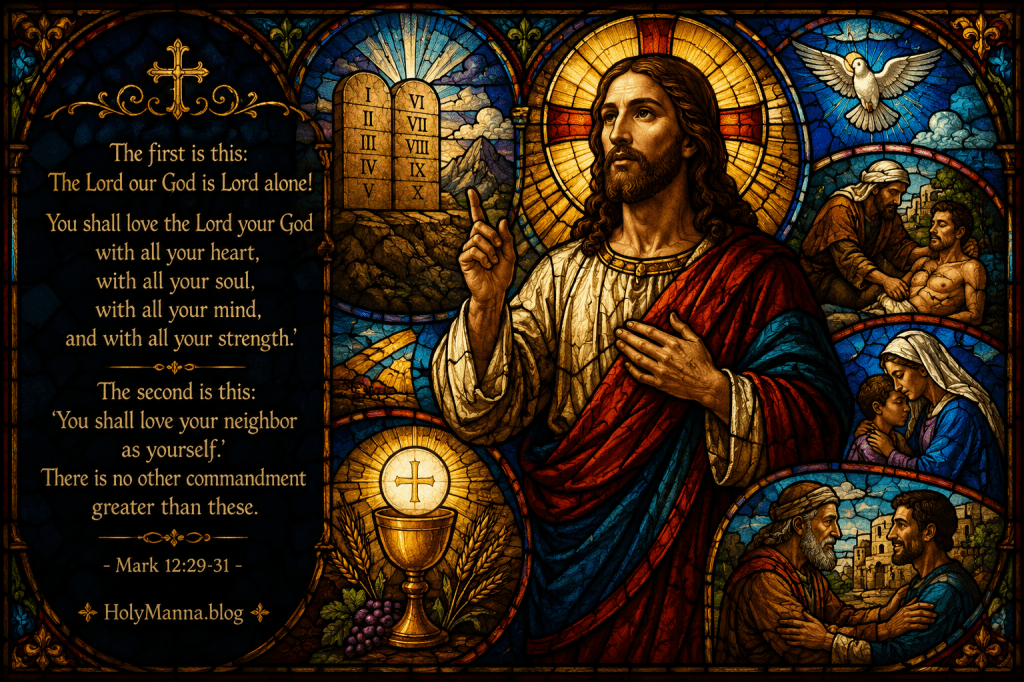
Thursday of the Ninth Week in Ordinary Time – Lectionary: 356
When Love Becomes the Shape of Faith
Some days, the readings at Mass feel like a gentle hand on the shoulder, quietly turning the soul back toward what matters most.
Today’s readings bring the Christian life back to its living center: faithful love. In 2 Timothy 2:8-15, Saint Paul writes from chains, yet he refuses to speak as a defeated man because “the word of God is not chained.” In Psalm 25:4-5, 8-10, 14, the psalmist prays with the humility of someone who knows that holiness begins by being taught: “Make known to me your ways, Lord; teach me your paths.” Then, in Mark 12:28-34, Jesus gathers the whole life of faith into the two great commandments: “You shall love the Lord your God with all your heart, with all your soul, with all your mind, and with all your strength” and “You shall love your neighbor as yourself.”
The historical background matters here. Paul is handing on the apostolic faith while suffering for the Gospel, reminding Timothy that Christianity is not preserved by clever arguments or worldly power, but by fidelity to the risen Christ. The psalm gives voice to Israel’s ancient wisdom, where the humble heart seeks the Lord’s covenant path of mercy and truth. The Gospel places Jesus in the Temple, where religious leaders debated the Law and its commandments. Into that setting, Christ does not dismiss the Law. He reveals its heart.
The central theme is simple, but demanding: true faith is love that remains faithful under pressure, humble before God, and generous toward neighbor. This is why The Catechism teaches that charity is the virtue by which Catholics love God above all things and love their neighbor for the love of God, as taught in CCC 1822. Today’s readings are not asking for a faith of empty words, religious noise, or outward sacrifice without conversion. They call for a faith that remembers Christ, learns His ways, speaks truth without deviation, and loves with the whole heart.
What would change today if love of God and love of neighbor became the measure of every thought, word, and decision?
First Reading – 2 Timothy 2:8-15
Faithful Love When the Gospel Costs Something
Saint Paul writes this passage from the shadow of suffering. This is not the voice of a comfortable teacher offering abstract advice from a safe distance. This is an apostle near the end of his life, imprisoned for preaching Christ, speaking to Timothy, his spiritual son and fellow worker in the Gospel. Paul knows that the Church will face persecution from the outside and confusion from the inside. He also knows that Timothy will need courage, humility, and discipline if he is going to shepherd souls faithfully.
This reading fits beautifully into today’s central theme: true faith is love that remains faithful under pressure, humble before God, and generous toward neighbor. Paul is chained, but the Gospel is not. He suffers, but his suffering is not wasted. He warns against useless disputes, but he does not tell Timothy to avoid truth. He calls him to handle “the word of truth without deviation.”
In a world where Christians are often tempted either to stay silent out of fear or to argue endlessly without charity, Paul gives a better path. Remember Jesus Christ. Endure for the salvation of others. Speak truth clearly. Avoid empty religious noise. Become a worker who belongs to God.
2 Timothy 2:8-15 – New American Bible (Revised Edition)
8 Remember Jesus Christ, raised from the dead, a descendant of David: such is my gospel, 9 for which I am suffering, even to the point of chains, like a criminal. But the word of God is not chained. 10 Therefore, I bear with everything for the sake of those who are chosen, so that they too may obtain the salvation that is in Christ Jesus, together with eternal glory. 11 This saying is trustworthy:
If we have died with him
we shall also live with him;
12 if we persevere
we shall also reign with him.
But if we deny him
he will deny us.
13 If we are unfaithful
he remains faithful,
for he cannot deny himself.Warning Against Useless Disputes. 14 Remind people of these things and charge them before God to stop disputing about words. This serves no useful purpose since it harms those who listen. 15 Be eager to present yourself as acceptable to God, a workman who causes no disgrace, imparting the word of truth without deviation.
Detailed Exegesis
Verse 8 – “Remember Jesus Christ, raised from the dead, a descendant of David: such is my gospel.”
Paul begins with memory, because Christian courage begins by remembering who Jesus is. He does not simply say, “Remember the teachings of Jesus,” or “Remember the example of Jesus.” He says to remember “Jesus Christ, raised from the dead, a descendant of David.” This is the Gospel in miniature.
Jesus is “raised from the dead,” which means death has been conquered. Paul is in chains, but Christ is risen. Paul may be treated like a criminal, but the Lord he serves has already passed through death into glory. This is why Paul can suffer without despair.
Jesus is also “a descendant of David,” which means He is the promised Messiah. God has kept His covenant promises to Israel. The Gospel is not a spiritual trend or an inspiring philosophy. It is the fulfillment of salvation history. In Jesus, the promises made to David find their true King.
This verse also reminds Catholics that faith is rooted in real events. Christianity is not built on vague spirituality. It is built on the Incarnation, Passion, death, and Resurrection of Jesus Christ. The risen Lord is not an idea. He is a Person.
Verse 9 – “For which I am suffering, even to the point of chains, like a criminal. But the word of God is not chained.”
Paul’s preaching has cost him his freedom. He is treated “like a criminal,” even though his only crime is fidelity to Christ. This is one of the great paradoxes of Christian history. The saints often look defeated in the eyes of the world at the very moment they are most powerfully united to Christ.
Then Paul gives one of the most powerful lines in the New Testament: “But the word of God is not chained.”
Rome can chain Paul’s wrists. It cannot chain the Gospel. It can lock a preacher in prison. It cannot lock Christ in the tomb. The same pattern appears throughout the history of the Church. Persecution often tries to silence the faith, but instead the witness of the suffering faithful becomes a seedbed for conversion.
This verse also speaks directly to ordinary Catholic life. A person may feel limited by circumstances, illness, family stress, workplace pressure, or fear of rejection. Yet the Word of God can still work through a faithful soul. Grace is not dependent on perfect conditions.
Verse 10 – “Therefore, I bear with everything for the sake of those who are chosen, so that they too may obtain the salvation that is in Christ Jesus, together with eternal glory.”
Paul does not suffer because he enjoys hardship. He suffers for love. He endures “for the sake of those who are chosen,” meaning for the salvation of souls. His trials become an offering. His pain becomes apostolic. His chains become part of his mission.
This is deeply Catholic. Suffering, united to Christ, can become redemptive. It does not replace the one sacrifice of Jesus, but it can be joined to it. Paul is not merely surviving prison. He is offering his endurance so that others may receive “the salvation that is in Christ Jesus.”
This also shows the heart of evangelization. The goal is not winning debates. The goal is salvation. Paul wants others to reach eternal glory. That desire gives meaning to his sacrifices.
Verse 11 – “This saying is trustworthy: If we have died with him we shall also live with him.”
Paul now quotes what appears to be an early Christian hymn or saying. The first line is baptismal. In Baptism, the Christian dies with Christ and rises with Him. The old life of sin is buried, and a new life of grace begins.
This verse points to a central truth of Catholic discipleship. Christianity is not self-improvement with religious language. It is death and resurrection. The disciple must die to sin, pride, selfishness, and fear in order to live in Christ.
This also connects with today’s Gospel, where Jesus commands love of God with the whole heart, soul, mind, and strength. Total love requires death to divided love. A heart cannot fully belong to God while clinging tightly to sin.
Verse 12 – “If we persevere we shall also reign with him. But if we deny him he will deny us.”
Paul moves from Baptism to perseverance. Beginning the Christian life matters, but remaining faithful matters too. The promise is glorious: “If we persevere we shall also reign with him.” The Christian who shares Christ’s suffering will also share His glory.
But the warning is serious: “If we deny him he will deny us.” Paul is not being harsh for the sake of fear. He is telling the truth. Love must remain faithful. A person cannot knowingly reject Christ and still claim the reward of communion with Him.
This verse challenges a casual view of discipleship. The Catholic life is not occasional religious interest. It is covenant fidelity. It requires perseverance, especially when faith becomes inconvenient, unpopular, or costly.
Verse 13 – “If we are unfaithful he remains faithful, for he cannot deny himself.”
This verse is both comforting and sobering. Christ remains faithful because faithfulness is not just something He does. It is who He is. He cannot deny Himself.
For the repentant sinner, this is hope. Human weakness does not exhaust the mercy of God. When a person falls and returns with contrition, Christ is faithful. He does not abandon the soul that comes back to Him.
At the same time, this verse does not excuse deliberate rebellion. Christ’s faithfulness means He remains true to His promises, His mercy, His justice, and His own divine holiness. He will not become false in order to flatter human sin.
This is why Catholic teaching always holds mercy and truth together. God is infinitely merciful, but His mercy heals by drawing us back to the truth.
Verse 14 – “Remind people of these things and charge them before God to stop disputing about words. This serves no useful purpose since it harms those who listen.”
Paul now turns from the hymn of perseverance to a pastoral warning. Timothy must remind the faithful of the core truths: Christ is risen, suffering can be endured for salvation, perseverance leads to glory, and denial of Christ has consequences.
Then Paul warns against “disputing about words.” He is not rejecting doctrine. Paul cares deeply about doctrine. The problem is useless controversy, religious argument that produces pride rather than holiness.
This warning feels especially timely. It is possible to know Catholic vocabulary and still lack charity. It is possible to argue about holy things in a way that harms the people listening. Paul says this kind of disputing “serves no useful purpose.” Even worse, it damages souls.
The Church needs faithful teaching, not performative arguing. Truth must be defended, but never as entertainment for the ego.
Verse 15 – “Be eager to present yourself as acceptable to God, a workman who causes no disgrace, imparting the word of truth without deviation.”
Paul closes this section with a call to holy discipline. Timothy must become a worker who stands before God, not merely before public opinion. His goal is not applause. His goal is to be “acceptable to God.”
The phrase “a workman who causes no disgrace” suggests careful, faithful labor. Teaching the faith is sacred work. It requires humility, study, prayer, moral integrity, and obedience to apostolic truth.
Then Paul gives the essential standard: “imparting the word of truth without deviation.” This is a beautiful Catholic balance. Timothy must avoid useless disputes, but he must not distort the truth. Charity does not mean confusion. Gentleness does not mean compromise. Pastoral care does not mean changing the Gospel.
The Church’s mission is to hand on what she has received. Every generation must receive the Word faithfully and pass it on without twisting it.
Teachings
Paul’s words show the heart of apostolic witness. The Christian remembers Christ, suffers with Christ, speaks truth in Christ, and endures for the salvation of others. This is why the passage speaks so powerfully to the Catholic understanding of witness, perseverance, martyrdom, and the responsible handling of divine truth.
The Catechism of the Catholic Church teaches that faith must be lived and professed, not hidden away when it becomes costly. In CCC 1816, the Church teaches: “The disciple of Christ must not only keep the faith and live on it, but also profess it, confidently bear witness to it, and spread it: ‘All however must be prepared to confess Christ before men and to follow him along the way of the Cross, amidst the persecutions which the Church never lacks.’ Service of and witness to the faith are necessary for salvation: ‘So every one who acknowledges me before men, I also will acknowledge before my Father who is in heaven; but whoever denies me before men, I also will deny before my Father who is in heaven.’”
That teaching sounds almost like a commentary on Paul’s prison cell. Paul does not keep the faith privately. He professes it. He bears witness to it. He spreads it. He follows Christ along the way of the Cross, even when that road includes chains.
The Church also teaches that martyrdom is the supreme witness to the truth of faith. In CCC 2473, the Church says: “Martyrdom is the supreme witness given to the truth of the faith: it means bearing witness even unto death. The martyr bears witness to Christ who died and rose, to whom he is united by charity. He bears witness to the truth of the faith and of Christian doctrine. He endures death through an act of fortitude.”
Paul’s suffering points toward this reality. Whether or not every Christian is called to physical martyrdom, every Christian is called to the spirit of martyrdom, which means faithful witness when love of Christ costs something.
Saint John Chrysostom, reflecting on Paul’s chains, saw that the apostle’s imprisonment did not weaken the Gospel. It revealed its power. The world thought it had reduced Paul to silence, but his letters from prison continued to teach the Church for centuries. That is the strange victory of Christian witness. When suffering is united to Christ, it becomes fruitful beyond what the sufferer can see.
This reading also connects to the Catholic duty to preserve the truth without distortion. In CCC 84, the Church teaches: “The apostles entrusted the ‘Sacred deposit’ of the faith, the depositum fidei, contained in Sacred Scripture and Tradition, to the whole of the Church.” Paul’s command to impart “the word of truth without deviation” is part of that apostolic responsibility. The faith is not personal property. It is a sacred deposit.
At the same time, Paul’s warning against useless disputes reminds Catholics that truth must be served with charity. In CCC 1822, the Church teaches: “Charity is the theological virtue by which we love God above all things for his own sake, and our neighbor as ourselves for the love of God.” This is the bridge between today’s First Reading and today’s Gospel. Paul suffers for the salvation of others because charity has made him free. He does not use truth to glorify himself. He serves truth because he loves Christ and loves souls.
This is the apostolic pattern. Hold fast to Christ. Preserve the Word without deviation. Avoid useless arguments. Endure suffering for love. Seek the salvation of others.
Reflection
This reading is a wake-up call for Catholics who want a comfortable faith. Paul reminds the Church that the Gospel is worth suffering for because Jesus Christ is risen from the dead. If Christ is risen, then no chain gets the final word. No prison gets the final word. No hostile culture gets the final word. No failure, fear, or humiliation gets the final word.
The Word of God is not chained.
That truth should give courage to every Catholic trying to live faithfully in ordinary life. Parents trying to raise children in the faith are not wasting their effort. Young adults trying to remain pure in a confused culture are not alone. Catholics who speak truth with charity at work, in family conversations, or among friends are not foolish. Those who endure sickness, loneliness, misunderstanding, or hidden sacrifices can unite it all to Christ for the salvation of souls.
Paul also challenges the way Catholics speak. He warns against disputes that harm listeners. This matters because truth can be handled badly. A person can defend Catholic teaching in a way that sounds more like pride than love. A person can win an argument and still fail to witness to Christ.
So the reading asks for a serious examination of the heart.
Is faith being lived as witness, or hidden when it becomes inconvenient?
Are sacrifices being offered for the salvation of others, or merely resented as interruptions?
Does conversation about the faith lead people closer to Christ, or does it become another way to argue, perform, and prove a point?
Is the word of truth being handed on without deviation, or softened whenever it feels uncomfortable?
A practical way to live this reading is to begin the day with Paul’s first command: remember Jesus Christ. Before checking the phone, remember Christ risen from the dead. Before entering a difficult conversation, remember Christ faithful and victorious. Before complaining about suffering, ask whether it can be offered for someone’s salvation. Before speaking about the faith, ask whether the words are true, necessary, and charitable.
Paul’s chains became a pulpit because he belonged completely to Christ. The same can happen in ordinary Catholic life. The hidden sacrifice, the patient conversation, the quiet act of courage, the refusal to distort the truth, and the willingness to love difficult people can all become places where the Word of God runs free.
The world can pressure Christians. It can mock them. It can misunderstand them. It can try to silence them.
But it cannot chain the Word of God in a faithful soul.
Responsorial Psalm – Psalm 25:4-5, 8-10, 14
The Humble Heart Learns the Road Home
After hearing Saint Paul proclaim that “the word of God is not chained,” the Church places on our lips a prayer for guidance. Psalm 25 is the voice of a soul that knows it cannot find the way home by pride, cleverness, or self-reliance. It is a prayer of trust, repentance, and teachability.
Traditionally associated with David, Psalm 25 belongs to the world of Israel’s covenant faith. It uses the language of paths, instruction, mercy, truth, humility, and reverence. These are not abstract religious ideas. In the biblical imagination, life with God is a road. The faithful person walks in the Lord’s ways. The sinner needs to be shown the way back. The humble are teachable because they no longer pretend to be their own savior.
This psalm fits today’s theme beautifully. Paul calls Timothy to handle “the word of truth without deviation.” Jesus will reveal the greatest commandment as total love of God and true love of neighbor. Between them, the psalm teaches the posture needed to receive both: humility. Before a person can speak truth faithfully or love God completely, that person must first pray, “Make known to me your ways, Lord; teach me your paths.”
Psalm 25:4-5, 8-10, 14 – New American Bible (Revised Edition)
4 Make known to me your ways, Lord;
teach me your paths.
5 Guide me by your fidelity and teach me,
for you are God my savior,
for you I wait all the day long.8 Good and upright is the Lord,
therefore he shows sinners the way,
9 He guides the humble in righteousness,
and teaches the humble his way.
10 All the paths of the Lord are mercy and truth
toward those who honor his covenant and decrees.14 The counsel of the Lord belongs to those who fear him;
and his covenant instructs them.
Detailed Exegesis
Verse 4 – “Make known to me your ways, Lord; teach me your paths.”
The psalm begins with surrender. The speaker is not asking God merely to bless a plan already made. He is asking God to reveal the road. In Scripture, the “ways” and “paths” of the Lord refer to the pattern of life that conforms the human heart to God’s covenant.
This is important because many people want God’s comfort without God’s instruction. The psalmist wants both. He wants to be taught. That is the beginning of wisdom.
For Catholics, this verse is a beautiful reminder that discipleship is not self-direction with religious decoration. The Christian life is learned from God through Scripture, Sacred Tradition, the teaching authority of the Church, the Sacraments, and daily obedience to grace. The soul becomes holy not by inventing its own path, but by walking the path God reveals.
Verse 5 – “Guide me by your fidelity and teach me, for you are God my savior, for you I wait all the day long.”
The psalmist does not ask to be guided by emotion, convenience, popularity, or personal preference. He asks to be guided by God’s fidelity. That word matters. God is faithful to His covenant, faithful to His promises, faithful to His mercy, and faithful to His truth.
The phrase “for you are God my savior” gives the prayer its foundation. The psalmist trusts God because God saves. This is not vague spirituality. It is personal reliance on the Lord.
The final line, “for you I wait all the day long,” reveals patient faith. Waiting on the Lord is not passive laziness. It is active trust. It means refusing to run ahead of God, refusing to panic when answers are slow, and refusing to replace God’s timing with anxious control.
In today’s larger theme, this verse teaches that faithful love must learn to wait. Paul waits in chains with hope. The psalmist waits for guidance. The scribe in the Gospel listens before he speaks. The person who truly loves God learns to trust His timing.
Verse 8 – “Good and upright is the Lord, therefore he shows sinners the way.”
This verse reveals the heart of God. Because the Lord is good and upright, He does not abandon sinners in confusion. He shows them the way.
That is a deeply consoling truth. God’s holiness is not cold distance. His goodness moves toward the lost. His uprightness does not mean He ignores sin, but it does mean He guides sinners toward conversion.
This verse also protects Catholics from despair. A person may have wandered, fallen, compromised, or delayed repentance, but the Lord still shows sinners the way. The road back begins when the sinner stops hiding and becomes teachable.
The Church’s sacramental life reflects this truth beautifully. In Confession, God does not merely expose sin. He forgives, heals, and redirects the soul toward the path of grace.
Verse 9 – “He guides the humble in righteousness, and teaches the humble his way.”
Humility appears twice in this verse because humility is essential to spiritual growth. God guides the humble because the humble can be guided. The proud may hear religious words, but they do not receive instruction. They are too busy defending themselves.
Biblical humility is not self-hatred. It is truth. The humble person knows he is not God. He knows he needs mercy. He knows he can be wrong. He knows holiness must be received before it can be lived.
This verse also connects strongly with today’s Gospel. The scribe who approaches Jesus is not far from the Kingdom because he listens well. He recognizes truth when he hears it. He does not come only to trap Jesus like others had done. He asks, receives, and responds with understanding.
The humble are taught the Lord’s way because the humble still know how to kneel.
Verse 10 – “All the paths of the Lord are mercy and truth toward those who honor his covenant and decrees.”
This verse brings together two realities that should never be separated: mercy and truth. The Lord’s paths are not mercy without truth, and they are not truth without mercy. They are both.
This is profoundly Catholic. Mercy without truth becomes permission to remain lost. Truth without mercy becomes a weapon instead of a healing light. In God, mercy and truth are perfectly united. He tells the truth because He loves. He shows mercy because He is good.
The phrase “those who honor his covenant and decrees” reminds readers that biblical faith is covenantal. God’s mercy is not opposed to obedience. His love invites His people into faithful relationship. To honor His covenant is to live as people who belong to Him.
This verse prepares the soul for Jesus’ answer in the Gospel. Love of God and love of neighbor are not sentimental slogans. They are covenant faithfulness lived in mercy and truth.
Verse 14 – “The counsel of the Lord belongs to those who fear him; and his covenant instructs them.”
The “fear of the Lord” is not terror of God. It is reverence, awe, worship, and holy seriousness before the One who is Lord. It is the opposite of casual pride.
The psalm says that the Lord’s counsel belongs to those who fear Him. This means that reverence opens the soul to wisdom. A person who treats God lightly will not understand His covenant deeply. A person who honors the Lord becomes capable of receiving His instruction.
This verse also completes the movement of the psalm. The soul asks to be taught, waits for the Savior, trusts God’s goodness, accepts humility, walks in mercy and truth, and receives covenant counsel through holy fear.
The road home is not hidden from the humble. God teaches those who reverence Him.
Teachings
Psalm 25 gives the Church a school of prayer. It teaches the soul how to stand before God without pretending, bargaining, or performing. The psalmist is needy, but not hopeless. He is humble, but not crushed. He is waiting, but not abandoned. He is a sinner, but he knows the Lord “shows sinners the way.”
The Catechism of the Catholic Church teaches that humility is the foundation of prayer. In CCC 2559, the Church says: “Prayer is the raising of one’s mind and heart to God or the requesting of good things from God. But when we pray, do we speak from the height of our pride and will, or ‘out of the depths’ of a humble and contrite heart? He who humbles himself will be exalted; humility is the foundation of prayer. Only when we humbly acknowledge that ‘we do not know how to pray as we ought,’ are we ready to receive freely the gift of prayer. ‘Man is a beggar before God.’”
That teaching is almost a doorway into Psalm 25. The psalmist comes before God as a beggar for guidance. He does not claim to already know the way. He asks to be taught. This is why the prayer is so powerful. It is honest.
The Catechism also teaches that the Psalms form the prayer of God’s people. In CCC 2587, the Church teaches: “The Psalter is the book in which the Word of God becomes man’s prayer.” That is exactly what happens at Mass. The Church receives the inspired Word and prays it back to God. In this responsorial psalm, every Catholic is invited to make David’s prayer their own: “Make known to me your ways, Lord; teach me your paths.”
Saint Augustine often read the psalms as the voice of Christ and the voice of the Church. In this way, the psalm is not merely an ancient poem. It becomes the prayer of the whole Body of Christ. The sinner praying for guidance is never praying alone. The Church prays with him. Christ, the Head of the Body, leads His members along the way of mercy and truth.
This also connects to the virtue of prudence, because the psalm asks for guidance in the concrete path of life. In CCC 1806, the Church teaches: “Prudence is the virtue that disposes practical reason to discern our true good in every circumstance and to choose the right means of achieving it; ‘the prudent man looks where he is going.’” Psalm 25 is a prayer for holy prudence. It asks God not only for good intentions, but for the grace to choose the right path.
Historically, Israel understood life with God as covenantal. The Lord had rescued His people, given them the Law, and called them to walk in His ways. The psalm’s language of covenant, decrees, mercy, and truth belongs to that sacred relationship. For Catholics, that covenant reaches its fulfillment in Christ, who is the Way, the Truth, and the Life. The Lord who teaches His paths in Psalm 25 is the same Lord who will reveal in Mark 12 that every path of holiness leads through love of God and love of neighbor.
Reflection
This psalm is a prayer for anyone who has ever felt spiritually turned around. It is for the person who wants to follow God but feels pulled in too many directions. It is for the Catholic who knows the right words but still struggles to choose the right road. It is for the sinner who wonders whether God still wants to teach him the way home.
The answer is yes.
“Good and upright is the Lord, therefore he shows sinners the way.”
God does not abandon the humble sinner. He teaches. He guides. He corrects. He waits. He leads the soul through mercy and truth.
The challenge is whether the soul is willing to be taught. Pride says, “The problem is everyone else.” Humility says, “Make known to me your ways, Lord.” Pride rushes ahead. Humility waits all the day long. Pride wants mercy without change. Humility receives mercy and walks in truth.
A simple way to live this psalm is to pray verse 4 slowly at the beginning of the day: “Make known to me your ways, Lord; teach me your paths.” Then actually watch for the Lord’s instruction. He may teach through Scripture, through the quiet conviction of conscience, through the Sacrament of Confession, through the counsel of the Church, through a difficult person, or through a moment that exposes impatience, pride, or fear.
The psalm also invites Catholics to recover the holy fear of the Lord. Modern life trains people to treat everything casually, including God. But reverence changes how a person listens. A reverent soul does not approach God as a consultant. A reverent soul approaches Him as Lord.
Where is the Lord asking for humility instead of control?
Is there a decision today that needs to be guided by mercy and truth rather than emotion and impulse?
When was the last time prayer began not with telling God what should happen, but by asking Him to teach the way?
The beautiful promise of Psalm 25 is that God does not hide His path from the humble. He shows sinners the way. He guides those who reverence Him. He teaches the soul that waits.
The Christian life is not walked by pride. It is walked by grace, one faithful step at a time.
Holy Gospel – Mark 12:28-34
The Commandment That Holds Everything Together
The scene in Mark 12:28-34 takes place in Jerusalem, close to the Passion of Christ. Jesus has been questioned by religious leaders, challenged in public, and surrounded by debates about authority, resurrection, law, and worship. Into this tense atmosphere comes a scribe who has been listening carefully. Unlike others who approach Jesus with traps, this man seems to come with a sincere question: “Which is the first of all the commandments?”
For a faithful Jew, this was not a casual question. The Law shaped the whole life of Israel. It governed worship, family, justice, purity, sacrifice, and covenant identity. Teachers of the Law often discussed which commandments were “greatest” or most central, not because the rest did not matter, but because they wanted to understand the heart that gave meaning to everything else.
Jesus answers by reaching back into Israel’s daily prayer, the Shema from Deuteronomy 6:4-5: “Hear, O Israel! The Lord our God is Lord alone!” Then He joins it to Leviticus 19:18: “You shall love your neighbor as yourself.” In doing this, Jesus does not abolish the Law. He reveals its center.
This Gospel gathers together the whole theme of today’s readings. Saint Paul reminds Timothy that the Gospel cannot be chained and must be handed on “without deviation.” The psalmist prays to be taught the Lord’s paths. Now Jesus shows where every path leads: total love of God and concrete love of neighbor. True faith is not empty argument, religious performance, or sacrifice without conversion. True faith is love that worships God with the whole person and then becomes mercy, patience, truth, and service toward the neighbor.
Mark 12:28-34 – New American Bible (Revised Edition)
28 One of the scribes, when he came forward and heard them disputing and saw how well he had answered them, asked him, “Which is the first of all the commandments?” 29 Jesus replied, “The first is this: ‘Hear, O Israel! The Lord our God is Lord alone! 30 You shall love the Lord your God with all your heart, with all your soul, with all your mind, and with all your strength.’ 31 The second is this: ‘You shall love your neighbor as yourself.’ There is no other commandment greater than these.” 32 The scribe said to him, “Well said, teacher. You are right in saying, ‘He is One and there is no other than he.’ 33 And ‘to love him with all your heart, with all your understanding, with all your strength, and to love your neighbor as yourself’ is worth more than all burnt offerings and sacrifices.” 34 And when Jesus saw that [he] answered with understanding, he said to him, “You are not far from the kingdom of God.” And no one dared to ask him any more questions.
Detailed Exegesis
Verse 28 – “One of the scribes, when he came forward and heard them disputing and saw how well he had answered them, asked him, ‘Which is the first of all the commandments?’”
The scribe is trained in the Law. He knows Scripture, tradition, and the religious debates of his time. He has heard Jesus answer wisely, and he recognizes something different in Him. This is important because not everyone in the Gospel listens to Jesus with an open heart. Some question Him to trap Him. This scribe asks because he sees wisdom.
His question is also spiritual. He wants to know what stands first. What commandment gives shape to everything else? What is the heart of the covenant?
This connects with Psalm 25, where the soul prays, “Make known to me your ways, Lord; teach me your paths.” The scribe may not fully understand who Jesus is yet, but he is close enough to ask the right question. A teachable heart is already moving toward the Kingdom.
Verse 29 – “Jesus replied, ‘The first is this: “Hear, O Israel! The Lord our God is Lord alone!”’”
Jesus begins not with action, but with worship. Before He commands love, He proclaims who God is. The Lord is one. The Lord alone is God. Everything in the moral life begins here.
This line comes from the Shema, the great confession of Israel’s faith. Faithful Jews prayed it daily. It was a declaration of covenant identity, a reminder that Israel belonged to the one true God in the midst of a world filled with idols.
For Catholics, this verse is foundational. The Christian life does not begin with personal preference, spiritual taste, or moral self-improvement. It begins with the Lordship of God. If God is Lord alone, then no created thing can take His place. Not money. Not pleasure. Not politics. Not reputation. Not comfort. Not self.
Jesus is teaching that love must be rooted in truth. The command to love God only makes sense because God alone is worthy of total love.
Verse 30 – “‘You shall love the Lord your God with all your heart, with all your soul, with all your mind, and with all your strength.’”
This is total love. Jesus does not ask for a small corner of the religious life. He asks for the whole person.
The heart means the center of desire, affection, loyalty, and decision. The soul means the whole life before God. The mind means thought, understanding, belief, imagination, and reason. The strength means energy, action, body, labor, and daily effort.
Nothing is left outside the commandment.
This matters because many people try to love God in fragments. They may give Him Sunday morning, but not Monday habits. They may give Him feelings, but not decisions. They may give Him beliefs, but not relationships. They may give Him prayers, but not priorities.
Jesus calls for an undivided heart. This is not because God is needy. It is because the human person was made for communion with Him. To love God with everything is to become properly ordered, healed, and free.
Verse 31 – “‘The second is this: “You shall love your neighbor as yourself.” There is no other commandment greater than these.’”
Jesus immediately joins love of God to love of neighbor. The two commandments are distinct, but inseparable. A person cannot truly love God while despising the people made in His image. A person also cannot reduce religion to generic kindness while ignoring worship, truth, repentance, and obedience to God.
This second commandment comes from Leviticus 19:18, where Israel is taught not to take vengeance or bear hatred against one’s neighbor. Jesus reveals that this command is not secondary in the sense of being optional. It is second because it flows from the first.
Love of neighbor is not sentimental approval of everything a person does. Catholic charity desires the true good of the other. Sometimes that means patience. Sometimes it means forgiveness. Sometimes it means correction. Sometimes it means practical help. Always, it means seeing the other person under the gaze of God.
Jesus ends with, “There is no other commandment greater than these.” The whole moral life is gathered here. Every commandment protects and expresses love.
Verse 32 – “The scribe said to him, ‘Well said, teacher. You are right in saying, “He is One and there is no other than he.”’”
The scribe recognizes the truth of Jesus’ answer. He affirms the unity of God, echoing the heart of Israel’s faith. This is a beautiful moment because the conversation is not hostile. It becomes a moment of shared reverence before divine truth.
The scribe calls Jesus “teacher,” and he acknowledges that Jesus has answered rightly. He is not yet making a full confession of Jesus as Lord, but he is responding to the light he has received. This matters spiritually. Grace often begins by helping a person recognize truth before he fully understands where that truth will lead.
In a world full of noise, the scribe shows the importance of honest listening. He does not argue for the sake of arguing. He receives wisdom when it is spoken.
Verse 33 – “‘And “to love him with all your heart, with all your understanding, with all your strength, and to love your neighbor as yourself” is worth more than all burnt offerings and sacrifices.’”
The scribe now goes even deeper. He understands that love is greater than external sacrifice when sacrifice is separated from the heart. In the Temple world of first-century Judaism, burnt offerings and sacrifices were central acts of worship. They were commanded by God and formed part of Israel’s covenant life.
The scribe is not rejecting sacrifice itself. He is recognizing what the prophets had taught again and again: worship without love, obedience, mercy, and conversion becomes hollow.
This prepares Catholics to understand worship rightly. The Mass is the true sacrifice of Christ made present sacramentally. It is not empty ritual. It is the source and summit of the Christian life. Yet the person who attends Mass must allow that sacrifice to transform the heart. Worship must become charity. Communion with Christ must become love for the members of Christ.
This verse is a needed examination of conscience. Religious practice is essential, but it must never become a substitute for conversion. The person who kneels before God at Mass must also learn to forgive, serve, speak truth, protect the vulnerable, honor family, and love the difficult neighbor.
Verse 34 – “And when Jesus saw that he answered with understanding, he said to him, ‘You are not far from the kingdom of God.’ And no one dared to ask him any more questions.”
Jesus sees that the scribe has answered “with understanding.” That detail matters. The scribe is not merely repeating words. He sees something true about the heart of the Law.
Then Jesus says, “You are not far from the kingdom of God.” This is both encouraging and challenging. The scribe is close. He understands that love of God and love of neighbor are greater than sacrifice without conversion. He is near the Kingdom because he has recognized the truth.
But Jesus does not say, “You are in the kingdom.” He says, “You are not far.” Understanding is not the same as surrender. Admiring the truth is not the same as following Christ. Being close to Jesus is not the same as becoming His disciple.
The final line, “And no one dared to ask him any more questions,” shows the authority of Christ. He has answered with such wisdom that debate falls silent. The Law has been brought to its living center, and no one can improve upon the answer.
Teachings
This Gospel stands at the heart of Catholic moral and spiritual life. Jesus reveals that all commandments are ordered toward love: love of God above all things and love of neighbor for God’s sake. This is not a reduction of the faith into vague niceness. It is the deepest structure of holiness.
The Catechism of the Catholic Church teaches this directly in CCC 1822: “Charity is the theological virtue by which we love God above all things for his own sake, and our neighbor as ourselves for the love of God.”
That single sentence beautifully summarizes today’s Gospel. Charity begins with God. Catholics love Him above all things, not merely because He gives blessings, but because He is God. Then, because God loves the neighbor, Catholics are commanded to love the neighbor for His sake.
The Catechism also teaches in CCC 2055: “When someone asks him, ‘Which commandment in the Law is the greatest?’ Jesus replies: ‘You shall love the Lord your God with all your heart, and with all your soul, and with all your mind. This is the greatest and first commandment. And a second is like it: You shall love your neighbor as yourself. On these two commandments hang all the Law and the prophets.’ The Decalogue must be interpreted in light of this twofold yet single commandment of love, the fullness of the Law.”
This is why the Ten Commandments are not cold rules. They are the structure of covenant love. The first commandments protect right worship and love of God. The remaining commandments protect love of neighbor by honoring family, life, marriage, property, truth, and purity of heart. The commandments do not compete with love. They teach love how to become faithful.
In CCC 2083, the Church teaches: “Jesus summed up man’s duties toward God in this saying: ‘You shall love the Lord your God with all your heart, and with all your soul and with all your mind.’ This immediately echoes the solemn call: ‘Hear, O Israel: the LORD our God is one LORD.’ God has loved us first. The love of the One God is recalled in the first of the ‘ten words.’ The commandments then make explicit the response of love that man is called to give to his God.”
This teaching is essential. God’s command to love is first rooted in God’s love for us. The Catholic life is a response. Before the soul loves God, God has already loved the soul into existence, redeemed it through Christ, and called it into communion.
The saints understood this well. Saint Augustine famously taught that love is the force that carries the soul. In Confessions 13.9, he writes: “My weight is my love; by it I am carried wherever I am carried.” That line helps explain why Jesus places love at the center. A person goes where his love carries him. If love is disordered, life becomes disordered. If love is purified by grace, life begins to move toward God.
Saint Thomas Aquinas, drawing from Scripture and the tradition of the Church, teaches that charity is the form of the virtues because it directs every virtuous act toward God. In Catholic language, this means that even good actions reach their full Christian meaning when animated by love of God. External sacrifice, religious knowledge, and moral discipline are good, but without charity they do not reach their proper end.
Historically, this Gospel also speaks into the life of worship. The scribe’s statement that love is worth more than burnt offerings would have carried enormous weight in the Temple setting. Jesus stands in Jerusalem, where sacrifices are offered daily, and confirms that worship must be joined to love. For Catholics, this does not diminish sacrificial worship. It deepens it. The Eucharist is the perfect sacrifice of Christ, and those who receive Him are called to become living witnesses of His charity.
This is why today’s Gospel is not merely a moral lesson. It is a Eucharistic lesson. At Mass, love of God and love of neighbor meet in the sacrifice of Christ. The Catholic receives the One who loved the Father perfectly and gave Himself completely for sinners.
Reflection
This Gospel brings every Catholic back to the question that cannot be avoided: what is really loved most?
Not what is admired. Not what is posted. Not what is claimed in conversation. What is loved most?
Jesus says to love God with all the heart, soul, mind, and strength. That means faith cannot stay in a Sunday compartment. God wants the calendar, the attention span, the imagination, the habits, the relationships, the spending, the screen time, the private thoughts, the public witness, and the hidden wounds.
He wants the whole person because He loves the whole person.
This is demanding, but it is not crushing. God does not command total love because He wants to take life away. He commands total love because only total love can make the human heart whole. Divided love exhausts the soul. Disordered love enslaves the soul. Holy love frees the soul.
Then Jesus turns the soul outward: “You shall love your neighbor as yourself.” This is where the Gospel becomes practical. The neighbor is not only the person who is easy to like. The neighbor may be the family member who drains patience, the coworker who gets under the skin, the stranger who needs help, the elderly person who feels forgotten, the unborn child who needs protection, the poor who need dignity, or the person who needs truth spoken with gentleness.
Love of neighbor begins close to home. It sounds spiritual to speak of loving humanity. It is harder to answer the text, forgive the sibling, visit the lonely, stop gossiping, listen without checking the phone, or serve without needing credit.
A simple way to live this Gospel is to examine the day through the four words Jesus gives: heart, soul, mind, and strength. The heart can be offered by choosing God over resentment. The soul can be offered through prayer and Confession. The mind can be offered by filling it with truth instead of noise. The strength can be offered through concrete service.
Then the second commandment can become one real act: forgive one person, encourage one person, help one person, tell the truth kindly to one person, or pray for one person who is difficult to love.
Does God truly have the whole heart, or only the parts that feel easy to surrender?
Is love of neighbor concrete, or does it stay safely in theory?
Are Catholic practices forming deeper charity, or have they become external habits without interior conversion?
What would change today if every decision were measured by love of God and love of neighbor?
Jesus tells the scribe, “You are not far from the kingdom of God.” That line should stir both hope and urgency. To understand the truth is a grace. To admire the truth is a beginning. But the invitation is to enter the Kingdom, not stand near it.
The door is love.
Love God completely. Love the neighbor concretely. Let every commandment, sacrifice, prayer, and act of worship lead there.
The Road of Love That Leads to the Kingdom
Today’s readings bring the soul back to the simple, demanding heart of Catholic discipleship. Saint Paul stands in chains and still proclaims that “the word of God is not chained.” The psalmist kneels in humility and prays, “Make known to me your ways, Lord; teach me your paths.” Then Jesus gathers the whole life of faith into the command that holds everything together: “You shall love the Lord your God with all your heart, with all your soul, with all your mind, and with all your strength” and “You shall love your neighbor as yourself.”
The message is clear. Faith is not meant to remain trapped in words, arguments, appearances, or private intentions. Faith becomes real when it remembers Christ under pressure, seeks the Lord’s path with humility, speaks truth without deviation, and loves the neighbor with concrete charity.
This is why The Catechism teaches in CCC 1822: “Charity is the theological virtue by which we love God above all things for his own sake, and our neighbor as ourselves for the love of God.” That is the shape of the Christian life. Love begins in God, is purified by God, and then moves outward toward the people God places nearby.
So today, the invitation is not complicated, but it is serious. Remember Jesus Christ. Ask the Lord to teach His paths. Refuse the useless disputes that harden the heart. Speak the truth with love. Offer suffering for the good of souls. Love God with the whole person, not only with the convenient parts. Love the neighbor not as an idea, but as a person who needs patience, mercy, honesty, and help.
The scribe in the Gospel was “not far from the kingdom of God.” That line still reaches into the heart today. It is possible to be close to the Kingdom, to admire the truth, to understand the commandment, and still hesitate at the doorway.
Christ invites more than nearness. He invites surrender.
What would change today if love of God and love of neighbor became the measure of every choice?
The Word of God cannot be chained in a soul that belongs to Christ. Let the Lord teach the way. Let charity shape the day. Let love become the road that leads home.
Engage with Us!
Share your reflections in the comments below. Today’s readings invite a real examination of the heart, not just of what is believed, but of how that faith is lived when life gets difficult, when guidance is needed, and when love becomes demanding.
- In the First Reading from 2 Timothy 2:8-15, Saint Paul says, “the word of God is not chained.” Where in your life do you need to trust that Christ can still work, even through suffering, limitations, or difficult circumstances?
- In Psalm 25:4-5, 8-10, 14, the psalmist prays, “Make known to me your ways, Lord; teach me your paths.” What area of your life needs more humility, guidance, and willingness to be taught by God?
- In the Holy Gospel from Mark 12:28-34, Jesus says the greatest commandment is to love God with all the heart, soul, mind, and strength, and to love the neighbor as oneself. What would change today if every choice were measured by love of God and love of neighbor?
- Jesus tells the scribe, “You are not far from the kingdom of God.” Is there an area where you may be close to surrender, but still holding something back from Christ?
May these readings inspire a deeper, steadier, and more generous faith. Let the Word of God remain unchained in daily life. Let humility teach the way forward. Let every prayer, sacrifice, conversation, and act of service be done with the love and mercy Jesus taught us.
Sacred Heart of Jesus, we trust in You!
Immaculate Heart of Mary, pray for us!
Saint Michael the Archangel, defend us in battle!
Follow us on YouTube, TikTok, Instagram and Facebook for more insights and reflections on living a faith-filled life.

 Holy Manna!
Leave a comment