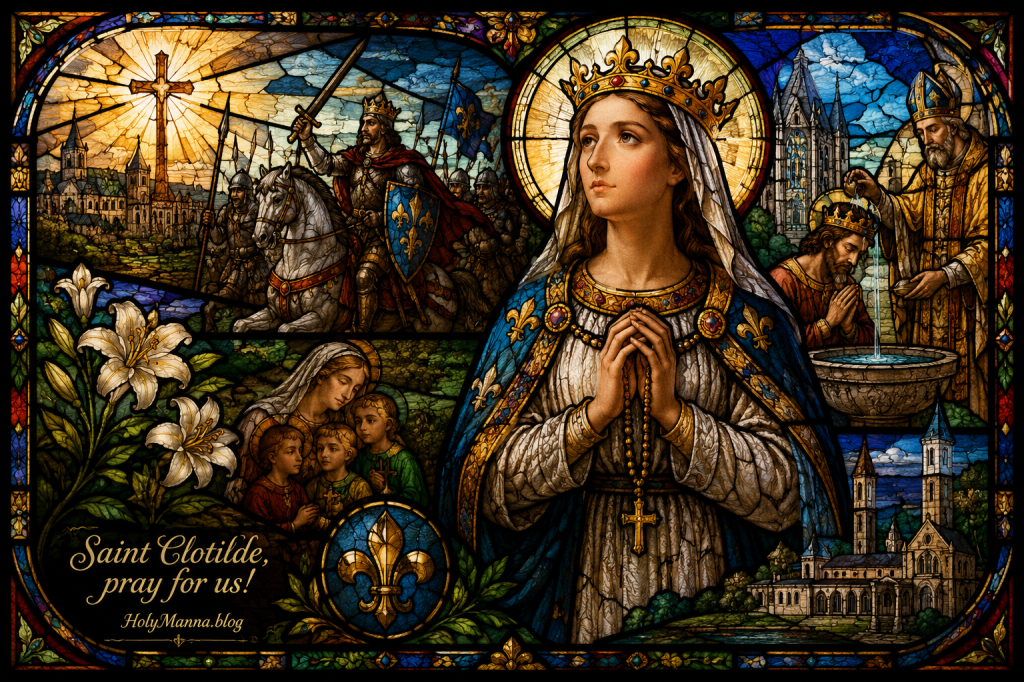
The Queen Whose Prayers Helped Baptize a Nation
Saint Clotilde, Queen of the Franks, is one of those saints whose life reminds Catholics that quiet fidelity can change history. She did not preach from a pulpit. She did not write a famous theological work. She did not lead an army into battle. She was a wife, a mother, a queen, a widow, and a woman of deep Catholic faith who prayed with extraordinary perseverance.
She is most remembered as the Catholic queen whose prayers and influence helped bring her husband, King Clovis I, into the Catholic faith. That conversion was not only personal. It helped lead the Frankish people into Catholic Christianity, shaping the future of France and Western Europe for centuries.
The Roman Martyrology remembers her as the queen “by whose prayers her husband, king Clovis, was converted to the faith of Christ.” That one sentence captures her mission beautifully. Saint Clotilde shows us that God often begins great works in hidden places, inside marriages, families, grief, patience, and prayer.
Her story is not a fairy tale. It includes political violence, religious division, the death of a child, conflict among her sons, the murder of grandchildren, and years of widowhood. Yet through it all, she remained faithful. She lived what the Catechism of the Catholic Church teaches about intercession, that Christian prayer is not only for oneself, but also for others. In CCC 2635, the Church teaches that intercession is “a prayer of petition which leads us to pray as Jesus did.” Saint Clotilde prayed this way, especially for the conversion of the man she loved and the healing of a broken family.
Born Into Burgundy’s Broken Crown
Saint Clotilde was born around the year 474 or 475, probably near Lyons, into the royal family of Burgundy. Her father was Chilperic, a Burgundian king, and her mother was Caretena, remembered in Catholic tradition as a devout Christian woman. Clotilde grew up in a world where royal blood did not guarantee safety, peace, or holiness.
The Burgundian kingdom was divided among royal relatives, and the family was marked by political rivalry. Some members of the royal house were Catholic, while others were Arians. That distinction mattered deeply. Arianism denied the full divinity of Christ, while the Catholic faith confesses that Jesus Christ is true God and true man. The Catechism teaches in CCC 464 that “the Son of God assumed a human nature in order to accomplish our salvation in it.” The faith Clotilde received was not vague spirituality. It was the Catholic faith in Jesus Christ, the eternal Son of God made flesh.
A famous story says that Clotilde’s uncle Gondebad murdered her father and drowned her mother with a stone tied around her neck. This dramatic version appears in early and medieval traditions, but Catholic historians treat parts of it carefully because some details cannot be fully verified. What can be said with confidence is that Clotilde grew up in a violent royal world, surrounded by conflict, ambition, and religious tension.
That context makes her holiness even more striking. She was not formed in comfort. She was formed in a world where power could destroy families. Yet she held tightly to the Catholic faith she received, and that faith would become the defining force of her life.
A Catholic Bride in a Pagan Court
Around 492 or 493, Clotilde married Clovis I, king of the Franks. Clovis was a powerful ruler, but he was still a pagan. Clotilde entered marriage with a man who did not share her faith, and she entered a royal court where her Catholic convictions were not yet the foundation of public life.
This was not an easy marriage from a spiritual perspective. Clotilde loved her husband, but she also wanted him to know the true God. She did not water down the faith to make it more convenient. She did not treat religion as a private hobby. She patiently encouraged Clovis to abandon idols and worship the living God.
St. Gregory of Tours, one of the major early sources for her story, presents Clotilde as speaking boldly to Clovis about the emptiness of pagan worship. He attributes to her the words, “The gods you worship are nothing.” This should not be treated as a verified word-for-word quotation in the modern sense, but it does preserve the Catholic memory of her courage. She wanted Clovis to know the Creator of heaven and earth.
Her life speaks powerfully to what the Catechism teaches about marriages marked by religious difference. In CCC 1634, the Church teaches that in such marriages, “sincere married love, the humble and patient practice of the family virtues, and perseverance in prayer” can prepare the way for the grace of conversion. Saint Clotilde lived exactly that. She did not nag Clovis into faith. She witnessed. She prayed. She suffered. She waited for grace.
A Mother Who Chose Baptism Through Tears
One of the most moving parts of Saint Clotilde’s life involves her children. Clovis allowed their first son, Ingomir, to be baptized. Tragically, the child died soon afterward while still very young. Clovis interpreted the death through pagan eyes and blamed Clotilde’s God. He believed the child might have lived if he had been dedicated to the old gods instead.
For a mother, this must have been devastating. Clotilde had wanted her child to belong to Christ. Instead of comfort, she received blame. Yet she did not abandon her faith.
St. Gregory of Tours places on her lips the words, “I give thanks to the omnipotent God.” Again, this is best understood as an ancient sacred history preserving her spiritual witness rather than a verified transcript. But the meaning is clear. Clotilde believed that her baptized child belonged to God.
This moment reveals her Catholic heart. The Catechism teaches in CCC 1213 that “Holy Baptism is the basis of the whole Christian life.” Clotilde understood that her children needed more than royal inheritance. They needed Christ. They needed the grace of Baptism. They needed eternal life.
Their second son, Clodomir, was also baptized. When he became seriously ill, Clovis feared the same thing would happen again. But according to St. Gregory of Tours, the child recovered through the prayers of his mother and the mercy of God. This recovery is one of the earliest miracle-like events associated with Saint Clotilde’s prayer.
Saint Clotilde’s motherhood was not sentimental. It was sacrificial. She loved her children enough to place them in God’s hands, even when that choice brought misunderstanding and suffering.
The Battle Prayer That Led a King to Baptism
The most famous event in Saint Clotilde’s life is the conversion of Clovis. According to Catholic tradition, Clovis was fighting the Alamanni when the battle began to turn against him. In desperation, he cried out to Jesus Christ, the God whom Clotilde had proclaimed to him. He promised that if Christ gave him victory, he would believe and be baptized.
The battle turned. Clovis won. Afterward, he told Clotilde what had happened. She rejoiced, not because her husband had merely won a military victory, but because grace had opened a door in his soul.
Clotilde then arranged for St. Remigius, the bishop of Reims, to instruct Clovis in the faith. Clovis was baptized, traditionally on Christmas Day in 496, though historians discuss the exact year. St. Gregory of Tours says that more than three thousand of his warriors were baptized with him.
At the baptism, St. Remigius is remembered for saying to Clovis, “Worship what you burned; burn what you worshipped.” That sentence captures the drama of conversion. Clovis was not simply adding Jesus to his old life. He was being called to renounce idolatry and begin again in Christ.
This is why Saint Clotilde is so important. Her prayers helped bring about one of the most significant conversions in early medieval Catholic history. Through Clovis, the Franks entered Catholic Christianity rather than Arian Christianity. That choice shaped the religious identity of France and influenced the future of Catholic Europe.
Still, it is important to remember that Clotilde did not convert Clovis by her own power. God converted him. Clotilde cooperated with grace. She planted seeds, watered them with prayer, and trusted God with the harvest.
The Queen Who Carried Family Sorrows
After Clovis became Catholic, life did not suddenly become easy or peaceful. This is one of the most honest parts of Saint Clotilde’s story. Conversion is real, but human weakness does not disappear overnight. The royal family remained complicated, ambitious, and wounded by sin.
Clotilde and Clovis had several children: Ingomir, who died young; Clodomir; Childebert; Clotaire; and a daughter also named Clotilde. Clovis also had a son, Theodoric, from an earlier union. When Clovis died in 511, his kingdom was divided among his sons. That division brought rivalry and violence.
Clotilde helped arrange for Clovis to be buried in the Church of the Holy Apostles in Paris, a church that she and Clovis had built and that later became associated with Saint Geneviève. After his death, she eventually withdrew more and more from court life.
Her son Clodomir later died in war against the Burgundians. Clotilde then cared for his three young sons, Theodoald, Gunther, and Clodoald. But her surviving sons, Childebert and Clotaire, wanted power and inheritance. In a horrifying act of dynastic cruelty, they murdered the two older boys. The youngest, Clodoald, escaped and entered religious life. He is remembered as Saint Cloud.
This tragedy must have pierced Clotilde’s heart. She had prayed for the conversion of a king and watched a nation move toward Catholic faith, yet her own family was still torn apart by greed and violence. Her daughter Clotilde also suffered in marriage to Amalaric, the Visigothic king, who mistreated her. She died after hardship while being brought back toward her family.
Saint Clotilde’s life reminds Catholics that holiness does not mean having a perfect family. It means remaining faithful inside an imperfect one. It means refusing to let grief turn into bitterness. It means continuing to pray when people we love make terrible choices.
What does Saint Clotilde’s suffering teach us about trusting God when family wounds do not heal quickly?
Legends of a Queen: The Ring, the Revenge, and the Lilies
Several legends grew around Saint Clotilde’s life. These stories are part of her cultural memory, but they should be told carefully.
One famous legend says that Clovis first heard of Clotilde’s beauty and virtue and sent a trusted man named Aurelian disguised as a beggar to meet her secretly. In the story, Aurelian gave her a ring from Clovis, and the marriage was arranged after that. This story is memorable and romantic, but it cannot be fully verified. It belongs to the legendary tradition surrounding her marriage.
Another legend claims that Clotilde urged her sons to wage war against Burgundy in order to avenge the murder of her parents. Catholic historians have been very cautious about this story and often reject it as unfair to her memory. It does not fit the stronger Catholic image of Clotilde as a woman of prayer, patience, and peace. If the violent stories about her parents are themselves uncertain in detail, then the revenge story becomes even more questionable.
There is also later French lore connecting Clotilde, Clovis, and the fleur-de-lis. The lily became a powerful symbol of Catholic France, purity, royalty, and divine favor. Some traditions link the symbol to the conversion of Clovis and the birth of Catholic France. This is a beautiful cultural association, but it should be treated as later legend rather than verified history from Clotilde’s own lifetime.
These legends show how deeply Saint Clotilde shaped the Catholic imagination of France. Still, her real life is more powerful than legend. She does not need embellishment. A praying wife, a grieving mother, and a faithful widow who helped change a nation is already a remarkable story.
A Widow at the Tomb of Saint Martin
After the murder of her grandsons, Clotilde withdrew to Tours, near the tomb of Saint Martin of Tours. This was not simply retirement. It was a spiritual turning point. She had been a queen in the world, but now she lived more like a religious woman.
At Tours, she devoted herself to prayer, penance, almsgiving, fasting, and works of charity. Catholic tradition remembers her as a widow who turned away from the glamour of court life and placed herself near one of the great saints of Gaul. She rarely returned to Paris and spent her remaining years preparing her soul for God.
This part of her life is especially beautiful because it reveals the depth of her conversion. She could have clung to status. She could have spent her widowhood trying to control royal politics. Instead, she chose prayer. She chose the poor. She chose the tomb of a saint over the noise of power.
The Catechism teaches in CCC 2447 that the works of mercy are charitable actions by which Christians come to the aid of their neighbors in bodily and spiritual needs. Saint Clotilde lived this in a royal way, but also in a deeply personal way. Her charity was not public relations. It was the fruit of a heart being purified by suffering.
Miracles, Healing, and the Memory She Left Behind
Several miracle stories are associated with Saint Clotilde, both during her life and after her death.
During her lifetime, the recovery of her son Clodomir after baptism is one of the most important miracle-like stories connected to her prayer. St. Gregory of Tours presents the child’s recovery as an answer to his mother’s intercession.
Another powerful story involves her sons Childebert and Clotaire. When they were heading toward violent conflict with each other, Clotilde is said to have spent the night in prayer at the tomb of Saint Martin. She begged God not to allow another fratricidal disaster in the family of Clovis. According to the tradition, a violent storm suddenly arose and scattered the armies before they could fight. This miracle story shows Clotilde as a mother still praying for peace, even after her family had caused her so much pain.
There is also a tradition that Clotilde was warned thirty days before her death while praying at the tomb of Saint Martin. She prepared herself spiritually, called her sons to her, urged them to honor God, keep His commandments, protect the poor, rule with fatherly care, remain united, and seek peace. She received the sacraments, made a profession of faith, and died on June 3, 545.
One of the most beloved local traditions connected with her is the fountain of Saint Clotilde at Les Andelys in Normandy. According to the story, Clotilde founded an abbey there for young noble women. While workers labored in the heat, they became thirsty. Clotilde prayed, and the water of a nearby fountain took on the strength and taste of wine. The fountain later became associated with healing, especially for those with illnesses and infirmities. Another local story says that a paralyzed man recovered the use of his limbs after bathing in the fountain. These stories belong to local devotional tradition and cannot be fully verified, but they show how generations of Catholics remembered Saint Clotilde as a motherly intercessor.
Her memory also lives on in churches, pilgrimages, and Catholic culture. The Basilica of Sainte-Clotilde in Paris bears her name and stands as a visible reminder of her importance in French Catholic history. Les Andelys preserves devotion to her through the tradition of the fountain and the memory of the religious foundation associated with her. In sacred art, she is often shown as a crowned queen, a woman holding a church, a praying widow, or a figure connected with the baptism of Clovis.
Saint Clotilde died in Tours and was buried in Paris near Clovis. Her veneration grew early, and the Church honors her as a saint whose prayers helped bring a king and a people to Christ.
The Catholic Legacy of a Hidden Intercessor
Saint Clotilde is most known for helping bring King Clovis into the Catholic faith. But her deeper legacy is even richer than that. She shows what happens when faith becomes steady, patient, and courageous inside ordinary human suffering.
She was a Catholic wife in a spiritually divided marriage. She was a mother who buried a child. She was a grandmother who endured unspeakable family tragedy. She was a queen who did not let power become her god. She was a widow who chose prayer, charity, and penance over comfort and prestige.
Her life also reminds Catholics that evangelization often begins at home. Not every Catholic is called to convert a kingdom, but every Catholic is called to witness faithfully in the place God has put them. That may be a marriage, a family, a workplace, a classroom, a parish, or a friendship. Saint Clotilde teaches that patient prayer can reach places arguments cannot.
The Catechism teaches in CCC 905 that lay people fulfill their prophetic mission by evangelization, “that is, the proclamation of Christ by word and the testimony of life.” Saint Clotilde did both. She spoke the truth, and she lived it.
When Faith Has to Wait
There is something very modern about Saint Clotilde’s story. Many Catholics today know what it is like to love someone who does not share the faith. Many know the pain of praying for a spouse, child, sibling, parent, or friend who seems far from God. Many know what it is like to wonder whether their prayers are doing anything.
Saint Clotilde says, through her life, keep praying.
She does not promise instant results. She does not offer a clean, easy path. Her own life had heartbreak after Clovis’ baptism. Yet she shows that no prayer offered in faith is wasted. God may work slowly. God may work invisibly. God may work through suffering. But God works.
Her witness also warns against despair when families remain messy. The conversion of Clovis did not make his descendants saints overnight. Grace is real, but human freedom is real too. Saint Clotilde remained faithful without pretending everything was fine. That is a deeply Catholic kind of hope.
Who in your life needs your patient prayer more than your frustration?
Becoming Faithful Where God Has Placed You
Saint Clotilde’s life invites Catholics to rediscover the power of hidden holiness. She did not need to control every outcome. She needed to be faithful. She could not force Clovis into the baptismal font. She could witness to Christ. She could pray. She could ask the Church to instruct him. She could remain steady when he resisted.
That lesson matters today. A Catholic home does not become holy because everyone is perfect. It becomes holy when someone keeps turning toward Christ. A marriage does not become sacred because it is easy. It becomes sacred when love is purified by sacrifice, patience, truth, and mercy. A family does not become healed because pain never enters it. It becomes open to healing when someone refuses to stop praying.
Saint Clotilde also teaches Catholics to bring grief to God instead of letting grief become bitterness. She suffered the death of a child, the violence of sons, the murder of grandchildren, and the sorrow of a daughter mistreated in marriage. Still, she spent her last years near Saint Martin’s tomb, praying and serving the poor. She allowed suffering to detach her from worldly power and deepen her longing for heaven.
There is a simple way to imitate her. Pray daily for the conversion and holiness of your family. Speak the truth without cruelty. Practice patience without cowardice. Choose Baptismal identity over worldly approval. Give to the poor. Stay close to the sacraments. When family wounds hurt, bring them to Christ instead of carrying them alone.
Saint Clotilde reminds us that the Cross can stand even in a palace. She also reminds us that grace can flow from that Cross into an entire nation.
Engage With Us!
Share your thoughts and reflections in the comments below. Saint Clotilde’s life gives us so much to think about, especially when it comes to marriage, family, prayer, grief, and perseverance in faith.
- Who is someone in your life that you are being called to pray for with more patience and trust?
- How does Saint Clotilde’s witness challenge the way you think about evangelizing family members or loved ones?
- Have you ever seen God work slowly through prayer, even when it seemed like nothing was changing?
- What part of Saint Clotilde’s life speaks most deeply to your own family wounds or hopes?
- How can you practice quiet faithfulness this week in your home, workplace, parish, or friendships?
Saint Clotilde teaches us that one faithful Catholic soul can make a difference far beyond what the world can see. Her life encourages us to pray with patience, love our families with courage, serve the poor with humility, and trust that God can bring grace into even the most complicated situations.
May her example help us live with steady faith, merciful hearts, and the kind of love that points others to Jesus Christ. And may everything we do be done with the love and mercy Jesus taught us.
Saint Clotilde, pray for us!
Follow us on YouTube, TikTok, Instagram and Facebook for more insights and reflections on living a faith-filled life.


Leave a Reply