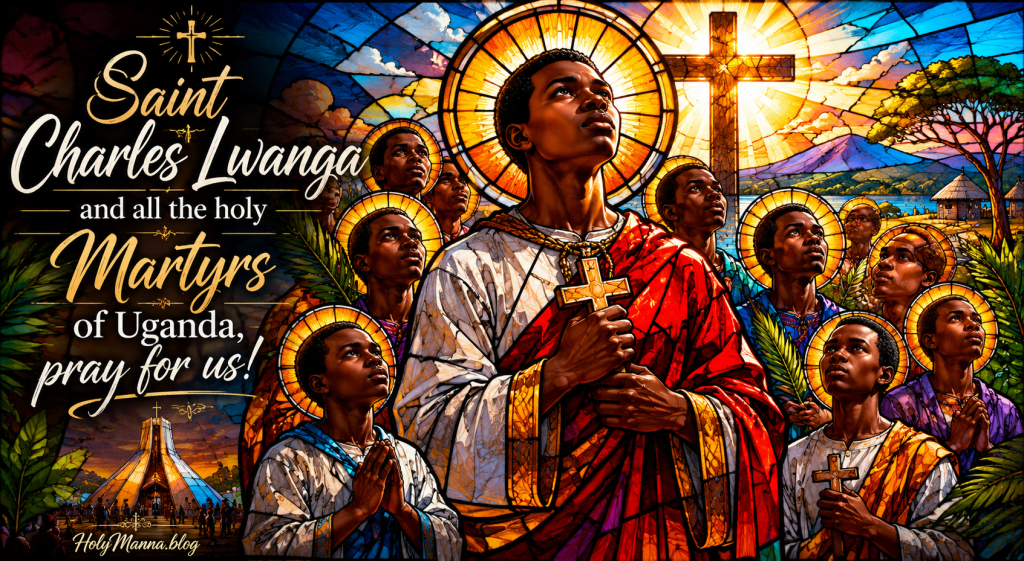
A Young Church Set Ablaze by Courage
Saint Charles Lwanga and his companions, the Martyrs of Uganda, are among the most powerful witnesses in modern Catholic history. They were young African Catholics, many of them pages and servants in the royal court of Buganda, who gave their lives for Jesus Christ between 1885 and 1887 under King Mwanga II.
Their feast day is celebrated on June 3, the day Saint Charles Lwanga and many of his companions were burned alive at Namugongo. The Church honors twenty-two canonized Catholic martyrs in this group, though Catholic tradition also respectfully remembers the Anglican Christians who died in the same persecution.
Saint Charles Lwanga is especially remembered as a lay catechist, a defender of chastity, a protector of young boys, and the spiritual leader of the Christian pages after the death of Saint Joseph Mukasa Balikuddembe. He was not a bishop, priest, monk, or famous theologian. He was a young layman in a dangerous royal court, and when the moment came to choose between comfort and Christ, he chose Christ.
The Catechism of the Catholic Church teaches that “Martyrdom is the supreme witness given to the truth of the faith.” That sentence feels almost written for Charles Lwanga and his companions. They did not die because they hated life. They died because they loved Christ more than life itself.
A Kingdom, a Court, and the First Seeds of Faith
Charles Lwanga was born around 1860 or 1861 in the kingdom of Buganda, in present-day Uganda. Catholic tradition identifies his birthplace as Birinzi in Buddu County. He belonged to the Baganda people and eventually entered the royal household, where he served among the pages of the king.
Christianity had only recently arrived in Buganda. Anglican missionaries came in 1877, and Catholic missionaries, known as the Missionaries of Africa or the White Fathers, arrived in 1879. The Gospel began to take root among the people, especially among young men in the royal court. These converts learned the faith, prayed, received instruction, and began to understand that Jesus Christ was not simply a foreign teacher, but Lord of heaven and earth.
At first, the presence of missionaries was tolerated. But when Mwanga II became king in 1884, the atmosphere changed. Mwanga saw Christianity as a threat to his power. Converts no longer obeyed every command without question. They refused immoral acts. They placed conscience above fear. They believed that God’s law stood above royal command.
That was dangerous in a court where the king expected total submission.
Before Charles Lwanga became the central leader of the Catholic pages, Saint Joseph Mukasa Balikuddembe stood as the most prominent Catholic convert at court. Joseph was a chief steward, a catechist, and a man of deep moral courage. He opposed the king’s immoral treatment of the young pages and rebuked him after the killing of Anglican Bishop James Hannington.
For that courage, Joseph Mukasa was condemned. On November 15, 1885, he was beheaded and burned, becoming the first Catholic martyr of Uganda.
That same night, Charles Lwanga asked to be baptized.
That detail is stunning. Charles knew exactly what baptism could cost him. He was not stepping into the Church at a peaceful moment. He was entering the life of Christ while persecution was beginning. His baptism was not casual. It was courageous.
The Lay Catechist Who Became a Spiritual Father
After the death of Joseph Mukasa, Charles Lwanga became the spiritual leader of the Christian pages. He instructed them in the faith, encouraged them to remain faithful, and protected the younger boys from the king’s immoral demands.
This is one of the most important parts of his story. Charles was not only defending doctrine in an abstract way. He was defending real young people from real danger. He understood that holiness is not just private prayer. Holiness protects the vulnerable. Holiness stands between innocence and abuse. Holiness refuses to cooperate with evil, even when evil wears a crown.
That is why Saint Charles Lwanga speaks so clearly to the modern Church. He is a saint for young people, catechists, converts, fathers, teachers, mentors, and anyone entrusted with the care of others. He shows that Catholic courage is not loud posturing. It is steady fidelity when fear is reasonable and silence would be easier.
Charles also became a teacher of the faith in the most dangerous setting imaginable. He helped the younger Christians understand what they believed and why it mattered. He prepared them not only to live as Catholics, but to die as Catholics if necessary.
One of the most famous stories from his life happened shortly before the final executions. Charles realized that persecution was about to intensify. Some of the young catechumens had not yet been baptized, including Kizito, the youngest of the martyrs, who was only about thirteen or fourteen years old.
So Charles secretly baptized them.
This moment is one of the most beautiful in the whole story. He could have spent his final hours trying to save himself. Instead, he prepared souls for Christ.
Faith Without Recorded Wonders, but Full of Grace
No major verified miracles are traditionally attributed to Saint Charles Lwanga during his lifetime in the way some saints are associated with healings, bilocation, visions, or other extraordinary signs. His miracle during life was quieter, but no less powerful. Grace made a young layman strong enough to become a father in faith to boys who were terrified, tempted, and hunted.
The Church does not honor Charles because he performed public wonders. The Church honors him because he lived the Gospel with heroic virtue. He taught, guarded, baptized, encouraged, and remained faithful under pressure.
His life reminds us that sanctity is not always spectacular from the outside. Sometimes holiness looks like protecting someone younger. Sometimes it looks like telling the truth when the room is against you. Sometimes it looks like quietly helping another soul receive the grace of baptism before the world closes in.
In John 15:13, Jesus says, “No one has greater love than this, to lay down one’s life for one’s friends.” Saint Charles Lwanga lived that verse. He did not abandon the young Christians entrusted to him. He walked with them all the way to the fire.
“Till Death!” The Choice Before the King
In May 1886, King Mwanga’s anger erupted. The Christian pages were gathered and forced to reveal themselves. The king demanded to know who among them were Christians.
They stepped forward.
Led by Charles Lwanga and young Kizito, the Christians separated themselves from the others. Mwanga asked whether they intended to remain Christians.
Their answer has echoed through Catholic memory ever since: “Till death!”
That was not dramatic poetry. It was a confession of faith. They knew what they were saying. They were young, but they were not confused. They belonged to Jesus Christ.
Mwanga condemned them to death and ordered that they be taken to Namugongo, the traditional place of execution.
The journey to Namugongo became a kind of African Way of the Cross. Some martyrs were killed along the road. Others were forced to continue walking toward the place where they would die. Catholic tradition remembers them praying, encouraging one another, and remaining faithful.
These were not distant figures from a stained-glass window. They were sons, friends, servants, young men, teachers, and converts. Some were newly baptized. Some were still learning the faith. Some were teenagers. Yet grace had already made them strong.
The Fire at Namugongo
On June 3, 1886, Saint Charles Lwanga was separated from the others and burned slowly. Some accounts say the executioners began by burning his feet, trying to increase his suffering and break his resolve.
The most famous words attributed to him are: “You are burning me, but it is as if you are pouring water over my body.”
His final cry is remembered as “Katonda!”, meaning “My God!”
Then he died.
Many of the other martyrs were wrapped in reed mats and placed on the pyre. Some were burned alive while praying and singing hymns. Saint Mbaga Tuzinde, whose father was connected to the executioners, was reportedly urged to renounce the faith and save his life. He refused. According to tradition, his father could not bear to see him burned alive, so Mbaga was killed before being thrown into the flames.
This story of Mbaga is one of the most moving traditions associated with the Uganda Martyrs. It reveals the terrible pressure these young Christians faced. They were not only threatened by the king. Some were pressured by family, authority, and fear itself. Still, they chose Christ.
The martyrs died as the king intended, but not with the meaning he intended. Mwanga wanted their deaths to terrify the Church. Instead, their deaths strengthened it.
A Communion of Saints in the Flames
The twenty-two canonized Catholic Uganda Martyrs are Saint Achilleus Kiwanuka, Saint Adolphus Ludigo-Mukasa, Saint Ambrosius Kibuuka, Saint Anatole Kiriggwajjo, Saint Andrew Kaggwa, Saint Athanasius Bazzekuketta, Saint Bruno Sserunkuuma, Saint Charles Lwanga, Saint Denis Ssebuggwawo Wasswa, Saint Gonzaga Gonza, Saint Gyavira Musoke, Saint James Buuzaabalyaawo, Saint John Maria Muzeeyi, Saint Joseph Mukasa Balikuddembe, Saint Kizito, Saint Luke Baanabakintu, Saint Matthias Mulumba Kalemba, Saint Mbaga Tuzinde, Saint Mugagga Lubowa, Saint Mukasa Kiriwawanvu, Saint Noa Mawaggali, and Saint Pontian Ngondwe.
Saint Joseph Mukasa was the first Catholic martyr of Uganda and the leader who prepared the way for Charles. Saint Kizito was the youngest, remembered for his innocence and courage. Saint Matthias Mulumba Kalemba was an older convert and former judge who endured an especially brutal martyrdom. Saint Andrew Kaggwa was a catechist and leader who brought others to the faith. Saint Denis Ssebuggwawo helped teach another page the faith and was killed early in the persecution.
Together, they show the beauty of the Church. They were different ages, different personalities, and different social positions, but they were united by one Lord, one faith, and one baptism.
The Uganda Martyrs were not foreign missionaries. They were Ugandans. Their witness shows that Africa did not merely receive the Gospel. Africa received it, loved it, suffered for it, and gave saints back to the universal Church.
The Church Raises Them Up
The Catholic Uganda Martyrs were beatified by Pope Benedict XV in 1920 and canonized by Pope Paul VI on October 18, 1964, during the Second Vatican Council.
Their canonization was a major moment for the Church in Africa and for the whole Catholic world. Pope Paul VI honored them as witnesses of a young but heroic African Church. He also respectfully acknowledged the Anglican martyrs who died in the same persecution, showing that hatred for Christ had fallen upon Christians across confessional lines.
Later, Pope John Paul II visited Namugongo in 1993 and praised the martyrs’ sacrifice as a source of new life for the Church in Africa. Pope Francis visited Uganda in 2015 and emphasized that Charles Lwanga and Joseph Mukasa were catechized by others and then passed on the faith they had received. Their legacy, he taught, is not something to keep like a museum memory. It is something to live.
That is the heart of the Uganda Martyrs. They were evangelized, and then they became evangelizers. They were taught the faith, and then they taught others. They received courage, and then they gave courage.
The Living Memory of the Martyrs
The miracles associated with the Uganda Martyrs are usually attributed to the martyrs as a group, rather than to Saint Charles Lwanga alone.
One important miracle tradition involves two Missionary Sisters of Our Lady of Africa who contracted plague while caring for another sister who had died. Catholic accounts say that after prayers and a novena through the intercession of the Uganda Martyrs, the two sisters were cured. This healing became part of the miracle tradition connected with the martyrs’ cause.
Another miracle story involves Levocatus or Revocato Kalema, a child born with severely curved legs. Catholic accounts say that after prayers and a novena connected with the martyrs’ relics, the child was healed and able to walk. This story is commonly preserved in the devotional memory surrounding the Uganda Martyrs.
There are also popular devotional stories connected with the shrine at Namugongo, especially around the shrine pond. Pilgrims have long associated the water with blessing and healing, and many faithful Catholics approach the site with deep devotion. These local devotional stories reflect the living faith of the people, though individual claims of healing should be treated carefully unless formally verified by the Church.
The great Uganda Martyrs Shrine at Namugongo, near Kampala, now stands as one of the most important pilgrimage sites in Africa. Every year on June 3, pilgrims come from Uganda, Kenya, Tanzania, Rwanda, and other countries. Many walk long distances. They come for novenas, Mass, prayer, singing, processions, and veneration of the martyrs.
The cultural impact of the Uganda Martyrs is enormous. Churches, schools, hospitals, parishes, religious groups, and Catholic institutions across Uganda and beyond bear their names. Saint Charles Lwanga is especially honored as patron of African youth and Catholic Action. He is also invoked by many Catholics as a patron of chastity, courage, converts, and the protection of the young.
Perhaps the most surprising part of their legacy is this: the persecution did not destroy the Church in Uganda. It helped it grow. When missionaries returned, they found Christians and catechumens still waiting, praying, and believing.
The king tried to silence the Gospel with fire. Instead, the fire became a light.
The Courage to Stand When It Costs Something
Saint Charles Lwanga and his companions speak directly to Catholics today because their witness is not abstract. They show what faith looks like under pressure.
They lived in a world where power demanded compromise. They were told to obey immoral commands. They were pressured to remain silent. They were tempted by fear, comfort, and survival. Their faith cost them status, safety, and eventually their lives.
Most Catholics today will not be asked to face flames at Namugongo. But many will be asked to stand for chastity in a culture that mocks purity. Many will be asked to protect the vulnerable when silence would be easier. Many will be asked to speak the truth when the room does not want to hear it. Many will be asked to teach the faith to someone younger, weaker, or more afraid.
Saint Charles Lwanga shows that lay Catholics can be heroic. He shows that young Catholics can become saints. He shows that catechesis matters. He shows that protecting the innocent is part of holiness. He shows that faith is not real only when it is comfortable. Faith becomes radiant when it costs something.
The Catechism of the Catholic Church teaches that the saints are models and intercessors. Saint Charles Lwanga and his companions are both. They model courage, chastity, loyalty, and sacrificial love. They also intercede for the Church, especially for young people, catechists, converts, and anyone trying to remain faithful under pressure.
Their lives ask a simple but serious question: Where is Christ asking for courage today?
Engage with Us!
Share your thoughts and reflections in the comments below. Saint Charles Lwanga and his companions gave everything for Christ, but their story is not meant to stay in the past. It is meant to wake up courage in the present.
- Where is God asking you to be more courageous in your faith right now?
- How can Saint Charles Lwanga’s example help you protect, guide, or encourage someone younger or more vulnerable?
- What does it mean to choose Christ “till death” in ordinary daily life?
- Are there places where fear, comfort, or social pressure make it difficult to live openly as a Catholic?
- How can the witness of the Uganda Martyrs inspire families, parishes, teachers, and catechists today?
May Saint Charles Lwanga and his companions pray for every heart that wants to follow Christ more faithfully. May their courage remind us that holiness is possible in every age, every culture, and every vocation. Live with faith, stand with courage, protect the vulnerable, and do everything with the love and mercy Jesus taught us.
Saint Charles Lwanga and all the holy Martyrs of Uganda, pray for us!
Follow us on YouTube, TikTok, Instagram and Facebook for more insights and reflections on living a faith-filled life.


Leave a Reply