Memorial of Saint Charles Lwanga and Companions, Martyrs – Lectionary: 355
Courage in the Hands of the Living God
Faith becomes real when fear has something to threaten.
Today’s readings bring the soul into that exact place, where belief must become courage, prayer must become trust, and hope in the resurrection must become stronger than the fear of suffering. In 2 Timothy 1:1-3, 6-12, Saint Paul writes from the shadow of imprisonment and tells Timothy to “stir into flame the gift of God.” In Psalm 123:1-2, the faithful lift their eyes to the Lord like servants waiting for the hand of their master. In Mark 12:18-27, Jesus confronts the Sadducees, who deny the resurrection, and declares that God “is not God of the dead but of the living.” Together, these readings reveal one central theme: Christian courage is born from trust in the living God.
This theme becomes even more powerful on the Memorial of Saint Charles Lwanga and Companions, Martyrs. These young Ugandan Christians lived in a world where loyalty to Christ came at a terrifying cost. They were pressured by a king, surrounded by corruption, and threatened with death, yet they chose purity, fidelity, and witness over comfort and survival. Their martyrdom gives flesh to Saint Paul’s words: “God did not give us a spirit of cowardice but rather of power and love and self-control.” Their lives remind the Church that holiness is not an abstract idea. It is often tested in the body, in conscience, in relationships, and in the moments when obedience to Christ becomes inconvenient or dangerous.
The Gospel also places the resurrection at the center of this courage. The Sadducees try to reduce eternal life to an intellectual puzzle, but Jesus reveals that their problem is deeper. They do not truly know the Scriptures or the power of God. Catholic faith does not treat the resurrection as a comforting symbol. It is a living doctrine rooted in God’s fidelity. As The Catechism teaches in CCC 993, Jesus links faith in the resurrection to faith in the God “who is not God of the dead, but of the living.” If God is truly the God of the living, then no faithful sacrifice is wasted, no suffering united to Christ is meaningless, and no martyr dies forgotten.
Today’s readings invite every disciple to lift his eyes, rekindle the flame of grace, and stop living as though fear has the final word. Where has fear made faith smaller than it should be? The witness of Saint Paul, Timothy, the psalmist, Jesus, and Saint Charles Lwanga all point to the same truth: the Christian life is not sustained by human strength alone. It is sustained by the grace of the living God, who gives power, love, self-control, and the hope of eternal life.
First Reading – 2 Timothy 1:1-3, 6-12
The Flame of Courage in a Fearful World
The first reading places us inside one of the most personal and moving letters in the New Testament. Saint Paul is writing to Timothy, his beloved spiritual son, coworker, and successor in ministry. This is not the voice of a comfortable preacher writing from a safe distance. This is the voice of an imprisoned apostle who knows that suffering for Christ is not theoretical.
Paul writes as a father in the faith, but also as a man preparing Timothy to carry the Gospel forward when courage will be costly. The Church has always heard in these words a deep apostolic meaning. Timothy has received a gift through the laying on of hands, a sign connected to sacred ministry and the handing on of apostolic mission. Yet Paul does not simply tell Timothy that he once received grace. He tells him to rekindle it.
That makes this reading deeply connected to today’s memorial of Saint Charles Lwanga and Companions. The Ugandan martyrs did not live their faith as a private feeling. They had to choose Christ under pressure, temptation, violence, and fear. Paul’s message to Timothy becomes the message to every disciple: the Christian life requires a courage that does not come from ego, personality, or natural toughness. It comes from the Holy Spirit, who gives “power and love and self-control.”
This reading prepares us to understand the whole theme of the day. Faith must be stirred into flame. Fear must not be allowed to rule the soul. Suffering for the Gospel is not a sign that God has abandoned His people. It can become the very place where grace shines most clearly.
2 Timothy 1:1-3, 6-12 – New American Bible (Revised Edition)
Greeting. 1 Paul, an apostle of Christ Jesus by the will of God for the promise of life in Christ Jesus, 2 to Timothy, my dear child: grace, mercy, and peace from God the Father and Christ Jesus our Lord.
Thanksgiving. 3 I am grateful to God, whom I worship with a clear conscience as my ancestors did, as I remember you constantly in my prayers, night and day.
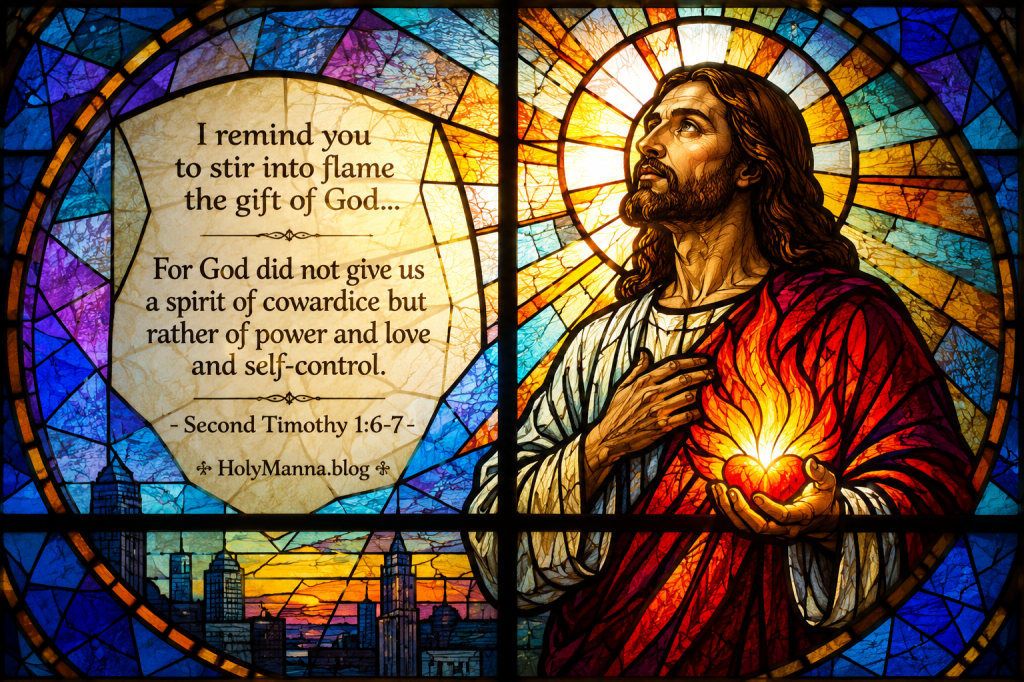
The Gifts Timothy Has Received. 6 For this reason, I remind you to stir into flame the gift of God that you have through the imposition of my hands. 7 For God did not give us a spirit of cowardice but rather of power and love and self-control. 8 So do not be ashamed of your testimony to our Lord, nor of me, a prisoner for his sake; but bear your share of hardship for the gospel with the strength that comes from God.
9 He saved us and called us to a holy life, not according to our works but according to his own design and the grace bestowed on us in Christ Jesus before time began, 10 but now made manifest through the appearance of our savior Christ Jesus, who destroyed death and brought life and immortality to light through the gospel, 11 for which I was appointed preacher and apostle and teacher. 12 On this account I am suffering these things; but I am not ashamed, for I know him in whom I have believed and am confident that he is able to guard what has been entrusted to me until that day.
Detailed Exegesis
Verse 1 – “Paul, an apostle of Christ Jesus by the will of God for the promise of life in Christ Jesus.”
Paul begins by identifying himself as an apostle, not by personal ambition, but “by the will of God.” His authority comes from Christ, not from popularity, social status, or human approval. This matters because Paul is about to encourage Timothy to suffer for the Gospel. He is not giving motivational advice. He is speaking with apostolic authority.
The phrase “for the promise of life in Christ Jesus” already points toward the heart of the day’s readings. Paul’s mission is rooted in life, not death. Even though he writes from prison and faces suffering, his message is centered on the life Christ gives. This connects directly to the Gospel, where Jesus declares that God “is not God of the dead but of the living.”
Verse 2 – “To Timothy, my dear child: grace, mercy, and peace from God the Father and Christ Jesus our Lord.”
Paul calls Timothy “my dear child,” revealing the warmth of spiritual fatherhood. In the Catholic faith, teaching is never meant to be cold information. The faith is handed on through love, witness, correction, encouragement, and spiritual family.
His blessing of “grace, mercy, and peace” is not casual language. Grace is God’s life given to us. Mercy is God’s compassionate love toward sinners and the weak. Peace is the fruit of being reconciled with God. Timothy will need all three because ministry requires more than talent. It requires a soul rooted in God.
Verse 3 – “I am grateful to God, whom I worship with a clear conscience as my ancestors did, as I remember you constantly in my prayers, night and day.”
Paul sees his Christian faith as the fulfillment of the worship of his ancestors. He does not treat the Gospel as a rejection of Israel’s faith, but as its fulfillment in Christ. This is deeply important. Christianity is not detached from the Old Covenant. It is the fulfillment of God’s promises.
Paul also reveals the hidden strength of apostolic ministry: prayer. He remembers Timothy “night and day.” Behind Timothy’s mission is Paul’s intercession. Behind the visible work of the Church is the invisible life of prayer. This is a reminder that courage is sustained by prayer, not personality alone.
Verse 6 – “For this reason, I remind you to stir into flame the gift of God that you have through the imposition of my hands.”
This is the central command of the reading. Paul does not say, “Create the gift yourself.” He says, “stir into flame the gift of God.” Grace comes from God, but the disciple must cooperate with it. The image is domestic and powerful. A fire can be real and still need tending. If neglected, it can grow dim. If fed, it can burn brightly again.
The “imposition of my hands” points to apostolic ministry and the sacramental life of the Church. In Catholic tradition, the laying on of hands is especially connected to Holy Orders and the transmission of sacred ministry. Timothy has received a real gift, and Paul is telling him not to let fear, discouragement, or routine bury it.
This also speaks to every baptized and confirmed Catholic. God has given each person real grace, real gifts, and a real mission. The question is whether those gifts are being tended or ignored.
Verse 7 – “For God did not give us a spirit of cowardice but rather of power and love and self-control.”
Paul names fear as a spiritual danger. Cowardice does not come from God. This does not mean Christians never feel afraid. It means fear must not become the governing spirit of the soul.
God gives something better: “power and love and self-control.” These three belong together. Power without love becomes harsh. Love without self-control becomes weak sentiment. Self-control without love becomes cold discipline. But when all three are united by grace, the Christian becomes capable of holy courage.
This verse fits perfectly with Saint Charles Lwanga and his companions. Their courage was not reckless. It was disciplined, loving, chaste, and faithful. They stood firm because the Holy Spirit gave them a courage stronger than fear.
Verse 8 – “So do not be ashamed of your testimony to our Lord, nor of me, a prisoner for his sake; but bear your share of hardship for the gospel with the strength that comes from God.”
Paul moves from the gift of courage to the test of courage. Timothy must not be ashamed of Jesus, and he must not be ashamed of Paul, who is imprisoned because of Jesus. In the ancient world, imprisonment carried shame and public disgrace. To be associated with a prisoner could be dangerous and humiliating.
Paul tells Timothy to “bear your share of hardship for the gospel.” This is not suffering for suffering’s sake. It is suffering for Christ and His truth. The strength for this does not come from human willpower alone. Paul says it comes “from God.”
This is where the Christian understanding of martyrdom begins to shine. The martyr does not overcome fear by pretending pain is nothing. The martyr overcomes fear because God’s strength is greater than the threat of death.
Verse 9 – “He saved us and called us to a holy life, not according to our works but according to his own design and the grace bestowed on us in Christ Jesus before time began.”
Paul grounds Timothy’s courage in salvation. God has saved us and called us “to a holy life.” Holiness is not optional for Catholics. It is not reserved for priests, religious sisters, monks, theologians, or people with dramatic public missions. Every Christian is called to holiness.
Paul also makes clear that salvation is not earned by human works. It comes from God’s design and grace. This does not deny the need to cooperate with grace. Rather, it puts everything in the right order. God acts first. Grace comes first. Our response is real, but it is always a response to God’s prior love.
This is especially important in a culture that often turns self-improvement into a religion. Christianity is not self-salvation with religious language. It is life received from Christ, lived in Christ, and offered back to Christ.
Verse 10 – “But now made manifest through the appearance of our savior Christ Jesus, who destroyed death and brought life and immortality to light through the gospel.”
Here Paul reveals the heart of Christian hope. Grace was part of God’s design “before time began,” but it has now been revealed through Jesus Christ. The Incarnation, Passion, Death, and Resurrection of Christ make visible the saving plan of God.
Paul says Christ “destroyed death.” This does not mean Christians no longer physically die. It means death has lost its final power. Christ has entered death and conquered it from within. Through the Gospel, He has brought “life and immortality to light.”
This verse connects directly to the Gospel reading from Mark 12:18-27. The Sadducees deny the resurrection, but Paul proclaims the full Christian answer: in Christ, death has been defeated, and eternal life has been revealed.
Verse 11 – “For which I was appointed preacher and apostle and teacher.”
Paul names his mission in three ways. He is a preacher, an apostle, and a teacher. He announces the Gospel, bears apostolic authority, and instructs the Church in truth.
This matters because the Gospel is not meant to remain vague inspiration. It must be proclaimed, handed on, taught, guarded, and lived. The Catholic faith is apostolic because it comes to us through the witness and teaching of the Apostles, preserved by the Church under the guidance of the Holy Spirit.
Paul’s mission also reminds us that every Christian witness has content. To bear witness to Christ means more than being generally kind. It means proclaiming the truth of Christ crucified and risen.
Verse 12 – “On this account I am suffering these things; but I am not ashamed, for I know him in whom I have believed and am confident that he is able to guard what has been entrusted to me until that day.”
Paul’s suffering is directly connected to his mission. He suffers because he has been faithful to the Gospel. Yet he says, “I am not ashamed.” This is not pride. It is trust.
The most beautiful part of the verse is Paul’s personal language: “I know him in whom I have believed.” He does not merely say, “I know what I believe.” He says he knows the One in whom he believes. Christianity is not simply agreement with doctrines, though doctrine is essential. Christianity is communion with the living Christ.
Paul is confident that God can guard what has been entrusted to him “until that day,” meaning the day of Christ’s return and final judgment. This confidence is not based on Paul’s strength. It is based on God’s fidelity.
Teachings
This reading is a powerful window into Catholic teaching on grace, vocation, courage, holiness, and witness. Paul’s command to Timothy to “stir into flame the gift of God” reminds us that grace is not magic and discipleship is not passive. God gives the gift, but the Christian must cooperate with the gift.
The Catechism teaches this beautifully in CCC 2002: “God’s free initiative demands man’s free response, for God has created man in his image by conferring on him, along with freedom, the power to know him and love him. The soul only enters freely into the communion of love. God immediately touches and directly moves the heart of man. He has placed in man a longing for truth and goodness that only he can satisfy. The promises of ‘eternal life’ respond, beyond all hope, to this desire.”
That is exactly what Paul is doing with Timothy. He is calling him to respond freely and faithfully to the grace God has already given.
Paul’s reference to the “imposition of my hands” also points toward the apostolic and sacramental structure of the Church. Timothy’s ministry is not self-appointed. It is received. Catholic faith has always understood sacred ministry as something handed on through the Church. The Catechism explains in CCC 1573: “The essential rite of the sacrament of Holy Orders for all three degrees consists in the bishop’s imposition of hands on the head of the ordinand and in the bishop’s specific consecratory prayer asking God for the outpouring of the Holy Spirit and his gifts proper to the ministry to which the candidate is being ordained.”
Paul’s words also teach that holiness belongs to every Christian. He says God “saved us and called us to a holy life.” This matches the constant teaching of the Church. The Catechism says in CCC 2013: “All Christians in any state or walk of life are called to the fullness of Christian life and to the perfection of charity. All are called to holiness: ‘Be perfect, as your heavenly Father is perfect.’”
This reading also teaches the virtue of fortitude. Paul does not tell Timothy that hardship can always be avoided. He tells him to bear hardship with God’s strength. The Catechism teaches in CCC 1808: “Fortitude is the moral virtue that ensures firmness in difficulties and constancy in the pursuit of the good. It strengthens the resolve to resist temptations and to overcome obstacles in the moral life. The virtue of fortitude enables one to conquer fear, even fear of death, and to face trials and persecutions. It disposes one even to renounce and sacrifice his life in defense of a just cause. ‘The Lord is my strength and my song.’ ‘In the world you have tribulation; but be of good cheer, I have overcome the world.’”
This is the virtue shining in Saint Charles Lwanga and his companions. Their martyrdom was not merely an act of human bravery. It was fortitude formed by faith, chastity, charity, and hope in eternal life.
The Church’s teaching on martyrdom brings Paul’s words into full focus. The Catechism teaches in CCC 2473: “Martyrdom is the supreme witness given to the truth of the faith: it means bearing witness even unto death. The martyr bears witness to Christ who died and rose, to whom he is united by charity. He bears witness to the truth of the faith and of Christian doctrine. He endures death through an act of fortitude.”
That teaching could almost be placed beside Paul’s words to Timothy. “Do not be ashamed.” “Bear your share of hardship.” “I know him in whom I have believed.” The martyr lives these words all the way to the end.
Saint John Chrysostom, preaching on this passage, saw clearly that Paul was calling Timothy to renew the grace already given to him. He wrote: “For as fire requires fuel, so grace requires our alacrity, that it may be ever fervent.” That is a simple and piercing teaching. Grace is divine, but the soul must remain awake. Faith must be fed. Prayer, the sacraments, repentance, spiritual reading, and works of charity are not spiritual decorations. They are the fuel that keeps the flame alive.
Saint Augustine also captures the heart of grace and cooperation when he prays in Confessions: “You have made us for yourself, O Lord, and our heart is restless until it rests in you.” Paul’s confidence comes from this same place. He knows the One in whom he has believed. His heart rests, not in his circumstances, but in Christ.
Reflection
This first reading is not only for bishops, priests, catechists, or missionaries. It is for every Catholic who has ever felt the flame of faith grow dim.
There are seasons when the soul feels alive with grace. Prayer feels natural. The Mass feels radiant. The Scriptures feel open. The desire for holiness feels strong. Then ordinary life comes in with pressure, fatigue, temptation, disappointment, busyness, and fear. The flame may not go out, but it can become covered by ash.
Paul’s words are merciful because he does not shame Timothy for needing encouragement. He reminds him. That is often how God works in the spiritual life. He reminds the soul of what it has already received.
The first practical step is to name the gift. God has placed something in every baptized soul. Maybe it is a gift for teaching, encouragement, service, prayer, leadership, hospitality, sacrifice, or quiet faithfulness. Maybe it is the simple but powerful gift of being able to witness to Christ in a family or workplace where faith is rarely spoken of with confidence. What gift has God placed in your life that has been neglected, hidden, or allowed to grow cold?
The second step is to feed the flame. A fire does not grow by being admired. It grows by being tended. The Catholic life gives concrete fuel for the soul: Sunday Mass, frequent confession, daily prayer, Scripture, Eucharistic adoration, the Rosary, spiritual friendship, fasting, and acts of charity. These are not boxes to check. They are ways the soul stays close to Christ.
The third step is to reject the spirit of cowardice. Fear often disguises itself as prudence. It whispers, “Do not say anything. Do not stand out. Do not be too Catholic. Do not make it awkward. Do not risk being misunderstood.” Prudence is a virtue, but cowardice is not. Paul gives the test. Does this spirit lead to power, love, and self-control, or does it lead to silence, compromise, and shame?
The fourth step is to remember the resurrection. Paul can suffer because Christ “destroyed death and brought life and immortality to light through the gospel.” If death has been conquered, then fear does not deserve the throne. This does not make suffering easy, but it makes suffering meaningful when united to Christ.
Saint Charles Lwanga and his companions show what this reading looks like when lived to the end. They stirred the flame. They refused cowardice. They chose chastity, truth, and fidelity. They were not ashamed of Christ. Their bodies were threatened, but their souls belonged to the living God.
Where is Christ asking you to stop being ashamed of the Gospel?
What fear has been quietly shaping your decisions more than faith?
How can you practice power, love, and self-control in one concrete situation today?
The message of Paul to Timothy is the message of the Church to every disciple today: the gift is already there. The grace is real. The flame can burn again. Stir it into flame, and do not be ashamed.
Responsorial Psalm – Psalm 123:1-2
Eyes Lifted Toward Mercy
The responsorial psalm gives today’s readings their posture. If Saint Paul tells Timothy to stir the flame of courage, and if Jesus reveals that God is the God of the living, then Psalm 123:1-2 shows what the faithful soul looks like while waiting on that living God. It looks upward.
This psalm belongs to the group known as the Songs of Ascents, prayers traditionally associated with pilgrims going up to Jerusalem. These were not casual travel songs. They were prayers for people on the road, people moving toward worship, people aware that they needed God’s mercy, protection, and favor. The imagery is humble and deeply human. Servants watch the hand of their master. A maid watches the hand of her mistress. The people of God watch the Lord.
In the world of the psalmist, the hand of a master could signal direction, provision, protection, correction, or mercy. The faithful person is not staring at heaven with vague optimism. He is attentive, dependent, and ready to respond. This makes the psalm a perfect bridge between Paul’s call to courage and the martyr witness of Saint Charles Lwanga and Companions. Courage does not begin by looking inward and pretending to be strong. Christian courage begins by lifting the eyes to God and waiting for the strength that only He can give.
Psalm 123:1-2 – New American Bible (Revised Edition)
Reliance on the Lord
1 A song of ascents.
To you I raise my eyes,
to you enthroned in heaven.
2 Yes, like the eyes of servants
on the hand of their masters,
Like the eyes of a maid
on the hand of her mistress,
So our eyes are on the Lord our God,
till we are shown favor.
Detailed Exegesis
Verse 1 – “To you I raise my eyes, to you enthroned in heaven.”
The psalm begins with a simple movement of the soul: the eyes are raised. This is not only physical language. It is spiritual language. The one who prays is choosing where to look, where to seek help, and where to place trust.
The Lord is described as “enthroned in heaven.” This reminds the faithful that God is not trapped inside the chaos of earthly life. He is sovereign. He reigns above the noise, pressure, injustice, temptation, and fear that can surround His people. For the Christian, this does not mean God is distant. It means God is Lord.
This verse fits beautifully with the first reading. Saint Paul is in prison, yet his confidence is not chained. He knows that Christ has destroyed death. He knows that his life is held by God. The psalm gives words to that same confidence. The soul raises its eyes because help does not come from fear, reputation, comfort, or control. Help comes from the Lord.
This also speaks directly to the memorial of Saint Charles Lwanga and Companions. These martyrs faced earthly power, but their eyes were lifted higher than the king who threatened them. Their courage came from knowing that the true throne was not in a royal court. The true throne was in heaven.
Verse 2 – “Yes, like the eyes of servants on the hand of their masters, like the eyes of a maid on the hand of her mistress, so our eyes are on the Lord our God, till we are shown favor.”
The second verse deepens the image. The psalmist compares the faithful to servants watching the hand of their masters. This may sound strange to modern ears, but the image is rich with meaning. The servant watches closely because the master’s hand gives direction. The servant depends on that hand for provision. The servant looks there for mercy and protection.
The psalm does not present dependence on God as weakness. It presents dependence on God as wisdom. A soul that knows its need is already closer to holiness than a soul pretending to be self-sufficient.
The words “till we are shown favor” reveal patient trust. The faithful do not look to God only for a moment and then give up. They remain fixed on Him. They wait for mercy. They trust His timing. This is the same spiritual posture Saint Paul encourages in Timothy. Timothy must not rely on cowardice, shame, or human strength. He must bear hardship “with the strength that comes from God.”
This verse also prepares the heart for the Gospel. The Sadducees are misled because they do not know the Scriptures or the power of God. Their eyes are fixed on a clever argument, not on the living Lord. The psalmist teaches the opposite posture. The faithful soul watches God, listens for God, and waits for God.
Teachings
Psalm 123 teaches the foundation of Christian prayer: humility before the living God. The psalmist does not come before God as a negotiator, critic, or spiritual consumer. He comes as one who needs mercy. This is the beginning of real prayer.
The Catechism teaches in CCC 2559: “Prayer is the raising of one’s mind and heart to God or the requesting of good things from God. But when we pray, do we speak from the height of our pride and will, or ‘out of the depths’ of a humble and contrite heart? He who humbles himself will be exalted; humility is the foundation of prayer. Only when we humbly acknowledge that ‘we do not know how to pray as we ought,’ are we ready to receive freely the gift of prayer. ‘Man is a beggar before God.’”
That teaching sounds like the soul of Psalm 123. The eyes are raised, but the heart is lowly. The person praying knows that everything depends on God’s mercy.
The psalm also reminds us that prayer comes from the deepest center of the person, not merely from words spoken on the surface. The Catechism teaches in CCC 2562: “Where does prayer come from? Whether prayer is expressed in words or gestures, it is the whole man who prays. But in naming the source of prayer, Scripture speaks sometimes of the soul or the spirit, but most often of the heart, more than a thousand times. According to Scripture, it is the heart that prays. If our heart is far from God, the words of prayer are in vain.”
This matters because the psalm is not only about lifted eyes. It is about a lifted heart. The body may look religious while the heart looks elsewhere. The psalm calls the whole person back to God.
The Church also teaches that the psalms form the prayer of Christ and His Church. The Catechism teaches in CCC 2587: “The Psalter is the book in which the Word of God becomes man’s prayer. In other books of the Old Testament, ‘the words proclaim [God’s] works and bring to light the mystery they contain.’ The words of the Psalmist, sung for God, both express and sing his saving works.”
This means that when Catholics pray the psalms, they are not merely reading ancient poetry. They are entering the prayer school of Israel, fulfilled in Christ and carried forward in the Church’s liturgy. The psalms teach the soul how to praise, lament, wait, trust, repent, and hope.
Saint Augustine expresses this restless hunger for God in Confessions, Book I: “You have made us for yourself, O Lord, and our heart is restless until it rests in you.” That restlessness is present in Psalm 123. The eyes rise because the heart knows it was made for God. The soul waits because nothing less than God’s mercy can satisfy it.
This psalm also connects beautifully to the witness of the martyrs. Martyrdom is not born from spiritual self-confidence. It is born from union with God. The martyr has learned where to look. Saint Charles Lwanga and his companions faced a king, but they watched the hand of the Lord. They were stripped of earthly security, but not of heavenly hope. Their eyes were fixed on the One who reigns.
Reflection
The great temptation in daily life is to look everywhere except toward God.
When pressure comes, the eyes often go first to the phone, the inbox, the bank account, the opinion of other people, the news, the mirror, the calendar, or the fear inside the heart. Some of those things matter in ordinary life, but none of them can save the soul. Psalm 123 gently but firmly redirects the gaze: “To you I raise my eyes.”
This is a small prayer that can change an entire day.
Before reacting in anger, raise your eyes. Before giving in to temptation, raise your eyes. Before making an important decision, raise your eyes. Before despairing over a problem that feels too heavy, raise your eyes. The psalm does not say the answer will come instantly. It says the faithful keep their eyes on the Lord “till we are shown favor.”
That kind of prayer builds spiritual patience. It also builds courage. A person who looks to God first is harder to manipulate by fear. A person who waits on God is less likely to panic. A person who depends on God is less enslaved to approval.
This is especially important on the Memorial of Saint Charles Lwanga and Companions. They show that the eyes of faith must be trained before the moment of crisis. Nobody becomes courageous by accident. Courage is formed in small acts of fidelity, small acts of prayer, small acts of chastity, small acts of obedience, and small acts of trust. Then, when the great test comes, the soul already knows where to look.
A practical way to live this psalm today is to pause three times and pray slowly: “To you I raise my eyes, Lord.” Pray it before work begins. Pray it when stress rises. Pray it before going to sleep. Let that simple prayer retrain the heart.
Another way is to notice where the eyes naturally go when anxiety appears. Do they go to control, distraction, resentment, or comparison? The answer can reveal what the soul has been trusting more than God.
The psalmist gives a better path. Lift the eyes. Watch for the Lord. Wait for mercy. Trust the hand of the One enthroned in heaven.
Where do your eyes go first when life becomes difficult?
What would change today if your first instinct was prayer instead of panic?
Are you willing to wait on the Lord even when His mercy does not arrive on your preferred timeline?
The faithful soul does not need to see the whole road. It only needs to keep its eyes on the hand of the Lord.
Holy Gospel – Mark 12:18-27
The God Who Refuses to Let Death Have the Last Word
The Gospel brings today’s theme to its highest point. Saint Paul has already told Timothy that Christ “destroyed death and brought life and immortality to light through the gospel,” and the psalmist has lifted his eyes toward the Lord enthroned in heaven. Now Jesus stands before the Sadducees and reveals the truth that makes Christian courage possible: God is not the God of the dead, but of the living.
The historical background matters here. The Sadducees were a Jewish religious group associated especially with the priestly aristocracy and the Temple leadership in Jerusalem. Unlike the Pharisees, they denied the resurrection of the dead. They also tended to give special authority to the Torah, the first five books of Moses. So when they approach Jesus with a question about marriage and resurrection, they are not simply asking for clarification. They are trying to trap Him with an argument they believe makes resurrection look absurd.
Their example comes from the practice of levirate marriage, found in Deuteronomy 25:5-10. If a man died without a son, his brother was expected to marry the widow so that descendants could be raised up in the dead brother’s name. The Sadducees turn this law into a hypothetical puzzle about one woman and seven brothers. Their goal is not pastoral concern for the woman. Their goal is to make eternal life sound ridiculous.
Jesus answers by exposing the deeper problem. They misunderstand both Scripture and the power of God. They imagine resurrection as merely an extension of earthly life, with all the same structures, limitations, and arrangements. Jesus reveals something far greater. The resurrection is not a return to ordinary life. It is life transformed by God.
This Gospel fits perfectly with the Memorial of Saint Charles Lwanga and Companions. The martyrs could face death because they believed the living God was stronger than death. They did not see earthly survival as the highest good. They knew, like Saint Paul, that Christ had brought immortality to light. Christian courage begins here: death is real, but it is not final.
Mark 12:18-27 – New American Bible (Revised Edition)
18 Some Sadducees, who say there is no resurrection, came to him and put this question to him, 19 saying, “Teacher, Moses wrote for us, ‘If someone’s brother dies, leaving a wife but no child, his brother must take the wife and raise up descendants for his brother.’ 20 Now there were seven brothers. The first married a woman and died, leaving no descendants. 21 So the second married her and died, leaving no descendants, and the third likewise. 22 And the seven left no descendants. Last of all the woman also died. 23 At the resurrection [when they arise] whose wife will she be? For all seven had been married to her.” 24 Jesus said to them, “Are you not misled because you do not know the scriptures or the power of God? 25 When they rise from the dead, they neither marry nor are given in marriage, but they are like the angels in heaven. 26 As for the dead being raised, have you not read in the Book of Moses, in the passage about the bush, how God told him, ‘I am the God of Abraham, [the] God of Isaac, and [the] God of Jacob’? 27 He is not God of the dead but of the living. You are greatly misled.”
Detailed Exegesis
Verse 18 – “Some Sadducees, who say there is no resurrection, came to him and put this question to him.”
Saint Mark immediately tells us the key issue: the Sadducees deny the resurrection. This is the theological conflict behind the conversation. They are not neutral questioners. They approach Jesus with a position already formed.
Their denial of the resurrection is important because it cuts against the hope that becomes central in the Gospel. If there is no resurrection, martyrdom looks foolish, suffering for the truth looks pointless, and death becomes the final authority over human life. But if God raises the dead, then every act of fidelity matters forever.
This is why today’s Gospel belongs with Saint Paul’s words to Timothy. Paul can suffer without shame because he knows Christ has conquered death. The martyrs can stand firm because they believe the soul is not owned by the executioner. The Christian can live courageously because the living God holds the future.
Verse 19 – “Teacher, Moses wrote for us, ‘If someone’s brother dies, leaving a wife but no child, his brother must take the wife and raise up descendants for his brother.’”
The Sadducees begin by appealing to Moses. This reference comes from the law of levirate marriage in Deuteronomy. In ancient Israel, family lineage, inheritance, and descendants carried tremendous religious and social importance. To die without descendants was seen as a serious loss, and this law protected the name and household of the deceased brother.
Their appeal to Moses is strategic. Since the Sadducees gave special authority to the books of Moses, they want to frame their challenge in terms they think Jesus cannot escape. They use Scripture, but they use it with a closed heart.
This matters for Catholic readers because Scripture is not meant to be handled like a weapon for winning arguments. Scripture is the inspired Word of God, entrusted to the Church and read within the living Tradition. When Scripture is detached from faith, humility, and the power of God, even a biblical argument can become spiritually blind.
Verse 20 – “Now there were seven brothers. The first married a woman and died, leaving no descendants.”
The Sadducees begin their exaggerated case. The number seven gives the story a sense of completion, making the situation feel as complicated as possible. The first brother marries and dies without descendants, which activates the law they have just cited.
The woman in the story is presented almost like a problem in a debate, not as a person. That detail should not be missed. When religion becomes only an intellectual trap, real people disappear. The Sadducees are discussing resurrection, marriage, and death, but their focus is not mercy, hope, or the woman’s dignity. Their focus is winning the argument.
Jesus will not let them reduce eternal life to a legal puzzle.
Verse 21 – “So the second married her and died, leaving no descendants, and the third likewise.”
The case continues. The second brother dies, and then the third. The Sadducees are trying to increase the absurdity of the situation. Their logic is simple: if the resurrection exists, and if all seven men were married to this woman, then resurrection must create an impossible marital problem.
But their argument rests on a false assumption. They assume risen life is just earthly life continued under the same conditions. Jesus will show that this is their mistake. Heaven is not earth with better weather. Resurrection life is transformed life in God.
This is a needed correction today as well. Many people imagine heaven either too vaguely or too materially. Some think of it as boring, ghostly, or less real than earthly life. Others imagine it as merely an upgraded version of earthly pleasures. The Catholic faith teaches something far richer. Heaven is perfect communion with God.
Verse 22 – “And the seven left no descendants. Last of all the woman also died.”
The Sadducees bring the story to its end. All seven brothers die, and finally the woman dies. Their scenario is built around death, barrenness, and confusion. It is almost a world without hope.
This verse quietly reveals the poverty of their imagination. Death dominates the whole story. There are marriages, but no children. There are brothers, but no lasting household. There is law, but no life. That is what happens when resurrection is denied. The horizon shrinks.
Jesus is about to widen the horizon beyond anything they are willing to imagine.
Verse 23 – “At the resurrection when they arise whose wife will she be? For all seven had been married to her.”
Here is the trap. The Sadducees ask whose wife she will be in the resurrection. Their question assumes that resurrected life must follow the exact same structure as earthly life. They think they have found an example that makes resurrection unreasonable.
Jesus does not reject marriage. The Catholic Church teaches that marriage is good, holy, and sacramental between the baptized. Marriage is a real vocation ordered toward the good of the spouses and the procreation and education of children. But marriage belongs to the pilgrimage of this life. It is a sign that points beyond itself.
In heaven, signs give way to fulfillment. Earthly marriage points toward the eternal communion of love between Christ and His Church. The Sadducees are focused on the sign, but Jesus is about to reveal the fulfillment.
Verse 24 – “Jesus said to them, ‘Are you not misled because you do not know the scriptures or the power of God?’”
Jesus gives a direct correction. The Sadducees are misled for two reasons: they do not know the Scriptures, and they do not know the power of God.
This is a serious warning. A person can quote Scripture and still misunderstand it. A person can know religious arguments and still underestimate God. The Sadducees have biblical language, but they lack biblical faith.
The phrase “the power of God” is especially important. Resurrection is not believable because human beings can explain every detail of it. Resurrection is believable because God is powerful and faithful. The One who creates life from nothing can restore life from death. The One who formed the body can raise the body. The One who made covenant with His people does not abandon them to the grave.
Verse 25 – “When they rise from the dead, they neither marry nor are given in marriage, but they are like the angels in heaven.”
Jesus now corrects their mistaken view of the resurrection. Risen life is not simply earthly life repeated. In the resurrection, people “neither marry nor are given in marriage.” This does not lower the dignity of marriage. It reveals the greatness of heaven.
Marriage is holy, but it belongs to this age. It serves the good of spouses, the generation of children, and the sanctification of family life. In heaven, there is no need for marriage as an earthly institution because the blessed live in perfect communion with God and with one another.
Jesus says the risen are “like the angels in heaven.” He does not say human beings become angels. Human beings remain human. The resurrection of the body is not the replacement of the body with an angelic nature. Rather, the risen share in a heavenly mode of life, free from death, corruption, and earthly marriage arrangements.
This is deeply consoling. Heaven is not less love. Heaven is love perfected.
Verse 26 – “As for the dead being raised, have you not read in the Book of Moses, in the passage about the bush, how God told him, ‘I am the God of Abraham, the God of Isaac, and the God of Jacob’?”
Jesus now answers the Sadducees from Moses himself. This is brilliant and deliberate. Since they appealed to Moses, Jesus points them back to the Book of Moses, specifically the burning bush in Exodus 3.
God reveals Himself to Moses as the God of Abraham, Isaac, and Jacob. At the time of Moses, the patriarchs had long since died. Yet God speaks of His covenant relationship with them in the present. He does not say, “I was their God.” He says, “I am.”
Jesus shows that God’s covenant is stronger than death. The patriarchs are not lost to Him. They live before Him. The God who binds Himself to His people does not become the God of corpses. He remains the God of the living.
This verse is one of the clearest examples of Jesus teaching resurrection from the deep unity of Scripture. He draws eternal life from the living grammar of God’s own revelation.
Verse 27 – “He is not God of the dead but of the living. You are greatly misled.”
This is the final blow to the Sadducees’ argument. God is not the God of the dead, but of the living. The resurrection is not a religious fantasy. It flows from who God is. If God is faithful, if God is living, and if God has entered covenant with His people, then death cannot be the final word.
Jesus ends with another correction: “You are greatly misled.” This is strong language, but it is merciful. False ideas about God, death, the body, heaven, and the resurrection are not harmless. They shape how people live. If death is final, then pleasure, power, and survival easily become idols. If God is the God of the living, then holiness, chastity, sacrifice, and martyrdom make eternal sense.
This verse gathers the whole day together. Saint Paul is not ashamed because he knows the living Christ. The psalmist lifts his eyes because God reigns. Saint Charles Lwanga and his companions give their lives because death cannot destroy those who belong to God.
Teachings
This Gospel gives one of the clearest teachings of Jesus on the resurrection of the dead. The Catholic faith does not treat resurrection as a poetic symbol or vague hope. It is a central doctrine of the Creed. Every Sunday, Catholics profess belief in the resurrection of the body and life everlasting.
The Catechism teaches in CCC 993: “The Pharisees and many of the Lord’s contemporaries hoped for the resurrection. Jesus teaches it firmly. To the Sadducees who deny it he answers, ‘Is not this why you are wrong, that you know neither the scriptures nor the power of God?’ Faith in the resurrection rests on faith in God who ‘is not God of the dead, but of the living.’”
This is exactly the heart of Mark 12:18-27. Jesus does not argue for resurrection as an abstract idea. He grounds it in the identity of God. God is living, faithful, and covenantal. Therefore, those who belong to Him are not abandoned to death.
The Church also teaches that the resurrection involves the whole human person. Catholics do not believe that the final hope is simply the soul escaping the body forever. The body matters because God created it, Christ assumed it, and Christ will raise it.
The Catechism teaches in CCC 997: “What is ‘rising’? In death, the separation of the soul from the body, the human body decays and the soul goes to meet God, while awaiting its reunion with its glorified body. God, in his almighty power, will definitively grant incorruptible life to our bodies by reuniting them with our souls, through the power of Jesus’ Resurrection.”
This teaching corrects many modern misunderstandings. The Christian hope is not becoming a ghost, merging into the universe, or living only as a memory. The Christian hope is the resurrection of the body through the power of Jesus Christ.
Jesus’ statement about marriage also fits within Catholic teaching on heaven. Marriage is holy, but it is not ultimate. It points toward the eternal communion for which every human heart was made. The Catechism teaches in CCC 1024: “This perfect life with the Most Holy Trinity, this communion of life and love with the Trinity, with the Virgin Mary, the angels and all the blessed is called ‘heaven.’ Heaven is the ultimate end and fulfillment of the deepest human longings, the state of supreme, definitive happiness.”
That is why Jesus can say the risen do not marry. Heaven does not destroy love. Heaven fulfills love. Every true love purified in Christ finds its home in the perfect love of God.
This Gospel also teaches the proper way to read Scripture. The Sadducees knew a text from Moses, but they missed the living God revealed through Moses. Catholic interpretation requires more than isolated proof texts. Scripture must be read within the faith of the Church and the unity of God’s saving plan.
The Catechism teaches in CCC 113: “Read the Scripture within ‘the living Tradition of the whole Church’. According to a saying of the Fathers, Sacred Scripture is written principally in the Church’s heart rather than in documents and records, for the Church carries in her Tradition the living memorial of God’s Word, and it is the Holy Spirit who gives her the spiritual interpretation of the Scripture.”
The Sadducees’ error was not that they took Scripture seriously. Their error was that they read Scripture without recognizing the fullness of God’s power and revelation. Jesus restores Scripture to its proper center: the living God.
Saint Augustine gives a beautiful expression of the Christian hope that death does not destroy those who live in God. In Sermon 172, he says: “For the souls of the pious dead are not separated from the Church, which even now is the kingdom of Christ.” This fits the Catholic understanding of the communion of saints. Death does not tear the faithful out of Christ. Those who die in God remain alive in Him.
This is why martyrdom makes sense in Catholic faith. Saint Charles Lwanga and his companions did not choose death because they hated life. They chose Christ because they believed in life beyond death. Their witness is a living commentary on Jesus’ words: “He is not God of the dead but of the living.”
Reflection
This Gospel asks the reader to face a question that many people avoid: What do you really believe about death?
Not what sounds comforting. Not what sounds religious. Not what would be nice to imagine. What do you actually believe?
The Sadducees denied the resurrection, and that denial shaped the way they approached Jesus. They came with a clever argument, but they had a small view of God. That can still happen today. A person may not formally deny the resurrection, but may live as though this life is all there is. When comfort becomes the highest goal, when sin is excused because “life is short,” when faith is kept private because approval feels more urgent than eternity, the soul may be living with a Sadducee-shaped imagination.
Jesus calls His people into something greater.
The resurrection means the body matters. What is done with the body matters. Chastity matters. Sacrifice matters. Suffering matters. Love matters. The hidden choices of ordinary life matter because the whole person is destined either for eternal communion with God or separation from Him.
That truth gives courage. It also gives clarity.
Saint Charles Lwanga and his companions understood this with astonishing maturity. They faced threats from a king, but they knew the king did not own eternity. They protected purity, refused sin, confessed Christ, and accepted death rather than betray the living God. Their martyrdom makes no sense if death is final. But if Jesus is telling the truth, their witness is radiant.
A practical way to live this Gospel is to examine where fear of death or fear of loss is quietly making decisions. Sometimes the fear is not physical death. It may be fear of losing status, comfort, a relationship, a reputation, or control. The resurrection does not make those losses painless, but it puts them in their proper place. Nothing earthly deserves to be treated as God.
Another way to live this Gospel is to recover a Catholic view of heaven. Heaven is not vague, boring, or less real than earth. Heaven is the fulfillment of every holy longing in perfect communion with God. When that truth becomes real, the Christian can love earthly goods without clinging to them as ultimate.
The Gospel also invites a deeper reverence for Scripture. Jesus tells the Sadducees they are misled because they do not know the Scriptures or the power of God. That warning should move every Catholic to read the Bible with humility, inside the heart of the Church, asking not only, “What does this text say?” but also, “What is the living God revealing through this Word?”
Where has your imagination of heaven become too small?
Do your daily choices show that you truly believe in the resurrection of the body?
What fear would lose its power over you if you trusted more deeply that God is the God of the living?
The Sadducees came to Jesus with a puzzle. Jesus answered with a revelation. God is not trapped by death, not limited by earthly categories, and not defeated by the grave. He is the God of Abraham, Isaac, Jacob, Paul, Timothy, Charles Lwanga, his companions, and every faithful soul who belongs to Christ.
He is not God of the dead, but of the living.
The Flame That Death Cannot Extinguish
Today’s readings leave the Church with a clear and courageous invitation: lift your eyes, stir the flame, and trust the God of the living.
In 2 Timothy 1:1-3, 6-12, Saint Paul speaks like a spiritual father who knows that fear can weaken even sincere disciples. He tells Timothy to “stir into flame the gift of God” and reminds him that the Holy Spirit does not give “a spirit of cowardice but rather of power and love and self-control.” In Psalm 123:1-2, the faithful soul learns where courage begins, not by looking inward for strength, but by raising its eyes to the Lord enthroned in heaven. In Mark 12:18-27, Jesus reveals why that courage is not foolish optimism. God “is not God of the dead but of the living.”
Together, these readings teach that Christian courage is not rooted in personality, confidence, or comfort. It is rooted in the resurrection. The disciple can bear hardship because Christ has destroyed death. The faithful can wait in prayer because the Lord is still enthroned in heaven. The martyr can face the fire because the grave does not get the final word.
That is why the Memorial of Saint Charles Lwanga and Companions fits so beautifully with today’s Word. These young martyrs did not live a vague faith. They lived a costly faith. They chose chastity over corruption, courage over cowardice, and Christ over survival. Their witness still speaks to a world that often asks Catholics to keep faith quiet, flexible, and harmless.
Today, the Church invites every disciple to take one honest step closer to Christ. Return to prayer. Go to confession. Rekindle the grace that has grown dim. Choose purity where temptation has been winning. Speak the truth with love where silence has become comfortable. Lift your eyes to God before fear tells you what to do.
What gift is God asking you to stir back into flame today?
The living God has not stopped calling saints. He still gives power, love, and self-control. He still strengthens His people for the Gospel. He still turns suffering into witness. He still raises the eyes of the weary and reminds the faithful that death is not the end.
So do not be ashamed of Christ. Do not let fear become your master. Do not live as though the world has the final word.
The God of Abraham, Isaac, Jacob, Paul, Timothy, Charles Lwanga, and all the martyrs is still the God of the living. And He is calling His people to live like resurrection is true.
Engage with Us!
Share your reflections in the comments below. Today’s readings give the Church a powerful invitation to live with courage, lift our eyes to God, and trust that Christ has truly conquered death. The witness of Saint Charles Lwanga and Companions reminds us that faith is not meant to stay hidden in safe places. It is meant to become love, courage, purity, mercy, and witness in everyday life.
- In the First Reading from 2 Timothy 1:1-3, 6-12, Saint Paul tells Timothy to “stir into flame the gift of God.” What gift has God placed in your life that needs to be rekindled through prayer, confession, service, or renewed courage?
- In Psalm 123:1-2, the psalmist prays, “To you I raise my eyes.” When life feels stressful, tempting, or uncertain, where do your eyes usually go first? How can you practice turning to the Lord before turning to fear, distraction, or control?
- In the Holy Gospel from Mark 12:18-27, Jesus says that God “is not God of the dead but of the living.” How does belief in the resurrection change the way you face suffering, sacrifice, purity, courage, and the daily choices that test your faith?
- On this Memorial of Saint Charles Lwanga and Companions, Martyrs, what part of their witness challenges you most: their courage, their chastity, their loyalty to Christ, or their willingness to suffer rather than betray the faith?
- Where is Jesus inviting you to stop being ashamed of the Gospel and live more openly as His disciple?
May these readings help every heart grow stronger in faith, steadier in hope, and more generous in love. Let us go forward with the courage of the martyrs, the prayer of the psalmist, and the confidence of Saint Paul, doing everything with the love and mercy Jesus taught us.
Sacred Heart of Jesus, we trust in You!
Immaculate Heart of Mary, pray for us!
Saint Michael the Archangel, defend us in battle!
Follow us on YouTube, TikTok, Instagram and Facebook for more insights and reflections on living a faith-filled life.

 Holy Manna!
Leave a comment