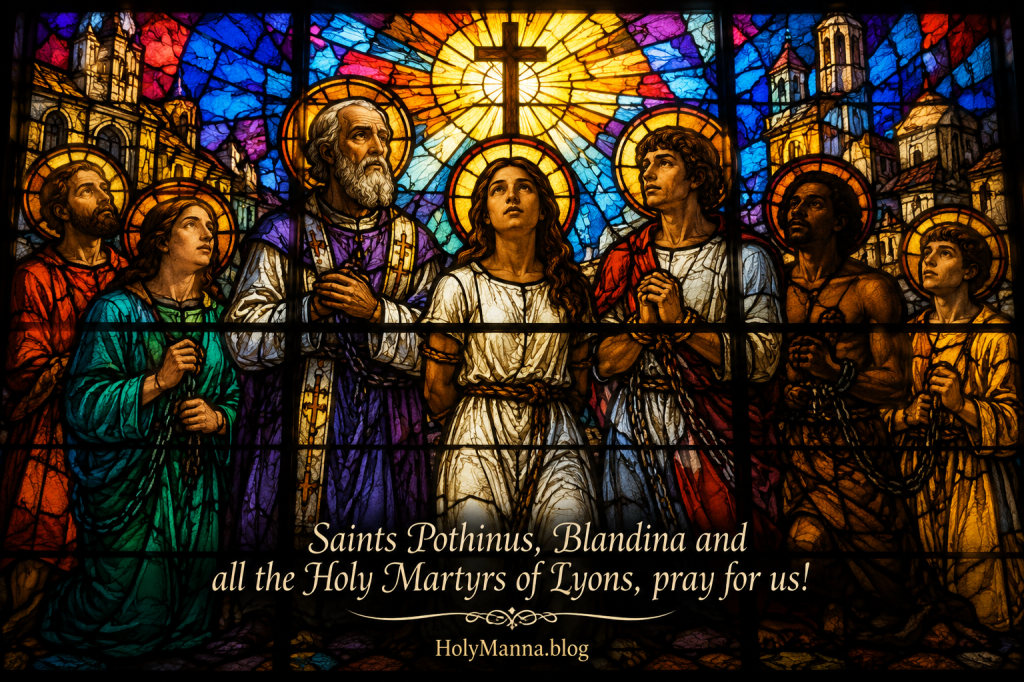
When the Weak Became Pillars of the Church
In the year A.D. 177, in the Roman city of Lugdunum, now Lyon, France, a small Christian community was tested by fire, torture, hatred, and death. The world saw them as criminals. The Church remembers them as saints.
Saints Pothinus, Blandina, and their Companions are honored as some of the earliest martyrs of the Church in Gaul. Their story comes mainly from an ancient letter written by the Churches of Lyon and Vienne to the Churches of Asia and Phrygia, preserved by Eusebius in Church History. It is one of the most moving martyrdom accounts from the early Church.
This was not a group made up only of priests, scholars, or noble families. These martyrs included an elderly bishop, a young enslaved woman, a deacon, recent converts, Roman citizens, foreign-born Christians, ordinary laypeople, and even a teenage boy. Their witness shows something deeply Catholic and deeply human: holiness is not reserved for the powerful. Christ can make saints out of the elderly, the young, the weak, the enslaved, the frightened, and even those who once failed but returned to Him.
The Catechism of the Catholic Church teaches, “Martyrdom is the supreme witness given to the truth of the faith: it means bearing witness even unto death” CCC 2473. That is exactly what happened in Lyon. These saints did not die because they were seeking attention or conflict. They died because they would not deny Jesus Christ.
From Smyrna to Lyon: The Roots of a Young Church
Saint Pothinus was the first bishop of Lyon. Catholic tradition connects him to Smyrna in Asia Minor, one of the great centers of early Christianity. Some traditions say he was a disciple of Saint Polycarp, who himself had known Saint John the Apostle. This connection places Pothinus very close to the living memory of the apostolic age.
By the time persecution broke out, Pothinus was already very old. Some traditions say he was over ninety, while other local sources say he was in his eighties. Either way, the picture is clear. He was an elderly bishop, physically weak, but spiritually firm.
Lyon itself was a major Roman city, full of commerce, religion, politics, and public spectacle. Christians there were a small minority, and like many early Christians, they were surrounded by suspicion and slander. Pagan neighbors accused them of horrifying crimes, including cannibalism and immorality. These were false accusations, but in a tense public environment, lies can become deadly when fear takes over.
Saint Blandina came from the opposite end of society. She was an enslaved Christian girl, likely very young, possibly around fifteen according to local tradition. She had no earthly status, no political power, and no protection from the Roman world. Yet she would become the most famous martyr of the entire group.
Her companions feared she might not survive the torture because she seemed physically fragile. But grace does not measure strength the way the world does. The one everyone thought was too weak became the one who strengthened everyone else.
The Faith That Would Not Be Silenced
The persecution began with social exclusion. Christians were pushed out of public life, forbidden from homes, baths, markets, and gathering places. Then came beatings, public insults, robberies, arrests, interrogations, and torture.
Some Christians were dragged before the authorities. Others were betrayed by fear. Even pagan servants of Christian households were pressured into repeating false accusations against their masters. The anger of the crowd grew, and the Roman governor began trying to force Christians to deny the faith.
Saint Pothinus was brought before the tribunal despite his age and weakness. When asked who the God of the Christians was, he gave one of the most famous answers from the persecution: “If thou art worthy, thou shalt know.” The crowd beat him brutally. He was thrown into prison and died two days later.
Saint Blandina was tortured again and again. Her tormentors tried to make her accuse Christians of the crimes being spread by rumor. She refused. Her famous confession was simple and stunning: “I am a Christian, and we commit no wrongdoing.”
That sentence matters. Blandina was not only confessing her faith. She was defending the Church. She was saying that Christians were not monsters, criminals, or enemies of society. They were disciples of Jesus Christ.
Sanctus, a deacon from Vienne, also gave one of the most powerful statements of Christian identity. Under torture, when asked his name, nationality, city, and status, he answered only: “I am a Christian.” That was enough. His identity was not built on class, tribe, job, wealth, or reputation. His life belonged to Christ.
Vettius Epagathus, a young man of noble character, stepped forward to defend the Christians. He could not stand by while innocent people were being condemned. When the governor asked if he too was a Christian, he confessed the faith and joined the martyrs. He is remembered as an advocate of the Christians, a man who defended truth even when truth became dangerous.
Biblis is one of the most moving figures in the story. At first, she denied the faith under pressure. But during torture, grace awakened her soul. She rejected the false accusations against Christians and returned to her confession. Her story reminds every Catholic that failure does not have to be the end. Repentance is real. Mercy is real. The door back to Christ is real.
Wonders in the Arena and Grace Under Torture
The miracles associated with Saints Pothinus, Blandina, and their Companions are mostly connected to their martyrdom rather than to healings or dramatic signs after death.
The most famous wonder is Blandina’s endurance. Her torturers worked on her from morning to evening, yet she remained alive and faithful. They became exhausted, but she continued to confess Christ. Her strength was not natural. It was grace.
Later, Blandina was bound to a stake in the arena and exposed to wild beasts. Yet the beasts did not touch her. The ancient account says that, as she hung there in the form of a cross, the other Christians saw in her an image of Christ crucified. This was not a verified miracle in the modern investigative sense, but it is part of the ancient martyrdom account preserved by the Church.
Another striking story involves Sanctus. After severe torture, his body was torn and wounded. Yet when he was tortured again, the ancient account says the second torment became like a healing rather than a further injury. This too belongs to the ancient martyrdom tradition and is best understood as a sign of divine strength in the midst of human cruelty.
There is also a beautiful story about Alcibiades, one of the confessors, who practiced severe fasting in prison by eating only bread and water. According to the ancient account, Attalus received a revelation that this could become a stumbling block to others. Alcibiades then accepted ordinary food with thanksgiving. It is a surprisingly Catholic moment. Holiness is not about spiritual performance. It is about humility, obedience, charity, and gratitude.
The Amphitheater, the Bull, and the Final Witness
The martyrdom of these saints unfolded over time. Some died in prison. Others were killed in the arena. Roman citizens were often beheaded, while others were given to the beasts.
Maturus, a recent convert, endured the arena with heroic courage. Attalus of Pergamum, known as a pillar of the Christian community, was tortured on a hot iron chair. When accused by the pagans, he turned their cruelty back on them and said, “Look, this which you do is eating men.” When asked the name of God, he answered, “God has not a name as men have.”
Alexander, a physician from Phrygia, stood near the tribunal encouraging Christians who had fallen to confess Christ again. When the crowd noticed him, he was arrested and martyred too. His story is deeply pastoral. He was not only trying to save his own soul. He was helping others return to Christ.
Ponticus, a boy of about fifteen, was brought out with Blandina on the final day. The authorities tried to force them to swear by pagan idols. Blandina encouraged Ponticus through his suffering like a spiritual mother. He endured torture and died before her.
Then Blandina, the last of the martyrs, was scourged, exposed to beasts, placed on a hot iron chair, wrapped in a net, and thrown before a bull. After being tossed by the animal, she was finally killed by the sword. Even some pagans reportedly admitted that no woman among them had endured so much.
The world looked at Blandina and saw an enslaved girl. Heaven saw a victorious daughter of God.
Ashes in the Rhône and a Memory No Empire Could Destroy
After the martyrs died, their persecutors tried to erase them completely. Their bodies were exposed and guarded so Christians could not bury them. After several days, the remains were burned, and the ashes were thrown into the Rhône River.
The pagans thought this would mock the Christian belief in the resurrection of the body. They believed that if the bodies were destroyed and scattered, the Christian hope would be defeated. But they misunderstood the power of God.
The Catechism of the Catholic Church teaches that belief in the resurrection of the dead has been an essential element of Christian faith from the beginning. The Christian does not hope in a vague spiritual survival, but in the victory of Christ over death and the resurrection of the body. The enemies of the martyrs could scatter ashes into a river, but they could not take one soul from the hand of Christ.
Later tradition, reported by Saint Gregory of Tours and repeated in Catholic devotional sources, says that some of the martyrs’ ashes were miraculously recovered and placed beneath the altar of an ancient church in Lyon. This story belongs to later tradition and cannot be verified with the same certainty as the ancient martyrdom account.
Their spiritual impact, however, is beyond dispute. Saint Irenaeus, who was away in Rome at the time of the persecution, returned to Lyon and became bishop after Saint Pothinus. Through Irenaeus, the Church in Lyon became one of the most important centers of Catholic theology in the early Church. In that sense, the blood of Pothinus, Blandina, and their companions helped water the soil from which one of the Church’s great teachers would continue the mission.
A Legacy Still Alive in Lyon and the Church
Saints Pothinus, Blandina, and their Companions are celebrated on June 2. In Lyon, their memory remains deeply connected to the city’s Catholic identity. The Amphitheater of the Three Gauls is traditionally associated with their martyrdom, and the memory of Saint Pothinus is tied to ancient Christian sites in the city.
Saint Blandina has become especially beloved in Christian art and devotion. She is often depicted with a bull, wild beasts, a net, a stake, or the arena. These images are not random decorations. They tell the story of a young enslaved woman who became a witness stronger than Rome’s cruelty.
Their cultural impact is especially important for France. These martyrs stand near the beginning of Christianity in Gaul. They are not just local saints. They are foundational witnesses for the Catholic faith in Western Europe.
They also speak powerfully to the whole Church because their group included so many kinds of people. Pothinus shows the dignity of old age and faithful leadership. Blandina shows the strength of the powerless when filled with grace. Ponticus shows that young people can belong completely to Christ. Biblis shows that those who fall can return. Sanctus shows that Christian identity is stronger than every worldly label. Vettius Epagathus shows that defending the innocent is part of Christian courage.
The Catechism of the Catholic Church teaches that in celebrating the saints, the Church proclaims the Paschal Mystery in those who have suffered and been glorified with Christ. Their lives give the faithful examples to imitate and intercessors to ask for help. This is why Catholics remember the martyrs with love. They are not dead heroes in a museum of religion. They are living members of the Body of Christ.
When Weakness Becomes Witness
The story of Saints Pothinus, Blandina, and their Companions is not comfortable. It is raw, violent, and heartbreaking. But it is also full of grace.
It reminds Catholics that the Church was not built by comfort, popularity, or cultural approval. It was built by Christ, through saints who loved Him more than life itself.
Their witness also speaks directly to modern Christians. Most believers today will not face an arena, wild beasts, or Roman courts. But every Christian will face moments when faith costs something. It may cost reputation, comfort, convenience, popularity, career advancement, or the approval of friends.
Saint Blandina teaches that no one is too weak for holiness. Saint Pothinus teaches that old age and suffering can still bear powerful witness. Biblis teaches that failure is not final when repentance is real. Ponticus teaches that young people are capable of heroic faith. Sanctus teaches that the name “Christian” should mean something.
Where is Christ asking for courage today?
Is there a place where fear has made faith quiet?
Is there someone who needs encouragement to return to Christ after falling?
A simple way to live their example is to be faithful in small public moments. Make the Sign of the Cross before meals. Speak about the faith without embarrassment. Defend someone being treated unjustly. Refuse to join gossip or mockery. Encourage someone who feels too weak to follow God. Go to confession when sin has wounded the soul. Receive the Eucharist with reverence and gratitude.
The martyrs of Lyon remind the Church that Christian courage is not loud arrogance. It is steady love. It is fidelity under pressure. It is the grace to say, with one’s whole life, “I am a Christian.”
Engage With Us!
Share your thoughts and reflections in the comments below. The witness of Saints Pothinus, Blandina, and their Companions still speaks to the Church today because their story is not only about ancient persecution. It is about courage, repentance, identity, and the power of grace in ordinary people.
- What part of Saint Blandina’s story challenges you the most?
- How does Saint Pothinus’ faithfulness in old age speak to the way we view suffering, weakness, and leadership?
- Have you ever had a moment when being openly Catholic cost you something?
- What does the simple confession, “I am a Christian,” mean in everyday life today?
- How can you encourage someone who has fallen away from the faith to return with hope instead of shame?
May the courage of Saints Pothinus, Blandina, and their Companions strengthen every heart that feels weak, afraid, or alone. May their witness remind us that Christ does not need perfect people to build His Church. He asks for faithful hearts. Live with courage, return to mercy when you fall, and do everything with the love and mercy Jesus taught us.
Saints Pothinus, Blandina and all the Holy Martyrs of Lyons, pray for us!
Follow us on YouTube, Instagram and Facebook for more insights and reflections on living a faith-filled life.


Leave a Reply