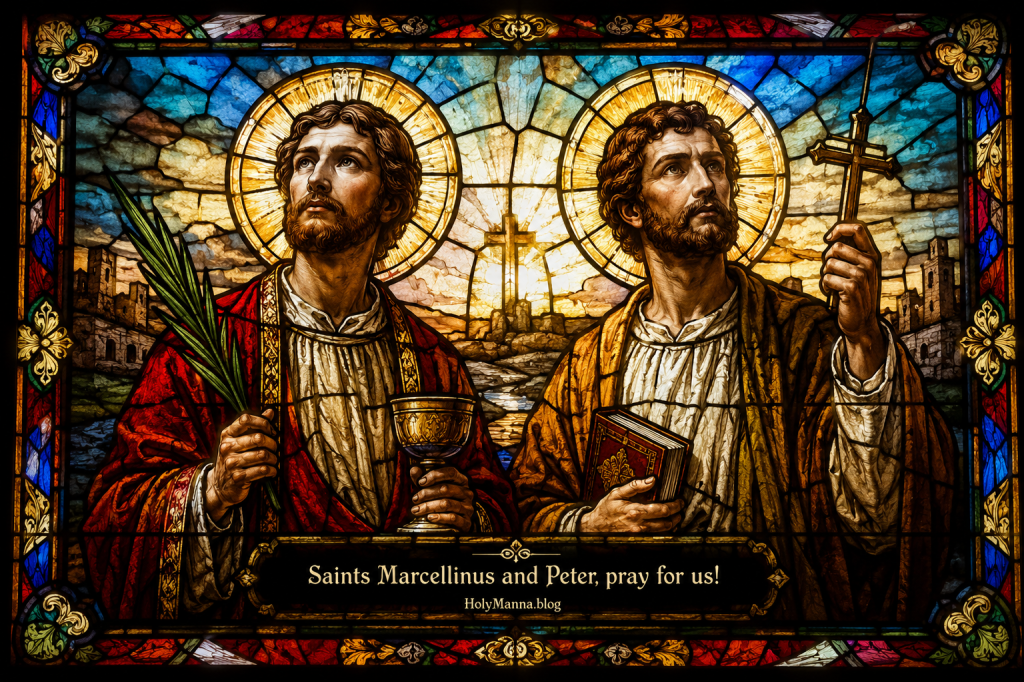
Martyrs Rome Tried to Hide, But the Church Never Forgot
Some saints are remembered because they wrote books, founded monasteries, preached to nations, or shaped history in obvious ways. Saints Marcellinus and Peter are remembered for something quieter, but just as powerful. They were faithful when faithfulness became dangerous.
Saint Marcellinus was a priest. Saint Peter was an exorcist. They served the Church of Rome during one of the darkest moments in early Christian history, the persecution of Emperor Diocletian. Around A.D. 304, they were imprisoned, tortured, and eventually executed for refusing to deny Christ.
The Roman authorities tried to make their deaths disappear. According to tradition, they were taken into a hidden forest, forced to dig their own graves, and beheaded in secret so Christians would not find their bodies or honor them as martyrs.
But the plan failed.
The Church remembered them. Their burial place became holy ground. Their names were placed in the Roman Canon, now Eucharistic Prayer I. Their catacombs became one of the great Christian burial sites of ancient Rome. And centuries later, Catholics still honor them on June 2 as courageous witnesses to Christ.
Their story reminds every Christian that no act of faithfulness is wasted. The world may overlook it. History may forget the details. But God remembers everything offered in love.
Two Servants of the Church in Dangerous Times
Very little is known about the early lives of Saints Marcellinus and Peter. Their birthplaces, families, and childhoods have not been preserved in the historical record. That is common with many early Roman martyrs. What the Church has preserved is not a full biography, but the heart of their witness.
Marcellinus was a priest of Rome. He would have offered the sacraments, preached the faith, baptized converts, and strengthened Christians during a time when following Jesus could cost a person everything.
Peter was an exorcist, which in the early Church was a recognized clerical ministry. His title matters because it shows that he served in the Church’s mission of spiritual liberation. The Catechism teaches, “When the Church asks publicly and authoritatively in the name of Jesus Christ that a person or object be protected against the power of the Evil One and withdrawn from his dominion, it is called exorcism.” CCC 1673
Peter’s role was not about spectacle. It was about the authority of Christ over darkness. The same Jesus who cast out demons in the Gospels continued His work through the Church.
Marcellinus and Peter lived during the Great Persecution under Diocletian, when Christians were ordered to surrender sacred books, destroy churches, abandon worship, and sacrifice to pagan gods. Clergy were especially targeted because they were seen as leaders of the Christian community.
In that dangerous world, Marcellinus and Peter did not hide their faith. They lived as men who belonged to Christ.
Prison Became Their Mission Field
The most beloved traditions about Saints Marcellinus and Peter come from their time in prison.
According to the ancient story, Peter the exorcist was imprisoned because of his faith. While there, he encountered the jailer Artemius and his daughter Paulina, who was said to be tormented by an evil spirit. Peter prayed for her, and she was delivered. This miracle led Artemius, his wife, sometimes named Secunda or Candida in later traditions, Paulina, and members of the household to believe in Christ.
Peter then brought them to Marcellinus, the priest, who baptized them.
This story cannot be fully verified in every detail, so it should be treated as a treasured Catholic tradition rather than a proven historical record. Still, it beautifully expresses the Christian truth at the center of their witness. The empire thought prison would silence them, but prison became a place of evangelization.
That is one of the most powerful parts of their story. Marcellinus and Peter did not wait for ideal conditions to serve God. They did not need comfort, safety, or applause. They preached Christ where they were.
A jail cell became a chapel. A persecutor’s household became a Christian family. A place meant for fear became a place of grace.
How often do Christians wait for life to get easier before living their faith boldly?
Saints Marcellinus and Peter remind the Church that the Gospel can bear fruit even in the hardest places.
The Priest, the Exorcist, and the Power of Christ
Marcellinus and Peter are often remembered together because their ministries complemented each other.
Peter, the exorcist, witnessed to Christ’s victory over evil. Marcellinus, the priest, brought converts into the sacramental life of the Church. Peter’s ministry revealed the power of Christ. Marcellinus’ ministry led souls into communion with Christ.
The story of Paulina’s deliverance is especially meaningful from a Catholic perspective. It shows that salvation is not just moral improvement or positive thinking. Christ came to rescue humanity from sin, death, and the power of the Evil One.
The Church still teaches this clearly. Evil is real. Sin is real. Spiritual battle is real. But Christ is stronger.
That is why Peter’s title is so fitting. He was not simply a brave man who happened to suffer. He was a servant of the Church who knew that Jesus Christ reigns over every darkness.
Marcellinus, too, shows the quiet power of priestly ministry. In the tradition, he baptizes the converts won through Peter’s witness. This is not a small detail. Baptism is the doorway into Christian life. Through Baptism, a soul is joined to Christ, cleansed from sin, and made a member of His Body, the Church.
Together, these two saints show the Church in action: proclaiming, healing, liberating, baptizing, and preparing souls for eternal life.
When Faithfulness Became a Crime
The Roman authorities eventually discovered that Marcellinus and Peter were not only refusing to abandon Christianity, but were also converting others.
According to tradition, they were brought before a judge and ordered to deny Christ. They refused.
Marcellinus was reportedly beaten, stripped, and locked in a dark cell without food or light. Some later accounts add that the floor was covered with broken glass. Peter, too, was returned to prison and subjected to suffering.
These details come from hagiographical tradition and cannot all be verified historically. But they match the known brutality of the Diocletian persecution and the kind of suffering many Christians endured for refusing to offer sacrifice to pagan gods.
Their courage reflects the teaching of The Catechism, which says, “Martyrdom is the supreme witness given to the truth of the faith.” CCC 2473
The martyr does not die because death is good. The martyr dies because Christ is worth more than life itself.
That is hard for the modern heart to understand. People today are often told that comfort is the goal, safety is the highest good, and truth should bend whenever it becomes inconvenient. The martyrs tell a different story. They teach that truth is worth suffering for, Christ is worth dying for, and eternal life is more real than earthly power.
The Forest Where Rome Tried to Bury Their Memory
The authorities wanted to prevent Christians from honoring Marcellinus and Peter after death. In the early Church, the tombs of martyrs became places of prayer, devotion, and Eucharistic worship. Rome understood that martyrdom did not weaken Christians. It strengthened them.
So, according to tradition, Marcellinus and Peter were taken secretly to a wooded place outside the city. The place was remembered as the Black Forest, or Selva Nera. There, they were forced to clear away thorns and brambles and dig their own graves.
Then they were beheaded.
The authorities wanted their deaths hidden. They wanted their bodies forgotten. They wanted no shrine, no pilgrimage, no memory, no testimony.
But God had other plans.
Christian tradition later remembered that the Black Forest became known as the White Forest, or Selva Candida, because the blood of the martyrs had made the place holy.
It is a striking image. Rome chose darkness, secrecy, and fear. Christ brought light, memory, and glory.
That is the Christian mystery of martyrdom. The world sees defeat. The Church sees victory. The executioner sees death. Heaven sees a crown.
The Faithful Women Who Found the Martyrs
After their deaths, the story says that two faithful Christian women, Lucilla and Firmina, recovered the bodies of the martyrs.
Some versions say Lucilla discovered the location through divine guidance. With Firmina’s help, she brought the bodies of Marcellinus and Peter to the Christian cemetery known as ad Duas Lauros, meaning “at the two laurel trees,” along the Via Labicana.
This part of the story is beautiful because it shows how seriously early Christians honored the bodies of the martyrs. They did not treat the body as disposable. They believed in the resurrection of the body. They believed that the saints were alive in Christ. They believed that the bodies of the martyrs, which had suffered for Jesus, deserved reverence.
This devotion was not a distraction from Christ. It pointed to Christ.
The martyr’s body says, “This person belonged to Jesus so completely that even death could not separate him from the love of God.”
The burial of Marcellinus and Peter transformed a hidden execution into public witness. What Rome tried to erase became holy memory.
Pope Damasus and the Executioner Who Remembered
One of the most remarkable details connected to Saints Marcellinus and Peter comes from Pope Saint Damasus I, who served as pope in the fourth century.
Pope Damasus was known for honoring the martyrs of Rome and composing inscriptions for their tombs. According to tradition, when Damasus was a boy, he heard the story of Marcellinus and Peter from the very executioner who had taken part in their deaths. That executioner later became Christian.
This is one of the most surprising and moving details in their story.
The man ordered to kill them became one of the men who helped preserve their memory.
There is a deep Gospel lesson there. The mercy of Christ can reach even the executioner. The blood of the martyrs does not only inspire the faithful. It can also convert the guilty.
That is the strange and beautiful power of Christian witness. Marcellinus and Peter did not defeat their enemies by violence. They conquered by fidelity. Their courage became a seed of conversion.
The Church does not preserve any verified personal quotations from Marcellinus or Peter. Their witness is their message. Their sermon is their martyrdom.
The Catacombs That Still Speak
The burial place of Saints Marcellinus and Peter became one of the great catacomb sites of ancient Rome. These catacombs, located near the ancient Via Labicana, became a major Christian cemetery. Thousands of Christians were buried there, and the walls preserve early Christian art, symbols, and signs of faith.
This matters because Catholicism is not an abstract faith. It is incarnational. It remembers places, bodies, tombs, relics, churches, roads, and altars. The faith is rooted in real history because God entered real history.
The catacombs of Marcellinus and Peter remind Catholics that the Church grew beneath the surface long before it stood openly in basilicas. While emperors ruled above ground, the faithful prayed below ground. While Rome boasted of power, the martyrs quietly proclaimed a kingdom that would outlast every empire.
Later, after the legalization of Christianity, Emperor Constantine built a basilica near their burial site. His mother, Saint Helena, was buried in a mausoleum nearby. This is another stunning reversal. The empire that once persecuted Christians eventually honored the martyrs it had tried to hide.
The secret forest gave way to a basilica. The hidden graves became a place of pilgrimage.
Their Names at the Altar
One of the greatest signs of their importance is that Saints Marcellinus and Peter are named in the Roman Canon, now Eucharistic Prayer I.
Many Catholics have heard their names at Mass without knowing their story. But every time their names are prayed in that ancient Eucharistic Prayer, the Church remembers their witness.
This is a powerful expression of the communion of saints. The Catechism teaches that the saints do not stop caring for the Church after death. It says, “Their intercession is their most exalted service to God’s plan.” CCC 956
The saints are not dead heroes trapped in the past. They are alive in Christ. They worship God in heaven. They pray for the Church on earth. Their lives encourage the faithful to keep going.
Marcellinus and Peter are not remembered because the world celebrated them. They are remembered because the Church recognizes in them the victory of Christ.
Relics, Pilgrimage, and a Legacy Beyond Rome
The legacy of Saints Marcellinus and Peter eventually spread beyond Rome.
In the ninth century, relics associated with them became connected with Einhard, the famous scholar and servant of Charlemagne. Their relics were brought into the Frankish world and became associated with Seligenstadt in Germany, where Einhard established a church and monastic foundation in their honor.
Medieval accounts speak of miracles connected to the translation of their relics, including healings and divine interventions. These stories belong to the devotional tradition surrounding the saints, but they cannot all be verified in the modern historical sense.
Still, their cultural impact is clear. These two Roman martyrs became loved not only in Rome, but also far beyond Italy. Their witness helped shape Christian memory in Germany, inspired devotion to the martyrs, and strengthened the Catholic belief that the saints remain united to the Church through prayer and intercession.
Their feast day is celebrated on June 2. Because they are martyrs, the liturgical color is red.
They are especially connected with the Catacombs of Saints Marcellinus and Peter in Rome, the ancient Roman church dedicated to them, and the devotion that developed around their relics in Seligenstadt.
Miracles, Legends, and the Faith Behind the Stories
Several miracle stories and legends are associated with Saints Marcellinus and Peter.
The first is the healing or deliverance of Paulina, the daughter of the jailer Artemius, through the prayers of Peter the exorcist. This story says that Paulina was tormented by an evil spirit and was freed through Peter’s ministry. Her healing helped lead her family to conversion. This story cannot be fully verified, but it remains one of the most meaningful traditions connected to the saints.
The second is the conversion of Artemius, his wife, his daughter, and others in the prison. According to tradition, Peter’s witness and Paulina’s deliverance led them to Christ, and Marcellinus baptized them. This story also cannot be fully verified in every detail, but it beautifully shows the Church’s belief that grace can work even in places of suffering.
The third is the discovery of their bodies by Lucilla and Firmina. Some versions say Lucilla was divinely guided to the hidden burial place. This cannot be historically verified in every detail, but it reflects the early Christian conviction that God protects the memory of His martyrs.
The fourth is the tradition of miracles connected to their relics after they were brought into the Frankish world, especially near Seligenstadt. Medieval Christians attributed healings and graces to their intercession. These miracle stories cannot all be verified, but they show how deeply the faithful trusted the prayers of the saints.
Catholics do not need every legendary detail to be historically provable in order to understand the spiritual truth being handed down. The truth at the center of their story is clear. Christ strengthened His martyrs. Their witness converted others. Their memory endured. Their intercession encouraged the Church.
The Courage to Be Faithful When No One Is Watching
Saints Marcellinus and Peter speak powerfully to modern Catholics because their story is mostly hidden.
They were not famous in the way the world understands fame. They did not build an empire. They did not leave behind a library of writings. They did not become celebrities of their age.
They were faithful.
That is the lesson.
Most Christians will never be asked to die in a forest for the faith. But every Christian is asked to die to sin, pride, cowardice, resentment, comfort, and compromise. Every Christian is asked to choose Christ when it costs something.
The witness of Marcellinus and Peter asks a serious question: Would faith remain strong if no one applauded it?
They also remind Catholics that suffering can become mission. Their prison became a place of evangelization. Their hardship became a witness. Their hidden death became a public memory of grace.
That does not mean suffering is easy. It means suffering offered to Christ is never wasted.
A difficult workplace can become a place of witness. A strained family relationship can become a place of mercy. A season of loneliness can become a place of prayer. A spiritual battle can become a deeper surrender to Christ.
Saints Marcellinus and Peter show that holiness does not always look impressive from the outside. Sometimes holiness looks like refusing to deny Jesus when the world applies pressure. Sometimes it looks like quietly doing the right thing. Sometimes it looks like trusting God in the dark.
What These Martyrs Teach the Church Today
The lives of Saints Marcellinus and Peter remind Catholics that courage is not the absence of fear. Courage is faithfulness in the presence of fear.
They teach that evil is real, but Christ is stronger.
They teach that the sacraments matter, especially Baptism, because souls are not simply improved by grace. They are reborn in Christ.
They teach that the Church remembers what the world forgets.
They teach that martyrdom is not failure. It is witness.
They teach that the saints are not distant legends, but living members of the Body of Christ who pray for the faithful and point them toward heaven.
For Catholics today, their example can be lived in simple but serious ways. Speak the truth with charity. Refuse to compromise the faith to fit in. Pray for courage before trials come. Make the sacraments the center of life. Remember that every hidden act of fidelity matters to God.
Where is Christ asking for courage today?
What hidden place in life could become a mission field?
What fear needs to be surrendered so faith can become more visible?
Saints Marcellinus and Peter were taken to a forest because Rome wanted silence. Instead, their witness still speaks.
Engage With Us!
Share your thoughts and reflections in the comments below. Saints Marcellinus and Peter remind the Church that hidden faithfulness can become a lasting witness. Their story invites every Catholic to think honestly about courage, sacrifice, and trust in Christ.
- What part of the story of Saints Marcellinus and Peter challenges you the most?
- Have you ever experienced a difficult place in life becoming a place where God asked you to witness to your faith?
- What does it mean to stay faithful to Christ when no one else sees the sacrifice?
- How can the courage of the martyrs help Catholics live more boldly in today’s world?
- Where might Jesus be asking you to choose truth, mercy, and faith over comfort?
May the witness of Saints Marcellinus and Peter encourage every heart to live with courage, humility, and trust. May their prayers help the faithful choose Christ in hidden places, love with patience, forgive with mercy, and do everything with the love and mercy Jesus taught us.
Saints Marcellinus and Peter, pray for us!
Follow us on YouTube, Instagram and Facebook for more insights and reflections on living a faith-filled life.


Leave a Reply