Tuesday of the Ninth Week in Ordinary Time – Lectionary: 354
The Soul Bears God’s Image
Every generation has to decide what it will do with the time God has given it.
Today’s readings place eternity, mortality, and daily responsibility side by side. Saint Peter lifts our eyes toward the promised “new heavens and a new earth in which righteousness dwells” (2 Peter 3:13). The Psalmist reminds us that human life is brief, fragile, and completely dependent on the mercy of the eternal God. Then Jesus stands before men trying to trap Him and teaches that while Caesar may have a rightful claim on the coin, God has the highest claim on the soul.
The central theme is holy belonging. Everything is passing, but God remains. Civil powers rise and fall. Human strength fades. Days move quickly. Even the created world, wounded by sin, awaits purification and renewal. Yet in the middle of all this, the Christian is not called to fear, panic, or withdraw from ordinary life. The Christian is called to live faithfully, to grow in grace, and to give God what already bears His image.
This background matters. The first reading comes from a Christian community learning to wait for Christ’s return without growing careless or cynical. The Psalm, traditionally connected to Moses, speaks with the wisdom of someone who knows that life is short and God alone is eternal. The Gospel takes place in Roman-occupied Judea, where the census tax was politically explosive and the denarius carried Caesar’s image and inscription. The Pharisees and Herodians think they have trapped Jesus between religious loyalty and political danger, but He reveals something far deeper.
The coin belongs to Caesar because it bears Caesar’s image. The human person belongs to God because every soul bears God’s image. This is why The Catechism of the Catholic Church teaches both respect for legitimate civil authority and the higher duty of conscience before God (CCC 2240-2242). Catholics are called to be responsible citizens, but never servants of the world’s idols. The final loyalty of the heart belongs to Christ.
Today’s readings prepare the soul to ask one honest question: What belongs to God that has quietly been handed over to something else?
First Reading – 2 Peter 3:12-15, 17-18
Waiting for the World God Promised
Saint Peter speaks to Christians who are learning how to wait without growing careless. The first generations of believers knew that Jesus had died, risen, ascended into heaven, and promised to return in glory. Yet as time passed, some began to doubt, while others began to treat God’s patience as if it were permission to live without urgency.
That is why this reading fits today’s theme so beautifully. If the Gospel will later ask what belongs to Caesar and what belongs to God, Peter begins by reminding the Church that time itself belongs to God. History is moving toward Christ. Creation is not drifting aimlessly. The world wounded by sin will be purified, renewed, and brought under the reign of the Lord.
This is not meant to make Christians panic about the end of the world. It is meant to teach them how to live today. A Catholic does not wait for Christ by becoming passive, cynical, or distracted. A Catholic waits by growing in holiness. Peter’s message is clear: because the Lord is coming, the Christian must live in peace, repentance, vigilance, and grace.
2 Peter 3:12-15, 17-18 – New American Bible (Revised Edition)
12 waiting for and hastening the coming of the day of God, because of which the heavens will be dissolved in flames and the elements melted by fire. 13 But according to his promise we await new heavens and a new earth in which righteousness dwells.
14 Therefore, beloved, since you await these things, be eager to be found without spot or blemish before him, at peace. 15 And consider the patience of our Lord as salvation, as our beloved brother Paul, according to the wisdom given to him, also wrote to you,
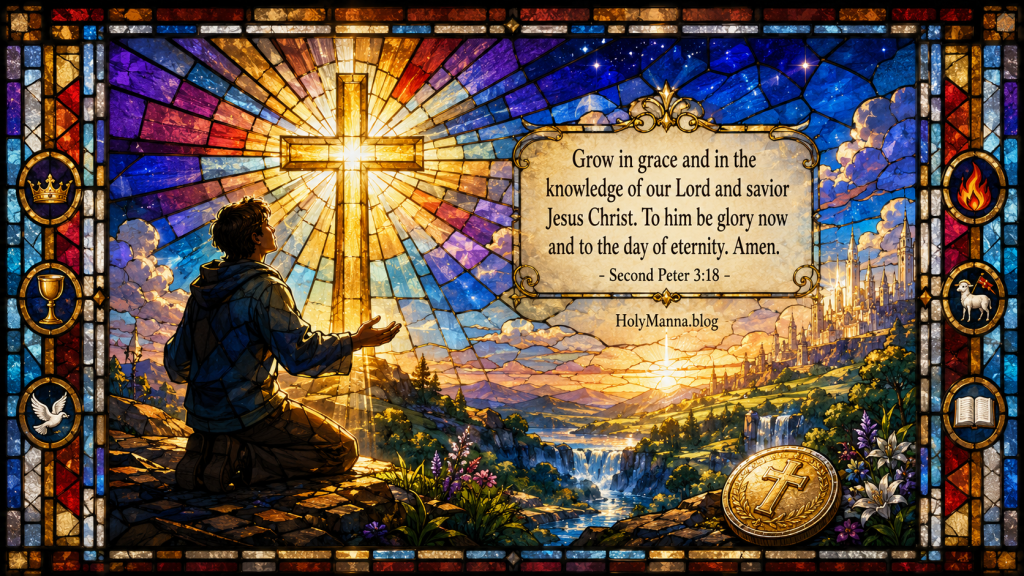
17 Therefore, beloved, since you are forewarned, be on your guard not to be led into the error of the unprincipled and to fall from your own stability. 18 But grow in grace and in the knowledge of our Lord and savior Jesus Christ. To him be glory now and to the day of eternity. [Amen.]
Detailed Exegesis
Verse 12 – “waiting for and hastening the coming of the day of God, because of which the heavens will be dissolved in flames and the elements melted by fire.”
Peter begins with a striking image of the “day of God” (2 Peter 3:12). In biblical language, the “day of the Lord” refers to God’s decisive intervention in history, a day of judgment, purification, and final victory. Peter is not speaking like someone trying to satisfy curiosity about dates and timelines. He is speaking like a pastor trying to wake up sleepy souls.
The phrase “waiting for and hastening” is especially important. Christians wait because the final renewal of all things is God’s work, not ours. Yet Christians also “hasten” that day by living holy lives, praying, evangelizing, repenting, and cooperating with grace. The Church has always understood that God’s plan unfolds through His providence, but He still invites His people to participate through faithfulness.
The fire in this verse should not be read as meaningless destruction. In Scripture, fire often purifies. Gold is tested by fire. Sacrifice is offered by fire. The Holy Spirit descends in tongues of fire. Peter is teaching that the world, corrupted by sin, will not remain as it is forever. God will purify what is disordered so that His righteousness may dwell fully.
Verse 13 – “But according to his promise we await new heavens and a new earth in which righteousness dwells.”
This verse is the heart of the reading. Peter does not leave the Christian staring at fire. He turns the eyes of the soul toward promise. The end of history is not emptiness. It is renewal. The Christian hope is not merely that souls escape the world, but that God brings about “new heavens and a new earth” (2 Peter 3:13).
This language reaches back to the prophet Isaiah, who speaks of God creating new heavens and a new earth, and forward to The Book of Revelation, where Saint John sees the holy city and hears that God will dwell with His people. Peter stands in that same biblical tradition. God does not abandon creation. He restores it.
The phrase “in which righteousness dwells” shows what kind of world God is preparing. It is not simply a prettier version of the present age. It is a renewed creation where sin no longer corrupts love, justice, worship, work, or human relationships. This matters because Christian hope is moral. To await a world where righteousness dwells means learning to love righteousness now.
Verse 14 – “Therefore, beloved, since you await these things, be eager to be found without spot or blemish before him, at peace.”
Peter now turns doctrine into daily life. Because Christians await the new heavens and new earth, they must be eager to be found “without spot or blemish” (2 Peter 3:14). This language recalls the Old Testament sacrifices, which were to be offered without defect, and it also points toward Christ, the spotless Lamb.
A Catholic hears this and thinks immediately of holiness, confession, and the life of grace. Peter is not saying that Christians save themselves by moral effort. He is saying that grace must bear fruit. The person who truly hopes in Christ’s return does not make peace with sin.
The phrase “at peace” is also deeply pastoral. Waiting for the Lord should not produce frantic fear in a faithful Christian. It should produce peace. This is the peace of a soul that is reconciled to God, attentive to conscience, and willing to be purified. It is the peace that comes from living ready, not from pretending judgment will never come.
Verse 15 – “And consider the patience of our Lord as salvation, as our beloved brother Paul, according to the wisdom given to him, also wrote to you.”
This verse gives one of the most comforting teachings in the reading: God’s patience is salvation. When the Lord delays judgment, He is not ignoring sin. He is giving time for repentance. His patience is not weakness. It is mercy.
This is a powerful correction for the modern heart. People often mistake God’s silence for absence, and they mistake His patience for approval. Peter says something very different. Every day before the final judgment is another day of mercy. Every confession is mercy. Every Mass is mercy. Every morning is mercy. Every invitation to repent is mercy.
Peter also refers to Saint Paul as “our beloved brother” (2 Peter 3:15), recognizing the wisdom given to him. This is a beautiful glimpse of apostolic unity. Peter and Paul had different personalities, different missions, and even moments of tension, but they preached the same Lord, the same Gospel, and the same hope. The Catholic faith is apostolic because it receives this living witness from those Christ sent.
Verse 17 – “Therefore, beloved, since you are forewarned, be on your guard not to be led into the error of the unprincipled and to fall from your own stability.”
Peter now becomes very direct. Christians are “forewarned” (2 Peter 3:17), which means they cannot pretend they have not been taught. The Church knows Christ will return. The Church knows false teachers will arise. The Church knows human beings can be spiritually unstable when they stop clinging to truth.
The warning is not dramatic for drama’s sake. It is fatherly. Peter knows that error does not always arrive looking ugly. Sometimes it sounds sophisticated. Sometimes it sounds compassionate while quietly rejecting the Gospel. Sometimes it flatters the ego. Sometimes it says sin is harmless, repentance is unnecessary, and holiness is extreme.
To “be on your guard” (2 Peter 3:17) is not to live suspiciously or fearfully. It is to remain rooted. Catholics remain stable through Scripture, Tradition, the sacraments, obedience to the Church, and a conscience formed by truth rather than mood or culture.
Verse 18 – “But grow in grace and in the knowledge of our Lord and savior Jesus Christ. To him be glory now and to the day of eternity. Amen.”
Peter ends not with fear, but with growth. The Christian answer to instability is not merely avoiding error. It is growing in grace. This is one of the simplest and most beautiful descriptions of the spiritual life in the New Testament.
To “grow in grace” (2 Peter 3:18) means that holiness is meant to mature. A Catholic should not have the same prayer life forever, the same avoidable sins forever, the same shallow understanding forever, or the same resistance to surrender forever. Grace is living. It heals, strengthens, purifies, and raises the soul toward God.
Peter also says to grow “in the knowledge of our Lord and savior Jesus Christ” (2 Peter 3:18). This is not just information about Jesus. It is personal, faithful, obedient knowledge. It is the kind of knowledge that comes from prayer, Scripture, the Eucharist, confession, and daily discipleship.
The final words give the whole reading its direction: “To him be glory now and to the day of eternity” (2 Peter 3:18). All history belongs to Christ. The present moment belongs to Christ. The end of time belongs to Christ. The soul belongs to Christ.
Teachings: The Patience of God and the Hope of a Renewed Creation
This reading brings together three major Catholic teachings: the return of Christ, the renewal of creation, and the call to holiness while waiting.
The Catechism of the Catholic Church teaches that history is moving toward fulfillment in Christ, not toward meaninglessness. In CCC 1042, the Church teaches: “At the end of time, the Kingdom of God will come in its fullness.” That short sentence carries enormous hope. Evil does not get the last word. Sin does not get the last word. Death does not get the last word. Christ does.
Peter’s promise of “new heavens and a new earth” (2 Peter 3:13) is also taken up directly by the Church’s teaching on the final renewal of creation. The Catechism explains in CCC 1043: “Sacred Scripture calls this mysterious renewal, which will transform humanity and the world, ‘new heavens and a new earth.’” This means Catholic hope is not anti-body or anti-creation. The Christian does not believe that matter is evil or that salvation means floating away from creation. The Son of God took on flesh. He rose bodily from the dead. The destiny of the redeemed is resurrection, not escape.
This is why Peter’s call to holiness matters so much. The future renewal of creation is not an excuse to neglect the present world. It is a reason to live more faithfully within it. The Catechism teaches in CCC 1049: “Far from diminishing our concern to develop this earth, the expectancy of a new earth should spur us on.” Catholics should care about justice, family, honest work, mercy, the poor, the unborn, the elderly, and the dignity of every human person precisely because creation belongs to God and is destined for renewal in Christ.
Saint Augustine’s teaching on the two cities also helps illuminate Peter’s warning. In The City of God, Augustine famously contrasts the earthly city and the heavenly city by their loves: “Two loves have made two cities: love of self, even to contempt of God, and love of God, even to contempt of self.” Peter is essentially asking Christians which city they are living for. The unstable soul is led away by disordered love. The holy soul is steadied by love of God.
The reading also teaches the mercy hidden inside God’s patience. Peter says, “Consider the patience of our Lord as salvation” (2 Peter 3:15). This is not sentimental. It is deeply Catholic. God gives time so sinners may repent. The sacrament of confession is one of the most concrete ways Catholics experience this patience. The Lord does not merely tell sinners to try harder. He gives grace. He forgives. He restores. He strengthens the soul to begin again.
Saint Peter’s final command, “grow in grace” (2 Peter 3:18), also points toward the Church’s sacramental life. Grace is not an idea. Grace is God’s own life shared with the soul. Baptism gives sanctifying grace. Confession restores it when it has been lost through mortal sin. The Eucharist nourishes it. Confirmation strengthens it. Prayer disposes the heart to receive and cooperate with it.
This is why Catholic waiting is active. The Church is waiting for Christ, but she waits like a Bride preparing for the Bridegroom. She keeps watch. She repents. She worships. She teaches. She serves. She grows.
Reflection: Do Not Waste the Time Mercy Has Given
Peter’s message is urgent, but it is not gloomy. He is not trying to scare Christians into spiritual anxiety. He is trying to shake them free from spiritual sleep.
There is a big difference.
Spiritual anxiety says, “God is coming, so panic.” Christian hope says, “God is coming, so live ready.” Spiritual laziness says, “God has not judged yet, so it must not matter.” Peter says, “Consider the patience of our Lord as salvation” (2 Peter 3:15).
That line is a gift for everyday life. God’s patience is the reason there is still time to forgive someone. There is still time to go to confession. There is still time to pray seriously. There is still time to stop feeding a sin that has been quietly weakening the soul. There is still time to return to Mass with attention and reverence. There is still time to become the kind of Catholic who does not just believe in eternity, but lives like eternity is real.
This reading also challenges the way modern people think about progress. The world often says progress means more comfort, more control, more entertainment, and more personal freedom without moral responsibility. Peter gives a better vision. True progress is growth in grace. True maturity is holiness. True peace is being found by Christ without spot or blemish.
A simple way to live this reading is to begin the day with eternity in mind. Before checking messages, before rushing into work, before giving the world the first claim on attention, the soul can turn to God and pray, “Lord, help this day belong to You.” That kind of prayer slowly changes a person. It reminds the heart that time is not a possession. It is a gift.
Another step is to examine what has made the soul unstable. Peter warns against being led into error and falling from stability. For some people, instability comes from consuming too much noise. For others, it comes from secret sin, resentment, political anger, laziness in prayer, or the slow habit of letting culture form the conscience more than the Church does. Stability returns when the soul returns to Christ.
The reading ends with the simplest path forward: grow in grace.
That growth does not need to be dramatic to be real. It may look like ten honest minutes of prayer. It may look like going to confession after too much delay. It may look like reading the Gospel before scrolling. It may look like forgiving before bitterness hardens. It may look like choosing purity, patience, humility, or silence when the old self wants attention.
The Lord is patient, but His patience is not an invitation to drift. It is an invitation to come home.
Where has God been patient with your soul lately?
Are you using the time God has given you to grow in grace, or simply to stay comfortable?
What would it look like today to live as someone waiting for the new heavens and the new earth?
What false idea, habit, or distraction has been pulling you away from stability in Christ?
Saint Peter does not ask the Church to guess the date of the Lord’s return. He asks the Church to be ready. The Christian who is growing in grace does not need to fear the day of God, because that day belongs to the One who already gave Himself for our salvation.
Responsorial Psalm – Psalm 90:1-4, 10, 14, 16
The Mercy That Meets Us in the Morning
Psalm 90 sounds like a prayer spoken by someone who has seen enough of life to stop pretending that time is endless. It is traditionally called “A prayer of Moses, the man of God” (Psalm 90:1), which gives it the feel of desert wisdom. Moses knew what it meant to walk with a people who were fragile, impatient, sinful, and constantly dependent on the mercy of God. He also knew that the Lord was faithful from generation to generation.
This Psalm fits today’s theme because it places human life under the light of eternity. Saint Peter speaks of the coming “new heavens and a new earth” (2 Peter 3:13), and Jesus teaches that the soul belongs to God because it bears His image. The Psalm sits between those truths and teaches the heart how to pray: life is short, God is eternal, and every day must begin with mercy.
The Psalmist does not deny sorrow, aging, or death. He faces them with faith. That is deeply Catholic. The Church never asks her children to pretend death is not real. She asks them to see death, time, and human weakness through the mercy of the eternal God. In a world that tries to distract itself from mortality, Psalm 90 quietly tells the truth and then turns that truth into prayer.
Psalm 90:1-4, 10, 14, 16 – New American Bible (Revised Edition)
God’s Eternity and Human Frailty
1 A prayer of Moses, the man of God.
Lord, you have been our refuge
through all generations.
2 Before the mountains were born,
the earth and the world brought forth,
from eternity to eternity you are God.
3 You turn humanity back into dust,
saying, “Return, you children of Adam!”
4 A thousand years in your eyes
are merely a day gone by,
Before a watch passes in the night,10 Seventy is the sum of our years,
or eighty, if we are strong;
Most of them are toil and sorrow;
they pass quickly, and we are gone.14 Fill us at daybreak with your mercy,
that all our days we may sing for joy.
Detailed Exegesis
Verse 1 – “Lord, you have been our refuge through all generations.”
The Psalm begins not with fear, but with trust. Before speaking about dust, sorrow, or the shortness of life, the Psalmist first names God as refuge. This matters because Christian reflection on mortality must always begin with God’s faithfulness, not human anxiety.
The word “refuge” (Psalm 90:1) suggests shelter, safety, and stability. Generations come and go, but the Lord remains. Families change. Nations rise and fall. Human strength fades. Yet God has carried His people through every age. This is the first lesson of the Psalm: the believer does not find ultimate security in youth, money, health, politics, reputation, or control. The believer finds refuge in the Lord.
Verse 2 – “Before the mountains were born, the earth and the world brought forth, from eternity to eternity you are God.”
The Psalmist now looks beyond human history to creation itself. Mountains seem ancient and immovable, but even they had a beginning. God did not. Before creation existed, God was already God.
This verse teaches the eternity of God. He is not one powerful being among others. He is the Creator, the One whose existence does not depend on anything else. The Catholic faith teaches that God is eternal, all-powerful, and the source of all that exists. When the Psalm says “from eternity to eternity you are God” (Psalm 90:2), it reminds the reader that human life only makes sense when placed inside God’s eternal life.
This also brings peace. God is not rushed. God is not aging. God is not surprised by history. The same God who formed the mountains holds the days of every soul.
Verse 3 – “You turn humanity back into dust, saying, ‘Return, you children of Adam!’”
Here the Psalm becomes very honest. Human beings are not eternal by nature. The body returns to dust. The verse echoes Genesis, where after the fall, God tells Adam, “For you are dust, and to dust you shall return” (Genesis 3:19).
This is not meant to humiliate humanity. It is meant to restore humility. Sin often makes people live as if they are self-made, self-sufficient, and untouchable. The memory of dust corrects that illusion. Every person is created by God, sustained by God, judged by God, and called back to God.
Catholic tradition has always seen this truth as spiritually healthy. The Church places ashes on the forehead at the beginning of Lent and says, “Remember that you are dust, and to dust you shall return.” That reminder is not despair. It is mercy. It teaches the soul not to waste the time given by God.
Verse 4 – “A thousand years in your eyes are merely a day gone by, before a watch passes in the night.”
Human beings experience time as pressure. God does not. A thousand years, which sounds unimaginably long to us, is like a passing day before the eternal Lord.
This verse helps explain the patience of God in the first reading. Saint Peter says, “Consider the patience of our Lord as salvation” (2 Peter 3:15). God’s timing is not human timing. What feels delayed to us is held within divine providence. The Lord is not careless with history. He is merciful within history.
The image of “a watch passes in the night” (Psalm 90:4) also gives the verse a quiet beauty. A night watch was only a portion of the night, brief and passing. The Psalmist is saying that even the longest stretch of human history is small before God. This should not make life feel meaningless. It should make life feel precious.
Verse 10 – “Seventy is the sum of our years, or eighty, if we are strong; most of them are toil and sorrow; they pass quickly, and we are gone.”
This verse is one of the most sobering lines in the Psalms. It does not flatter the reader. It tells the truth. Even a long life is brief. Even a strong life carries toil and sorrow. The years pass quickly.
In Catholic spirituality, this kind of reflection is called remembrance of death. It is not morbid when joined to faith. It is clarifying. It helps the soul ask better questions. Not merely, “How can life be more comfortable?” but, How can this life become holy? Not merely, “How can time be filled?” but, How can time be offered to God?
The Psalm does not say life is worthless because it is short. It says life is serious because it is short. The passing nature of earthly life should awaken love, repentance, gratitude, and urgency.
Verse 14 – “Fill us at daybreak with your mercy, that all our days we may sing for joy.”
After speaking honestly about death and sorrow, the Psalmist turns toward morning. This is beautiful. The answer to human frailty is not denial. It is mercy.
The prayer “Fill us at daybreak with your mercy” (Psalm 90:14) teaches the soul how to begin again. Before work, before worry, before conflict, before temptation, before the day’s responsibilities press in, the believer asks to be filled with God’s mercy. This is the only way to live joyfully in a passing world.
The Psalm does not promise a life without suffering. It asks for joy rooted in mercy. That is a very Catholic kind of joy. It does not depend on everything going smoothly. It depends on being held by God.
Verse 16 – “Show your deeds to your servants, your glory to their children.”
The Psalm ends by looking beyond one individual life. The Psalmist asks God to reveal His works not only to the present generation, but also to their children. Faith is meant to be handed on.
This verse matters deeply in a culture that often lives only for the present moment. The believer prays for God’s glory to be seen by the next generation. Parents, grandparents, godparents, catechists, priests, religious, and ordinary Catholics all share in this mission. The mercy received at daybreak must become a witness that reaches children, families, parishes, and communities.
This is also where Psalm 90 connects to today’s Gospel. If the soul belongs to God, then family life, work, time, and witness also belong to God. The question is not only whether one generation will survive. The question is whether that generation will show the next one where refuge is found.
Teachings: Mortality, Mercy, and the Wisdom of the Church
Psalm 90 teaches the Catholic heart how to hold together two truths that modern culture often separates: life is fragile, and God is faithful.
The Catechism of the Catholic Church speaks plainly about mortality in CCC 1007: “Death is the end of earthly life.” That sentence is simple, but it cuts through denial. Earthly life has an end. Every person has limited time to love, repent, forgive, serve, pray, and become holy.
Yet the Church does not teach this as despair. She teaches it in light of Christ. Death entered human experience through sin, but Christ transformed death by entering it Himself. Because of the Resurrection, death is still serious, but it is no longer the final word for those who die in God’s grace.
The Psalm’s prayer for mercy also fits the whole life of the Church. Every Mass begins with an appeal to mercy. Every confession is a personal encounter with mercy. Every morning prayer is a new chance to receive mercy before trying to carry the day alone. This is why the Psalm says, “Fill us at daybreak with your mercy” (Psalm 90:14). The soul does not need vague optimism. The soul needs divine mercy.
Saint Augustine gives a beautiful key for understanding this Psalm’s longing for refuge. In Confessions, he writes, “You have made us for yourself, O Lord, and our heart is restless until it rests in you.” That is exactly what Psalm 90 reveals. Human life feels restless when it tries to make temporary things into eternal shelters. God alone can be the refuge of every generation.
The monastic tradition also cherished the remembrance of death as a path to wisdom. Saint Benedict writes in his Rule, “Keep death daily before your eyes.” This is not a command to be gloomy. It is a command to live awake. The person who remembers death in Christ becomes more grateful, more honest, less attached to vanity, and more serious about love.
The Church’s liturgical life carries this same wisdom. On Ash Wednesday, Catholics hear, “Remember that you are dust, and to dust you shall return.” The ashes do not deny the dignity of the human person. They remind the baptized that every earthly life must be surrendered to God. Dust is not the end of the Christian story, because Christ has promised resurrection. Still, the path to resurrection passes through humility, repentance, and trust.
This Psalm also deepens today’s central theme of holy belonging. God is eternal. Human life is brief. Therefore, the right response is not fear, but surrender. Time belongs to God. The body belongs to God. Each morning belongs to God. Each generation belongs to God. The soul that understands this begins to pray differently.
Reflection: Begin the Day Where Life Finds Its Refuge
There is something deeply honest and deeply healing about Psalm 90. It does not pretend life is easy. It does not pretend years move slowly. It does not pretend sorrow is rare. It looks directly at the shortness of life and still says, “Lord, you have been our refuge through all generations” (Psalm 90:1).
That is a lesson for daily life. A person can spend years trying to make fragile things feel permanent. Career, money, health, youth, status, comfort, and control can all become false refuges. They may be good in their proper place, but none of them can carry the weight of eternity.
Only God can.
This Psalm invites a simple but powerful habit: begin the day with mercy. Before checking the phone, before stepping into work, before carrying yesterday’s stress into today, the heart can pray, “Lord, fill this morning with Your mercy.” That prayer changes the day because it puts God first. It reminds the soul that life is received, not owned.
Another practical step is to let mortality create gratitude instead of fear. If life is short, then resentment is too expensive. Pride is too heavy. Sin is too dangerous. Prayer is too important to keep postponing. Confession is too healing to avoid. Family is too precious to take for granted. The Eucharist is too great a gift to treat casually.
The Psalm also challenges the way time is spent. A Catholic does not need to live anxiously, but a Catholic should live intentionally. If the years “pass quickly” (Psalm 90:10), then every day deserves to be offered back to God. This can happen through morning prayer, honest work, patience with family, a small act of charity, a sincere examination of conscience, and a renewed commitment to Sunday Mass.
The final verse asks God to show His glory to the next generation. That makes this Psalm especially urgent for parents, grandparents, catechists, godparents, and anyone whose life quietly teaches others what matters. Children learn where refuge is found by watching where adults run in times of stress, sorrow, and decision.
Where do you run first when life feels uncertain?
Does your morning begin with God’s mercy, or does the world get the first word over your heart?
If life is shorter than people like to admit, what act of love, forgiveness, or repentance should not be delayed?
What would the next generation learn about God by watching how you spend your time?
The Psalmist does not ask God for endless earthly years. He asks for mercy, joy, and a glimpse of God’s glory. That is wisdom. A long life without God is still empty, but even a fragile life becomes holy when it is filled at daybreak with His mercy.
Holy Gospel – Mark 12:13-17
The Coin Bears Caesar’s Image, but the Soul Bears God’s
The Gospel brings today’s theme into the streets of Jerusalem, where faith, politics, money, and conscience collide in one carefully planned trap. Jesus is approached by Pharisees and Herodians, two groups that did not naturally belong together. The Pharisees were known for their concern with the Law and religious purity, while the Herodians were politically connected to the ruling dynasty supported by Rome. Yet both groups see Jesus as a threat, so they join forces.
The question they bring Him is dangerous: should the Jewish people pay the census tax to Caesar? In Roman-occupied Judea, this was not a harmless tax question. The denarius used for the tax carried Caesar’s image and an inscription connected to imperial authority. For faithful Jews, this raised deep concerns about idolatry, oppression, and loyalty to God. If Jesus says to pay the tax, He risks appearing to side with Rome. If He says not to pay it, He can be accused of rebellion.
But Jesus does not fall into their trap. He asks for the coin, points to Caesar’s image, and gives an answer that reaches far beyond politics: “Repay to Caesar what belongs to Caesar and to God what belongs to God” (Mark 12:17). The coin may bear Caesar’s image, but the human person bears God’s image. That is the heart of today’s Gospel, and it completes the theme running through the readings. Time belongs to God. Mercy belongs to God. The soul belongs to God.
Mark 12:13-17 – New American Bible (Revised Edition)
Paying Taxes to the Emperor. 13 They sent some Pharisees and Herodians to him to ensnare him in his speech. 14 They came and said to him, “Teacher, we know that you are a truthful man and that you are not concerned with anyone’s opinion. You do not regard a person’s status but teach the way of God in accordance with the truth. Is it lawful to pay the census tax to Caesar or not? Should we pay or should we not pay?” 15 Knowing their hypocrisy he said to them, “Why are you testing me? Bring me a denarius to look at.” 16 They brought one to him and he said to them, “Whose image and inscription is this?” They replied to him, “Caesar’s.” 17 So Jesus said to them, “Repay to Caesar what belongs to Caesar and to God what belongs to God.” They were utterly amazed at him.
Detailed Exegesis
Verse 13 – “They sent some Pharisees and Herodians to him to ensnare him in his speech.”
This verse reveals the motive before the question is even asked. They are not coming to Jesus as honest seekers. They are coming to “ensnare him” (Mark 12:13). Their goal is not truth. Their goal is accusation.
The alliance between Pharisees and Herodians shows how opposition to Christ can bring unlikely groups together. They may disagree on many things, but they agree that Jesus must be contained. This often happens when truth threatens comfort, power, or control.
Spiritually, this verse warns against using religious language with a dishonest heart. A person can ask a religious question while secretly avoiding conversion. A person can sound respectful while inwardly resisting God. Jesus sees through appearances because He knows the heart.
Verse 14 – “They came and said to him, ‘Teacher, we know that you are a truthful man and that you are not concerned with anyone’s opinion. You do not regard a person’s status but teach the way of God in accordance with the truth. Is it lawful to pay the census tax to Caesar or not? Should we pay or should we not pay?’”
Their words about Jesus are technically true, but their intention is false. They call Him truthful. They admit He teaches the way of God. They acknowledge that He does not bend before human opinion. Yet they say all this as flattery, not faith.
The question about the census tax was politically explosive. The tax symbolized Roman rule over the Jewish people. Some saw paying it as cooperation with oppression. Others saw refusal as dangerous rebellion. The question is designed to force Jesus into a public answer that can be used against Him.
This verse also shows the difference between curiosity and conversion. They are close enough to hear Jesus, but they are not humble enough to receive Him. The Church teaches that truth requires a sincere heart. When people approach Christ only to test Him, they miss the grace being offered.
Verse 15 – “Knowing their hypocrisy he said to them, ‘Why are you testing me? Bring me a denarius to look at.’”
Jesus names the problem plainly: hypocrisy. They pretend to seek moral clarity, but they are setting a trap. He does not respond by flattering them back. He exposes the disorder beneath the question.
Then He asks for a denarius. This small detail matters. Jesus does not produce the coin. They do. The men asking whether it is lawful to pay Caesar are already carrying Caesar’s coin. They are already participating in the economic system they are using to trap Him.
The denarius becomes a teaching tool. Jesus brings the hidden tension into the open. The coin in their hand reveals the world they are navigating. The question is no longer abstract. It is visible, practical, and personal.
Verse 16 – “They brought one to him and he said to them, ‘Whose image and inscription is this?’ They replied to him, ‘Caesar’s.’”
Jesus asks about the image and inscription. The coin bears Caesar’s image, so it belongs to the political order represented by Caesar. But the deeper meaning is unmistakable when read through the whole Bible.
Human beings also bear an image. Genesis teaches, “God created mankind in his image; in the image of God he created them” (Genesis 1:27). If the coin bears Caesar’s image, then the coin can be returned to Caesar. But if the human person bears God’s image, then the human person must be returned to God.
This is why the Gospel is not merely about taxes. It is about worship, identity, conscience, and belonging. Caesar may place his image on money, but only God places His image on the soul.
Verse 17 – “So Jesus said to them, ‘Repay to Caesar what belongs to Caesar and to God what belongs to God.’ They were utterly amazed at him.”
Jesus answers with perfect wisdom. He does not deny that civil authority has legitimate claims. Paying taxes, contributing to the common good, and respecting lawful authority are part of moral responsibility. Catholics are not called to be reckless, rebellious, or detached from civic life.
But Jesus also places a limit on Caesar. Caesar may receive what belongs to Caesar, but Caesar must never receive what belongs to God. The state may have a claim on coins, taxes, and civic duties. It does not have a claim on worship, conscience, the moral law, or the final loyalty of the human heart.
The crowd is amazed because Jesus escapes the trap while revealing a deeper truth. He does not choose between religious faith and civic responsibility as if they were equal masters. He puts everything in right order. God comes first. Everything else must serve Him.
Teachings: Civil Duty, Conscience, and the Image of God
This Gospel gives one of the clearest Catholic teachings on the relationship between faith and civil society. Jesus does not call His followers to abandon the world. He calls them to live in the world with rightly ordered loyalty.
The Catechism of the Catholic Church teaches in CCC 2240: “Submission to authority and co-responsibility for the common good make it morally obligatory to pay taxes, to exercise the right to vote, and to defend one’s country: ‘Pay to all of them their dues, taxes to whom taxes are due, revenue to whom revenue is due, respect to whom respect is due, honor to whom honor is due.’ Christians reside in their own nations, but as resident aliens. They participate in all things as citizens and endure all things as foreigners. They obey the established laws and their way of life surpasses the laws. So noble is the position to which God has assigned them that they are not allowed to desert it.”
This teaching is beautifully balanced. Catholics should be responsible citizens. They should contribute to society, vote with formed consciences, pay what is owed, and work for the common good. The Christian life is not an excuse for civic neglect.
At the same time, the Church clearly teaches that civil authority is not absolute. The Catechism teaches in CCC 2242: “The citizen is obliged in conscience not to follow the directives of civil authorities when they are contrary to the demands of the moral order, to the fundamental rights of persons or the teachings of the Gospel. Refusing obedience to civil authorities, when their demands are contrary to those of an upright conscience, finds its justification in the distinction between serving God and serving the political community. ‘Render therefore to Caesar the things that are Caesar’s, and to God the things that are God’s.’ ‘We must obey God rather than men.’ When citizens are under the oppression of a public authority which oversteps its competence, they should still not refuse to give or to do what is objectively demanded of them by the common good; but it is legitimate for them to defend their own rights and those of their fellow citizens against the abuse of this authority within the limits of the natural law and the Law of the Gospel.”
This is exactly the tension Jesus reveals. Civil obedience is real, but it is not ultimate. When the state commands what God forbids, or forbids what God commands, the Christian must obey God.
The witness of Saint Thomas More shows this Gospel lived with heroic courage. He served England faithfully, held high public office, and respected lawful authority. Yet when the king demanded a surrender of conscience against the truth of marriage and the authority of the Church, More refused. His famous final words are remembered as: “I die the King’s good servant, but God’s first.” That is Mark 12 in the life of a saint.
The Fathers of the Church also saw a deeper spiritual meaning in the coin. In the traditional patristic reading, the denarius bears Caesar’s image, but man bears God’s image. The lesson is clear: give the coin to Caesar, but give the soul to God. This connects the Gospel directly to Genesis, where the human person is made in God’s image, and to today’s first reading, where Saint Peter calls believers to be found “without spot or blemish before him, at peace” (2 Peter 3:14).
The Gospel is not asking whether God gets one part of life while Caesar gets another equal part. God is not one category among many. He is Lord of all. Work, politics, money, family, technology, sexuality, citizenship, and conscience must all be ordered toward Him.
Reflection: Give God What Already Belongs to Him
This Gospel is easy to quote and hard to live. Most people understand the line “Repay to Caesar what belongs to Caesar and to God what belongs to God” (Mark 12:17) as soon as they hear it. The challenge is admitting how much of the heart has quietly been handed to other masters.
Caesar does not always look like an emperor. Sometimes Caesar looks like career pressure. Sometimes Caesar looks like political obsession. Sometimes Caesar looks like social media approval. Sometimes Caesar looks like comfort, money, lust, resentment, fear, or the need to be liked. Anything that demands the loyalty, worship, obedience, or identity that belongs to God has become a false Caesar.
Jesus does not say to ignore earthly responsibilities. Bills still need to be paid. Work still needs to be done honestly. Laws still matter. Communities need service. Elections matter because human dignity and the common good matter. A Catholic should not retreat from society as if civic life were beneath the Gospel.
But the heart must stay free.
A practical way to live this Gospel is to examine what receives the first claim each day. Does God receive the first attention, or does the phone? Does conscience receive formation from the Church, or from the loudest voices online? Does money serve the soul’s mission, or does the soul serve money? Does political concern remain under charity, or has it become a substitute religion?
The denarius asks a simple question: whose image is on this? The Gospel asks a deeper one: whose image is on you?
The answer is God’s.
That means the soul is too sacred to be owned by fear. The body is too holy to be used carelessly. The conscience is too important to be surrendered to fashion, party, pressure, or convenience. The family is too precious to be shaped by the world more than by the Gospel. Time is too short to spend life giving God only leftovers.
This reading also offers peace. Jesus is not asking for something foreign to the human person. He is asking for what already belongs to Him. The return to God is not the loss of the self. It is the restoration of the self. The image of God becomes clearer when the soul returns through prayer, confession, the Eucharist, obedience, and daily conversion.
What “Caesar” has been asking for too much of your heart?
Does your conscience belong to Christ, or has it been shaped more by comfort, politics, fear, or public opinion?
Where is Jesus asking you to be a faithful citizen without forgetting that your highest loyalty is to God?
What would change today if you truly believed that your soul bears the image of God?
The coin went back to Caesar because it carried Caesar’s image. The soul must go back to God because it carries His. That is not a burden. That is the deepest truth of who we are.
Give God the Soul That Bears His Image
Today’s readings leave the heart with a clear and holy challenge: live as someone who belongs to God.
Saint Peter reminds the Church that history is moving toward Christ. The world as it is now will not last forever, but God has promised “new heavens and a new earth in which righteousness dwells” (2 Peter 3:13). That promise is not meant to make the Christian afraid. It is meant to make the Christian awake. The Lord is patient because He desires salvation, and every day of mercy is another invitation to grow in grace.
The Psalm teaches the same truth from the quiet place of prayer. Life is short. Years pass quickly. Human strength fades. Yet God remains the refuge of every generation. The soul that remembers its own frailty does not need to fall into fear. It can pray with trust, “Fill us at daybreak with your mercy” (Psalm 90:14). Mercy is how the Christian begins again.
Then Jesus brings everything into focus with the coin in His hand. Caesar’s image is stamped on the denarius, but God’s image is stamped on the human person. That is why His words are so powerful: “Repay to Caesar what belongs to Caesar and to God what belongs to God” (Mark 12:17). A Catholic can and should live responsibly in the world, but the heart must never forget its highest loyalty. The soul belongs to God.
That is the call today. Give God the morning. Give Him the conscience. Give Him the hidden places that need healing. Give Him the workday, the family, the worries, the decisions, the money, the body, the time, and the future. Give Him what fear has tried to claim. Give Him what sin has tried to distort. Give Him what the world has tried to own.
The Christian life is not about escaping ordinary responsibilities. It is about placing them in the right order. Pay what is owed. Serve the common good. Love the neighbor. Work honestly. Forgive quickly. Go to confession when the soul needs mercy. Receive the Eucharist with reverence. Pray before the day gets crowded. Let grace restore the image of God.
What would change today if every part of life were handed back to the Lord?
The coin may belong to Caesar, but the soul was made for God. The wise heart does not wait until the end of time to return to Him. It begins now, at daybreak, with mercy.
Engage with Us!
Share your reflections in the comments below. Today’s readings invite the soul to slow down, look honestly at life, and remember that everything belongs to God. Saint Peter calls the Church to grow in grace while awaiting the promised new creation. The Psalm teaches us to begin each day with mercy because life is short and God is eternal. Jesus reminds us that while Caesar may receive the coin, God must receive the heart.
- In the First Reading from 2 Peter 3:12-15, 17-18, where is God inviting you to “grow in grace” instead of simply staying spiritually comfortable?
- In Psalm 90:1-4, 10, 14, 16, what would change in your daily life if you began each morning by asking God to fill you with His mercy?
- In the Holy Gospel from Mark 12:13-17, what “Caesar” in your life has been asking for too much of your attention, loyalty, or peace?
- How can today’s readings help you give God what already belongs to Him: your time, your conscience, your relationships, your work, and your heart?
As you go through the day, remember that the soul bears the image of God. Live with faith, stay rooted in grace, and do everything with the love, truth, and mercy Jesus taught us.
Sacred Heart of Jesus, we trust in You!
Immaculate Heart of Mary, pray for us!
Saint Michael the Archangel, defend us in battle!
Follow us on YouTube, Instagram and Facebook for more insights and reflections on living a faith-filled life.


Leave a Reply