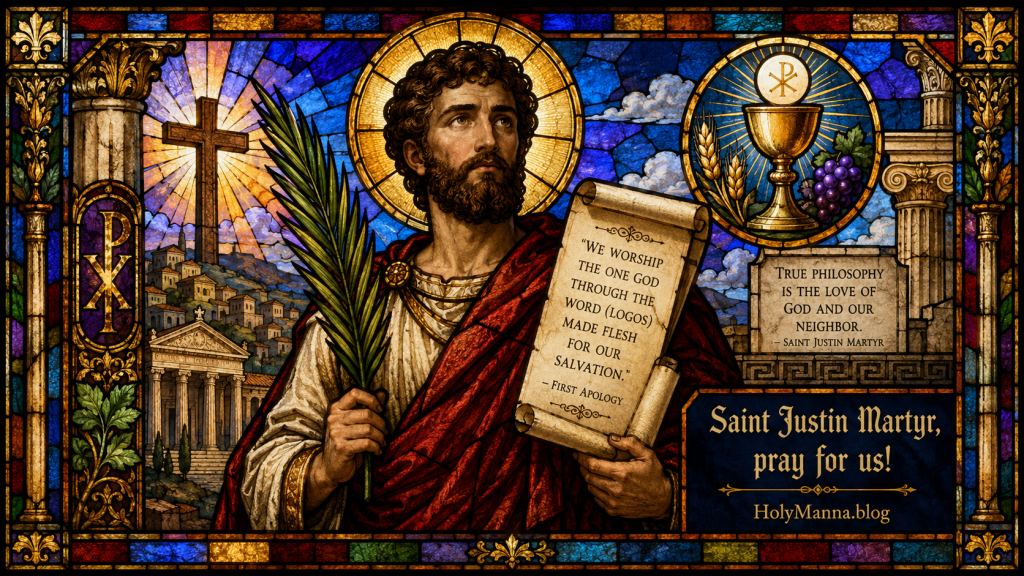
The Philosopher Who Followed Truth All the Way to the Sword
Saint Justin Martyr is one of the great early witnesses of the Catholic faith, not because he began life as a saint, but because he began life as a seeker. He was a philosopher, a student of ideas, a man who wanted more than opinions, arguments, or intellectual trophies. He wanted truth.
Born around the year 100 in Flavia Neapolis, a Roman city in Samaria near ancient Shechem, Justin grew up in a pagan family in a land filled with biblical memory. He lived near places tied to Abraham, Jacob, Joseph, and the Samaritan woman at the well, yet he did not begin as a believer in Christ. His path to the Church came through questions, study, disappointment, courage, and finally grace.
Justin is remembered as one of the first great Christian apologists, which means he defended the faith with reason, Scripture, and public witness. He is also one of the earliest Christian philosophers and one of the most important early witnesses to the Catholic Mass. His writings show that the Church of the second century already believed deeply in Baptism, Sunday worship, the Eucharist, moral conversion, and martyrdom.
The Catechism of the Catholic Church teaches that faith and reason are not enemies, because God is the source of all truth. Justin’s life gives flesh to that idea. He searched through human wisdom and found that every real truth points to Jesus Christ, the eternal Word of God.
The Young Philosopher Who Tried Every Road
Justin was not satisfied with shallow answers. As a young man, he moved through the major philosophical schools of his day. He studied with a Stoic, but the teacher had little to say about God. He tried a Peripatetic philosopher, but became discouraged when the man seemed too interested in payment. He approached a Pythagorean, but was told he first needed to study music, astronomy, and geometry. Finally, Justin found Platonism, and for a time it seemed to lift his mind toward higher realities.
Platonism attracted him because it taught him to look beyond the visible world. It stirred in him a hunger for the unseen. Yet even there, Justin discovered that philosophy could point upward, but it could not fully open heaven.
That is a very human story. Many people today chase meaning through achievement, politics, relationships, self-improvement, spirituality, or endless information. Some of those things can contain glimpses of truth, but none of them can save. Justin’s story reminds the modern soul that truth is not merely an idea to admire. Truth is a Person to follow.
The Old Man by the Sea
The most famous story from Justin’s life comes from his own Dialogue with Trypho. Justin describes walking alone near the sea when he met a mysterious old man. The old man began asking him about philosophy, the soul, happiness, and the knowledge of God. Justin, trained in philosophy, was ready to talk. But the old man gently pressed him deeper.
The old man challenged Justin’s confidence in human reason alone. He pointed him beyond the philosophers to the prophets of Israel, who had spoken not by clever speculation, but by the inspiration of God. He told Justin to pray that the light of truth would be opened to him.
The old man’s counsel became one of the turning points of Justin’s life. He urged Justin to seek God not only through study, but through prayer and revelation. As the story is told in Justin’s own work, this encounter led him toward the Scriptures, the prophets, and finally Christ.
This story is not a legend in the same way many later saint stories are legends. It comes from Justin’s own telling, though it is written in the literary style of an ancient dialogue. What matters most is the spiritual truth at the center of it. Justin needed more than intelligence. He needed grace.
The old man’s advice could still speak to anyone today who feels spiritually restless: pray that God will open the gates of light.
Converted by Truth and Courage
Justin’s conversion was not caused by one moment alone. The old man helped direct his mind toward the prophets, but Justin was also deeply moved by the courage of Christian martyrs.
Before becoming Christian, he had heard accusations against believers. Christians were called atheists because they refused to worship the pagan gods. They were accused of immorality, secret crimes, and disloyalty to Rome. But Justin watched Christians face death with peace and courage, and he knew something did not add up. People enslaved to pleasure and vice do not usually walk calmly toward execution rather than deny their faith.
Their witness became an argument stronger than rhetoric. Holiness made the Gospel believable.
This is exactly what the Church teaches about martyrdom. The Catechism says, “Martyrdom is the supreme witness given to the truth of the faith” CCC 2473. Justin first saw that witness in others. Later, he would give that witness himself.
Around the year 130, Justin became Christian, likely at Ephesus. He received Baptism and embraced Christianity as the true philosophy. He did not abandon his love of wisdom. He discovered that wisdom had a name: Jesus Christ.
Christ, the Logos, and the Seeds of Truth
After his conversion, Justin continued to wear the philosopher’s cloak. That was not a costume. It was a statement. He believed Christianity fulfilled the best longing of philosophy because Christ is the Logos, the eternal Word through whom all things were made.
Justin taught that whatever truth could be found among the pagans existed because every person shares in some way in the light of the divine Logos. The philosophers may have seen fragments of truth, but Christ revealed the fullness of truth. This is why Justin could write, “Whatever things were rightly said among all men are the property of us Christians.”
That line does not mean Justin believed all religions or philosophies were equally true. He did not. It means that every genuine truth belongs to Christ, because Christ is Truth Himself.
This is deeply Catholic. The Church does not fear truth, science, beauty, reason, or honest questions. The Church fears only falsehood and sin. Justin shows how a Catholic mind can engage the world without surrendering to it. He did not baptize pagan philosophy blindly. He judged it in the light of Christ.
The Defender of Christians Before Rome
Justin eventually went to Rome, where he opened a school and taught Christianity as the true philosophy. He wrote defenses of the faith called apologies, not because he was apologizing for Christianity, but because he was giving a reasoned defense.
His First Apology was addressed to the Roman emperor Antoninus Pius, his sons, the Senate, and the Roman people. Christians were being slandered and punished simply for bearing the name Christian. Justin argued that they should not be condemned because of rumors. They should be judged by their actual lives.
He explained that Christians were not enemies of Rome. They prayed, lived morally, cared for the poor, rejected sexual immorality, refused idolatry, loved their enemies, and accepted death rather than betray Christ. He wanted Rome to see that Christians were not dangerous because they loved evil. They seemed dangerous because they would not pretend false gods were true.
Justin’s courage is striking because he did not defend the faith from a safe distance. He put his name, city, background, and beliefs before the empire. He knew the risks, and he spoke anyway.
A Precious Witness to Baptism
Justin’s writings are especially important because they show what the early Church believed and practiced. In his First Apology, he describes Baptism as a real spiritual rebirth, connected to faith, repentance, forgiveness of sins, and a new way of life.
Those who accepted Christian teaching, believed it to be true, committed to living according to it, prayed, fasted, and sought forgiveness were brought to water and baptized. This was not treated as a mere symbol. It was the beginning of a new life in Christ.
The Catechism teaches that Baptism forgives sins, gives new birth in the Holy Spirit, incorporates a person into Christ and the Church, and marks the soul with an indelible spiritual seal CCC 1262-1274. Justin’s witness shows that this sacramental understanding was not a later invention. It belonged to the early life of the Church.
The Early Mass in Justin’s Own Words
One of the greatest reasons Catholics remember Saint Justin is because he gives one of the earliest descriptions of the Mass.
Writing around the middle of the second century, Justin describes Christians gathering on Sunday. The writings of the prophets and the memoirs of the apostles are read. The presider instructs the people. Everyone rises and prays. Bread, wine, and water are brought forward. The presider gives thanks. The people answer, “Amen.” Communion is distributed, and deacons bring the Eucharist to those who are absent.
For a Catholic today, this sounds amazingly familiar. There is the Liturgy of the Word, the homily, the prayers, the offering of bread and wine, the Eucharistic prayer, the Amen, Communion, the role of deacons, and care for the sick or absent.
The Catechism quotes Saint Justin’s description of the Eucharistic celebration and says that the basic structure of the Mass has remained the same through the centuries CCC 1345. That is a stunning thing to consider. When Catholics go to Mass today, they are not participating in something invented recently. They are entering the worship of the ancient Church.
Justin also gives one of the clearest early witnesses to the Real Presence of Christ in the Eucharist. He writes, “For not as common bread and common drink do we receive these.” He explains that the Eucharist is the flesh and blood of Jesus Christ made flesh.
That is Catholic to the core. The Catechism teaches that in the Most Blessed Sacrament of the Eucharist, Christ is present “truly, really, and substantially” with His Body, Blood, Soul, and Divinity CCC 1374. Justin did not use later theological vocabulary like transubstantiation, but he clearly witnessed to the same faith: the Eucharist is not ordinary bread and wine.
Mary, the New Eve
Another beautiful detail in Justin’s writings is his early reflection on Mary as the New Eve. In his Dialogue with Trypho, Justin contrasts Eve’s disobedience with Mary’s obedience. Eve listened to the serpent and helped bring sin into the world. Mary listened to the angel and gave her faithful consent to the coming of the Savior.
This theme would later be developed more fully by Saint Irenaeus, but Justin is one of the early witnesses to it. It shows that Catholic reflection on Mary did not come from nowhere. From the early centuries, Christians saw Mary in relation to salvation history, always in connection with Christ.
The Catechism teaches that Mary gave her free consent in faith at the Annunciation and became the Mother of the Son of God CCC 494. Justin helps us see that Mary’s yes was not a small detail. It was part of God’s great reversal of the fall.
Stories, Legends, and What Can Be Verified
Saint Justin is not surrounded by many miracle legends in the way some later saints are. There are no widely accepted, well-attested stories of dramatic healings, bilocation, visions, or wonders performed by him during his life. His greatness rests mainly on his conversion, his teaching, his defense of the faith, his witness to the Eucharist, and his martyrdom.
There is, however, a traditional story connected to his death involving a pagan philosopher named Crescens. Justin criticized Crescens, a Cynic philosopher, and accused him of attacking Christians without truly understanding their beliefs. Some early Christian writers suggest that Crescens may have helped bring about Justin’s arrest and death. This story is plausible and ancient, but it cannot be verified with certainty.
That uncertainty actually teaches something useful. Catholic storytelling should love the saints without exaggerating them. Justin does not need invented miracles to be inspiring. His life is already extraordinary because he followed truth from pagan philosophy to Baptism, from Baptism to public witness, and from public witness to martyrdom.
The Philosopher on Trial
Justin was arrested in Rome with several companions during the reign of Marcus Aurelius. His companions are traditionally named Chariton, Charito, Euelpistus, Hierax, Paeon, and Liberianus. They were brought before Rusticus, the prefect of Rome.
Rusticus ordered them to obey the gods and submit to the rulers. Justin answered with calm conviction. When asked what doctrines he followed, he said, “I have endeavoured to learn all doctrines; but I have acquiesced at last in the true doctrines, those namely of the Christians.”
That sentence captures his entire life. He had searched. He had studied. He had tested the claims of philosophers. At last, he found the true doctrine in Christ.
Rusticus threatened him with punishment if he refused to sacrifice to the pagan gods. Justin replied, “No right-thinking person falls away from piety to impiety.”
His companions also refused to sacrifice. They confessed that they were Christians and would not worship idols. Rusticus sentenced them to be scourged and beheaded.
Justin died around the year 165. The philosopher who had spent his life seeking truth finally sealed his testimony with blood.
The Martyr Under the Philosopher Emperor
One of the most surprising facts about Justin’s death is that he was martyred during the reign of Marcus Aurelius, the famous philosopher-emperor. History remembers Marcus Aurelius as a thoughtful Stoic ruler, yet under his reign, the Christian philosopher Justin was executed.
There is a deep irony there. The empire could tolerate many philosophies, many gods, many cults, and many opinions. What it could not tolerate was the Christian claim that Jesus Christ is Lord and that false gods must not be worshiped.
Justin’s martyrdom reminds modern Catholics that the world often welcomes faith as long as faith stays private, vague, and harmless. But true Christianity cannot call idols good just to avoid conflict. Justin was respectful, rational, and charitable, but he would not lie.
Miracles and Impact After Death
There are no strong, universally recognized posthumous miracle traditions associated with Saint Justin Martyr. This is not unusual for an early martyr of the Church. His sanctity was recognized long before the modern canonization process, and his veneration grew from his faithful witness, orthodox teaching, and martyrdom.
Relics associated with Saint Justin are claimed in different places, including churches near Rome, in Malta, and in other Catholic communities. These relic traditions should be treated with reverence, but also with historical care, since the early centuries often leave us with limited documentation.
His impact after death, however, is beyond question. Justin became one of the foundational voices of Catholic apologetics. His writings helped future Christians defend the faith against misunderstanding, persecution, and false accusation. He also became one of the most important early witnesses to the Mass and the Eucharist.
His influence reaches into Catholic theology, philosophy, Scripture, liturgy, and evangelization. He helped establish a model for engaging the surrounding culture without surrendering the faith. He showed that reason can serve revelation, that philosophy can be purified by Christ, and that truth must be loved enough to suffer for it.
Why Saint Justin Still Matters
Saint Justin matters because the modern world is still full of seekers. Many people are surrounded by information but starved for wisdom. They have opinions, podcasts, books, arguments, trends, and algorithms, but not peace. Justin speaks to that restlessness.
He reminds Catholics that faith is not anti-intellectual. It is not blind emotion. It is not superstition. Catholic faith welcomes reason, but it also knows reason needs grace. The human mind can ask profound questions, but only God can fully answer the deepest hunger of the soul.
Justin also teaches that apologetics must be more than winning arguments. He defended Christianity with intelligence, but also with holiness. He pointed to Christian chastity, charity, courage, and love of enemies. He knew the most convincing defense of the faith is a life transformed by Christ.
This matters today. The Church does not need Catholics who are merely loud. She needs Catholics who are truthful, courageous, sacramental, charitable, and faithful.
Seeking Truth Without Fear
Saint Justin’s life asks every Catholic a serious question: Is truth something to admire from a distance, or something worth following no matter the cost?
Justin did not stop at curiosity. He let truth interrupt his life. He allowed the Scriptures to challenge his assumptions. He allowed the witness of martyrs to change his view of Christians. He allowed Christ to claim his mind, his heart, his work, and finally his life.
His example is especially helpful for anyone who has questions about the faith. Questions are not the enemy. Pride is the enemy. Laziness is the enemy. Fear is the enemy. Justin shows that honest questions, when joined to humility and prayer, can become a road to God.
A practical way to live his example is to bring the mind into discipleship. Read Scripture seriously. Learn what the Church actually teaches. Study the Catechism. Ask better questions. Do not settle for social media summaries of Catholic doctrine. Go deeper.
Another way is to witness with calm courage. Justin did not respond to slander with panic. He responded with truth. When the culture misunderstands Christianity, Catholics should answer with clarity, charity, and confidence.
Finally, Justin calls Catholics back to the Eucharist. He reminds us that the early Church did not gather around entertainment, ideology, or self-expression. The Church gathered around the Word of God and the Body and Blood of Jesus Christ. If Catholics want courage like Justin, they must stay close to the altar.
Where is God asking you to seek truth more seriously?
What fear keeps you from defending the faith with charity and courage?
How would your life change if the Eucharist became the center of your week rather than one part of it?
Engage with Us!
Share your thoughts and reflections in the comments below. Saint Justin Martyr is a powerful saint for anyone who has ever wrestled with big questions, searched for meaning, or struggled to explain the faith in a skeptical world.
- What part of Saint Justin’s journey speaks to you most: his search for truth, his love of reason, his witness to the Eucharist, or his courage in martyrdom?
- Have you ever had a moment when someone’s courage or holiness made the Catholic faith more believable to you?
- How can Catholics today defend the faith more like Saint Justin, with both intelligence and charity?
- What is one concrete way you can make Sunday Mass more central in your life this week?
Saint Justin Martyr reminds us that truth is not just something to study. Truth is Someone to follow. May his example help us seek Christ with honest minds, love Him with faithful hearts, and witness to Him with courage in a world that still needs the light of the Gospel.
Live today with faith, speak the truth with love, and do everything with the mercy and compassion Jesus taught us.
Saint Justin Martyr, pray for us!
Follow us on YouTube, Instagram and Facebook for more insights and reflections on living a faith-filled life.


Leave a Reply