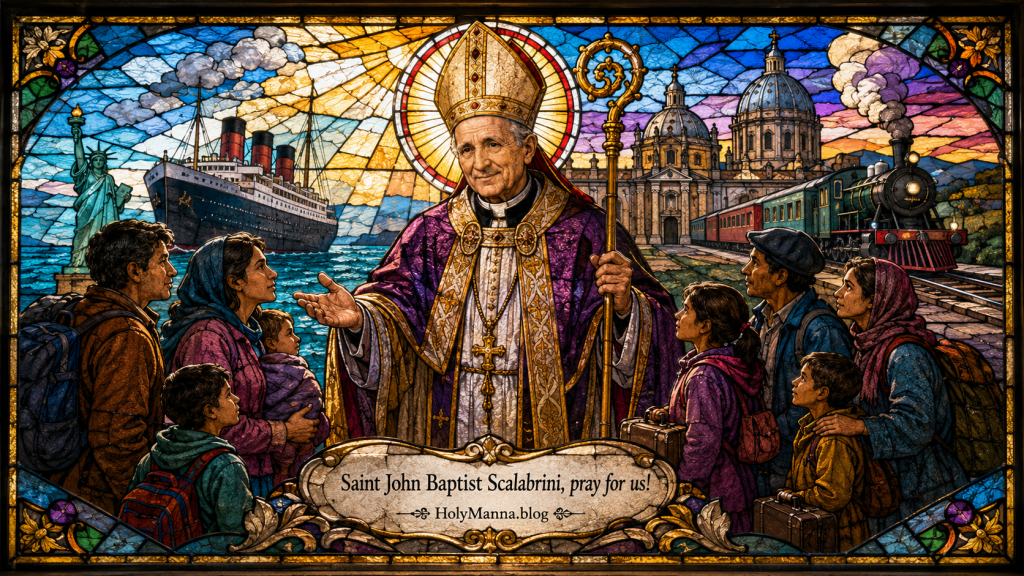
The Bishop Who Saw Christ in the Migrant
Saint John Baptist Scalabrini was the kind of bishop the modern world still desperately needs. He was a man of the altar, a teacher of the faith, a defender of the poor, a reformer of Catholic life, and a spiritual father to people who had been uprooted from home.
Born in Italy in the nineteenth century, Scalabrini became known as the “Father of Migrants” because he saw the suffering of Italian emigrants leaving for the Americas and understood something deeply Catholic. These people did not only need food, work, and legal protection. They needed the Church. They needed priests, sacraments, catechesis, community, and the loving presence of Christ in a strange land.
He founded the Missionaries of St. Charles Borromeo, later known as the Scalabrinians, and the Missionary Sisters of St. Charles Borromeo to care for migrants spiritually and materially. He also organized lay assistance for migrants through the St. Raphael Association.
Yet he was more than a migration saint. He was also called the “Apostle of the Catechism” because of his tireless work teaching the Catholic faith clearly and faithfully. His whole life was a living expression of what The Catechism of the Catholic Church teaches about human dignity, charity, and the duty to welcome the stranger while respecting the common good. In CCC 2241, the Church teaches that wealthier nations are obliged, as far as they are able, to welcome foreigners seeking safety and livelihood, while also recognizing that public authorities may regulate immigration for the common good.
Saint John Baptist Scalabrini lived that balance with courage, compassion, and remarkable Catholic common sense.
A Boy from Como with a Missionary Heart
John Baptist Scalabrini was born on July 8, 1839, in Fino Mornasco, near Como, Italy. He was baptized the same day, a small but beautiful reminder that his life began under the sign of grace. He was the third of eight children in a humble Catholic family. His father ran a modest wine shop, and his mother cared for the home.
From a young age, Scalabrini showed intelligence, discipline, and a deep attraction to the things of God. He entered the seminary and was ordained a priest on May 30, 1863. As a young priest, he wanted to become a foreign missionary. He hoped to bring the Gospel to distant lands, but his bishop had other plans. Instead of sending him abroad, the bishop assigned him to teach and form seminarians.
That might have felt like a closed door. In reality, it was providence.
Scalabrini became a professor, vice-rector, and later rector of the seminary. He taught history and Greek, formed future priests, and grew into a pastor with both intellectual depth and a tender heart. He also cared personally for cholera victims in Portichetto in 1867, an act of courage that earned him civil recognition.
Later, as pastor of San Bartolomeo in Como, he encountered workers, the poor, children in need of instruction, and families struggling under the pressures of industrial life. His heart did not become hardened by suffering. It became more priestly.
He wrote catechetical material for children, gave lectures on the First Vatican Council, and developed a lifelong conviction that Catholic faith had to be taught clearly, loved deeply, and lived concretely.
The Young Bishop Who Traveled on a Mule
In 1876, when he was only thirty-six years old, Scalabrini was appointed Bishop of Piacenza by Pope Pius IX. He hesitated at first, but accepted out of obedience. Once he became bishop, he gave himself completely to the people entrusted to him.
His episcopate lasted twenty-nine years. During that time, he made five pastoral visits throughout his diocese. Many of the parishes were difficult to reach, especially in the mountains, but Scalabrini went anyway. He often traveled on muleback, visiting remote villages, preaching, confirming, teaching, correcting, encouraging, and listening.
He celebrated three diocesan synods, renewed seminary formation, restored churches, strengthened clerical discipline, promoted devotion to the Eucharist, encouraged Marian devotion, and revived Catholic life in the diocese.
His episcopal heart can be heard in one of his well-known sayings:
“Would that I could sanctify myself and all the souls entrusted to me!”
That was not pious decoration. That was his mission. He wanted heaven for his people.
He also lived by this beautiful phrase:
“Preach the truth with charity.”
That sentence captures the Catholic soul of Scalabrini. Truth without charity becomes cold. Charity without truth becomes weak. Scalabrini wanted the Church to speak clearly, love deeply, and serve generously.
The Apostle of the Catechism
Before Scalabrini became famous for helping migrants, he became known for teaching the faith. Pope Pius IX called him the “Apostle of the Catechism,” and the title fits perfectly.
Scalabrini believed that Catholics needed more than vague religious feelings. They needed formation. They needed to know what the Church teaches, why it matters, and how to live it in daily life.
He launched the catechetical review Il Catechista Cattolico, organized thousands of catechists in his diocese, and held the first National Catechetical Congress in 1889. He also promoted the idea of a unified catechism for Italian Catholics, including those scattered abroad through migration.
This part of his life matters so much today. Scalabrini understood that charity and doctrine are not enemies. The same bishop who served the poor also insisted on clear teaching. The same bishop who defended migrants also formed catechists. The same bishop who organized social help also loved the Eucharist, the sacraments, and the truth of the Catholic faith.
That is why his life reflects the wisdom of The Catechism, which teaches that the Church is catholic because Christ is present in her and because she has been sent to all peoples. Scalabrini saw that mission not as an abstract idea, but as a real call to reach families boarding ships, workers crossing borders, and souls in danger of being forgotten.
The Train Station That Changed Everything
One of the most famous stories from Scalabrini’s life happened at a train station in Milan. He saw a crowd of poor Italian emigrants preparing to leave for the Americas. They were exhausted, poorly dressed, anxious, and heartbroken. Many were leaving because poverty gave them no other option.
Scalabrini watched them and was deeply moved. He later wrote:
“I felt my heart clench, and wept over their fate.”
That moment changed the direction of his mission.
He realized these migrants were not simply travelers. They were families uprooted from language, culture, parish life, and community. Many would arrive in foreign lands vulnerable to exploitation, loneliness, religious neglect, and loss of faith. They needed someone to care for their bodies, but also for their souls.
Scalabrini did not respond with sentimental pity. He responded like a Catholic shepherd. He studied the causes of migration. He spoke to Church leaders. He appealed to civil authorities. He preached. He wrote. He organized. He founded institutions.
That is one of the most important lessons of his life. Christian compassion cannot remain a feeling. It must become action.
The Father of Migrants
On November 28, 1887, Scalabrini founded the Congregation of the Missionaries of St. Charles Borromeo, now commonly known as the Scalabrinians. These priests and brothers were sent to care for migrants, especially Italians who had gone to the Americas.
The first missionaries left for Brazil and the United States in 1888. Scalabrini wanted them to provide spiritual and practical help. They were to bring the sacraments, preserve the faith, protect families from exploitation, and help migrants remain connected to the Church.
In 1889, he founded the St. Raphael Association, a lay organization that assisted migrants especially during departure, travel, and arrival. In 1895, he founded the Missionary Sisters of St. Charles Borromeo because he understood that the work of caring for migrant families needed the maternal presence, teaching, and service of religious sisters.
A surprising and beautiful detail is that Scalabrini also encouraged Saint Frances Xavier Cabrini to go to the Americas. Mother Cabrini would later become one of the most beloved Catholic saints associated with immigrant care in the United States. Their missions were distinct, but their hearts beat with the same Catholic concern for souls far from home.
Scalabrini himself traveled to the United States in 1901 and to Brazil in 1904 to visit migrants and his missionaries. This was no small thing for a bishop of his age and condition. He crossed the ocean because the people he loved had crossed the ocean.
He once wrote of migrants as:
“Free instruments of Divine Providence.”
That phrase shows how deeply Catholic his vision was. Scalabrini did not romanticize suffering. He knew migration could involve exploitation, loneliness, poverty, and loss. But he also believed that God could work through the movement of peoples, bringing cultures into contact and revealing the universality of the Church.
Charity That Became Concrete
Scalabrini’s care for migrants was part of a much larger life of charity. During a famine in 1879 and 1880, he sold or pawned valuable items, including horses used for pastoral visits and a chalice given by Pope Pius IX, to feed the poor. His episcopal residence became a center of relief.
He cared for prisoners, the sick, orphans, poor clerics, deaf and mute persons, workers, and seasonal rice-field laborers. He supported efforts to help vulnerable women working in rice fields, many of whom faced harsh conditions and exploitation.
He also wrote about social questions, including workers’ rights, the right to work, the right to strike, accident insurance, old-age pensions, reduced working hours, cooperatives, mutual aid societies, Catholic banks, and rural funds.
That may sound surprisingly modern, but it was deeply rooted in Catholic social teaching. Scalabrini lived in the age of Pope Leo XIII, whose encyclical Rerum Novarum helped shape the Church’s modern social doctrine. Scalabrini understood that the Church must defend human dignity without reducing the Gospel to politics.
He did not divide souls from bodies. He cared about both. He wanted people fed, protected, taught, confessed, confirmed, and brought to Christ.
Stories of Courage, Mercy, and Holy Humor
Because Scalabrini was a modern saint, his stories are not usually medieval-style legends. They are mostly witness-based accounts preserved by those who knew him or by those involved in his cause for beatification.
One story shows his humility. A young priest once came to see him in Rome and had not yet celebrated Mass. Scalabrini, already a bishop, simply served the young priest’s Mass himself. He did not act as if dignity made service beneath him. In the Catholic imagination, that kind of humility speaks loudly.
Another story shows his courage. A sick man who had rejected the sacraments reportedly kept a revolver by his bedside and threatened any priest who came near him. When Scalabrini heard of this, he said he would go himself. His meekness and courage moved the man to tears and conversion. This story comes from Catholic testimony associated with his life, though like many saintly anecdotes, it should be received as a pious story rather than treated as a formally verified miracle.
Another story reveals his mercy. During public unrest, a man nicknamed “Tredici” insulted Scalabrini and spat on him. Years later, when that same man was elderly and abandoned, Scalabrini paid for him to live in a nursing home. That is Gospel mercy. He did not merely forgive from a distance. He cared for the man who had humiliated him.
There is also a story from 1902 about a factory fire. During a pastoral visit, a fire broke out near alcohol tanks. Scalabrini reportedly prayed, led the people in prayer, blessed the fire, and the flames died down. This story is part of Scalabrinian devotional tradition and witness testimony, but it should not be treated as an officially approved miracle.
These stories all point to the same truth. Scalabrini’s holiness was not theatrical. It was practical, humble, brave, and merciful.
The Crosses He Carried
Saint John Baptist Scalabrini was not a martyr in the sense of shedding his blood for the faith. His martyrdom was pastoral. He carried the slow cross of exhaustion, misunderstanding, financial pressure, public unrest, diocesan reform, social tension, and the emotional burden of seeing so many families uprooted by poverty.
He lived during a difficult period in Italian history, when the Church faced political pressure, social change, anticlericalism, poverty, and the wounds of mass migration. Many Catholics were trying to understand how to live faithfully in a rapidly changing modern world.
Scalabrini responded not by retreating into fear, but by becoming more Catholic, not less. He taught the faith. He served the poor. He formed priests. He organized lay people. He defended migrants. He visited prisoners. He promoted devotion. He crossed oceans.
His body eventually weakened. After his journey to Brazil in 1904, his health declined. He died on June 1, 1905, the Solemnity of the Ascension that year.
There is something profoundly fitting about that. The bishop who spent his life helping people on the move died on the feast that lifts Christian eyes toward heaven, the true homeland.
Miracles and Legacy After Death
After his death, devotion to Scalabrini continued to grow, especially among the communities he founded and among Catholics committed to migrant ministry.
The official miracle recognized for his beatification involved the healing of a religious sister suffering from advanced ovarian cancer with widespread complications. The healing was judged rapid, complete, lasting, and scientifically inexplicable. The Church recognized it as a miracle through the intercession of Scalabrini, and Pope Saint John Paul II beatified him on November 9, 1997.
Pope Francis canonized him on October 9, 2022. His canonization was unusual because Pope Francis dispensed from the usual requirement of a second miracle, recognizing the strength of his cause, the widespread devotion to him, and the urgent relevance of his witness in an age marked by migration, displacement, and refugee crises.
His remains are venerated in the Cathedral of Piacenza, the diocese he served so faithfully. His feast is celebrated on June 1.
His legacy continues through the Scalabrinian priests, brothers, sisters, secular missionaries, study centers, migrant houses, parishes, shelters, schools, seafarer ministries, and pastoral works around the world. His spiritual family continues to serve migrants, refugees, displaced persons, and seafarers in many countries.
His influence also helped shape the Church’s organized care for migrants. Near the end of his life, Scalabrini proposed that the Holy See establish a structure for the care of migrants throughout the world. That vision later helped inspire official Catholic structures dedicated to migration and refugee ministry.
His cultural impact remains especially strong in Italian, Brazilian, American, and migrant Catholic communities. His canonization renewed Catholic attention to the dignity of migrants and the responsibility of the Church to accompany people who are far from home.
A Saint for a Restless World
Saint John Baptist Scalabrini feels incredibly timely because the world is still full of people on the move. Some leave home because of poverty. Some flee violence. Some search for work. Some are displaced by war, instability, or desperation. Some arrive in new countries with hope. Others arrive with fear.
Scalabrini reminds Catholics that no person is merely a statistic, a headline, a political issue, or an inconvenience. Every person is a soul loved by God.
At the same time, Scalabrini’s witness is not shallow sentimentality. He understood order, duty, prudence, and the common good. His charity was not chaotic. It was organized. His compassion was not vague. It was sacramental. His love was not performative. It was costly.
He teaches modern Catholics that defending human dignity begins with seeing clearly. The migrant is not first a problem to solve. The migrant is a person to encounter. The poor are not background noise. They are Christ at the door. The faith is not meant to be hidden in private devotion. It must become visible in mercy.
Where is Christ asking you to move from compassion into concrete action?
The Lesson of Saint John Baptist Scalabrini
The life of Saint John Baptist Scalabrini gives the Church a powerful model of Catholic love. He did not choose between truth and mercy. He did not choose between doctrine and charity. He did not choose between the Eucharist and social concern. He held them together because the Catholic faith holds them together.
He taught children the catechism. He formed priests. He visited mountain parishes. He sold his possessions to feed the hungry. He defended workers. He cared for prisoners. He founded missionaries for migrants. He crossed oceans to visit his people.
That is what holiness looked like in his life. Not noise. Not slogans. Not comfort. Faithfulness.
His story challenges every Catholic to ask whether faith is becoming action, whether love is becoming sacrifice, and whether the stranger is being seen through the eyes of Christ.
Who are the people today who feel forgotten, displaced, or spiritually abandoned?
How can ordinary Catholics help them find not only assistance, but also the warmth of the Church?
Saint John Baptist Scalabrini would remind the faithful that the answer begins with prayer, but it cannot end there. Prayer must become charity. Charity must become service. Service must become mission.
Engage With Us!
Share your thoughts and reflections in the comments below. Saint John Baptist Scalabrini’s life gives Catholics so much to consider, especially in a world where migration, loneliness, poverty, and spiritual confusion are still very real.
- What part of Saint John Baptist Scalabrini’s life stands out to you the most, his love for migrants, his passion for catechesis, or his practical charity toward the poor?
- Have you ever experienced what it feels like to be far from home, physically, emotionally, or spiritually?
- How can Catholics today welcome the stranger without losing sight of truth, prudence, and the common good?
- Who in your parish or community might feel forgotten, and how could you help them feel seen by the Church?
- What is one concrete act of mercy you can practice this week in honor of Saint John Baptist Scalabrini?
May the example of Saint John Baptist Scalabrini inspire a deeper love for Christ in the Eucharist, a stronger commitment to teaching the faith, and a more generous heart toward those who are far from home. Let every act of service become a small witness to the love and mercy Jesus taught us, and let every person encountered be treated as a soul made for heaven.
Saint John Baptist Scalabrini, pray for us!
Follow us on YouTube, Instagram and Facebook for more insights and reflections on living a faith-filled life.


Leave a Reply