Memorial of Saint Justin, Martyr – Lectionary: 353
The Vineyard, the Promise, and the Fruit God Desires
Every soul has a vineyard, a place where God has planted grace and now waits patiently for fruit.
Today’s readings speak to anyone who has ever received much from God and wondered what comes next. In 2 Peter 1:2-7, Saint Peter reminds the Church that holiness begins as a gift before it becomes a task. God has already given His people “everything that makes for life and devotion,” and through His promises, He calls them to “share in the divine nature.” This is not vague spiritual inspiration. It is the Catholic mystery of grace, the astonishing truth taught in The Catechism, that Christ became man so that humanity could become, by grace, participants in God’s own life.
The Psalm gives this calling a posture of trust. The soul that dwells in God’s shelter can say, “My refuge and fortress, my God in whom I trust.” That trust is not passive. It clings. It remains faithful in distress. It holds onto God’s name when life becomes uncertain. Then, in The Gospel of Mark 12:1-12, Jesus gives the sobering parable of the tenants, where the vineyard represents God’s people, the servants recall the prophets, and the beloved son points unmistakably to Christ Himself. The leaders understand the warning. God’s vineyard is a gift, but it is not a possession to be controlled. It is a holy trust meant to bear fruit.
This is the thread tying the readings together: God gives the vineyard, God gives the promise, and God sends the Son. The only faithful response is fruit. Not the fruit of anxious performance, but the fruit of grace received, trust lived, and love made visible. On the Memorial of Saint Justin, Martyr, this message becomes even sharper. Saint Justin searched for truth, found Christ, defended the apostolic faith, and finally gave his life rather than deny the Lord. His witness shows what happens when faith matures into courage, knowledge becomes devotion, and devotion becomes love.
Today, the Church invites every reader to ask honestly: What has God entrusted to me, and what fruit is He asking for now?
First Reading – 2 Peter 1:2-7
Grace Is Not Just Forgiveness, It Is the Power to Become Holy
The Second Letter of Saint Peter speaks with the urgency of a spiritual father who knows that Christian faith must mature. The Church has always received this letter as apostolic Scripture, a voice calling believers to stand firm in truth, reject corruption, and grow in holiness. In the first century, Christians lived in a world filled with pagan moral confusion, false teachers, and pressure to compromise. Saint Peter does not respond by telling the faithful to blend in. He reminds them that God has already given them the power to live differently.
This reading fits perfectly with today’s central theme: God gives the vineyard, God gives the promise, and God expects fruit. In 2 Peter 1:2-7, the fruit is a holy life. The Christian does not become holy by raw willpower, but by grace. Yet that grace must be received, cultivated, and lived. Saint Peter gives the Church a beautiful path of growth, beginning with faith and reaching its fullness in love.
2 Peter 1:2-7 – New American Bible (Revised Edition)
2 may grace and peace be yours in abundance through knowledge of God and of Jesus our Lord.
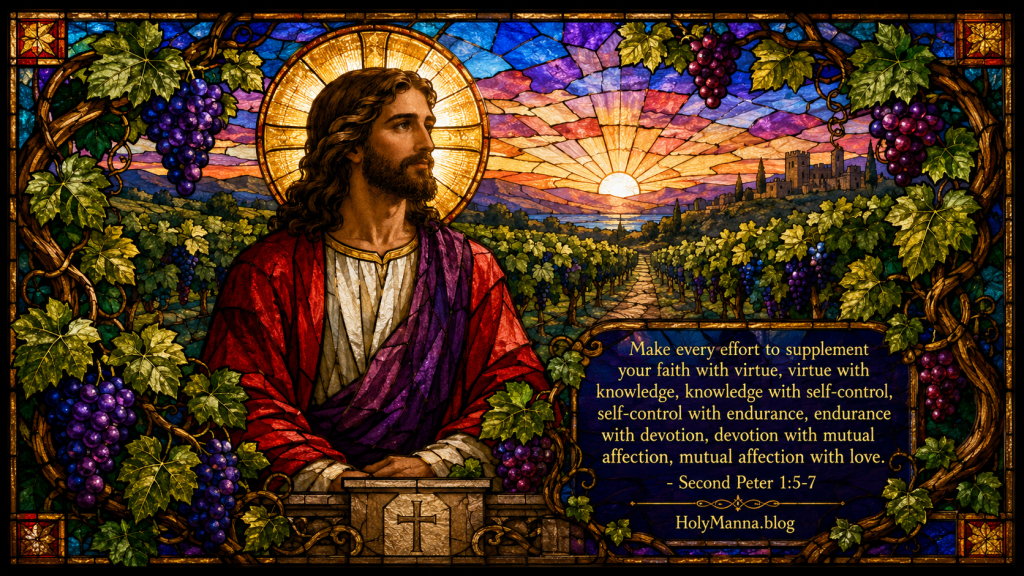
The Power of God’s Promise. 3 His divine power has bestowed on us everything that makes for life and devotion, through the knowledge of him who called us by his own glory and power. 4 Through these, he has bestowed on us the precious and very great promises, so that through them you may come to share in the divine nature, after escaping from the corruption that is in the world because of evil desire. 5 For this very reason, make every effort to supplement your faith with virtue, virtue with knowledge, 6 knowledge with self-control, self-control with endurance, endurance with devotion, 7 devotion with mutual affection, mutual affection with love.
Detailed Exegesis
Verse 2 – “May grace and peace be yours in abundance through knowledge of God and of Jesus our Lord.”
Saint Peter begins with blessing, not burden. The Christian life starts with grace and peace, gifts that come through knowing God and Jesus Christ. This “knowledge” is not simply religious information or Bible trivia. It is the personal, saving knowledge of the Lord. In Catholic life, this knowledge is nourished through Scripture, the sacraments, prayer, and the teaching of the Church. The more deeply a person knows Christ, the more grace and peace can take root in the soul.
Verse 3 – “His divine power has bestowed on us everything that makes for life and devotion, through the knowledge of him who called us by his own glory and power.”
This verse is a powerful reminder that God does not call His people to holiness and then leave them unequipped. His divine power has already given what is needed for “life and devotion.” That means holiness is possible. Not easy, not automatic, but possible through grace. The call to Christian life is not simply moral improvement. It is a divine calling. God calls His people by His own glory and power, drawing them out of spiritual mediocrity into the life of Christ.
Verse 4 – “Through these, he has bestowed on us the precious and very great promises, so that through them you may come to share in the divine nature, after escaping from the corruption that is in the world because of evil desire.”
This is one of the most profound verses in the New Testament. Saint Peter says that Christians are called to “share in the divine nature.” The Church does not understand this to mean that human beings become God by nature. Rather, by grace, they are brought into communion with God’s own life. This is the mystery of sanctifying grace, adoption, and holiness. The same verse also names what must be escaped: the corruption of the world caused by evil desire. Grace does not simply comfort the soul. Grace rescues it, purifies it, and lifts it into communion with God.
Verse 5 – “For this very reason, make every effort to supplement your faith with virtue, virtue with knowledge.”
After speaking of grace, Saint Peter immediately calls for effort. This is deeply Catholic. Grace does not erase cooperation. Grace makes cooperation possible. Faith must be supplemented with virtue, meaning it must become visible in a rightly ordered life. Virtue must be joined to knowledge, because good intentions need truth. A Christian cannot grow by emotion alone. Faith must be formed by the truth revealed by God and guarded by the Church.
Verse 6 – “Knowledge with self-control, self-control with endurance, endurance with devotion.”
Saint Peter continues the pattern of spiritual growth. Knowledge must lead to self-control, because truth that never disciplines desire remains incomplete. Self-control must become endurance, because holiness is not proven in a single good moment, but through faithful perseverance. Endurance must become devotion, because Christian perseverance is not stubbornness. It is love for God expressed through worship, prayer, reverence, and fidelity.
Verse 7 – “Devotion with mutual affection, mutual affection with love.”
The ladder reaches its summit in love. Devotion to God must overflow into love for others. Mutual affection means that the Christian life is not isolated or cold. The Church is a family, and holiness must become visible in patience, mercy, service, and charity. But Saint Peter ends with love because love is the crown of the Christian life. Love is not mere niceness. It is the self-giving charity revealed perfectly in Jesus Christ.
Teachings: Participation in God’s Life and the Growth of Virtue
The heart of this reading is the Catholic doctrine of grace. Saint Peter says that believers may “share in the divine nature,” and The Catechism of the Catholic Church gives this verse a central place in explaining why the Son of God became man.
CCC 460 teaches: “The Word became flesh to make us ‘partakers of the divine nature’: ‘For this is why the Word became man, and the Son of God became the Son of man: so that man, by entering into communion with the Word and thus receiving divine sonship, might become a son of God.’ ‘For the Son of God became man so that we might become God.’ ‘The only-begotten Son of God, wanting to make us sharers in his divinity, assumed our nature, so that he, made man, might make men gods.’”
This teaching can sound shocking at first, but it is one of the great treasures of Catholic faith. The Church is not saying that people become God in essence. She is saying that through Christ, human beings are invited into communion with God by grace. Salvation is not only being forgiven. It is being transformed.
This also explains why Saint Peter immediately speaks about virtue. If grace brings the soul into communion with God, then life must begin to change. The Catechism teaches in CCC 1803: “A virtue is an habitual and firm disposition to do the good. It allows the person not only to perform good acts, but to give the best of himself.”
That is exactly what Saint Peter describes. Faith grows into virtue. Virtue grows into knowledge. Knowledge becomes self-control. Self-control becomes endurance. Endurance becomes devotion. Devotion becomes affection. Affection becomes love.
The Church also teaches that this growth requires both grace and cooperation. CCC 1810 says: “Human virtues acquired by education, by deliberate acts and by a perseverance ever-renewed in repeated efforts are purified and elevated by divine grace.”
This is a beautiful Catholic balance. God acts first. Human beings respond. Grace is primary, but the soul must cooperate. Holiness is not earned like a paycheck, but it must be cultivated like a vineyard.
Saint Augustine captured this mystery well when he preached that God created us without us, but He does not will to save us without us. The point is not that human effort replaces grace. The point is that grace awakens a real response. The Christian life is alive, and living things grow.
Saint Justin Martyr, whose memorial the Church celebrates today, gives flesh to this reading. He was a philosopher who searched for truth and found its fullness in Christ. Once he received the gift of faith, he did not bury it. He studied, defended the Gospel, explained the Eucharistic worship of the early Church, and finally gave his life rather than deny Christ. In him, faith became knowledge, knowledge became endurance, endurance became devotion, and devotion became love unto martyrdom.
Reflection: Let Grace Become Fruit
This reading is a wake-up call for anyone who has settled for a small version of Christianity. Saint Peter is not content with a faith that stays private, vague, or comfortable. He shows that God has given everything needed for holiness, but that gift must become fruitful.
There is real hope here. The Christian who struggles with impatience, distraction, lust, resentment, laziness, fear, pride, or discouragement is not abandoned. God has already given grace. The Holy Spirit is not waiting for perfect people. He is forming saints out of people who are willing to cooperate.
A good place to begin is Saint Peter’s list. Faith asks for trust. Virtue asks for action. Knowledge asks for formation. Self-control asks for discipline. Endurance asks for perseverance. Devotion asks for prayer. Mutual affection asks for charity in community. Love asks for the gift of self.
This can become practical very quickly. Choose one virtue from the reading and bring it into prayer. If self-control is weak, begin with one concrete fast from a distraction, habit, or indulgence. If endurance is weak, stay faithful to prayer even when it feels dry. If devotion is weak, return to Sunday Mass with greater reverence and arrive early enough to actually prepare the heart. If mutual affection is weak, speak with patience to the person who normally receives irritation. If love is weak, make one hidden sacrifice for someone else without needing credit.
Saint Peter is not asking for instant perfection. He is calling for real growth.
Where has faith remained only a belief instead of becoming a virtue?
Which part of Saint Peter’s spiritual ladder needs attention right now?
What desire or habit is keeping the soul tied to the corruption of the world?
How can grace become visible today in one concrete act of love?
God has given the vineyard of the soul everything it needs to bear fruit. The question is whether the soul will receive His grace like a gift, cultivate it with effort, and offer the harvest back to Him in love.
Responsorial Psalm – Psalm 91:1-2, 14-16
The Soul That Clings to God Finds Shelter in Him
Psalm 91 is one of the great songs of trust in the prayer life of Israel. It speaks to the person who knows that life is not always safe, predictable, or easy, but who has learned where true security is found. In the ancient world, a fortress was not a decoration. It was the place people ran when danger came. A shadow was not just shade. In the heat and vulnerability of the Near East, it was protection, relief, and life.
This Psalm fits beautifully into today’s theme because it shows the posture of the faithful tenant. In 2 Peter 1:2-7, God gives grace and calls the soul to grow in holiness. In Mark 12:1-12, Jesus warns against those who receive the vineyard but refuse the Owner. Here, Psalm 91 reveals the opposite spirit. The righteous person does not grasp at God’s gifts as personal property. The righteous person clings to God Himself and says, “My refuge and fortress, my God in whom I trust.”
This is not a shallow kind of trust. It is not pretending that distress will never come. God Himself says, “I will be with him in distress.” The promise is not that faithful people avoid every trial. The promise is that God remains with those who cling to Him.
Psalm 91:1-2, 14-16 – New American Bible (Revised Edition)
Security Under God’s Protection
1 You who dwell in the shelter of the Most High,
who abide in the shade of the Almighty,
2 Say to the Lord, “My refuge and fortress,
my God in whom I trust.”14 Because he clings to me I will deliver him;
because he knows my name I will set him on high.
15 He will call upon me and I will answer;
I will be with him in distress;
I will deliver him and give him honor.
16 With length of days I will satisfy him,
and fill him with my saving power.
Detailed Exegesis
Verse 1 – “You who dwell in the shelter of the Most High, who abide in the shade of the Almighty.”
The Psalm begins with a picture of spiritual nearness. To “dwell” in the shelter of the Most High means more than visiting God occasionally when life becomes painful. It means making God the place where the soul lives. The titles “Most High” and “Almighty” remind the reader that God is not one helper among many. He is the Lord above every power, fear, enemy, and temptation.
The word “shade” carries deep biblical meaning. In Scripture, God’s shadow often represents His protection and closeness. Just as the cloud of God’s presence guided Israel in the wilderness, the faithful soul finds shelter beneath the care of the Lord. This verse invites the reader to move from occasional religious activity into abiding trust.
Verse 2 – “Say to the Lord, ‘My refuge and fortress, my God in whom I trust.’”
The Psalm now becomes personal. It is not enough to say that God is powerful in general. Faith must learn to say, “My refuge and fortress.” This is covenant language. The soul belongs to God, and God receives the soul that turns to Him.
A fortress is where people go when they cannot defend themselves. That matters spiritually. Many people try to be their own fortress through control, money, reputation, comfort, distraction, or pride. The Psalm teaches a better way. Trust begins when the soul stops pretending it is self-sufficient and chooses to hide in God.
Verse 14 – “Because he clings to me I will deliver him; because he knows my name I will set him on high.”
Here the voice shifts, and God Himself speaks. The key phrase is “Because he clings to me.” Biblical trust is not casual. It holds on. It remains attached to God when fear, temptation, grief, or confusion tries to pull the soul away.
To “know” God’s name means more than knowing a label. In the biblical world, a name revealed identity, relationship, and presence. The one who knows God’s name knows who He is: faithful, merciful, powerful, and near. God promises deliverance and honor to the one who clings to Him, not because the person is strong, but because God is faithful.
Verse 15 – “He will call upon me and I will answer; I will be with him in distress; I will deliver him and give him honor.”
This verse is one of the most comforting lines in the Psalm. God does not say that His beloved will never experience distress. He says, “I will be with him in distress.” This is the heart of Catholic hope. God’s presence is not limited to peaceful seasons. He is present in suffering, temptation, persecution, illness, grief, and spiritual struggle.
This verse also teaches the power of prayer. The faithful person calls, and God answers. The answer may not always come in the form expected, but the promise stands. God hears the cry of the one who belongs to Him.
Verse 16 – “With length of days I will satisfy him, and fill him with my saving power.”
The Psalm ends with satisfaction and salvation. “Length of days” points to blessing, but the deeper promise is not merely a long earthly life. The deepest promise is communion with God and the fullness of His saving power. In light of Christ, Catholics read this hope through the mystery of eternal life.
God does not merely rescue His people so they can return to business as usual. He saves them so they can live in Him. The soul that clings to God is finally satisfied not by comfort, success, or control, but by God Himself.
Teachings: Trust, Providence, and the Shelter of God
The Catholic tradition reads Psalm 91 as a prayer of confidence in divine providence. It does not teach superstition or a false promise that faithful people will never suffer. Rather, it teaches that God governs creation, sustains His people, and remains present even in distress.
The Catechism of the Catholic Church teaches in CCC 301: “With creation, God does not abandon his creatures to themselves. He not only gives them being and existence, but also, and at every moment, upholds and sustains them in being, enables them to act and brings them to their final end.”
That is the foundation of the Psalm. God is not distant. He is not merely watching from far away. He sustains, protects, guides, and brings His people toward their final end, which is eternal communion with Him.
The Psalm also teaches the meaning of trust during suffering. The Catechism says in CCC 2734: “Filial trust is tested, it proves itself, in tribulation. The principal difficulty concerns the prayer of petition, for oneself or for others in intercession.”
That line fits the Psalm perfectly. The soul that says, “My God in whom I trust,” must often learn to say it in tribulation. Trust becomes real when life is uncertain and God still receives the soul’s prayer.
The Church also sees this kind of trust fulfilled in Christ. Jesus Himself is the faithful Son who clings perfectly to the Father. In the desert, the devil even twists Psalm 91 to tempt Jesus to test God’s protection. Jesus refuses. He shows that true trust does not manipulate God. True trust obeys the Father.
Saint Augustine often taught that the Psalms give voice to Christ and His Body, the Church. In this Psalm, the Church hears the prayer of every Christian who takes refuge in God, but also the voice of Christ, who enters distress, suffering, and death, yet remains perfectly faithful to the Father. The Psalm does not deny the Cross. It prepares the heart to trust God through it.
This is especially meaningful on the Memorial of Saint Justin, Martyr. Saint Justin clung to God in a world that did not understand him. He searched for truth, found Christ, defended the faith, and faced martyrdom with confidence. He lived as a man who could say with the Psalm, “My refuge and fortress, my God in whom I trust.”
Reflection: Learning to Cling Instead of Control
This Psalm speaks directly to modern hearts because so many people are exhausted from trying to be their own fortress. Control becomes a fortress. Money becomes a fortress. Image becomes a fortress. Career becomes a fortress. Comfort becomes a fortress. Even distraction can become a fortress when silence feels too honest.
But none of those shelters can save the soul.
Psalm 91 invites the reader to return to the only refuge that holds. God does not ask His people to pretend that life is painless. He asks them to cling to Him when life is painful. That one word, “cling,” may be the spiritual lesson of the whole Psalm.
Clinging to God can look simple in daily life. It can mean beginning the morning with prayer before reaching for the phone. It can mean saying, “Jesus, I trust in You,” when anxiety rises. It can mean going to confession instead of hiding in shame. It can mean staying faithful to Mass when life feels dry. It can mean choosing obedience when temptation offers an easier escape. It can mean praying honestly, even when the heart feels tired.
God’s promise is not that distress disappears instantly. His promise is better: “I will be with him in distress.”
Where is the soul trying to build a fortress without God?
What fear, temptation, or burden is Jesus asking to be brought into His shelter?
Does prayer become the first refuge, or only the last resort?
What would it look like today to cling to God instead of clinging to control?
The soul that clings to God may still walk through distress, but it never walks alone. The Lord remains refuge, fortress, shelter, and salvation. In Him, the vineyard of the heart is protected, strengthened, and made ready to bear fruit.
Holy Gospel – Mark 12:1-12
The Beloved Son Rejected, the Cornerstone Raised
By the time Jesus speaks this parable in The Gospel of Mark, He has entered Jerusalem, cleansed the Temple, and confronted the religious leaders who question His authority. The atmosphere is tense. The Cross is drawing near. Jesus is not speaking in vague moral lessons anymore. He is revealing the drama of salvation history right in front of those who will soon reject Him.
The image of the vineyard would have been immediately familiar to His listeners. In the Old Testament, especially in Isaiah 5, Israel is described as the Lord’s vineyard, carefully planted and lovingly tended by God. A vineyard required patience, protection, cultivation, and fruit. So when Jesus tells a story about a man who plants a vineyard, builds a hedge, digs a wine press, and constructs a tower, He is drawing from Israel’s own sacred memory.
This Gospel fits today’s theme with holy seriousness. In 2 Peter 1:2-7, God gives everything needed for life and devotion. In Psalm 91, the faithful soul clings to God as refuge and fortress. Here in Mark 12:1-12, Jesus warns what happens when God’s gifts are received without humility. The tenants are entrusted with the vineyard, but they begin to act like owners. They reject the servants, kill the son, and lose the vineyard they were supposed to cultivate. It is a warning to every age of the Church: God’s gifts are never meant to be possessed selfishly. They are meant to bear fruit for Him.
Mark 12:1-12 – New American Bible (Revised Edition)
Parable of the Tenants. 1 He began to speak to them in parables. “A man planted a vineyard, put a hedge around it, dug a wine press, and built a tower. Then he leased it to tenant farmers and left on a journey. 2 At the proper time he sent a servant to the tenants to obtain from them some of the produce of the vineyard. 3 But they seized him, beat him, and sent him away empty-handed. 4 Again he sent them another servant. And that one they beat over the head and treated shamefully. 5 He sent yet another whom they killed. So, too, many others; some they beat, others they killed. 6 He had one other to send, a beloved son. He sent him to them last of all, thinking, ‘They will respect my son.’ 7 But those tenants said to one another, ‘This is the heir. Come, let us kill him, and the inheritance will be ours.’ 8 So they seized him and killed him, and threw him out of the vineyard. 9 What [then] will the owner of the vineyard do? He will come, put the tenants to death, and give the vineyard to others. 10 Have you not read this scripture passage:
‘The stone that the builders rejected
has become the cornerstone;
11 by the Lord has this been done,
and it is wonderful in our eyes’?”12 They were seeking to arrest him, but they feared the crowd, for they realized that he had addressed the parable to them. So they left him and went away.
Detailed Exegesis
Verse 1 – “He began to speak to them in parables. ‘A man planted a vineyard, put a hedge around it, dug a wine press, and built a tower. Then he leased it to tenant farmers and left on a journey.’
Jesus begins with language that echoes Isaiah 5, where God’s people are pictured as a vineyard. The owner does everything needed for the vineyard to flourish. He plants it, protects it, prepares it for harvest, and entrusts it to tenants. This shows the generosity of God. Israel’s covenant, the Law, the prophets, the Temple, and the promises were all gifts. In a broader spiritual sense, every life is also a vineyard. God gives time, talents, faith, family, vocation, conscience, sacraments, and opportunities for holiness. The tenants are not owners. They are stewards.
Verse 2 – “At the proper time he sent a servant to the tenants to obtain from them some of the produce of the vineyard.”
The owner comes at the proper time looking for fruit. This is not unreasonable. The vineyard belongs to him, and the tenants have received it as a trust. Spiritually, this verse reminds readers that God’s patience does not mean indifference. He gives grace, and He desires the fruit of repentance, justice, worship, mercy, obedience, and love. The servant represents the prophets, whom God sent to call His people back to covenant faithfulness.
Verse 3 – “But they seized him, beat him, and sent him away empty-handed.”
The tenants respond with violence instead of gratitude. They do not simply fail to produce fruit. They actively reject the owner’s rightful claim. This reveals the deeper sickness of sin. Sin is not only weakness. It can become resistance to God’s authority. The servant being sent away empty-handed recalls the way many prophets were rejected when they called Israel to conversion.
Verse 4 – “Again he sent them another servant. And that one they beat over the head and treated shamefully.”
The owner’s patience continues. He sends another servant. The tenants respond with even greater contempt. The detail that the servant is beaten over the head and treated shamefully highlights the humiliation often suffered by God’s messengers. Throughout salvation history, the prophets were not celebrities. They were frequently opposed because they spoke uncomfortable truth.
Verse 5 – “He sent yet another whom they killed. So, too, many others; some they beat, others they killed.”
The violence escalates from beating to murder. Jesus is summarizing Israel’s long history of rejecting the prophets. This does not mean every person in Israel rejected God, because the faithful remnant remained. Rather, Jesus is confronting the leaders who resisted God’s messengers and are now preparing to reject the Messiah Himself. The verse also warns the Church today that religious privilege does not guarantee faithfulness. A person can be close to holy things and still resist God’s voice.
Verse 6 – “He had one other to send, a beloved son. He sent him to them last of all, thinking, ‘They will respect my son.’
This is the heart of the parable. The owner’s final messenger is not another servant, but his beloved son. In The Gospel of Mark, the phrase “beloved son” recalls the Baptism and Transfiguration of Jesus, where the Father reveals Jesus as His beloved Son. The meaning is unmistakable. God sent the prophets, and then He sent His Son. This verse reveals both the mercy of the Father and the identity of Christ. Jesus is not merely another prophet. He is the Son.
Verse 7 – “But those tenants said to one another, ‘This is the heir. Come, let us kill him, and the inheritance will be ours.’
The tenants understand who the son is, and they reject him anyway. Their desire is not just disobedience. It is possession. They want the inheritance without the heir. This is the logic of sin at its deepest level. It wants God’s gifts without God’s authority. It wants the vineyard without the owner. It wants religion without surrender, blessing without obedience, and salvation without the Son.
Verse 8 – “So they seized him and killed him, and threw him out of the vineyard.”
Jesus foretells His Passion. He will be seized, killed, and cast out. The detail of being thrown out of the vineyard points toward the rejection and shame of the Cross. Christ is driven outside by those who refuse Him, yet in that rejection, He fulfills the Father’s saving plan. The Son does not respond with vengeance from the Cross. He gives His life for sinners.
Verse 9 – “What then will the owner of the vineyard do? He will come, put the tenants to death, and give the vineyard to others.”
The owner’s patience is real, but it is not endless permission for evil. Judgment comes. The vineyard is given to others, which points to the expansion of God’s covenant people in the Church, made up of Jews and Gentiles united in Christ. This verse must be read carefully from a Catholic perspective. It is not a license for contempt toward the Jewish people. It is a warning against unfaithful leadership and a revelation that the Kingdom will bear fruit among those who receive the Son.
Verse 10 – “Have you not read this scripture passage: ‘The stone that the builders rejected has become the cornerstone.’
Jesus quotes Psalm 118. The rejected stone becomes the cornerstone, the foundation stone upon which the whole structure depends. The leaders may reject Jesus, but the Father will exalt Him. This is the mystery of the Cross and Resurrection. Human rejection does not defeat God’s plan. The rejected Christ becomes the foundation of the Church and the source of salvation.
Verse 11 – “By the Lord has this been done, and it is wonderful in our eyes’?”
The Resurrection is the Lord’s doing. Salvation is not a human achievement, a political victory, or a religious strategy. It is the work of God. What looks like defeat on Good Friday becomes wonder on Easter Sunday. This verse trains the Christian heart to see with faith. God can bring glory out of rejection, life out of death, and victory out of the Cross.
Verse 12 – “They were seeking to arrest him, but they feared the crowd, for they realized that he had addressed the parable to them. So they left him and went away.”
The leaders understand the parable, but they do not repent. That is one of the saddest parts of the Gospel. They recognize that Jesus is speaking to them, yet instead of conversion, they choose hostility. This verse warns every reader that understanding a message is not the same as receiving it. A person can know that God is calling for change and still walk away.
Teachings: Christ the Cornerstone and the Vineyard of God
The Catholic Church reads this parable as a revelation of salvation history. God lovingly formed His people, sent the prophets, and finally sent His beloved Son. The rejection of Christ becomes the doorway through which God brings redemption to the world.
The Catechism of the Catholic Church teaches in CCC 546: “Jesus’ invitation to enter his kingdom comes in the form of parables, a characteristic feature of his teaching. Through his parables he invites people to the feast of the kingdom, but he also asks for a radical choice: to gain the kingdom, one must give everything. Words are not enough, deeds are required. The parables are like mirrors for man: will he be hard soil or good earth for the word? What use has he made of the talents he has received? Jesus and the presence of the kingdom in this world are secretly at the heart of the parables. One must enter the kingdom, that is, become a disciple of Christ, in order to ‘know the secrets of the kingdom of heaven’. For those who stay ‘outside’, everything remains enigmatic.”
This teaching fits the parable perfectly. Jesus is not simply telling an interesting story. He is holding up a mirror. The question is whether the listener will become fruitful soil or remain hardened in resistance.
The Church also uses vineyard imagery to describe herself. The Catechism teaches in CCC 755: “The Church is a cultivated field, the tillage of God. On that land the ancient olive tree grows whose holy roots were the prophets and in which the reconciliation of Jews and Gentiles has been brought about and will be brought about again. That land, like a choice vineyard, has been planted by the heavenly cultivator. Yet the true vine is Christ who gives life and fruitfulness to the branches, that is, to us, who through the Church remain in Christ, without whom we can do nothing.”
This is essential for reading today’s Gospel correctly. The vineyard is not a trophy. It is a living reality entrusted to God’s people so that Christ may bear fruit through them. The Church belongs to Christ. The parish belongs to Christ. The family belongs to Christ. The soul belongs to Christ.
The rejection of the Son also must be understood through the mystery of the Passion. The Catechism teaches in CCC 599: “Jesus’ violent death was not the result of chance in an unfortunate coincidence of circumstances, but is part of the mystery of God’s plan, as St. Peter explains to the Jews of Jerusalem in his first sermon on Pentecost: ‘This Jesus was delivered up according to the definite plan and foreknowledge of God.’ This Biblical language does not mean that those who handed him over were merely passive players in a scenario written in advance by God.”
The tenants are responsible for their rejection, but God is not defeated by it. The Father brings salvation through the Son who is rejected, crucified, and raised.
This also connects beautifully to the Memorial of Saint Justin, Martyr. Saint Justin lived in the second century, when Christians were misunderstood, accused, and often persecuted. Like the servants in the parable, he bore witness to the truth even when the world resisted it. He defended the faith before Roman authorities and explained the worship of the early Church, especially the Sunday Eucharist. His martyrdom shows that the Church continues the mission of the servants, bearing witness to the Son even when the vineyard becomes hostile.
Reflection: Becoming Faithful Tenants
This Gospel asks a serious question: What kind of tenant is the soul becoming?
God has planted so much. He has given life, faith, the Church, the sacraments, Scripture, conscience, family, work, time, gifts, and opportunities to love. None of it is truly owned. All of it is entrusted. The danger comes when the heart starts acting like the vineyard belongs to itself.
That can happen quietly. A person can say, “My time,” and never ask how God wants it used. A person can say, “My money,” and forget the poor. A person can say, “My body,” and ignore the call to chastity and holiness. A person can say, “My plans,” and resist vocation. A person can say, “My faith,” and treat Catholicism like a personal preference instead of a received apostolic truth.
The tenants in the parable wanted the inheritance without the son. Modern hearts can fall into the same temptation. They may want peace without obedience, blessings without surrender, Catholic identity without conversion, and heaven without the Cross.
But the good news is that the rejected Son is still the cornerstone. Christ is not only the One rejected by sinners. He is also the One who saves sinners. The same Jesus who exposes the violence of the tenants offers mercy to every heart willing to repent.
A practical way to live this Gospel is to return the vineyard to God one area at a time. Give Him the schedule. Give Him the relationship. Give Him the wound. Give Him the temptation. Give Him the talent. Give Him the resentment. Give Him the part of life that has quietly become “off limits.”
Then ask for fruit.
Ask for the fruit of repentance where there has been pride. Ask for the fruit of charity where there has been selfishness. Ask for the fruit of courage where there has been fear. Ask for the fruit of obedience where there has been control. Ask for the fruit of worship where there has been spiritual laziness.
Where has the soul started acting like an owner instead of a steward?
What part of the vineyard has God been asking to receive back?
Which messenger of truth has been ignored because the message felt uncomfortable?
Is Christ truly the cornerstone, or has He been treated like an accessory to personal plans?
The vineyard is not ours, but that is actually good news. It belongs to a Father who is generous, patient, just, and merciful. He has sent His beloved Son. The faithful response is to receive Him, build everything on Him, and bear fruit that belongs to God.
The Fruit of a Life Built on Christ
Today’s readings leave the soul with a clear and loving challenge: God has given everything, and now He asks for fruit.
In 2 Peter 1:2-7, Saint Peter reminds the Church that holiness begins with grace. God has already given His people “everything that makes for life and devotion,” and He calls them to become sharers in His divine life. Faith is not meant to remain small, vague, or hidden. It is meant to grow into virtue, knowledge, self-control, endurance, devotion, mutual affection, and love.
In Psalm 91, the soul learns the posture needed for that growth. The faithful person does not cling to control, comfort, or pride. The faithful person clings to God and says, “My refuge and fortress, my God in whom I trust.” The Psalm does not promise a life without distress. It promises something better: the presence of God in the middle of distress.
Then, in Mark 12:1-12, Jesus brings everything into focus through the parable of the vineyard. God plants, protects, provides, and sends. The tenants are entrusted with the vineyard, but they forget that it belongs to the owner. Their sin is not only violence. It is possession. They want the inheritance without the beloved son. Yet the Son they reject becomes the cornerstone, and the mercy of God turns rejection into redemption.
On the Memorial of Saint Justin, Martyr, this message becomes especially alive. Saint Justin searched for truth, found Christ, defended the apostolic faith, and gave his life rather than deny the Lord. He shows what happens when grace is not wasted. Faith becomes courage. Knowledge becomes witness. Devotion becomes love. The vineyard bears fruit.
The invitation today is simple, but serious. Receive the gift. Cling to the Lord. Return the vineyard to God. Let faith become visible in one concrete act of love, one decision for holiness, one honest surrender, one step away from sin, and one step closer to Christ.
What has God entrusted to the soul that needs to be offered back to Him?
Where is Christ asking to become the cornerstone, not just a part of the structure?
What fruit of love, courage, repentance, or trust is God asking for today?
The vineyard is not ours, but it has been entrusted to us by a generous Father. The Son has come. The cornerstone has been raised. Now the faithful response is to build on Him, cling to Him, and bear fruit that lasts.
Engage with Us!
Share your reflections in the comments below. Today’s readings invite every soul to look honestly at the vineyard God has entrusted to them, the grace He has already given, and the fruit He is patiently calling forth. Faith is not meant to sit untouched in the heart. It is meant to grow, cling, surrender, and love.
- In the First Reading from 2 Peter 1:2-7, which part of Saint Peter’s path of growth most speaks to your life right now: faith, virtue, knowledge, self-control, endurance, devotion, mutual affection, or love?
- In Psalm 91:1-2, 14-16, where do you most need to trust God as your refuge and fortress instead of relying on control, comfort, or distraction?
- In the Holy Gospel from Mark 12:1-12, what part of the vineyard has God entrusted to you, and how is He asking you to offer it back to Him with humility and love?
- As the Church remembers Saint Justin, Martyr, how can his courage inspire you to defend the faith, seek truth, and witness to Christ in everyday life?
May these readings help every heart receive God’s grace with gratitude, cling to Him in every trial, and bear fruit that gives glory to the Father. Let us live each day with faith, courage, and generosity, doing everything with the love and mercy Jesus taught us.
Sacred Heart of Jesus, we trust in You!
Immaculate Heart of Mary, pray for us!
Saint Michael the Archangel, defend us in battle!
Follow us on YouTube, Instagram and Facebook for more insights and reflections on living a faith-filled life.


Leave a Reply