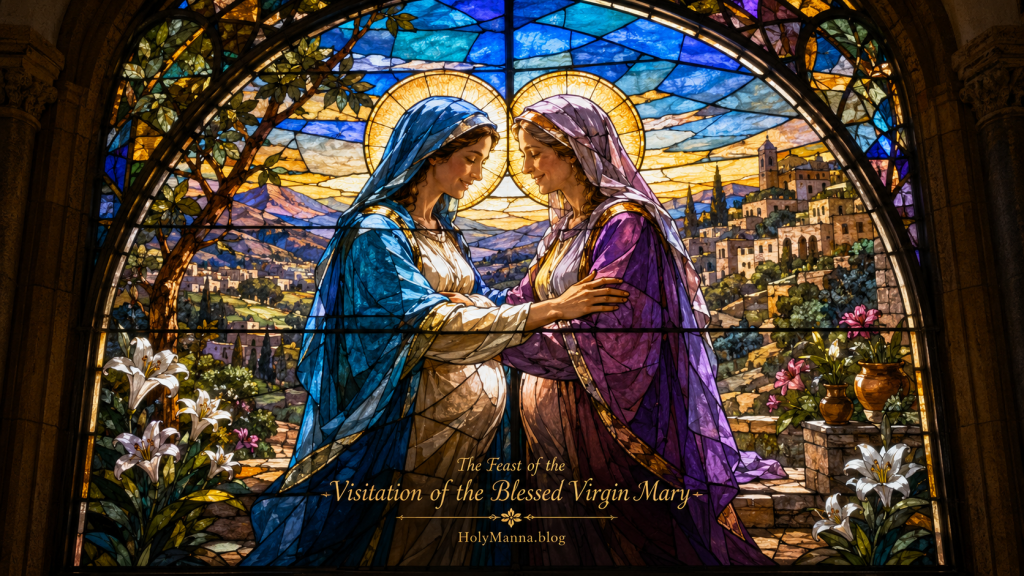
When Mary Carries Jesus, Joy Enters the House
The Feast of the Visitation of the Blessed Virgin Mary is one of the most tender and powerful Marian feasts in the Catholic Church. It celebrates the moment when Mary, newly carrying the Son of God in her womb, travels to visit her cousin Elizabeth, who is also miraculously pregnant with St. John the Baptist.
At first glance, the Visitation looks like a simple family visit. One pregnant woman goes to help another. A young mother greets an older mother. Two cousins rejoice together in the hidden work of God. But in the Catholic imagination, this scene is much more than a sweet moment between relatives. It is the first meeting between Jesus and John the Baptist. It is the first time someone recognizes Mary as the Mother of the Lord. It is the first great Marian hymn of the Church. It is also one of the earliest signs that wherever Mary brings Jesus, joy follows.
In The Gospel of Luke, Elizabeth cries out, “Most blessed are you among women, and blessed is the fruit of your womb.” Then she asks, “And how does this happen to me, that the mother of my Lord should come to me?” These words reveal the heart of the feast. Mary is not honored apart from Jesus. She is honored because she carries Jesus. She is blessed because she believed. She is the Mother of the Lord because the eternal Son of God has truly taken flesh in her womb.
The Church celebrates this feast today on May 31, beautifully placing it near the end of Mary’s month and between the Annunciation of the Lord on March 25 and the Nativity of St. John the Baptist on June 24. It is a feast of faith, service, motherhood, mission, and joy.
The Road from Nazareth to Elizabeth’s House
The story begins right after the Annunciation. The angel Gabriel has appeared to Mary in Nazareth and announced that she will conceive by the Holy Spirit and bear the Son of God. Mary has given her complete yes to God, saying, “Behold, I am the handmaid of the Lord. May it be done to me according to your word.” Then Gabriel gives her a sign: Elizabeth, her relative, has conceived a son in her old age, “for nothing will be impossible for God.”
Mary does not sit still after receiving this news. The Gospel of Luke says, “Mary set out and traveled to the hill country in haste to a town of Judah.” That little phrase, “in haste,” has been loved by saints, popes, and spiritual writers for centuries. Mary’s haste is not anxiety. It is love. She has just received the greatest announcement in human history, and her first instinct is to go serve someone else.
Elizabeth is older. She has lived with the sorrow of barrenness. In the biblical world, that sorrow was not only personal but also social. Yet God has remembered her. In her old age, she is carrying the child who will become the final prophet of the Old Covenant and the forerunner of the Messiah. Mary, the young Virgin Mother, goes to help Elizabeth, the older mother of the prophet. In that meeting, the Old Covenant and the New Covenant touch.
The house of Zechariah becomes a little sanctuary. Mary enters and greets Elizabeth. At the sound of Mary’s greeting, John leaps in Elizabeth’s womb. Elizabeth is filled with the Holy Spirit. Before Jesus is born in Bethlehem, before John preaches in the wilderness, before the crowds hear a single public word from Christ, grace is already moving.
The unborn John rejoices before the unborn Jesus. Elizabeth blesses Mary. Mary praises God. The whole scene is quiet, domestic, and hidden, but heaven is already breaking into the world.
A Feast Born from Scripture, Liturgy, and a Divided Church
The Feast of the Visitation grew from the Church’s deep love for this Gospel mystery. Its roots are connected to the Christian East, where the Gospel of Mary’s visit to Elizabeth was associated with a July 2 celebration connected to the holy garment of the Theotokos, a title meaning “God-bearer.” In the West, the Franciscans adopted the feast in 1263, helping spread devotion to this mystery of Mary’s charity and Christ’s hidden presence.
Pope Urban VI extended the feast to the universal Church in 1389. That historical detail matters because the Church at that time was suffering through the Great Western Schism, a painful period of division and confusion. By establishing the feast more widely, the pope sought Mary’s intercession, asking that Christ and His Mother would visit and heal a wounded Church.
That makes the Visitation more than a beautiful scene from the past. It is also a feast for a Church that needs healing. Mary goes into Elizabeth’s house carrying Christ. The Church asks Mary to help bring Christ again into divided hearts, divided homes, and divided communities.
For centuries, the feast was celebrated on July 2. After the liturgical reforms following the Second Vatican Council, it was moved to May 31 so its place in the calendar would better follow the Gospel timeline. The Annunciation comes first. Then Mary visits Elizabeth. Then John the Baptist is born. The current date helps Catholics walk through the mystery in a way that feels almost like following Mary on the road.
Mary’s Intercession and the Miracles of Hidden Grace
The Visitation itself is not based on a later Marian apparition like Lourdes, Fatima, or Guadalupe. It is rooted directly in Sacred Scripture. That is important. This feast does not begin with a private revelation. It begins with the inspired Word of God.
Still, the Visitation is full of divine intervention. Elizabeth’s pregnancy is a miracle of God’s mercy. Mary’s virginal conception is the mystery of the Incarnation. John’s leap in the womb is a prophetic response to Christ. Elizabeth’s proclamation is inspired by the Holy Spirit. Mary’s Magnificat becomes one of the great prayers of the Church.
The most important “miracle” of the Visitation is that Jesus, hidden in Mary’s womb, sanctifies and brings joy before anyone can see Him. The Catechism of the Catholic Church teaches that John the Baptist was filled with the Holy Spirit from his mother’s womb by Christ Himself. Then The Catechism gives one of the most beautiful summaries of the entire feast: “Mary’s visitation to Elizabeth thus became a visit from God to his people.” CCC 717
That sentence is the key. Mary visits, but God is visiting through her. Mary greets, but Christ is acting. Mary serves, but grace fills the house.
There are also local Catholic devotions under the title Our Lady of the Visitation. In the Philippines, the National Shrine of Our Lady of the Visitation of Guibang honors Mary under this title and is connected with local devotion and pilgrimage. In France, Notre-Dame de Lescure is associated with a regional pilgrimage tradition connected to reported Marian apparitions. These local devotions can be honored respectfully, but they should always be understood properly. The universal feast itself rests on Scripture and the Church’s liturgy, not on a later apparition.
The Church also teaches Catholics to be careful and faithful when speaking about private revelations. The Catechism explains that even approved private revelations do not add to the deposit of faith. They can help the faithful live the Gospel more deeply in a particular time, but Christ is already the fullness of Revelation. The Visitation points to that truth beautifully because Mary’s whole mission is to bring us to Jesus.
The Ark of the New Covenant and the Mother of the Lord
The theology of the Visitation is rich, deeply Catholic, and profoundly Christ-centered. Elizabeth calls Mary “the mother of my Lord,” and in that moment the Church hears a biblical witness to Mary’s divine motherhood. Mary is Mother of God because the child in her womb is not a mere human person later joined to God. He is the eternal Son of God who has taken a true human nature from Mary.
This is why Marian devotion always protects the truth about Jesus. To honor Mary as Mother of God is to proclaim that Jesus is truly God and truly man. Mary’s greatness depends entirely on Him. She is the moon, not the sun. She reflects the glory of the Son she carries.
Catholic tradition also sees Mary in the Visitation as the Ark of the New Covenant. In the Old Testament, the Ark of the Covenant carried the signs of God’s presence among His people. It held the tablets of the Law, the manna, and Aaron’s rod. In the New Testament, Mary carries not a sign, but the living God Himself. The old Ark held sacred things. Mary carries the Holy One.
Pope Benedict XVI drew attention to this connection when he compared John’s leap in Elizabeth’s womb to David dancing before the Ark. In 2 Samuel 6, David rejoices before the Ark of the Covenant. In Luke 1:39-56, John rejoices before Mary, the Ark of the New Covenant, because she carries Jesus Christ, the Son of God made man.
The Visitation also reveals Mary as the model believer. Elizabeth says, “Blessed are you who believed that what was spoken to you by the Lord would be fulfilled.” This is sometimes called the first Marian beatitude. Mary is blessed because she believed God. She trusted before she understood everything. She obeyed before she saw the whole road. She carried the Word because she first received the Word in faith.
The Catechism of the Catholic Church teaches that Mary most perfectly embodies the obedience of faith. Her yes at the Annunciation continues on the road to Elizabeth. She does not merely say yes with her lips. She says yes with her feet, her time, her body, and her service.
The Visitation also speaks beautifully to the dignity of unborn life. Jesus is unborn, yet He is already Lord. John is unborn, yet he already responds with joy. Elizabeth is filled with the Holy Spirit because Christ is present. This moment reminds Catholics that life in the womb is not invisible to God. The unborn child is already part of the story of salvation.
The Magnificat, Mary’s Song and the Church’s Song
After Elizabeth blesses her, Mary does not turn the attention toward herself. She turns everything toward God. Her response is the Magnificat, the great hymn that begins, “My soul proclaims the greatness of the Lord; my spirit rejoices in God my savior.”
This is one of the most important prayers in Christian history. Mary praises God for looking upon her lowliness, for showing mercy, for casting down the mighty, for lifting up the lowly, for filling the hungry with good things, and for remembering His promise to Abraham and his descendants.
The Magnificat is personal, but it is not private. Mary sings as a daughter of Israel. She sings as the Mother of the Messiah. She sings as the perfect disciple. She sings as the voice of the poor who know that God sees them. She sings as the beginning of the Church’s praise.
That is why the Church prays the Magnificat every evening in the Liturgy of the Hours at Vespers. Every day, the Church places Mary’s words on her lips. Every evening, Catholics are invited to see history the way Mary sees it. The proud do not win forever. The powerful do not sit on their thrones forever. The hungry are not forgotten forever. God remembers His mercy.
Pope Benedict XVI described the Magnificat as a profound theological reading of history. Mary sees the world through faith. She knows that God’s mercy is stronger than human pride. She knows that hidden obedience matters more than public power. She knows that the Lord keeps His promises, even when the world seems upside down.
Devotion, Pilgrimage, and the Road to Ain Karem
The Visitation is also the Second Joyful Mystery of the Rosary. When Catholics pray this mystery, they meditate on Mary going in haste to Elizabeth, John leaping for joy, and Jesus bringing grace while still hidden in Mary’s womb. It is a mystery especially suited for anyone trying to learn how to serve without making everything about themselves.
The most famous pilgrimage site connected to the Visitation is the Church of the Visitation in Ain Karem, near Jerusalem. Catholic tradition remembers this area as the place of Mary’s visit to Elizabeth. Pilgrims who go there are not just visiting an old location. They are stepping into the memory of a meeting that changed salvation history.
One of the most beautiful features of the shrine is the presence of the Magnificat in many languages. That detail says something powerful. Mary sang in a specific place, in a specific language, as a daughter of Israel. But the Church now sings with her in every nation. Her song has become the song of believers across the world.
The feast also inspired the Order of the Visitation of Holy Mary, founded in 1610 by St. Francis de Sales and St. Jane Frances de Chantal. The spirituality of the Visitation Sisters reflects the heart of this mystery: humility, gentleness, charity, and hidden holiness. This order later became connected to one of the great devotions of the Church through St. Margaret Mary Alacoque, a Visitation nun who received the revelations of the Sacred Heart of Jesus at Paray-le-Monial.
That connection is not accidental in a spiritual sense. The Visitation teaches that love moves outward. The Sacred Heart reveals the burning love of Christ for humanity. The one who carries Christ brings charity. The Heart of Christ sends the Church into the world with mercy.
A Feast That Still Shapes Catholic Culture
The Visitation has shaped Catholic art, music, prayer, religious life, youth ministry, and popular devotion. Artists often show Mary and Elizabeth embracing, two mothers standing face to face while the hidden children in their wombs are the true center of the scene. It is one of the most human images in Christian art, but also one of the most theological.
The Visitation has also shaped Catholic culture through hymns and prayers inspired by the Magnificat. Mary’s song has been chanted in monasteries, sung in cathedrals, prayed in parish churches, whispered by religious sisters, and carried in the hearts of ordinary believers for centuries.
In recent years, the Visitation became especially visible through World Youth Day Lisbon 2023, whose theme was taken from Luke 1:39: “Mary arose and went with haste.” Pope Francis used that theme to call young people to rise up, move outward, and bring Christ to others. That message fits the feast perfectly. Mary’s faith is not stuck in theory. It becomes movement, service, and mission.
This is why the Visitation speaks so clearly to modern Catholics. A lot of people today are isolated, distracted, tired, and spiritually numb. The Visitation says that one holy visit can matter. One act of charity can open a door for grace. One person carrying Christ can change the atmosphere of a home.
Mary does not need a stage. She does not need applause. She simply brings Jesus.
The House Where Joy Leaped
The Visitation is the feast of holy presence. Mary shows that receiving Jesus is never meant to end with private comfort. When Mary receives Christ, she carries Him to someone else. She brings Him to an older woman who needs help, companionship, and encouragement. She brings Him into a home where God has already been working quietly.
That is one of the most practical lessons of this feast. Catholic life is not only about believing the right things, although truth matters deeply. It is also about becoming the kind of person who carries Christ into ordinary places. Into kitchens. Into family visits. Into hospital rooms. Into difficult conversations. Into friendships. Into homes where people feel forgotten.
Mary’s charity is not loud, but it is powerful. Her humility is not weakness. Her service is not random kindness. It is the fruit of grace.
The Visitation also teaches Catholics how to recognize God’s work in others. Elizabeth does not compete with Mary. She blesses her. Mary does not seek attention from Elizabeth. She praises God. John does not see Jesus with his eyes, but he responds with joy. Everyone in this scene is turned toward the Lord.
That is what holy relationships do. They make room for God.
Who is the Elizabeth in your life, someone who needs your presence, your help, or your encouragement?
Where is God asking you to go in haste, not with anxiety, but with charity?
When people encounter you, do they encounter more noise, more stress, and more ego, or do they encounter something of Christ’s peace?
The Visitation is a reminder that Mary still teaches the Church how to evangelize. Bring Jesus. Serve quietly. Rejoice sincerely. Praise God. Let the Holy Spirit fill the house.
When Mary carries Jesus, joy enters the room.
Engage with Us!
Share your thoughts and reflections in the comments below. The Feast of the Visitation is such a beautiful reminder that faith is meant to move, serve, and bring Christ into the ordinary places of life.
- What part of the Visitation speaks most deeply to your heart: Mary’s haste, Elizabeth’s joy, John’s leap, or the Magnificat?
- Is there someone in your life who may need a “visitation” from you, not just a quick message, but real presence and love?
- How can Mary’s humility and charity help you become more attentive to the needs of your family, parish, or community?
- What does the unborn John’s leap before the unborn Jesus teach you about the dignity of life and the hidden work of grace?
- How can you make Mary’s words your own this week: “My soul proclaims the greatness of the Lord”?
May this feast help every heart receive Christ more deeply, carry Him more faithfully, and bring His joy into the homes, friendships, and communities that need Him most. Let us keep growing together in faith under the guidance of our Blessed Mother, who never keeps Jesus to herself, but always leads her children to Him.
Most Blessed Virgin Mary, pray for us!
Saint Elizabeth, pray for us!
Follow us on YouTube, Instagram and Facebook for more insights and reflections on living a faith-filled life.


Leave a Reply