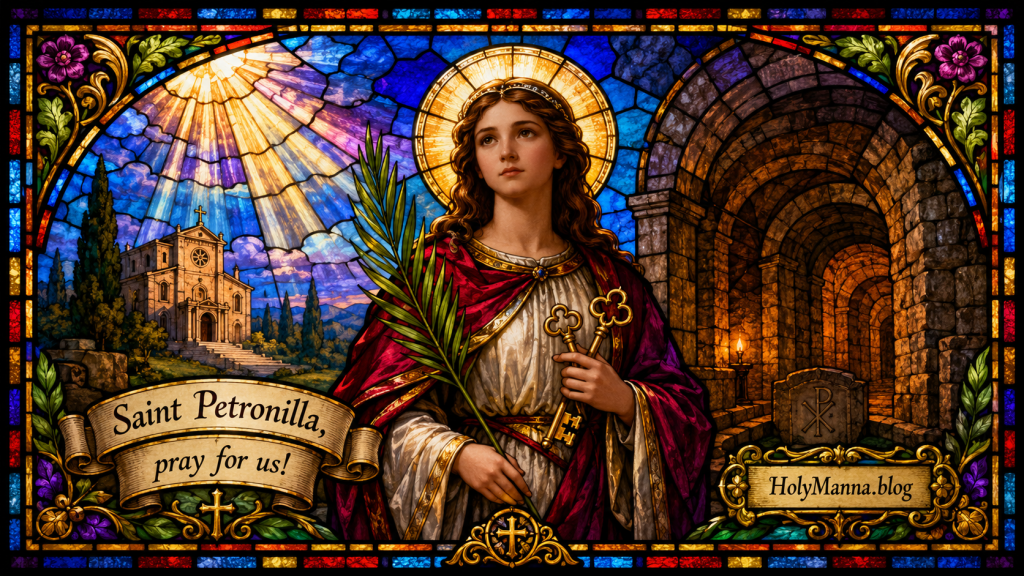
The Hidden Daughter of Apostolic Rome
Saint Petronilla is one of those ancient saints whose name comes to us wrapped in mystery, reverence, and holy tradition. She is honored by the Church as a virgin and martyr, and she has long been remembered as the daughter, or perhaps the spiritual daughter, of Saint Peter.
That detail alone makes her fascinating. The Church is careful here, because Scripture does not tell us that Saint Peter had a daughter. What Catholic tradition does preserve is a beautiful association between Petronilla and the Apostle Peter, one that made her beloved in Rome and especially dear to France. Whether she was his biological daughter, his spiritual daughter, or later connected to him through devotion and legend, Saint Petronilla became a symbol of purity, courage, and closeness to the apostolic heart of the Church.
She is most known for her consecrated virginity, her ancient Roman martyrdom, her legendary refusal to marry the nobleman Flaccus, and her relics in Saint Peter’s Basilica. Her story reminds us that some saints are not known because they left behind many words, but because the Church remembered where they were buried, how they were honored, and what their witness meant.
A Young Woman Remembered by the Church
Very little is known with certainty about Saint Petronilla’s early life. Her name is sometimes given as Aurelia Petronilla, which may suggest that she came from a noble Roman family. Some Catholic scholars have connected her name and burial place with the Christian circles around Saint Flavia Domitilla and the ancient Roman families who quietly embraced the faith while the Church was still young and often persecuted.
Her birthplace is usually associated with Rome, or at least the Christian community of Rome. Her tomb was venerated in the Catacomb of Domitilla along the Via Ardeatina, near the tombs of Saints Nereus and Achilleus. This is one of the strongest pieces of evidence we have about her. The Church did not simply invent devotion to Petronilla in the Middle Ages. Her memory was already rooted in the ancient Christian cemeteries of Rome.
In the Catacomb of Domitilla, there is an early Christian fresco showing Petronilla welcoming a woman named Veneranda into paradise. The inscription identifies Petronilla as a martyr. That little painted scene says so much. Long before modern biographies, long before printed books, the Christians of Rome remembered her as someone already alive in Christ, someone who could accompany the faithful into the hope of heaven.
Petronilla’s faith did not become famous through public preaching, writings, or a known missionary journey. Her life was hidden, but hidden does not mean insignificant. In the Catholic imagination, she stands as one of the quiet flowers of early Rome, rooted near the tombs of martyrs and nourished by the faith of the apostles.
A Virgin Claimed by Christ
Saint Petronilla is traditionally remembered as a virgin consecrated to Christ. The most famous story about her tells of a nobleman named Flaccus who desired to marry her. According to the legend, he was powerful, wealthy, and determined. Petronilla, however, had already given her heart to Christ.
In the story preserved in later Christian tradition, Flaccus demanded her hand in marriage. Petronilla asked for three days to consider the proposal. But she was not weighing earthly comfort against heavenly love. She spent those days in fasting and prayer. Then she received the Holy Eucharist and surrendered her soul to God before she could be forced into marriage.
This story cannot be verified as strict historical biography, but it carries a deeply Catholic meaning. It shows a young woman whose dignity was not for sale, whose body was not to be claimed by pressure, and whose heart belonged first to Christ. Her death in the legend is not presented as despair, but as a kind of peaceful victory. She receives Our Lord in the Eucharist, then goes to meet Him.
That detail matters. Petronilla’s story places the Eucharist at the threshold of death. It reminds Catholics that Holy Communion is not only food for the journey of daily life. It is also the Bread that prepares the soul for eternity.
The Legend of Saint Peter’s Healing
Another famous legend says that Petronilla suffered from illness, often described as palsy, paralysis, or fever. In some versions of the story, people wondered why Saint Peter healed others but did not heal his own daughter. Peter then commanded Petronilla to rise and serve, and she was healed. Afterward, he told her to return to her bed, and the illness came back.
At first, that might sound strange. But in the spirit of the legend, the point is not cruelty. The point is that God’s power was not lacking. Rather, Petronilla’s suffering was mysteriously permitted for the good of her soul. Later versions say that when she had been spiritually perfected through patience, she was finally healed.
This miracle story cannot be verified historically. It belongs to the realm of pious legend. Still, it teaches something very Catholic and very human. Not every suffering disappears when we ask. Sometimes God heals immediately. Sometimes He strengthens the soul while the body remains weak. Sometimes the greater miracle is not the removal of the cross, but the holiness that grows while carrying it.
Because of this tradition, Saint Petronilla has long been invoked against fever. That patronage likely comes from the old stories of her illness and healing.
Martyrdom in the Shadows of Rome
The Church honors Saint Petronilla as a martyr, but the exact circumstances of her martyrdom are uncertain. This is where Catholic honesty is important. Some later stories present her as dying peacefully after prayer and Holy Communion, especially in the legend of Flaccus. Yet ancient Christian art and inscriptions identify her as a martyr.
The best Catholic way to hold these together is to say that Saint Petronilla was venerated from ancient times as a Roman martyr, even though the precise details of her death were not preserved. Many early saints are like this. Their names survived because the Church prayed at their tombs, celebrated their memory, and passed down their witness, even when the full story of their final moments was lost.
That does not make their witness weaker. In some ways, it makes it more moving. Petronilla stands for the many early Christians whose lives were known to God, whose blood or suffering helped water the faith in Rome, and whose names were lovingly guarded by the Church.
Her martyrdom, whether dramatic in the public sense or hidden in the quiet violence of persecution and pressure, points to the same truth. Christ is worth everything.
Relics, France, and a Saint Who Crossed Centuries
Saint Petronilla’s legacy after death is better documented than her life. Her body was first venerated in the Catacomb of Domitilla. In the eighth century, her relics were transferred to Saint Peter’s Basilica. This translation gave her a special place in the heart of Catholic Rome.
Her chapel became closely associated with the Frankish kings and later with France. Since Petronilla was remembered as the daughter of Saint Peter, and the kings of the Franks were seen as protectors and beloved sons of the Holy See, her chapel became a symbol of the bond between France and the papacy. Over time, it was known as a kind of national church for France within Saint Peter’s.
That is one of the surprising facts about Saint Petronilla. A mostly hidden early Roman martyr became, centuries later, a heavenly patroness connected with one of the great Catholic nations of Europe. She was also associated with the dauphins of France, and some traditions connect this with dolphin imagery linked to her sarcophagus and French royal symbolism.
Her altar remains in Saint Peter’s Basilica, where her relics are honored. The famous artwork connected to her, especially Guercino’s Burial of Saint Petronilla, presents her burial below and her heavenly glorification above. It is a beautiful Catholic image. The world sees a body laid in the earth. Faith sees a soul received by Christ.
The fresco in the Catacomb of Domitilla, where Petronilla welcomes Veneranda into paradise, is not a recorded miracle in the modern sense. Still, it shows how early Christians understood her heavenly role. They saw her as a martyr alive in Christ, a saint who could intercede and accompany souls toward heaven.
No verified posthumous miracle collection survives for Saint Petronilla. The miracle stories most associated with her are the legends of her healing during life and her heavenly intercession suggested through ancient Christian art. Those healing stories cannot be verified, but they remain part of her devotional memory.
A Quiet Saint for Souls Under Pressure
Saint Petronilla is a wonderful saint for anyone who feels hidden, pressured, misunderstood, or spiritually tested. She did not leave behind famous sermons. No verified quotations from her survive. She did not become known as a founder, queen, theologian, or missionary. Yet the Church remembered her.
That should comfort ordinary Catholics. Holiness does not always look impressive from the outside. Sometimes holiness looks like fidelity when nobody applauds. Sometimes it looks like purity in a corrupt culture. Sometimes it looks like prayer while suffering. Sometimes it looks like quietly belonging to Christ when the world tries to claim ownership over the soul.
Petronilla’s legend of refusing Flaccus speaks powerfully in every age. The names and customs change, but pressure remains. The world still tells people to compromise, to surrender their dignity, to treat the body as something disconnected from the soul, and to choose comfort over covenant. Petronilla answers with silence, fasting, prayer, and the Eucharist.
Her life also invites Catholics to see suffering through the Cross. The healing legend connected with Saint Peter does not give an easy answer to pain. It does something better. It points toward trust. God is never absent from the sickbed. Christ is never far from the soul that suffers faithfully.
Where is Christ asking for quiet faithfulness rather than public recognition?
What pressure needs to be resisted with prayer, patience, and courage?
How can the Eucharist become the center of daily strength, not only a Sunday habit?
Saint Petronilla teaches that a hidden life can still shine in eternity. She reminds us that purity is not weakness, suffering is not useless, and the saints are not distant memories. They are living members of the Body of Christ, praying for us as we make our way home.
Engage With Us!
Share your thoughts and reflections in the comments below. Saint Petronilla’s story is mysterious, but sometimes the hidden saints have a special way of speaking to the hidden places in our own hearts.
- What part of Saint Petronilla’s story stood out to you the most: her virginity, her suffering, her martyrdom, or her connection to Saint Peter?
- Have you ever experienced a season where God seemed to allow a difficulty for your spiritual growth?
- What can Saint Petronilla teach us about staying faithful when the world pressures us to compromise?
- How can receiving the Eucharist more reverently help us live with greater courage and purity?
May Saint Petronilla pray for us, especially when faithfulness feels hidden and the road feels heavy. Let us live with courage, purity, and trust, doing everything with the love and mercy Jesus taught us.
Saint Petronilla, pray for us!
Follow us on YouTube, Instagram and Facebook for more insights and reflections on living a faith-filled life.

 Holy Manna!
Leave a comment