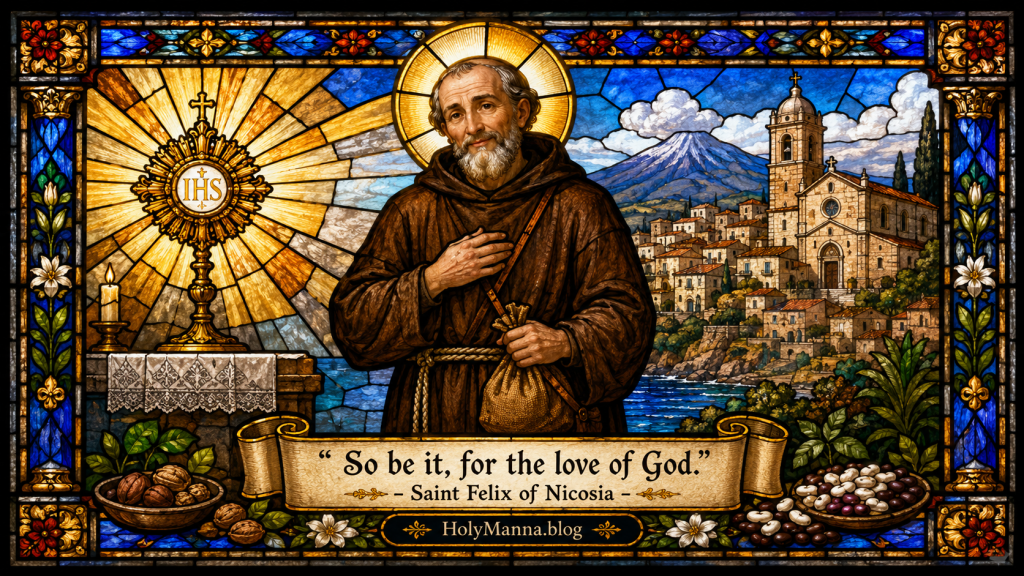
The Saint Who Turned Every Insult into Love
Saint Felix of Nicosia is one of those saints who quietly destroys the excuse that holiness is only for the brilliant, the famous, the ordained, or the naturally impressive. He was not a priest. He was not a scholar. He was not a founder of a religious order. He was an illiterate Sicilian lay brother who begged for alms, served the sick, taught children the faith, endured insults, and answered almost everything with one simple phrase: “So be it, for the love of God.”
That phrase became the shape of his soul.
Saint Felix was a Capuchin friar in 18th-century Sicily, and his whole life was a sermon on humility. He shows the Church that the smallest duties can become holy when they are offered to God. He lived what The Catechism of the Catholic Church teaches about the works of mercy, which are the charitable actions by which Christians help their neighbors in bodily and spiritual needs. These include feeding the hungry, visiting the sick and imprisoned, instructing the ignorant, forgiving offenses, and bearing wrongs patiently, as taught in CCC 2447.
That was Saint Felix’s life. He did not just talk about mercy. He walked it through the streets of Nicosia with a begging sack over his shoulder and Christ in his heart.
A Poor Child in the Shadow of the Friary
Saint Felix was born Filippo Giacomo Amoroso on November 5, 1715, in Nicosia, Sicily. He was baptized the same day. His family was poor, and his father, a shoemaker, died shortly before or around the time of his birth, leaving his mother, Carmela Pirro, a widow with three children.
Felix grew up without formal schooling and remained illiterate for the rest of his life. That detail is not small. In the eyes of the world, it could have made him seem limited. In the eyes of God, it became part of his path to sanctity. He could not read Scripture for himself, but he listened carefully. He learned Christian doctrine, Sacred Scripture, sermons, and spiritual wisdom by hearing them and holding them in his heart.
As a young man, he worked in a shoemaker’s workshop near the Capuchin friary in Nicosia. That workshop became almost like his first school of holiness. He watched the friars as they prayed, fasted, served the poor, and lived with Franciscan simplicity. Their life touched something deep in him. He saw a kind of freedom in their poverty and a kind of joy in their sacrifice.
Even before he entered religious life, Felix was known for devotion to the Eucharist and to the Blessed Virgin Mary. Capuchin tradition remembers him using the greeting: “In every hour and every moment, may the Most Blessed Sacrament always be praised.” When the bell rang for prayer, he encouraged others to pray the Rosary.
This was not the faith of a man looking for attention. It was the quiet faith of someone who had already begun to understand that God is found in hidden places.
The Vocation That Refused to Give Up
Felix wanted to become a Capuchin lay brother, but his path was not easy. Because he was illiterate, he could not become a cleric or priest. He asked to enter as a lay brother, but he was refused repeatedly. Vatican and Capuchin sources say he waited about eight years, with some traditions describing the wait as nearly ten.
That kind of waiting can purify a soul. Felix could have become bitter. He could have walked away. He could have decided that God had closed the door. Instead, he remained patient.
In 1743, he was finally admitted to the Capuchins and sent to Mistretta for his novitiate. On October 10, 1743, he received the habit and the religious name Felix, after Saint Felix of Cantalice, another beloved Capuchin lay brother known for begging alms and serving the poor. One year later, on October 10, 1744, Felix made his religious profession.
Then something unusual happened. He was assigned back to his hometown of Nicosia. Religious superiors often avoided sending friars back to their own hometowns because it could stir up pride, attachment, or favoritism. But Felix returned as a true son of Saint Francis. He came back not to be honored, but to serve.
A Begging Sack Full of Mercy
For roughly forty years, Saint Felix served as a questor, which means he begged alms for the friary and for the poor. He walked through Nicosia and nearby towns, knocking on doors, asking for help, and turning each visit into a small act of evangelization.
When people welcomed him, he blessed them and thanked them. When people rejected him, mocked him, or insulted him, he answered with his famous phrase: “So be it, for the love of God.”
That was not weakness. That was spiritual strength.
Inside the friary, Felix worked as porter, gardener, cook, shoemaker, nurse, and servant. Outside the friary, he visited the sick, helped the poor, comforted families, taught children, and visited prisoners. He cared for the forgotten with the tenderness of someone who knew that Christ was hidden in them.
This is deeply Catholic. In The Gospel of Matthew, Jesus says, “Amen, I say to you, whatever you did for one of these least brothers of mine, you did for me.” Matthew 25:40. Saint Felix lived that verse in an ordinary, practical, daily way.
He also reminds Catholics that holiness is not only found in dramatic moments. It is found in repeated acts of love. It is found in answering the door. It is found in serving the difficult person. It is found in doing the small job well when no one notices.
The Illiterate Catechist Who Taught with Nuts and Beans
One of the most beautiful parts of Saint Felix’s life is the way he taught children the faith. He could not read or write, but he knew the truths of the faith by heart. He taught with simplicity, creativity, and love.
Capuchin tradition says he used ordinary objects to explain Catholic doctrine. One nut helped him teach that there is one God. Three nuts or hazelnuts helped him teach the mystery of the Most Holy Trinity. Five beans reminded children of the Five Wounds of Christ. Ten chickpeas helped him teach the Ten Commandments.
That image is unforgettable. A simple Capuchin brother, walking the streets of Sicily, using nuts and beans to teach eternal truths to children.
He understood something many people forget today. Children need doctrine. They need the Creed. They need the Commandments. They need the Cross. They need the Eucharist. They need the Rosary. They need adults who are willing to pass on the faith with patience and joy.
The Catechism of the Catholic Church teaches that parents have the first responsibility for educating their children in the faith, as seen in CCC 2223. Saint Felix helped strengthen that mission. He did not replace the family. He supported it by bringing the faith into the streets, homes, and hearts of the people.
A Soul Formed by the Eucharist and the Cross
Saint Felix’s holiness was not powered by personality. It was powered by prayer.
He spent long hours before the tabernacle. He meditated deeply on the Passion of Christ, especially on Fridays. During Fridays in March, he fasted on bread and water. He had great devotion to Our Lady of Sorrows and encouraged the Rosary.
This matters because Felix’s charity did not come from mere human niceness. It came from union with Christ. The Church teaches in The Catechism of the Catholic Church that the Eucharist is “the source and summit of the Christian life.” CCC 1324. Saint Felix shows what that means in action. He adored Christ in the Blessed Sacrament, then went out and served Christ in the poor.
His love for the Passion also shaped his patience. He could endure rejection because he kept his eyes on Jesus rejected. He could endure humiliation because he contemplated Jesus crowned with thorns. He could bear insults because he loved the Crucified One who remained silent before His accusers.
That is why his favorite phrase was not just a nice saying. “For the love of God” was his whole theology of suffering.
Tested by Humiliation, Strengthened by Obedience
Saint Felix’s life was not easy, even inside the friary. His superior and confessor, Father Macario, tested him harshly for years. Capuchin sources say Father Macario often humiliated him publicly and called him names. Felix was sometimes mocked as lazy, hypocritical, or discontented.
He did not respond with resentment. He did not gossip. He did not demand recognition. He endured it with obedience and humility.
This part of his life can be hard for modern readers. It does not mean every harsh treatment is holy or that abuse should be ignored. But in Felix’s particular life, the Church recognizes a heroic patience rooted in love for Christ. He transformed humiliation into sacrifice. He offered it to God.
He was also known by a humble nickname that can be translated as the little donkey of the friary. Rather than being offended, Felix embraced the image as a symbol of service. A donkey carries burdens quietly. Felix carried burdens for the love of God.
His hardship was not martyrdom by blood. He was not killed for the faith. But he lived a kind of white martyrdom, the daily dying to pride, comfort, reputation, and self-will.
In The Gospel of Luke, Jesus says, “If anyone wishes to come after me, he must deny himself and take up his cross daily and follow me.” Luke 9:23. Saint Felix took up the daily cross, and he carried it with a begging sack and a smile.
Stories and Legends from a Humble Wonderworker
During his lifetime, Saint Felix became known among the faithful as a wonderworker. Many miracle stories are preserved in Capuchin tradition. Some belong to the devotional memory of the people rather than formal Church verification, so they should be received as pious stories unless they are connected to the official beatification or canonization process.
One famous story says that Felix was ordered to distribute ricotta made from ashes. In obedience, he did so, and the ashes became fresh ricotta. The story beautifully expresses two themes that marked his life: obedience and God’s care for the poor. This story comes from Capuchin tradition, but it cannot be historically verified in the same way as the miracles examined for his canonization.
Another story says Felix once drew water from a well using a wicker basket, and by God’s power the water remained inside it. This story is part of the devotional tradition surrounding him, but it cannot be verified.
A different tradition says that someone mockingly gave him water as if it were wine, and the water became wine. Another says stones mockingly offered as bread became actual bread. These stories reflect the popular memory of Felix as a humble friar through whom God defended the poor and exposed mockery, but these stories cannot be verified.
Capuchin tradition also associates him with healings, knowledge of hidden things, bilocation, deliverance from demonic affliction, and powerful intercession for the sick. These stories show how deeply the people trusted him, but the individual accounts cannot all be verified.
One especially striking story concerns his response to blasphemy. When Felix heard someone blaspheme, tradition says he would kneel down, pray the Glory Be three times, and then gently call the person to repentance. That is a very Catholic response. He made reparation first, then corrected with humility.
He did not excuse sin. He did not rage against the sinner. He loved God, honored His holy name, and invited the person back to grace.
Obedient Even at the Door of Death
Near the end of May 1787, Felix became seriously ill after working in the friary garden, where he tended herbs used to care for the sick. He developed a sudden fever, and medical treatment did not help.
The story of his death is one of the most moving parts of his life. Capuchin tradition says that as he approached death, Felix asked Father Macario for permission to die. His superior initially refused, and Felix obeyed. He continued to suffer patiently. After repeated requests, Father Macario finally blessed him and gave permission.
Felix died around 2:00 a.m. on May 31, 1787. Tradition says his final words echoed the phrase he had lived by: “Let it be for the love of God.”
Whether working, begging, suffering, being insulted, or dying, Felix wanted only one thing: to belong completely to God.
A Saint Remembered After Death
After Felix died, devotion to him spread immediately. His body was displayed in the church, and crowds came from Nicosia and surrounding towns. People were so eager for relics that they cut pieces from his habit, cord, hair, and beard. The friars reportedly had to change his habit more than once because of the devotion of the people.
His funeral drew religious, civic, military, and popular participation. The people knew they had lost someone holy.
His cause for canonization opened in the 19th century. Pope Leo XIII beatified him on February 12, 1888. Pope Benedict XVI canonized him on October 23, 2005, in Saint Peter’s Square. At his canonization, Pope Benedict XVI highlighted the phrase that summarized Felix’s holiness: “So be it, for the love of God.”
The approved miracles connected with his beatification included healings attributed to his intercession, including Vincenzo Abate of Palermo and Capuchin Father Giuseppe Antonio of Adernò, now Adrano. The miracle connected with his canonization involved the healing of Father Giuseppe Turdo of Tusa.
This is important because the Church distinguishes between devotional miracle stories and formally investigated miracles. Saint Felix has both. He is surrounded by the loving memory of the faithful, and he was also raised to the altars through the Church’s official discernment.
A Living Legacy in Sicily and Beyond
Saint Felix remains especially loved in Nicosia. He is honored as a patron of the city, and his feast is celebrated with deep local devotion. His liturgical memorial is observed on May 31 in many listings, while the Capuchins and the Churches of Sicily celebrate him on June 2. In Nicosia, his feast is also celebrated with special solemnity on the last Sunday of August, including religious and civic events, processions, Masses, and local devotion.
His legacy also continues in modern Catholic life. In 2020, the Sicilian Episcopal Conference proclaimed Saint Felix the regional patron of blood donors in Sicily. That is a beautiful connection. Felix spent his life serving the sick and needy with no desire for reward. Blood donation, when done generously, reflects that same spirit of mercy and self-gift.
There is also a modern pilgrimage route connected to his memory, the Cammino di San Felice da Nicosia. Pilgrims who walk in his footsteps are reminded that holiness is a journey of small steps, humble service, and daily surrender.
Saint Felix’s cultural impact is not loud or flashy. It is the impact of a saint who still teaches ordinary people how to become holy through ordinary love.
The Lesson of the Little Donkey of God
Saint Felix of Nicosia is the kind of saint needed in an age obsessed with recognition. He reminds Catholics that God sees what the world overlooks.
He sees the parent who keeps showing up.
He sees the worker who does the honest thing when no one notices.
He sees the person who forgives an insult instead of escalating it.
He sees the Catholic who prays quietly, serves faithfully, and keeps choosing love.
Felix did not need fame to become holy. He needed grace. He needed the Eucharist. He needed obedience. He needed the Cross. He needed love.
His life beautifully reflects the teaching of The Catechism of the Catholic Church that charity is the soul of holiness. As CCC 826 teaches, love gives life to all the members of the Church and is the heart of the Christian vocation.
Saint Felix shows that holiness is not complicated, but it is costly. It means saying, again and again, “for the love of God.”
Say it when work feels unnoticed.
Say it when someone is rude.
Say it when service feels tiring.
Say it when obedience feels heavy.
Say it when prayer feels dry.
Say it when the cross is not dramatic, but daily.
What hidden duty in your life could become an offering of love today?
What insult, frustration, or disappointment could be handed to God instead of held in resentment?
Where is Jesus asking you to serve quietly, without needing applause?
Engage With Us!
Share your thoughts and reflections in the comments below. Saint Felix of Nicosia reminds us that holiness often grows in hidden places, through small acts of mercy, patience, and love.
- What part of Saint Felix’s life challenges you the most: his humility, his obedience, his poverty, or his patience under insult?
- How can you practice the works of mercy more intentionally this week in your family, parish, workplace, or community?
- What ordinary task could you offer today with the prayer, “for the love of God”?
- How can Saint Felix’s Eucharistic devotion inspire you to spend more time with Jesus in prayer, Mass, or Adoration?
- Who in your life needs mercy, patience, or encouragement from you right now?
May Saint Felix of Nicosia teach us to find Christ in the poor, the sick, the difficult, and the forgotten. May his simple prayer become part of our own daily lives: “So be it, for the love of God.” Let us live with faith, serve with humility, forgive with mercy, and do everything with the love and mercy Jesus taught us.
Saint Felix of Nicosia, pray for us!
Follow us on YouTube, Instagram and Facebook for more insights and reflections on living a faith-filled life.


Leave a Reply