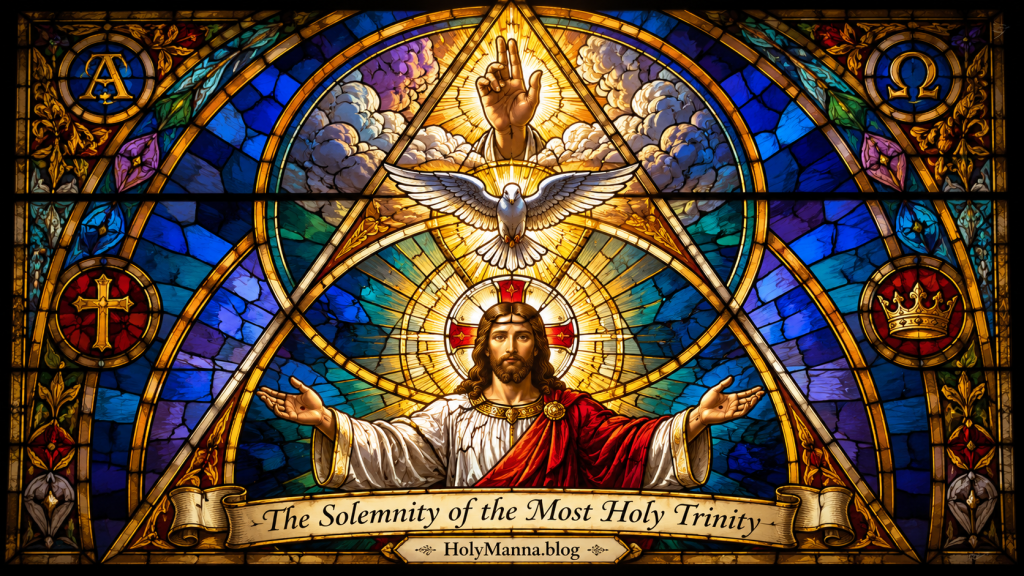
The Mystery at the Heart of Everything
The Solemnity of the Most Holy Trinity celebrates the deepest mystery of the Catholic faith: one God in three divine Persons, Father, Son, and Holy Spirit. This is not a feast about solving a theological riddle. It is a feast about worshiping the living God as He has revealed Himself.
The Church teaches in The Catechism of the Catholic Church that “The mystery of the Most Holy Trinity is the central mystery of Christian faith and life” and that it is “the source of all the other mysteries of faith” (CCC 234). That means everything Catholics believe begins here. Creation, salvation, Baptism, the Eucharist, prayer, grace, heaven, and the Church’s mission all flow from the life of the Father, the Son, and the Holy Spirit.
This solemnity is celebrated on the Sunday after Pentecost. That timing is beautiful. After the Holy Spirit descends upon the Church at Pentecost, the Church lifts her eyes to the fullness of God’s inner life. The Father sends the Son. The Son reveals the Father. The Holy Spirit draws the Church into communion with both. Trinity Sunday gathers the whole story of salvation into one act of praise.
The Story Behind the Feast: A Mystery Revealed Before It Was Celebrated
The Solemnity of the Most Holy Trinity does not begin with an apparition, a single miracle, or one dramatic moment in history. It begins with God Himself revealing who He is.
From the very beginning of Christianity, the Church worshiped the Father, the Son, and the Holy Spirit. Jesus commanded the Apostles to baptize “in the name of the Father, and of the Son, and of the holy Spirit” (Matthew 28:19). That baptismal formula was not a later decoration added to Christianity. It was given by Christ Himself.
The early Christians prayed in a Trinitarian way, were baptized in a Trinitarian way, and heard the Apostles speak in a Trinitarian way. Saint Paul’s blessing in 2 Corinthians is one of the clearest examples: “The grace of the Lord Jesus Christ and the love of God and the fellowship of the holy Spirit be with all of you” (2 Corinthians 13:13).
Still, as the centuries passed, the Church had to defend this revealed mystery from serious errors. Some denied the full divinity of the Son. Others misunderstood the Holy Spirit. The Church responded with clarity, not by inventing a new doctrine, but by protecting the faith once handed down by the Apostles.
At the Council of Nicaea in 325, the Church confessed that the Son is consubstantial with the Father. At the Council of Constantinople in 381, the Church confessed the Holy Spirit as Lord and giver of life, worshiped and glorified with the Father and the Son. These councils helped give the Church the language needed to say faithfully what Christians had believed and worshiped from the beginning.
The feast itself developed later in the Western Church. In some places, especially during the Middle Ages, local churches began celebrating a special liturgical office in honor of the Holy Trinity. Bishop Stephen of Liège is often associated with an early Office of the Holy Trinity. Pope Alexander II did not immediately impose a universal feast because the Trinity was already honored every day in the Church’s prayer, especially through the Gloria Patri, the doxologies, and the Mass itself.
There is also a meaningful English connection. Saint Thomas Becket, who was consecrated Archbishop of Canterbury on the Sunday after Pentecost, is traditionally associated with promoting the celebration of the Trinity on that day in England. Over time, this devotion spread more widely.
Finally, in 1334, Pope John XXII extended the feast to the entire Latin Church. Later, Pope Saint Pius X elevated its liturgical importance. The feast developed slowly, but the mystery it celebrates was there from the beginning, at the heart of Christian faith, worship, and Baptism.
The God Who Is Communion: Theological Significance
The Catholic faith teaches that God is one. Not three gods. Not three parts of God. Not one God wearing three different masks. One God in three divine Persons.
The Catechism teaches, “The Trinity is One. We do not confess three Gods, but one God in three persons” (CCC 253). The Father is God. The Son is God. The Holy Spirit is God. Yet there is only one divine nature.
The three Persons are truly distinct. The Father is not the Son. The Son is not the Holy Spirit. The Holy Spirit is not the Father. Yet they are not divided. The Father eternally begets the Son. The Son is eternally begotten of the Father. The Holy Spirit proceeds from the Father and the Son. The Church summarizes this mystery with great precision: “The divine Unity is Triune” (CCC 254).
That may sound lofty, but it matters deeply for ordinary Catholic life. God is not loneliness. God is not isolation. God is not a distant power sitting alone in heaven. God is eternal communion. Before the world existed, God was already love. Creation did not make God loving. Redemption did not make God merciful. The Cross revealed the love that has always existed in the heart of God.
Saint John gives the key: “God is love” (1 John 4:8). Love is not merely something God does. Love is who God is. The Father loves the Son. The Son loves the Father. The Holy Spirit is the eternal communion of love. Human beings are made in the image of this God, which means people are made for communion, not isolation.
This is why sin is always more than rule-breaking. Sin damages communion. Pride separates. Lust uses. Envy divides. Anger hardens the heart. Greed closes the soul. Grace does the opposite. Grace restores communion with God, with the Church, with family, with neighbors, and even with the difficult person who is hard to forgive.
The Mass prayers for Trinity Sunday teach this beautifully. The Collect speaks to the Father, who sent the Word of truth and the Spirit of sanctification. The Preface proclaims that the Father, the Only Begotten Son, and the Holy Spirit are “one God, one Lord: not in the unity of a single person, but in a Trinity of one substance.” The Church does not only explain the Trinity. She adores the Trinity.
The Readings: Mercy, Communion, and Love Poured Out
For the Solemnity of the Most Holy Trinity in 2026, the readings are Exodus 34:4b-6, 8-9, Daniel 3:52-56, 2 Corinthians 13:11-13, and John 3:16-18. Together, they reveal not only that God is Trinity, but what the Triune God is like toward His people.
In Exodus, Moses climbs Mount Sinai, and the Lord reveals His name. God passes before Moses and declares Himself “a merciful and gracious God, slow to anger and rich in kindness and fidelity” (Exodus 34:6). This is one of the most important moments in the Old Testament. God does not reveal Himself first as a cold concept. He reveals Himself as merciful, faithful, patient, and near.
Moses responds by bowing down in worship. That is the right posture before mystery. Before Moses asks for anything, he adores. Then he begs God to remain with His people, even though they are stiff-necked. That is honest Catholic prayer. It admits the truth about human weakness, but it trusts even more deeply in divine mercy.
The responsorial canticle from Daniel 3 is pure praise: “Glory and praise for ever!” (Daniel 3:52). On Trinity Sunday, the Church places praise on the lips of her children because the mystery of God is not first approached by argument. It is approached by worship.
Saint Paul’s words in 2 Corinthians sound familiar because the priest often uses them at Mass: “The grace of the Lord Jesus Christ and the love of God and the fellowship of the holy Spirit be with all of you” (2 Corinthians 13:13). Grace, love, and fellowship. That is not a random greeting. It is a doorway into the life of the Trinity.
Then comes the Gospel from John, where Jesus reveals the heart of the Father: “For God so loved the world that he gave his only Son” (John 3:16). The Father gives the Son. The Son is given for the salvation of the world. The Holy Spirit applies that salvation to the soul. Trinity Sunday is not abstract. It is personal. God loved the world. God gave His Son. God came not to condemn, but to save.
Devotion and Pilgrimage: Living Under the Name of the Trinity
The simplest and most universal devotion to the Holy Trinity is the Sign of the Cross. It is so familiar that Catholics can rush through it without thinking. Yet it is one of the most powerful prayers in the Church.
Every Sign of the Cross says the Christian life begins, continues, and ends “in the name of the Father, and of the Son, and of the Holy Spirit.” It is a confession of faith. It is a remembrance of Baptism. It is a shield against evil. It is a surrender of the whole person to God.
The Glory Be is another deeply Trinitarian prayer. “Glory be to the Father, and to the Son, and to the Holy Spirit” is one of the most common prayers in Catholic life, but it carries the weight of the whole Creed. It gives glory equally to the three divine Persons. It teaches the soul to praise God as He is.
The Trisagion, meaning “thrice holy,” is also connected to Trinitarian devotion. The Church’s worship constantly echoes the heavenly praise of God as holy, holy, holy. Every Mass includes the Sanctus, where the Church joins the angels and saints in singing “Holy, Holy, Holy Lord God of hosts.”
The Athanasian Creed also has a special place in Trinitarian teaching. It says, “We worship one God in the Trinity and the Trinity in unity, without either confusing the persons or dividing the substance.” This line is a powerful guardrail. Do not confuse the Persons. Do not divide the one God. Hold both truths together with faith.
There are also Catholic devotions connected to the Trinity through Fatima. The Angel of Peace taught the children of Fatima prayers of adoration and reparation addressed to the Most Holy Trinity. The well-known Angel Prayer begins, “Most Holy Trinity, Father, Son and Holy Spirit, I adore Thee profoundly.” This prayer reminds Catholics that true devotion always leads to adoration, repentance, and Eucharistic love.
There are holy sites connected with Trinitarian devotion as well. The Basilica of the Most Holy Trinity at the Shrine of Fatima is one of the most significant modern Catholic examples. Its dedication reflects the deeply Trinitarian horizon of the Fatima message, especially the angel’s invitation to adore God and offer reparation.
The Order of the Most Holy Trinity, commonly known as the Trinitarians, is another important expression of this mystery in Catholic history. Founded by Saint John de Matha and approved by Pope Innocent III in 1198, the order united contemplation of the Trinity with works of mercy, especially the redemption of captives. That is a beautiful Catholic pattern. True worship of the Trinity leads to charity in action.
Cultural Impact and Celebration: A Sunday of White, Praise, and Wonder
Around the world, Trinity Sunday is celebrated with the solemn beauty of the Roman Rite. White vestments are worn because the feast celebrates the glory, purity, and majesty of God. Parishes often sing hymns and acclamations that emphasize divine holiness and Trinitarian praise. The prayers of the Mass, especially the Preface, offer a rich catechesis on the one God in three Persons.
In many Catholic communities, the day is also a quiet catechetical moment. Priests preach on the central mystery of the faith. Families make the Sign of the Cross with renewed attention. Children learning the faith begin to understand that Christianity is not simply belief in “God” in a vague way, but faith in the Father, the Son, and the Holy Spirit.
The feast also shapes Catholic culture through ordinary prayer. Every Rosary begins with the Sign of the Cross and the Apostles’ Creed. Every decade ends with the Glory Be. Every Mass begins and ends in the name of the Trinity. Every blessing is Trinitarian. Every Baptism brings a soul into the life of the Triune God.
This is why the Trinity is not a theme Catholics visit once a year. It is the air Catholic life breathes. Trinity Sunday simply slows everything down and says, “Look again. This is the mystery behind everything.”
A Reflection for the Heart: The Mystery Is Love
The Trinity is not a mystery to solve. It is a love to enter.
That is the key. A person can study the Trinity for a lifetime and still never exhaust the mystery. That is not because the doctrine is irrational. It is because God is infinite. The human mind can truly know what God has revealed, but it cannot contain God as if He were a small object to be mastered.
This feast teaches humility. The greatest minds in Church history, including Saint Augustine and Saint Thomas Aquinas, approached the Trinity with reverence. They used reason beautifully, but they also knew that reason must kneel before revelation. The goal is not to shrink God down until He feels manageable. The goal is to be lifted by grace into the life God freely shares.
Trinity Sunday also teaches identity. Every baptized Catholic has been marked by the name of the Father, and of the Son, and of the Holy Spirit. That means the Christian does not belong to chaos, fear, sin, or the passing opinions of the world. The Christian belongs to God.
That truth should change daily life. A person who belongs to the Trinity is called to live differently. Speak with mercy because the Father is merciful. Sacrifice with love because the Son gave Himself. Seek holiness because the Holy Spirit sanctifies. Build communion because God is communion.
This feast also speaks powerfully to a lonely age. Many people are connected online but isolated in the heart. Many have followers but no real fellowship. Many know how to express opinions but struggle to forgive, listen, and remain faithful. Trinity Sunday reminds Catholics that communion is not optional decoration. Communion is written into reality because it begins in God Himself.
Where is God inviting deeper communion today?
Is there a relationship that needs mercy instead of pride?
Is the Sign of the Cross being made with attention, or only out of habit?
Does daily life reflect the love of the Trinity, or does it drift toward isolation and self-protection?
The Solemnity of the Most Holy Trinity brings Catholics back to the beginning and the end of everything. Life begins in the name of the Trinity. Prayer rises to the Trinity. The sacraments draw souls into the Trinity. Heaven is eternal communion with the Trinity.
The Father creates and loves. The Son redeems and gives Himself. The Holy Spirit sanctifies and makes the heart holy. This is the God Catholics worship. This is the God who saves. This is the God who calls every soul home.
Engage with Us!
Share your thoughts and reflections in the comments below. Trinity Sunday is one of the most beautiful feasts of the Church year because it invites every Catholic to slow down and rediscover the mystery behind every prayer, every sacrament, and every act of love.
- When making the Sign of the Cross, do you pause to remember that you are calling upon the Father, the Son, and the Holy Spirit?
- Which part of this feast speaks most deeply to your heart: the Father’s love, the Son’s sacrifice, or the Holy Spirit’s sanctifying presence?
- Where is God inviting you to build communion instead of division in your family, parish, workplace, or friendships?
- How can the truth that God is love change the way you pray, forgive, and serve this week?
- What would it look like to live each day more consciously in the name of the Father, and of the Son, and of the Holy Spirit?
May this solemnity help every Catholic return to the heart of the faith with wonder, humility, and love. Live this week under the name of the Most Holy Trinity. Love generously. Forgive quickly. Pray faithfully. Serve quietly. Do everything with the love and mercy Jesus taught us.
Most Holy Trinity, have mercy on us!
Follow us on YouTube, Instagram and Facebook for more insights and reflections on living a faith-filled life.


Leave a Reply