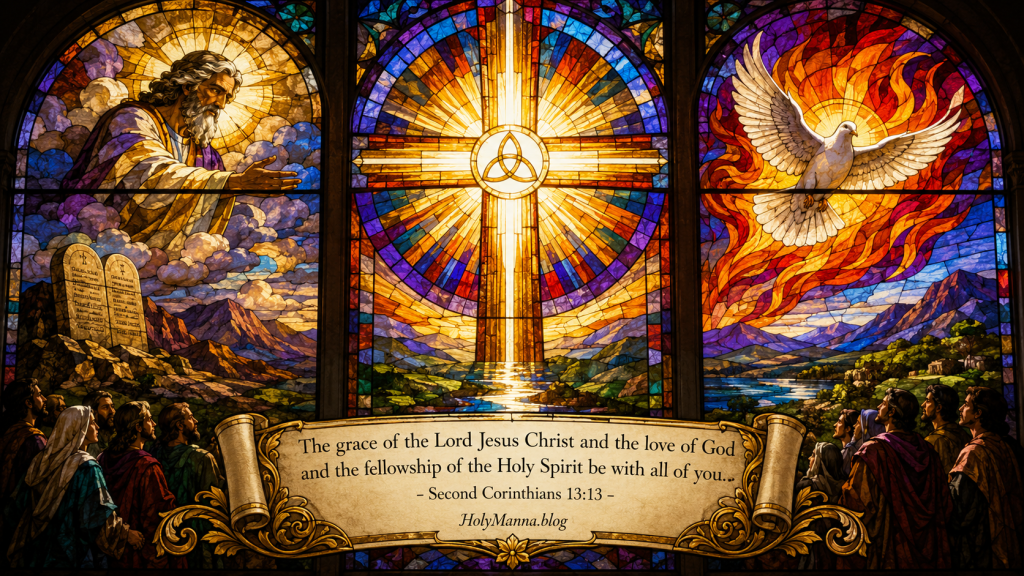
The Solemnity of the Most Holy Trinity – Lectionary: 164
The God Who Comes Down in Love
Some mysteries are not meant to be solved like riddles, but entered like a home where the door has been opened by love.
On this Solemnity of the Most Holy Trinity, the Church invites us to contemplate the central mystery of the Christian faith: one God in three divine Persons, Father, Son, and Holy Spirit. The Catechism teaches that the Trinity is “the central mystery of Christian faith and life” because it reveals who God is in Himself and what He desires for us: communion with Him forever. Yet today’s readings do not speak of the Trinity as a cold doctrine reserved for theologians. They reveal the Trinity as the living God who comes close, forgives sinners, receives worship, forms His people into communion, and gives His only Son so the world might be saved.
In Exodus 34:4-6, 8-9, Moses climbs Mount Sinai after Israel’s terrible sin with the golden calf. The covenant has been wounded, the people have proven themselves stiff-necked, and judgment would seem justified. But the Lord descends in the cloud and proclaims His name: “gracious and merciful, slow to anger and abounding in love and fidelity.” This is the God who does not abandon His people in their failure. He reveals His mercy precisely where sin has broken trust. Moses responds with worship and intercession, asking God to pardon His people and claim them as His own.
The canticle from Daniel 3:52-56 lifts that same mercy into praise. Spoken from the story of the fiery furnace, it reminds us that true worship does not depend on comfortable circumstances. The Lord is blessed in His holy glory, on His throne, above the cherubim, and in the firmament of heaven. Even in trial, God remains worthy of praise. The soul that knows God’s mercy learns to bless Him not only after deliverance, but even while standing in the heat of the furnace.
Then, in 2 Corinthians 13:11-13, Saint Paul shows what the life of the Trinity looks like inside the Church. He calls the Corinthians to rejoice, mend their ways, encourage one another, live in peace, and receive the blessing of “the grace of the Lord Jesus Christ and the love of God and the fellowship of the holy Spirit.” This is not just a beautiful ending to a letter. It is a glimpse into Christian life itself. The Church is meant to become a people shaped by the grace of the Son, the love of the Father, and the communion of the Holy Spirit.
Finally, John 3:16-18 reveals the heart of the Trinity with words that have consoled sinners for centuries: “God so loved the world that he gave his only Son.” The Father gives. The Son is sent. The Holy Spirit draws believers into the life of salvation. Jesus makes clear that the Son was not sent to condemn the world, but so that the world might be saved through Him. The mystery of the Trinity is therefore not distant from daily life. It is the reason sinners can repent, families can be healed, parishes can become places of communion, and weary hearts can still hope.
Today’s readings all point to one central theme: the Most Holy Trinity is the God who comes down in love to claim His people as His own. The Father’s mercy is revealed on Sinai. The Son’s saving mission is revealed in the Gospel. The Holy Spirit’s communion is poured into the Church. The Christian life begins and ends inside this mystery every time we make the Sign of the Cross and say, “In the name of the Father, and of the Son, and of the Holy Spirit.”
What would change today if that sign were made slowly, prayerfully, and with the confidence that the God of mercy truly wants to claim us as His own?
First Reading – Exodus 34:4-6, 8-9
The God Who Comes Down to a Broken Covenant
The first reading places us on Mount Sinai after one of the most painful moments in Israel’s history. God had rescued His people from slavery in Egypt, led them through the Red Sea, fed them in the wilderness, and entered into covenant with them. Yet while Moses was on the mountain receiving the Law, Israel made and worshiped the golden calf. The covenant was wounded almost immediately by idolatry.
That background matters because this reading is not simply about Moses receiving new stone tablets. It is about mercy after betrayal. Israel has acted like an unfaithful bride, and yet the Lord does not abandon His people. He calls Moses back up the mountain, descends in the cloud, and reveals His own name. In the ancient world, a name was not merely a label. It revealed identity, character, and presence. So when God proclaims His name, He is revealing His heart.
This fits beautifully into today’s central theme for the Solemnity of the Most Holy Trinity: God does not stay far away from His wounded people. The Father reveals mercy. The Son will later embody that mercy in the flesh. The Holy Spirit will draw sinners into communion with God. On Sinai, before the full revelation of the Trinity in Christ, the Church already hears the heartbeat of the one true God: merciful, gracious, faithful, and near.
Exodus 34:4-6, 8-9 – New American Bible (Revised Edition)
4 Moses then cut two stone tablets like the former, and early the next morning he went up Mount Sinai as the Lord had commanded him, taking in his hand the two stone tablets.
5 The Lord came down in a cloud and stood with him there and proclaimed the name, “Lord.” 6 So the Lord passed before him and proclaimed: The Lord, the Lord, a God gracious and merciful, slow to anger and abounding in love and fidelity,
8 Moses at once knelt and bowed down to the ground. 9 Then he said, “If I find favor with you, Lord, please, Lord, come along in our company. This is indeed a stiff-necked people; yet pardon our wickedness and sins, and claim us as your own.”
Detailed Exegesis
Verse 4 – “Moses then cut two stone tablets like the former, and early the next morning he went up Mount Sinai as the Lord had commanded him, taking in his hand the two stone tablets.”
Moses cuts two new stone tablets because the first tablets had been broken after Israel’s sin with the golden calf. That breaking was not just emotional anger. It symbolized a broken covenant. The people had shattered their relationship with God through idolatry.
Yet God commands Moses to prepare new tablets. This is already mercy in action. The Lord is not pretending the sin did not happen, but He is making a way for covenant renewal. Catholic faith always holds these two truths together: sin is real, and mercy is greater. God does not save us by ignoring our rebellion. He saves us by calling us back into communion.
The detail that Moses rises “early the next morning” also carries spiritual weight. Moses obeys promptly. He does not delay. After grave sin, delayed repentance can become another form of resistance. Moses shows the posture of a faithful intercessor. When God opens a path to restoration, the soul should not move slowly out of pride or fear. It should rise and return.
Verse 5 – “The Lord came down in a cloud and stood with him there and proclaimed the name, ‘Lord.’”
This verse is breathtaking. The Lord comes down. The God of heaven descends to meet Moses. The cloud recalls God’s mysterious presence throughout the Exodus journey. A cloud guided Israel by day, covered Sinai, and later filled the tabernacle. It reveals God’s nearness while also preserving His mystery.
The Lord “stood with him there” because divine mercy is not distant sympathy. God comes close. This is one of the great movements of salvation history. God comes down to Sinai. Later, in the fullness of time, the Son of God comes down in the Incarnation. At Pentecost, the Holy Spirit comes down upon the Church. The same God who descends in the cloud will one day dwell among us in Christ and within us by grace.
The proclamation of the divine name is also central. In Scripture, God’s name reveals His identity and presence. To call upon the name of the Lord is to call upon the living God Himself. Here, God does not allow Moses to define Him by Israel’s failure. God defines Himself by His own mercy, holiness, and faithfulness.
Verse 6 – “So the Lord passed before him and proclaimed: The Lord, the Lord, a God gracious and merciful, slow to anger and abounding in love and fidelity.”
This is the heart of the reading. God proclaims Himself as “gracious and merciful, slow to anger and abounding in love and fidelity.” These words become one of the great biblical descriptions of God’s character. They echo throughout the Old Testament because Israel never forgets that God revealed His mercy after the golden calf.
The Lord is “gracious” because His love is not earned. He gives Himself freely. He is “merciful” because He bends toward the misery of His people. He is “slow to anger” because His justice is not impulsive or petty. He is “abounding in love and fidelity” because His covenant love is stronger than human instability.
This verse does not reduce God to kindness without holiness. It reveals that God’s holiness includes mercy. He is not like pagan gods who are moody, manipulative, or indifferent. The God of Israel is faithful even when His people are not. This prepares us to understand the Gospel, where the Father gives His only Son not to condemn the world, but to save it.
Verse 8 – “Moses at once knelt and bowed down to the ground.”
Moses responds with worship. He does not debate. He does not casually acknowledge God. He kneels and bows to the ground. When the soul truly encounters divine mercy, reverence follows.
This matters today because modern culture often mistakes mercy for casualness. God’s mercy does not make Him less holy. It should make us more humble. Moses has just heard that God is gracious and merciful, and his immediate response is adoration. The more deeply a person understands mercy, the less lightly they treat sin and the more reverently they approach God.
Catholic worship carries this same instinct. Kneeling, genuflecting, bowing, silence, and reverence at Mass are not empty gestures. They teach the body to tell the truth. God is God, and we are loved sinners standing before mystery.
Verse 9 – “Then he said, ‘If I find favor with you, Lord, please, Lord, come along in our company. This is indeed a stiff-necked people; yet pardon our wickedness and sins, and claim us as your own.’”
Moses becomes an intercessor. He does not deny Israel’s sin. He calls the people “stiff-necked”, which means stubborn, resistant, and unwilling to bend before God. Yet Moses does not stop there. He asks the Lord to pardon their wickedness and sins and to claim them as His own.
This is a deeply Catholic pattern of prayer. Real intercession does not excuse sin. It brings sin before God’s mercy. Moses knows that Israel’s only hope is not self-improvement alone, but God’s presence. His prayer is not simply, “Forgive us and leave us alone.” His prayer is, “Come along in our company.”
That is the desire of every soul restored by grace. Forgiveness is not merely the cancellation of guilt. It is communion restored. God does not only pardon. He claims. He makes a people His own.
Teachings: The Name of Mercy and the Mystery of the Trinity
This passage is so important that The Catechism of the Catholic Church directly reflects on it when teaching about God’s mercy and faithfulness after Israel’s sin. CCC 210 teaches: “After Israel’s sin, when the people had turned away from God to worship the golden calf, God hears Moses’ prayer of intercession and agrees to walk in the midst of an unfaithful people, thus demonstrating his love. When Moses asks to see his glory, God responds ‘I will make all my goodness pass before you, and will proclaim before you my name “the Lord”; and I will be gracious to whom I will be gracious, and will show mercy on whom I will show mercy.’ Then the Lord passes before Moses and proclaims, ‘The Lord, the Lord, a God merciful and gracious, slow to anger, and abounding in steadfast love and faithfulness’; Moses then confesses that the Lord is a forgiving God.”
This is the heart of the first reading. God’s glory is not separated from His goodness. His name is not revealed as raw power, but as merciful faithfulness. He is the Lord who walks with an unfaithful people.
This also prepares the Church to contemplate the Trinity. On Sinai, God reveals His mercy. In the Gospel, the Father reveals the depth of that mercy by sending His only Son. Through the Holy Spirit, believers are drawn into divine communion. CCC 221 expresses this beautifully: “But St. John goes even further when he affirms that ‘God is love’: God’s very being is love. By sending his only Son and the Spirit of Love in the fullness of time, God has revealed his innermost secret: God himself is an eternal exchange of love, Father, Son and Holy Spirit, and he has destined us to share in that exchange.”
That means the mercy shown to Moses is not a temporary attitude God adopts after Israel sins. Mercy flows from the truth that God is love. The Trinity is eternal communion, and salvation history is the story of God drawing wounded humanity into that communion.
Saint Augustine captured this connection between love and the Trinity with a simple and profound line often associated with his teaching: “If you see charity, you see the Trinity.” Charity is not merely being nice. It is the divine love poured into human hearts by grace. When God forgives, restores, and claims sinners as His own, He is inviting them into the life of the Father, Son, and Holy Spirit.
The historical moment of the golden calf also matters for daily Catholic life. Israel was not tempted because God had done nothing for them. They were tempted after miracles, after deliverance, after covenant promises. That should make every believer humble. People can receive blessings and still drift into idolatry. A person can know the faith, attend Mass, and still become stiff-necked in subtle ways. Idols are not always golden statues. Sometimes they look like control, comfort, money, approval, resentment, lust, politics, career, or the need to always be right.
Sin breaks communion, but the God of Sinai is still the God who calls His people back.
Reflection: Let Mercy Bend the Stiff Neck
This first reading speaks to anyone who has ever looked at their own life and wondered whether God is tired of forgiving them. Israel’s sin was not small. The golden calf was a betrayal after rescue. Yet God came down.
That is the first truth to carry into prayer: God comes down. He does not wait for His people to become impressive before He approaches them. He reveals mercy in the very place where the covenant has been wounded. This does not make sin harmless. It makes repentance possible.
The second truth is that Moses does not minimize the problem. He says, “This is indeed a stiff-necked people.” That honesty is freeing. Catholic repentance does not require pretending. In confession, the soul does not walk in with a public relations strategy. It walks in with truth. The priest does not need a polished excuse. God desires a contrite heart.
The third truth is that forgiveness is meant to restore communion. Moses asks, “Come along in our company.” That should become a prayer for every household, parish, marriage, friendship, and wounded heart. Lord, come with us. Lord, do not let sin have the final word. Lord, pardon us and claim us again.
A simple way to live this reading is to make a serious examination of conscience this week, especially around the places where the heart has become stiff-necked. Where is there stubbornness? Where is there resistance to God’s commandments? Where has an idol quietly taken the place of trust? Then bring that honestly to confession, prayer, and the Eucharist.
Another way is to recover reverence. Moses bows when God reveals mercy. That is worth remembering. The more a Catholic believes in mercy, the more reverently he should approach the Lord. Make the Sign of the Cross slowly. Genuflect with intention. Listen at Mass as someone standing at Sinai. Receive the Eucharist as someone being claimed by God.
Where has the heart become stiff-necked toward God’s will?
What idol needs to be named honestly before the Lord?
Is there a sin being excused that God is actually inviting into His mercy?
What would change if confession were seen not as shame, but as the mountain where God comes down to restore His covenant?
The God who met Moses on Sinai is not distant from the person reading this today. He is still gracious and merciful. He is still slow to anger. He is still abounding in love and fidelity. And through Jesus Christ, in the communion of the Holy Spirit, He still says to His people: come back, be forgiven, and become Mine.
Responsorial Psalm – Daniel 3:52-56
Blessed Be God in the Furnace
The responsorial psalm for Trinity Sunday does not come from the Book of Psalms, but from the hymn of praise in Daniel 3. That alone should make the reader slow down. The Church places on our lips the song of faithful men standing inside a furnace, blessing God while surrounded by fire.
The wider story is familiar and powerful. Shadrach, Meshach, and Abednego refuse to worship the golden statue of King Nebuchadnezzar. They are thrown into the fiery furnace because they will not bend the knee to an idol. In the Catholic canon of Scripture, this chapter includes the Prayer of Azariah and the Song of the Three Young Men, a hymn of blessing that rises from within suffering. They do not wait until the flames are gone before praising God. They bless Him in the middle of the trial.
That is why this canticle belongs so beautifully with today’s theme. In the first reading, God comes down to Moses in mercy. In the psalm, human praise rises up to the God who reigns in glory. In the second reading, Saint Paul blesses the Church in the grace of Christ, the love of God, and the fellowship of the Holy Spirit. In the Gospel, the Father gives His only Son so the world might be saved. The whole day is moving between heaven and earth, between divine mercy coming down and human worship rising up.
On Trinity Sunday, this hymn teaches the Church how to respond to the mystery of God. The Trinity is not first a problem to analyze, but the living God to adore. The Father is blessed. The Son is blessed. The Holy Spirit is blessed. And even when life feels like a furnace, the faithful soul can still say, “praiseworthy and exalted above all forever.”
Daniel 3:52-56 – New American Bible (Revised Edition)
52 “Blessed are you, O Lord, the God of our ancestors,
praiseworthy and exalted above all forever;
And blessed is your holy and glorious name,
praiseworthy and exalted above all for all ages.
53 Blessed are you in the temple of your holy glory,
praiseworthy and glorious above all forever.
54 Blessed are you on the throne of your kingdom,
praiseworthy and exalted above all forever.
55 Blessed are you who look into the depths
from your throne upon the cherubim,
praiseworthy and exalted above all forever.
56 Blessed are you in the firmament of heaven,
praiseworthy and glorious forever.
Detailed Exegesis
Verse 52 – “Blessed are you, O Lord, the God of our ancestors, praiseworthy and exalted above all forever; And blessed is your holy and glorious name, praiseworthy and exalted above all for all ages.”
The canticle begins by blessing the Lord as “the God of our ancestors.” This is covenant language. The three young men are not praying to an unknown force or a vague spiritual idea. They are calling upon the God of Abraham, Isaac, Jacob, Moses, and the prophets. In the furnace, they remember that God has been faithful before, and that memory becomes fuel for praise.
They also bless God’s “holy and glorious name.” In Scripture, God’s name reveals His presence and identity. This connects directly to the first reading from Exodus 34:4-6, 8-9, where the Lord proclaims His name to Moses as merciful, gracious, slow to anger, and abounding in love and fidelity. The name of God is not a magical phrase. It is the revelation of who God is.
The repeated phrase “praiseworthy and exalted above all forever” teaches the soul that God is worthy of praise beyond changing circumstances. The three young men are not praising God because their lives are comfortable. They are praising Him because He is God. That is the heart of true worship.
Verse 53 – “Blessed are you in the temple of your holy glory, praiseworthy and glorious above all forever.”
The temple was the sacred place of God’s presence among His people. For Israel, the temple was not just a religious building. It was the place of sacrifice, priestly worship, covenant memory, and divine glory. To bless God “in the temple of your holy glory” is to acknowledge that all worship belongs to Him and that His presence sanctifies His people.
For Catholics, this verse naturally points the heart toward the Mass. The temple finds its fulfillment in Christ, who is the true meeting place between God and man. In every Catholic church, the tabernacle reminds the faithful that God does not remain distant. The same Lord who filled the temple with glory gives Himself to His people in the Eucharist.
On Trinity Sunday, this verse reminds us that Christian worship is always Trinitarian. The Mass is offered to the Father, through the Son, in the Holy Spirit. Every Gloria, every Sanctus, every Sign of the Cross, and every doxology draws the Church into the worship of the one God in three divine Persons.
Verse 54 – “Blessed are you on the throne of your kingdom, praiseworthy and exalted above all forever.”
This verse shifts the image from temple to throne. God is not only near His people. He is also sovereign over all creation. His kingdom does not depend on earthly rulers, armies, or empires. Nebuchadnezzar may sit on a royal throne in Babylon, but the three young men proclaim that the Lord reigns above every human power.
This matters deeply in the context of Daniel. The faithful are living under foreign domination. They are pressured to conform, compromise, and worship what the empire commands. Yet from within the furnace, they proclaim that God is King.
For Catholics today, this verse is a needed correction. The world constantly tempts believers to treat politics, money, career, popularity, or personal comfort as ultimate. But only God sits on the throne of the kingdom that lasts forever. Trinity Sunday reminds us that the Father reigns, the Son conquers through the Cross, and the Holy Spirit strengthens the Church to remain faithful in every age.
Verse 55 – “Blessed are you who look into the depths from your throne upon the cherubim, praiseworthy and exalted above all forever.”
This verse reveals both God’s majesty and His knowledge. He looks “into the depths.” Nothing is hidden from Him. He sees creation, history, nations, families, souls, wounds, sins, and secret prayers. His throne “upon the cherubim” recalls the Ark of the Covenant, where the cherubim overshadowed the mercy seat. It is an image of divine holiness, heavenly worship, and covenant presence.
The fact that God looks into the depths can be frightening if a person imagines God only as a judge waiting to condemn. But in light of today’s readings, it becomes a source of hope. The God who sees the depths is the same God who revealed Himself to Moses as merciful and gracious. He sees the whole truth, and still He desires to save.
This verse prepares the heart for the Gospel, where Jesus says, “God did not send his Son into the world to condemn the world, but that the world might be saved through him.” God’s gaze is not shallow. He sees everything. Yet His saving love goes deeper than human sin.
Verse 56 – “Blessed are you in the firmament of heaven, praiseworthy and glorious forever.”
The final verse lifts the eyes to heaven. The “firmament of heaven” speaks of the vastness of creation and the glory of God above all things. The hymn has moved from ancestors, to God’s name, to the temple, to the throne, to the cherubim, and now to the heavens. It is as if praise keeps expanding until all creation is caught up in blessing.
This is the proper movement of worship. It begins in the concrete reality of the believer’s life, even in suffering, but it does not stay trapped there. Praise opens the soul upward. It reminds the believer that God is larger than the furnace, larger than fear, larger than the empire, and larger than the present moment.
On Trinity Sunday, this verse invites the Church to remember her destiny. Humanity was not created merely to survive earthly trials. We were created for glory. Through the Son and in the Holy Spirit, the Father calls His children into eternal communion with Him.
Teachings: The Prayer of Praise and the Worship of the Trinity
The canticle from Daniel 3:52-56 teaches the Church the meaning of praise. Praise is not simply thanking God for something received. It is adoring God because He is God. The Catechism of the Catholic Church says in CCC 2639: “Praise is the form of prayer which recognizes most immediately that God is God. It lauds God for his own sake and gives him glory, quite beyond what he does, but simply because HE IS. It shares in the blessed happiness of the pure of heart who love God in faith before seeing him in glory. By praise, the Spirit is joined to our spirits to bear witness that we are children of God, testifying to the only Son in whom we are adopted and by whom we glorify the Father. Praise embraces the other forms of prayer and carries them toward him who is its source and goal: the ‘one God, the Father, from whom are all things and for whom we exist.’”
That paragraph is deeply Trinitarian. Praise is offered to God because He is God. The Spirit joins our spirits. We bear witness that we are children of God. We are adopted in the only Son. We glorify the Father. This means Christian praise is not just religious emotion. It is participation in the life of the Trinity.
The same teaching continues in CCC 2641: “‘Address one another in psalms and hymns and spiritual songs, singing and making melody to the Lord with all your heart.’ Like the inspired writers of the New Testament, the first Christian communities read the Book of Psalms in a new way, singing in them the mystery of Christ. In the newness of the Spirit, they also composed hymns and canticles in the light of the unheard-of event that God accomplished in his Son: his Incarnation, his death which conquered death, his Resurrection, and Ascension to his right hand. Doxology, the praise of God, arises from this ‘marvelous work’ of the whole economy of salvation.”
That is exactly what the Church does with this canticle on Trinity Sunday. The words come from Daniel, but the Church now sings them in the light of Christ. The God praised by the three young men has fully revealed His saving love in the Son and pours that love into our hearts through the Holy Spirit.
The ancient story behind this hymn also teaches resistance to idolatry. Shadrach, Meshach, and Abednego are commanded to bow before the golden statue of Nebuchadnezzar. Their refusal is not political stubbornness. It is fidelity to the First Commandment. CCC 2084 teaches: “God makes himself known by recalling his all-powerful loving, and liberating action in the history of the one he addresses: ‘I brought you out of the land of Egypt, out of the house of bondage.’ The first word contains the first commandment of the Law: ‘You shall fear the LORD your God; you shall serve him. . . . You shall not go after other gods.’ God’s first call and just demand is that man accept him and worship him.”
The three young men live that commandment with heroic courage. They would rather enter the furnace than worship an idol. Their praise is not cheap. It has been tested by fire.
The saints understood this kind of praise. Saint Augustine, reflecting on worship and love, taught that praise should become the language of the whole Christian life. In his commentary on the psalms, he says: “You praise God when you do your work. You praise God when you eat and drink. You praise God when you rest on your bed. You praise God when you sleep. When do you not praise him?” His point is simple and convicting. Praise is not limited to church hymns. A faithful life becomes praise when everything is ordered toward God.
This is why the canticle from Daniel belongs at the center of Catholic prayer. It teaches that praise is not an escape from reality. It is the truest response to reality. God is holy in the temple. God reigns on the throne. God sees into the depths. God is glorious in heaven. And because God is God, He is worthy of blessing even before the flames go out.
Reflection: Learning to Bless God Before the Fire Is Gone
This responsorial psalm speaks to anyone who has ever felt trapped in a furnace of anxiety, grief, temptation, pressure, sickness, family conflict, or uncertainty. The three young men do not teach a shallow optimism. They teach faithful praise. They do not deny the fire. They bless God inside it.
That kind of praise is not easy. It has to be chosen. It begins when a person stops treating God as worthy of worship only when life feels manageable. The mature Christian learns to say, “Blessed are you, O Lord”, even when the prayer is spoken through tears.
One practical way to live this psalm is to begin the day with praise before asking for anything. Before checking messages, before carrying the weight of responsibilities, before rehearsing worries, bless God for who He is. Say slowly: “Blessed are you, O Lord, the God of our ancestors.” That simple act reorders the heart. It places God back on the throne before the noise of the world tries to take over.
Another way is to bring praise into suffering without pretending suffering is pleasant. A Catholic can say, “Lord, this is hard, but You are still good.” That is not denial. That is faith. It is the soul refusing to let pain become an idol.
This psalm also challenges modern idolatry. The golden statue of Nebuchadnezzar may look ancient, but the pressure to bow has not disappeared. Today, the idols are often more subtle. Bow to comfort. Bow to approval. Bow to lust. Bow to anger. Bow to money. Bow to politics. Bow to the version of yourself the world rewards. The furnace may come when a believer refuses.
But the canticle teaches that fidelity is worth the fire because God is worthy of the whole heart.
Can God still be blessed in the middle of the trial that has not ended yet?
What modern idol is asking for a bow that belongs only to the Lord?
Does daily prayer begin with praise, or only with requests?
How would life change if worship became the first response instead of the last resort?
The three young men sang in the furnace because they knew the Lord was greater than the fire. On Trinity Sunday, the Church sings with them because the Father reigns in glory, the Son enters the fire of human suffering to save us, and the Holy Spirit teaches wounded hearts how to praise. Blessed is the Lord, praiseworthy and exalted above all forever.
Second Reading – 2 Corinthians 13:11-13
The Blessing That Reveals the Life of the Trinity
Saint Paul’s Second Letter to the Corinthians is one of his most personal and emotionally intense letters. The Church in Corinth was gifted, but it was also wounded by division, pride, confusion, and distrust. Paul had defended his apostolic ministry, corrected serious disorder, and pleaded with them to return to the truth of the Gospel. So when he reaches the end of the letter, his final words are not casual farewell lines. They are a spiritual father’s last appeal to a divided family.
That context makes this reading especially powerful on the Solemnity of the Most Holy Trinity. Paul does not end by saying, “Try harder and be nicer.” He calls the Corinthians into conversion, encouragement, unity, and peace, then blesses them with one of the clearest Trinitarian formulas in the New Testament: “The grace of the Lord Jesus Christ and the love of God and the fellowship of the holy Spirit be with all of you.”
The Trinity is not merely something Catholics believe about God. The Trinity is the divine life Christians are invited to enter. If God is Father, Son, and Holy Spirit, then Christian life must become a life of communion, love, peace, forgiveness, and self-gift. Paul’s words show that the Church is healed not by personality, politics, or human control, but by grace, divine love, and the fellowship of the Holy Spirit.
2 Corinthians 13:11-13 – New American Bible (Revised Edition)
11 Finally, brothers, rejoice. Mend your ways, encourage one another, agree with one another, live in peace, and the God of love and peace will be with you. 12 Greet one another with a holy kiss. All the holy ones greet you.
13 The grace of the Lord Jesus Christ and the love of God and the fellowship of the holy Spirit be with all of you.
Detailed Exegesis
Verse 11 – “Finally, brothers, rejoice. Mend your ways, encourage one another, agree with one another, live in peace, and the God of love and peace will be with you.”
Paul begins with “Finally, brothers”, reminding the Corinthians that they are family in Christ. Even after correction and conflict, he still speaks to them as brothers and sisters in the Lord. This matters because Christian correction is never meant to destroy communion. It is meant to restore it.
The command “rejoice” is not shallow positivity. Christian joy is rooted in the saving work of Christ. Even a wounded community can rejoice because grace is still available. Paul then says, “Mend your ways.” This means conversion must become concrete. The Corinthians cannot simply feel inspired. They must repair what sin has damaged.
He continues, “encourage one another.” A Christian community should not be a place where people are constantly crushed by criticism, gossip, suspicion, or rivalry. Encouragement does not mean ignoring sin. It means helping one another keep walking toward holiness.
Paul then says, “agree with one another, live in peace.” This does not mean every Catholic will have the same personality, preference, or opinion. It means the Church must be united in Christ, in truth, and in charity. Peace is not merely the absence of conflict. It is the presence of rightly ordered love.
The promise is beautiful: “the God of love and peace will be with you.” Paul is not saying that human harmony earns God’s presence. He is saying that when Christians live according to grace, they become more open to the God who is love and peace. The community begins to reflect the communion of the Trinity.
Verse 12 – “Greet one another with a holy kiss. All the holy ones greet you.”
The “holy kiss” was an early Christian sign of peace, reconciliation, and communion. In the ancient world, a kiss could express family affection, friendship, covenant loyalty, or respect. Among Christians, it became a sacred gesture showing that those gathered in Christ were no longer strangers, rivals, or enemies. They were members of one Body.
The word “holy” is important. This is not empty social politeness. It is a sign of communion purified by Christ. Before believers approach the altar, they must remember that love of God and love of neighbor belong together. This ancient practice helps explain why the Catholic Mass includes the Sign of Peace. It is not meant to become a casual greeting break. It is a liturgical sign that the peace of Christ is meant to reconcile His people.
When Paul says, “All the holy ones greet you,” he reminds the Corinthians that they belong to a wider Church. They are not an isolated spiritual club. They are part of the communion of believers. The word “holy ones” refers to the saints, meaning the baptized faithful consecrated to God. Even a struggling local Church remains connected to the larger Body of Christ.
Verse 13 – “The grace of the Lord Jesus Christ and the love of God and the fellowship of the holy Spirit be with all of you.”
This verse is the treasure of the reading. Paul blesses the Corinthians in explicitly Trinitarian language. He names “the Lord Jesus Christ,” “God,” meaning the Father, and “the holy Spirit.” The order begins with Christ because it is through the Son that believers come to know the Father and receive the Spirit.
Paul speaks first of “the grace of the Lord Jesus Christ.” Grace is God’s free gift, poured out through Christ’s saving life, death, and Resurrection. The Corinthians do not heal themselves by willpower alone. They need the grace of Jesus.
Then Paul speaks of “the love of God.” This points to the Father’s eternal love, the love that sends the Son for the salvation of the world. This connects directly to today’s Gospel from John 3:16-18, where Jesus says, “God so loved the world that he gave his only Son.”
Finally, Paul speaks of “the fellowship of the holy Spirit.” The Holy Spirit creates communion. He unites believers to Christ and to one another. Where sin scatters, the Spirit gathers. Where pride divides, the Spirit reconciles. Where fear isolates, the Spirit draws souls into the family of God.
This blessing is not decorative. It reveals the pattern of Christian life. Grace comes through the Son. Love flows from the Father. Communion is formed by the Holy Spirit. This is the life of the Trinity touching the life of the Church.
Teachings: The Trinity Forms the Church into Communion
This reading brings the doctrine of the Trinity directly into parish life, family life, and daily discipleship. The Catechism of the Catholic Church teaches in CCC 234: “The mystery of the Most Holy Trinity is the central mystery of Christian faith and life. It is the mystery of God in himself. It is therefore the source of all the other mysteries of faith, the light that enlightens them. It is the most fundamental and essential teaching in the ‘hierarchy of the truths of faith’. The whole history of salvation is identical with the history of the way and the means by which the one true God, Father, Son and Holy Spirit, reveals himself to men ‘and reconciles and unites with himself those who turn away from sin’.”
That final line explains Paul’s concern. God does not merely forgive isolated individuals. He reconciles and unites them with Himself. A divided Church contradicts the communion into which God is drawing His people.
CCC 221 also helps illuminate Paul’s blessing: “But St. John goes even further when he affirms that ‘God is love’: God’s very being is love. By sending his only Son and the Spirit of Love in the fullness of time, God has revealed his innermost secret: God himself is an eternal exchange of love, Father, Son and Holy Spirit, and he has destined us to share in that exchange.”
Paul’s words to Corinth make sense in light of this truth. If God Himself is an eternal exchange of love, then the Church cannot treat division, bitterness, and pride as normal. Christians are destined to share in the life of the Trinity. That means the way believers speak, forgive, correct, reconcile, and worship should reflect the God who is communion.
The Church’s unity comes from the Trinity, not from mere human agreement. CCC 813 teaches: “The Church is one because of her source: ‘the highest exemplar and source of this mystery is the unity, in the Trinity of Persons, of one God, the Father and the Son in the Holy Spirit.’ The Church is one because of her founder: for ‘the Word made flesh, the prince of peace, reconciled all men to God by the cross, . . . restoring the unity of all in one people and one body.’ The Church is one because of her ‘soul’: ‘It is the Holy Spirit, dwelling in those who believe and pervading and ruling over the entire Church, who brings about that wonderful communion of the faithful and joins them together so intimately in Christ that he is the principle of the Church’s unity.’ Unity is of the essence of the Church.”
This is why Paul’s command to “live in peace” is not optional Christian advice. Unity belongs to the essence of the Church. Of course, this unity must be rooted in truth. Catholic peace is not fake peace that avoids hard conversations. It is the peace Christ gives through repentance, charity, and fidelity to the Gospel.
Saint Augustine expressed this beautifully when teaching on charity and the Trinity: “If you see charity, you see the Trinity.” This does not mean every act of human kindness automatically explains the full mystery of God. It means that authentic charity reflects the divine life because God is love. A parish marked by humility, forgiveness, reverence, truth, and peace becomes a living sign of the Trinity.
Saint Paul’s final blessing also shaped the Church’s liturgical life. At Mass, Catholics still hear Trinitarian greetings and blessings that echo this apostolic faith. The Church prays to the Father, through the Son, in the Holy Spirit. The same mystery Paul proclaimed to Corinth is the mystery into which every Catholic is baptized and the mystery celebrated at every Eucharist.
Reflection: Let the Trinity Heal What Division Has Wounded
This second reading is practical because it speaks to real Catholic life. Every parish, family, ministry, workplace, and friendship can experience Corinthian problems. People misunderstand each other. Pride gets involved. Old wounds harden. Gossip spreads. Corrections are avoided or delivered without charity. Peace becomes something everyone wants, but few are willing to practice.
Paul gives a better way. “Rejoice.” Do not let the failures of others steal the joy of belonging to Christ. “Mend your ways.” Stop waiting for everyone else to convert first. “Encourage one another.” Be the person who strengthens faith instead of draining it. “Agree with one another.” Seek unity in truth rather than victory in arguments. “Live in peace.” Choose reconciliation where pride would rather stay offended.
This does not mean pretending everything is fine. Paul did not pretend Corinth was fine. He corrected them strongly. But correction was ordered toward communion, not domination. That is a needed lesson. Some people avoid truth in the name of peace. Others use truth like a weapon and wonder why peace never comes. The Christian way is truth spoken in charity, with the goal of restoration.
A concrete way to live this reading is to ask where peace has been disturbed and what one faithful step can be taken. Apologize if needed. Forgive if possible. Stop repeating the story that keeps resentment alive. Pray for the person who is difficult. Go to confession before demanding everyone else change. At Mass, let the Sign of Peace become more than a gesture. Let it become a decision to live as part of the Body of Christ.
This reading also invites every Catholic to slow down when hearing Trinitarian blessings. “The grace of the Lord Jesus Christ and the love of God and the fellowship of the holy Spirit be with all of you.” Those words are not religious decoration. They are the life every soul needs. The grace of Christ heals sin. The love of the Father restores identity. The fellowship of the Holy Spirit breaks isolation and forms communion.
Where is God asking for repaired communion rather than protected pride?
Who needs encouragement instead of criticism?
Is there a relationship where peace has been desired, but repentance has been avoided?
What would change if every conversation were entered in the grace of Christ, the love of the Father, and the fellowship of the Holy Spirit?
Saint Paul’s final blessing is a reminder that the Trinity is not far away from ordinary life. The Father’s love, the Son’s grace, and the Spirit’s communion are meant to enter kitchens, parish halls, text messages, marriages, friendships, and difficult conversations. The God of love and peace still desires to be with His people. The question is whether His people are willing to become a place where His communion can be seen.
Holy Gospel – John 3:16-18
The Love That Sent the Son to Save the World
The Holy Gospel brings us into one of the most tender and powerful conversations in Scripture. Jesus is speaking with Nicodemus, a Pharisee and teacher of Israel who comes to Him at night. Nicodemus knows the Law, knows the prophets, and knows the religious life of Israel, but he senses that something greater is standing before him. In the darkness, he comes to the Light.
Just before today’s Gospel passage, Jesus tells Nicodemus that a person must be born from above, born of water and Spirit. He also recalls the bronze serpent lifted up by Moses in the wilderness, a sign that points toward the Son of Man being lifted up on the Cross. Then comes the sentence that has echoed through the hearts of Christians for centuries: “For God so loved the world that he gave his only Son.”
This Gospel fits perfectly with today’s theme for the Solemnity of the Most Holy Trinity. In Exodus 34:4-6, 8-9, God comes down in mercy to a sinful people. In Daniel 3:52-56, praise rises to God from the furnace. In 2 Corinthians 13:11-13, Saint Paul blesses the Church with the grace of Christ, the love of God, and the fellowship of the Holy Spirit. Now, in John 3:16-18, Jesus reveals the heart of it all. The Father loves. The Son is given. The Holy Spirit brings new birth and communion. The Trinity is not a distant idea. The Trinity is the God who saves.
John 3:16-18 – New American Bible (Revised Edition)
16 For God so loved the world that he gave his only Son, so that everyone who believes in him might not perish but might have eternal life. 17 For God did not send his Son into the world to condemn the world, but that the world might be saved through him. 18 Whoever believes in him will not be condemned, but whoever does not believe has already been condemned, because he has not believed in the name of the only Son of God.
Detailed Exegesis
Verse 16 – “For God so loved the world that he gave his only Son, so that everyone who believes in him might not perish but might have eternal life.”
This verse begins with the motive of salvation: “God so loved the world.” God’s love is not vague kindness or distant approval. It is active, sacrificial, and saving. The Father loves the world wounded by sin, rebellion, darkness, and death. He does not love because the world is worthy. He loves because He is love.
The phrase “he gave his only Son” points to the mystery of the Incarnation and the Cross. The Son is given when the Word becomes flesh in the womb of the Blessed Virgin Mary. The Son is also given when He is handed over on Calvary for the salvation of sinners. Bethlehem and Good Friday are both hidden in this one verse.
Jesus is called the “only Son” because He is not merely a prophet, moral teacher, or holy messenger. He is the eternal Son of the Father, true God from true God. On Trinity Sunday, this matters deeply. The Father does not send someone disposable. He gives His beloved Son.
The purpose is clear: “so that everyone who believes in him might not perish but might have eternal life.” Belief in John’s Gospel is not merely agreeing with religious information. It is trusting, receiving, and giving oneself to Christ. Eternal life is not simply living forever. It is sharing in the divine life of God, beginning now through grace and fulfilled in heaven.
Verse 17 – “For God did not send his Son into the world to condemn the world, but that the world might be saved through him.”
This verse clarifies the Father’s intention. The Son is not sent first as condemnation, but as salvation. This does not mean sin is harmless or judgment is imaginary. It means the mission of Jesus flows from divine mercy.
That is important because many people secretly imagine God as someone waiting to crush them. Jesus reveals otherwise. The Father sends the Son because He desires salvation. The Son enters the world not to humiliate sinners, but to redeem them. The Cross is not proof that God hates the world. The Cross is proof that God loves the world enough to enter its suffering, bear its sin, and open the way to eternal life.
This verse also connects back to Moses in the first reading. After the golden calf, Israel deserved judgment, yet God revealed Himself as merciful and gracious. In the Gospel, that mercy reaches its fullness. God does not merely descend in a cloud. The Son comes in the flesh.
Verse 18 – “Whoever believes in him will not be condemned, but whoever does not believe has already been condemned, because he has not believed in the name of the only Son of God.”
This verse holds together mercy and responsibility. Jesus does not erase the seriousness of unbelief. He makes clear that the response to the Son matters eternally. To believe in Him is to receive the salvation He offers. To refuse Him is to remain in the darkness from which He came to rescue us.
The phrase “has already been condemned” does not mean God is eager to punish. It means that apart from Christ, humanity remains trapped in sin and death. Jesus is not one option among many equal spiritual paths. He is the only Son of God, the Savior sent by the Father.
This is why faith is not casual. The Gospel is an invitation, but it is also a decision. God has come close. God has given His Son. God has opened the door to eternal life. The question is whether the heart will receive Him.
Teachings: The Trinity Revealed as Saving Love
The Gospel of John 3:16-18 brings the Church to the heart of Christian faith. The Catechism of the Catholic Church teaches in CCC 219: “God’s love for Israel is compared to a father’s love for his son. His love for his people is stronger than a mother’s for her children. God loves his people more than a bridegroom his beloved; his love will be victorious over even the worst infidelities and will extend to his most precious gift: ‘God so loved the world that he gave his only Son.’”
That final line shows how the whole history of Israel leads to Christ. The God who loved Israel through covenant, mercy, and forgiveness now reveals the fullness of His love by giving His Son. The golden calf did not have the final word. Human sin did not have the final word. The Father’s love did.
CCC 221 takes us even deeper into the mystery of the Trinity: “But St. John goes even further when he affirms that ‘God is love’: God’s very being is love. By sending his only Son and the Spirit of Love in the fullness of time, God has revealed his innermost secret: God himself is an eternal exchange of love, Father, Son and Holy Spirit, and he has destined us to share in that exchange.”
This is why Trinity Sunday is not abstract. God’s innermost secret is not loneliness, power, or domination. God is an eternal exchange of love. The Father sends the Son. The Son gives Himself. The Holy Spirit draws believers into communion. Salvation is not simply being rescued from punishment. Salvation is being brought into the life of God.
The Church also teaches why the Son became man. CCC 458 says: “The Word became flesh so that thus we might know God’s love: ‘In this the love of God was made manifest among us, that God sent his only Son into the world, so that we might live through him.’ ‘For God so loved the world that he gave his only Son, that whoever believes in him should not perish but have eternal life.’”
The Incarnation is the visible proof of invisible love. In Jesus, God’s love has a face, a voice, hands that touch the sick, eyes that look with mercy, and a heart pierced for sinners.
Saint Athanasius, one of the great defenders of the true divinity of Christ, expressed the purpose of the Incarnation with a line preserved in CCC 460: “For the Son of God became man so that we might become God.” This does not mean human beings become God by nature. It means that through grace, we are made sharers in divine life. The Son became what we are so that we might be lifted into communion with what He is by grace.
This is the saving love revealed in John 3:16-18. The Father does not send the Son merely to improve human behavior. He sends the Son to save, heal, restore, and bring us into eternal life.
Reflection: Let the Gospel Become Personal Without Making It Private
This Gospel is so familiar that it can be easy to pass over it too quickly. But the soul should pause and hear it slowly: “God so loved the world.” That means the love of God is not imaginary. It is not reserved only for saints, scholars, monks, priests, or people who have their lives completely together. God loved the world in its need, its darkness, and its sin.
At the same time, this love demands a response. Jesus says, “everyone who believes in him” may have eternal life. Faith is not just a religious label. It is a daily surrender to Christ. It means trusting Him more than fear, more than sin, more than pride, and more than the false promises of the world.
One way to live this Gospel is to pray with the Sign of the Cross more intentionally. Every time Catholics say, “In the name of the Father, and of the Son, and of the Holy Spirit,” they are standing inside the truth of this passage. The Father loves. The Son saves. The Spirit gives life.
Another way is to bring hidden shame into the light of Christ. Jesus says the Son was sent not to condemn the world, but to save it. That should give courage to every Catholic who has delayed confession, avoided prayer, or assumed God is tired of them. The Savior was sent for sinners. Mercy is not an excuse to remain in sin. It is the invitation to come home.
This Gospel also calls believers to evangelize with both truth and tenderness. If God loved the world enough to give His Son, then Christians cannot treat the world with contempt. The Church must speak clearly about sin, judgment, and the need for faith, but always from the heart of Christ, who came to save.
Do you really believe the Father looks at you with saving love?
Where has fear of condemnation kept you from approaching Jesus?
What part of your life still needs to be brought into the light of Christ?
How would your faith change if eternal life were not treated only as a future reward, but as communion with God beginning now?
The Holy Gospel reveals the heart of Trinity Sunday. God is not far away. The Father gives the Son. The Son comes to save. The Spirit draws hearts into belief, communion, and eternal life. The world was loved enough for God to come down. The only question left is whether each heart will believe, receive, and live in that love.
Claimed by the Love of the Trinity
The readings for this Solemnity of the Most Holy Trinity lead the heart on a beautiful journey from the mountain, to the furnace, to the Church, and finally to the saving mission of the Son.
On Mount Sinai, God reveals Himself to Moses as “gracious and merciful, slow to anger and abounding in love and fidelity.” Israel has sinned, the covenant has been wounded, and the people have proven stubborn. Yet God comes down. He does not abandon His people in their failure. He reveals mercy, invites repentance, and allows Moses to plead, “pardon our wickedness and sins, and claim us as your own.”
In the canticle from Daniel 3:52-56, that mercy becomes worship. The faithful bless God from within the fire, proclaiming Him “praiseworthy and exalted above all forever.” Their praise teaches that God is worthy not only when life is peaceful, but also when life feels like a furnace. The soul that knows God’s faithfulness can bless Him even before the flames are gone.
Then Saint Paul shows what this mystery should look like in the Church. In 2 Corinthians 13:11-13, he calls believers to rejoice, mend their ways, encourage one another, agree with one another, and live in peace. Then he blesses them with the life of the Trinity: “The grace of the Lord Jesus Christ and the love of God and the fellowship of the holy Spirit be with all of you.” The Trinity is not only a doctrine to confess. The Trinity is the divine communion that heals division, restores peace, and teaches Christians how to love.
Finally, in John 3:16-18, Jesus reveals the heart of the whole mystery: “God so loved the world that he gave his only Son.” The Father gives. The Son is sent. The Holy Spirit draws believers into eternal life. God does not come to crush the world, but to save it. He does not reveal the Trinity as a distant idea, but as the living love that comes down, forgives, restores, and claims sinners as His own.
This is the invitation of Trinity Sunday. Make the Sign of the Cross slowly. Pray it like a person who knows they are being held by the Father, saved by the Son, and filled by the Holy Spirit. Return to confession with trust. Worship in the middle of the furnace. Choose peace where pride wants conflict. Let the love of God become visible in the way ordinary life is lived.
Where is the Father inviting deeper trust?
Where is the Son calling for repentance and renewed faith?
Where is the Holy Spirit asking for peace, healing, and communion?
The Most Holy Trinity is the central mystery of Christian faith and life, as The Catechism teaches in CCC 234. But today, the Church reminds us that this mystery is not cold or far away. The Trinity is the God who comes down in mercy, receives our worship, forms us into communion, and gives eternal life through Jesus Christ.
So begin again in the name that has claimed every baptized soul: “In the name of the Father, and of the Son, and of the Holy Spirit.” Amen.
Engage with Us!
Share your reflections in the comments below. The Solemnity of the Most Holy Trinity invites every Catholic to slow down, look honestly at the heart, and ask how deeply the love of the Father, the grace of the Son, and the fellowship of the Holy Spirit are shaping daily life.
- First Reading, Exodus 34:4-6, 8-9: Where has your heart become “stiff-necked,” and how is God inviting you to return to Him with humility and trust?
- Responsorial Psalm, Daniel 3:52-56: Can you bless God even while standing in the middle of a difficult season, trusting that He is still “praiseworthy and exalted above all forever”?
- Second Reading, 2 Corinthians 13:11-13: Where is God asking you to mend your ways, encourage someone, or become an instrument of peace in your family, parish, workplace, or friendships?
- Holy Gospel, John 3:16-18: Do you truly believe that “God so loved the world that he gave his only Son”, and what part of your life still needs to receive that saving love more deeply?
May this Trinity Sunday renew faith, deepen worship, and strengthen every heart to live as someone claimed by God. Go forward in the name of the Father, and of the Son, and of the Holy Spirit, choosing mercy over resentment, communion over division, and faithful love in every ordinary moment. Live the faith boldly, and do everything with the love and mercy Jesus taught us.
Sacred Heart of Jesus, we trust in You!
Immaculate Heart of Mary, pray for us!
Saint Michael the Archangel, defend us in battle!
Follow us on YouTube, Instagram and Facebook for more insights and reflections on living a faith-filled life.


Leave a Reply