The Apostle of the Smile Who Made Ordinary Life Shine
Saint Ursula Ledóchowska was one of those saints who did not make holiness look distant, cold, or impossible. She made it look joyful, practical, and deeply human. Born Julia Ledóchowska in 1865, she became a Polish Ursuline sister, missionary, educator, foundress, writer, patriot, and spiritual mother to young women, orphans, students, and the poor.
She is most remembered as the foundress of the Ursuline Sisters of the Agonizing Heart of Jesus, also known as the Grey Ursulines. She is also lovingly known as the “Apostle of the Smile,” because she believed that Christian joy, kindness, serenity, and a simple smile could become real tools of evangelization when they came from a heart united to Christ.
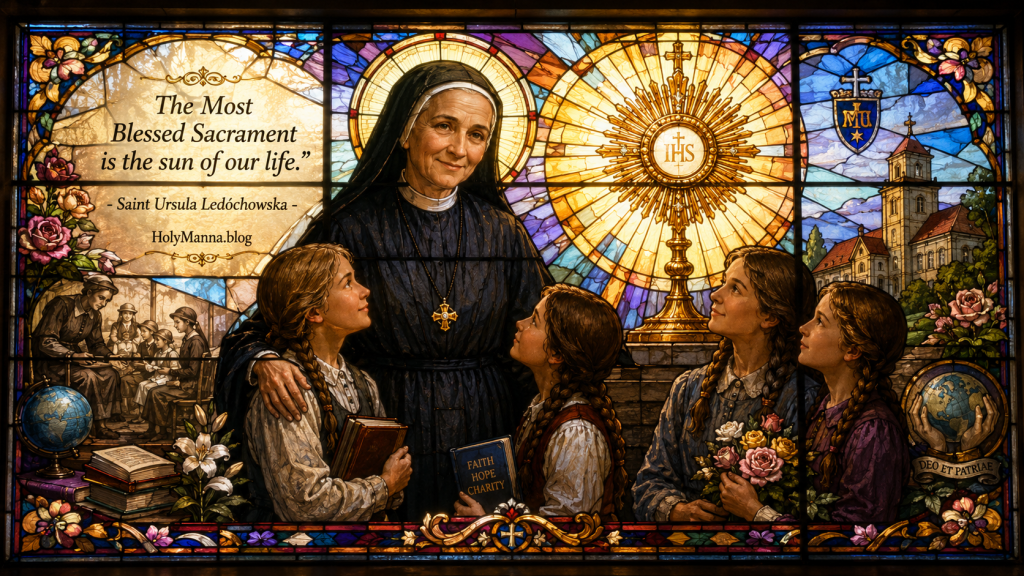
Her life was deeply Eucharistic. She once said, “The Most Blessed Sacrament is the sun of our life.” That single line explains almost everything about her. Her schools, orphanages, lectures, missions, writings, and works of mercy were not just humanitarian projects. They were the light of the Eucharist poured into ordinary places.
Her life reflects the teaching of The Catechism of the Catholic Church, which says that “All Christians in any state or walk of life are called to the fullness of Christian life and to the perfection of charity” (CCC 2013). Saint Ursula lived that call not by escaping the world, but by entering into its need with courage, intelligence, warmth, and love.
Born Into a Family Where Faith Had Deep Roots
Saint Ursula was born Julia Maria Ledóchowska on April 17, 1865, in Loosdorf, Austria. Her family belonged to the Polish nobility, but what matters most is not the title attached to her name. What matters is the Catholic seriousness of the home in which she was raised.
Her father, Count Antoni Ledóchowski, was Polish. Her mother, Countess Josephine Salis-Zizers, came from a Swiss Catholic family. The Ledóchowski family was extraordinary in the life of the Church. Her sister Maria Teresa Ledóchowska, later known as “Mother of Africa,” founded the Missionary Sisters of Saint Peter Claver and was beatified by the Church. Her brother Włodzimierz became Superior General of the Society of Jesus. Her uncle, Cardinal Mieczysław Ledóchowski, suffered imprisonment during the Kulturkampf for defending the rights of the Church.
This was a family where Catholic faith was not treated like a decoration. It was a mission. It shaped the mind, trained the will, and demanded sacrifice.
As a young girl, Julia received a strong education and learned multiple languages. This would later become one of the quiet weapons of her mission. She would serve across cultures, speak to different peoples, and carry the Catholic faith into places where it was restricted, misunderstood, or deeply needed.
In 1883, her family moved to Lipnica Murowana in Poland. There, Julia grew in her love for the Polish people and their Catholic identity. She also helped care for the sick and poor. Before she ever wore a religious habit, charity was already shaping her heart.
From Julia to Sister Maria Ursula of Jesus
In 1886, Julia entered the Ursuline convent in Kraków. She took the religious name Sister Maria Ursula of Jesus and professed her vows in 1889. As a young religious, she expressed a desire that became the spiritual heartbeat of her whole life: “To burn, burn with love.”
That was not sentimental language. For Saint Ursula, love meant discipline, work, sacrifice, service, and deep union with Christ. It meant becoming available to God in whatever situation Providence allowed.
In Kraków, she became a teacher and later a superior. She was gifted, energetic, artistic, and practical. She studied, painted, decorated the convent chapel, taught young women, and became known for her ability to form students personally. She did not treat education as information transfer. She treated it as formation of the whole person.
Her students remembered that she knew them. She recognized their strengths, weaknesses, personalities, fears, and potential. That is very Catholic. True education sees the soul, not just the report card.
During her years in Kraków, she also helped establish one of the first residences for female university students in Poland. This was a forward-looking work. At a time when women’s higher education was still developing, she wanted young women to have a safe place to live, study, grow in virtue, and remain rooted in the faith.
She understood something many Catholics still need to remember. The Church does not fear the education of women. The Church wants education to serve truth, dignity, holiness, and the salvation of souls.
A Mission Hidden Under Watchful Eyes
In 1907, with the blessing of Pope Saint Pius X, Mother Ursula left Kraków for Saint Petersburg, Russia. She went to serve the Polish Catholic community and help direct a girls’ boarding school connected with Saint Catherine’s.
This was not an easy assignment. Catholic religious life was heavily restricted in the Russian Empire. Mother Ursula and her sisters had to live discreetly. At times, they wore civilian clothing. They carried out religious life under watch and suspicion.
That detail matters. Saint Ursula was not only kind. She was brave.
She learned Russian, passed a state exam, and worked among young women in a setting where Catholic witness had to be careful, intelligent, and courageous. In 1908, the community in Saint Petersburg became an autonomous Ursuline house, and Mother Ursula became its superior.
In 1910, she founded a house in Finland, then part of the Russian Empire, called Merentähti, meaning “Star of the Sea.” There she opened a school and helped provide a place of prayer for local people, including many Protestants, in their own language. Catholic accounts also remember that she translated songs and catechetical materials and served the needs of local fishermen and families.
This was one of her great gifts. She did not water down Catholic truth, but she knew how to speak with charity across cultural and religious boundaries. Her mission was rooted in Christ, and because it was rooted in Christ, it could be generous without becoming vague.
Exile Became Another Mission Field
When World War I began in 1914, Mother Ursula was expelled from Russia because she was an Austrian citizen. A lesser soul might have seen this as failure. She saw it as a new assignment from Providence.
She went first to Sweden and later to Denmark. There she organized schools, language instruction, care for children, and help for Polish war victims. She gave lectures throughout Scandinavia about Poland, its history, its suffering, and its hopes for independence.
She loved Poland deeply, but her patriotism was not bitter. When asked about her political orientation, she gave one of her most famous answers: “My policy is love.”
That line is worth sitting with. She did not say she had no convictions. She did not say love of country was unimportant. She said her policy was love. In other words, every loyalty had to be purified by charity.
That is a Catholic lesson for every age, especially an age where politics can easily become a replacement religion. Saint Ursula loved her people, but she belonged first to Christ.
The Birth of the Grey Ursulines
After Poland regained independence, Mother Ursula returned with her sisters and orphaned children. In 1920, they settled in Pniewy near Poznań. There, with the approval of the Holy See, her community became the Congregation of the Ursuline Sisters of the Agonizing Heart of Jesus, known as the Grey Ursulines.
Their name reveals their spirituality. They were Ursulines, rooted in the educational tradition of Saint Angela Merici. But they were also dedicated to the Agonizing Heart of Jesus, the Heart of Christ poured out in suffering love for the salvation of the world.
The Grey Ursulines served children, young women, orphans, students, workers, immigrants, the poor, and those wounded by war or loneliness. They founded schools, homes, student residences, orphanages, catechetical works, and publishing efforts. Saint Ursula also wrote for children and young people and helped promote Eucharistic formation, including the Eucharistic Crusade, known today as the Eucharistic Youth Movement.
Her work grew quickly. By the time she died, her congregation had hundreds of sisters and dozens of communities in Poland, Italy, and France. After her death, it would continue to spread around the world.
No Stage Tricks, Just Holiness That Worked
There are no well-attested stories of dramatic miracles performed by Saint Ursula during her lifetime in the way some saints are remembered for healings, bilocation, or supernatural signs. Her great miracle during life was different. It was the miracle of making ordinary duty holy.
She built institutions where others saw obstacles. She created homes for young women when society was changing rapidly. She cared for orphans when war had shattered families. She served Catholics under Russian pressure. She learned languages in order to serve people better. She kept moving when exile could have made her bitter.
Pope Saint John Paul II later described her holiness by saying that she made ordinary things extraordinary, daily things eternal, and banal things holy. That is exactly her gift.
Her life teaches that holiness is not always fireworks. Sometimes holiness is a teacher who notices the lonely student. Sometimes it is a sister who learns a new language for the sake of the Gospel. Sometimes it is a foundress who makes room for orphaned children. Sometimes it is a smile offered when the heart is tired but still belongs to Jesus.
The Apostle of the Smile
Saint Ursula’s most beloved title is “Apostle of the Smile.” That nickname can sound sweet at first, but it is much deeper than sweetness.
Her smile was not fake cheerfulness. It was not pretending life was easy. She lived through surveillance, exile, war, poverty, institutional pressure, and constant responsibility. Her smile was a chosen act of Christian charity. It was a visible sign that Christ had not been defeated in her.
This is where her spirituality becomes very practical. She believed joy could evangelize. She believed kindness could open hearts. She believed serenity could preach without words. She believed a Catholic life should make goodness visible.
That does not mean Christians must act cheerful every second. It means grace should slowly shape the face, the tone, the reactions, and the way a person enters a room. Saint Ursula understood that people often meet Christ first through the warmth of someone who belongs to Him.
The Catechism of the Catholic Church teaches that charity is the soul of holiness and that spiritual progress tends toward ever deeper union with Christ (CCC 2014 and CCC 2015). Saint Ursula showed that this union can become visible in small things: patience, gentleness, readiness to serve, and a smile that says God is near.
Her Eucharistic Fire
The center of Saint Ursula’s life was not her personality. It was Jesus in the Eucharist.
She said, “The Most Blessed Sacrament is the sun of our life.” She also urged others, “Love Jesus in the tabernacle!”
Those words explain why she had the strength to do so much. Her apostolic life came from adoration, prayer, and union with Christ. She did not simply work for God. She lived from God.
This is completely in harmony with Catholic teaching. The Catechism of the Catholic Church teaches that the Eucharist is “the source and summit of the Christian life” (CCC 1324). For Saint Ursula, the Eucharist was not one devotion among many. It was the sun. Everything else found its light, warmth, and direction from there.
That is why her service did not become activism. Her charity remained worshipful. Her education remained evangelical. Her patriotism remained purified. Her smile remained supernatural.
Hardship Without Bitterness
Saint Ursula was not a martyr, but she carried real crosses.
She lived under religious restrictions in Russia. She endured surveillance. She was expelled during World War I. She lived in exile. She served refugees and orphans. She worked across cultures and languages. She led a growing congregation through uncertainty. She watched Europe move toward another terrible war.
Yet hardship did not harden her. That may be one of the most beautiful things about her.
Some people suffer and become suspicious. Some suffer and become cold. Some suffer and begin to see enemies everywhere. Saint Ursula suffered and became more available to God.
Her answer to conflict was not retreat. It was mission. Her answer to exile was not resentment. It was service. Her answer to politics was not hatred. It was love.
Her famous words, “My policy is love,” were not naïve. They were heroic.
Death of a Mother, Birth of a Legacy
Saint Ursula Ledóchowska died in Rome on May 29, 1939, just months before the outbreak of World War II. Those who knew her reportedly said, “A saint has passed away.”
That sentence proved true.
Her congregation continued its mission through the devastation of war, the pressures of Communist rule, and the changing needs of the modern world. The Grey Ursulines expanded beyond Poland into other countries and continents, serving in education, catechesis, youth formation, missions, immigrant communities, orphanages, schools, and works of mercy.
Her legacy after death was not simply admiration. It was continuation. Her daughters kept doing what she had taught them to do: love Christ, serve the young, care for the poor, form hearts, and let joy become a witness.
Miracles, Relics, and the Communion of Saints
Several miracles are associated with Saint Ursula after her death.
One account connected with her cause tells of Sister Maria Danuta Pawlak, a Grey Ursuline who was gravely ill and considered beyond human hope. The sisters prayed through Mother Ursula’s intercession, and Sister Danuta recovered. Catholic accounts present this healing as one of the graces associated with Saint Ursula’s intercession.
Another account tells of Jan Kołodziejski, who was seriously injured in a work accident. He prayed while holding an image of Mother Ursula and recovered. Catholic accounts also connect this healing with her intercession.
The miracle most closely associated with her canonization involved a fourteen-year-old boy named Daniel Gajewski. In 1996, he survived a powerful electric shock. The account says that while he was unable to free himself, he saw a Grey Ursuline sister approach, remove the danger, and disappear. Later, when he saw an image of Mother Ursula, he recognized her as the sister who had helped him. This miracle was accepted in the canonization process.
These stories belong to the Catholic understanding of the communion of saints. The Catechism of the Catholic Church teaches that the saints in heaven do not stop caring for us, but intercede for us before the Father (CCC 956). Catholics do not worship saints. Catholics honor them as living members of Christ’s Body and ask their prayers, just as Christians ask one another for prayer on earth.
In 1989, Saint Ursula’s remains were transferred from Rome to Pniewy, Poland, where they are venerated at the motherhouse of the Grey Ursulines. Her body has been described in Catholic sources as incorrupt. Pniewy remains an important place of pilgrimage and devotion, especially for those connected to the Grey Ursulines, Catholic education, and Polish Catholic life.
Saint John Paul II beatified her in Poznań in 1983, in what is remembered as the first beatification on Polish soil. He canonized her in Rome on May 18, 2003.
A Saint for Poland, Europe, and the New Evangelization
Saint Ursula had a major cultural and national impact, especially in Poland. She served Polish communities under foreign pressure, defended Polish dignity through lectures and humanitarian work, cared for Polish war victims and orphans, and helped rebuild Catholic life after Poland regained independence.
Yet her influence was never limited to nationalism. She worked in Austria, Poland, Russia, Finland, Sweden, Denmark, Italy, and France. Her congregation later spread farther still. Her life shows how Catholic identity can be both deeply rooted and genuinely missionary.
In 1998, she was named a patron of the Archdiocese of Poznań. In 2009, the Polish Senate honored her as an exemplary patriot on the seventieth anniversary of her death. That recognition makes sense, but the Church sees even more. She was not merely a patriotic figure. She was a saint because her love of country was placed under the lordship of Jesus Christ.
She is especially important today because she understood evangelization in a modern way. She used education, writing, public speaking, youth movements, residences, charitable institutions, and cultural engagement to bring Christ into real human lives. She did not wait for perfect conditions. She built where she was planted.
Famous Sayings That Reveal Her Soul
Saint Ursula’s words are simple, direct, and full of spiritual fire. As a young religious, she desired “To burn, burn with love.” When asked about her political stance, she answered, “My policy is love.” Speaking of the Eucharist, she said, “The Most Blessed Sacrament is the sun of our life.” She also urged others, “Love Jesus in the tabernacle!”
Each quote reveals a part of her soul. She wanted to burn with love. She wanted charity to govern public life. She wanted the Eucharist to be the center. She wanted hearts to return to Jesus hidden in the tabernacle.
That is not complicated spirituality. It is demanding, but it is simple. Love Christ. Serve others. Stay close to the Eucharist. Let joy become visible.
What Saint Ursula Teaches Today
Saint Ursula Ledóchowska is a saint for anyone who feels like ordinary life cannot become holy.
She teaches teachers that every student is a soul. She teaches parents that formation matters more than achievement. She teaches young adults that education and faith belong together. She teaches Catholics in public life that conviction without charity becomes dangerous. She teaches parish workers and catechists that joy is not optional decoration. Joy is part of witness.
She also teaches something very needed today. Catholic kindness is not weakness. A smile rooted in Christ is not shallow. Gentleness does not mean compromise. Charity does not mean silence about truth. Saint Ursula was cheerful, but she was not soft in the lazy sense. She was disciplined, brave, organized, and faithful.
Her life asks every Catholic a serious question: Does faith make the people around us more aware of Christ’s love?
Not every Catholic will found a congregation. Not every Catholic will run a school, rescue orphans, or lecture across Scandinavia. But every Catholic can make ordinary life holy. Every Catholic can bring warmth into a cold room. Every Catholic can visit Jesus in the tabernacle. Every Catholic can turn daily duty into love.
Reflection
Saint Ursula’s life is a reminder that holiness does not always announce itself loudly. Sometimes it arrives in a classroom. Sometimes it sits beside an orphan. Sometimes it learns another language. Sometimes it organizes a safe home for young women. Sometimes it smiles when the world expects bitterness.
Her witness is especially powerful because it is so livable. She did not teach a spirituality reserved for mystics hidden away from the world. She taught a Eucharistic, practical, joyful holiness that can be lived in homes, offices, parishes, schools, and ordinary routines.
The lesson is not that life will become easy if someone follows Christ. Saint Ursula’s life was not easy. The lesson is that grace can make a soul fruitful anywhere.
A Catholic trying to live her example can begin simply. Visit Jesus in the tabernacle. Offer daily work for love of God. Smile at someone who expects impatience. Help a young person feel seen. Refuse to let politics poison charity. Build something good instead of only complaining about what is broken.
That is the kind of holiness Saint Ursula lived. It was not flashy. It was faithful. And because it was faithful, it became radiant.
Engage With Us!
Share your thoughts and reflections in the comments below. Saint Ursula Ledóchowska’s life gives so much to reflect on, especially for anyone trying to live the Catholic faith with courage, joy, and love in ordinary daily life.
- Where is God asking daily duty to become a place of holiness in your life?
- What would change if the Eucharist truly became “the sun” of your daily life?
- Is there someone in your life who needs the kind of Christian kindness Saint Ursula called an apostolate of the smile?
- How can love of country, family, parish, or community be purified by charity rather than fear or anger?
- What is one ordinary task you can offer to Jesus today with greater love and patience?
Saint Ursula Ledóchowska shows that holiness can be joyful, practical, brave, and deeply Eucharistic. May her example help every heart live with greater faith, serve with greater mercy, and do everything with the love and compassion Jesus taught us.
Saint Ursula Ledóchowska, pray for us!
Follow us on YouTube, Instagram and Facebook for more insights and reflections on living a faith-filled life.


Leave a Reply