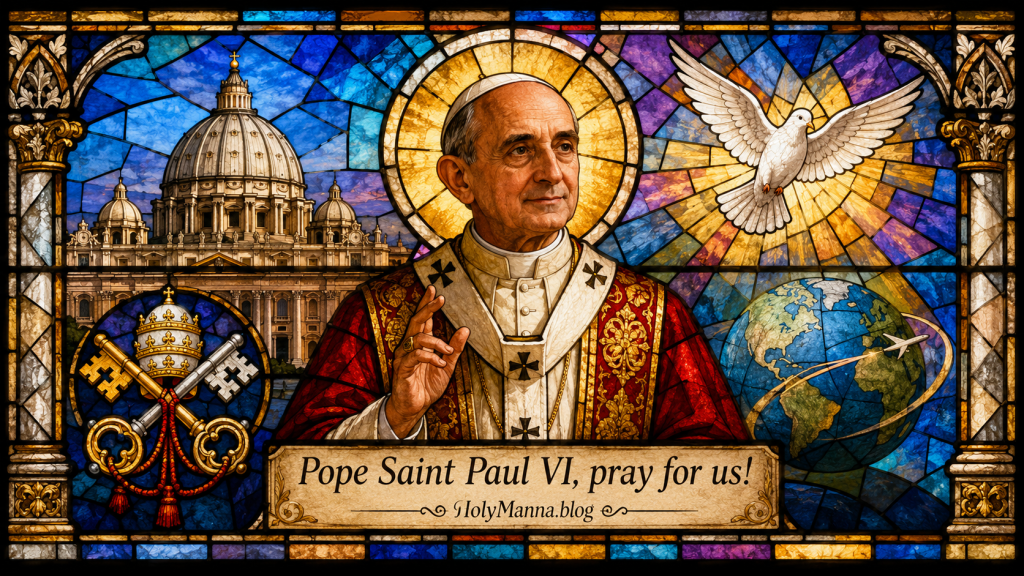
A Pope for a Confusing Age
Pope Saint Paul VI was not the kind of saint surrounded by ancient legends, dragons, caves, or dramatic medieval visions. His story is modern, heavy, and deeply human. He was the pope who carried the Catholic Church through one of the most difficult transitions in recent history, guiding her from the world before the Second Vatican Council into the restless, noisy, wounded modern age.
Born Giovanni Battista Montini, he became pope in 1963 and led the Church until his death in 1978. His pontificate touched nearly every part of Catholic life today. He completed the Second Vatican Council, helped implement its reforms, defended the Church’s teaching on marriage and human life in Humanae Vitae, promoted peace before the nations, deepened Catholic social teaching in Populorum Progressio, gave the Church one of her greatest modern texts on evangelization in Evangelii Nuntiandi, and began the modern age of papal travel.
He is remembered as a pope of dialogue, peace, evangelization, human dignity, and courageous fidelity. He was gentle, intellectual, prayerful, and often misunderstood. That is part of what makes his holiness so relatable. He did not live in easy times, and he did not pretend that fidelity would make life simple.
Pope Saint Paul VI shows the Church that holiness is not always loud. Sometimes holiness looks like carrying a burden faithfully while the world criticizes from every side.
The Boy from Brescia Who Became a Servant of Peter
Giovanni Battista Enrico Antonio Maria Montini was born on September 26, 1897, in Concesio, near Brescia, Italy. His family was devoutly Catholic, educated, and deeply involved in public life. His father, Giorgio Montini, was a lawyer, journalist, and public servant. His mother, Giuditta Alghisi, helped shape the young Giovanni in faith, discipline, and charity.
From the beginning, Montini was formed in a home where Catholic faith was not meant to stay locked inside a church building. It was meant to shape culture, politics, family life, education, and service to the poor. That early formation would follow him for the rest of his life.
He was ordained a priest on May 29, 1920. After ordination, he continued studies in philosophy, civil law, and canon law. He briefly served in the Vatican diplomatic service in Warsaw, Poland, before returning to Rome. There, he began long service in the Vatican Secretariat of State under Pope Pius XI and Pope Pius XII.
During World War II, Montini helped coordinate Vatican relief efforts for refugees, prisoners, and persecuted people, including Jews seeking assistance. This hidden work matters. Before he became the pope who would plead before the United Nations, “Never again war, never again war!”, he had already seen the devastation of war up close and served suffering people through quiet, practical charity.
In 1954, Pope Pius XII appointed him Archbishop of Milan. Milan was one of the largest and most industrialized dioceses in the world. It was a city of factories, workers, immigrants, postwar wounds, secular ideologies, and spiritual restlessness. Montini did not retreat from that world. He entered it as a pastor. He cared for workers, engaged modern culture, and tried to speak the Gospel to people who were drifting away from the Church.
Pope Saint John XXIII made him a cardinal in 1958. Five years later, after John XXIII died, Cardinal Montini was elected pope on June 21, 1963. He took the name Paul VI, a name that immediately pointed to mission, travel, evangelization, and apostolic courage.
The Pope of Vatican II and the Mission of the Church
Paul VI became pope in the middle of the Second Vatican Council. Pope Saint John XXIII had opened the Council, but Paul VI had to complete it and begin the even harder work of implementation.
That was not easy. Some Catholics feared change. Others demanded more change. Some wanted to preserve Catholic tradition by resisting renewal. Others wanted renewal in ways that risked abandoning Catholic tradition. Paul VI stood in the middle, trying to keep the Church faithful to Christ while helping her speak clearly to the modern world.
This is one reason his life is so important for Catholics today. He was not trying to invent a new Church. He was trying to help the ancient Church bring the Gospel to a new age.
In The Catechism of the Catholic Church, the pope is described as the successor of Saint Peter and the visible source and foundation of unity among the bishops and the faithful. That was exactly the burden Paul VI carried. He had to preserve unity when confusion, argument, and spiritual tension were everywhere.
His first encyclical, Ecclesiam Suam, revealed the heart of his mission. He wanted the Church to grow in self-knowledge, renewal, and dialogue. But for Paul VI, dialogue never meant watering down the faith. True Catholic dialogue meant speaking truth with charity, patience, clarity, and love.
The Church must meet the world, but she must meet the world as the Church.
A Pilgrim Pope for the Nations
One of the most surprising facts about Pope Saint Paul VI is that he became the first pope in history to travel by airplane for an apostolic pilgrimage. In 1964, he traveled to the Holy Land. This began the modern era of papal travel.
Today, Catholics are used to seeing popes travel the world. Before Paul VI, that was not normal. His journeys helped transform the papacy from something many people experienced only from a distance into a visible missionary presence among the nations.
During his Holy Land pilgrimage, Paul VI met Ecumenical Patriarch Athenagoras of Constantinople. This was a historic moment in relations between Catholics and Orthodox Christians. Later, the Catholic and Orthodox leaders made a major gesture of reconciliation connected to the mutual excommunications of 1054. It did not heal the whole division between East and West, but it was a powerful step toward Christian unity.
Another famous moment came in 1969, when Paul VI visited the World Council of Churches in Geneva. There, he introduced himself with the simple words: “My name is Peter.”
That sentence was humble and bold at the same time. He did not introduce himself as a celebrity, diplomat, or political figure. He came as the successor of Saint Peter, longing for Christian unity while remaining faithful to the Catholic understanding of the Petrine office.
The Pope Who Pleaded for Peace
Paul VI was a pope of peace because he had seen the twentieth century’s wounds. On October 4, 1965, he addressed the United Nations in New York. His cry remains one of the most famous papal appeals of the modern age: “Never again war, never again war!”
He urged the nations to seek peace through justice, law, dialogue, and respect for human dignity. He knew peace could not be reduced to a slogan. Peace had to be built by conversion, sacrifice, justice, and responsibility.
In 1967, he issued Populorum Progressio, one of the great modern social encyclicals. There, he taught that authentic development is deeply connected to peace. One of its most famous themes is: “Development is the new name for peace.”
This teaching fits beautifully with Catholic social doctrine. The Catechism of the Catholic Church teaches that the Church has the right and duty to make moral judgments about social and economic matters when human dignity and salvation require it. Paul VI understood that poverty, exploitation, violence, and injustice are not merely political issues. They are human and spiritual issues.
In 1968, he established the World Day of Peace, to be observed every year on January 1. This annual observance continues to shape the Church’s prayer and teaching for peace.
Humanae Vitae and the Cost of Fidelity
Paul VI is especially remembered for Humanae Vitae, published in 1968. This encyclical reaffirmed the Catholic teaching that married love has both a unitive and procreative meaning, and that these meanings must not be deliberately separated.
This teaching was deeply controversial. Many expected the Church to change her teaching on contraception. Paul VI did not. He taught that married love must remain open to life and faithful to God’s design.
The Catechism of the Catholic Church later echoed this teaching clearly. In CCC 2366, the Church teaches that by its nature, the marital act is ordered toward the procreation and education of children. In CCC 2367, the Church teaches responsible parenthood. In CCC 2370, the Church teaches that contraception is morally unacceptable because it deliberately separates the procreative meaning from the marital act.
Paul VI suffered for this teaching. He was criticized harshly, even by some within the Church. Yet he chose fidelity over popularity.
That is one of the clearest signs of his holiness. A saint is not someone who tells the age what it wants to hear. A saint tells the truth with love, even when the truth costs something.
There is a beautiful providential detail in his canonization story. The miracles approved for his beatification and canonization both involved unborn children. The pope who suffered for defending life in the womb was raised to the altars through miracles connected to children in the womb.
The Evangelizer Who Knew the World Needed Witnesses
In 1975, Paul VI issued Evangelii Nuntiandi, one of the most important Catholic documents on evangelization ever written.
Its most famous line is: “Modern man listens more willingly to witnesses than to teachers, and if he does listen to teachers, it is because they are witnesses.”
That line feels like it was written for today. People are surrounded by opinions, influencers, arguments, podcasts, platforms, and noise. Paul VI understood that the world does not only need Catholics who can explain the faith. The world needs Catholics whose lives make the faith believable.
Evangelization is not Catholic branding. It is not religious marketing. It is the proclamation of Jesus Christ through word, sacrament, holiness, mercy, courage, and love.
This connects deeply with The Catechism of the Catholic Church, which teaches in CCC 905 that lay people fulfill their prophetic mission by evangelization, “that is, the proclamation of Christ by word and the testimony of life.”
Paul VI saw this clearly. A Catholic life must become a living invitation.
Mary, Mother of the Church
Pope Saint Paul VI also had a deep devotion to the Blessed Virgin Mary. During the Second Vatican Council, on November 21, 1964, he proclaimed Mary as Mother of the Church. This title expresses a beautiful Catholic truth. Mary is Mother of Christ, and because the Church is the Body of Christ, she is also mother to the faithful.
He later wrote Marialis Cultus, an apostolic exhortation on devotion to the Blessed Virgin Mary. In it, he taught that authentic Marian devotion must be rooted in Scripture, centered on Christ, connected to the liturgy, and ordered toward the worship of God.
This is classic Catholic Marian devotion. Mary does not distract from Jesus. She leads souls to Him. Her whole life says, “Do whatever he tells you.” That quote from John 2:5 remains the heart of Marian discipleship.
The Weight of Reform and the Pain of Misunderstanding
Paul VI also oversaw major liturgical reforms after Vatican II, including the revised Roman Missal and changes to the Liturgy of the Hours, the Church calendar, and other liturgical books.
This part of his legacy remains debated among Catholics. Some remember the reforms with gratitude. Others associate the period after Vatican II with confusion, irreverence, and loss. A fair Catholic view should recognize both the Council’s legitimate call for renewal and the pain caused when renewal was sometimes implemented poorly or interpreted through the spirit of the age rather than the mind of the Church.
Paul VI carried all of this painfully. He wanted a Church renewed in Christ, not a Church remade according to the world.
He also established the modern Synod of Bishops in 1965 to strengthen communion between the pope and the bishops. This decision continues to shape Catholic life today.
He laid aside the papal tiara, a symbolic gesture of simplicity and concern for the poor. He wanted the papacy to be seen less as worldly monarchy and more as evangelical service.
His life reminds the faithful that reform without holiness becomes confusion, but tradition without charity becomes brittle. The Church needs fidelity, reverence, courage, and conversion.
Stories of Courage, Sorrow, and Mercy
Because Paul VI is a modern saint, there are no major ancient legends attached to him in the way there are with some early martyrs or medieval saints. The powerful stories connected to him are historical rather than legendary.
One dramatic story happened in Manila on November 27, 1970. During his apostolic journey to the Philippines, Paul VI survived an assassination attempt. A man disguised as a priest attacked him with a knife. Paul VI was wounded but continued his mission. Later, he forgave the attacker. This was not a legend. It was a real moment of danger, courage, and Christian mercy.
Another deeply painful story came near the end of his life. In 1978, Italian statesman Aldo Moro, whom Paul VI knew personally, was kidnapped by the Red Brigades. Paul VI publicly pleaded for his release. Moro was eventually murdered. The tragedy wounded the aging pope deeply and revealed his fatherly grief over political violence and the loss of human life.
Near his death, Paul VI asked for simplicity. In his final testament, he wrote: “I do not desire any special tomb.” He wanted no grand monument. His true monument would be the Church he served.
That humility says so much. A man who had stood before the nations, completed a Council, changed the papacy, and shaped the modern Church wanted to be buried simply.
Miracles of Life in the Womb
The miracles associated with Pope Saint Paul VI after death are especially moving because they both involved unborn children.
The miracle approved for his beatification involved an unborn child in California in the 1990s. During pregnancy, the child was diagnosed with a serious medical condition and was at risk of grave harm. The mother refused abortion and entrusted the child to Paul VI’s intercession. The child was born healthy, and the healing was later judged medically inexplicable by the Church.
The miracle approved for his canonization involved a pregnant woman in Italy whose unborn child faced serious medical danger. The mother prayed through the intercession of Paul VI, especially after his beatification. The child was born healthy, and the healing was again judged medically inexplicable.
These miracles are not random details. They beautifully echo the central suffering of his pontificate. Paul VI defended unborn life in Humanae Vitae. After death, the Church recognized miracles involving unborn children through his intercession.
This does not mean the miracles “prove” the encyclical in a simplistic way. Catholic teaching does not work like that. But from a Catholic perspective, the symbolism is powerful. The saint who defended life in the womb became a heavenly intercessor for life in the womb.
A Saint for the Modern Church
Pope Saint Paul VI died on August 6, 1978, the Feast of the Transfiguration. That date feels providential. The Transfiguration reveals Christ shining in glory before His Passion. Paul VI spent his life trying to help the Church reflect the light of Christ in a world filled with anxiety, rebellion, confusion, and suffering.
He was beatified by Pope Francis on October 19, 2014, and canonized on October 14, 2018. His feast day is May 29, the anniversary of his priestly ordination.
His cultural and Catholic impact is enormous. The modern image of the pope traveling the world owes much to him. The annual World Day of Peace began with him. The Synod of Bishops was established by him. The Church’s modern language of evangelization owes a great debt to Evangelii Nuntiandi. Catholic social teaching on development and peace was deepened by Populorum Progressio. Catholic moral teaching on marriage and openness to life was defended with prophetic courage in Humanae Vitae.
He is a saint for Catholics living in confusing times. He shows that fidelity does not always feel victorious in the moment. Sometimes fidelity feels lonely. Sometimes it is criticized. Sometimes it is misunderstood. But the truth of Christ does not depend on applause.
The Courage to Stay Faithful
Pope Saint Paul VI teaches that holiness can look like patience under pressure. It can look like obedience when obedience is costly. It can look like speaking the truth gently when almost everyone wants a simpler answer.
His life invites Catholics to resist two temptations. The first is fear of the modern world. The second is surrender to the modern world. Paul VI chose a better path. He brought the Gospel into conversation with the modern age without letting the modern age become the Gospel.
That is a lesson every Catholic needs today.
Where is Christ asking for courage instead of comfort?
Where is fidelity becoming difficult because the world is loud?
Where does daily life need more witness, not just more words?
Pope Saint Paul VI reminds the faithful that the Church does not belong to the age. She belongs to Christ. And because she belongs to Christ, she can enter every age with confidence.
Engage with Us!
Share your thoughts and reflections in the comments below. Pope Saint Paul VI lived through confusion, criticism, reform, suffering, and hope, yet he remained faithful to Christ and the Church.
- What part of Pope Saint Paul VI’s life speaks most powerfully to the challenges Catholics face today?
- How can his teaching in Evangelii Nuntiandi inspire Catholics to become better witnesses, not just better explainers of the faith?
- Why do you think his canonization miracles involving unborn children are so meaningful in light of Humanae Vitae?
- Where is God asking for greater courage, patience, or fidelity in ordinary daily life?
- How can Catholics speak truth with charity in a world that often rejects both?
May Pope Saint Paul VI pray for the Church, for families, for unborn children, for pastors, and for all who are trying to stay faithful in confusing times. May his example inspire a life rooted in truth, strengthened by prayer, and filled with the love and mercy Jesus taught us.
Pope Saint Paul VI, pray for us!
Follow us on YouTube, Instagram and Facebook for more insights and reflections on living a faith-filled life.

 Holy Manna!
Leave a comment