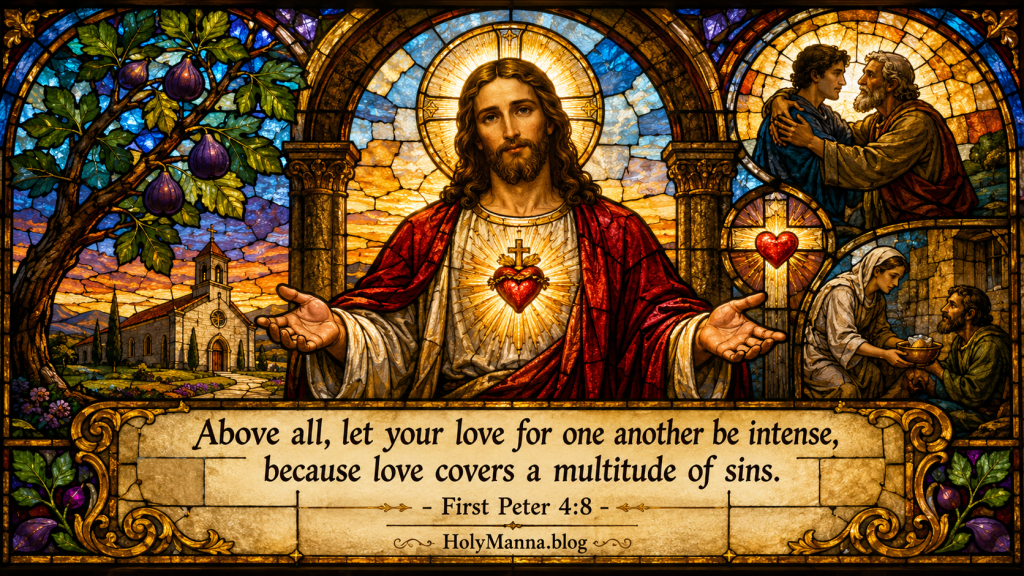
Friday of the Eighth Week in Ordinary Time – Lectionary: 351
When Faith Has Leaves, But God Looks for Fruit
Sometimes the most dangerous kind of spiritual life is not the one that looks dead, but the one that looks alive while quietly bearing no fruit. Today’s readings gather around that searching truth. In 1 Peter 4:7-13, Saint Peter calls Christians to sober prayer, intense love, generous service, and faithful endurance under trial. In Psalm 96:10-13, creation rejoices because the Lord is King and comes to judge the world with justice and faithfulness. Then in Mark 11:11-25, Jesus enters Jerusalem, confronts a fruitless fig tree, cleanses the Temple, and teaches His disciples that real faith must be rooted in prayer, trust, and forgiveness.
The central theme is fruitful faith before the judgment of God. Saint Peter shows what that fruit looks like in the daily life of the Church: “Let your love for one another be intense”, and “use it to serve one another as good stewards of God’s varied grace.” The Psalm reminds us that God’s judgment is not something creation fears, because the Lord governs with fairness, justice, and faithfulness. The Gospel then brings that judgment into the Temple itself, where Jesus exposes religion that has become busy, noisy, and profitable, but no longer truly prayerful.
Historically, the Temple in Jerusalem was the center of Jewish worship, sacrifice, pilgrimage, and covenant identity. It was meant to be the holy place where Israel encountered the living God and where the nations could glimpse His mercy. That is why Jesus’ words are so powerful: “My house shall be called a house of prayer for all peoples.” He is not simply upset about commerce. He is revealing that worship can become corrupted when it loses its purpose. The fig tree with leaves but no fruit becomes a living parable of outward religion without inward conversion.
Catholic tradition reads this passage as a call to examine the heart. The Catechism teaches that prayer requires humility, trust, perseverance, and forgiveness, because the heart itself must be converted before God. The Lord does not desire spiritual appearances alone. He desires charity that covers sins, service that glorifies Christ, worship that is sincere, and prayer that forgives before it asks.
Today’s readings prepare the soul to ask a hard but holy question: Where does faith look leafy, but still need fruit? Jesus is not trying to shame the weak. He is trying to purify His people. He enters the temple of the heart not to destroy it, but to restore it as a house of prayer.
First Reading – 1 Peter 4:7-13
A Sober Heart, an Intense Love, and a Faith That Can Survive the Fire
The First Reading comes from The First Letter of Peter, a letter written to Christians who were learning how to live faithfully while facing suspicion, rejection, and suffering. These were not comfortable Christians living in a culture that admired their faith. They were believers discovering that following Jesus meant becoming different from the world around them. Saint Peter writes like a spiritual father. He does not tell them to panic. He does not tell them to hide. He tells them to pray, love, serve, and endure.
This reading fits beautifully with today’s central theme of fruitful faith. In the Gospel, Jesus confronts a fig tree full of leaves but empty of fruit. Here, Saint Peter shows what real spiritual fruit looks like. A Christian life that is alive in Christ will be serious in prayer, intense in love, generous in service, hospitable without complaint, and faithful even when trials come. Peter is teaching the Church that true discipleship is not proven by appearances, but by charity that holds firm under pressure.
1 Peter 4:7-13 – New American Bible (Revised Edition)
7 The end of all things is at hand. Therefore, be serious and sober for prayers. 8 Above all, let your love for one another be intense, because love covers a multitude of sins. 9 Be hospitable to one another without complaining. 10 As each one has received a gift, use it to serve one another as good stewards of God’s varied grace. 11 Whoever preaches, let it be with the words of God; whoever serves, let it be with the strength that God supplies, so that in all things God may be glorified through Jesus Christ, to whom belong glory and dominion forever and ever. Amen.
Trial of Persecution. 12 Beloved, do not be surprised that a trial by fire is occurring among you, as if something strange were happening to you. 13 But rejoice to the extent that you share in the sufferings of Christ, so that when his glory is revealed you may also rejoice exultantly.
Detailed Exegesis
Verse 7 – “The end of all things is at hand. Therefore, be serious and sober for prayers.”
Saint Peter begins with urgency. When he says “the end of all things is at hand,” he is reminding Christians that history is moving toward Christ, judgment, and eternal life. This is not meant to create fear, but focus. The early Church lived with a vivid awareness that Christ had died, Christ had risen, and Christ would come again. That belief shaped everything.
Because the Lord is coming, Peter says Christians must be “serious and sober for prayers.” Prayer requires an awake soul. A scattered heart struggles to listen to God. A heart drunk on anger, distraction, pleasure, fear, or noise becomes spiritually dull. Peter is calling the Church to live with spiritual clarity. The Christian who remembers eternity prays differently, loves differently, and suffers differently.
Verse 8 – “Above all, let your love for one another be intense, because love covers a multitude of sins.”
Peter places charity at the center: “Above all.” This means love is not a small decoration added to the Christian life. It is the beating heart of Christian holiness. The word “intense” suggests a love that stretches, perseveres, and refuses to collapse under irritation or offense.
When Peter says “love covers a multitude of sins,” he is not saying that love excuses evil or hides serious wrongdoing. Catholic love never calls sin good. Instead, this means charity refuses to become petty, vindictive, or eager to expose another person’s faults. Love protects dignity. Love forgives. Love bears with weakness. Love tries to heal what bitterness wants to keep open.
This connects directly to today’s Gospel, where Jesus teaches, “When you stand to pray, forgive anyone against whom you have a grievance.” A fruitful Christian life cannot separate prayer from mercy.
Verse 9 – “Be hospitable to one another without complaining.”
Hospitality was especially important in the early Church. Christians often gathered in homes. Traveling missionaries, persecuted believers, widows, the poor, and strangers depended on the generosity of fellow disciples. Hospitality was not just social politeness. It was a concrete expression of Christian communion.
Peter adds the important phrase “without complaining.” That is where the verse gets very real. It is possible to serve while quietly resenting the people being served. It is possible to open the door of the home while closing the door of the heart. Peter calls Christians to a hospitality that is not performative, irritated, or self-pitying, but generous because Christ has been generous first.
Verse 10 – “As each one has received a gift, use it to serve one another as good stewards of God’s varied grace.”
Peter teaches that every Christian has received a gift. No baptized person is useless in the Body of Christ. Some gifts are public. Some are hidden. Some are dramatic. Many are ordinary. But all of them are meant for service.
The phrase “good stewards of God’s varied grace” is powerful. Grace is not private property. God gives gifts so they can be shared. A steward does not own the treasure. A steward manages what belongs to another. Every talent, insight, skill, opportunity, and spiritual gift belongs first to God. The question is not, How can this gift make me look impressive? The real question is, How can this gift serve others and glorify Christ?
Verse 11 – “Whoever preaches, let it be with the words of God; whoever serves, let it be with the strength that God supplies, so that in all things God may be glorified through Jesus Christ, to whom belong glory and dominion forever and ever. Amen.”
Peter gives two examples: preaching and serving. The one who speaks must not treat the Gospel like personal opinion or entertainment. The preacher must speak “with the words of God.” That means humility before divine revelation. Catholic teaching is not self-invention. It is received, guarded, proclaimed, and lived.
The one who serves must serve “with the strength that God supplies.” This protects the Christian from pride and burnout. Ministry is not meant to be powered only by personality, ambition, or willpower. Christian service depends on grace.
Peter gives the purpose of every gift: “so that in all things God may be glorified through Jesus Christ.” This is the test of Christian fruitfulness. Real holiness does not draw attention merely to the servant. It points through the servant to Christ.
Verse 12 – “Beloved, do not be surprised that a trial by fire is occurring among you, as if something strange were happening to you.”
Peter now turns to suffering. He calls them “Beloved,” which matters. His words are firm, but fatherly. He does not minimize their pain. He reminds them that suffering for Christ is not strange. It is part of discipleship.
The phrase “trial by fire” suggests purification. Fire can destroy, but it can also refine. Gold is tested by fire. Faith is tested by suffering. Peter does not say every suffering is good in itself. Rather, he teaches that suffering united to Christ can purify the heart, strengthen faith, and reveal whether love is rooted deeply or only sitting on the surface.
Verse 13 – “But rejoice to the extent that you share in the sufferings of Christ, so that when his glory is revealed you may also rejoice exultantly.”
This verse is deeply Christian because it makes no sense apart from the Cross. Peter is not telling Christians to enjoy pain. He is telling them that suffering becomes meaningful when it is united to Jesus. The disciple who shares in Christ’s sufferings will also share in His glory.
The key phrase is “when his glory is revealed.” Christian endurance looks forward. The final word does not belong to persecution, sickness, rejection, loneliness, or death. The final word belongs to Christ. This is why Peter can speak of rejoicing. The Christian can suffer with hope because Jesus has already passed through suffering into glory.
Teachings
This reading teaches that the Christian life must be awake, charitable, generous, and ready for the Cross. Saint Peter does not present holiness as a vague feeling. He makes it practical. Pray with sobriety. Love intensely. Welcome others without complaining. Use gifts for service. Speak God’s word faithfully. Serve with God’s strength. Do not be shocked by suffering. Rejoice when suffering unites the soul to Christ.
The Catechism of the Catholic Church teaches the same sober vision of holiness in CCC 2015: “The way of perfection passes by way of the Cross. There is no holiness without renunciation and spiritual battle.” This perfectly matches Peter’s message. Holiness is not comfort with religious language sprinkled on top. It is a life conformed to Christ, including Christ crucified.
Peter’s call to prayer also echoes The Catechism in CCC 2744: “Prayer is a vital necessity.” This short sentence is easy to understand and hard to live. Prayer is not optional decoration for Christians. It is breath for the soul. If the end is near, if Christ is coming, if suffering is real, and if love must remain intense, then prayer is not a luxury. It is survival.
Peter’s teaching on charity reflects The Catechism in CCC 1827: “The practice of all the virtues is animated and inspired by charity.” Charity gives life to every other virtue. Without love, even correct doctrine can become cold. Without love, service can become self-promotion. Without love, hospitality can become performance. Without love, suffering can become bitterness.
His teaching on gifts and stewardship also fits Catholic teaching on grace. The Catechism says in CCC 2003: “Grace is first and foremost the gift of the Spirit who justifies and sanctifies us.” Every true Christian gift begins with God’s grace. The Christian does not serve in order to prove personal greatness, but because the Spirit has given gifts for the building up of the Church.
The saints understood this deeply. Saint Augustine famously taught, “Love, and do what you will.” This does not mean that feelings decide morality. It means that when the soul is truly formed by divine charity, it desires what God desires and acts for the good of the beloved. Peter’s command to intense love is not sentimental. It is the kind of love that chooses mercy, service, and fidelity even when the heart is tired.
Saint Peter’s words also connect to the lived experience of the early martyrs. The first Christians were often misunderstood as disloyal, strange, or dangerous because they refused pagan worship and lived by a different kingdom. Yet their hospitality, charity, courage, and willingness to suffer became one of the great witnesses of the Church. Their lives preached what their mouths professed. They bore fruit.
Reflection
This reading feels especially timely because modern life often rewards appearance more than fruit. It is easy to look faithful from a distance. It is easy to have the leaves of Catholic identity, Catholic opinions, Catholic routines, and Catholic aesthetics. But Saint Peter asks whether the fruit is really there.
A fruitful Christian prays when distracted. A fruitful Christian loves when annoyed. A fruitful Christian serves without needing applause. A fruitful Christian welcomes without complaining. A fruitful Christian uses gifts for others instead of turning them into a personal brand. A fruitful Christian does not collapse when life becomes difficult, because suffering can be joined to Christ.
This does not mean the Christian never struggles. Peter is writing to people who are under pressure. He knows they are tired. He knows they are suffering. But he also knows that grace can make them steady. The Christian life is not about pretending the fire is not hot. It is about discovering that Christ is present in the fire.
A simple way to live this reading today is to begin with prayer before reacting. When stress rises, pause and pray. When resentment appears, choose one act of charity. When someone needs help, serve without turning it into a complaint. When a gift is recognized, give glory back to God. When suffering comes, do not immediately assume God has abandoned you. Ask how this pain can be united to Jesus.
Where is God asking for sober prayer instead of distraction?
Who needs intense love from you right now, not just polite tolerance?
What gift has God given you that needs to be used more generously for the good of others?
Where have you been serving with resentment instead of joy?
What trial in your life could become more fruitful if it were consciously united to the sufferings of Christ?
Saint Peter’s message is challenging, but hopeful. The Lord is not asking for a life that merely looks alive. He is forming a people whose faith bears fruit under pressure. Prayer steadies the heart. Charity covers wounds. Grace gives gifts. Suffering becomes communion with Christ. And through it all, “in all things God may be glorified through Jesus Christ.”
Responsorial Psalm – Psalm 96:10-13
Creation Rejoices Because the King Is Coming
The Responsorial Psalm answers the First Reading with a song of confidence. Saint Peter tells the Church to pray seriously, love intensely, serve faithfully, and endure suffering because the Lord is near. Then Psalm 96 lifts the eyes of the faithful from personal trials to the throne of God. The world may feel unstable, but the Psalm declares that the Lord is King. The Christian does not live under chaos, luck, or human power. The Christian lives under the reign of God.
In its historical and religious setting, Psalm 96 is a royal psalm of praise. It proclaims the kingship of the Lord not only over Israel, but over all nations and all creation. This matters deeply for today’s theme of fruitful faith. If Jesus exposes barren religion in the Gospel, the Psalm reminds us why that purification is good news. God comes to judge, but His judgment is not corrupt, petty, or cruel. He comes with justice and faithfulness. The trees, the sea, the fields, and the heavens rejoice because the world is safest when God reigns.
Psalm 96:10-13 – New American Bible (Revised Edition)
10 declare among the nations: The Lord is king.
The world will surely stand fast, never to be shaken.
He rules the peoples with fairness.11 Let the heavens be glad and the earth rejoice;
let the sea and what fills it resound;
12 let the plains be joyful and all that is in them.
Then let all the trees of the forest rejoice
13 before the Lord who comes,
who comes to govern the earth,
To govern the world with justice
and the peoples with faithfulness.
Detailed Exegesis
Verse 10 – “Declare among the nations: The Lord is king. The world will surely stand fast, never to be shaken. He rules the peoples with fairness.”
This verse begins with proclamation. Israel is called to declare God’s kingship “among the nations.” This is already missionary in spirit. The Lord is not a tribal deity belonging only to one people. He is King over all peoples, all lands, all histories, and all hearts.
The line “The world will surely stand fast, never to be shaken” does not mean that life will never feel unstable. It means that creation is held in being by God’s providence. Human kingdoms rise and fall. Cultures change. Temples can be corrupted. Hearts can grow cold. But the Lord remains King.
The verse ends with hope: “He rules the peoples with fairness.” God’s rule is not like fallen human rule. He does not judge by appearances, wealth, influence, or noise. This prepares the reader for the Gospel, where Jesus sees past leafy appearances and judges whether fruit is truly present.
Verse 11 – “Let the heavens be glad and the earth rejoice; let the sea and what fills it resound.”
The Psalm now invites creation itself to worship. The heavens, the earth, the sea, and every creature are called into praise. This is not poetic filler. It reveals a deeply biblical view of creation. The material world is not meaningless. It belongs to God, reflects His glory, and waits for His final renewal.
This verse also reminds the Church that worship is bigger than private emotion. When the people of God praise the Lord, they are joining the praise already written into creation. The sea resounds because it knows its Maker. The heavens are glad because they reveal His majesty. The earth rejoices because it was made good by God.
Verse 12 – “Let the plains be joyful and all that is in them. Then let all the trees of the forest rejoice.”
The image becomes even more grounded. The plains and trees are pictured as joyful before the Lord. In today’s readings, this detail is striking because the Gospel also gives us a tree. Jesus finds a fig tree full of leaves but without fruit. The Psalm shows creation rejoicing before the coming King, while the Gospel shows a tree becoming a sign of judgment against fruitlessness.
This contrast is powerful. Creation praises God by being what God made it to be. The sea resounds. The fields are joyful. The trees rejoice. But the human heart, created for prayer, charity, and obedience, can become barren. A tree may symbolize joy before the Lord, but a fruitless tree can also become a warning.
Verse 13 – “Before the Lord who comes, who comes to govern the earth, To govern the world with justice and the peoples with faithfulness.”
This verse gives the reason for all the joy: the Lord is coming. He comes not as a distant idea, but as Judge and King. The repetition of “who comes” creates a feeling of certainty. God’s justice is not theoretical. His reign is moving toward fulfillment.
The Lord comes “to govern the world with justice and the peoples with faithfulness.” This is why creation rejoices. Divine judgment is good news because God sees clearly, loves perfectly, and restores what sin has wounded. In the Gospel, Jesus’ cleansing of the Temple is a preview of this justice. He comes to purify worship, restore prayer, and expose what has become spiritually barren.
Teachings
The Responsorial Psalm teaches that God’s kingship is the foundation of Christian hope. The world is not abandoned. History is not meaningless. Evil does not get the last word. God reigns, and His judgment will reveal the truth of all things.
The Catechism of the Catholic Church teaches this clearly in CCC 1040: “The Last Judgment will come when Christ returns in glory. Only the Father knows the day and the hour; only he determines the moment of its coming. Then through his Son Jesus Christ he will pronounce the final word on all history. We shall know the ultimate meaning of the whole work of creation and of the entire economy of salvation and understand the marvelous ways by which his Providence led everything towards its final end. The Last Judgment will reveal that God’s justice triumphs over all the injustices committed by his creatures and that God’s love is stronger than death.”
That teaching gives Catholic depth to the Psalm’s joy. The Lord’s coming is not meant to terrify the faithful who are trying to live in grace. It is meant to console them. Every hidden act of love will matter. Every injustice will be answered. Every suffering offered to Christ will be gathered into His victory. Every false appearance will be exposed, and every true fruit will be revealed.
The Psalm also points to the renewal of creation. The Catechism says in CCC 1047: “The visible universe, then, is itself destined to be transformed, ‘so that the world itself, restored to its original state, facing no further obstacles, should be at the service of the just,’ sharing their glorification in the risen Jesus Christ.”
This is why the sea, fields, and trees can rejoice. Creation is not disposable. God made it good, sin wounded it, and Christ’s victory will bring renewal. The Christian faith is not escape from creation, but the redemption of all things in Christ.
This psalm also fits the Church’s worship. Every Mass proclaims the kingship of God. Every Eucharist anticipates the return of Christ. The faithful do not gather merely for inspiration. They gather before the King who has come in humility, who comes sacramentally on the altar, and who will come again in glory.
Saint Augustine often taught that true praise must be joined to a holy life. That insight fits this Psalm and today’s Gospel beautifully. It is not enough for the mouth to say, “The Lord is king,” while the heart remains closed to conversion. True worship bears fruit. Praise becomes credible when it is joined to prayer, charity, justice, forgiveness, and faithful obedience.
Reflection
This Psalm is a needed reminder for anyone who feels like the world is shaking. The news feels heavy. Families carry wounds. The Church faces scandals and struggles. Personal lives can feel uncertain. Yet the Psalm tells the soul to begin here: “The Lord is king.”
That one truth changes the way Christians live. If the Lord is King, then anxiety does not have to rule the heart. If the Lord governs with justice, then revenge does not have to become a personal mission. If the Lord comes with faithfulness, then suffering does not have to feel meaningless. If creation rejoices before Him, then human hearts should not live as though God has abandoned His world.
A simple way to pray this Psalm is to let creation teach trust. Step outside. Look at the sky, trees, grass, wind, rain, or sunlight. Creation is not frantic. It receives existence from God moment by moment. It praises by being what it was made to be. The Christian can do the same through faithfulness in ordinary duties, sincere prayer, honest repentance, and generous love.
This Psalm also invites a serious examination. If the Lord comes to judge with justice and faithfulness, then appearances will not be enough. The question is not simply whether life looks religious. The question is whether the soul is being governed by God.
Where do you need to remember today that the Lord is King?
What part of your life feels shaken, and how would it change if you entrusted it again to God’s faithful rule?
Does your worship of God remain only in words, or is it becoming visible in justice, mercy, prayer, and forgiveness?
If creation rejoices because the Lord is coming, what fear is keeping your heart from rejoicing with it?
The Psalm prepares the soul to meet Jesus in the Gospel. The King who comes with justice is the same Jesus who enters the Temple, overturns what corrupts worship, and calls His disciples to faith-filled prayer. His judgment is not the enemy of mercy. His judgment is mercy purifying what has forgotten its purpose. The world rejoices because the King is coming, and the faithful can rejoice too, because His justice is faithful, His reign is good, and His love is stronger than death.
Holy Gospel – Mark 11:11-25
When Jesus Enters the Temple, He Looks for Fruit
The Holy Gospel brings today’s theme into sharp focus. Saint Peter has already shown what fruitful Christian life looks like in 1 Peter 4:7-13: sober prayer, intense love, humble service, hospitality, and endurance in suffering. Psalm 96:10-13 has declared that the Lord comes to govern the earth with justice and faithfulness. Now in Mark 11:11-25, that divine judgment arrives in Jerusalem through Jesus Christ Himself.
This passage takes place during the final week before the Passion. Jesus has entered Jerusalem, the holy city, and He comes to the Temple, the heart of Israel’s worship. The Temple was not just a religious building. It was the place of sacrifice, pilgrimage, covenant identity, and prayer. For faithful Jews, it represented God’s dwelling among His people. Yet Jesus finds something deeply wrong. The place meant to be a house of prayer has become crowded with commerce, noise, and exploitation.
Saint Mark places the story of the fig tree around the cleansing of the Temple, which is important. The fig tree has leaves but no fruit. The Temple has religious activity but has lost its proper purpose. Together, they reveal the danger of outward religion without inward conversion. Jesus is not rejecting prayer, worship, or sacred tradition. He is purifying them. He is looking for faith that bears fruit.
Mark 11:11-25 – New American Bible (Revised Edition)
11 He entered Jerusalem and went into the temple area. He looked around at everything and, since it was already late, went out to Bethany with the Twelve.
Jesus Curses a Fig Tree. 12 The next day as they were leaving Bethany he was hungry. 13 Seeing from a distance a fig tree in leaf, he went over to see if he could find anything on it. When he reached it he found nothing but leaves; it was not the time for figs. 14 And he said to it in reply, “May no one ever eat of your fruit again!” And his disciples heard it.
Cleansing of the Temple. 15 They came to Jerusalem, and on entering the temple area he began to drive out those selling and buying there. He overturned the tables of the money changers and the seats of those who were selling doves. 16 He did not permit anyone to carry anything through the temple area. 17 Then he taught them saying, “Is it not written:
‘My house shall be called a house of prayer for all peoples’?
But you have made it a den of thieves.”18 The chief priests and the scribes came to hear of it and were seeking a way to put him to death, yet they feared him because the whole crowd was astonished at his teaching. 19 When evening came, they went out of the city.
The Withered Fig Tree. 20 Early in the morning, as they were walking along, they saw the fig tree withered to its roots. 21 Peter remembered and said to him, “Rabbi, look! The fig tree that you cursed has withered.” 22 Jesus said to them in reply, “Have faith in God. 23 Amen, I say to you, whoever says to this mountain, ‘Be lifted up and thrown into the sea,’ and does not doubt in his heart but believes that what he says will happen, it shall be done for him. 24 Therefore I tell you, all that you ask for in prayer, believe that you will receive it and it shall be yours. 25 When you stand to pray, forgive anyone against whom you have a grievance, so that your heavenly Father may in turn forgive you your transgressions.”
Detailed Exegesis
Verse 11 – “He entered Jerusalem and went into the temple area. He looked around at everything and, since it was already late, went out to Bethany with the Twelve.”
Jesus enters Jerusalem and goes straight to the Temple area. This is not accidental. The King has come to His city, and He begins by inspecting the place of worship. Saint Mark tells us that Jesus “looked around at everything.” That detail is quiet but intense. Before He acts, He sees. Nothing in the Temple is hidden from Him.
This moment prepares the reader for what comes next. Jesus does not cleanse the Temple because of a sudden emotional reaction. He has observed what is happening. His judgment is deliberate, righteous, and rooted in love for the Father. He then goes to Bethany with the Twelve, giving the scene a sense of solemn pause before the prophetic action begins.
Verse 12 – “The next day as they were leaving Bethany he was hungry.”
Jesus’ hunger reveals His true humanity. The Son of God, fully divine, is also fully human. He knows bodily hunger, fatigue, sorrow, and suffering. In the final days before His Passion, this small detail reminds us that the Lord who judges the Temple is also the Lord who will suffer in the flesh for sinners.
His hunger also prepares the symbolic action with the fig tree. Jesus seeks fruit. On the surface, He seeks food. At a deeper level, He is revealing what God seeks from His people: not empty appearances, but living faith.
Verse 13 – “Seeing from a distance a fig tree in leaf, he went over to see if he could find anything on it. When he reached it he found nothing but leaves; it was not the time for figs.”
The fig tree looks promising from a distance. It has leaves, which suggest life and fruitfulness. But when Jesus comes close, there is nothing there. Saint Mark adds that “it was not the time for figs,” which can make the scene seem strange at first. Yet this is a prophetic sign, not a simple agricultural complaint.
In the Old Testament, the fig tree could symbolize Israel. The prophets sometimes used fruitfulness or barrenness to describe the people’s covenant fidelity. Here, the tree becomes a living parable. It has the appearance of life, but no fruit. This connects directly to the Temple, which appears active and religious, but has become spiritually disordered.
Verse 14 – “And he said to it in reply, ‘May no one ever eat of your fruit again!’ And his disciples heard it.”
Jesus speaks a word of judgment over the fig tree. This is not petty anger. It is a prophetic sign. The disciples hear it because they are meant to learn from it. The tree represents barren religion, the kind of faith that looks alive but gives nothing to God or neighbor.
This is a warning for every generation. Religious appearance cannot replace conversion. Catholic language, habits, routines, ministries, and external identity are good when they bear fruit. But without repentance, prayer, charity, mercy, and obedience, the leaves cannot save the tree.
Verse 15 – “They came to Jerusalem, and on entering the temple area he began to drive out those selling and buying there. He overturned the tables of the money changers and the seats of those who were selling doves.”
Jesus now enters the Temple and acts with divine authority. Money changers were present because pilgrims needed acceptable coinage for Temple offerings. Doves were sold because they were used in sacrifices, especially by the poor. The problem was not sacrifice itself, nor the Law’s provision for offerings. The problem was that commerce had overtaken worship, and sacred space had been corrupted.
Jesus overturns the tables because the Father’s house is not a marketplace. His action is forceful, but not sinful. This is holy zeal. It is the love of the Son defending the honor of the Father and the dignity of true worship.
Verse 16 – “He did not permit anyone to carry anything through the temple area.”
This detail shows how seriously Jesus regarded the sacredness of the Temple. Some people may have been treating the Temple courts as a shortcut or common public passageway. Jesus stops this behavior because the holy place must not be reduced to convenience.
There is a lesson here for worship. Sacred things are not ordinary things. Churches, altars, tabernacles, the Mass, the sacraments, and prayer are not meant to be treated casually. Reverence teaches the heart that God is real, present, and worthy of worship.
Verse 17 – “Then he taught them saying, ‘Is it not written: My house shall be called a house of prayer for all peoples? But you have made it a den of thieves.’”
Jesus explains His action with Scripture. He first draws from Isaiah 56:7, where God promises that His house will be a place of prayer for all nations. The Temple was meant to welcome the nations into worship of the true God. Then Jesus echoes Jeremiah 7:11, where the prophet condemns those who commit evil and then hide behind Temple worship as if religious appearance could protect them from judgment.
This is the heart of the passage. Jesus is not against the Temple. He is against the corruption of the Temple. He is not against sacrifice. He is against worship emptied of conversion. He is not against religious structure. He is against using holy things while refusing holiness.
Verse 18 – “The chief priests and the scribes came to hear of it and were seeking a way to put him to death, yet they feared him because the whole crowd was astonished at his teaching.”
The religious leaders respond not with repentance, but with hostility. Jesus’ cleansing of the Temple threatens their authority, their system, and their comfort. Rather than ask whether He is right, they seek a way to kill Him.
The crowd, however, is astonished at His teaching. Jesus speaks with an authority that cannot be ignored. This verse shows the growing conflict that will lead to the Passion. The One who purifies worship will be rejected by those who should have recognized Him.
Verse 19 – “When evening came, they went out of the city.”
Jesus leaves the city again. This simple movement keeps the rhythm of the passage. He enters, judges, teaches, and withdraws. Jerusalem is being visited by her King, but the tension is building. The Passion is drawing near.
There is also a spiritual sense here. Jesus gives time. He warns before judgment is complete. He teaches before the final confrontation. God’s mercy often comes to us as a warning, giving the heart time to repent.
Verse 20 – “Early in the morning, as they were walking along, they saw the fig tree withered to its roots.”
The fig tree has not merely lost a few leaves. It is “withered to its roots.” The judgment reaches the source. This shows that fruitlessness is not just an external problem. It is a root problem. Something deep is wrong when religious life produces no love, no prayer, no mercy, and no obedience.
This verse connects back to the Temple. The issue is not merely bad behavior on the surface. The deeper issue is worship disconnected from conversion. Jesus is revealing that God desires fruit from the roots of the soul.
Verse 21 – “Peter remembered and said to him, ‘Rabbi, look! The fig tree that you cursed has withered.’”
Peter notices the result of Jesus’ word. His reaction is amazement. The disciples are still learning who Jesus is and what authority He carries. His words are not empty. What He speaks happens.
Peter’s memory matters. Discipleship often involves remembering what Jesus has said and then recognizing its meaning later. The Christian life is filled with moments when the Lord’s words become clearer after prayer, suffering, or experience.
Verse 22 – “Jesus said to them in reply, ‘Have faith in God.’”
Jesus does not let the disciples focus only on the miracle of the withered tree. He directs them to faith. The heart of discipleship is trust in God. The Temple may be corrupted, the leaders may oppose Him, and the fig tree may be withered, but the disciple must remain rooted in God.
This faith is not vague optimism. It is confident trust in the Father. It is the faith that prays, forgives, obeys, and bears fruit even when circumstances look difficult.
Verse 23 – “Amen, I say to you, whoever says to this mountain, ‘Be lifted up and thrown into the sea,’ and does not doubt in his heart but believes that what he says will happen, it shall be done for him.”
Jesus uses vivid language to describe the power of faith. A mountain being thrown into the sea is an image of something impossible by human strength. Faith opens the soul to the power of God.
This does not mean prayer is magic or that God must obey every human desire. Catholic faith teaches that true prayer seeks God’s will. Jesus is teaching confidence, not spiritual manipulation. The disciple should not approach God as if God were reluctant to hear. The Father is good, and faith trusts Him.
Verse 24 – “Therefore I tell you, all that you ask for in prayer, believe that you will receive it and it shall be yours.”
Jesus deepens the teaching on prayer. The disciple is invited to pray with confidence. Prayer is not meant to be timid in the sense of doubting God’s goodness. The Christian may ask boldly, trusting that the Father hears.
At the same time, prayer must be purified by faith. To believe in prayer is not to demand control over outcomes. It is to entrust the request to God, believing that He is faithful, wise, and loving. The most powerful prayer is not the one that bends God to human will, but the one that allows the human heart to be conformed to God’s will.
Verse 25 – “When you stand to pray, forgive anyone against whom you have a grievance, so that your heavenly Father may in turn forgive you your transgressions.”
This final line brings the whole Gospel back to the heart. Jesus has just spoken about faith that can move mountains, but He immediately attaches that faith to forgiveness. That is not a side note. It is the condition of Christian prayer. A heart that clings to vengeance is not free to stand confidently before the Father.
This does not mean forgiveness is easy, instant, or emotionally painless. It also does not mean pretending that real harm did not happen. Catholic forgiveness does not erase justice, boundaries, or truth. But Jesus teaches that prayer cannot be separated from mercy. The disciple who asks the Father for forgiveness must also become willing to forgive others.
This is where the fig tree, the Temple, and prayer all come together. The fruit Jesus wants is not only visible religious devotion. He wants a heart that trusts God enough to release resentment. He wants worship that becomes mercy. He wants prayer that bears fruit in reconciliation.
Teachings
The Holy Gospel teaches that Jesus is the true Lord of the Temple, the fulfillment of Israel’s worship, and the divine judge who exposes barren religion. He enters Jerusalem not as a tourist, but as the Son who has authority over His Father’s house. He does not cleanse the Temple because He hates worship. He cleanses it because worship is sacred. He does not curse the fig tree because He despises creation. He uses it as a prophetic sign against religious life that looks alive but bears no fruit.
This is deeply Catholic. The Church has always taught that external worship matters, but it must be joined to interior conversion. The Mass, the sacraments, devotions, fasting, preaching, ministries, and Catholic identity are holy gifts, but they are not meant to become spiritual decorations. They are meant to form saints. When worship becomes separated from repentance, charity, reverence, and mercy, it begins to resemble the Temple courts in today’s Gospel.
The Catechism of the Catholic Church teaches in CCC 583: “Like the prophets before him Jesus expressed the deepest respect for the Temple in Jerusalem. It was in the Temple that Joseph and Mary presented him forty days after his birth. At the age of twelve he decided to remain in the Temple to remind his parents that he must be about his Father’s business. He went there each year during his hidden life at least for Passover. His public ministry itself was patterned by his pilgrimages to Jerusalem for the great Jewish feasts.”
This matters because Jesus’ cleansing of the Temple was not an act of disrespect. It was an act of zeal. He loved the Temple as His Father’s house. His anger was not worldly rage. It was holy love defending the purpose of worship.
The Catechism continues in CCC 584: “Jesus went up to the Temple as the privileged place of encounter with God. For him, the Temple was the dwelling of his Father, a house of prayer, and he was angered that its outer court had become a place of commerce. He drove merchants out of it because of jealous love for his Father: ‘You shall not make my Father’s house a house of trade’; ‘His disciples remembered that it was written, “Zeal for your house will consume me.”’ After his Resurrection his apostles retained their reverence for the Temple.”
That phrase, “jealous love for his Father,” helps explain the whole scene. Jesus is not acting out of impatience. He is revealing divine love that refuses to let sacred things be profaned.
The fig tree also carries a serious warning. From the prophets onward, fruitfulness was often used as an image for covenant faithfulness. God looks for fruit among His people: justice, mercy, worship, repentance, humility, and love. In today’s Gospel, the fig tree has leaves but no fruit. It becomes an image of a religious life that has appearance without conversion.
The Church also teaches that faith-filled prayer must be joined to trust in God’s will. The Catechism says in CCC 2610: “Just as Jesus prays to the Father and gives thanks before receiving his gifts, so he teaches us filial boldness: ‘Whatever you ask in prayer, believe that you receive it, and you will.’ Such is the power of prayer and of faith that does not doubt: ‘all things are possible to him who believes.’ Jesus is as saddened by the ‘lack of faith’ of his own neighbors and the ‘little faith’ of his own disciples as he is struck with admiration at the great faith of the Roman centurion and the Canaanite woman.”
This is the prayer Jesus teaches after the fig tree withers. He wants His disciples to trust the Father boldly. Christian prayer is not timid suspicion. It is the confidence of children who know the Father is good.
Yet Jesus immediately speaks of forgiveness because prayer and mercy belong together. The Catechism teaches in CCC 2840: “Now, and this is daunting, this outpouring of mercy cannot penetrate our hearts as long as we have not forgiven those who have trespassed against us. Love, like the Body of Christ, is indivisible; we cannot love the God we cannot see if we do not love the, this outpouring of mercy cannot penetrate our hearts as long as we have not forgiven those who have trespassed against us. Love, like the Body of Christ, is brother or sister we do see. In refusing to forgive our brothers and sisters, our hearts are closed and their hardness makes them impervious to the Father’s merciful love; but in confessing our sins, our hearts are opened to his grace.”
That teaching is hard, but it is healing. Jesus is not trying to shame wounded people. He is trying to free them. Unforgiveness hardens the heart. Mercy opens it. Forgiveness does not deny pain, but it refuses to let pain become a prison.
Pope Benedict XVI taught that the cleansing of the Temple points beyond the old Temple toward the new worship fulfilled in Christ. Jesus does not merely reform a building. He reveals that true worship will be centered in His own Body, offered on the Cross and made present in the Eucharist. This is why every Catholic church must be treated as a house of prayer. The tabernacle is not a symbol of vague spirituality. It is the dwelling place of Christ’s Real Presence.
Pope Francis also reflected on this passage by describing three ways of life: the barren fig tree, those who exploit sacred things, and the person of faith. The barren fig tree represents a life turned in on itself. The exploiters in the Temple represent people who use religion for gain. The person of faith is the one who trusts God and forgives. That is the path Jesus places before His disciples.
Reflection
This Gospel is a loving examination of conscience. Jesus walks into the Temple and looks around at everything. That same Jesus sees the temple of every heart. He sees the parts that are prayerful and sincere. He also sees the places crowded with noise, distraction, resentment, vanity, greed, lust, pride, and spiritual laziness.
That can sound intimidating, but it is actually mercy. Jesus does not enter the heart to destroy it. He enters to cleanse it. He overturns what keeps the soul from prayer. He exposes leaves without fruit because He wants real life to grow.
A person can have plenty of leaves. Catholic routines can become leaves. Knowledge of doctrine can become leaves. A beautiful rosary, a favorite devotion, a parish role, a blog, a podcast, or a public Catholic identity can become leaves if they are not joined to humility, repentance, reverence, charity, and forgiveness. Leaves are not bad. Leaves are supposed to point to life. But when there is no fruit, Jesus lovingly tells the truth.
The first step is to let Jesus look around. Do not rush past that detail. In prayer, ask Him to inspect the heart. Ask Him to show what has become cluttered. Ask Him where worship has become distracted. Ask Him where service has become self-focused. Ask Him where faith has become appearance without surrender.
The second step is to recover reverence. Jesus says the Father’s house must be a house of prayer. That applies to the church building, but it also applies to the soul. Reverence can begin in simple ways: arriving at Mass with a prepared heart, genuflecting with intention, dressing with dignity, keeping silence before the tabernacle, praying before reacting, and treating Sunday worship as the center of the week rather than an interruption.
The third step is to ask for fruit. Ask for the fruit of prayer, not just the habit of prayer. Ask for the fruit of charity, not just the appearance of niceness. Ask for the fruit of forgiveness, not just the words of forgiveness. Ask for the fruit of faith, not just Catholic vocabulary.
The fourth step is to forgive from the will, even when the emotions need time to heal. Forgiveness may begin with a small prayer: “Lord, bless this person and free my heart from hatred.” That prayer may need to be repeated many times. That is not failure. That is spiritual battle.
Where has faith become busy, but not prayerful?
What table might Jesus need to overturn in the temple of your heart?
Are there leaves in your Catholic life that look good from a distance, but are not yet bearing fruit?
Who needs forgiveness from you, at least in the form of a sincere prayer before God?
How can your home, parish, ministry, or daily routine become more truly a house of prayer?
The Gospel ends by bringing the disciple back to trust. “Have faith in God.” That is the answer to barren religion, corrupted worship, and hardened hearts. Faith lets Jesus cleanse what needs cleansing. Faith lets prayer become bold again. Faith lets forgiveness become possible. Faith lets the withered places become honest before God, so that real fruit can finally grow.
Let the King Find Fruit When He Comes
Today’s readings leave the soul with a clear and loving challenge: faith must bear fruit. Saint Peter shows what that fruit looks like in everyday Christian life. It looks like sober prayer when the world feels distracted, intense love when relationships are difficult, generous service when gifts could easily become self-promotion, and faithful endurance when suffering becomes part of the journey. The Christian life is not meant to be leafy from a distance and empty up close. It is meant to be alive from the roots.
Psalm 96 lifts that call into a bigger vision. The Lord is King, and His coming is good news because He governs with justice and faithfulness. The world may feel unstable, but God is not absent. His judgment is not cruel or random. It is the judgment of the Father who wants creation restored, worship purified, and His people made whole.
Then the Gospel brings that divine judgment close. Jesus enters the Temple, looks around, overturns what has corrupted worship, and teaches His disciples to pray with faith and forgive from the heart. The fig tree warns against appearances without conversion. The cleansing of the Temple reminds us that sacred things must remain sacred. The command to forgive shows that real prayer cannot be separated from mercy.
This is where the readings become personal. Jesus still enters the temple of the heart. He still looks around at everything. He still sees what is fruitful and what is only leaves. He still overturns what keeps the soul from prayer. And He still says, “Have faith in God.”
The Catechism teaches in CCC 2015, “The way of perfection passes by way of the Cross. There is no holiness without renunciation and spiritual battle.” That is the invitation today. Let Christ purify what needs purifying. Let prayer become serious again. Let love become intense again. Let service become generous again. Let forgiveness begin, even if it starts with one difficult prayer.
What fruit is the Lord asking to grow in your life today? Bring that question honestly to prayer. Ask Jesus to cleanse the cluttered places, strengthen the weak places, and make the heart a true house of prayer. The King who comes with justice also comes with mercy, and He desires not a life of empty leaves, but a life rooted in Him and fruitful for His glory.
Engage with Us!
Share your reflections in the comments below. Today’s readings invite a real examination of the heart, not to shame us, but to help us let Jesus make our lives fruitful, prayerful, merciful, and rooted in Him.
- First Reading, 1 Peter 4:7-13: Where is God calling you to become more serious in prayer, more intense in love, or more generous with the gifts He has given you?
- Responsorial Psalm, Psalm 96:10-13: What part of your life needs to remember that the Lord is King and that He governs with justice and faithfulness?
- Holy Gospel, Mark 11:11-25: Where might Jesus be asking you to move beyond outward appearances and bear real fruit through prayer, reverence, faith, and forgiveness?
May these readings help us welcome Christ into the temple of our hearts, let Him cleanse what needs to be purified, and trust Him enough to bear fruit in daily life. Let us live with faith, serve with humility, forgive with courage, and do everything with the love and mercy Jesus taught us.
Sacred Heart of Jesus, we trust in You!
Immaculate Heart of Mary, pray for us!
Saint Michael the Archangel, defend us in battle!
Follow us on YouTube, Instagram and Facebook for more insights and reflections on living a faith-filled life.


Leave a Reply