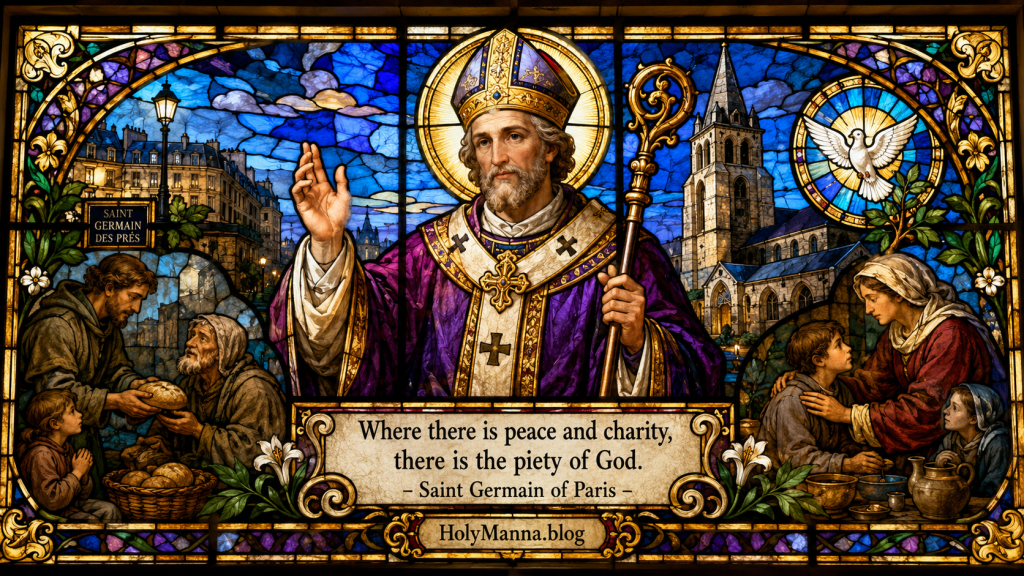
The Bishop Who Made Mercy Visible
Saint Germain of Paris was a sixth-century monk, abbot, bishop, reformer, miracle-worker, and defender of the poor. He is most often remembered as the “Father of the Poor,” a title that fits him beautifully because his charity was not theoretical. He fed the hungry, cared for prisoners, welcomed beggars, healed the sick, rebuked immoral rulers, and worked for peace in a violent age.
He became Bishop of Paris around the middle of the sixth century and served during the turbulent Merovingian period, when Christian kings often needed bishops brave enough to remind them that power was meant to serve God, not the ego. Saint Germain was that kind of bishop. He was gentle with the suffering, firm with sinners, and fearless before kings.
His life reflects what The Catechism of the Catholic Church teaches about the saints, that “they contemplate God, praise him and constantly care for those whom they have left on earth” CCC 2683. Saint Germain cared for the people of Paris during life, and Catholic devotion remembers him as continuing to care for the faithful after death through his intercession.
A Child of Burgundy Formed for Prayer
Saint Germain was born near Autun in Burgundy, in what is now France. Most traditions place his birth around the year 496, though some older accounts give an earlier date. His parents are traditionally named Eleutherius and Eusebia. He was raised in a Christian world, so his story is not one of conversion from paganism, but of a deepening of faith from youth into mature holiness.
As a young man, Germain studied at Avalon and later at Luzy under the guidance of a priest who was also a relative. He was ordained by Saint Agrippinus, Bishop of Autun, when he was around thirty-four years old. Later, he became abbot of the monastery of Saint-Symphorien near Autun.
Even before he became a bishop, Germain was known for prayer, discipline, and charity. Older Catholic accounts say that no bad weather could keep him from going to the church for midnight prayer, even though it was more than a mile away. That small detail says a lot. Germain was not formed by comfort. He was formed by showing up for God, again and again, when it would have been easier to stay home.
As abbot, Germain became famous for giving to the poor with shocking generosity. His own monks reportedly worried that he would give everything away. That may sound almost reckless, but in Germain’s heart, the poor were not a problem to be managed. They were Christ at the door.
The Abbot Who Gave Like He Trusted God
One of the most famous stories from Germain’s early life says that he gave away the monastery’s provisions to the poor, leaving the monks angry and afraid that there would be nothing left to eat. Then, while Germain prayed, a woman named Anna arrived with carts of bread and grain, providing what the community needed.
This story comes from the early hagiographic tradition surrounding Saint Germain. It cannot be verified in the way a modern historical event can be verified, but it reveals the spiritual truth Catholics have long seen in him. Germain trusted Divine Providence. He believed generosity was not a loss when it was done for Christ.
The lesson is deeply Catholic. Charity is not merely giving from what is extra. Sometimes charity means letting God stretch the heart beyond the limits of what feels safe. Germain’s life asks a hard question: Is there a place where fear has made generosity smaller than the Gospel asks it to be?
The Dream of the Keys of Paris
A beautiful story says that Germain once had a dream in which a venerable old man handed him the keys of Paris and told him that God had entrusted the people of that city to his care. A few years later, while Germain was in Paris, Bishop Eusebius died. Germain was chosen to succeed him as Bishop of Paris, though tradition says he accepted the office reluctantly and with tears.
This story cannot be verified with certainty, but it captures the meaning of his vocation. Germain did not seek the keys of Paris as symbols of power. He received them as a burden of love. To be a bishop was not to become important. It was to become responsible for souls.
Shepherd of Paris and Father of the Poor
As Bishop of Paris, Germain continued living with monastic simplicity. His house became a place of refuge for the poor, the sick, prisoners, beggars, and the forgotten. Catholic tradition says that beggars ate at his table, and while they were fed, holy books were read aloud so that both body and soul could be nourished.
This is why Saint Germain is remembered as the “Father of the Poor.” He did not merely preach charity. He organized his life around it. He gave alms, ransomed captives, visited the suffering, and used his influence to turn royal wealth toward mercy.
His preaching also influenced King Childebert I. The king, who had lived in a worldly way, was moved by Germain’s holiness and became more generous to the poor. Tradition says Childebert sent money to Germain for the needy, melted down silver plate, and gave away valuable chains so that the bishop could help the distressed.
There is something beautiful about that. Germain did not simply condemn worldly wealth from a distance. He converted it into bread, mercy, and relief for the poor. His life makes clear that Catholic charity is not vague kindness. It is concrete love.
Miracles of Healing, Mercy, and Deliverance
Saint Germain was remembered as a miracle-worker during his lifetime. One of the best-known miracles associated with him is the healing of King Childebert. The king became gravely ill, and ordinary remedies had failed. Germain spent the night in prayer, laid his hands upon the king, and Childebert was restored to health. This miracle became closely connected with the king’s later generosity toward the Church and the poor.
Other miracle stories come from early Catholic hagiography, especially the life written by Venantius Fortunatus, who knew Germain’s world closely. These stories include healings, deliverances from demonic oppression, the freeing of prisoners, protection from fire, the opening of locked doors, and the healing of people who were blind, mute, or physically afflicted. These stories cannot all be verified by modern historical standards, but they formed part of the Church’s early memory of Germain as a bishop through whom Christ showed mercy.
What stands out is the pattern. Germain’s miracles were not random displays of spiritual power. They were acts of compassion. The hungry were fed. The sick were healed. The imprisoned were freed. The afflicted were delivered. His miracles reflected the mission of Jesus, who came near to the poor, the suffering, and the bound.
A Bishop Brave Enough to Correct Kings
Saint Germain lived in an age of violent rulers, political betrayal, and public immorality. He did not respond by hiding inside the church walls. He entered the mess of his time as a shepherd.
One of the strongest examples of his courage came in 568, when he excommunicated King Charibert because of the king’s immoral conduct. That was not a small act. In the Merovingian world, kings had power, armies, wealth, and influence. Germain had the authority of Christ and the courage to use it for the salvation of souls.
This was not harshness for the sake of harshness. It was pastoral charity. The Church teaches that sin wounds communion with God and with others. To correct sin, especially public sin, is not hatred. When done rightly, it is mercy in its more difficult form.
Saint Germain also worked against lingering pagan customs and immoral excesses connected to public celebrations. He attended Church councils and encouraged reforms that protected the sacredness of Sundays and feast days. He understood that worship shapes culture, and when worship becomes mixed with disorder, the whole Christian life suffers.
The Peacemaker Who Warned a Queen
Saint Germain was also a peacemaker. He tried to restrain the violent conflicts among the Frankish rulers, especially during the rivalry involving Sigebert, Chilperic, Brunhild, and Fredegund. His efforts did not always succeed, but his words still carry weight.
In a preserved letter to Queen Brunhild, Germain urged peace and warned against the spiritual cost of fraternal war. Two of his most memorable sayings come from this letter:
“It is a dishonorable victory to conquer a brother.”
“Where there is peace and charity, there is the piety of God.”
Those words are powerful because they do not sound like political strategy. They sound like the Gospel. Germain knew that a Christian could win outwardly and still lose inwardly. Victory without charity is not truly Christian victory.
Sadly, Germain’s warning was ignored. Sigebert was assassinated in 575, and Germain died the following year. His peacemaking did not produce a clean happy ending in his lifetime. That matters. Saints are not holy because everything works out exactly as they hoped. They are holy because they remain faithful even when the world refuses to listen.
The Abbey That Carried His Name
One of Saint Germain’s greatest legacies is Saint-Germain-des-Prés in Paris. The church and abbey were originally connected to King Childebert and relics of Saint Vincent the Martyr. According to tradition, Childebert had besieged Zaragoza in Spain, but the people of the city placed themselves under the protection of Saint Vincent. Moved by their devotion, Childebert lifted the siege and received a relic associated with Saint Vincent. When he returned to Paris, he founded a church and monastery to honor the relic.
After Germain’s death, his own relics were eventually translated there, and the church became known as Saint-Germain-des-Prés. Over time, this abbey became one of the most important religious and cultural centers in Paris. It was a place of prayer, learning, manuscripts, scholarship, and Catholic memory.
That is one of the surprising things about Saint Germain’s impact. Many people today know Saint-Germain-des-Prés as a famous Paris neighborhood associated with cafés, writers, students, artists, and intellectual life. But beneath all that later cultural history is the memory of a Catholic bishop whose life was marked by poverty, mercy, prayer, reform, and love for Christ.
His Death and the Miracles at His Tomb
Saint Germain died in Paris on May 28, 576. His feast day is celebrated on May 28. He was buried near the church connected to Saint Vincent, in the chapel of Saint Symphorien.
After his death, miracles were reported at his tomb. Catholic tradition remembers healings connected with his intercession, including the restoration of sight to the blind and speech to the mute. These miracle stories are part of the devotional memory surrounding him and cannot all be verified by modern standards, but they show how strongly the faithful believed God continued to work through Germain’s intercession.
In 754, his relics were solemnly translated in the presence of King Pepin and the young Charlemagne. Tradition says Charlemagne was deeply moved by the miracles associated with the translation. From that time forward, devotion to Saint Germain grew even stronger, and the church that held his relics became more firmly associated with his name.
This is the Catholic view of sainthood in action. Death does not erase the bonds of grace. The Catechism of the Catholic Church teaches that “being more closely united to Christ, those who dwell in heaven fix the whole Church more firmly in holiness” CCC 956. Saint Germain’s earthly life ended, but his witness continued to strengthen the Church.
A Saint of Charity, Liturgy, and Catholic Culture
Saint Germain is best known for his charity, but his legacy also includes reform, liturgy, and culture. A work on the ancient Gallican liturgy has been attributed to him, showing that his memory was connected not only with the poor and with miracles, but also with the worship of the Church.
He was also connected to other holy figures, including Saint Droctoveus and Saint Bertrand of Le Mans. This reminds us that saints often leave a legacy not only through buildings and miracles, but through people formed by their example.
The story of Saint-Germain-des-Prés also continued through centuries of Catholic history. The abbey endured destruction, rebuilding, cultural influence, and suffering during the French Revolution. The monks were expelled, and the church was damaged, yet the memory of Saint Germain remained. That is fitting for a saint who lived through instability and still chose faithfulness.
What Saint Germain Teaches Today
Saint Germain of Paris is a saint for Catholics who want a faith that is both tender and strong. He shows that love for the poor cannot be separated from reverence for God. He shows that peace is not weakness. He shows that courage before sin is part of charity. He shows that bishops, leaders, parents, teachers, and ordinary Christians must care about both souls and bodies.
His life also challenges a modern temptation. It is easy to admire charity from a distance. It is harder to let charity interrupt schedules, budgets, comfort, and plans. Germain did not treat the poor as a cause for occasional attention. He treated them as Christ’s personal invitation.
Who is the poor person at the door today? Where is peace needed in the family, workplace, parish, or community? Where has comfort made generosity too cautious? Where does truth need to be spoken with courage and charity together?
Saint Germain reminds the Church that holiness is not fragile. It can pray through the night, feed the hungry at dawn, rebuke a king by noon, and still plead for peace before sunset.
Engage with Us!
Share your thoughts and reflections in the comments below. Saint Germain’s life gives us a lot to consider because he was not only a man of prayer, but a man of action, mercy, courage, and peace.
- What part of Saint Germain’s life challenges you the most: his generosity to the poor, his courage before rulers, or his commitment to peace?
- Where might God be asking you to practice more concrete charity this week?
- Have you ever had to speak the truth with love, even when it was uncomfortable?
- What would it look like to bring more peace and charity into your home, parish, or workplace?
- How can Saint Germain’s example help you see the poor, the sick, the lonely, or the forgotten with the eyes of Christ?
May Saint Germain of Paris pray for us, that our faith may become visible through mercy, courage, and love. May his example help us live with generous hearts, defend what is holy, care for the poor, seek peace, and do everything with the love and mercy Jesus taught us.
Saint Germain of Paris, pray for us!
Follow us on YouTube, Instagram and Facebook for more insights and reflections on living a faith-filled life.


Leave a Reply