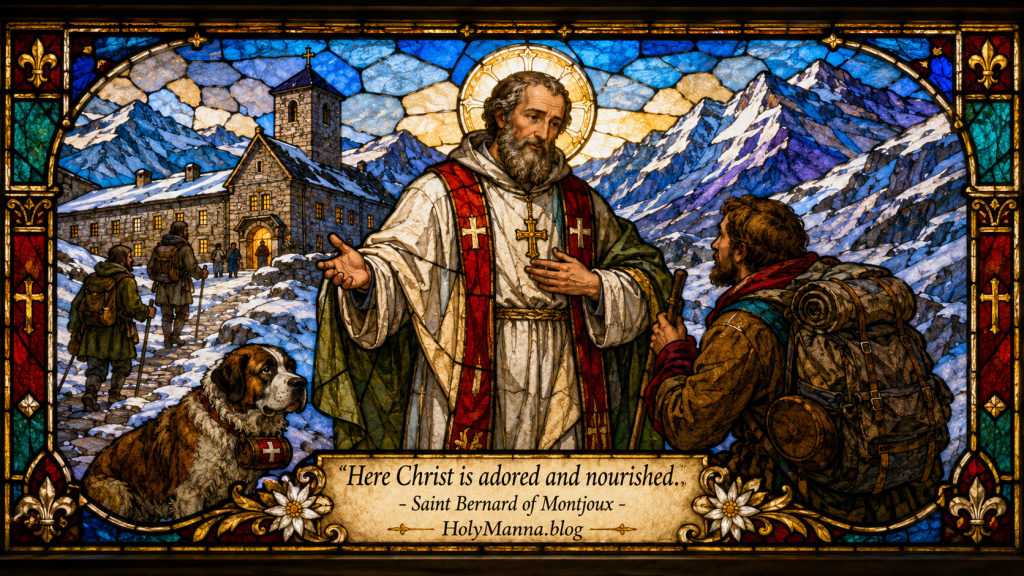
The Priest Who Turned the Alps into a House of Mercy
Saint Bernard of Montjoux, also known as Saint Bernard of Aosta, Saint Bernard of Menthon, and Saint Bernard of the Alps, is remembered as the Apostle of the Alps. He was a Catholic priest, missionary, reformer, and founder of the famous hospices on the Great Saint Bernard and Little Saint Bernard Alpine passes. His life became a living answer to one of the most practical questions in the Christian life: What does love look like when someone is cold, hungry, afraid, and far from home?
For Saint Bernard, love looked like a door opened in the snow.
He lived in a time when crossing the Alps could be deadly. Travelers, pilgrims, merchants, and the poor had to pass through mountain routes where they faced freezing temperatures, avalanches, exhaustion, thieves, and the terrifying possibility of dying alone in the ice. Bernard saw this danger and responded like a priest with the heart of Christ. He built places of refuge where the weary could find food, shelter, medical care, prayer, and spiritual comfort.
That is why his legacy is so much bigger than mountains and dogs. Saint Bernard reminds the Church that Catholic charity is not vague kindness. It is concrete love. It is bread on the table, a fire in the cold, a bed for the stranger, a prayer for the dying, and Christ honored in every wounded person who knocks.
The Catechism of the Catholic Church teaches, “The works of mercy are charitable actions by which we come to the aid of our neighbor in his spiritual and bodily necessities.” CCC 2447. Saint Bernard lived that teaching in one of the harshest places in Europe.
A Noble Beginning and a Heart Claimed by Christ
The details of Saint Bernard’s early life are not all certain. Older Catholic tradition says he was born around 923 at the castle of Menthon near Annecy in Savoy, while more careful modern Catholic sources often place him closer to the 11th century and connect him especially with Aosta. Because of that, he is sometimes called Bernard of Menthon, but Bernard of Aosta or Bernard of Montjoux may be historically safer.
The traditional story says Bernard came from a noble family and received a strong education. His family expected him to live the life of a nobleman, and one popular legend says he was even expected to enter an arranged marriage. According to that beloved story, Bernard fled from his family castle the night before the marriage by escaping through a window, and angels lowered him safely to the ground. This story cannot be historically verified, but it beautifully expresses what the Church has always seen in him: a man who chose Christ over comfort, status, and worldly expectations.
Whether every detail of that story happened exactly as told or not, the spiritual truth is clear. Bernard’s heart belonged to God.
He placed himself under the guidance of Peter, the Archdeacon of Aosta, and eventually became a priest. Later, Bernard himself became Archdeacon of Aosta, a major position in the Church that involved pastoral leadership, reform, administration, and care for the poor. He was not simply a kind man who liked helping travelers. He was a priest of Jesus Christ, and his mercy flowed from the altar.
The Catechism teaches that the disciple of Christ must “profess it, confidently bear witness to it, and spread it.” CCC 1816. Saint Bernard did exactly that, not only with sermons, but with stone walls, warm meals, and a life spent protecting the vulnerable.
The Apostle Who Climbed Into the Cold
Saint Bernard preached throughout the mountain villages of the Alps and into nearby regions. Catholic tradition remembers him as a missionary who brought the Gospel into places where faith had grown weak, superstition lingered, and travelers were often exploited or abandoned. He became known as the Apostle of the Alps because he carried the light of Christ into valleys, villages, and mountain passes where life was hard and danger was ordinary.
Some sources say he preached for decades, winning many conversions and working miracles. The exact details of those miracles are not always preserved, but Catholic tradition consistently remembers Bernard as a holy missionary whose preaching bore spiritual fruit.
His holiness was not soft or sentimental. He served Christ among people who were vulnerable, poor, frightened, and exposed to death. He saw the traveler not as an interruption, but as an image of Christ.
That is deeply Catholic. In The Gospel of Matthew, Jesus says, “I was a stranger and you welcomed me.” Matthew 25:35. Bernard seems to have heard those words not as poetry, but as a command.
At the Great Saint Bernard Hospice, the famous motto became:
“Hic Christus adoratur et pascitur.”
Translated into English, it means:
“Here Christ is adored and nourished.”
This is not known to be a direct personal quote from Saint Bernard himself. It is the motto of the hospice tradition that grew from his mission. But it may be the perfect summary of his soul. Christ is adored in the chapel, and Christ is nourished in the hungry traveler. Christ is worshiped in the Eucharist, and Christ is served in the stranger at the door.
The Catechism teaches, “The Eucharist commits us to the poor.” CCC 1397. Saint Bernard understood that long before modern Catholics were tempted to separate worship from charity.
A Hospice Where Death Used to Wait
The Great Saint Bernard Pass was once known as Mont Joux, a name connected to Jupiter. In the ancient world, the mountain pass had been associated with pagan worship, and later tradition remembered the site as a place shadowed by danger and spiritual darkness. Bernard transformed it into a Christian refuge.
Around the middle of the 11th century, he founded a hospice at the summit of the Great Saint Bernard Pass. He also founded another on the Little Saint Bernard Pass. These were not luxury inns. They were works of mercy placed where mercy was most needed. The hospices offered food, shelter, warmth, care for the sick, spiritual help for pilgrims, and burial for those who died on the mountain.
This was evangelization with a roof.
There is a famous legend that Bernard destroyed an idol of Jupiter on the mountain and exposed the deception of pagan priests who had used the idol for false oracles. Another related tradition says he fought against a demon associated with the mountain and cast it down from the heights. These stories cannot be verified as historical events, but they carry a strong Catholic meaning. Bernard brought the Cross of Christ into a place of fear, danger, and old pagan memory. Where people once feared death, he built hospitality. Where travelers were abandoned, he built a home. Where the mountain seemed merciless, he made mercy visible.
That is why the story still matters.
Saint Bernard did not simply make travel safer. He made the Alps speak a Christian language. The mountain pass became a place where weary souls could learn that God had not forgotten them.
Miracles, Mercy, and the Courage to Care
Catholic tradition says Saint Bernard worked miracles during his lifetime, especially through his preaching and missionary work. The most commonly preserved accounts speak generally of conversions, healings, and signs of divine favor, though detailed miracle stories are harder to verify.
The popular story of his angelic escape from the castle window is one of the most memorable miracle-like traditions associated with his early life. Since it belongs to legend, it should be received as a pious story rather than a documented event.
The story of his victory over the idol of Jupiter or the demon of the mountain also belongs to legendary tradition. Yet it remains powerful because it expresses the spiritual battle at the heart of Bernard’s mission. He was not merely building shelters. He was claiming dangerous ground for Christ.
His greatest miracle may have been the one that lasted.
He founded a tradition of Christian hospitality that continued for centuries. Long after Bernard died, the canons of the Great Saint Bernard Hospice continued welcoming travelers in his spirit. In the Catholic imagination, that kind of endurance is not small. A work of mercy that survives the centuries is a sign of grace.
A Saint Who Faced Conflict Without Losing Peace
Saint Bernard was not martyred, but his life was not easy. He faced harsh terrain, spiritual resistance, dangerous journeys, and the burden of caring for people in places where failure could mean death. His hardships were the hardships of a missionary priest who did not choose comfort.
One of the most moving traditions about his final years is his mission as a peacemaker. Saint Bernard is said to have traveled while sick to try to promote peace between Emperor Henry IV and Pope Saint Gregory VII during one of the great conflicts of the medieval Church. The mission did not succeed, but his willingness to try reveals something important about his holiness.
A saint does not only work for peace when peace is likely. A saint works for peace because Christ commands it.
The Catechism teaches, “Peace is the work of justice and the effect of charity.” CCC 2304. Bernard’s final mission shows a priest still spending himself for the Church, still trying to heal division, still choosing charity even when the outcome was uncertain.
He died at Novara in Italy. Some older sources give the year 1008, while many modern Catholic sources place his death in 1081. His relics came to be venerated in the Cathedral of Novara, and devotion to him continued to grow.
The Saint, the Dogs, and the Legacy That Would Not Die
After Saint Bernard’s death, his influence continued through the hospices, the canons who served there, and the countless travelers who found refuge because of his work. His canonization history is complex, with local veneration and later wider Church recognition, but his holiness became firmly rooted in Catholic memory.
His feast is observed on different dates in different calendars, including May 28 and June 15. June 15 is especially connected with the Great Saint Bernard community. He is honored as patron of mountaineers, mountain climbers, skiers, Alpine travelers, and inhabitants of the Alps.
Of course, many people first hear his name because of the Saint Bernard dogs.
Here is the surprising part. The famous dogs were not part of Bernard’s own lifetime. They appeared at the hospice centuries later, around the 17th century. They became famous for helping rescue travelers lost in snow and storms. The most famous of these dogs was Barry, who lived at the hospice in the early 1800s and is traditionally credited with saving more than forty people.
The image of Saint Bernard dogs carrying little barrels of brandy is more cultural legend than reliable rescue history. Still, the dogs became a worldwide symbol of the same mercy Bernard began: strength used to save, warmth sent into the cold, and help arriving when hope seems almost gone.
That is part of the beauty of his legacy. A priest’s charity became so concrete that even centuries later, people still associate his name with rescue.
The Great Saint Bernard Hospice continues to this day as a place of prayer, welcome, and pilgrimage. Pilgrims and visitors still remember the man who believed that the stranger at the door might be Christ Himself.
The Road to Heaven Is Climbed Together
Saint Bernard of Montjoux gives modern Catholics a powerful lesson. Faith is not meant to stay safe indoors. It must go where people are freezing, wandering, afraid, and forgotten.
He teaches that evangelization and mercy belong together. He preached the Gospel, but he also built a place where hungry people could eat. He adored Christ, but he also served Christ in the poor. He defended the faith, but he also opened the door to travelers who may have had nothing to offer in return.
That matters today.
Many people are not lost in the Alps, but they are still lost. They are exhausted by sin, anxiety, loneliness, confusion, family wounds, addiction, disappointment, and fear. They may not need a mountain hospice, but they do need Catholics who know how to open a door.
Saint Bernard reminds the Church that holiness often begins with noticing who is cold.
Who is the traveler God has placed on the road today? Who needs shelter, patience, encouragement, or prayer? Who is standing at the door, waiting to be received as Christ?
A simple way to live his example is to practice hospitality with intention. Welcome the lonely person at parish events. Check on someone who has been absent from Mass. Feed someone who is struggling. Pray for travelers, emergency workers, rescue teams, and those who feel spiritually lost. Offer warmth in a world that often feels cold.
Saint Bernard did not wait for the road to become safe before he served. He brought Christ into the danger.
That is what saints do.
Engage with Us!
Share your thoughts and reflections in the comments below. Saint Bernard’s life is a powerful reminder that Christian love must become visible, practical, and courageous.
- Where is God asking you to practice hospitality in your daily life?
- Who in your life might be spiritually or emotionally “lost in the snow” and in need of encouragement?
- How can your home, parish, workplace, or online presence become a small refuge of mercy?
- What does the motto “Here Christ is adored and nourished” teach you about the connection between worship and service?
- How can Saint Bernard’s courage help you serve others even when the road feels difficult?
May Saint Bernard of Montjoux inspire every Christian heart to adore Christ faithfully, serve Him generously, and recognize Him in every weary traveler along the road. Live the faith with courage, open the door with mercy, and do everything with the love and compassion Jesus taught us.
Saint Bernard of Montjoux, pray for us!
Follow us on YouTube, Instagram and Facebook for more insights and reflections on living a faith-filled life.


Leave a Reply