Thursday of the Eighth Week in Ordinary Time – Lectionary: 350
Mercy Opens Our Eyes and Gives Us a Name
What happens when a soul that has been sitting in darkness hears that Jesus is passing by? Today’s readings answer with the tenderness and power of the Gospel: that soul cries out for mercy, receives sight, and discovers that it was never meant to remain on the roadside. It was made to belong to God.
In 1 Peter 2:2-5, 9-12, Saint Peter speaks to Christians who are learning how to live as God’s people in a world that does not fully understand them. They are “living stones” built into a spiritual house, a “chosen race”, a “royal priesthood”, and a people called “out of darkness into his wonderful light.” This is the dignity given through Baptism. The Catechism teaches that the baptized share in Christ’s priestly, prophetic, and royal mission, offering their lives to God through Christ, even in the ordinary duties of daily life (CCC 1268, CCC 1546).
The Psalm gathers that identity into worship. Psalm 100 is a song of joyful belonging, reminding God’s people that “we belong to him” and that “his mercy endures forever.” This is not abstract religion. It is covenant love. Israel knew the Lord as Creator, Shepherd, and faithful God, and the Church now sings that same truth in the light of Christ.
Then, in Mark 10:46-52, Bartimaeus shows what this mercy looks like when it reaches one forgotten man on the road outside Jericho. Blind, poor, and silenced by the crowd, he still sees enough to call Jesus “Son of David.” His cry, “Jesus, son of David, have pity on me,” becomes the prayer of every person who knows they need saving. Jesus stops, calls him, heals him, and Bartimaeus follows Him on the way.
Together, these readings tell one story. God does not simply comfort people in darkness. He calls them out of it. He does not merely heal wounds. He gives a new identity. He does not leave His people scattered by the roadside. He builds them into His Church, fills them with praise, and sends them into the world as witnesses of mercy.
First Reading – 1 Peter 2:2-5, 9-12
Built Into Mercy, Sent Into the Light
Saint Peter writes to Christians who are learning how to live faithfully while surrounded by a world that does not share their faith. Many of these believers are likely Gentile converts, people who once lived outside the covenant promises of Israel but have now been gathered into Christ through Baptism. They are not powerful. They are not socially comfortable. They are, in Peter’s words, “aliens and sojourners”, people whose true homeland is now found in God.
This makes today’s first reading a perfect doorway into the theme of the day. Before Bartimaeus cries out from the roadside in the Gospel, Saint Peter shows what happens after mercy finds a soul. The Christian is not merely forgiven and left alone. The Christian is nourished like a newborn child, built into the Church like a living stone, made part of a holy people, and sent into the world as a witness.
Peter’s language is rich with Old Testament meaning. He echoes Israel’s covenant identity from Exodus 19:6, where God calls His people “a kingdom of priests, a holy nation.” He also echoes Hosea, where those who were once not God’s people receive mercy and become His people. In Christ, these promises are fulfilled and extended to the Church. The baptized now share in the dignity of God’s people, not by birth, status, or achievement, but by grace.
1 Peter 2:2-5 – New American Bible (Revised Edition)
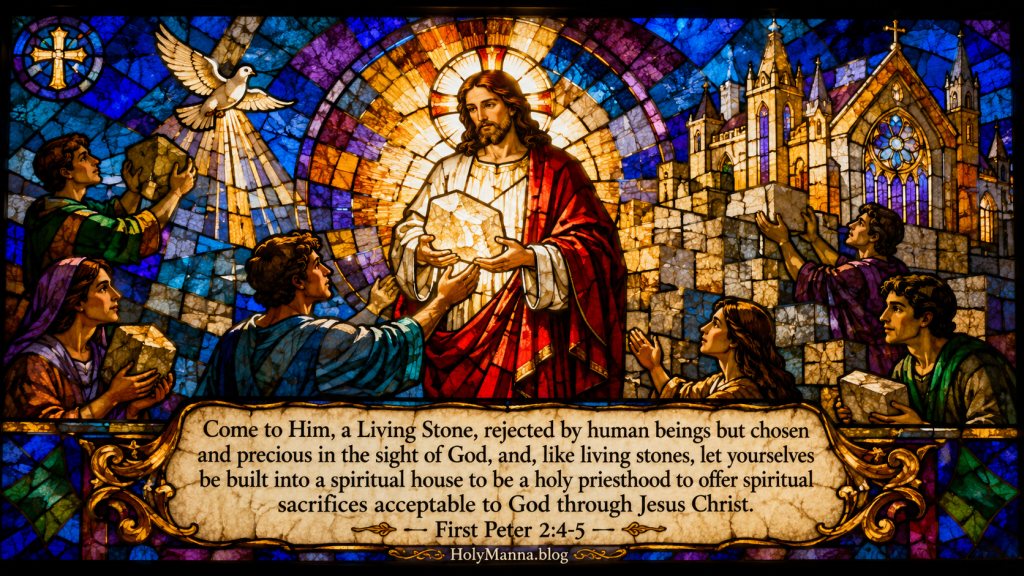
2 like newborn infants, long for pure spiritual milk so that through it you may grow into salvation, 3 for you have tasted that the Lord is good. 4 Come to him, a living stone, rejected by human beings but chosen and precious in the sight of God, 5 and, like living stones, let yourselves be built into a spiritual house to be a holy priesthood to offer spiritual sacrifices acceptable to God through Jesus Christ.
9 But you are “a chosen race, a royal priesthood, a holy nation, a people of his own, so that you may announce the praises” of him who called you out of darkness into his wonderful light.
10 Once you were “no people”
but now you are God’s people;
you “had not received mercy”
but now you have received mercy.Christian Examples. 11 Beloved, I urge you as aliens and sojourners[c] to keep away from worldly desires that wage war against the soul. 12 Maintain good conduct among the Gentiles, so that if they speak of you as evildoers, they may observe your good works and glorify God on the day of visitation.
Detailed Exegesis
Verse 2 – “Like newborn infants, long for pure spiritual milk so that through it you may grow into salvation.”
Peter begins with the image of a newborn child. This is tender, but it is also humbling. A newborn does not pretend to be self-sufficient. A newborn lives by receiving. In the same way, the Christian life begins and continues with dependence on God. The soul needs grace, Scripture, prayer, the sacraments, sound teaching, and the life of the Church. Peter is not describing spiritual immaturity as something shameful. He is describing spiritual hunger as something necessary.
This verse reminds Catholics that growth in holiness is not automatic. Baptism gives new life, but that life must be nourished. The Christian who stops hungering for God becomes weak, distracted, and vulnerable to the desires that Peter will later warn about. The soul must learn to crave what is holy.
Verse 3 – “For you have tasted that the Lord is good.”
Peter assumes that these Christians have already experienced the goodness of God. This line echoes Psalm 34:9, which says, “Taste and see that the Lord is good.” The word “tasted” is deeply Eucharistic in Catholic imagination, even though Peter is speaking broadly about the experience of grace. The Christian faith is not only an idea to be considered. It is a life to be received.
For a Catholic, this verse naturally draws the heart toward the Eucharist. In Holy Communion, the goodness of the Lord is not merely remembered. He is received. The same Lord who called His people out of darkness feeds them with Himself.
Verse 4 – “Come to him, a living stone, rejected by human beings but chosen and precious in the sight of God.”
Christ is called the “living stone.” Stones are usually lifeless, but Peter speaks of a stone that lives because Christ is risen. He is the foundation of the Church, rejected by men but chosen by the Father. This recalls the pattern of salvation history. The world often rejects what God chooses. Bethlehem looked small. Nazareth looked ordinary. The Cross looked like defeat. Yet God built redemption through what the world dismissed.
This verse also prepares the heart for Bartimaeus in the Gospel. The crowd will treat the blind man like an interruption, but Jesus will stop for him. God sees differently than the world sees. The rejected one often becomes the chosen one when mercy enters the story.
Verse 5 – “And, like living stones, let yourselves be built into a spiritual house to be a holy priesthood to offer spiritual sacrifices acceptable to God through Jesus Christ.”
Peter now applies the image of Christ to the Church. If Christ is the living stone, Christians become “living stones” in Him. Faith is personal, but it is never private or isolated. Catholics are not scattered spiritual individuals trying to invent their own path. They are built together into a spiritual house, which is the Church.
Peter also says the baptized are “a holy priesthood.” This refers to the common priesthood of the faithful. It does not erase the difference between the baptized and the ordained priesthood. Rather, it teaches that every baptized Catholic has a real share in Christ’s priestly mission. The faithful offer spiritual sacrifices through prayer, works of mercy, daily duties, suffering patiently endured, and lives united to Christ.
This is where ordinary life becomes sacred. A long workday, a hard conversation, a temptation resisted, a hidden act of charity, a family sacrifice, and a quiet prayer can become offerings to God when joined to Jesus Christ.
Verse 9 – “But you are ‘a chosen race, a royal priesthood, a holy nation, a people of his own, so that you may announce the praises’ of him who called you out of darkness into his wonderful light.”
This is one of the most beautiful descriptions of Christian identity in the New Testament. Peter takes covenant language once spoken over Israel and applies it to the Church in Christ. The baptized are chosen, priestly, holy, and claimed by God.
But this identity comes with a mission. God calls His people out of darkness so they may “announce the praises” of the One who saved them. A Catholic does not receive mercy only for personal comfort. Mercy becomes testimony. The Christian life is meant to make God visible through worship, holiness, charity, and public witness.
The phrase “out of darkness into his wonderful light” also connects directly with today’s Gospel. Bartimaeus literally moves from blindness to sight. Peter shows the deeper spiritual reality. Every Christian has been called from the darkness of sin, confusion, and alienation into the light of Christ.
Verse 10 – “Once you were ‘no people’ but now you are God’s people; you ‘had not received mercy’ but now you have received mercy.”
This verse is pure Gospel. Peter echoes the prophet Hosea, where God promises mercy to those who had been estranged. In Christ, the outsider is brought in. The forgotten one is named. The sinner receives mercy. The scattered become God’s people.
This matters because Catholic identity begins with mercy, not personal achievement. The Church is not a club for the impressive. She is the people gathered by the mercy of God. Every saint began here. Every convert begins here. Every Confession returns here. Once there was sin, distance, shame, and exile. Now there is mercy.
Verse 11 – “Beloved, I urge you as aliens and sojourners to keep away from worldly desires that wage war against the soul.”
Peter calls the faithful “beloved”, but then he speaks plainly. Christians are “aliens and sojourners” because they live in this world while belonging ultimately to heaven. This does not mean Catholics should despise the world. Creation is good. Human life is good. Family, work, culture, and friendship are good. But fallen desires can become enemies of the soul when they pull the heart away from God.
Peter describes these desires as waging war. That is serious language. Sin is not harmless. Disordered desires do not simply entertain the soul. They attack it. The Christian life requires vigilance, self-denial, and grace. This is why the Church calls the faithful to prayer, fasting, Confession, Eucharistic devotion, and moral discipline. Freedom is not doing whatever the body wants. Freedom is becoming capable of loving God and neighbor rightly.
Verse 12 – “Maintain good conduct among the Gentiles, so that if they speak of you as evildoers, they may observe your good works and glorify God on the day of visitation.”
Peter knows Christians may be misunderstood, judged, or falsely accused. His answer is not bitterness. His answer is holiness. Good conduct becomes a witness. The world may argue against doctrine, mock prayer, misunderstand the Church, or resist conversion, but a holy life has a quiet power that is hard to dismiss.
This does not mean Catholics live morally upright lives just to impress others. It means visible goodness can become a doorway to God. When believers live with integrity, chastity, mercy, courage, patience, and joy, their lives point beyond themselves. Peter’s hope is that even those who criticize Christians may one day glorify God.
Teachings: The Dignity and Mission of the Baptized
The first major teaching in this reading is the identity of the baptized. Saint Peter is not using decorative religious language. He is describing what grace actually does. The Christian becomes part of a new people, built upon Christ, nourished by God, and sent into the world.
The Catechism of the Catholic Church directly quotes this passage when teaching about the grace of Baptism: “The baptized have become ‘living stones’ to be ‘built into a spiritual house, to be a holy priesthood.’ By Baptism they share in the priesthood of Christ, in his prophetic and royal mission. They are ‘a chosen race, a royal priesthood, a holy nation, God’s own people, that [they] may declare the wonderful deeds of him who called [them] out of darkness into his marvelous light.’ Baptism gives a share in the common priesthood of all believers.” (CCC 1268)
This is essential for understanding Catholic life. Baptism is not merely a symbol of belonging. It truly configures the soul to Christ and incorporates the person into the Church. The baptized are called to worship, witness, and holiness.
The Catechism also explains how lay Catholics live this priestly mission in ordinary life: “For all their works, prayers, and apostolic undertakings, family and married life, daily work, relaxation of mind and body, if they are accomplished in the Spirit, indeed even the hardships of life if patiently born, all these become spiritual sacrifices acceptable to God through Jesus Christ.” (CCC 901)
That quote gives practical weight to Peter’s phrase “spiritual sacrifices.” The Christian does not need a dramatic life to offer something beautiful to God. The ordinary becomes holy when it is united to Christ.
The Church also guards the distinction between the common priesthood and the ordained priesthood. The Catechism teaches: “The ministerial or hierarchical priesthood of bishops and priests, and the common priesthood of all the faithful participate, ‘each in its own proper way, in the one priesthood of Christ.’ While being ‘ordered one to another,’ they differ essentially.” (CCC 1547)
This balance matters. Every baptized Catholic has dignity and mission, but not every Catholic is ordained to act in the person of Christ the Head in the same way as a priest. The Church is not flattened into sameness. She is built as a living body with ordered gifts, all flowing from Christ.
Saint Augustine also helps illuminate this reading by reminding the faithful that belonging to Christ must become visible in charity. In a sermon on the Body of Christ, he famously taught: “Be what you see, and receive what you are.” This Eucharistic line captures the heart of Peter’s vision. Catholics receive Christ so they may become more fully His Body in the world.
The reading also carries historical power. The early Christians often lived as a misunderstood minority in the Roman world. They were accused of being strange, disloyal, or even dangerous because they would not worship pagan gods or conform to immoral customs. Peter’s response was not to tell them to hide their faith or retaliate with anger. He called them to visible holiness. Their conduct was to become an argument for the Gospel.
That same witness is needed today. Catholics still live in a culture that often misunderstands chastity, sacramental life, obedience to Church teaching, reverence for the Eucharist, and the dignity of human life. Peter’s instruction remains clear. Remember who you are. Resist what wages war against the soul. Live so well that even critics can glimpse the goodness of God.
Reflection: Living Like People Who Have Received Mercy
This reading is a reminder that Catholic identity is not something to dust off on Sundays. It is the deepest truth of a baptized life. Saint Peter looks at ordinary Christians and tells them they are “living stones”, “a royal priesthood”, and “God’s people.” That is not motivational language. That is sacramental reality.
The challenge is to live like it.
A person who knows they have received mercy does not need to be ruled by shame. A person called out of darkness does not need to keep making peace with sin. A person built into the Church does not need to live like an isolated spiritual consumer. A person who shares in Christ’s priesthood does not need to waste suffering, work, or daily responsibilities. Everything can be offered.
This reading invites Catholics to begin the day with a simple offering. Before the phone takes over, before the noise begins, before the stress rushes in, the soul can pray: Lord, take this day. Take this work. Take this struggle. Take this family responsibility. Take this temptation. Take this hidden sacrifice. Let it become acceptable to the Father through Jesus Christ.
It also invites an honest examination of desire. Peter says worldly desires “wage war against the soul.” That means the faithful need to stop treating sin like a harmless side habit. The enemy often works slowly, through compromise, distraction, resentment, lust, pride, laziness, envy, and comfort. The Christian who wants to grow must ask for the grace to see the battle clearly and choose the light again.
What desires are quietly waging war against your soul right now?
Do you see your daily work, sacrifices, and responsibilities as something that can be offered to God?
Where is Christ asking you to stop living like a spiritual spectator and start living like a living stone in His Church?
If someone watched your conduct this week, would they see a life that announces the praises of God?
Saint Peter gives the Church a bold and beautiful identity today. Once there was no people. Now there is God’s people. Once there was no mercy. Now mercy has been received. Once there was darkness. Now there is wonderful light.
The only fitting response is to live like the light is real.
Responsorial Psalm – Psalm 100:2-5
The Joyful Song of a People Who Belong to God
There is a kind of joy that does not come from life being easy. It comes from knowing whose you are. That is the joy singing through Psalm 100. After Saint Peter tells the Church that the baptized are “a chosen race”, “a royal priesthood”, and “God’s people”, the Psalm teaches those same people how to respond. They do not respond first with anxiety, self-reliance, or spiritual performance. They respond with worship.
Psalm 100 is a hymn of thanksgiving, shaped by the worship of Israel. Its language of gates and courts points to Temple worship, where God’s people would enter His presence with praise, sacrifice, and blessing. In the life of the Church, this Psalm finds an even deeper fulfillment in the Mass, where thanksgiving becomes Eucharist and the People of God gather around the true Shepherd, Jesus Christ.
Today’s theme moves from darkness into light, from mercy into mission, and from isolation into belonging. This Psalm gives that movement its song. Bartimaeus cries for mercy in the Gospel, Saint Peter announces that mercy has made us God’s people, and Psalm 100 teaches the healed and gathered Church to sing: “We belong to him.”
Psalm 100:2-5 – New American Bible (Revised Edition)
2 serve the Lord with gladness;
come before him with joyful song.
3 Know that the Lord is God,
he made us, we belong to him,
we are his people, the flock he shepherds.
4 Enter his gates with thanksgiving,
his courts with praise.
Give thanks to him, bless his name;
5 good indeed is the Lord,
His mercy endures forever,
his faithfulness lasts through every generation.
Detailed Exegesis
Verse 2 – “Serve the Lord with gladness; come before him with joyful song.”
This verse begins with service, but not the kind of service that feels bitter, forced, or resentful. The Psalm calls God’s people to “serve the Lord with gladness.” In biblical faith, worship and service belong together. To worship God is not only to sing to Him, but to give Him the whole life.
This matters because joy is not an optional decoration on Catholic discipleship. Joy is one of the signs that the heart knows it belongs to God. The Psalm does not say that every day will feel easy. It says that God is worthy of glad service even when life is heavy. The soul that has received mercy can still sing, because its deepest identity is not found in circumstances. It is found in the Lord.
This verse connects beautifully with Saint Peter’s call to offer “spiritual sacrifices acceptable to God through Jesus Christ.” Christian service becomes joyful when it is offered through Christ rather than performed for approval, control, or personal pride.
Verse 3 – “Know that the Lord is God, he made us, we belong to him, we are his people, the flock he shepherds.”
This is the theological center of the Psalm. The command is simple: “Know that the Lord is God.” Israel’s worship begins with truth. God is not one option among many. He is the Lord, the Creator, the Shepherd, and the One to whom His people belong.
The line “he made us” reminds the reader that human life is received, not invented. Before anyone achieves, chooses, succeeds, fails, posts, performs, or proves anything, that person exists because God willed them into being. Then the Psalm goes deeper: “we belong to him.” This is not ownership in a cold or oppressive sense. It is covenant belonging. God’s people are not abandoned to confusion. They are shepherded.
This prepares the heart for the Gospel. Bartimaeus sits by the roadside, but Jesus sees him as more than a blind beggar. He is one of the sheep the Shepherd came to call. The crowd may try to silence him, but the Shepherd hears him.
Verse 4 – “Enter his gates with thanksgiving, his courts with praise. Give thanks to him, bless his name.”
The Psalm now brings the worshiper into sacred space. Gates and courts recall the Temple, the place where Israel came to offer sacrifice and praise before the Lord. The movement is important. God’s people do not enter His presence casually or selfishly. They enter with thanksgiving.
For Catholics, this verse naturally points toward the Mass. The Eucharist is the Church’s great act of thanksgiving. The faithful come not merely to consume religious content, but to enter the worship of Christ offered to the Father. Thanksgiving is not just good manners before God. It is the proper response of a people who know they have received mercy.
The command “bless his name” also matters. To bless God is to praise Him as the source of every blessing. The Christian life becomes healthier when thanksgiving becomes a habit, because gratitude trains the soul to see grace where the world sees only inconvenience, entitlement, or lack.
Verse 5 – “Good indeed is the Lord, His mercy endures forever, his faithfulness lasts through every generation.”
The Psalm ends by giving the reason for all this joy: God is good, merciful, and faithful. This is not sentimental optimism. It is covenant confidence. Israel could look back on creation, Abraham, the Exodus, the Law, the Temple, and the prophets and say that God had remained faithful. The Church can look even further, to the Incarnation, the Cross, the Resurrection, the sacraments, and the saints.
The phrase “His mercy endures forever” is the heartbeat of salvation history. God’s mercy is not fragile. It does not expire after one failure. It does not disappear when the soul is embarrassed, wounded, or spiritually blind. This truth prepares the reader for Bartimaeus, who cries out for mercy and discovers that Jesus does not pass him by.
The final words, “his faithfulness lasts through every generation,” remind the Church that the God who shepherded Israel, healed Bartimaeus, and built the early Christians into a spiritual house is still faithful now. Every generation must learn to sing this Psalm as its own.
Teachings: Thanksgiving, Worship, and the Prayer of the Church
The first great teaching of this Psalm is that worship begins with belonging. The Psalm does not say, “Make yourself worthy, then come before God.” It says to know the truth: “He made us, we belong to him.” Catholic worship begins with grace. God creates, calls, shepherds, forgives, feeds, and gathers His people.
The Catechism of the Catholic Church teaches the importance of the Psalms in the prayer of God’s people: “The Psalms constitute the masterwork of prayer in the Old Testament. They present two inseparable qualities: the personal, and the communal. They extend to all dimensions of history, recalling God’s promises already fulfilled and looking for the coming of the Messiah.” (CCC 2596)
That perfectly describes Psalm 100. It is personal because every soul must learn to thank God. It is communal because the Psalm is sung by a people entering His presence together. It looks back on God’s faithfulness and points forward to Christ, the Good Shepherd and the fulfillment of Israel’s hope.
The Catechism also teaches: “Prayed and fulfilled in Christ, the Psalms are an essential and permanent element of the prayer of the Church. They are suitable for men of every condition and time.” (CCC 2597)
This means Psalm 100 is not locked in the past. It belongs to the Church today. The Catholic who prays it at Mass, in the Liturgy of the Hours, or in personal prayer is joining the ancient worship of Israel now fulfilled in Jesus Christ.
The Psalm’s call to thanksgiving also leads directly to the Eucharist. The Catechism teaches: “Thanksgiving characterizes the prayer of the Church which, in celebrating the Eucharist, reveals and becomes more fully what she is. Indeed, in the work of salvation, Christ sets creation free from sin and death to consecrate it anew and make it return to the Father, for his glory. The thanksgiving of the members of the Body participates in that of their Head.” (CCC 2637)
This is why thanksgiving is not a shallow attitude adjustment. It is deeply Catholic. In the Eucharist, the Church becomes most fully herself by giving thanks through Christ. The people who belong to God enter His courts with praise because Christ has opened the way.
The Psalm also teaches adoration. The Catechism says: “Adoration is the first attitude of man acknowledging that he is a creature before his Creator. It exalts the greatness of the Lord who made us and the almighty power of the Savior who sets us free from evil. Adoration is homage of the spirit to the ‘King of Glory,’ respectful silence in the presence of the ‘ever greater’ God. Adoration of the thrice-holy and sovereign God of love blends with humility and gives assurance to our supplications.” (CCC 2628)
That is exactly the posture of Psalm 100. The soul stands before God and says, in effect, “You are God. You made us. We belong to You. You are good. Your mercy endures forever.”
Saint Augustine captures the deepest hunger behind this worship in his Confessions: “You have made us for yourself, O Lord, and our heart is restless until it rests in you.” That restlessness is healed in worship. The human heart was not made to belong to trends, fears, sins, careers, applause, or the endless noise of the world. It was made to belong to God.
Reflection: Learning to Sing Because Mercy Is Real
This Psalm asks the modern Catholic a simple but searching question: Does your life sound like someone who belongs to God?
That does not mean every Catholic needs to walk around with a fake smile. The Church is not asking wounded people to pretend. But Psalm 100 does challenge the soul to remember what is truer than the stress of the moment. God is good. His mercy endures. His faithfulness has not run out. The Shepherd still knows His flock.
A practical way to live this Psalm is to begin the day with thanksgiving before turning to complaints, worries, or screens. Name three concrete graces. Thank God for life. Thank Him for mercy. Thank Him for the Eucharist. Thank Him for the chance to begin again. Gratitude does not erase suffering, but it does keep suffering from becoming the only voice in the room.
This Psalm also invites Catholics to recover joyful service. A person can do the right thing with a bitter heart. A parent can serve resentfully. A worker can fulfill responsibilities with anger. A parish volunteer can help while secretly wanting recognition. The Psalm gently calls the heart back: “Serve the Lord with gladness.” The Lord does not only want external obedience. He wants the heart.
Finally, this Psalm prepares the soul to come to Mass differently. The church is not merely a building to enter. It is the place where the flock gathers before the Shepherd. The Mass is not merely an obligation to complete. It is the Eucharistic thanksgiving of the Church, the place where mercy, sacrifice, praise, and belonging meet.
Where has gratitude grown quiet in your life?
Do you approach Sunday Mass as an obligation to finish or as an entrance into the courts of the Lord?
What would change this week if you truly believed, in your bones, that you belong to God?
How can your daily service become more joyful, more generous, and more clearly offered to the Lord?
The Psalm gives the Church a song for the road. Saint Peter tells the baptized who they are. Bartimaeus shows what mercy can do. Psalm 100 teaches the healed and gathered people of God how to respond.
They serve with gladness. They enter with thanksgiving. They bless His name. And they keep singing because “good indeed is the Lord, His mercy endures forever, his faithfulness lasts through every generation.”
Holy Gospel – Mark 10:46-52
The Blind Man Who Saw the King Before the Crowd Did
There are moments in the Gospel when one person’s cry seems to stop the whole world. Bartimaeus is sitting by the roadside outside Jericho, blind, poor, and dependent on the mercy of strangers. Jesus is passing through with His disciples and a large crowd, moving toward Jerusalem, where the Cross is waiting. This makes the scene more powerful. Jesus is on the road to His Passion, yet He still stops for one beggar who calls out in faith.
Jericho carried deep biblical memory for the Jewish people. It was the city connected to Israel’s entrance into the Promised Land under Joshua. Now, near that ancient city, a new Joshua, Jesus, is leading God’s people toward a greater victory. But this victory will not come through collapsing walls. It will come through mercy, the Cross, and the opening of blind eyes.
This Gospel beautifully completes today’s theme. In 1 Peter 2:2-5, 9-12, the baptized are called out of darkness into God’s wonderful light. In Psalm 100:2-5, God’s people sing because they belong to Him and His mercy endures forever. In Mark 10:46-52, Bartimaeus becomes the living picture of that truth. He begins the story in darkness, crying for mercy. He ends it with sight, following Jesus on the way.
Mark 10:46-52 – New American Bible (Revised Edition)
46 They came to Jericho. And as he was leaving Jericho with his disciples and a sizable crowd, Bartimaeus, a blind man, the son of Timaeus, sat by the roadside begging. 47 On hearing that it was Jesus of Nazareth, he began to cry out and say, “Jesus, son of David, have pity on me.” 48 And many rebuked him, telling him to be silent. But he kept calling out all the more, “Son of David, have pity on me.” 49 Jesus stopped and said, “Call him.” So they called the blind man, saying to him, “Take courage; get up, he is calling you.” 50 He threw aside his cloak, sprang up, and came to Jesus. 51 Jesus said to him in reply, “What do you want me to do for you?” The blind man replied to him, “Master, I want to see.” 52 Jesus told him, “Go your way; your faith has saved you.” Immediately he received his sight and followed him on the way.
Detailed Exegesis
Verse 46 – “They came to Jericho. And as he was leaving Jericho with his disciples and a sizable crowd, Bartimaeus, a blind man, the son of Timaeus, sat by the roadside begging.”
Mark places Bartimaeus by the roadside, not on the road. That detail matters. In Mark’s Gospel, the “way” often points to discipleship, especially the road Jesus is taking toward Jerusalem and His Passion. Bartimaeus is near the path of Jesus, but not yet walking it.
He is also named, which is unusual for many healing stories. Bartimaeus means “son of Timaeus,” and Mark repeats that meaning for his readers. This gives the man a personal dignity. He is not just “a blind beggar.” He is a person with a name, a history, and a place in God’s saving plan.
His blindness also has spiritual weight. Throughout Scripture, physical sight often points beyond itself to the deeper need for faith. Bartimaeus lacks bodily sight, but as the story unfolds, he sees Jesus more clearly than many in the crowd.
Verse 47 – “On hearing that it was Jesus of Nazareth, he began to cry out and say, ‘Jesus, son of David, have pity on me.’”
Bartimaeus hears before he sees. Faith often begins this way. Saint Paul says in Romans 10:17, “Thus faith comes from what is heard, and what is heard comes through the word of Christ.” Bartimaeus hears that Jesus is near, and something in him refuses to stay silent.
His prayer is simple: “Jesus, son of David, have pity on me.” Calling Jesus “Son of David” is a messianic confession. Bartimaeus may be blind, but he recognizes the King. He sees with faith before he sees with his eyes.
This cry also teaches the heart how to pray. It is humble, direct, and persistent. It does not negotiate. It does not pretend. It simply brings need before mercy.
Verse 48 – “And many rebuked him, telling him to be silent. But he kept calling out all the more, ‘Son of David, have pity on me.’”
The crowd tries to silence Bartimaeus. This is painfully familiar. Sometimes the world tells people to keep their faith private, to stop making a scene, to settle down, to stop being “too Catholic,” or to stop asking Jesus for too much. Sometimes the louder crowd is inside the soul, saying that the sin is too old, the wound is too deep, the prayer is too late, or the person is too far gone.
Bartimaeus does not listen. He cries out even more. This is not stubbornness in a worldly sense. This is persevering faith. He knows that Jesus is passing by, and he refuses to let shame, pressure, or human opinion keep him from mercy.
His second cry drops the name “Jesus” and goes straight to the title: “Son of David, have pity on me.” The crowd sees a beggar making noise. Bartimaeus sees the Messiah.
Verse 49 – “Jesus stopped and said, ‘Call him.’ So they called the blind man, saying to him, ‘Take courage; get up, he is calling you.’”
This is one of the most beautiful moments in the passage. Jesus stopped. The Lord of heaven and earth, walking toward Jerusalem and the Cross, stops for the cry of one blind beggar.
Then Jesus involves the crowd: “Call him.” The same crowd that tried to silence Bartimaeus now becomes the messenger of Christ’s invitation. Their words are unforgettable: “Take courage; get up, he is calling you.”
That sentence carries the sound of conversion. Courage is needed because coming to Jesus means leaving behind the familiar. Getting up is needed because faith cannot remain passive forever. The call of Jesus is personal, direct, and full of mercy.
In this moment, the Church can see her own mission. The Church must never become the crowd that silences the wounded. She must be the voice that says, “Take courage; get up, he is calling you.”
Verse 50 – “He threw aside his cloak, sprang up, and came to Jesus.”
Bartimaeus throws aside his cloak. For a beggar, a cloak could be one of his few possessions. It may have protected him from cold, marked his place, or held the coins people tossed his way. Yet when Jesus calls, Bartimaeus leaves it behind.
This gesture is more than movement. It is surrender. He is leaving behind the life he knew in order to come to Christ. The Fathers of the Church often saw symbolic meaning here. The cloak can represent old attachments, sins, false securities, and the habits that keep a soul settled in spiritual begging.
Mark says Bartimaeus “sprang up”. There is urgency here. When mercy calls, he does not delay. He does not ask the crowd for permission. He comes to Jesus.
Verse 51 – “Jesus said to him in reply, ‘What do you want me to do for you?’ The blind man replied to him, ‘Master, I want to see.’”
Jesus asks a question that seems obvious: “What do you want me to do for you?” But Jesus is not asking because He lacks information. He is drawing Bartimaeus into honest, personal prayer. God wants the heart to name its desire before Him.
Bartimaeus answers with one of the most powerful prayers in Scripture: “Master, I want to see.” This prayer is simple, but it is not small. To ask for sight is to ask for healing, truth, direction, and responsibility. Once Bartimaeus sees, he cannot remain the same.
This is also the prayer every disciple needs. Lord, help me see my sins clearly. Help me see the people I ignore. Help me see the truth of the Church with humility. Help me see the Eucharist with faith. Help me see where You are calling me next.
Verse 52 – “Jesus told him, ‘Go your way; your faith has saved you.’ Immediately he received his sight and followed him on the way.”
Jesus says, “Your faith has saved you.” The healing is physical, but the language is deeper than physical sight. Bartimaeus is not merely cured. He is saved, restored, and brought into discipleship.
Then comes the final line: “He received his sight and followed him on the way.” This is the true completion of the miracle. Bartimaeus does not receive mercy and return to his old place by the roadside. He follows Jesus.
The way of Jesus leads to Jerusalem, to the Cross, and ultimately to Resurrection. Bartimaeus becomes a model disciple because he does what the rich man earlier in Mark’s Gospel could not do. He leaves behind what he has and follows Christ.
Teachings: Faith, Mercy, Healing, and the Road of Discipleship
This Gospel teaches that faith begins by hearing, grows through perseverance, and becomes complete in following Jesus. Bartimaeus is physically blind, but spiritually awake. The crowd has working eyes, but they do not yet see him with the mercy of Christ. Jesus reveals the difference between human visibility and divine attention. The forgotten man is not forgotten by God.
The Catechism of the Catholic Church teaches that Christ’s miracles are signs of His divine mission: “The signs worked by Jesus attest that the Father has sent him. They invite belief in him. To those who turn to him in faith, he grants what they ask. So miracles strengthen faith in the One who does his Father’s works; they bear witness that he is the Son of God.” (CCC 548)
This is exactly what happens with Bartimaeus. The miracle is not entertainment. It is a sign that Jesus is the Messiah, the Son of David, and the merciful Savior. Bartimaeus turns to Him in faith and receives what he asks.
The Catechism also teaches about the prayer of those who approach Jesus in faith: “Prayer to Jesus is answered by him already during his ministry, through signs that anticipate the power of his death and Resurrection: Jesus hears the prayer of faith, expressed in words, or in silence.” (CCC 2616)
Bartimaeus expresses his prayer in words, and loudly. Others in the Gospel are healed through silent faith, but Bartimaeus teaches the courage of crying out. His prayer is not polished. It is desperate, honest, and full of trust. Jesus hears it.
The Catechism gives another important teaching on Christ’s compassion toward the sick and suffering: “Moved by so much suffering Christ not only allows himself to be touched by the sick, but he makes their miseries his own: ‘He took our infirmities and bore our diseases.’” (CCC 1505)
Jesus does not treat Bartimaeus like a distraction from His mission. Mercy is His mission. The suffering person is not an interruption to Christ. The suffering person is the one He came to save.
The Fathers of the Church also saw profound meaning in this Gospel. Saint Bede taught that Jesus asks Bartimaeus what he wants not because the Lord is ignorant, but so that the blind man’s desire may be stirred into prayer. This shows a beautiful truth about the spiritual life. Jesus knows what the soul needs, but He still invites the soul to ask. Prayer opens the heart to receive.
Theophylact saw Bartimaeus’ response after healing as a sign of gratitude. He does not run away with his miracle. He follows the One who healed him. That matters because the goal of grace is not merely relief. The goal of grace is communion with Christ.
Pope Benedict XVI reflected that Bartimaeus stands at a decisive place in Mark’s Gospel, near the end of Jesus’ journey toward Jerusalem. His blindness represents humanity’s need for the light of faith, and his healing becomes a sign of discipleship. Bartimaeus is not only given sight. He is placed on the road behind Jesus.
Pope Francis has also emphasized the movement of this Gospel through the cry, faith, and journey of Bartimaeus. Jesus sees the one the crowd ignores, listens to him, calls him, heals him, and sets him on the road of discipleship. That is a powerful image of evangelization. The Church must notice those sitting by the roadside and help them hear that Jesus is calling.
This Gospel also fits beautifully with today’s first reading. Saint Peter says that the baptized have been called “out of darkness into his wonderful light” (1 Peter 2:9). Bartimaeus shows that movement in living color. He begins in darkness, cries for mercy, receives sight, and follows Jesus. His story is the story of every Christian soul touched by grace.
Reflection: When Jesus Is Passing By
Bartimaeus is one of the great teachers of prayer because he refuses to pretend he is fine. He does not soften his need. He does not wait until he looks respectable. He does not let the crowd decide whether his prayer is appropriate. He hears that Jesus is near and cries out for mercy.
That is where many people need to begin again. Not with a perfect plan. Not with a flawless spiritual résumé. Not with impressive words. Just with the honest cry: “Jesus, son of David, have pity on me.”
This Gospel invites the reader to notice the crowds that silence prayer. There is the crowd of distraction, constantly pulling the heart toward noise. There is the crowd of shame, whispering that God must be tired of forgiving the same sins. There is the crowd of cynicism, saying that prayer does not change anything. There is the crowd of comfort, convincing the soul to stay wrapped in the old cloak because change is too costly.
Bartimaeus shows another way. He cries louder. He gets up. He leaves the cloak. He tells Jesus the truth. Then he follows.
A practical way to live this Gospel is to pray the words of Bartimaeus slowly throughout the day: “Jesus, son of David, have pity on me.” This prayer can be said in traffic, before Confession, during temptation, after failure, while walking into work, or when the soul feels spiritually blind. It is short enough to remember and deep enough to reshape the heart.
Another step is to ask Jesus directly for sight. Not vague improvement, but real sight. Lord, show the truth. Show the next faithful step. Show what needs repentance. Show who needs forgiveness. Show where fear is winning. Show where mercy is already present.
This Gospel also challenges Catholics to become the right kind of crowd. The world has enough voices telling wounded people to be quiet. The Church must become the voice that says, “Take courage; get up, he is calling you.” That can happen through encouragement, invitation, patient listening, helping someone return to Mass, walking with a friend toward Confession, or simply refusing to treat broken people like burdens.
Where are you sitting by the roadside instead of following Jesus on the way?
What voices have been telling you to keep quiet when your soul needs to cry out for mercy?
What cloak of comfort, sin, fear, or false security needs to be thrown aside?
When Jesus asks, “What do you want me to do for you?” what answer rises from the deepest part of your heart?
Are you part of the crowd that silences the wounded, or part of the Church that says, “Take courage; get up, he is calling you”?
Bartimaeus begins as a blind beggar beside the road. He ends as a disciple walking behind Jesus. That is the movement of grace. Mercy does not leave the soul where it was found. Christ opens the eyes, lifts the heart, and calls His people onto the way.
The cry of Bartimaeus can become the prayer of every Catholic who wants to see again: “Master, I want to see.”
When Mercy Gives Us Sight, We Follow the Way
Today’s readings carry one clear invitation: let the mercy of God move the soul from darkness into light, and then let that light become a life of discipleship.
Saint Peter reminds the baptized who they are. They are not spiritual wanderers trying to invent themselves from scratch. They are “living stones”, built into a spiritual house. They are “a chosen race, a royal priesthood, a holy nation”, a people who have received mercy and now belong to God. This identity is not earned by achievement or polished religious performance. It is received through grace, especially through Baptism, where the soul is joined to Christ and given a share in His priestly, prophetic, and royal mission, as the Catechism of the Catholic Church teaches in CCC 1268.
The Psalm gives that identity a voice. If Saint Peter tells the Church who she is, Psalm 100 teaches her how to sing. “Serve the Lord with gladness” and “we belong to him” are not just comforting words. They are a way of seeing life. The Christian belongs to a faithful Shepherd whose mercy does not run out, whose goodness is not seasonal, and whose love remains steady through every generation.
Then Bartimaeus shows what this looks like in one wounded human life. He sits by the roadside, blind and begging, yet he recognizes Jesus more clearly than many in the crowd. When others tell him to be quiet, he cries out even louder: “Jesus, son of David, have pity on me.” Jesus stops. Jesus calls. Jesus heals. And Bartimaeus, now able to see, does not simply return to his old place. He follows Jesus on the way.
That is the whole Christian life in miniature. Cry out for mercy. Get up when Christ calls. Leave behind the old cloak. Ask to see. Receive healing. Follow Him.
The readings do not invite Catholics to settle for a comfortable faith that stays near the road but never walks it. They invite the soul into movement. The baptized are called to live as people who belong to God, to offer daily life as a spiritual sacrifice, to serve with gladness, and to become the kind of witnesses who help others hear the words, “Take courage; get up, he is calling you.”
Today is a good day to pray with the honesty of Bartimaeus: “Master, I want to see.” Let that prayer become specific. Ask Christ to reveal the sin that needs repentance, the wound that needs healing, the habit that needs surrender, the person who needs mercy, and the next step of discipleship that needs courage.
Where is Jesus calling you to get up and follow Him more faithfully?
What old cloak needs to be left behind so your hands are free to receive mercy?
How can your life this week announce the praises of the One who called you out of darkness into His wonderful light?
The Lord is still passing by. His mercy still endures forever. And when He calls, the only faithful answer is to rise, receive sight, and follow Him on the way.
Engage with Us!
Share your reflections in the comments below. Today’s readings invite a beautiful conversation about mercy, identity, worship, and discipleship. Every heart has places where it needs Christ to bring light, and every Catholic has a mission to help others hear the words, “Take courage; get up, he is calling you.”
- First Reading, 1 Peter 2:2-5, 9-12: What does it mean to you personally that the baptized are called “living stones” and part of “a royal priesthood”? How can your daily work, struggles, and sacrifices become an offering to God through Jesus Christ?
- Responsorial Psalm, Psalm 100:2-5: Where do you need to recover the joy of belonging to God? How can gratitude change the way you approach prayer, Mass, family life, work, or service this week?
- Holy Gospel, Mark 10:46-52: What is the “cloak” you may need to throw aside in order to come freely to Jesus? When Christ asks, “What do you want me to do for you?” what honest prayer rises from your heart?
May these readings help every soul cry out with the faith of Bartimaeus, worship with the joy of Psalm 100, and live with the dignity Saint Peter describes. Let us walk this week as people who have received mercy, doing everything with the love, courage, and compassion Jesus taught us.
Sacred Heart of Jesus, we trust in You!
Immaculate Heart of Mary, pray for us!
Saint Michael the Archangel, defend us in battle!
Follow us on YouTube, Instagram and Facebook for more insights and reflections on living a faith-filled life.


Leave a Reply