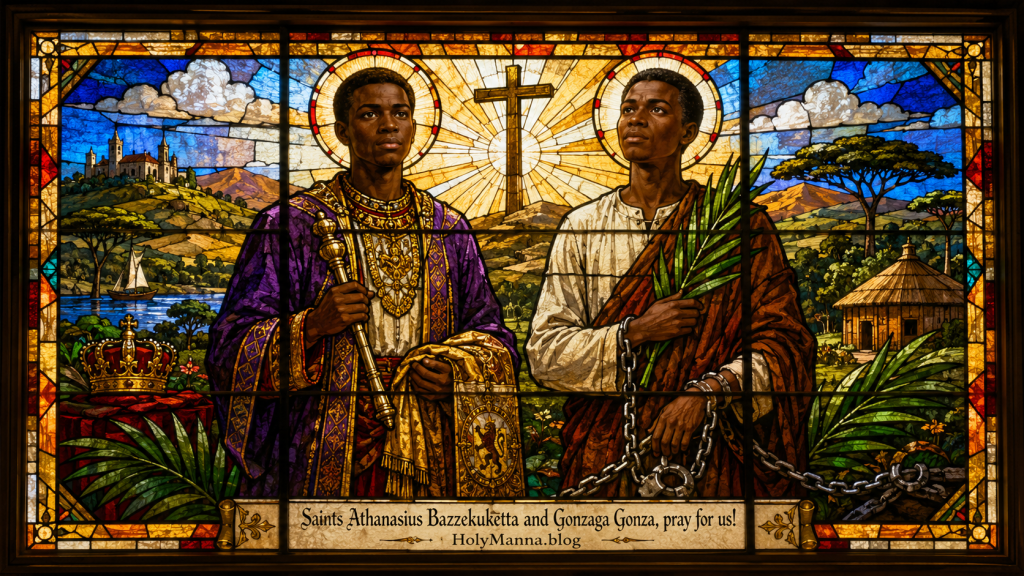
Two Young Martyrs Who Chose Christ Over the King
Saint Athanasius Bazzekuketta and Saint Gonzaga Gonza were two of the heroic Uganda Martyrs, young Catholic converts who gave their lives for Christ during the persecution under Kabaka Mwanga II of Buganda in 1886. They were not bishops, monks, famous preachers, or lifelong theologians. They were young men serving in a royal court, newly baptized, still near the beginning of their Catholic journey, and suddenly faced with the question every Christian must eventually answer in some form: Is Jesus worth everything?
Their answer was yes.
The Catholic Church honors them among the Uganda Martyrs, whose feast is celebrated on June 3. Athanasius and Gonzaga died earlier than many of the others, on May 27, 1886, while being taken toward Namugongo, the place where several of their companions would later be burned alive. Their witness shines with two different but beautifully connected virtues. Athanasius is remembered for fearless courage and integrity in royal service. Gonzaga is remembered for humility, charity toward prisoners, and endurance in suffering.
The Catechism of the Catholic Church teaches that “Martyrdom is the supreme witness given to the truth of the faith” in CCC 2473. That is exactly what these two young saints gave. They did not simply believe in Christ quietly. They bore witness to Him when that witness cost them their lives.
Faith Growing in the Shadow of the Palace
The story of Athanasius and Gonzaga begins in the Kingdom of Buganda, where Catholic missionaries had begun evangelizing in the late nineteenth century. The faith spread especially among young men serving in the royal court. Some were pages, attendants, servants, or officials close to the king. This made their conversion spiritually beautiful, but also politically dangerous.
Kabaka Mwanga II became increasingly hostile toward Christians, especially because the young converts placed obedience to God above obedience to immoral royal commands. The martyrdom of Saint Joseph Mukasa Balikuddembe in November 1885 made the danger clear. After his death, several catechumens hurried toward baptism, knowing that persecution could intensify at any moment.
Saint Athanasius Bazzekuketta was born around 1866 at Mukuma in Bulemeezi, in present-day Uganda. Catholic Ugandan sources describe him as a Muganda of the Nkima clan. His father was Kafeero Ssebaggala Kabaalu, and his mother was Namukwaya. From a young age, he was known as trustworthy, orderly, obedient, clean, and faithful in his duties.
Those virtues placed him in a position of remarkable responsibility. Athanasius served in the royal court and was entrusted with the king’s treasury, money, ivory, robes, ornaments, and other valuable royal goods. That detail says a great deal. Before he became a martyr, he had already learned how to be faithful in ordinary responsibility. He handled earthly treasure honestly, then proved by his death that Christ was his true treasure.
Saint Gonzaga Gonza, also known as Gonzaga Gonza Gonzabato, was born around 1862 in Busoga. Catholic sources remember him as a Musoga connected with the region of Bulamogi. His early life was marked by suffering because he was taken from his homeland as a child and brought to Buganda. He was raised in the household of Kasoma or Nkambo Buluusi, who treated him as a son. Around the age of twelve, Gonzaga entered service in the royal court of Kabaka Muteesa I.
Gonzaga’s path to Catholicism was not simple. Catholic sources say that he first professed Islam, then Protestantism, and later became Catholic. He was eventually baptized on November 17, 1885, the same day often given for Athanasius’s baptism. His journey reminds us that saints are not always people with tidy beginnings. Sometimes grace finds a heart after confusion, displacement, searching, and hardship.
The Treasurer and the Prisoner’s Friend
Athanasius is most known for his courage and integrity. He served close to power, handled royal wealth, and carried out important duties in the king’s household. In a court filled with danger, ambition, fear, and pressure, he became known for reliability. That matters because Catholic holiness is not only found in churches and monasteries. It is also found in offices, homes, workplaces, finances, leadership, and daily duties done honestly before God.
This is why Saint Athanasius is often associated with those who work in finance, treasury, banking, stewardship, and administration. He reminds every Catholic that money and responsibility are spiritual tests. The question is not only whether someone can manage wealth. The deeper question is whether wealth can be managed without losing the soul.
Gonzaga is most known for charity toward prisoners. One of the most moving stories from his life tells of his friend Namulabira, who was falsely accused and imprisoned after a court scandal involving a princess and one of the king’s wives. According to Catholic tradition, Gonzaga arranged for Namulabira to be released so that he could continue his catechism and Christian instruction. Gonzaga then took his place in prison.
That story is not just inspiring. It is deeply Catholic. Gonzaga lived something close to the heart of the Gospel. He took another man’s place. He entered suffering willingly so another could be free. He also cared for prisoners by preparing food for them, even though cooking was looked down upon as women’s work in that cultural setting. Gonzaga accepted mockery because charity mattered more than pride.
In Matthew 25:36, Jesus says, “I was in prison and you visited me.” Gonzaga did more than visit. He served, fed, loved, and even entered prison himself. His life shows that holiness is not always dramatic at first. Sometimes it begins with a hidden act of mercy no one applauds.
The Miracle of Grace Before the Crown
There are no well-attested Catholic accounts of individual miracles performed by Athanasius or Gonzaga during their lifetime in the way some saints are remembered for healings, visions, or wonders. Their lives were short, and their sanctity is preserved above all through their martyrdom and witness.
Still, the grace in their lives was extraordinary. Athanasius had been baptized only months before his death, yet he faced martyrdom with astonishing readiness. Gonzaga had endured displacement, court life, imprisonment, humiliation, and chains, yet he became a man of mercy rather than bitterness.
That kind of transformation may not be called a miracle in the formal sense, but it is certainly the work of grace. The Church teaches in the Catechism of the Catholic Church that grace is God’s free help, given so that we may respond to His call. In these saints, that grace bore fruit quickly. They did not have decades to build a public legacy. They simply gave Christ the time they had, and He made it holy.
How much can God do with a willing heart, even in a short life?
The Road to Namugongo
The persecution intensified in May 1886. The Christian converts in the royal court were condemned and sent toward Namugongo, a known place of execution. Some would reach Namugongo and be burned alive on June 3. Others, including Athanasius and Gonzaga, would die along the road.
Athanasius was among the first to be killed on the journey. The traditional Catholic account says that when the executioner asked who wanted to die at the place where Saint Joseph Mukasa had been killed, Athanasius stepped forward with remarkable courage. His famous saying is remembered as: “Here I am. Why delay me and take me all the way to Namugongo as if death cannot be met here?”
That line should stop every comfortable Catholic in their tracks. Athanasius was not chasing death because life had no value. He was embracing martyrdom because Christ had become more valuable than life itself. He was speared to death at Nakivubo on May 27, 1886, at about twenty years old.
Gonzaga’s final suffering was different, but no less powerful. He was arrested at Munyonyo and spent the night in chains. When the executioners tried to remove the chains from his legs, they could not. He was forced to walk toward Namugongo while still bound. The chains tore into his legs until they bled. Eventually, he could no longer continue. He collapsed on the road near Lubowa and was speared to death on May 27, 1886. He was about twenty-four years old.
There is no widely verified famous quotation from Gonzaga preserved in Catholic sources. His witness comes through his actions. He had taken the place of a prisoner. He had fed the forgotten. He had endured chains. His final sermon was not spoken with words. It was written in blood on the road to Namugongo.
Saints Who Still Walk With Uganda
After their deaths, Athanasius and Gonzaga were remembered with the other Uganda Martyrs as witnesses who helped give birth to a strong Catholic identity in Uganda and throughout Africa. The Catholic martyrs were beatified by Pope Benedict XV in 1920 and canonized by Pope Saint Paul VI on October 18, 1964, during the Second Vatican Council.
Their legacy is not small. The Uganda Martyrs became a sign that the Catholic faith had truly taken root in African soil. These were not foreign missionaries dying in a foreign land. These were Ugandan sons of the Church, young African Catholics who loved Christ unto death.
Namugongo is now one of the great Catholic pilgrimage sites in Africa. Every year on June 3, pilgrims gather to honor the Uganda Martyrs. Many walk long distances in prayer, sacrifice, and devotion. Munyonyo is also remembered as the place where the final journey began. Along that road, the memory of saints like Athanasius and Gonzaga continues to speak.
The Catechism of the Catholic Church teaches that the saints in heaven “do not cease to intercede with the Father for us” in CCC 956. That is why Catholics do not remember Athanasius and Gonzaga as dead heroes only. They are living members of the Body of Christ, friends of God, and intercessors for the Church.
Healings Through the Uganda Martyrs’ Intercession
There are no strong Catholic sources that assign a specific posthumous miracle uniquely to Saint Athanasius Bazzekuketta alone or Saint Gonzaga Gonza alone. The miracles are connected to the Uganda Martyrs collectively.
One major miracle involved two Missionary Sisters of Our Lady of Africa who contracted bubonic plague while caring for another sister. Their condition was considered medically hopeless. Prayers and a novena were offered through the intercession of the Uganda Martyrs, and relics were placed upon them. They recovered in a way judged medically inexplicable during the Church’s investigation.
Another miracle associated with the Uganda Martyrs involved a child named Revocato Kalema, who suffered from severely deformed legs. After prayers and novenas through the Uganda Martyrs, he was reportedly found moving among the pews and eventually walking. This healing was among the miracle stories connected to the canonization process.
These stories must be understood in a Catholic way. The saints do not heal by their own power. God heals. The saints intercede. Their miracles are not magic tricks from heaven. They are signs that Christ is alive, the communion of saints is real, and the Church on earth is still joined to the Church in glory.
Courage, Charity, and the Cost of Discipleship
Athanasius and Gonzaga are remembered together, but their lives speak in different ways.
Athanasius teaches courage in the face of fear. He was trusted with royal treasure, yet he did not make safety his treasure. He shows that integrity matters, especially when someone works close to money, power, influence, or responsibility. He is the saint for the Catholic who wants to be faithful at work, honest in stewardship, and brave when faith becomes inconvenient.
Gonzaga teaches mercy in the face of suffering. He was taken from his homeland, shaped by hardship, and placed in a dangerous royal court. Yet he became a man of charity. He cared for prisoners. He took another man’s place. He endured humiliation. He walked in chains until his body could go no farther. He is the saint for the forgotten, the falsely accused, the mistreated, the imprisoned, the traveler, and the person who feels trapped by suffering.
Together, they show that holiness is not one personality type. One saint stepped forward with boldness. The other served quietly with mercy. One is remembered for a courageous saying. The other is remembered for sacrificial action. Both belonged completely to Christ.
Which witness does your heart need more today, the courage of Athanasius or the mercy of Gonzaga?
What Their Witness Means for Us Today
It can be tempting to imagine the martyrs as people from another world, but Athanasius and Gonzaga feel surprisingly close to modern life.
Athanasius speaks to anyone who handles responsibility. He reminds us that money, work, leadership, and trust are not separate from faith. A Catholic cannot be honest only on Sundays. The Christian life must reach into business decisions, workplace ethics, financial responsibility, and the way one treats what belongs to others.
Gonzaga speaks to anyone who sees suffering and wonders what can be done. Not everyone can solve a system. Not everyone can change a kingdom. But everyone can love the person in front of them. Gonzaga did not end all imprisonment in Buganda. He helped one prisoner. He cooked one meal. He took one place. He walked one road with Christ.
That is how sainthood often begins. Not with grand speeches, but with daily fidelity.
The world does not need softer Christians who hide when faith becomes costly. It needs Catholics who can be both courageous and merciful. It needs people who can say yes to Christ at work, at home, in relationships, in suffering, and in public witness.
Athanasius and Gonzaga remind us that the road to holiness may be shorter than expected, harder than expected, and more beautiful than expected. They were young. They were newly baptized. They were still learning. But they gave Jesus everything.
Engage With Us!
Share your thoughts and reflections in the comments below. Saints Athanasius Bazzekuketta and Gonzaga Gonza lived very different kinds of holiness, but both gave everything to Christ. Their witness invites every Catholic to ask what fidelity looks like in ordinary life, especially when courage and mercy are costly.
- Where is Christ asking you to show more courage in your faith right now?
- How can Saint Athanasius Bazzekuketta’s integrity with responsibility, money, and trust challenge the way you live your daily work?
- Who is the forgotten, imprisoned, lonely, or mistreated person God may be asking you to serve like Saint Gonzaga Gonza?
- What would change if you saw your ordinary duties as a place where sainthood can begin?
- Are you willing to follow Christ even when obedience to Him costs comfort, approval, or safety?
May Saints Athanasius Bazzekuketta and Gonzaga Gonza pray for us, especially when faith feels costly and mercy feels inconvenient. May their witness help us live with courage, serve with humility, and do everything with the love and mercy Jesus taught us.
Saints Athanasius Bazzekuketta and Gonzaga Gonza, pray for us!
Follow us on YouTube, Instagram and Facebook for more insights and reflections on living a faith-filled life.


Leave a Reply