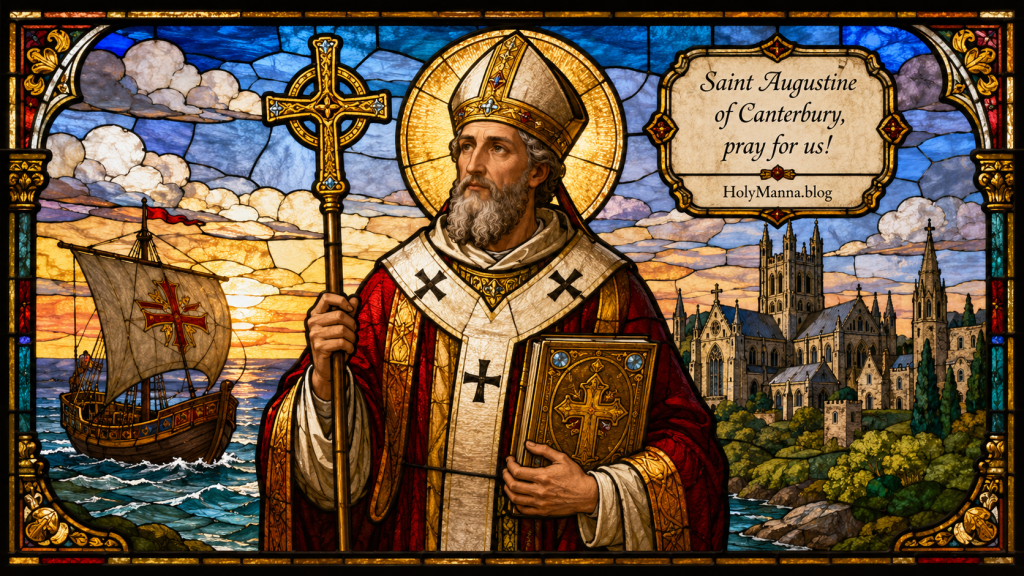
The Monk Who Turned Back, Then Helped Bring England to Christ
Saint Augustine of Canterbury is remembered as the Apostle of the English, the first Archbishop of Canterbury, and one of the most important missionary bishops in the history of Western Christianity. He was the Roman monk sent by Pope Saint Gregory the Great to bring the Catholic faith to the Anglo-Saxon people of England, a mission that would eventually reshape the spiritual history of an entire nation.
He is not to be confused with Saint Augustine of Hippo, the great Doctor of the Church. Saint Augustine of Canterbury did not leave behind famous theological books or a long collection of personal writings. His legacy was different. He preached, baptized, organized, prayed, endured setbacks, founded churches, and helped plant the roots of the Catholic Church in England.
His story is deeply Catholic because it shows how grace works through obedience, patience, courage, and the visible witness of holy lives. The Catechism of the Catholic Church teaches that “the Church on earth is by her very nature missionary” (CCC 849). Saint Augustine lived that truth. He was sent, he was afraid, he obeyed anyway, and through his obedience, God began something that outlived him by centuries.
From a Roman Monastery to an Impossible Mission
Very little is known with certainty about Augustine’s early life. He was likely born in Rome sometime in the sixth century and seems to have come from a respected Roman background. What is known is that he became a monk at Saint Andrew’s monastery on the Caelian Hill in Rome, a monastery founded by Pope Saint Gregory the Great before Gregory became pope.
Augustine eventually became prior of that monastery, which means he was already a trusted man of prayer, discipline, and leadership before he ever set foot in England. His life was shaped by monastic rhythm: prayer, obedience, humility, study, and worship. That formation would matter because the mission he received was not simple.
At the time, Christianity had already existed in Britain for centuries, especially during the Roman period. But after the collapse of Roman authority and the arrival of pagan Anglo-Saxon peoples, much of southern and eastern Britain had fallen away from Christian life. Older British Christian communities still survived in other parts of the island, but they were culturally separated from the Anglo-Saxons and often divided from Roman customs.
Kent, however, had one important opening for the Gospel. King Æthelberht of Kent had married Queen Bertha, a Christian Frankish princess. As part of her marriage arrangement, she was allowed to practice her Catholic faith. She brought a bishop named Liudhard with her and worshiped in the old church of Saint Martin near Canterbury. So when Augustine arrived, the light of Christianity was not completely absent. It was already flickering quietly in the royal household.
Not Angles, But Angels
One of the most famous stories connected to Augustine’s mission begins with Pope Saint Gregory the Great. According to the tradition preserved by Saint Bede, Gregory once saw fair-haired boys from England being sold in the Roman slave market. When he was told they were Angles, Gregory made the famous wordplay: “Non Angli sed angeli,” meaning “Not Angles, but angels.”
This line belongs to Pope Gregory, not Augustine, but it is impossible to separate it from Augustine’s story. Gregory saw not merely captives, but souls made for Christ. He wanted the English people brought into the light of the Gospel.
Gregory originally desired to go to England himself, but the people of Rome would not let him leave. Later, after becoming pope, he entrusted the mission to Augustine and sent him with about forty monks. This was not a casual trip. These men were leaving the comfort of Rome for a foreign land, a strange language, dangerous travel, and a people they had been told were fierce and pagan.
Then something very human happened. Augustine and the monks lost their nerve.
While traveling through Gaul, they heard frightening reports about the Anglo-Saxons and the difficulty of the mission. Augustine returned to Rome and asked Pope Gregory to release them from the task. Gregory refused. Instead, he encouraged them, strengthened Augustine’s authority, and sent them forward again.
That moment may be one of the most relatable parts of Augustine’s life. The Apostle of the English began as a missionary who turned back. His courage was not natural fearlessness. His courage was obedience after fear.
The Cross Comes to Kent
Augustine and his companions landed in Kent, traditionally on the Isle of Thanet, in 597. Their first meeting with King Æthelberht was dramatic. According to Saint Bede’s account, the king chose to meet them outdoors because he feared they might use magic or spells if he received them inside a building.
The monks approached in procession, carrying a silver cross and an image of Christ. They chanted prayers as they came before the king. It was a powerful image: not soldiers with weapons, but monks with the Cross; not conquerors seeking land, but missionaries proclaiming Christ.
King Æthelberht listened carefully. He did not immediately convert. His response was cautious but respectful. He said, in substance, that their words and promises were fair, but new and uncertain, and he could not immediately abandon the customs of his people. Still, he gave them permission to live in Canterbury, preach freely, and win converts.
This detail matters. The Catholic faith was not meant to be forced upon the people. The king eventually became Christian, but he did not compel conversion by violence or political pressure. Saint Bede records that he would “compel no man to embrace Christianity.” That is a deeply Catholic point. True conversion must be free, because love cannot be coerced.
The King, the Monks, and the Birth of Canterbury
Augustine and his monks settled in Canterbury and lived the Gospel in a visible way. They prayed, fasted, preached, served, and lived simply. Their holiness became part of their evangelization. King Æthelberht watched not only what they said, but how they lived.
Eventually, Æthelberht was baptized, traditionally around Pentecost of 597. His conversion opened the door for many others. A traditional account says that more than ten thousand people were baptized on Christmas Day of that same year. That number comes from early Christian tradition and should be treated as a hagiographical report of a massive response, not as a modern statistical record. Still, it shows how powerful the memory of Augustine’s mission became.
After Æthelberht’s conversion, Augustine was consecrated bishop in Gaul, traditionally by the bishop of Arles. He returned to Canterbury and began organizing the Church in England. Pope Gregory later sent him the pallium, a sign of metropolitan authority, and additional missionaries joined him, including Mellitus, Justus, Paulinus, and Ruffinianus.
Gregory had originally imagined London and York becoming the two major metropolitan sees in England. But because Augustine’s mission flourished in Kent under Æthelberht’s protection, Canterbury became the spiritual center of the English Church.
This is one of those moments where providence works through circumstances. Gregory had a plan. God allowed history to unfold differently. Canterbury, not London, became the heart of English Christianity.
A Mission of Worship, Relics, and Sacred Beauty
Augustine’s mission was not only about preaching sermons. Pope Gregory sent sacred vessels, altar linens, vestments, relics, and books for worship and instruction. The Catholic faith arrived with liturgy, beauty, sacred objects, Scripture, monastic life, and sacramental worship.
That matters because Catholic evangelization is never just an idea. It is a way of life. It is the Mass, the sacraments, the saints, prayer, sacred art, the works of mercy, and a whole vision of reality centered on Jesus Christ.
Pope Gregory also gave Augustine and the missionaries wise pastoral guidance about how to evangelize a pagan culture. He told them not to destroy well-built pagan temples simply because they had once been used for false worship. Instead, the idols were to be removed, the buildings purified, altars built, relics placed there, and the people gradually led to the worship of the true God.
Gregory’s wisdom was patient and practical. He wrote that “he who would climb to a lofty height must go by steps, not leaps.” That line is worth remembering. It shows a Catholic instinct for conversion. Grace transforms. It does not always erase everything overnight.
This reflects what The Catechism of the Catholic Church teaches about mission and culture. The Gospel is meant to take root among peoples, purifying what is false, elevating what is good, and bringing all things into Christ.
The Miracle at Augustine’s Oak
Saint Augustine is associated with several miracles, though they come to us through early hagiographical tradition rather than modern documentation.
The most famous miracle happened during his difficult dealings with the older British Christian bishops. These British Christians were already believers in Christ, but they differed from Roman practice on important matters, including the dating of Easter and certain baptismal customs. Augustine wanted them to conform to Roman Catholic practice and join him in evangelizing the Anglo-Saxons.
The meetings took place at a site remembered as Augustine’s Oak. According to Saint Bede, Augustine proposed that God reveal which side was following the right path. A blind Englishman was brought forward. The British bishops were unable to heal him. Augustine prayed, and the man received his sight.
This story belongs to the Catholic hagiographical tradition. It cannot be verified in the modern historical sense, but it has long been part of the Christian memory of Saint Augustine’s mission. Spiritually, the meaning is clear: Augustine came to bring sight, not only to one blind man, but to a people who had not yet received the fullness of the Gospel.
Pope Gregory also heard reports that miracles were being worked through Augustine’s ministry and wrote to warn him against pride. Gregory reminded him that miracles were given for the salvation of souls, not for the glory of the missionary. That warning itself reveals something beautiful. Even saints need humility. Especially when God works powerfully through them.
When Saints Struggle to Build Unity
One of the saddest parts of Augustine’s life was his failed attempt to reconcile with the British bishops. These Christians had preserved the faith in parts of Britain, but they were separated by culture, history, wounds, and customs from Augustine’s Roman mission.
Augustine asked three main things of them: that they celebrate Easter according to the Roman calculation, that they conform to Roman baptismal practice, and that they help preach the Gospel to the pagan English. The request was serious because Catholic unity matters. Christ founded one Church, and The Catechism of the Catholic Church teaches that the Church is one because of her source in the Trinity, her founder in Christ, and her soul in the Holy Spirit (CCC 813).
Yet the meeting failed. According to Bede’s account, the British bishops had consulted a holy hermit, who told them to test Augustine’s humility. If he rose to greet them, they should hear him. If he did not, they should be cautious. When they arrived, Augustine remained seated. Whether this was intentional, accidental, cultural misunderstanding, or episcopal formality, the result was disastrous. They took it as pride and rejected his appeal.
This part of the story is painfully human. Augustine was holy, obedient, and courageous, but his mission of reconciliation did not succeed. He brought many pagans to Christ, but he could not heal every division among Christians.
A warning is later attributed to Augustine: “If ye will not have peace with the brethren, ye shall have war from your enemies.” Later tradition connected this with the massacre of monks at Bangor by King Æthelfrith in 613. This connection should be handled carefully. Catholic tradition does not require believing that Augustine desired or caused that violence. The saying survives as part of the story, but the tragedy itself reminds every generation that division among Christians is never a small thing.
The Shepherd Who Planted for the Future
Augustine spent his final years strengthening the young English Church. He founded churches, established Canterbury as his see, helped organize bishops, and prepared for the mission to continue after his death. Before he died, he consecrated Laurence as his successor, likely to prevent confusion or instability in the young mission.
He died in Canterbury, traditionally on May 26, 604. He was first buried outside the city walls near the unfinished abbey church of Saints Peter and Paul. After the church was completed, his relics were translated to a proper tomb. That monastery later became known as Saint Augustine’s Abbey because of his burial and veneration there.
Augustine did not live to see the full conversion of England. He did not see the later flourishing of English monasticism, scholarship, saints, missionaries, and martyrs. He planted seeds. God gave the growth.
Relics, Pilgrimage, and Miracles After Death
After Augustine’s death, his tomb became a place of veneration. Saint Augustine’s Abbey in Canterbury became one of the great monastic centers of medieval England. His relics were honored there for centuries, and his memory was cherished by the English Church.
Later medieval tradition records miracles connected with Augustine after his death, especially around the translation of his relics. The monk Goscelin is said to have compiled accounts of posthumous miracles, including healings and divine favors associated with Augustine’s relics. These stories cannot be verified according to modern historical standards, but they belong to the Catholic devotional tradition surrounding his sanctity.
The translation of his remains in 1091 was also remembered as being accompanied by miracles. Again, these accounts should be presented honestly as medieval miracle traditions, not modern documented investigations. For Catholics, however, there is nothing strange about God granting graces through the intercession of the saints and the veneration of relics. The Catechism of the Catholic Church teaches that the communion of saints unites the faithful on earth with those already in glory, and that their intercession helps the Church (CCC 956).
Saint Augustine’s Abbey was later surrendered during the dissolution of the monasteries under Henry VIII in 1538 and eventually fell into ruin. That detail gives his legacy a bittersweet quality. The missionary who helped bind England to Rome was later buried in a land torn away from Catholic unity. Yet his memory endured.
Today, Canterbury, Saint Martin’s Church, and the ruins of Saint Augustine’s Abbey remain powerful reminders of the Catholic roots of English Christianity. Devotion to him also continues at the Shrine of Saint Augustine in Ramsgate, near the traditional area associated with his landing. He remains honored as the Apostle of the English and a patron of England.
The Feast of the Apostle of the English
Saint Augustine of Canterbury is celebrated in the Roman Catholic calendar on May 27 as an optional memorial. Older calendars and local traditions sometimes placed his feast on May 26 or May 28, reflecting different historical commemorations of his death and liturgical celebration.
His feast was honored very early in English Catholic memory. The Council of Clovesho in 747 ordered that his feast be kept with honor and that his name be included in the litany after Saint Gregory. That tells us something important. England did not remember Augustine as a minor figure. It remembered him as a father in the faith.
He is most known for being the first Archbishop of Canterbury, the leader of Pope Gregory’s mission to the Anglo-Saxons, the bishop who helped baptize King Æthelberht, and the saint who laid the foundation for England’s conversion to Catholic Christianity.
The Grace to Begin Again After Fear
Saint Augustine of Canterbury is a saint for anyone who has ever felt unqualified for the work God placed in front of them.
He was not fearless at the beginning. He turned back. He asked to be released from the mission. He had to be encouraged and sent again. Yet that frightened monk became the Apostle of the English.
His life teaches that courage is not always loud. Sometimes courage is simply getting back on the road after fear has already won once. Sometimes holiness looks like obedience when confidence is gone.
He also teaches that evangelization requires patience. Pope Gregory’s guidance to Augustine was not reckless or harsh. It was careful, gradual, and deeply pastoral. Destroy the idols, but purify what can be purified. Preach clearly, but allow people to climb by steps. Teach the truth, but do not confuse every cultural custom with falsehood.
That lesson matters today. Catholics are called to bring Christ into a confused world, but not with panic, bitterness, or contempt. The Gospel must be preached with clarity and charity. Falsehood must be rejected, but people must be loved. Culture must be purified, not merely mocked from a distance.
Saint Augustine also teaches humility. He had great success with pagans, but painful failure with fellow Christians. His life reminds us that even good work can be wounded by misunderstanding, pride, cultural tension, or poor timing. Saints are not imaginary superheroes. They are real people through whom God works.
And maybe that is why Augustine’s story still speaks. He did not complete everything. He did not fix every division. He did not see every fruit. But he obeyed. He planted. He trusted.
The Catechism of the Catholic Church teaches that the Church’s mission continues until Christ returns. Saint Augustine of Canterbury reminds us that every Catholic has a part in that mission. Some preach. Some teach. Some parent. Some serve quietly. Some invite one friend back to Mass. Some simply begin again after fear.
That is how nations are converted. That is how families are healed. That is how souls come home.
Engage with Us!
Share your thoughts and reflections in the comments below. Saint Augustine of Canterbury’s life is full of courage, fear, obedience, patience, and missionary fire, which makes his story surprisingly relatable for Catholics today.
- Where is God asking you to be courageous after fear has already made you hesitate?
- What part of Saint Augustine’s mission speaks most to your own faith journey: his obedience, his perseverance, his humility, or his willingness to begin again?
- How can Catholics today evangelize with both clarity and patience, especially in a culture that does not always understand the faith?
- What familiar parts of modern culture might need to be purified and redirected toward Christ rather than simply rejected?
- Who is one person in your life who may need a patient, faithful witness to the love of Jesus?
May Saint Augustine of Canterbury pray for us, especially when the mission feels too big, the road feels too uncertain, and fear makes obedience difficult. Let us live with courage, speak the truth with charity, and do everything with the love and mercy Jesus taught us.
Saint Augustine of Canterbury, pray for us!
Follow us on YouTube, Instagram and Facebook for more insights and reflections on living a faith-filled life.


Leave a Reply